
Optical Activity and Chirality
Some molecules can rotate the plane of plane-polarised light — they are optically active. This property, measured with a polarimeter, is the basis of stereochemistry.
The molecular cause is chirality. A molecule is chiral if it is non-superimposable on its mirror image — just like your left and right hands (the word comes from the Greek cheir, "hand"). A molecule that is superimposable on its mirror image is achiral.
The commonest source of chirality is a chiral (asymmetric) carbon — an sp carbon bonded to four different groups. For example, in CHFClBr the central carbon has four different atoms attached, so the molecule is chiral.
Test for chirality: build the molecule and its mirror image; if they cannot be superimposed, the molecule is chiral and optically active.
Enantiomers, Dextro/Laevo and Racemic Mixtures
A pair of non-superimposable mirror-image molecules are called enantiomers.
- The two enantiomers rotate plane-polarised light by equal amounts in opposite directions.
- The one that rotates it clockwise is dextrorotatory (d or +); the one anticlockwise is laevorotatory (l or -).
- Enantiomers are identical in all ordinary physical properties (melting point, boiling point, density) and differ only in the direction they rotate polarised light and in their interaction with other chiral molecules.
A racemic mixture (or racemate) is a 50:50 mixture of the two enantiomers. It is optically inactive because the rotations of the two enantiomers exactly cancel (it shows zero net rotation). The conversion of an enantiomer (or a pure compound) into a racemic mixture is called racemisation.
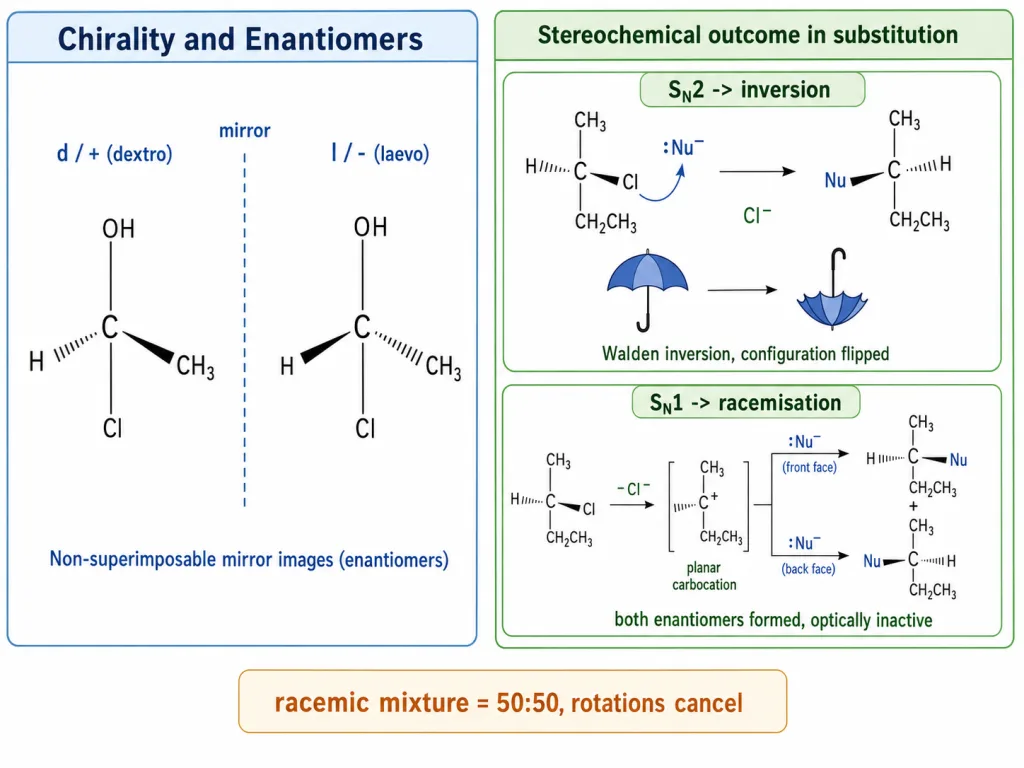
Key Point: Enantiomers = non-superimposable mirror images (d and l). A 50:50 racemic mixture is optically inactive (rotations cancel).
Retention, Inversion and the Stereochemistry of Substitution
When a reaction happens at a chiral carbon, the spatial arrangement (configuration) can be kept or flipped:
- Retention of configuration: the product keeps the same relative spatial arrangement as the reactant.
- Inversion of configuration: the arrangement is flipped to its mirror form. In SN2, the backside attack causes inversion at the chiral carbon — the Walden inversion (like an umbrella turning inside out).
This links directly to the two mechanisms:
- SN2 → inversion. A single backside attack flips the configuration. If the reactant is a single enantiomer, the product is the inverted enantiomer.
- SN1 → racemisation. The planar carbocation can be attacked from either face, giving roughly equal amounts of both enantiomers — a racemic mixture (often with some excess of inversion).
Key Point — stereochemical signatures:
- SN2 at a chiral centre → inversion (Walden inversion).
- SN1 at a chiral centre → racemisation (both enantiomers form).
[NEET Important] "An optically active alkyl halide reacts to give a racemic product — which mechanism?" → SN1 (carbocation, attack from both faces). "…gives an inverted product?" → SN2 (backside attack). This stereochemical clue is a guaranteed exam tool.
Solved Examples
Example 1: Identify a chiral molecule
Is CHFClBr chiral? Why?
Solution: Yes. The central carbon is bonded to four different atoms (H, F, Cl, Br), so it is a chiral (asymmetric) carbon, and the molecule is non-superimposable on its mirror image — it is chiral and optically active.
Example 2: Define enantiomers
What are enantiomers?
Solution: Enantiomers are stereoisomers that are non-superimposable mirror images of each other. They rotate plane-polarised light equally but in opposite directions (one + / dextro, the other - / laevo).
Example 3: Racemic mixture
Why is a racemic mixture optically inactive?
Solution: A racemic mixture is a 50:50 mixture of two enantiomers. Their equal and opposite optical rotations exactly cancel, so the net rotation is zero — it is optically inactive.
Example 4: SN2 stereochemistry
An optically active 2-bromobutane undergoes SN2 with OH-. What is the stereochemical outcome?
Solution: Inversion of configuration (Walden inversion). The backside attack flips the configuration, so the product is the inverted enantiomer of butan-2-ol.
Example 5: SN1 stereochemistry
An optically active alkyl halide is hydrolysed by SN1. What is the stereochemical result?
Solution: Racemisation — a racemic (optically inactive) product forms, because the planar carbocation intermediate is attacked from both faces with nearly equal probability.
Example 6: Chiral carbon count
How many chiral carbons does butan-2-ol (CH-CHOH-CH-CH) have?
Solution: One — C2 is bonded to four different groups (H, OH, CH and CH), so it is a chiral carbon. Butan-2-ol is therefore chiral.
Example 7: Achiral molecule
Is propan-2-ol (CH-CHOH-CH) chiral?
Solution: No. The C2 carbon is bonded to two identical methyl groups (plus H and OH), so it is not bonded to four different groups. The molecule is superimposable on its mirror image — it is achiral.
Example 8: Dextro vs laevo
What do "dextrorotatory" and "laevorotatory" mean?
Solution: Dextrorotatory (d or +) rotates plane-polarised light clockwise; laevorotatory (l or -) rotates it anticlockwise. The two enantiomers of a chiral compound are one of each.
Example 9: Stereochemical clue to mechanism
A single enantiomer of an alkyl halide gives a product with completely inverted configuration. Which mechanism operated?
Solution: SN2 — the complete inversion (Walden inversion) is the signature of the single-step backside attack of SN2.
Example 10: Racemisation as evidence
A reaction of a pure enantiomer gives an optically inactive product. What does this tell you about the mechanism?
Solution: It indicates SN1 (racemisation): the reaction went through a planar carbocation that was attacked from both faces, producing equal amounts of both enantiomers (a racemic mixture).