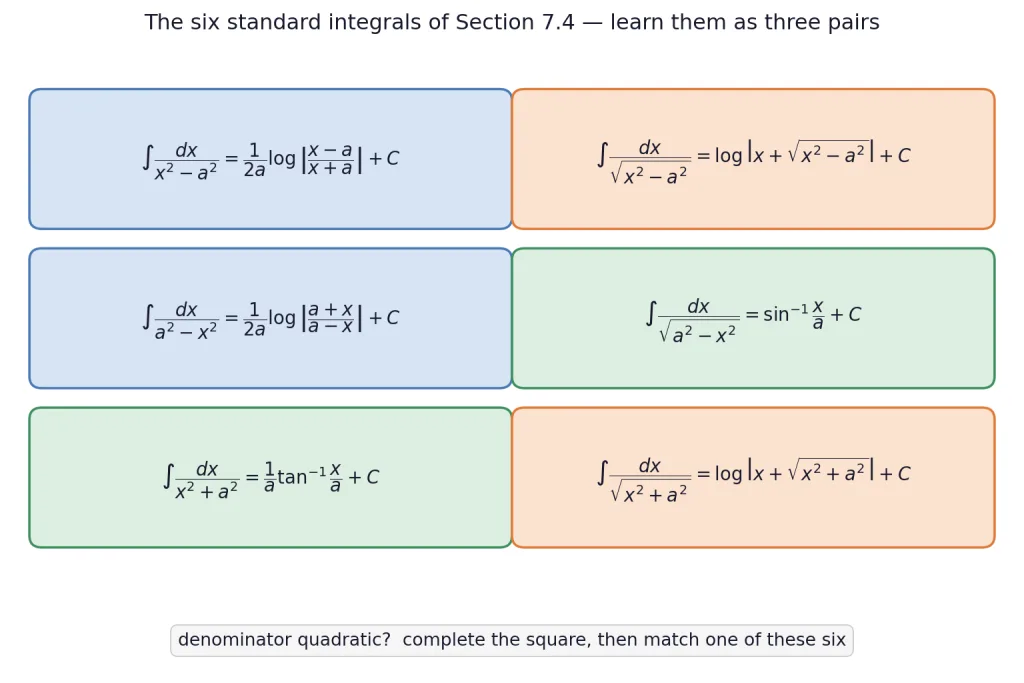
Six integrals appear so often that NCERT promotes them to standard formulae — used from now on without proof:
∫x2−a2dx=2a1logx+ax−a+C
∫a2−x2dx=2a1loga−xa+x+C
∫x2+a2dx=a1tan−1ax+C
∫x2−a2dx=logx+x2−a2+C
∫a2−x2dx=sin−1ax+C
∫x2+a2dx=logx+x2+a2+C
Where they come from: (1) and (2) split by partial fractions — e.g. x2−a21=2a1[x−a1−x+a1]; (3) uses the substitution x=atanθ; (4) uses x=asecθ; (5) uses x=asinθ; (6) uses x=atanθ — each trig substitution collapses the denominator via a Pythagorean identity.
How to tell (1) from (2) and the log forms apart: look at what can vanish. x2−a2 (roots at ±a, log of a ratio with x−a on top); a2−x2 (same roots, a+x on top); x2+a2 (never zero — that's the tan−1). Under a square root: minus in front of x2 → sin−1; plus → a log.
Key Point: Match the SIGN PATTERN, then read off the answer. x2−a2, a2−x2 and x2+a2 each have exactly one formula, with and without the square root.
[JEE Tip] Formulas (4) and (6) are often written with sinh−1,cosh−1 in other books; JEE answer keys use the log forms — quote them exactly as above.
General Quadratics: Complete the Square
Any integral ∫ax2+bx+cdx or ∫ax2+bx+cdx reduces to one of the six standard forms by completing the square:
ax2+bx+c=a[(x+2ab)2+(ac−4a2b2)]
Put t=x+2ab and write the leftover constant as ±k2; the integral becomes a1∫t2±k2dt (or its square-root version) — a table entry.
Worked micro-example:x2−6x+13=(x−3)2+4, so ∫x2−6x+13dx=21tan−12x−3+C.
Linear-over-Quadratic: the A-B Split
For ∫ax2+bx+cpx+qdx (and the same with a square root), write the numerator as
px+q=A⋅dxd(ax2+bx+c)+B=A(2ax+b)+B
and find A,B by comparing coefficients. The integral splits into two solvable pieces:
the A-piece is ∫denominator(derivative of denominator)dx=log∣denominator∣ (or 2denominator under a root),
the B-piece is a pure standard form after completing the square.
Key Point: Two moves cover this entire section: complete the square (no x in the numerator) and numerator = A(derivative) + B (linear numerator). Identify which case you're in before touching the algebra.
[Board Important] When completing the square with a negative x2 coefficient — e.g. 5−4x−x2=9−(x+2)2 — factor the minus sign carefully first. Sign slips here are the top mark-loser of Exercise 7.4.
Solved Examples
Example 1: Straight table match
Find ∫x2−16dx.
Solution:
Match the pattern:x2−a2 with a=4 — standard form (1).
Apply:2(4)1logx+4x−4+C.
Final Answer:81logx+4x−4+C.
Example 2: Complete the square under a root
Find ∫2x−x2dx.
Solution:
Complete the square:2x−x2=1−(x−1)2.
Substitute:t=x−1: the integral is ∫1−t2dt=sin−1t+C.
Return:sin−1(x−1)+C.
Final Answer:sin−1(x−1)+C.
Takeaway: Minus sign on x2 under a root → expect sin−1. The completed square tells you the shifted variable and the radius.
Example 3: Quadratic that never vanishes
Find ∫x2−6x+13dx.
Solution:
Complete the square:x2−6x+13=(x−3)2+22.
Substitute:t=x−3: ∫t2+22dt=21tan−12t+C.
Return:21tan−12x−3+C.
Final Answer:21tan−1(2x−3)+C.
Takeaway: Positive leftover constant (+4) → the tan−1 form. Negative → the log-ratio form (next example).
Example 4: Factorisable quadratic
Find ∫3x2+13x−10dx.
Solution:
Take out the 3 and complete the square:3x2+13x−10=3[(x+613)2−(617)2].
Apply form (1) with t=x+613, k=617: 31⋅2k1logt+kt−k=171log…x−64⋅66 — simplifying the ratio: 6x+306x−4.
Simplify and absorb constants:171logx+53x−2+C.
Final Answer:171logx+53x−2+C.
Takeaway: The constant 171log31 produced while cancelling the 6's merges into C — tidy ratios are always legal up to a constant.
Example 5: Root of a quadratic with no constant term
Find ∫5x2−2xdx.
Solution:
Factor out 5:5x2−2x=5x2−52x.
Complete the square:x2−52x=(x−51)2−(51)2.
Apply form (4):51logt+t2−251 with t=x−51.
Final Answer:51logx−51+x2−52x+C.
Takeaway: The a1 factor from pulling a out of the root is easy to forget — write the factoring step explicitly.
Example 6: Linear numerator over a quadratic
Find ∫2x2+6x+5x+2dx.
Solution:
Split the numerator:x+2=A(4x+6)+B (using the derivative of the denominator). Comparing: 4A=1, 6A+B=2, so A=41, B=21.
Takeaway: The split is deliberately built so the A-piece is a pure log and the B-piece a pure standard form — never integrate a linear-over-quadratic in one go.
Example 7: Linear numerator under a root
Find ∫5−4x−x2x+3dx.
Solution:
Split:x+3=A(−4−2x)+B; comparing: −2A=1, −4A+B=3, so A=−21, B=1.