Definite Integral and the Fundamental Theorem of Calculus
From a Family of Functions to a Single Number
An indefinite integral ∫f(x)dx is a family of functions (all the anti-derivatives, differing by C). A definite integral
∫abf(x)dx
is a number — it has a unique value. Here a is the lower limit and b the upper limit of the integral. Geometrically, ∫abf(x)dx represents the area of the region bounded by the curve y=f(x), the ordinates x=a and x=b, and the x-axis (for f(x)>0 on [a,b]; the definitions below hold for other functions too).
If f has an anti-derivative F on [a,b], the value of the definite integral is simply the difference of F at the endpoints: F(b)−F(a). Making this precise is the job of the two fundamental theorems.
The area function
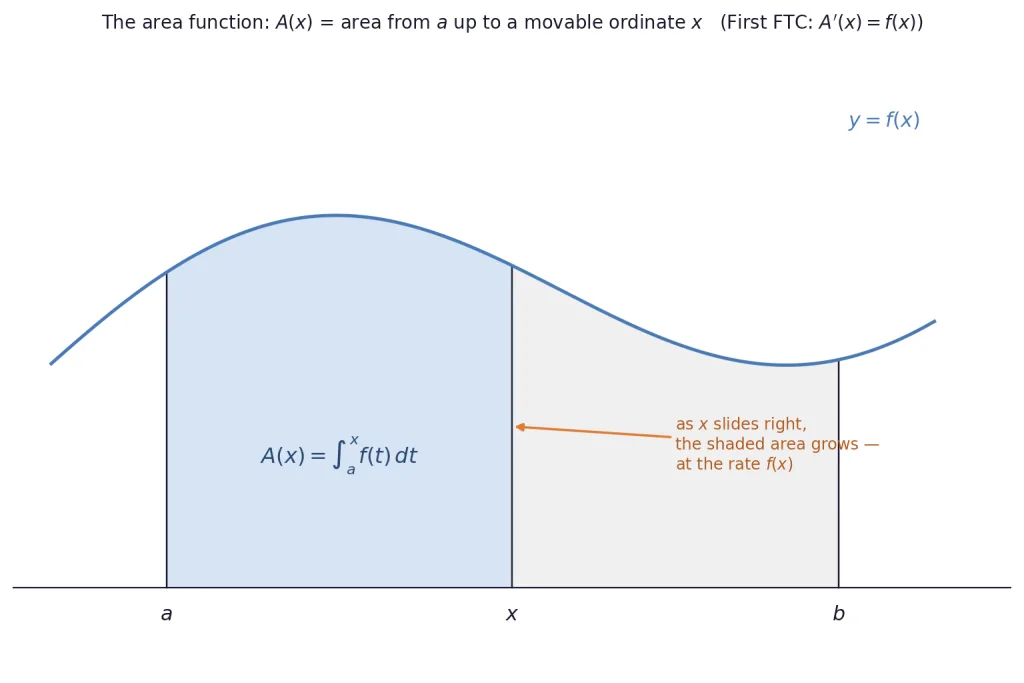
Fix the lower limit a and let the upper limit be a variable point x in [a,b]. The area swept out from a to x,
A(x)=∫axf(t)dt
depends on where x is — it is a function of x, called the area function.
Key Point: The area function turns integration into a function-building machine: feed in an upper limit x, get out the accumulated area A(x). Asking how fast A(x) grows as x moves is what connects areas back to derivatives.
First Fundamental Theorem of integral calculus
Theorem 1. Let f be a continuous function on [a,b] and let A(x) be the area function. Then
A′(x)=f(x)for all x∈[a,b]
The shaded area grows exactly at the rate given by the curve's current height — differentiation undoes the accumulation. (NCERT states both fundamental theorems without proof; the proofs are beyond the scope of the textbook.)
The Second Fundamental Theorem — the Evaluation Engine
Theorem 2. Let f be a continuous function defined on [a,b] and let F be an anti-derivative of f. Then
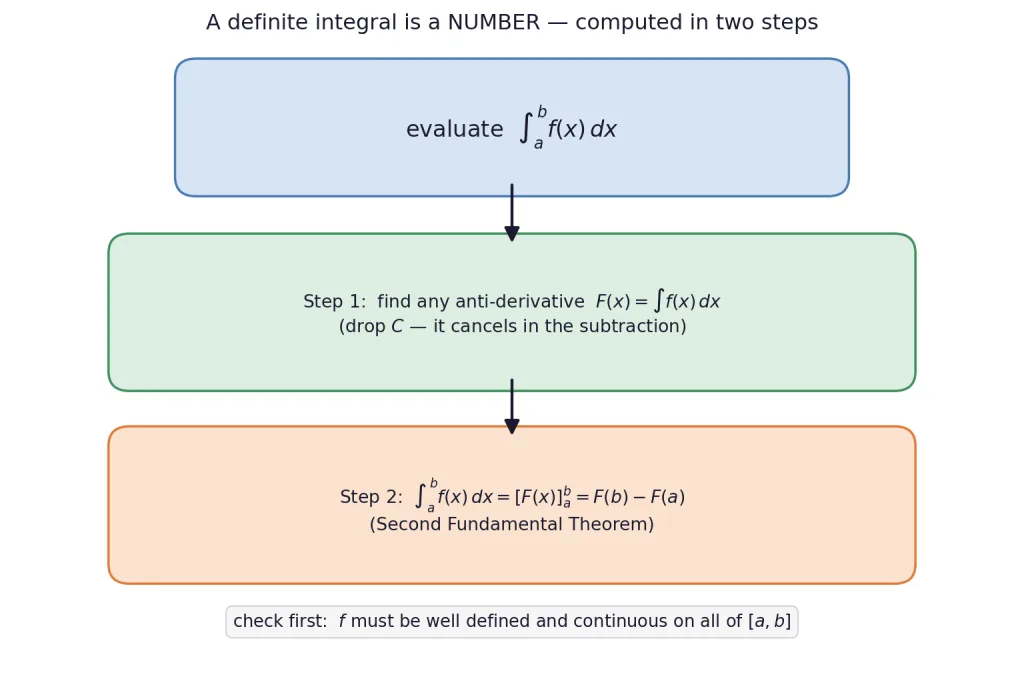
∫abf(x)dx=[F(x)]ab=F(b)−F(a)
In words: the definite integral equals (value of the anti-derivative at the upper limit) minus (value of the same anti-derivative at the lower limit).
The two-step working method
Find the indefinite integral∫f(x)dx=F(x). There is no need to keep+C: if we carried it, [F(x)+C]ab=[F(b)+C]−[F(a)+C]=F(b)−F(a) — the arbitrary constant disappears in the subtraction.
EvaluateF(b)−F(a)=[F(x)]ab. That number is the answer.
Remarks worth exam marks
Why this theorem matters: it computes a definite integral from an anti-derivative alone — the crucial skill is finding a function whose derivative is the integrand, which is exactly what Sections 7.2 to 7.6 taught. Every technique (substitution, partial fractions, by parts) now feeds directly into definite integrals.
Continuity check first. In ∫abf(x)dx, the function f must be well defined and continuous on all of [a,b]. NCERT's warning example: ∫−23x(x2−1)1/2dx is erroneous, because (x2−1)1/2 is not defined (not real) for −1<x<1 — a portion of the interval [−2,3]. No amount of clever anti-differentiation rescues an integral whose integrand doesn't exist on part of the interval.
Same F at both ends. Use one anti-derivative for both limits — mixing two different anti-derivatives (different C's) is meaningless.
[JEE Tip] JEE Main uses the Second FTC silently inside almost every definite-integral question. The traps are (a) integrands that are undefined or discontinuous inside the interval, and (b) modulus integrands like ∫−12∣x∣dx, where you must split the interval at the point where the expression inside the modulus changes sign before applying F(b)−F(a) on each piece.
Solved Examples
Example 1: The basic evaluation
Evaluate ∫23x2dx.
Solution:
Anti-derivative:F(x)=3x3 (no C needed).
Second FTC:I=F(3)−F(2)=327−38.
Final Answer:319.
Example 2: Substitution inside, evaluate after
Evaluate ∫49(30−x3/2)2xdx.
Solution:
Find the anti-derivative first: put t=30−x3/2, so dt=−23xdx, i.e. xdx=−32dt.
Integrate in t:−32∫t2dt=3t2, so F(x)=3(30−x3/2)2.
Second FTC:I=F(9)−F(4)=32[30−271−30−81]=32[31−221].
Final Answer:9919.
Takeaway: Here the substitution was used only to findF; the limits stayed in x. Section 7 shows the faster route — changing the limits along with the variable.
Example 3: Partial fractions in a definite integral
Evaluate ∫12(x+1)(x+2)xdx.
Solution:
Decompose:(x+1)(x+2)x=x+1−1+x+22 (cover-up: at x=−1 numerator −1 over (x+2)=1; at x=−2 numerator −2 over (x+1)=−1).
Evaluate:I=e5−e4 (leave it exact — no decimal needed).
Final Answer:e5−e4=e4(e−1).
Example 7: The log answer
Evaluate ∫0π/4tanxdx.
Solution:
Anti-derivative:∫tanxdx=log∣secx∣.
Evaluate:I=logsec4π−log∣sec0∣=log2−log1.
Final Answer:log2=21log2.
Example 8: Inverse trig values
Evaluate (i) ∫011−x2dx (ii) ∫011+x2dx.
Solution:
(i):F(x)=sin−1x; I=sin−11−sin−10=2π−0.
(ii):F(x)=tan−1x; I=tan−11−tan−10=4π−0.
Final Answer: (i) 2π; (ii) 4π.
Takeaway: Definite integrals of the standard special forms turn into exact angle values — know the sin−1 and tan−1 values at 0,21,1,3 cold.
Example 9: A Section 7.4 form with limits
Evaluate ∫23x2−1dx.
Solution:
Standard form:∫x2−1dx=21logx+1x−1=F(x) (here a=1).
Evaluate:I=21log42−21log31=21[log21+log3].
Final Answer:21log23.
Example 10: Substitution with x2
Evaluate ∫01xex2dx.
Solution:
Anti-derivative: put t=x2, dt=2xdx: 21∫etdt=2ex2=F(x).
Evaluate:I=2e1−2e0.
Final Answer:2e−1.
Example 11: By parts plus a trig piece
Evaluate ∫01(xex+sin4πx)dx.
Solution:
Split and integrate:∫xexdx=(x−1)ex (by parts); ∫sin4πxdx=−π4cos4πx.
Evaluate the first piece:[(x−1)ex]01=0−(−1)=1.
Evaluate the second:−π4[cos4π−cos0]=−π4[21−1]=π4−π22.
Final Answer:1+π4−π22.
Example 12: Why the continuity check matters
Explain why ∫−23x(x2−1)1/2dx cannot be evaluated by the Second FTC.
Solution:
Check the domain:(x2−1)1/2=x2−1 requires x2≥1, i.e. x≤−1 or x≥1.
Compare with the interval: the interval [−2,3] contains (−1,1), where the integrand is not defined.
Conclusion: the hypothesis of Theorem 2 (f continuous on all of [a,b]) fails, so writing F(b)−F(a) is erroneous — the definite integral does not exist as stated.
Final Answer: The integrand is undefined on (−1,1)⊂[−2,3], so the definite integral is meaningless — always verify continuity on the whole interval first.
Ready to test your knowledge?
Take a quick interactive quiz on this topic —
free, works without login.