Step 3: Integrate term by term:
21(∫sin7xdx−∫sinxdx)=21(−7cos7x+cosx)+C
Answer:2cosx−14cos7x+C
Example 9: Completing the Square
Evaluate:∫x2−6x+13dx
Solution:
Step 1: Complete the square:
x2−6x+13=x2−6x+9−9+13=(x−3)2+4
So,
x2−6x+13=(x−3)2+22
Step 2: Rewrite the integral:
∫(x−3)2+22dx
Step 3: Use the standard result:
∫X2+a2dx=a1tan−1(aX)+C
Here X=x−3 and a=2.
Answer:21tan−1(2x−3)+C
Example 10: Completing the Square Inside a Root
Evaluate:∫5−4x−x2dx
Solution:
Step 1: Rewrite the expression inside the root:
5−4x−x2=5−(x2+4x)
Now complete the square inside the bracket:
x2+4x=x2+4x+4−4=(x+2)2−4
Therefore,
5−4x−x2=5−[(x+2)2−4]=9−(x+2)2=32−(x+2)2
Step 2: So the integral becomes:
∫32−(x+2)2dx
Step 3: Use the standard formula:
∫a2−X2dx=sin−1(aX)+C
with X=x+2 and a=3.
Answer:sin−1(3x+2)+C
Example 11: Linear / Quadratic Form
Evaluate:∫2x2+6x+5x+2dx
Solution:
Step 1: Write the numerator in the form
x+2=Adxd(2x2+6x+5)+B
Since
dxd(2x2+6x+5)=4x+6,
we need
x+2=A(4x+6)+B=4Ax+(6A+B).
Step 3: Split the integral:
I=41∫2x2+6x+54x+6dx+21∫2x2+6x+5dx
Step 4: Evaluate the first part:
41∫2x2+6x+54x+6dx=41ln∣2x2+6x+5∣
Step 5: For the second part, complete the square:
2x2+6x+5=2(x2+3x+25)
Now,
x2+3x+25=x2+3x+49−49+25=(x+23)2+41
Hence,
2x2+6x+5=2[(x+23)2+(21)2]
So,
∫2x2+6x+5dx=21∫(x+23)2+(21)2dx
Using the standard formula,
=tan−1(2x+3)
Thus the contribution of this part is
21tan−1(2x+3).
Answer:41ln∣2x2+6x+5∣+21tan−1(2x+3)+C
Example 12: Partial Fractions (Distinct Linear Factors)
Evaluate:∫(x+1)(x+2)dx
Solution:
Step 1: Assume
(x+1)(x+2)1=x+1A+x+2B
Step 2: Multiply by (x+1)(x+2):
1=A(x+2)+B(x+1)
Step 3: Find constants:
Put x=−1:
1=A(1)⟹A=1
Put x=−2:
1=B(−1)⟹B=−1
Step 4: Rewrite and integrate:
∫(x+11−x+21)dx=ln∣x+1∣−ln∣x+2∣+C=lnx+2x+1+C
Answer:lnx+2x+1+C
Example 13: Partial Fractions (Improper Fraction)
Evaluate:∫x2−5x+6x2+1dx
Solution:
Step 1: Since the degree of the numerator equals the degree of the denominator, first divide:
x2−5x+6x2+1=1+x2−5x+65x−5
Step 2: Factor the denominator:
x2−5x+6=(x−2)(x−3)
So we resolve
(x−2)(x−3)5x−5=x−2A+x−3B
Step 3: Multiply through:
5x−5=A(x−3)+B(x−2)
Now substitute convenient values:
Example 14: Partial Fractions (Repeated Linear Factor)
Evaluate:∫(x−1)2(x+2)xdx
Solution:
Step 1: Write the decomposition:
(x−1)2(x+2)x=x−1A+(x−1)2B+x+2C
Step 2: Multiply by the common denominator:
x=A(x−1)(x+2)+B(x+2)+C(x−1)2
Step 3: Find constants.
Put x=1:
1=3B⟹B=31
Put x=−2:
−2=9C⟹C=−92
Compare the coefficients of x2:
0=A+C⟹A=−C=92
Step 4: Integrate:
∫(x−12/9+(x−1)21/3−x+22/9)dx
Now,
∫(x−1)21dx=∫(x−1)−2dx=−x−11
So,
=92ln∣x−1∣−3(x−1)1−92ln∣x+2∣+C=92lnx+2x−1−3(x−1)1+C
Answer:92lnx+2x−1−3(x−1)1+C
Example 15: Integration by Parts (Basic)
Evaluate:∫xsinxdx
Solution:
Step 1: By ILATE, choose
u=x,dv=sinxdx
Then
du=dx,v=−cosx
Step 2: Apply the formula
∫udv=uv−∫vdu
So,
∫xsinxdx=x(−cosx)−∫(−cosx)dx=−xcosx+∫cosxdx=−xcosx+sinx+C
Answer:−xcosx+sinx+C
Example 16: Integration by Parts (Logarithmic)
Evaluate:∫lnxdx
Solution:
Step 1: Write it as
∫lnx⋅1dx
Choose
u=lnx,dv=dx
Then
du=x1dx,v=x
Step 2: Apply integration by parts:
∫lnxdx=xlnx−∫x⋅x1dx=xlnx−∫1dx=xlnx−x+C
Answer:x(lnx−1)+C
Example 17: Integration by Parts (Inverse Trigonometric)
Evaluate:∫sin−1xdx
Solution:
Step 1: Write it as
∫sin−1x⋅1dx
Choose
u=sin−1x,dv=dx
Then
du=1−x21dx,v=x
Step 2: Apply integration by parts:
∫sin−1xdx=xsin−1x−∫1−x2xdx
Step 3: Evaluate the remaining integral by substitution.
Let
t=1−x2⟹dt=−2xdx⟹xdx=−2dt
Then,
∫1−x2xdx=∫t−dt/2=−21∫t−1/2dt=−t
Thus,
−∫1−x2xdx=−(−t)=t
Step 4: Substitute back t=1−x2.
Answer:xsin−1x+1−x2+C
Example 18: Cyclic Integration by Parts
Evaluate:I=∫exsinxdx
Solution:
Step 1: First application of integration by parts.
Choose
u=sinx,dv=exdx
Then
du=cosxdx,v=ex
So,
I=exsinx−∫excosxdx
Step 2: Apply integration by parts again to
∫excosxdx
Choose
u=cosx,dv=exdx
Then
du=−sinxdx,v=ex
Hence,
∫excosxdx=excosx−∫ex(−sinx)dx=excosx+I
Step 3: Substitute back into the first equation:
I=exsinx−(excosx+I)I=exsinx−excosx−I2I=ex(sinx−cosx)
Step 4: Solve for I.
Answer:2ex(sinx−cosx)+C
Example 19: Special Form ∫ex[f(x)+f′(x)]dx
Evaluate:∫ex(x1−x21)dx
Solution:
Step 1: Compare the integrand with the pattern
ex[f(x)+f′(x)]
Let
f(x)=x1
Then
f′(x)=−x21
Step 2: Therefore,
x1−x21=f(x)+f′(x)
So the integral is exactly of the required form.
Step 3: Use the theorem:
∫ex[f(x)+f′(x)]dx=exf(x)+C
Answer:xex+C
Example 20: Manipulating into the Special Form
Evaluate:∫(1+x)2xexdx
Solution:
Step 1: Rewrite the algebraic part:
(x+1)2x=(x+1)2x+1−1=x+11−(x+1)21
So the integral becomes:
∫ex(x+11−(x+1)21)dx
Step 2: Let
f(x)=x+11
Then
f′(x)=−(x+1)21
Thus the integrand is
ex[f(x)+f′(x)]
Step 3: Apply the theorem.
Answer:x+1ex+C
Example 21: Definite Integral Basics
Evaluate:∫011+x2dx
Solution:
Step 1: Use the standard anti-derivative:
∫1+x2dx=tan−1x
Step 2: Apply the limits:
∫011+x2dx=[tan−1x]01=tan−1(1)−tan−1(0)=4π−0
Answer:4π
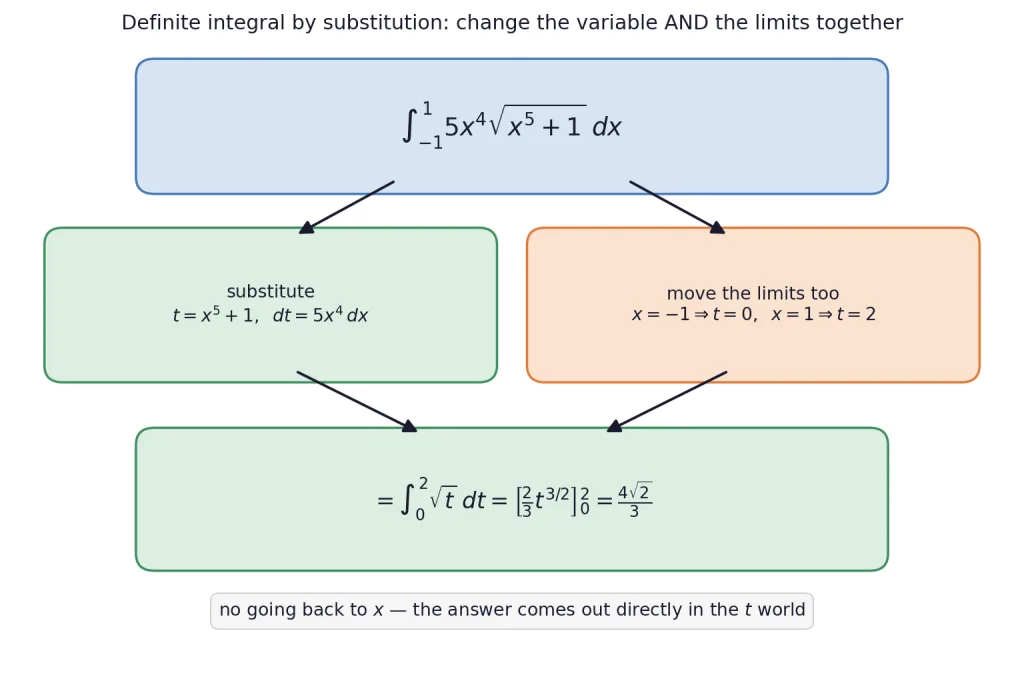
Example 22: Definite Integral with Substitution
Evaluate:∫0π/2sin3xcosxdx
Solution:
Step 1: Let
t=sinx⟹dt=cosxdx
Step 2: Change the limits:
When x=0, t=sin0=0
When x=π/2, t=sin(π/2)=1
Step 3: Rewrite the integral:
∫01t3dt
Step 4: Evaluate:
[4t4]01=41
Answer:41
Example 23: Definite Integral Splitting Property (P2)
Evaluate:∫−12∣x3−x∣dx
Solution:
Step 1: Find the zeros of the expression inside modulus:
x3−x=x(x−1)(x+1)=0
So the critical points are x=−1,0,1.
Step 2: Determine signs:
On (−1,0), x3−x>0
On (0,1), x3−x<0
On (1,2), x3−x>0
Step 3: Split the integral:
∫−12∣x3−x∣dx=∫−10(x3−x)dx+∫01−(x3−x)dx+∫12(x3−x)dx
Step 4: Use
∫(x3−x)dx=4x4−2x2
Then evaluate:
=[4x4−2x2]−10−[4x4−2x2]01+[4x4−2x2]12
This gives
41+41+49=411
Answer:411
Example 24: King's Rule (P4)
Evaluate:I=∫0π/2sinx+cosxsinxdx
Solution:
Step 1: Apply Property P4 with x→2π−x:
I=∫0π/2cosx+sinxcosxdx
Step 2: Add this to the original integral:
2I=∫0π/2sinx+cosxsinx+cosxdx=∫0π/21dx
Step 3: Evaluate:
2I=[x]0π/2=2π
Hence,
I=4π
Answer:4π
Example 25: Removing 'x' using P4
Evaluate:I=∫0π1+cos2xxsinxdx
Solution:
Step 1: Apply Property P4 with x→π−x:
I=∫0π1+cos2(π−x)(π−x)sin(π−x)dx
Using
sin(π−x)=sinx,cos2(π−x)=cos2x,
we get
I=∫0π1+cos2x(π−x)sinxdx
Step 2: Add this to the original expression:
2I=∫0π1+cos2xπsinxdx=π∫0π1+cos2xsinxdx
Solution:
Step 1: Let
f(x)=sin5xcos4x
Then
f(−x)=sin5(−x)cos4(−x)=(−sinx)5(cosx)4=−f(x)
So f(x) is odd.
Step 2: For an odd function over symmetric limits,
∫−aaf(x)dx=0
Hence,
∫−11sin5xcos4xdx=0
Answer:0
Example 27: Applying Property 6
Evaluate:∫02πcos5xdx
Solution:
Step 1: Let
f(x)=cos5x
For the interval [0,2π], the midpoint is π.
Check:
f(2π−x)=cos5(2π−x)=cos5x=f(x)
Hence,
∫02πcos5xdx=2∫0πcos5xdx
Step 2: Now consider the interval [0,π], whose midpoint is π/2.
Check:
f(π−x)=cos5(π−x)=(−cosx)5=−cos5x=−f(x)
Therefore,
∫0πcos5xdx=0
So the original integral is also 0.
Answer:0
JEE Main Standard
Example 28: Advanced Substitution
Evaluate:∫x2(x4+1)3/4dx
Solution:
Step 1: Rewrite (x4+1)3/4 by factoring out x4 inside the bracket:
x4+1=x4(1+x−4)
Hence,
(x4+1)3/4=(x4)3/4(1+x−4)3/4=x3(1+x−4)3/4
(using the standard simplification used in such substitution problems).
Step 3: Hence,
I=∫0π/2sin2xdx
Use
sin2x=21−cos2x
So,
I=∫0π/221−cos2xdx=21[x−2sin2x]0π/2
Since sinπ=0 and sin0=0,
I=21⋅2π=4π
Answer:4π
Example 31: Greatest Integer Function
Evaluate:I=∫0π[cotx]dx
where [⋅] denotes the greatest integer function.
Solution:
Step 1: Apply King's Rule with x→π−x:
I=∫0π[cot(π−x)]dx
Since
cot(π−x)=−cotx,
we get
I=∫0π[−cotx]dx
Step 2: Add the two expressions:
2I=∫0π([cotx]+[−cotx])dx
Step 3: Use the property of the greatest integer function:
For a real number u,
[u]+[−u]={0,−1,u∈Zu∈/Z
Now cotx is an integer only at isolated points. Such points do not affect the value of the integral. Hence, almost everywhere on (0,π),
[cotx]+[−cotx]=−1
So,
2I=∫0π(−1)dx=−π
Step 4: Therefore,
I=−2π
Answer:−2π
Example 32: Limit of a Sum
Evaluate:n→∞limr=1∑nn+r1
Solution:
Step 1: Rewrite each term by dividing numerator and denominator by n:
n+r1=1+r/n1/n
So,
r=1∑nn+r1=n1r=1∑n1+r/n1
Step 2: Recognize this as a Riemann sum for
∫011+x1dx
Indeed, as n→∞, nr runs from near 0 to 1, and n1 acts as dx.
Step 3: Evaluate the integral:
∫011+x1dx=[ln(1+x)]01=ln2−ln1=ln2
Answer:ln2
Example 33: Advanced Factoring
Evaluate:∫(x5+x3+1)32x12+5x9dx
Solution:
Step 1: Rewrite the denominator by factoring x5 inside the bracket:
x5+x3+1=x5(1+x−2+x−5)
Hence,
(x5+x3+1)3=x15(1+x−2+x−5)3
Step 2: Divide the numerator by x15:
x15(1+x−2+x−5)32x12+5x9=(1+x−2+x−5)32x−3+5x−6
Step 3: Let
t=1+x−2+x−5
Then,
dt=(−2x−3−5x−6)dx
So,
−dt=(2x−3+5x−6)dx
Step 6: Replace t:
2(1+x−2+x−5)21+C
Multiply numerator and denominator by x10:
=2(x5+x3+1)2x10+C
Answer:2(x5+x3+1)2x10+C
Example 34: Definite Integral involving Logarithm
Evaluate:I=∫0π/4log(1+tanx)dx
Solution:
Step 1: Apply King's Rule with x→4π−x:
I=∫0π/4log(1+tan(4π−x))dx
Step 2: Use the identity
tan(4π−x)=1+tanx1−tanx
Hence,
1+tan(4π−x)=1+1+tanx1−tanx=1+tanx2
So,
I=∫0π/4log(1+tanx2)dx
Step 3: Split the logarithm:
I=∫0π/4[log2−log(1+tanx)]dx=∫0π/4log2dx−I
Step 4: Solve for I:
2I=log2∫0π/4dx=log2⋅4π
Thus,
I=8πlog2
Answer:8πlog2
Example 35: Leibniz Rule Application
Evaluate:x→0limx31∫0xtln(1+t)dt
Solution:
Step 1: As x→0, both numerator and denominator tend to 0, so this is a 0/0 form.
Apply L'Hospital's Rule.
Step 2: Differentiate the numerator using the First Fundamental Theorem of Calculus:
dxd(∫0xtln(1+t)dt)=xln(1+x)
Also,
dxd(x3)=3x2
So the limit becomes:
x→0lim3x2xln(1+x)=x→0lim3xln(1+x)
Step 3: Use the standard limit:
x→0limxln(1+x)=1
Therefore,
x→0lim3xln(1+x)=31
Answer:31
Example 36: Advanced Integration by Parts / Special Form
Evaluate:∫(log(logx)+(logx)21)dx
Solution:
Step 1: Let
t=logx
Then
dx=etdtsince x=et
So the integral becomes:
∫et(logt+t21)dt
Step 2: Try to write the bracket in the form f(t)+f′(t).
Let
f(t)=logt−t1
Then,
f′(t)=t1+t21
Hence,
f(t)+f′(t)=(logt−t1)+(t1+t21)=logt+t21
So the integrand is exactly
et[f(t)+f′(t)].
Step 3: Use the theorem:
∫et[f(t)+f′(t)]dt=etf(t)+C
Thus,
=et(logt−t1)+C