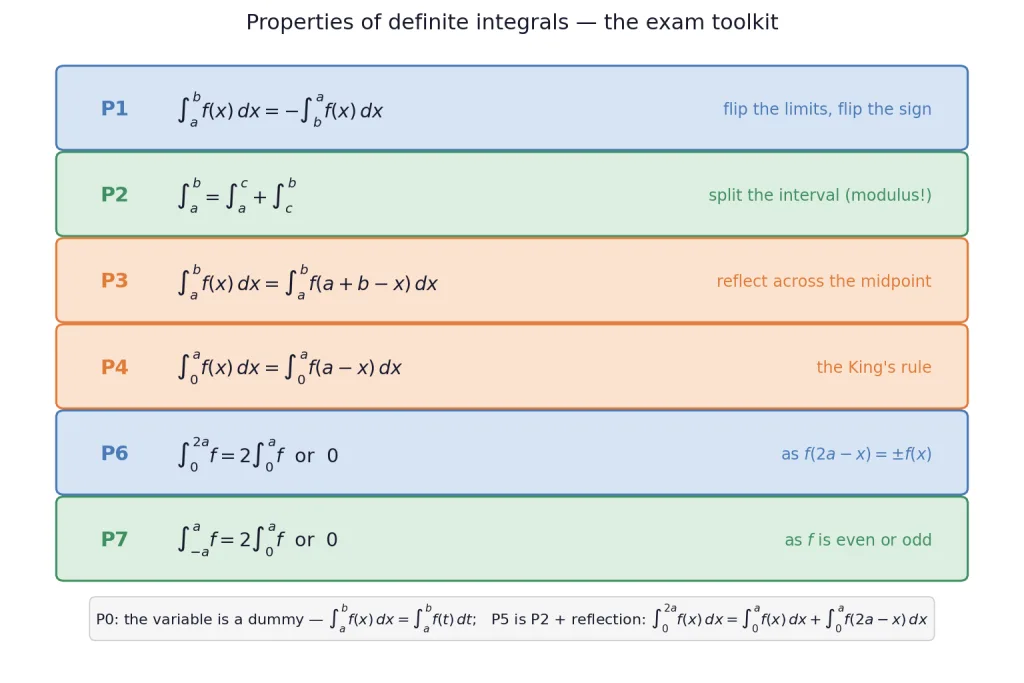
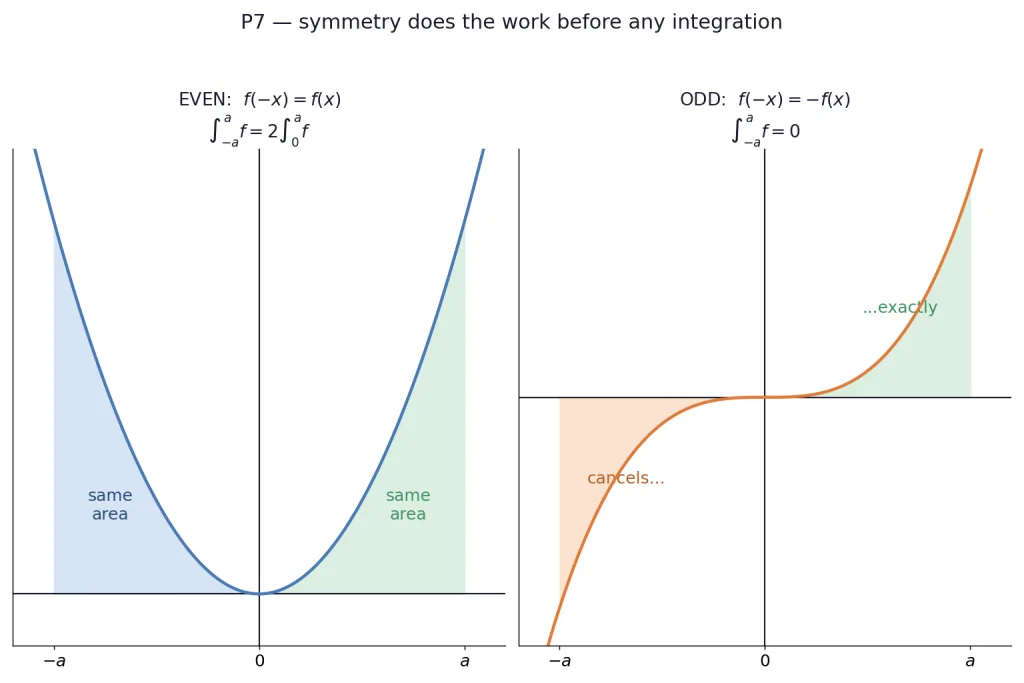
This section contains 30 important board-style questions based on the chapter on Integration. Board examinations reward a clear, stepwise method. For indefinite integrals, always include the constant of integration C. For definite integrals, clearly mention the property or theorem being used, such as the substitution rule for definite integrals, symmetry properties, or
∫abf(x)dx=∫abf(a+b−x)dx.
Showing the method explicitly is often just as important as getting the final answer.
Question 1 [CBSE 2026]
Evaluate:∫(x−1)(x−2)xdx
Solution:
Step 1: Resolve the rational expression into partial fractions:
(x−1)(x−2)x=x−1A+x−2B.
Step 2: Multiply both sides by (x−1)(x−2):
x=A(x−2)+B(x−1).
Solution:
Step 1: Let
I=∫0π/2sinx+cosxsinxdx...(1)
Step 2: Use the property
∫0af(x)dx=∫0af(a−x)dx,
with a=π/2:
I=∫0π/2sin(π/2−x)+cos(π/2−x)sin(π/2−x)dx.
Using complementary angle identities,
sin(π/2−x)=cosx,cos(π/2−x)=sinx,
so
I=∫0π/2cosx+sinxcosxdx...(2)
Step 3: Add (1) and (2):
2I=∫0π/2sinx+cosxsinx+cosxdx=∫0π/21dx.
Step 4: Evaluate:
2I=[x]0π/2=2π.
Hence,
I=4π.
Answer:4π
Question 3 [CBSE 2025]
Evaluate:∫ex(1+cosx1+sinx)dx
Solution:
Step 1: Rewrite the trigonometric fraction in a useful form.
Observe that
1+cosx1+sinx=1+cosx1+1+cosxsinx.
Now,
1+cosx1=21sec2(2x)
using 1+cosx=2cos2(x/2), and
1+cosxsinx=tan(2x)
using sinx=2sin(x/2)cos(x/2).
Therefore,
1+cosx1+sinx=tan(2x)+21sec2(2x).
Step 2: Let
f(x)=tan(2x).
Then
f′(x)=21sec2(2x).
So the integrand becomes
ex[f(x)+f′(x)].
Step 3: Use the standard result
∫ex[f(x)+f′(x)]dx=exf(x)+C.
Thus,
∫ex(1+cosx1+sinx)dx=extan(2x)+C.
Answer:extan(2x)+C
Question 4 [CBSE 2023]
Evaluate:∫9+8x−x2dx
Solution:
Step 1: Complete the square in the expression under the root:
9+8x−x2=−(x2−8x−9).
A cleaner way is:
9+8x−x2=9−(x2−8x).
Now add and subtract 16 inside the bracket:
=9−(x2−8x+16−16)=9−(x−4)2+16=25−(x−4)2.
Thus,
9+8x−x2=52−(x−4)2.
Step 2: The integral becomes
∫52−(x−4)2dx.
Step 3: Use the standard formula
∫a2−u2dx=sin−1(au)+C,
where here u=x−4 and a=5.
Therefore,
∫9+8x−x2dx=sin−1(5x−4)+C.
Answer:sin−1(5x−4)+C
Question 5 [CBSE 2026]
Evaluate:∫0πsecx+tanxxtanxdx
Solution:
Step 1: Simplify the integrand:
secx+tanxtanx=cosx1+cosxsinxcosxsinx=1+sinxsinx.
So,
I=∫0π1+sinxxsinxdx...(1)
Step 2: Use the property
∫0af(x)dx=∫0af(a−x)dx
with a=π:
I=∫0π1+sin(π−x)(π−x)sin(π−x)dx.
Since sin(π−x)=sinx,
I=∫0π1+sinx(π−x)sinxdx...(2)
Step 3: Add (1) and (2):
2I=∫0π1+sinxπsinxdx=π∫0π1+sinxsinxdx.
Step 4: Rewrite the fraction:
1+sinxsinx=1+sinx1+sinx−1=1−1+sinx1.
Hence,
2I=π∫0π(1−1+sinx1)dx.
Step 5: Rationalize the second fraction:
1+sinx1=1−sin2x1−sinx=cos2x1−sinx=sec2x−secxtanx.
Therefore,
1−1+sinx1=1−sec2x+secxtanx.
So,
2I=π∫0π(1−sec2x+secxtanx)dx.
Step 7: Evaluate the limits:
At x=π:
π−tanπ+secπ=π−0−1=π−1.
At x=0:
0−tan0+sec0=1.
Therefore,
2I=π[(π−1)−1]=π(π−2).
Hence,
I=2π(π−2).
Answer:2π(π−2)
Question 6 [CBSE 2024]
Evaluate:∫xlogxdx
Solution:
Step 1: Use integration by parts.
Choose
u=logx,dv=xdx
according to the ILATE rule.
Step 2: Differentiate and integrate:
du=x1dx,v=2x2.
Step 3: Apply the formula
∫udv=uv−∫vdu.
So,
∫xlogxdx=logx⋅2x2−∫2x2⋅x1dx.
Step 4: Simplify the second integral:
=2x2logx−21∫xdx=2x2logx−21⋅2x2+C=2x2logx−4x2+C.
Answer:2x2logx−4x2+C
Question 7 [CBSE 2025]
Evaluate:∫−11log(2+x2−x)dx
Solution:
Step 1: Let
f(x)=log(2+x2−x).
Since the limits are symmetric, check whether f(x) is even or odd.
Step 2: Compute f(−x):
f(−x)=log(2−x2+x).
Using
log(ba)=−log(ab),
we get
f(−x)=−log(2+x2−x)=−f(x).
So f(x) is an odd function.
Step 3: The integral of an odd function over [−a,a] is zero:
∫−11f(x)dx=0.
Answer:0
Question 8 [CBSE 2022]
Evaluate:∫x2+2x−12x+1dx
Solution:
Step 1: The derivative of the expression inside the square root is
dxd(x2+2x−1)=2x+2,
which is close to the numerator 2x+1.
So write:
2x+1=(2x+2)−1.
Hence,
I=∫x2+2x−12x+2dx−∫x2+2x−11dx.
Let these be I1−I2.
Step 2: Evaluate
I1=∫x2+2x−12x+2dx.
Put
t=x2+2x−1⟹dt=(2x+2)dx.
Then
I1=∫t−1/2dt=2t=2x2+2x−1.
Step 3: Evaluate
I2=∫x2+2x−11dx.
Complete the square:
x2+2x−1=(x+1)2−2=(x+1)2−(2)2.
Now use the standard formula
∫u2−a2dx=ln∣u+u2−a2∣+C,
with u=x+1 and a=2:
I2=ln∣x+1+x2+2x−1∣.
Step 4: Combine:
I=2x2+2x−1−ln∣x+1+x2+2x−1∣+C.
Answer:2x2+2x−1−log∣x+1+x2+2x−1∣+C
Question 9 [CBSE 2026]
Evaluate:∫13∣x2−4∣dx
Solution:
Step 1: Find where the expression inside the modulus becomes zero:
x2−4=0⟹x=±2.
In the interval [1,3], only x=2 lies inside.
Step 2: Split the integral at x=2:
I=∫12∣x2−4∣dx+∫23∣x2−4∣dx.
Step 3: Determine the sign in each interval:
For 1<x<2, x2<4, so x2−4<0 and
∣x2−4∣=4−x2.
For 2<x<3, x2>4, so
∣x2−4∣=x2−4.
Step 4: Rewrite:
I=∫12(4−x2)dx+∫23(x2−4)dx.
Step 5: Integrate:
∫(4−x2)dx=4x−3x3,∫(x2−4)dx=3x3−4x.
So,
I=[4x−3x3]12+[3x3−4x]23.
Step 6: Evaluate first part:
(8−38)−(4−31)=316−311=35.
Second part:
(9−12)−(38−8)=−3−(−316)=37.
Thus,
I=35+37=312=4.
Answer:4
Question 10 [CBSE 2023]
Evaluate:∫x(xn+1)dx
Solution:
Step 1: Multiply numerator and denominator by xn−1:
∫xn(xn+1)xn−1dx.
Step 2: Let
t=xn+1.
Then
dt=nxn−1dx⟹xn−1dx=ndt.
Also,
xn=t−1.
Step 3: Substitute:
∫x(xn+1)1dx=n1∫t(t−1)dt.
Step 4: Resolve into partial fractions:
t(t−1)1=t−11−t1.
So,
n1∫(t−11−t1)dt.
Step 2: Use the property
∫0af(x)dx=∫0af(a−x)dx
with a=π/2:
I=∫0π/2log(sin(π/2−x))dx=∫0π/2log(cosx)dx...(2)
Step 3: Add (1) and (2):
2I=∫0π/2[log(sinx)+log(cosx)]dx=∫0π/2log(sinxcosx)dx.
Now,
sinxcosx=2sin2x.
So,
2I=∫0π/2log(2sin2x)dx=∫0π/2log(sin2x)dx−∫0π/2log2dx.
Step 4: Let
I1=∫0π/2log(sin2x)dx.
Put 2x=t, so dt=2dx, dx=dt/2. Limits change from 0 to π:
I1=21∫0πlog(sint)dt.
Now use symmetry about π/2:
∫0πlog(sint)dt=2∫0π/2log(sint)dt=2I.
Hence,
I1=I.
Step 5: Therefore,
2I=I−[xlog2]0π/2=I−2πlog2.
So,
I=−2πlog2.
Answer:−2πlog2
Question 12 [CBSE 2024]
Evaluate:∫(1−sinx)(2−sinx)cosxdx
Solution:
Step 1: Let
t=sinx⟹dt=cosxdx.
Then the integral becomes
∫(1−t)(2−t)dt.
Step 2: Resolve into partial fractions:
(1−t)(2−t)1=1−tA+2−tB.
Multiplying through:
1=A(2−t)+B(1−t).
Step 3: Find A and B:
Put t=1:
1=A⟹A=1.
Put t=2:
1=−B⟹B=−1.
Step 4: So,
∫(1−t1−2−t1)dt.
Now,
∫1−t1dt=−ln∣1−t∣,∫2−t1dt=−ln∣2−t∣.
Thus,
=−ln∣1−t∣+ln∣2−t∣+C=ln1−t2−t+C.
Step 5: Substitute back t=sinx.
Answer:log1−sinx2−sinx+C
Question 13 [CBSE 2026]
Evaluate:∫(x2+1)(x2+4)x2dx
Solution:
Step 1: Since the denominator is a product of quadratic factors, try decomposition of the form
(x2+1)(x2+4)x2=x2+1A+x2+4B.
Step 2: Multiply both sides by (x2+1)(x2+4):
x2=A(x2+4)+B(x2+1).
That is,
x2=(A+B)x2+(4A+B).
Solution:
Step 1: Rewrite in terms of sine and cosine:
1+tanx1=1+cosxsinx1=cosx+sinxcosx.
Hence,
I=∫0π/2cosx+sinxcosxdx...(1)
Step 2: Use the property
∫0af(x)dx=∫0af(a−x)dx
with a=π/2:
I=∫0π/2cos(π/2−x)+sin(π/2−x)cos(π/2−x)dx.
Now,
cos(π/2−x)=sinx,sin(π/2−x)=cosx,
so
I=∫0π/2sinx+cosxsinxdx...(2)
Step 3: Add (1) and (2):
2I=∫0π/21dx=2π.
Therefore,
I=4π.
Answer:4π
Question 19 [CBSE 2025]
Evaluate:∫x+xdx
Solution:
Step 1: Put
x=t2⟹dx=2tdt,x=t.
Step 2: Substitute:
∫t+t22tdt=∫t(1+t)2tdt.
Cancel the common factor t:
=∫1+t2dt.
Step 3: Integrate:
=2ln∣1+t∣+C.
Step 4: Put back t=x:
=2ln∣1+x∣+C.
Since for the usual domain x≥0, we have 1+x>0, this is commonly written without modulus.
Answer:2log(1+x)+C
Question 20 [CBSE 2023]
Evaluate:∫ex(1+x21−x)2dx
Solution:
Step 1: Expand the square in the numerator:
(1+x21−x)2=(1+x2)2(1−x)2=(1+x2)21−2x+x2.
Now split the numerator:
1−2x+x2=(1+x2)−2x.
Hence,
(1+x2)21−2x+x2=(1+x2)21+x2−(1+x2)22x=1+x21−(1+x2)22x.
Step 2: Let
f(x)=1+x21.
Then
f′(x)=−(1+x2)22x.
So the integrand is exactly
ex[f(x)+f′(x)].
Step 3: Use the theorem
∫ex[f(x)+f′(x)]dx=exf(x)+C.
Thus,
∫ex(1+x21−x)2dx=1+x2ex+C.
Answer:1+x2ex+C
Question 21 [CBSE 2026]
Evaluate:∫01x(1−x)5dx
Solution:
Step 1: Use the property
∫0af(x)dx=∫0af(a−x)dx
with a=1.
Thus,
∫01x(1−x)5dx=∫01(1−x)x5dx.
Step 2: Expand the simpler integrand:
=∫01(x5−x6)dx.
Step 3: Integrate term by term:
=[6x6−7x7]01.
Step 4: Evaluate:
=61−71=427−6=421.
Answer:421
Question 22 [CBSE 2024]
Evaluate:∫04∣x−1∣dx
Solution:
Step 1: The expression inside the modulus becomes zero at
x=1.
So split the interval at x=1:
I=∫01∣x−1∣dx+∫14∣x−1∣dx.
Step 2: Decide the sign in each interval:
For 0≤x<1, x−1<0, so
∣x−1∣=1−x.
For 1≤x≤4, x−1≥0, so
∣x−1∣=x−1.
Step 3: Rewrite:
I=∫01(1−x)dx+∫14(x−1)dx.
Step 4: Integrate:
∫(1−x)dx=x−2x2,∫(x−1)dx=2x2−x.
So,
I=[x−2x2]01+[2x2−x]14.
Step 5: Evaluate:
First part:
(1−21)−0=21.
Second part:
(8−4)−(21−1)=4−(−21)=29.
Hence,
I=21+29=5.
Answer:5
Question 23 [CBSE 2025]
Evaluate:∫sin(x+a)sin(x−a)dx
Solution:
Step 1: Let
t=x+a⟹dt=dx.
Then
x−a=t−2a,
so the integral becomes
∫sintsin(t−2a)dt.
Step 2: Expand sin(t−2a) using
sin(A−B)=sinAcosB−cosAsinB.
Thus,
sin(t−2a)=sintcos2a−costsin2a.
Step 3: Divide by sint:
sintsin(t−2a)=cos2a−cottsin2a.
So the integral becomes
∫(cos2a−cottsin2a)dt.
Step 4: Integrate. Since a is constant, both cos2a and sin2a are constants:
=tcos2a−sin2a∫cottdt.
But
∫cottdt=ln∣sint∣.
So,
=tcos2a−sin2aln∣sint∣+C.
Step 5: Replace t=x+a:
=(x+a)cos2a−sin2aln∣sin(x+a)∣+C.
Since acos2a is a constant, it may be absorbed into C.
Answer:xcos2a−sin2alog∣sin(x+a)∣+C
Question 24 [CBSE 2023]
Evaluate:∫0π/2sin4x+cos4xsin2xdx
Solution:
Step 1: Use
sin2x=2sinxcosx.
Divide numerator and denominator by cos4x:
∫0π/2sin4x+cos4x2sinxcosxdx=∫0π/2tan4x+12tanxsec2xdx.
Solution:
Step 1: Complete the square:
x2+2x+5=(x+1)2+4=(x+1)2+22.
Thus,
∫(x+1)2+22dx.
Step 2: Use the standard formula
∫u2+a2du=2uu2+a2+2a2ln∣u+u2+a2∣+C.
Here u=x+1 and a=2.
Step 3: Substitute into the formula:
=2x+1(x+1)2+4+24ln∣x+1+(x+1)2+4∣+C.
That is,
=2x+1x2+2x+5+2ln∣x+1+x2+2x+5∣+C.
Answer:2x+1x2+2x+5+2log∣x+1+x2+2x+5∣+C
Question 26 [CBSE 2024]
Evaluate:∫x3−x2−x+13x+5dx
Solution:
Step 1: Factor the denominator by grouping:
x3−x2−x+1=x2(x−1)−1(x−1)=(x2−1)(x−1).
Now,
x2−1=(x−1)(x+1),
so
x3−x2−x+1=(x−1)2(x+1).
Step 2: Decompose into partial fractions:
(x−1)2(x+1)3x+5=x−1A+(x−1)2B+x+1C.
Multiplying through:
3x+5=A(x−1)(x+1)+B(x+1)+C(x−1)2.
Step 3: Find the constants:
Put x=1:
8=2B⟹B=4.
Put x=−1:
2=4C⟹C=21.
Put x=0:
5=−A+B+C=−A+4+21.
So,
5=29−A⟹A=−21.
Step 4: Rewrite the integral:
∫(−2(x−1)1+(x−1)24+2(x+1)1)dx.
Step 5: Integrate term by term:
=−21ln∣x−1∣−x−14+21ln∣x+1∣+C.
Combine logarithms:
=21lnx−1x+1−x−14+C.
Answer:21logx−1x+1−x−14+C
Question 27 [CBSE 2025]
Evaluate:∫0πa2cos2x+b2sin2xxdx
Solution:
Step 1: Let
I=∫0πa2cos2x+b2sin2xxdx.
Use King's Rule with x→π−x:
I=∫0πa2cos2(π−x)+b2sin2(π−x)π−xdx.
Since
cos2(π−x)=cos2x,sin2(π−x)=sin2x,
we have
I=∫0πa2cos2x+b2sin2xπ−xdx.
Step 2: Add the two expressions for I:
2I=π∫0πa2cos2x+b2sin2xdx.
Thus,
I=2π∫0πa2cos2x+b2sin2xdx.
Step 3: The integrand is symmetric about π/2, so
∫0πa2cos2x+b2sin2xdx=2∫0π/2a2cos2x+b2sin2xdx.
Hence,
I=π∫0π/2a2cos2x+b2sin2xdx.
Step 4: Divide numerator and denominator by cos2x:
I=π∫0π/2a2+b2tan2xsec2xdx.
Now put
t=tanx⟹dt=sec2xdx.
Limits change from 0 to ∞.
So,
I=π∫0∞a2+b2t2dt.
Step 5: Factor out b2:
I=b2π∫0∞(a/b)2+t2dt.
Use the formula
∫α2+t2dt=α1tan−1(αt).
Here α=a/b, so
I=b2π⋅ab[tan−1(abt)]0∞=abπ⋅2π=2abπ2.
Answer:2abπ2
Question 28 [CBSE 2022]
Evaluate:∫x2−4x+2dx
Solution:
Step 1: Complete the square:
x2−4x+2=x2−4x+4−4+2=(x−2)2−2=(x−2)2−(2)2.
Step 2: The integral becomes
∫(x−2)2−(2)2dx.
Step 3: Use the standard formula
∫u2−a2dx=ln∣u+u2−a2∣+C,
with u=x−2 and a=2.
So,
=ln∣x−2+(x−2)2−2∣+C.
Since
(x−2)2−2=x2−4x+2,
we may write
=ln∣x−2+x2−4x+2∣+C.
Answer:log∣x−2+x2−4x+2∣+C
Question 29 [CBSE 2026]
Evaluate:∫(1+sinx)(2+sinx)cosxdx
Solution:
Step 1: Let
t=sinx⟹dt=cosxdx.
Then the integral becomes
∫(1+t)(2+t)dt.
Step 2: Decompose into partial fractions:
(1+t)(2+t)1=1+tA+2+tB.
Multiplying through,
1=A(2+t)+B(1+t).
Step 3: Find the constants:
Put t=−1:
1=A⟹A=1.
Put t=−2:
1=−B⟹B=−1.
Step 4: So the integral becomes
∫(1+t1−2+t1)dt.
Integrating,
=ln∣1+t∣−ln∣2+t∣+C=ln2+t1+t+C.
Step 5: Replace t=sinx.
Answer:log2+sinx1+sinx+C
Question 30 [CBSE 2023]
Evaluate:∫02[x]dx,
where [x] denotes the greatest integer function.
Solution:
Step 1: The greatest integer function changes value at integer points. On the interval [0,2], the relevant break point is x=1.
So split the integral:
I=∫01[x]dx+∫12[x]dx.
Step 2: Determine the value of [x] on each interval:
For 0≤x<1,
[x]=0.
For 1≤x<2,
[x]=1.
The values at isolated points like x=1 and x=2 do not affect the integral.