
The Chapter in One Sweep
Integration is differentiation run backwards. If , then — the indefinite integral, a whole family of functions differing by the constant . The definite integral is a single number.
The standard integrals table (know it cold)
- ();
- ;
- ;
- ;
- ;
- ;
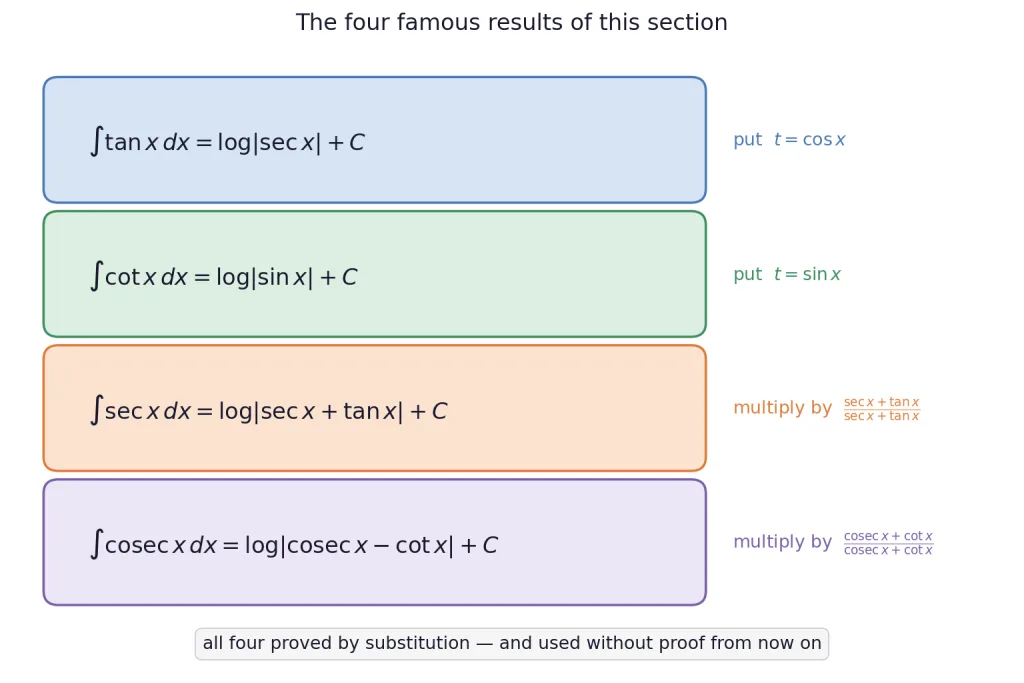
The four famous results (proved by substitution)
The technique decision tree
- Composite function with its inner derivative visible → substitution .
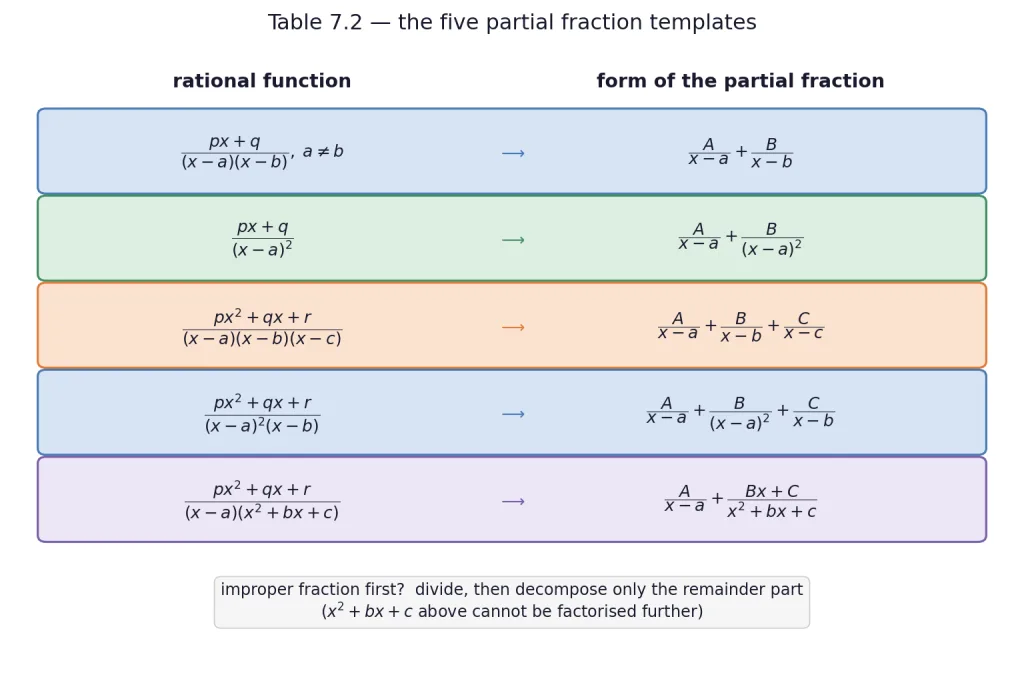
- Rational function → proper? decompose by partial fractions (five templates). Improper? divide first.
- Product of unlike functions → by parts, first function by ILATE; watch for the shortcut.
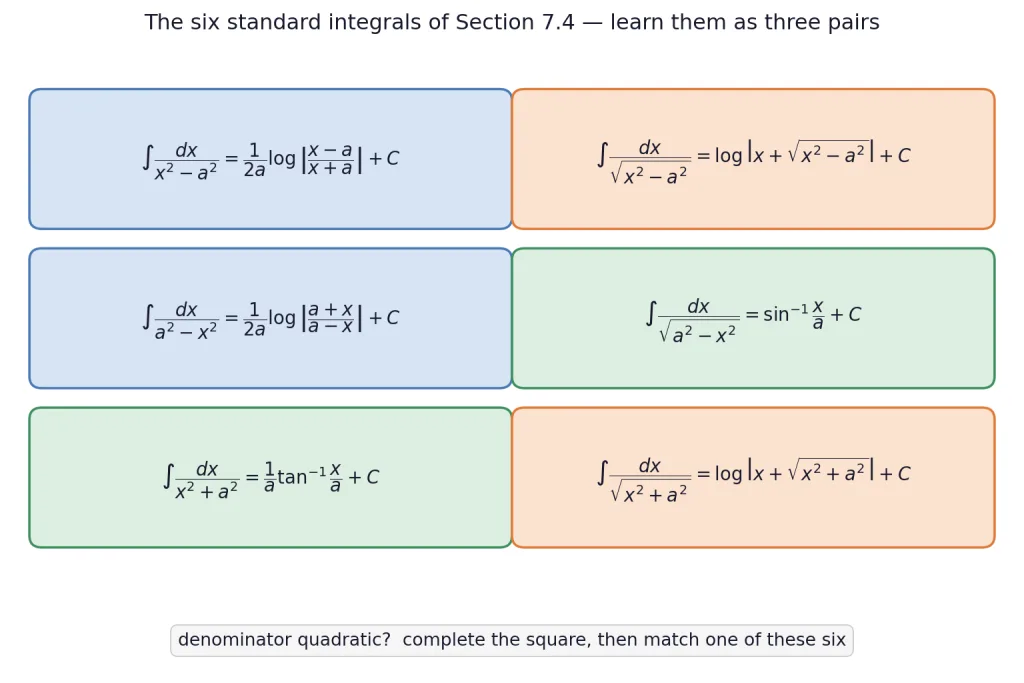
- Quadratic (or its root) in the denominator → complete the square, match one of the six standard forms.
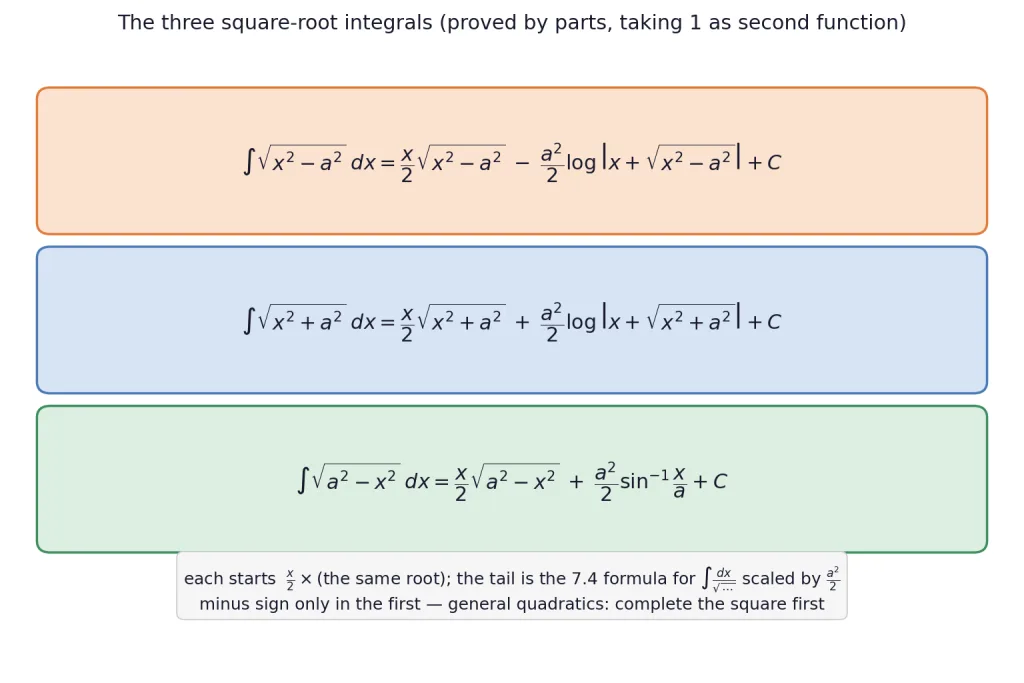
- being integrated → the three root formulas.
Templates and Definite-Integral Toolkit
Partial fraction templates (Table 7.2)
By parts and the root integrals
Special patterns: , and the three root formulas:
Definite integrals
- Second FTC: find any anti-derivative (drop ), compute . The integrand must be defined and continuous on all of .
- Substitution: move the limits with the variable — never evaluate a -antiderivative at -limits.
- Properties:
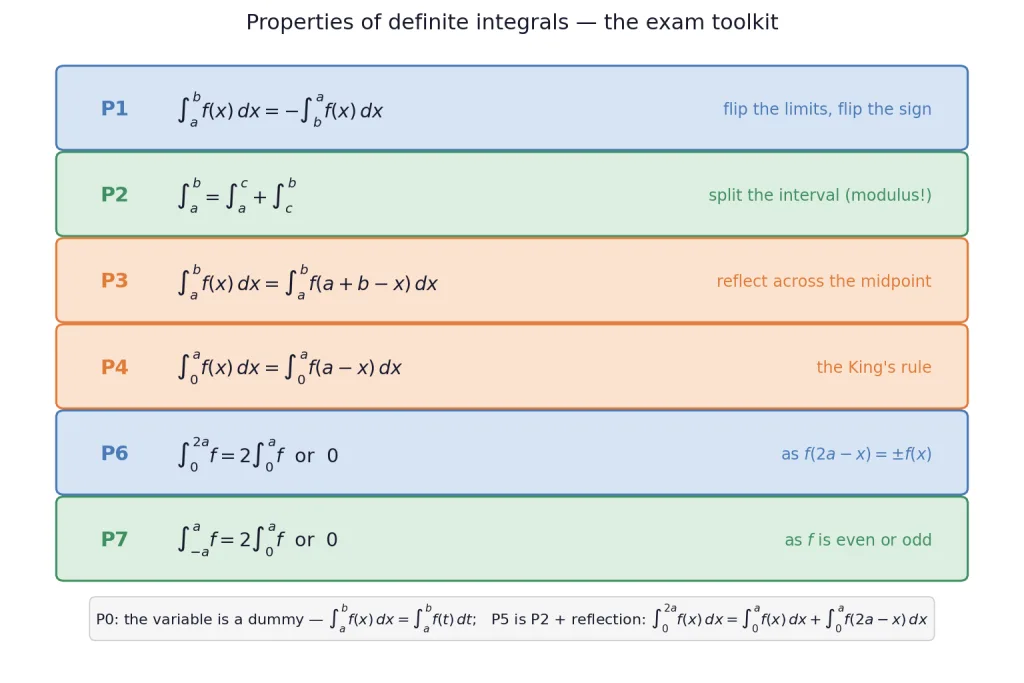
The three most-used values: ; ; for every .
The Mistake Checklist — Read Before Every Exam
- Dropped on an indefinite integral — an instant half-mark gone.
- Chain-rule amnesia: , not . Divide by the inner derivative for every linear inner function.
- Power rule on : — the case is the exception to .
- Sign slips with : — the minus must appear.
- Forgetting to move limits after substitution in a definite integral.
- treated as odd: squares of odd functions are even. Check the whole integrand's parity, and confirm the interval is symmetric before using P7.
- Improper fractions decomposed directly: divide first when .
- Modulus integrated without splitting: find the sign changes, split by P2, then integrate.
- Wrong first function in by parts: ILATE — inverse trig and logs before algebra; algebra before trig and exponentials.
- FTC across a discontinuity: check the integrand exists on the whole interval (NCERT's warning).
- Mixing the six standard forms: the sign pattern of the quadratic (, , ) picks the formula — memorise them as three pairs (with root, without root).
- King's rule missed: if multiplies a symmetric trig block on or , reflect and add before attempting anything else.
Key Point: Revision strategy: one pass through the formula cards above, one pass through this checklist, then attempt the Section 12 drill under time. Wrong answers point to the section to re-read.
[JEE Tip] The night before the exam, re-derive (don't just re-read) the four famous integrals, one root formula, and one King's-rule evaluation — active recall of one representative per family locks in the whole family.