Rational Functions: Proper, Improper, and the Plan
A rational function is a ratio Q(x)P(x) of polynomials with Q(x)=0. It is proper if degP<degQ, otherwise improper.
The plan for integrating any rational function:
Improper? Divide first. Long division gives Q(x)P(x)=T(x)+Q(x)P1(x) with T a polynomial (easy) and QP1 proper.
Factorise the denominator into linear and quadratic factors.
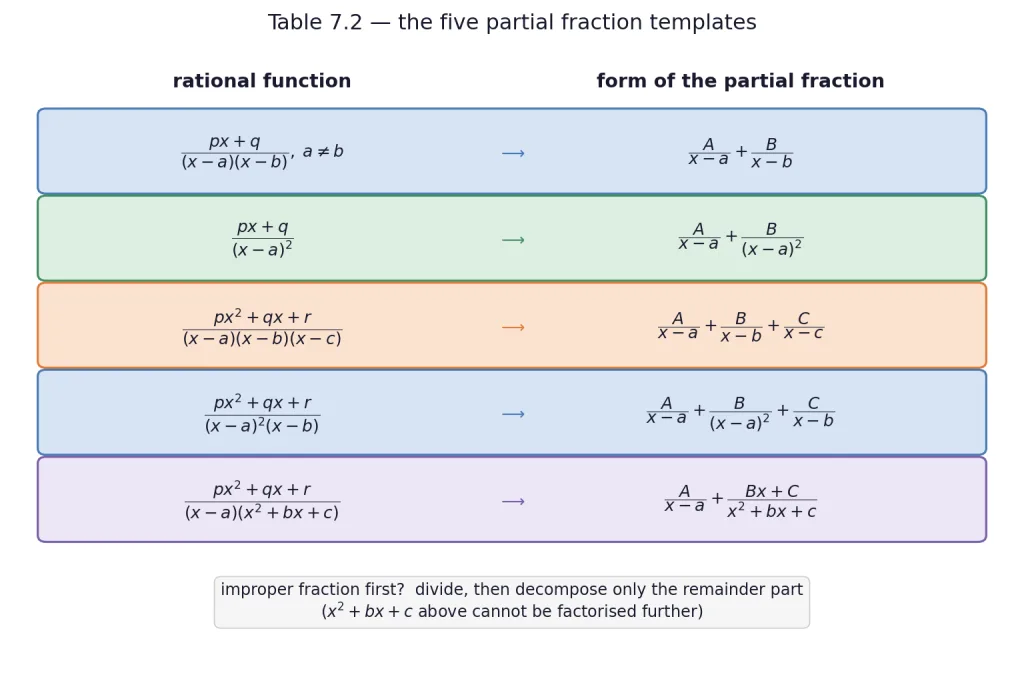
Decompose the proper part into simpler fractions using Table 7.2.
Integrate each piece — they are all logs, powers, or tan−1 forms from Section 3.
Table 7.2 — the five decomposition forms:
Rational function
Partial fraction form
(x−a)(x−b)px+q, a=b
x−aA+x−bB
(x−a)2px+q
x−aA+(x−a)2B
(x−a)(x−b)(x−c)px2+qx+r
x−aA+x−bB+x−cC
(x−a)2(x−b)px2+qx+r
x−aA+(x−a)2B+x−bC
(x−a)(x2+bx+c)px2+qx+r, quadratic irreducible
x−aA+x2+bx+cBx+C
Key Point: A repeated linear factor (x−a)2 needs BOTH x−aA and (x−a)2B; an irreducible quadratic needs a full linear numerator Bx+C, not just a constant. These two rules are where wrong decompositions come from.
[Board Important] The decomposition is an identity (true for all x) — that is why both coefficient-comparison and value-plugging are valid ways to find the constants.
Finding the Constants — and Two Power Moves
Method 1 — compare coefficients. Clear denominators, expand, and match the coefficients of each power of x. Always works; more algebra.
Method 2 — plug convenient values. Since the identity holds for ALL x, substituting the roots kills terms instantly: in 1=A(x+2)+B(x+1), putting x=−1 gives A=1; putting x=−2 gives B=−1. Fast for distinct linear factors.
Power move 1 — substitution before decomposition. For trig rationals like ∫5−cos2ϕ−4sinϕ(3sinϕ−2)cosϕdϕ: substitute y=sinϕ first; the integral becomes an ordinary rational function ∫(y−2)23y−2dy — then decompose.
Power move 2 — the x2=y trick (decomposition only). For (x2+1)(x2+4)x2, treat x2 as a single letter y to decompose (y+1)(y+4)y=y+1−1/3+y+44/3 — then restore x2 and integrate with tan−1 forms. The substitution is a bookkeeping device for the algebra; the integration still happens in x.
Key Point: Partial fractions is pure algebra followed by Section 1-3 integration. If your integration step feels hard, the decomposition step was wrong — go back.
[JEE Tip] After finding constants, spot-check with one easy value of x (like x=0) before integrating. Ten seconds of checking beats re-doing the whole problem.
Solved Examples
Example 1: Two distinct linear factors
Find ∫(x+1)(x+2)dx.
Solution:
Decompose:(x+1)(x+2)1=x+1A+x+2B, so 1=A(x+2)+B(x+1).
Find constants:x=−1⇒A=1; x=−2⇒B=−1.
Integrate:∫x+1dx−∫x+2dx=log∣x+1∣−log∣x+2∣.
Final Answer:logx+2x+1+C.
Takeaway: Root-plugging found both constants in one line each — use it whenever the factors are distinct and linear.
Example 2: Improper — divide first
Find ∫x2−5x+6x2+1dx.
Solution:
Degrees are equal (2 = 2) — improper. Divide: x2−5x+6x2+1=1+(x−2)(x−3)5x−5.
Decompose the proper part:(x−2)(x−3)5x−5=x−2A+x−3B; 5x−5=A(x−3)+B(x−2): x=2⇒A=−5; x=3⇒B=10.
Integrate all three pieces:∫dx−5∫x−2dx+10∫x−3dx.
Final Answer:x−5log∣x−2∣+10log∣x−3∣+C.
Takeaway: Decomposing an improper fraction directly gives garbage — the division step is not optional.
Example 3: A repeated linear factor
Find ∫(x+1)2(x+3)3x−2dx.
Solution:
Decompose (Table form 4):(x+1)2(x+3)3x−2=x+1A+(x+1)2B+x+3C.
Clear and compare:3x−2=A(x+1)(x+3)+B(x+3)+C(x+1)2. Comparing coefficients (or plugging x=−1,−3 plus one comparison): A=411, B=−25, C=−411.
Integrate:411log∣x+1∣−25⋅(−x+11)−411log∣x+3∣.
Final Answer:411logx+3x+1+2(x+1)5+C.
Takeaway: The (x+1)2 piece integrates by the power rule to −x+1B — no logs from repeated-factor terms of power two.
Integrate with tan−1 forms:−31tan−1x+34⋅21tan−12x.
Final Answer:−31tan−1x+32tan−12x+C.
Takeaway: The y-substitution served only the algebra; the final integration used x and the Section 3 forms. Never actually substitute y=x2 in the integral itself (there is no 2xdx available!).
Example 5: Substitution first, then partial fractions
Find ∫5−cos2ϕ−4sinϕ(3sinϕ−2)cosϕdϕ.
Solution:
Substitute:y=sinϕ, dy=cosϕdϕ; using cos2ϕ=1−y2, the denominator is 5−(1−y2)−4y=y2−4y+4=(y−2)2.