
Two Big Problems, One New Calculus
Differential calculus grew out of one geometric problem: finding the tangent to a curve. Integral calculus grows out of two:
- The reverse problem: given the derivative of a function at every point, can we recover the function itself? (Given the velocity of a car at every instant, can we find its position?)
- The area problem: how do we compute the area of a region bounded by the graph of a function?
The first leads to the indefinite integral, the second to the definite integral — and the miracle of this chapter is that the two are connected by the Fundamental Theorem of Calculus (Section 6), which turns area computations into anti-differentiation.
A function whose derivative is the given function is called an anti-derivative (or primitive) of ; the formula that captures all the anti-derivatives is the indefinite integral, and the process of finding them is integration.
Key Point: This chapter is differentiation played backwards. Every derivative formula you memorised in Chapter 5 is about to become an integration formula read right-to-left.
[JEE Tip] Integral calculus (this chapter + the next two) is consistently among the heaviest-weighted units in JEE Main mathematics — the techniques you build here are used again in Areas, Differential Equations, and even Probability. Invest here once, harvest four chapters long.
The Anti-Derivative and the Constant
Start from three derivative facts:
So is an anti-derivative of , of , and of itself. But they are not the only ones! Since the derivative of any constant is zero,
Each function therefore has infinitely many anti-derivatives, differing from each other by constants. Conversely — and this is the key theorem — functions with the same derivative on an interval differ by a constant: if on , then , so is constant.
Hence the family captures ALL anti-derivatives of , and we write
read as "the indefinite integral of with respect to ". Here is the integrand, the variable of integration, and the constant of integration.
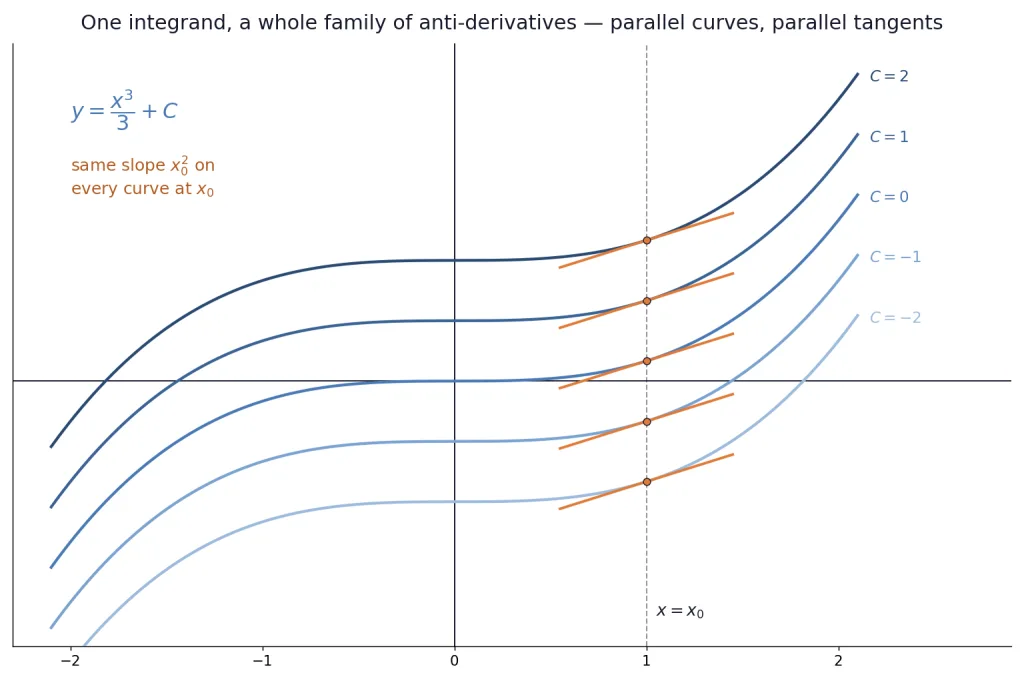
Geometrically, is a family of parallel curves — vertical shifts of one another. At any fixed , every curve in the family has the same slope : the tangents are parallel. Choosing selects one member of the family.
Key Point: Never drop the . An indefinite integral is a family of functions, not one function — and Boards deduct a mark for a missing constant of integration.
[Board Important] When a question supplies an extra condition like , that condition exists precisely to pin down — compute the general anti-derivative first, then solve for .
The Standard Integrals Table
Every derivative formula, read in reverse, is an integration formula. This table is the foundation of the whole chapter — it must become reflex:
| Integral | Result |
|---|---|
| , valid for | |
| (or ) | |
Three entries deserve special attention:
- The power rule excludes — that missing case is exactly what the formula covers.
- The modulus in makes the formula valid on both sides of zero: for , too.
- and are both correct answers for — they differ by the constant , which the absorbs. Two correct-looking different answers can both be right in integration!
Key Point: If two answers to the same integral look different, differentiate both — if each gives back the integrand, they differ only by a constant and both are correct.
[JEE Tip] JEE options exploit the "answers differing by a constant" fact: your correct answer may not literally match any option. Differentiate the options or rewrite yours (e.g. using trig identities) before concluding you made an error.
Properties of the Indefinite Integral
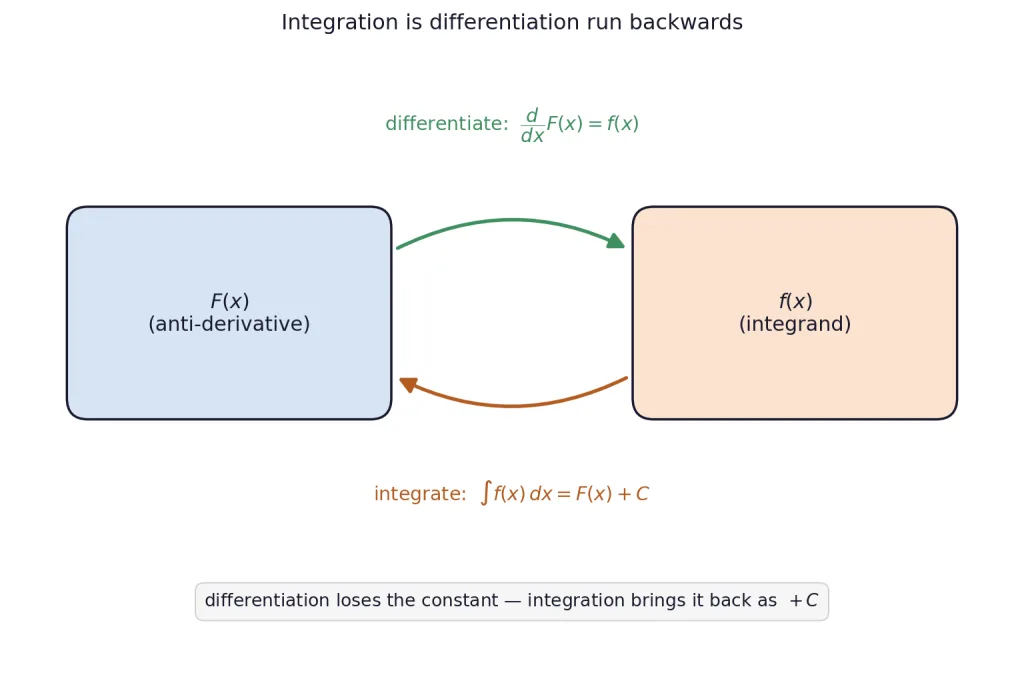
(I) Differentiation and integration undo each other:
Note the asymmetry: differentiating an integral gives back exactly, but integrating a derivative recovers only up to a constant — differentiation destroyed the constant's information.
(II) Equivalence: two indefinite integrals with the same derivative represent the same family of curves, and we treat them as equal (the constants absorb any difference).
(III) Sum rule:
(IV) Constant multiple rule: for any real
(V) Linearity (the working form):
Linearity is what lets you integrate any polynomial (and much more) term by term.
Key Point: There is NO product rule or quotient rule for integration. — products need substitution (Section 2) or integration by parts (Section 5). Splitting is legal only across + and −.
[Board Important] When you split an integral into several pieces, each piece technically gets its own constant — but they merge into one. Write a single in the final answer; that is the accepted convention.
Integration by Inspection — and Preparing the Integrand
The most basic method: stare at the integrand and guess a function whose derivative it is, then adjust constants. Examples:
- For : we know — twice too big — so the anti-derivative is .
- For : recognise it as directly.
- For : since , we get — the "divide by the inner coefficient" reflex.
Often the real work is algebra before integration. Split fractions, expand squares, use identities — until each term is a standard form:
Two closing remarks from the NCERT:
- Not every function has an elementary anti-derivative. For example cannot be expressed using polynomials, trig, exponentials or logs — no method in this chapter (or any chapter) will produce a closed form. Recognising these saves exam time.
- The variable name is irrelevant: — the same formulas apply with any letter.
Key Point: Before reaching for heavy machinery, always try 10 seconds of algebraic simplification. A large fraction of "hard" NCERT integrals are one identity away from the standard table.
[JEE Tip] Verify any inspection answer instantly by differentiating it in your head. Differentiation is mechanical and fast; integration is creative and slow — always check in the cheap direction.
Solved Examples
Example 1: Anti-derivatives by inspection
Write an anti-derivative for each by the method of inspection: (i) (ii) (iii) , .
Solution:
- (i) , so : an anti-derivative is .
- (ii) : an anti-derivative is .
- (iii) For : ; for : . Combining: an anti-derivative is .
Final Answer: ; ; .
Takeaway: Inspection = recall the nearest derivative formula, then fix the constant factor. Part (iii) is why the modulus appears in the log formula.
Example 2: Split the fraction first
Find .
Solution:
- Simplify the integrand: .
- Integrate term by term (linearity): .
- Tidy up: .
Final Answer: .
Takeaway: Division by turned the fraction into two power-rule terms. Note only ONE constant is written at the end.
Example 3: Fractional powers
Find .
Solution:
- Power rule on each term: ; and .
- Combine: .
Final Answer: .
Takeaway: The power rule works for every real exponent except : add 1 to the power, divide by the new power — fractions included.
Example 4: A three-term mix
Find .
Solution:
- Apply linearity: integrate the three terms separately.
- Power term: .
- Exponential term: .
- Reciprocal term: .
Final Answer: .
Takeaway: Three different table entries in one integral — the table, not cleverness, does all the work.
Example 5: Trigonometric sums
Find (i) (ii) .
Solution:
- (i) .
- (ii) Expand first: .
- Table entries: .
Final Answer: (i) ; (ii) .
Takeaway: Expand products into sums of table entries. Watch the minus signs on the "co-" integrals — they are the most common slip in this section.
Example 6: Rewrite with identities
Find .
Solution:
- Split the fraction: .
- Recognise standard forms: .
- Integrate from the table: .
Final Answer: .
Takeaway: The two-step rhythm of this whole section: rewrite into table forms, then read off the answer.
Example 7: Pinning down the constant
Find the anti-derivative of satisfying .
Solution:
- General anti-derivative: .
- Apply the condition: .
- Write the specific function: .
Final Answer: .
Takeaway: An initial condition converts the family of anti-derivatives into a unique function — the standard two-step: integrate generally, then solve for .
Example 8: A general quadratic
Find .
Solution:
- Linearity: .
- Power rule: .
Final Answer: .
Takeaway: Symbolic coefficients change nothing — they ride along like the constants they are.
Example 9: Divide before integrating
Find .
Solution:
- Split the fraction: .
- Integrate term by term: .
- Tidy: .
Final Answer: .
Takeaway: When the denominator is a single power of , term-wise division is always faster than any formal method.
Example 10: Factor and cancel
Find .
Solution:
- Factor the numerator by grouping: .
- Cancel: the integrand is (for ).
- Integrate: .
Final Answer: .
Takeaway: A polynomial-over-polynomial integrand should trigger one question first: does it divide exactly? Here grouping made the division instant.
Example 11: A secant product
Find .
Solution:
- Expand: .
- Both are table entries: .
Final Answer: .
Takeaway: This exact integrand returns in Section 3 as the key trick for evaluating — remember the pattern .
Example 12: Hidden
Find .
Solution:
- Rewrite in sines and cosines: .
- Use the identity : the integral becomes .
- Integrate: .
Final Answer: .
Takeaway: and are never integrated directly — always convert via or .
Example 13: One more identity workout
Find .
Solution:
- Split: .
- Table entries: .
Final Answer: .
Takeaway: should instantly parse as — train the eye to see products of standard derivatives inside fractions.