Inspection runs out of steam quickly — we need a systematic technique. Substitution is the chain rule played backwards: transform ∫f(x)dx by changing the variable from x to t via x=g(t), so that dx=g′(t)dt and
∫f(x)dx=∫f(g(t))g′(t)dt
In practice you usually spot it the other way round: substitute t=(some inner function) whose derivative also sits in the integrand.
The 4-step recipe
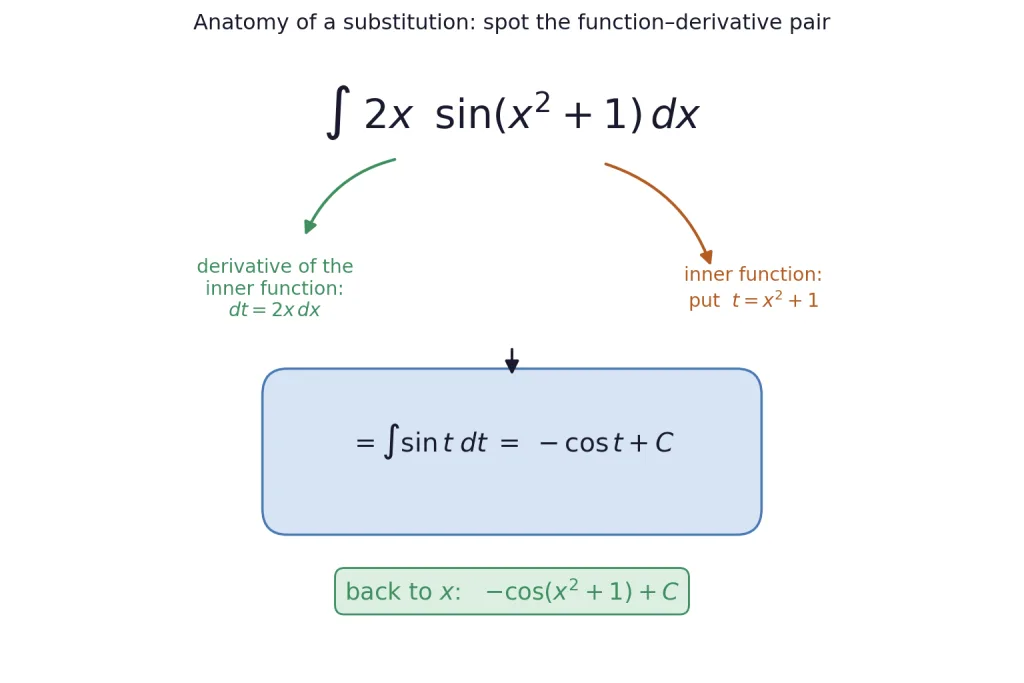
Spot the inner function whose derivative (up to a constant) appears as a factor: in ∫2xsin(x2+1)dx, the inner function is x2+1 and its derivative 2x is right there.
Substitute:t=x2+1, dt=2xdx — the integral collapses to ∫sintdt.
Integrate in t:−cost+C.
Return to x:−cos(x2+1)+C. Always convert back — an answer left in t is incomplete.
If the derivative appears with a wrong constant, adjust: for ∫sinmxdx, put t=mx, dt=mdx, so dx=mdt and the answer is −m1cosmx+C.
Key Point: Substitution works when the integrand is (inner function's derivative) × (function of the inner function). Train your eye to scan for the pair g(x) and g′(x) before anything else.
[JEE Tip] Common inner functions with instantly recognisable derivatives: x2+a (deriv 2x), logx (deriv x1), tan−1x (deriv 1+x21), sin−1x (deriv 1−x21), x (deriv 2x1), ex, sinx/cosx pairs. Half of JEE substitution questions use one of these seven.
The Four Famous Results
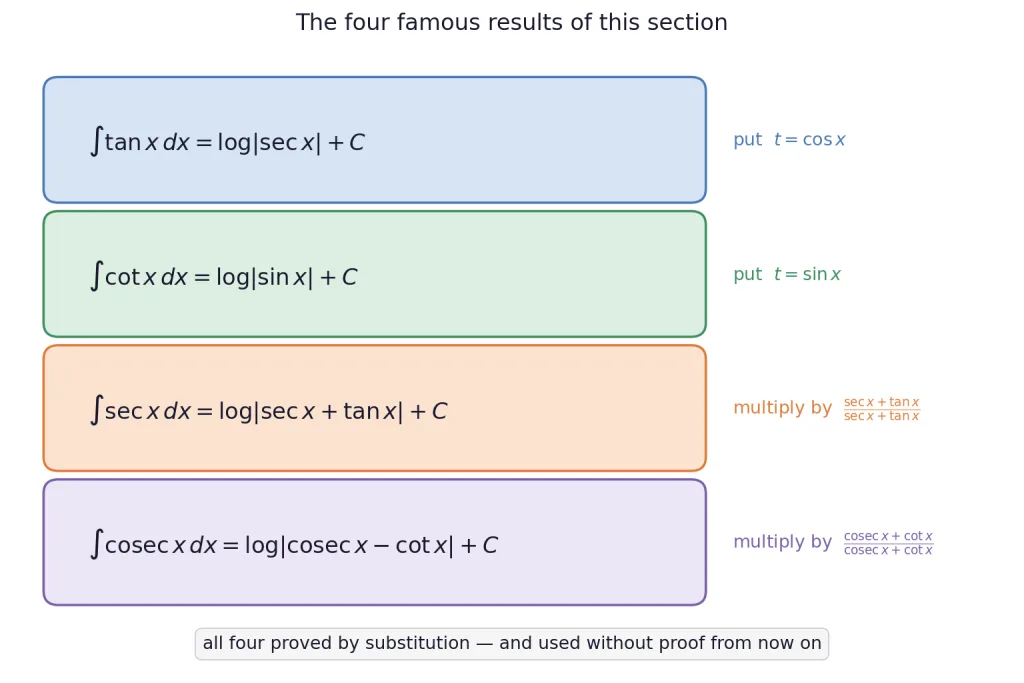
Substitution immediately delivers four integrals used constantly for the rest of the chapter — memorise them as table entries:
1.∫tanxdx=log∣secx∣+C
Proof:∫cosxsinxdx; put t=cosx, dt=−sinxdx: −∫tdt=−log∣cosx∣+C=log∣secx∣+C.
2.∫cotxdx=log∣sinx∣+C
Proof:∫sinxcosxdx; put t=sinx, dt=cosxdx: ∫tdt=log∣sinx∣+C.
3.∫secxdx=log∣secx+tanx∣+C
Proof (the famous trick): multiply and divide by secx+tanx:
∫secx+tanxsecx(secx+tanx)dx
Put t=secx+tanx; then dt=(secxtanx+sec2x)dx — exactly the numerator! So the integral is ∫tdt=log∣secx+tanx∣+C.
4.∫cosecxdx=log∣cosecx−cotx∣+C
Proof: same trick with cosecx+cotx, then simplify using cosec2x−cot2x=1.
Key Point: The sec and cosec derivations are exam questions in their own right ("Prove that ∫secxdx=…"). Learn the multiply-and-divide trick, not just the results.
[Board Important] Write the modulus signs in all four results. logsecx without modulus loses a mark whenever secx can be negative.
Harder Substitution Patterns
Pattern 1 — Odd powers of sine or cosine: peel one factor off.
For ∫sin3xcos2xdx: the power of sine is odd, so write sin3x=(1−cos2x)sinx and substitute t=cosx:
∫(1−t2)t2(−dt)=−3t3⋅(−1)…=−3cos3x+5cos5x+C
Rule of thumb: odd power of sin → substitute t=cosx; odd power of cos → substitute t=sinx; both even → use identities (next block).
Pattern 2 — Shifted angles: substitute the shift.
For ∫sin(x+a)sinxdx: put t=x+a, expand sin(t−a)=sintcosa−costsina:
Pattern 3 — 1+tanx1 types: split the numerator smartly.
∫1+tanxdx=∫cosx+sinxcosxdx. Write the numerator as a combination of the denominator and its derivative:
cosx=21(cosx+sinx)+21(cosx−sinx)
The first piece integrates to 2x; the second is 21∫cosx+sinxd(cosx+sinx)=21log∣cosx+sinx∣. Total: 2x+21log∣cosx+sinx∣+C.
Key Point: Pattern 3's idea — numerator = A(denominator) + B(derivative of denominator) — is a general JEE technique for ∫csinx+dcosxasinx+bcosxdx. Solve for A and B by comparing coefficients.
[JEE Tip] In Pattern 1, if BOTH powers are odd, peel from the smaller power — less algebra. If the integrand is sinmxcosnx with m+n even and negative-ready, JEE-level shortcuts exist via t=tanx — see the JEE Corner.
Integration Using Trigonometric Identities
When the integrand is built from powers or products of sines and cosines with NO convenient derivative pair, reshape it with identities until every term is linear in some sin(kx) or cos(kx).
Power reduction (even powers):
cos2x=21+cos2x,sin2x=21−cos2x
So ∫cos2xdx=2x+4sin2x+C, and fourth powers just need the identity twice: sin4x=(21−cos2x)2, then reduce cos22x again.
Cubes (odd powers) via triple-angle:
sin3x=43sinx−sin3x,cos3x=43cosx+cos3x
giving ∫sin3xdx=−43cosx+121cos3x+C (equivalently −cosx+3cos3x+C by the peel-a-factor route — both are correct, differing by a constant… in fact by identity they are equal!).
So ∫sin2xcos3xdx=21∫[sin5x−sinx]dx=−10cos5x+2cosx+C.
Half-angle for 1±cosx:
1+cosx=2cos22x,1−cosx=2sin22x
These demolish integrands like 1+cosx1−cosx=tan22x.
Key Point: The goal of every identity manoeuvre is the same: reach a sum of terms of the form asin(kx), bcos(kx) or constants — each integrable in one line with the divide-by-k reflex.
[Board Important] For ∫sinAcosB products, expect half-marks reserved for correctly writing the product-to-sum identity. Quote it, substitute, then integrate — don't jump.
Solved Examples
Example 1: The basic adjust-the-constant substitution
Integrate sinmx with respect to x.
Solution:
Substitute:t=mx, so dt=mdx, i.e. dx=mdt.
Transform:∫sinmxdx=m1∫sintdt=−m1cost+C.
Return to x:−m1cosmx+C.
Final Answer:−m1cosmx+C.
Takeaway: Linear inner functions just cost a division by the coefficient — soon you will do this without writing the substitution at all.
Example 2: The model derivative-pair substitution
Find ∫2xsin(x2+1)dx.
Solution:
Spot the pair: inner function x2+1 has derivative 2x — present as a factor.
Substitute:t=x2+1, dt=2xdx: the integral becomes ∫sintdt.
Integrate and return:−cost+C=−cos(x2+1)+C.
Final Answer:−cos(x2+1)+C.
Takeaway: This is the picture-perfect substitution: derivative sitting beside its function. Most exam integrands are disguised versions of exactly this.
Example 3: Substitution inside substitution
Find ∫xtan4xsec2xdx.
Solution:
First substitution:t=x, dt=2xdx, so xdx=2dt: the integral is 2∫tan4tsec2tdt.
Second substitution:u=tant, du=sec2tdt: it becomes 2∫u4du=52u5.
Unwind both:52tan5t=52tan5x+C.
Final Answer:52tan5x+C.
Takeaway: Layered integrands unwrap one layer at a time — and the single substitution u=tanx would have done it in one step. Practice builds that compression.
Example 4: An inverse-trig inner function
Find ∫1+x2sin(tan−1x)dx.
Solution:
Spot the pair:tan−1x has derivative 1+x21 — present.
Substitute:t=tan−1x, dt=1+x2dx: the integral is ∫sintdt=−cost+C.
Return:−cos(tan−1x)+C.
Final Answer:−cos(tan−1x)+C.
Takeaway:1+x21 in an integrand is a flashing sign saying "substitute t=tan−1x".
Example 5: Deriving the famous ∫tanx and ∫secx
Prove that (i) ∫tanxdx=log∣secx∣+C and (ii) ∫secxdx=log∣secx+tanx∣+C.
Solution:
(i) Write as a fraction:∫cosxsinxdx. Put t=cosx, dt=−sinxdx.