
Line of Sight, Elevation and Depression
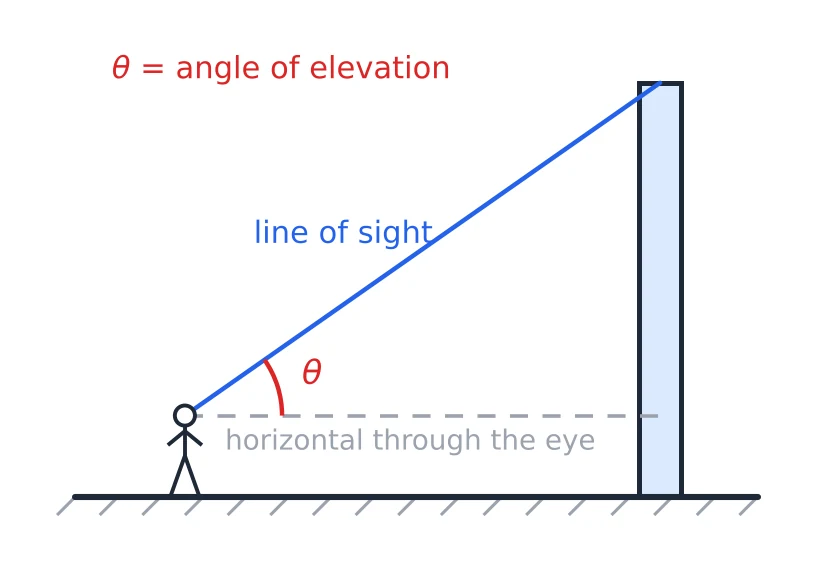
Every question in this chapter is about one person looking at one thing. Draw the straight line from the eye to the object: that is the line of sight. Then draw a horizontal line through the eye. The angle between these two lines tells you where the object is.
If the object is above the horizontal, as the top of a tower is for someone standing on the ground, the angle is the angle of elevation. The eye looks up.
If the object is below the horizontal, as a car on the road is for someone on a roof, the angle is the angle of depression. The eye looks down.
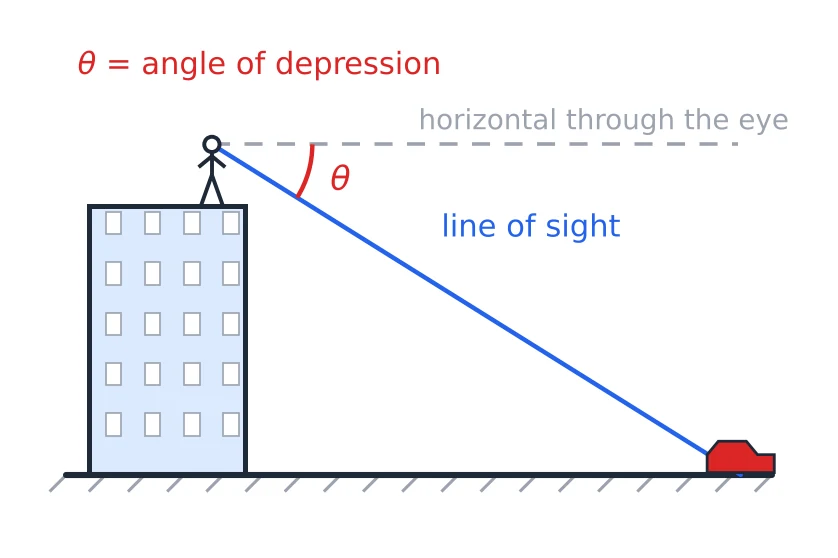
Both angles are measured from the horizontal, never from the vertical wall or the tower, and both lie between 0° and 90°.
The rest of the setting is fixed by the question:
- the ground (or the sea) is level and the tower, pole or building stands straight up, so there is a right angle at its foot;
- the observer is a point on the ground unless the question gives his or her height;
- a distance “from the tower” is measured along the ground to its foot.
So every figure turns into a right triangle. The height is one leg, the distance along the ground is the other leg, and the line of sight is the hypotenuse. The angle of elevation sits in the observer's corner, opposite the height.
Draw a rough figure every time, even in the exam hall. Mark the right angle at the foot, put the given angle in its corner, write each known length on its side and a letter (h, d or x) on the side you want. Putting the angle in the wrong corner is the mistake that costs marks here, and a ten-second sketch stops it.
The Angle of Depression Goes to the Bottom Corner
From the top A of a lighthouse, a boat B is seen at an angle of depression . The horizontal AX through A is parallel to the sea CB. The line of sight AB cuts both parallel lines, so the angles it makes with them are alternate angles, and alternate angles are equal:
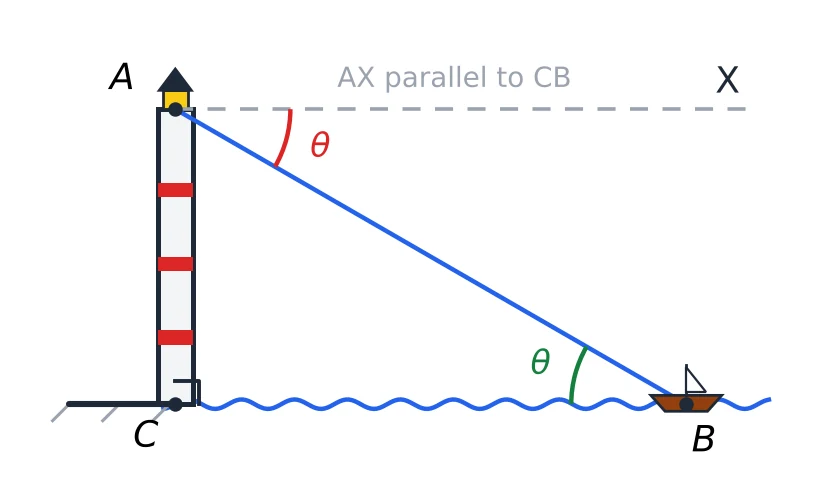
So the angle of depression of B from A equals the angle of elevation of A from B. The sailor in the boat looks up at the lamp at exactly the angle at which the keeper looks down at the boat.
This decides the working. The angle of depression lies outside triangle ABC, between the dashed horizontal and AB. Its equal copy lies inside the triangle at B, the bottom corner, opposite the height AC. Once you move it there, a depression question is worked exactly like an elevation question:
Take a lighthouse 51 m high from which a boat is seen at a depression of 30°. The angle at B is 30°, so
The wrong corner. The angle inside the triangle at the top, , is not . It is 90° − , here 60°, because the vertical AC and the horizontal AX are at right angles. Putting the 30° at A gives m, which is the same as measuring the depression from the vertical.
Some questions use that inside angle on purpose: “the line of sight makes an angle of 30° with the wall of the building”. That 30° is at the top, between the wall and the line of sight, and the angle of depression is 60°.
The Two Triangles That Do Most of the Work
The angles 30°, 45° and 60° come from two right triangles. Their trigonometric values are in Chapter 15; here is how to use the triangles themselves, without writing tan or sin at all.
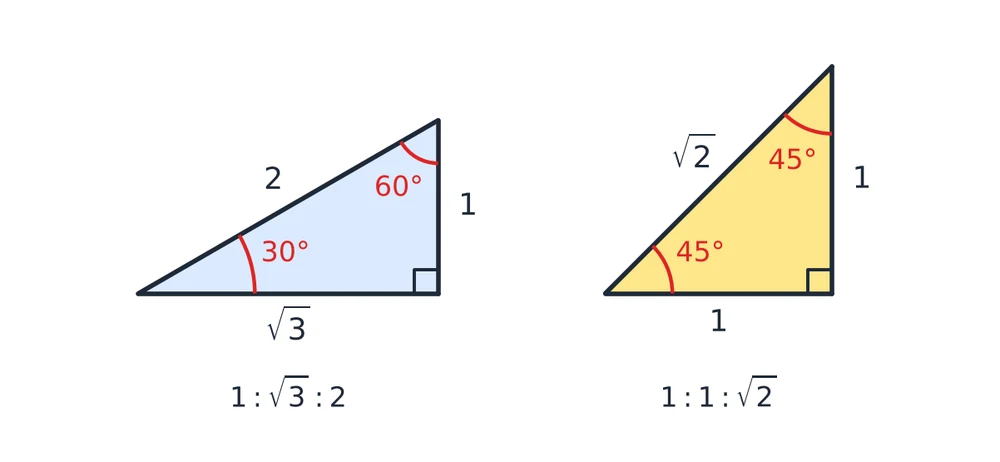
The 30°-60°-90° triangle: sides .
- The side opposite 30° is the shortest. Call it one part.
- The side opposite 60° is parts.
- The hypotenuse is 2 parts, twice the shortest side.
The 45°-45°-90° triangle: sides . The two legs are equal, and the hypotenuse is times a leg.
Reading a side straight off. Find the side you know, divide by its number of parts to get one part, then multiply.
- The side opposite 30° is 14 m: the hypotenuse is 28 m and the side opposite 60° is m.
- The side opposite 60° is 18 m: one part is m, so the shortest side is m and the hypotenuse m.
- The hypotenuse is 50 m and an angle is 45°: each leg is m.
In a heights question the observer's angle is opposite the height. That gives this table:
| Angle at the observer | height : distance : line of sight |
|---|---|
| 30° | |
| 45° | |
| 60° |
With an angle of elevation of 60°, the height is times the distance; with 30°, the distance is times the height; with 45°, the two are equal.
The larger angle faces the larger side. That one fact settles most option checks: if the angle at the observer is 60°, the tower must come out taller than the distance on the ground, and with 30° it must come out shorter.
Height from the Distance and the Angle
The basic question gives the distance d from the observer to the foot of the tower and the angle of elevation , and asks for the height h. The height is opposite and the distance is next to it, so the ratio that joins them is tan:
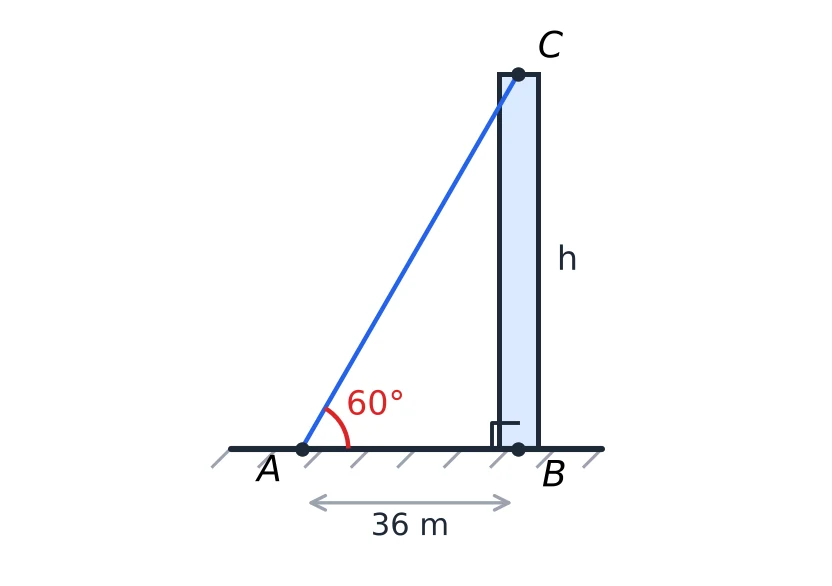
In the figure, A is 36 m from the foot B of the tower and the angle of elevation of the top C is 60°:
The three standard angles give three quick rules:
- 30°: . From 54 m away, m.
- 45°: . From 29 m away, the height is 29 m.
- 60°: , as in the figure.
Rationalise before you compare. Options are written in the simplest surd form, so will appear as . Multiply the top and the bottom by : . When a is a multiple of 3, the 3 cancels neatly.
[SSC Tip] and both turn up in the options, one from tan and one from cot. Before you choose, compare the angle with 45°: above 45° the height is more than the distance, below 45° it is less. For 60° and 36 m, m is less than 36 m, so it cannot be the height.
Distance from the Height and the Angle
Turn the same triangle round: the height is known and the distance along the ground is wanted. Now the unknown is next to the angle, so
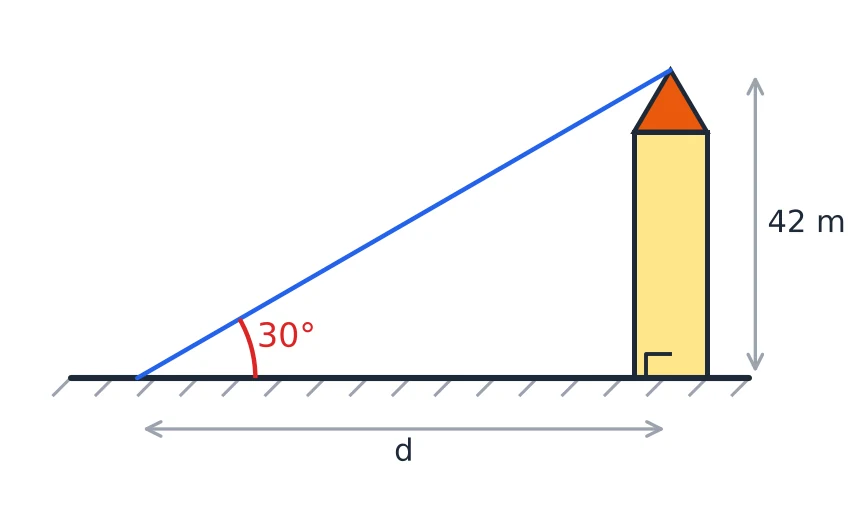
The temple in the figure is 42 m high, and its top is seen at an angle of elevation of 30°. Then
Seen at 60° instead, the same temple would be m away. The closer you stand, the more steeply you look up.
The quick rules turn round too:
- 30°:
- 45°:
- 60°:
Which way to divide. One rule works every time: write tan of the angle as height over distance, then put in what you know. gives , so m. Writing by mistake gives m, three times too far.
Rounding. When a question wants a decimal answer, it gives the value of to use, usually 1.732. Simplify the surd first and multiply last: m. Dividing 75 by 1.732 also gives 43.30, but with more work and more room for error.
The Length of the Line of Sight
The line of sight is the hypotenuse of the triangle. A question may ask for it (“how far is the top of the tower from the observer?”), or give it and ask for something else. Use sin or cos, or the side ratios:
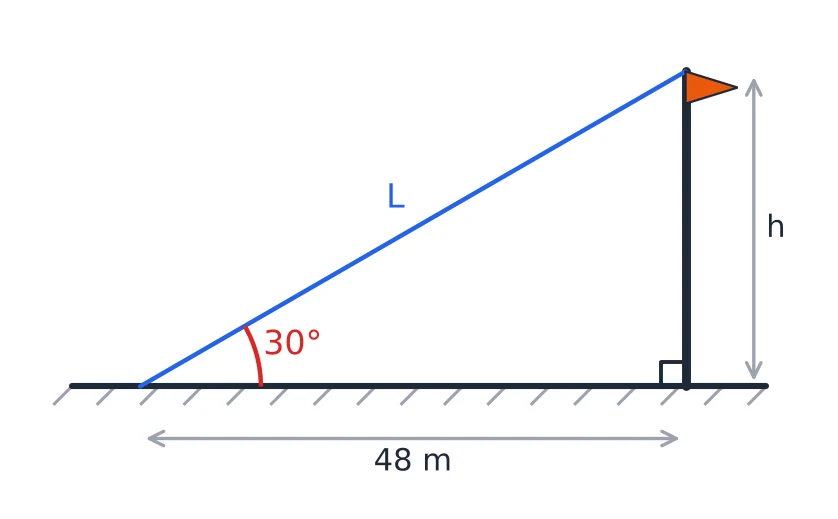
In the figure the top of a mast is seen at 30° from a point 48 m from its foot. In the triangle, 48 m is the side, so one part is m. Then
With cos it is the same: m.
The line of sight given. If the line of sight to the top of a tower is 64 m and the angle of elevation is 60°, the distance along the ground is half of it, 32 m, and the height is m. At 45°, a line of sight L gives .
Which distance is asked? “How far is the boat from the lighthouse” means along the water to the foot. “How far is the boat from the top of the lighthouse” means the line of sight. Both values are among the options, so read the last line of the question twice before you mark.
Finding the Angle
When the height and the distance are both given, the angle comes from their ratio:
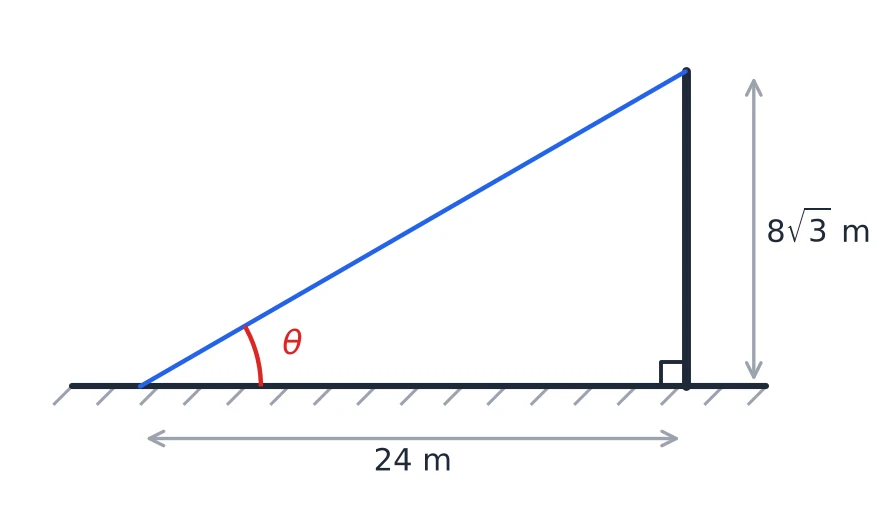
For the pole in the figure, , so = 30°.
The answers here are almost always 30°, 45° or 60°, so all you need is to recognise the ratio:
| What the question gives | Angle of elevation |
|---|---|
| height = distance | 45° |
| distance = × height | 30° |
| height = × distance | 60° |
| line of sight = 2 × height | 30° |
| line of sight = 2 × distance | 60° |
| line of sight = × height | 45° |
The last three rows use sin and cos: a line of sight twice the height means .
A ratio instead of lengths. “The height of a tower and the distance of a point from its foot are in the ratio ” gives , so = 60°. The actual lengths are not needed.
Depression works the same way. From the top of a 35 m building, a car 35 m from its foot is seen at a depression of 45°, because the angle at the car is 45° and the two angles are equal.
Mixed units. A tower of 0.04 km and a distance of m give 30°, but only after both are in metres. If a ratio refuses to match any standard value, check the units before anything else.
When the Angle Is Given Only by Its Ratio
Not every angle is 30°, 45° or 60°. A question may say “the angle of elevation is , where ” and leave you to use the ratio as it stands. Read it as the shape of the triangle: the height and the distance are in the ratio 5 : 12, and the line of sight, by Pythagoras, is 13 of the same parts.
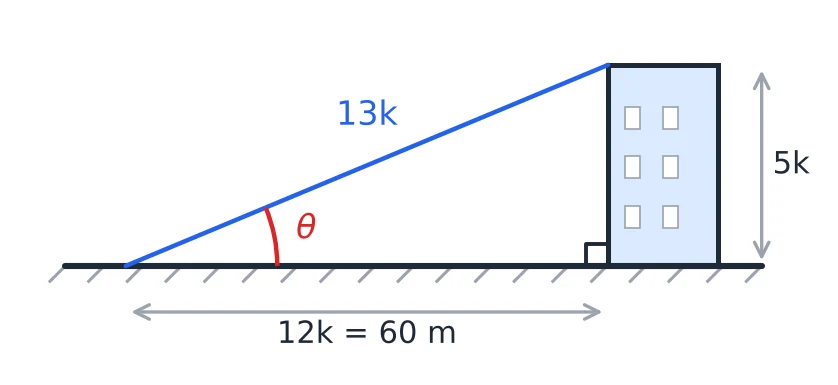
Take a building seen from a point 60 m from its foot, with . The distance is the 12 side, so one part is m. Then
sin or cos given. Put the numbers on the right sides first. means height : line of sight = 5 : 13, and the distance is the 12 side. If the line of sight is 39 m, then k = 3, the height is 15 m and the distance 36 m. With , the distance is the 4 side and the line of sight the 5 side, so the height is 3 parts.
Keep these triplets ready (Chapter 15 has a longer list): 3, 4, 5; 5, 12, 13; 8, 15, 17; 7, 24, 25; 20, 21, 29.
Check the side before you multiply. With and a distance of 28 m, one part is 7 m and the height is 21 m. Putting the 28 on the 3 side instead gives 37.33 m. A tan below 1 means the height is less than the distance, and that alone shows 37.33 m is wrong.
Angles Like 15° and 75°, and Rounded Answers
Sometimes the angle is not one of the standard three, and the question supplies its value. The two you are likely to meet are
They are reciprocals of each other, since . So and .
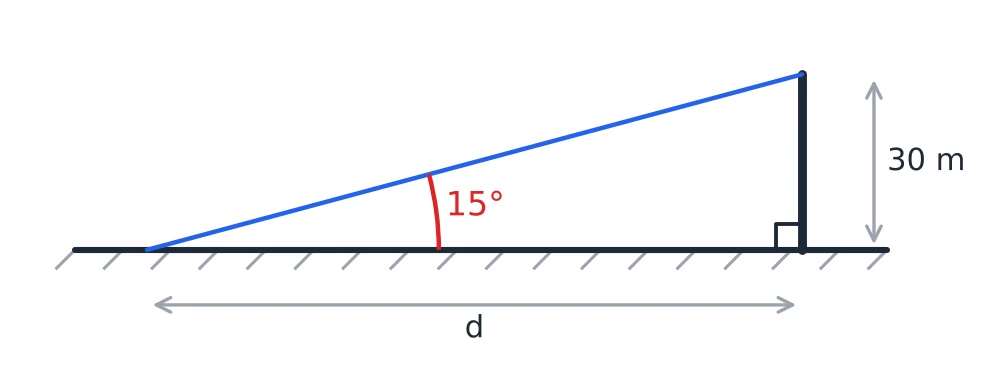
A low angle. The top of a 30 m pole is seen at 15°. The distance is
A small angle needs a long way back, and the figure shows how flat the triangle is.
A steep angle. From 40 m away the top of a tower is at 75°. Then m.
Dividing by . If you write , multiply the top and the bottom by . The bottom becomes 1 and you are back at .
Rounding to two places. Use the value of the question gives, finish the surd form first, and round only at the end:
- m
- m
- m
Rounding to 1.7 at the start turns 34.64 into 34, and two options can be closer together than that.
The Observer's Own Height
A person does not see from ground level. If the question says the observer is 1.5 m tall, or that his eyes are 1.5 m above the ground, the horizontal through the eye is 1.5 m up, and the right triangle starts there.
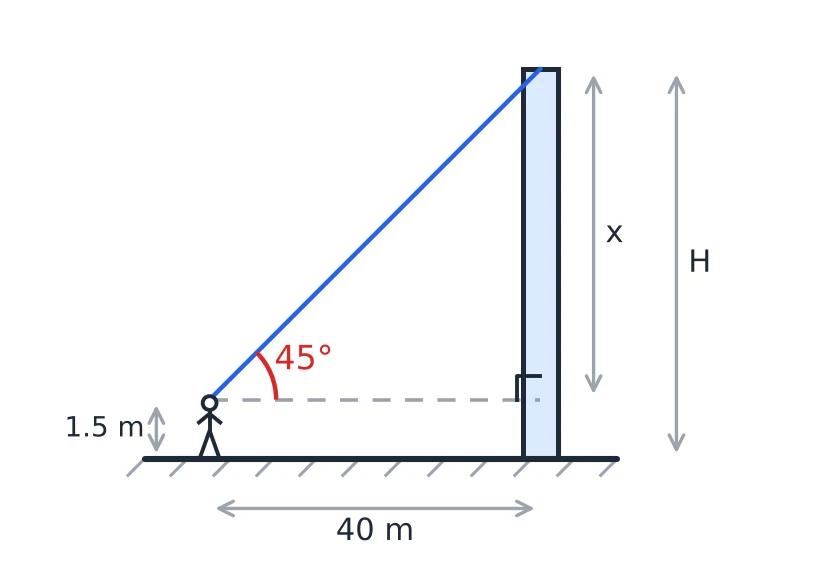
In the figure the horizontal from the eye to the tower is 40 m and the angle is 45°, so the part of the tower above eye level is x = 40 m. The whole tower is
Finding the tower: work out the part above eye level, then add the eye height.
Finding the distance: take the eye height off the tower first. A girl whose eyes are 1.6 m up sees the top of a 31.6 m tree at 60°. The tree rises 30 m above her eyes, so she stands m from it.
Finding the angle: use the part above the eye. With the eye at 1.5 m, a 21.5 m tower 20 m away is seen at 45° (20 m up, 20 m across). The full 21.5 m against 20 m would suggest a slightly bigger angle, and that is wrong.
“A man 1.8 m tall” is read as his eyes being 1.8 m up; these questions do not separate the eyes from the top of the head.
[SSC Tip] The options in these questions include the answer without the eye height, such as 40 m beside 41.5 m. Underline the person's height the moment you read it, so it is still there when you reach the last line of the working.
Looking Down from a Cliff, a Lighthouse or a Building
From the top of a cliff, a lighthouse or a tall building, the angle of depression of something on the ground or the water fixes how far away it is. Move the angle to the bottom corner (it equals the angle of elevation from the object) and use the same triangle:
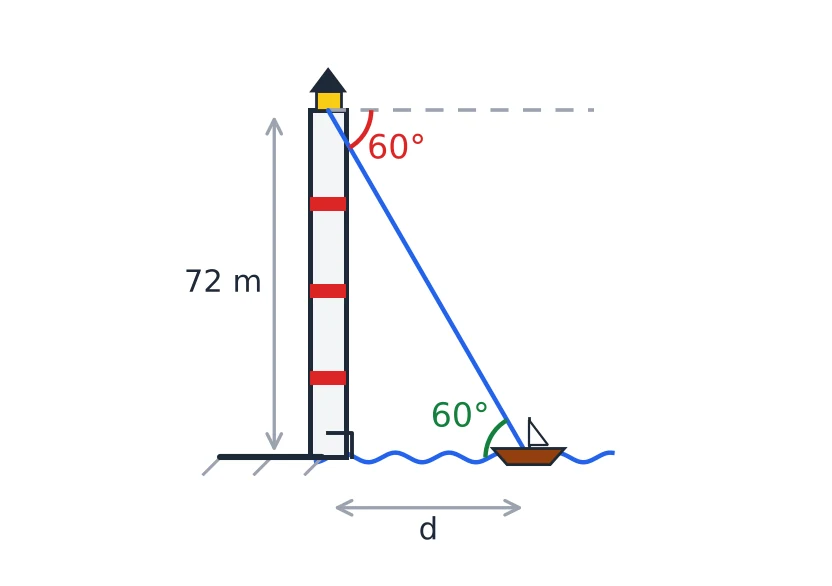
The lighthouse in the figure is 72 m tall, and a boat is seen from its top at a depression of 60°. The angle at the boat is 60°, so
and the boat is m from the lamp at the top.
Height from the depression. From the roof of a building, a car 57 m from the foot is seen at a depression of 30°. The building is m tall.
Someone standing on the top. If a man whose eyes are 1.5 m up stands on a 25 m building, the horizontal through his eyes is 26.5 m above the ground, and 26.5 m is the height to use. The same goes for a person on a cliff or on the deck of a ship.
Nearer means steeper. The bigger the angle of depression, the closer the object: a boat seen at 60° is nearer the cliff than one seen at 30°. Questions with two boats, or a boat that moves between two angles, are in Two Angles and Moving Objects.
Depression from an Aeroplane or a Balloon
An aeroplane, a balloon or a helicopter is a point in the air at a height h. Drop a vertical from it to the ground: that is the height side of the triangle. The horizontal through the plane is the dashed line, and the angle of depression of a place on the ground is measured below it.
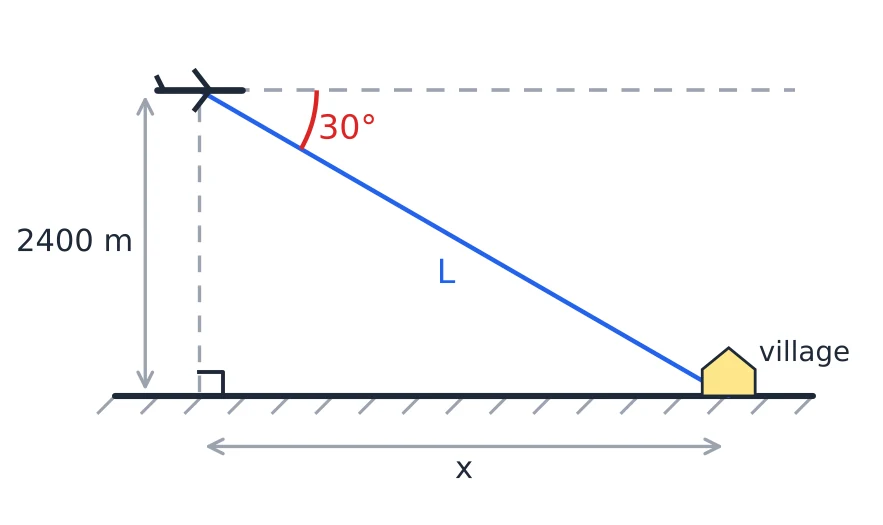
In the figure the plane flies at 2400 m and sees a village at a depression of 30°. The angle at the village is 30°, so
x is the horizontal distance: from the village to the point on the ground directly below the plane. L is the distance through the air. Either may be asked, and “how far is the village from the plane” means L.
Units. The height of a plane may be given in km. 2.4 km is 2400 m; work in one unit, and change to km at the end if the options are in km. m is km, about 4.16 km.
A balloon works the same way. A balloon 150 m up sees a car at a depression of 45°. The car is 150 m from the point below the balloon and m from the balloon itself.
A plane seen at two different angles a few seconds apart, or a balloon rising at a steady speed, turns the question into one about speed. Those are in Two Angles and Moving Objects.
Solved Examples
Question 1
The angle of elevation of the top of a tower from a point on the ground 45 m from its foot is 60°. How tall is the tower? (a) m (b) m (c) 90 m (d) 45 m
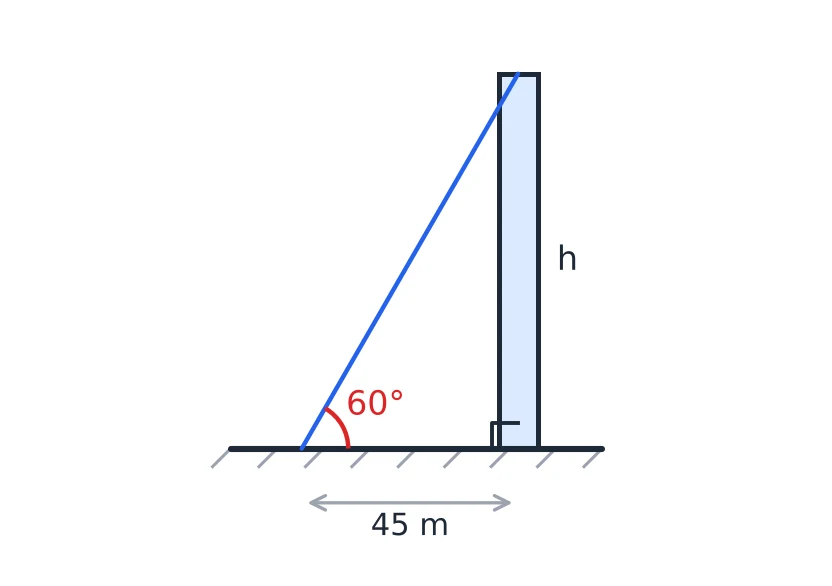
Answer. I put the 60° at the point on the ground, with the height h opposite it and the 45 m next to it. That gives , so , which is (a) m, roughly 78 m. Quick check: the angle is more than 45°, so the tower has to be taller than 45 m. m is only about 26 m, so it cannot be right.
Question 2
From a point on the ground 72 m from the foot of a temple, the angle of elevation of the top of the temple is 30°. What is the height of the temple? (a) m (b) 36 m (c) m (d) 24 m
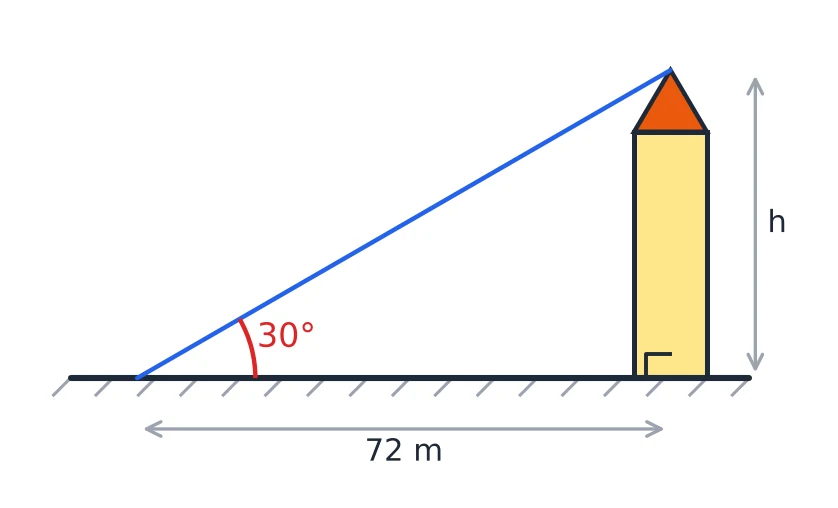
Answer. The height is opposite the 30° and the 72 m is next to it. , so . I multiply the top and the bottom by and get (c) m. With only 30° at my corner, the temple must be shorter than 72 m, so m is out straight away.
Question 3
The angle of elevation of the top of an 18 m pole from a point P on the ground is 60°. How far is P from the foot of the pole? (a) m (b) m (c) 9 m (d) m
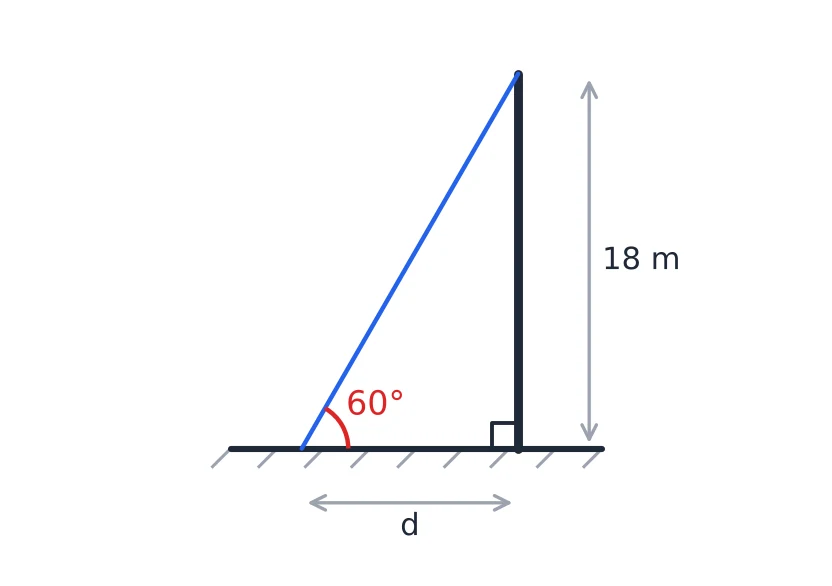
Answer. This time the height is known and the distance d is what I want. , so and (b) m. In the triangle the distance is one part and the pole is parts. m is two parts, the length of the line of sight from P to the top.
Question 4
From a point 33 m from the foot of a water tower, the angle of elevation of its top is 45°. How long is the line of sight from the point to the top of the tower? (a) 33 m (b) 66 m (c) m (d) m
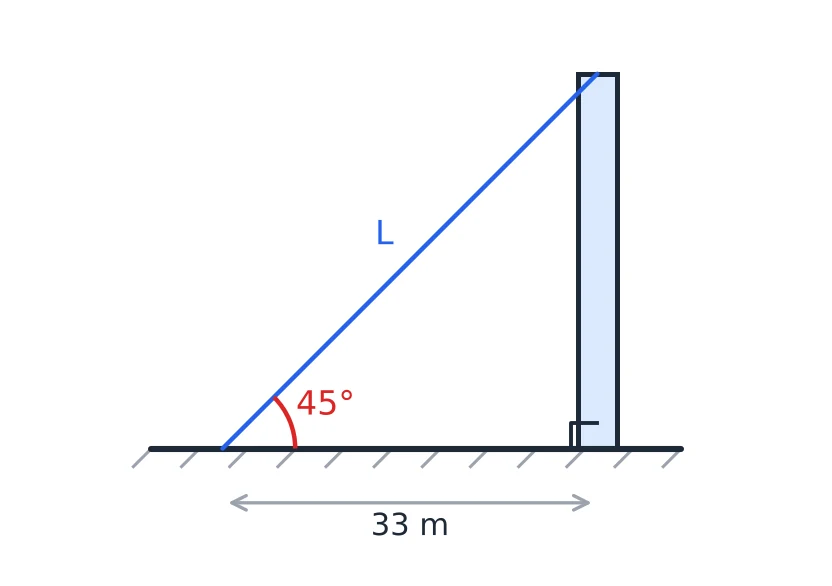
Answer. At 45° the triangle is the one, so the tower is also 33 m tall. The line of sight is the hypotenuse, times a leg: (d) m. The 33 m in the options is the height, which is not what the question wants.
Question 5
The line of sight from a point on the ground to the top of a chimney is 90 m long and makes an angle of 30° with the ground. How tall is the chimney? (a) 45 m (b) m (c) m (d) m
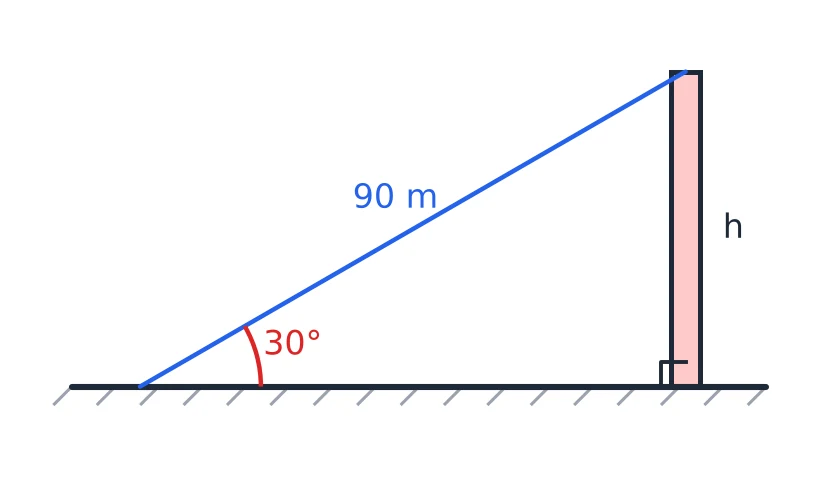
Answer. The 90 m is the hypotenuse, and the height is opposite the 30°, so (a) 45 m. In the picture, 90 m is 2 parts and the height is 1 part. The third side, m, is how far the point is from the chimney.
Question 6
A tower is m tall. A point on the ground is 14 m from its foot. What is the angle of elevation of the top of the tower from the point? (a) (b) (c) (d)
Answer. , and . So the angle is (b) . Turning the fraction upside down would give and 30°, which is why I always put the height on top.
Question 7
The top of a flagpole is 25 m above the ground. The line of sight to it from a point P on the ground is 50 m long. What is the angle of elevation of the top from P? (a) (b) (c) (d)
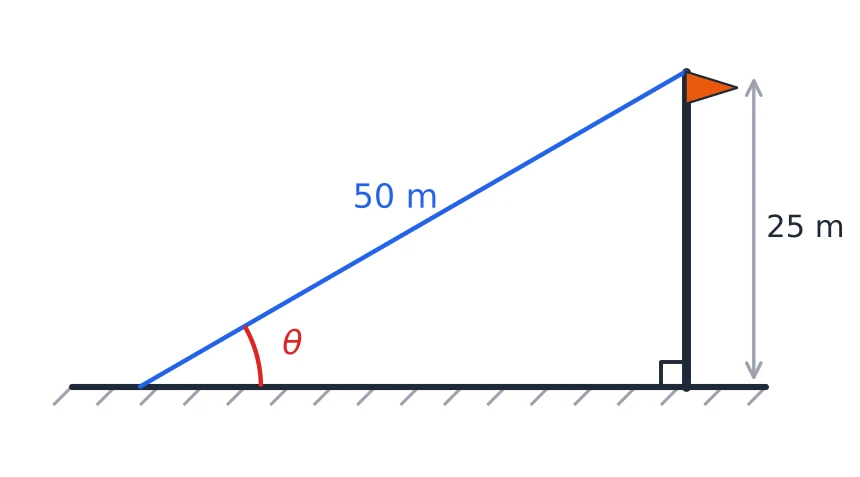
Answer. Height 25 m and hypotenuse 50 m, so and is (c) . A line of sight twice the height always means 30°. Using cos by mistake, , would have given 60°.
Question 8
From a point 48 m from the foot of a building, the angle of elevation of its top is such that . How long is the line of sight from the point to the top of the building? (a) 14 m (b) 62 m (c) 25 m (d) 50 m
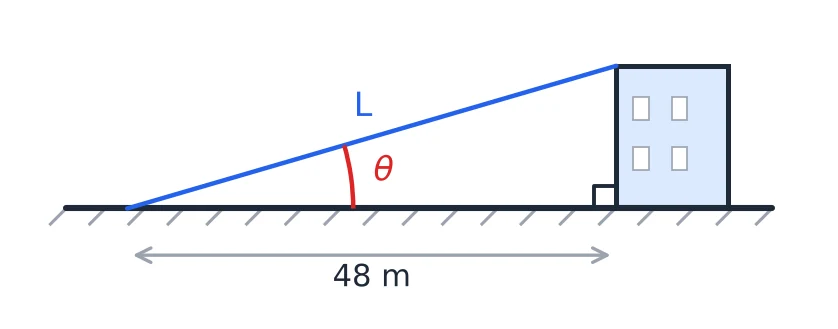
Answer. means height : distance = 7 : 24, and the 7, 24, 25 triplet makes the line of sight 25 parts. The distance 48 m is 24 parts, so one part is 2 m. The building is 14 m tall and the line of sight is 25 × 2 = (d) 50 m. Stopping at 25 m leaves the triplet unscaled.
Question 9
The line of sight from a point on the ground to the top of a tower is 85 m long, and the angle of elevation of the top satisfies . How far is the point from the foot of the tower? (a) 75 m (b) 40 m (c) 80 m (d) 45 m
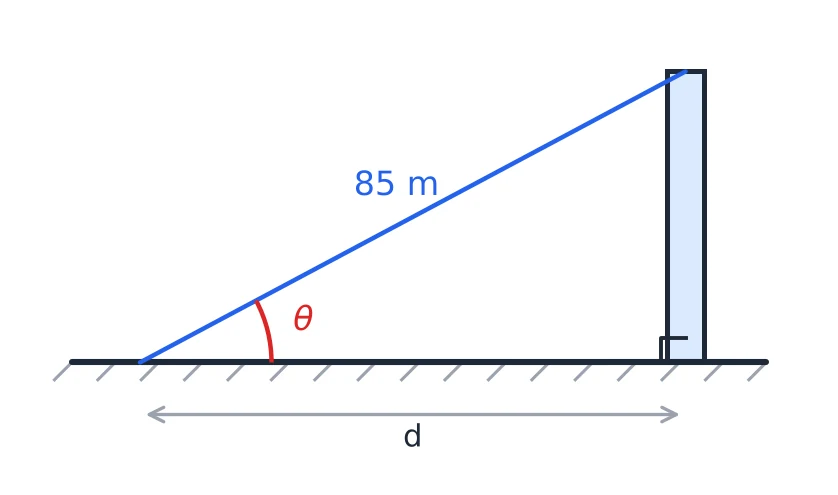
Answer. : the height is 8 parts and the line of sight 17 parts, and from 8, 15, 17 the distance is 15 parts. 85 m is 17 parts, so a part is 5 m. The tower is 40 m high and the distance is 15 × 5 = (a) 75 m. Check: .
Question 10
The angle of elevation of the top of a tower from a point 60 m from its foot is 15°. Taking , what is the height of the tower? (a) m (b) m (c) m (d) m
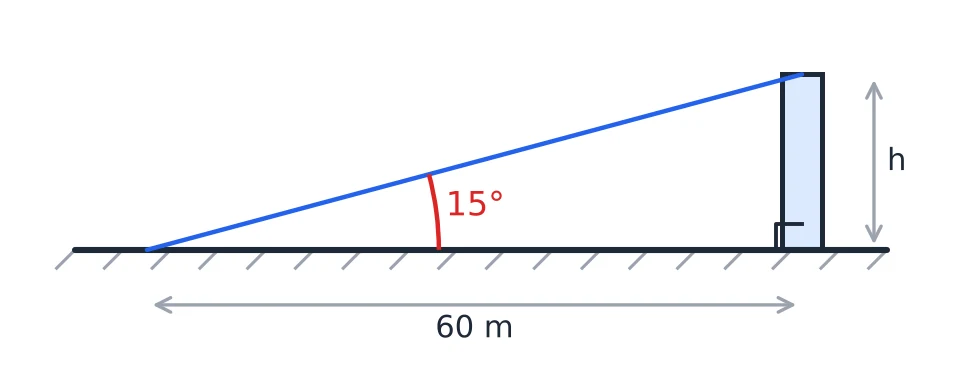
Answer. Height from distance is , whatever the angle. So (c) m. With that is 60 × 0.268, about 16.1 m: a low angle and a short tower for that distance. m would be the height for an angle of 75°.
Question 11
A boy whose eyes are 1.5 m above the ground stands 36 m from a tower. He sees the top of the tower at an angle of elevation of 30°. How tall is the tower? (a) m (b) m (c) m (d) m
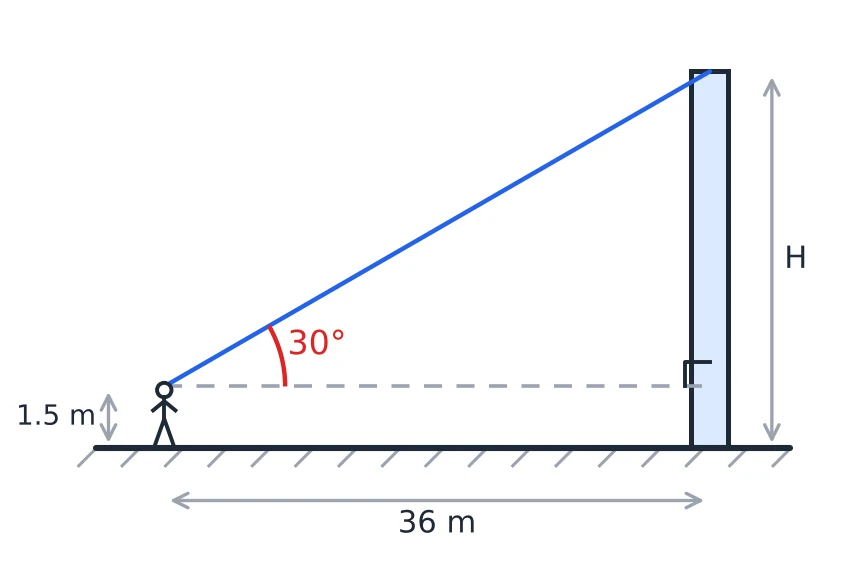
Answer. My triangle starts at his eyes, 1.5 m up. Along that horizontal the tower is 36 m away, so the part of the tower above his eyes is m. Below his eyes there is another 1.5 m of tower, so the whole tower is (d) m, about 22.3 m.
Question 12
A man whose eyes are 1.8 m above the ground sees the top of a 51.8 m tower at an angle of elevation of 45°. How far is he from the tower? (a) 50 m (b) 51.8 m (c) 53.6 m (d) m
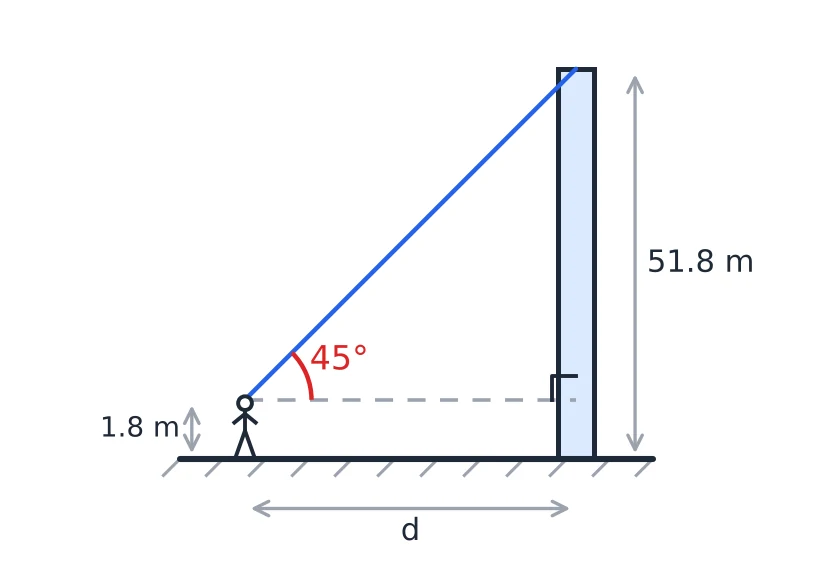
Answer. First I take away his eye height: the top is 51.8 − 1.8 = 50 m above his eyes. At 45° the distance equals that height, so he stands (a) 50 m from the tower. 51.8 m treats the angle as if it were measured from the ground, but it is measured from his eyes.
Question 13
A girl whose eyes are 1.2 m above the ground stands 20 m from a pole. The angle of elevation of the top of the pole from her eyes has . How tall is the pole? (a) 15 m (b) 13.8 m (c) 16.2 m (d) 26.2 m
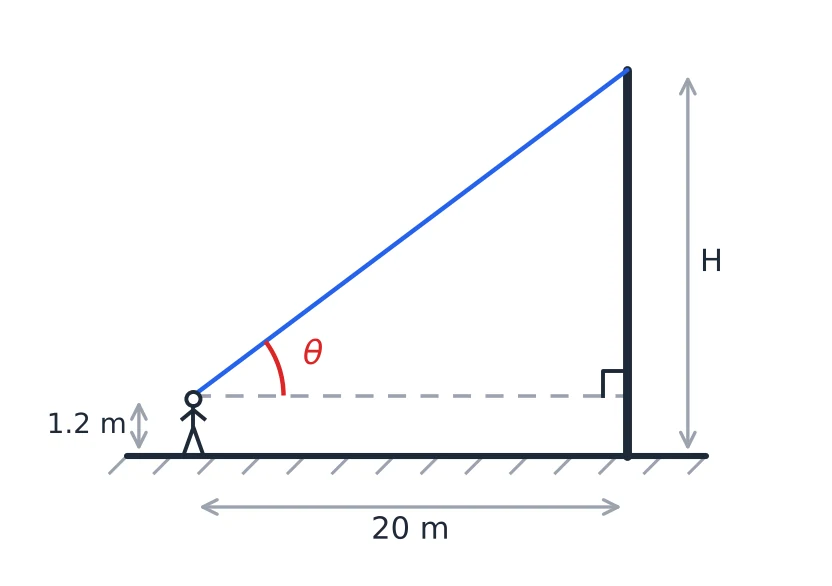
Answer. Above her eyes, height : distance = 3 : 4, and the distance is 20 m, so that part of the pole is m. Adding her eye height, the pole is 15 + 1.2 = (c) 16.2 m.
Question 14
From the top of a cliff 54 m high, the angle of depression of a boat is 30°. How far is the boat from the foot of the cliff? (a) m (b) m (c) 108 m (d) 54 m
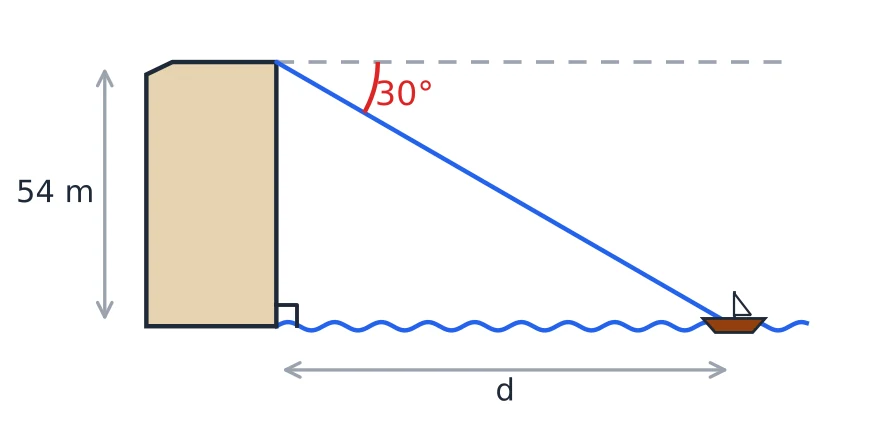
Answer. The angle of depression equals the angle of elevation of the cliff top as seen from the boat, so I put the 30° at the boat. Then , and m. That is (b) m, about 93.5 m. m is what you get if the 30° is put at the top of the cliff, between the cliff face and the line of sight.
Question 15
From the top of a lighthouse, the angle of depression of a ship is 60°. The ship is 40 m from the foot of the lighthouse. How tall is the lighthouse? (a) m (b) m (c) 80 m (d) m
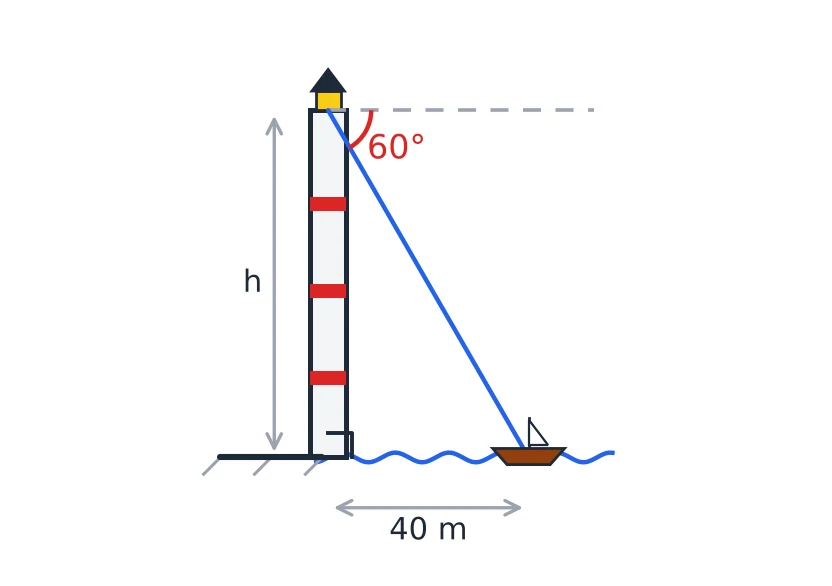
Answer. The 60° goes to the ship's corner. Opposite it is the height h, next to it the 40 m, so (b) m. A 60° depression is steep, so the lighthouse should be a good deal taller than 40 m; this one is about 69 m.
Question 16
From the top of a building 21 m high, the angle of depression of a car on the road is such that . How far is the car from the foot of the building? (a) 35 m (b) 15.75 m (c) 12.6 m (d) 28 m
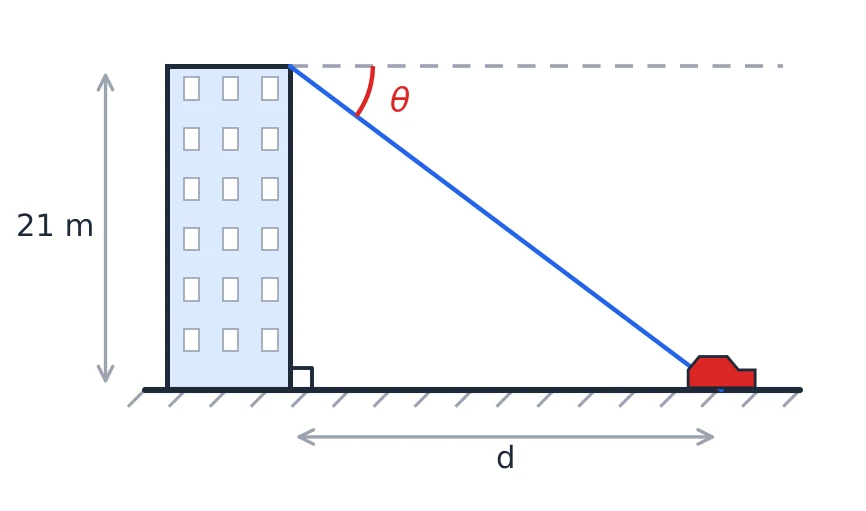
Answer. I move to the car's corner. makes the height 3 parts and the line of sight 5 parts, so the distance is 4 parts (the 3, 4, 5 triangle). The height 21 m is 3 parts, a part is 7 m, and the car is 4 × 7 = (d) 28 m away. 35 m is the line of sight from the roof to the car.
Question 17
From the top of a 50 m building, the line of sight to a car on the road makes an angle of 30° with the wall of the building. How far is the car from the foot of the building? (a) m (b) m (c) 25 m (d) 100 m
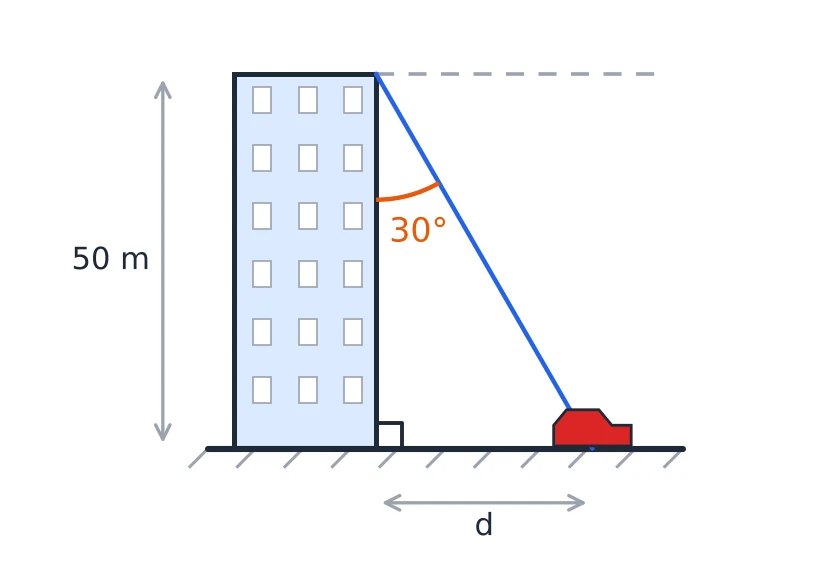
Answer. The 30° is measured from the wall, which is vertical, so it is not the angle of depression. The angle of depression is 90° − 30° = 60°, and the angle at the car is 60° too. Then gives (a) m, about 28.9 m. Working at the top gives the same: . Taking 30° as the depression would put the car m away.
Question 18
From the top of a cliff 36 m high, the straight-line distance to a boat on the sea is 72 m. What is the angle of depression of the boat? (a) (b) (c) (d)
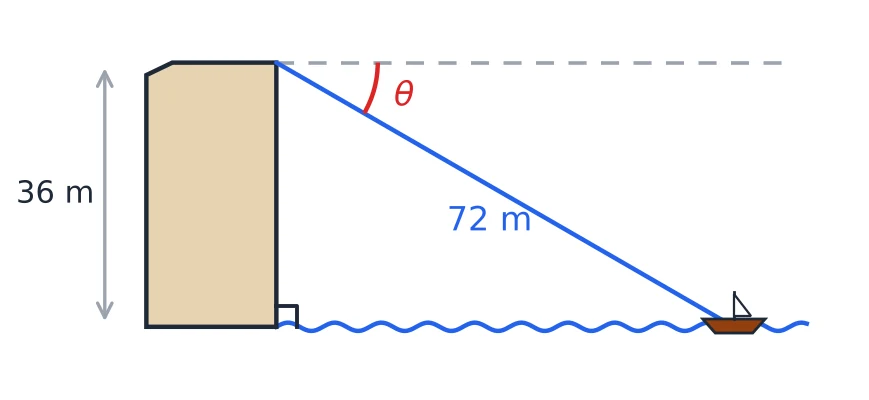
Answer. The 72 m is the line of sight, the hypotenuse, and it is exactly twice the height. So the angle at the boat has , which makes it 30°. The angle of depression equals the angle at the boat: (d) .
Question 19
From the top of a lighthouse, a boat is seen at an angle of depression of 45°. The straight-line distance from the top of the lighthouse to the boat is m. How tall is the lighthouse? (a) m (b) 130 m (c) 65 m (d) m
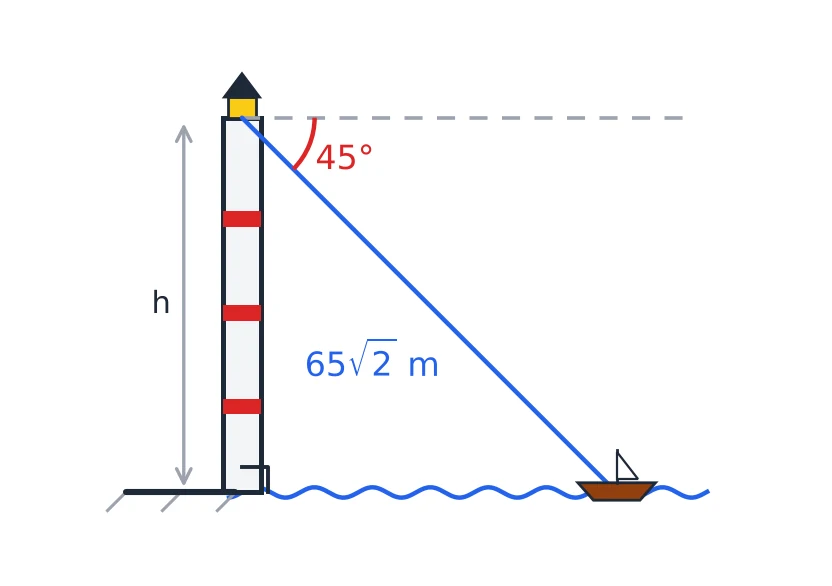
Answer. At 45° the height and the distance are equal, and the line of sight is times either. So the height is (c) 65 m, and the boat is 65 m from the foot as well.
Question 20
From the top of an 80 m tower, the angle of depression of a car on the road is 60°. How far is the car from the foot of the tower? (Take and give the answer to two decimal places.) (a) 138.56 m (b) 46.19 m (c) 92.38 m (d) 40.00 m
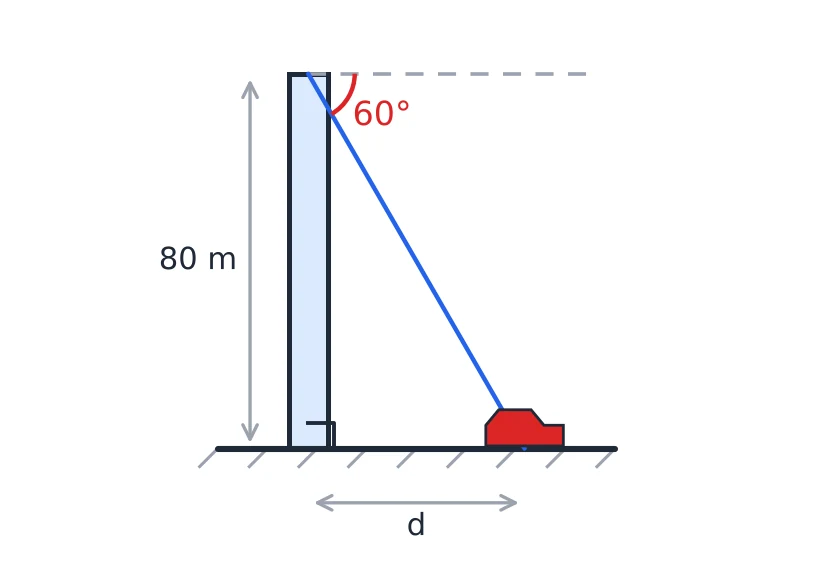
Answer. The 60° sits at the car, so . Now I put in the value: , which rounds to (b) 46.19 m. 138.56 m is , what you get with tan and cot swapped.
Question 21
A small aeroplane flying at a height of 900 m sees a helipad on the ground at an angle of depression of 30°. What is the straight-line distance between the aeroplane and the helipad? (a) m (b) m (c) 450 m (d) 1800 m
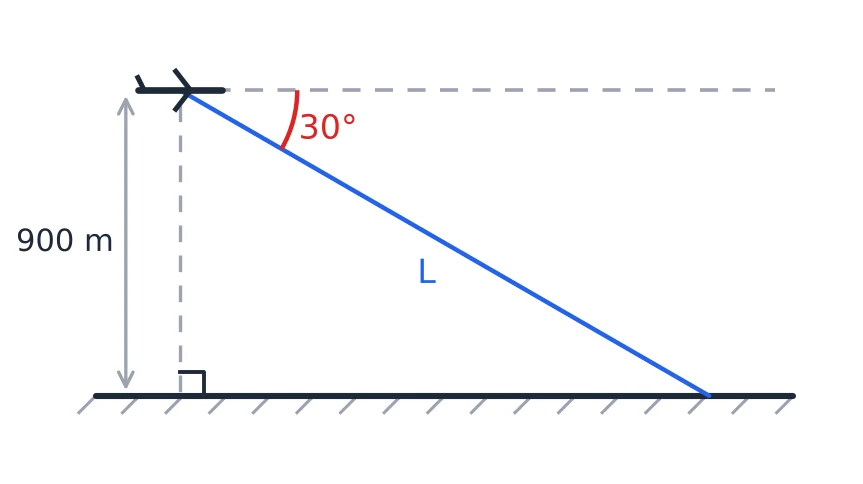
Answer. The height 900 m is opposite the 30° at the helipad, and the straight-line distance is the hypotenuse. In the triangle the height is 1 part, so the hypotenuse is 2 parts: (d) 1800 m. m is the distance along the ground to the point under the plane.
Question 22
A balloon is 250 m above the ground. From the balloon, the angle of depression of a point P on the ground is 30°. How far is P from the point on the ground directly below the balloon? (Take .) (a) 144.33 m (b) 500 m (c) 433 m (d) 216.5 m
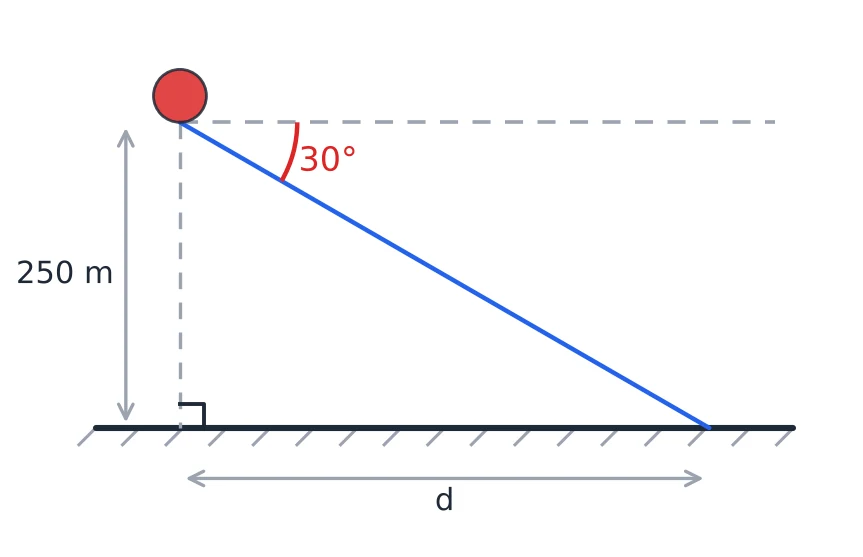
Answer. The angle at P is 30°, the height 250 m is opposite it and the distance I want is next to it. (c) 433 m. A 30° depression is a gentle slope, so P has to be well over 250 m away.
Question 23
A man stands at the edge of a cliff 48 m high. His eyes are 1.6 m above the top of the cliff, and he sees a boat at an angle of depression of 30°. How far is the boat from the foot of the cliff? (a) m (b) m (c) m (d) m
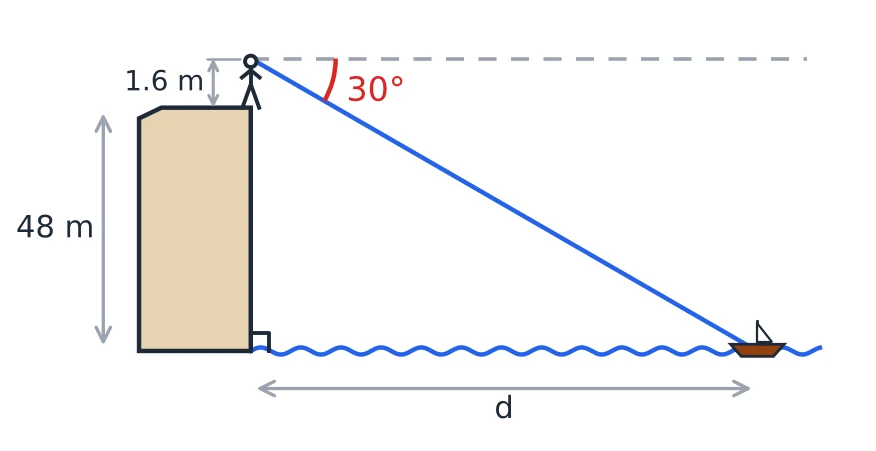
Answer. His eyes are 48 + 1.6 = 49.6 m above the sea, and the 30° is measured from the horizontal through his eyes. So the height in my triangle is 49.6 m, and (b) m, about 85.9 m.