
Two Points on the Same Side
With one angle you need one length to find a height (see Angles of Elevation and Depression). Many questions give two angles instead. A man looks at the top of a tower, walks straight towards it, and looks again. The question tells you how far he walked, not how far either point is from the tower.
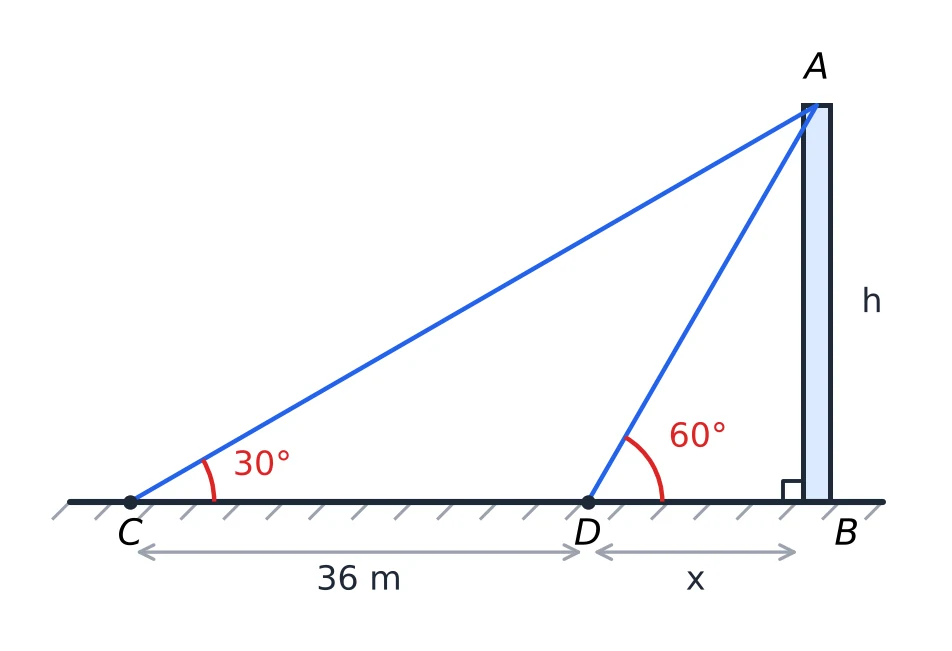
Call the tower AB, with A the top and B the foot, the first point C and the second point D. The nearer point always sees the top at the bigger angle. Neither triangle ABC nor ABD has two known lengths, so neither can be solved alone. What they share is the height AB = h, so write each distance from the foot in terms of h:
where is the angle at C and the angle at D. The walk is the difference:
With numbers. The angle changes from 30° to 60° after a walk of 36 m. Then and , so
The tower is m high, about 31.18 m.
The same question with x. Many students prefer to call the shorter distance x, as in the figure. Triangle ABD gives , and triangle ABC gives . Equating the two, 3x = x + 36, so x = 18 and m again. Use whichever route you find easier. Once h or x is known, the rest follows: D is 18 m from the foot and C is 18 + 36 = 54 m from it.
Read carefully what the question gives. Walks 36 m towards the tower is the gap CD. Stands 36 m from the tower is BC or BD, and that is a one-angle question.
The 30° and 60° Pair: the Walk Is Twice the Distance Left
When the angles are 30° and 60°, the distances from the foot are and . The first is exactly three times the second. So if the man still has x to go, he started 3x away and has walked 2x:
the distance walked is twice the distance still left to the foot.
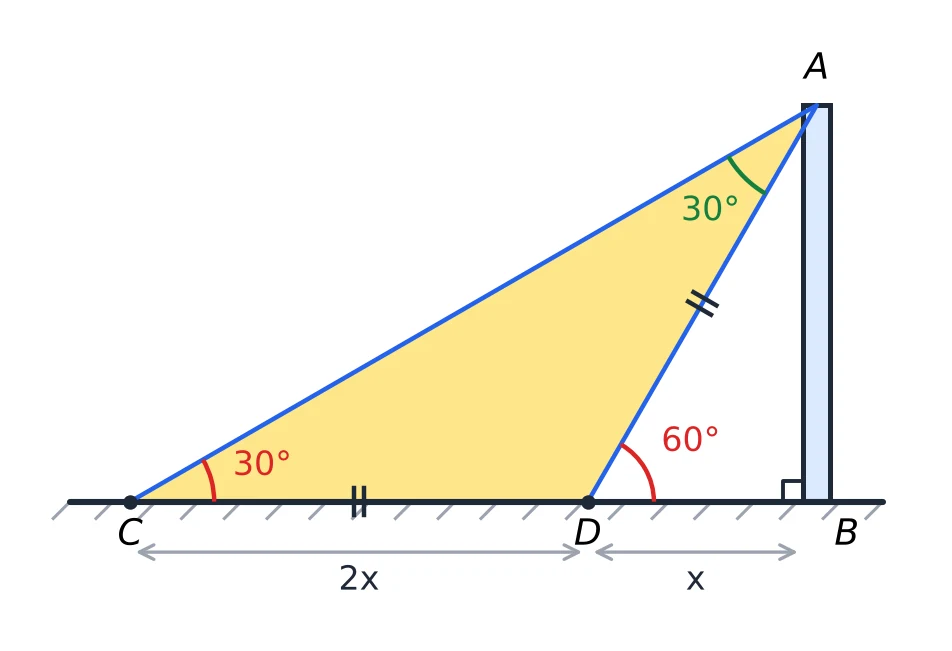
There is also a reason you can see in the picture. In triangle ACD the angle at C is 30°. The angle ADB = 60° is an exterior angle of triangle ACD, so it equals the sum of the two interior opposite angles: , which gives . Triangle ACD has two angles of 30°, so it is isosceles and AD = CD. The line of sight from D is exactly as long as the walk. Then in the right triangle ABD,
So with 30° and 60° every length comes from the walk in one line. For a walk of 50 m:
| Length | Value |
|---|---|
| distance left, BD | 25 m |
| first distance, BC | 75 m |
| line of sight from D, AD | 50 m |
| line of sight from C, AC | m |
| height, AB | m |
The rule works backwards too. If the man is 25 m from the foot when the angle is 60°, and it was 30° earlier on the same line, he walked 50 m.
The pair also gives the ratio of the two distances from the foot, 3 : 1, and the ratio of the two lines of sight, AC : AD = .
Other Pairs: 30° and 45°, 45° and 60°
The subtraction works for any pair; only the cot values change.
| Angles (far, near) | Height for a walk d | |
|---|---|---|
| 30°, 60° | ||
| 30°, 45° | ||
| 45°, 60° |
To clear the root from the bottom, multiply top and bottom by , since .
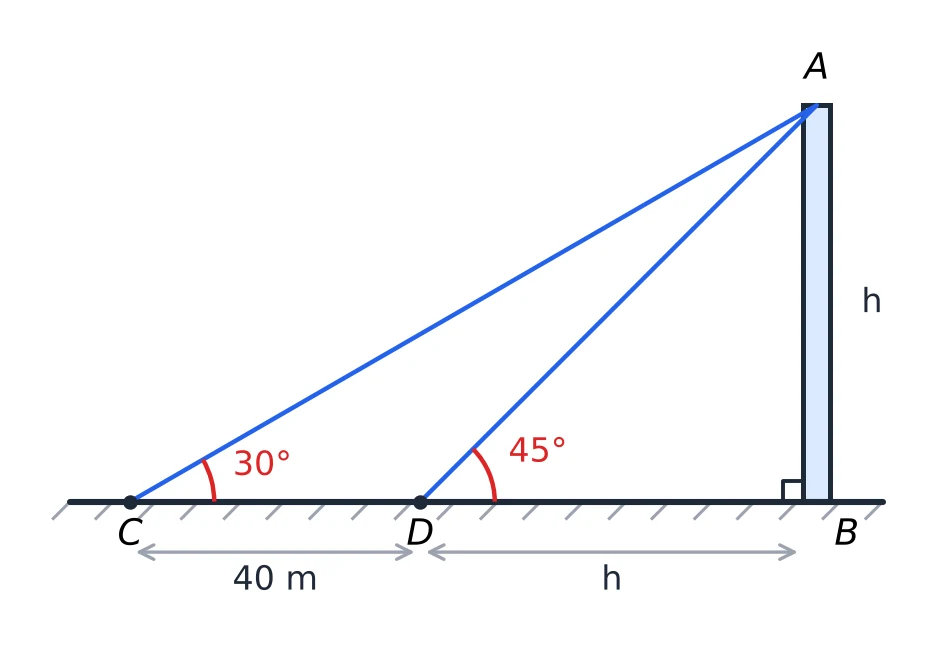
30° to 45° after a 40 m walk. At D the angle is 45°, so BD = h: the height and the distance left are equal. Then BC = h + 40, and triangle ABC gives
With that is 20 × 2.732 = 54.64 m.
45° to 60° after a 30 m walk. Now the first point is h from the foot and the second is , so , which gives m, that is m or about 70.98 m.
Put in the decimal value of only at the last step. In the first example, rounding to 0.7 too early gives 57.14 m instead of 54.64 m, which is far enough off to land on a wrong option.
Two Points on Opposite Sides
Now the tower stands between the two points: one observer is in front of it and the other behind it, or two ships lie on either side of a lighthouse. The distances from the foot add instead of subtracting:
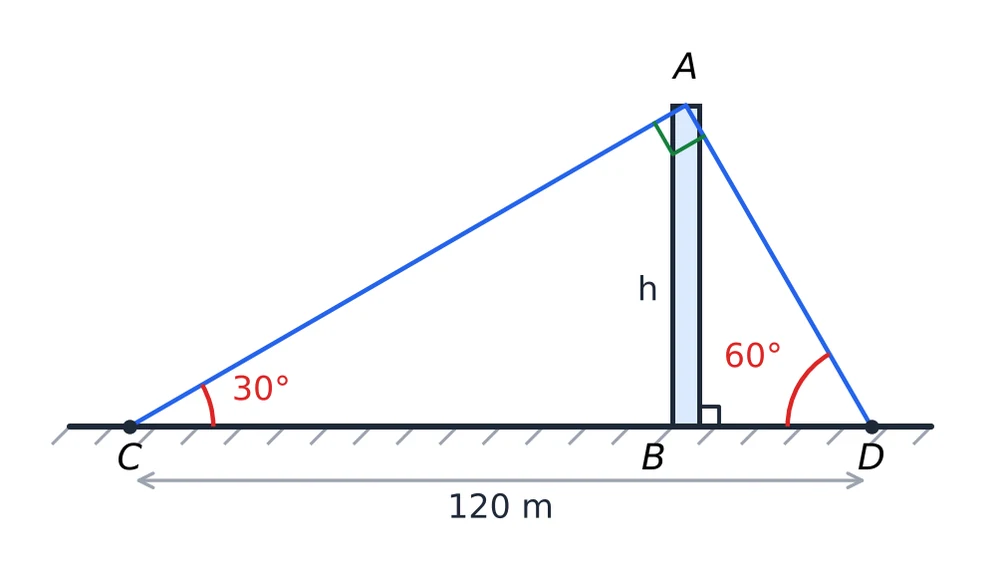
With numbers. From C on one side the angle is 30°, from D on the other side it is 60°, and C and D are 120 m apart. Then
So the tower is m high, and the feet distances are BD = 30 m and BC = 90 m. With 30° and 60° on opposite sides the gap is , and the height is of the gap.
Two quick cases. With 45° on both sides each point is h from the foot, so the gap is 2h. With 30° and 45° the gap is ; for a gap of 150 m, m, about 54.9 m.
The angles at C and D in the figure add up to 90°, so the angle CAD at the top is a right angle (marked in green). That fact comes back with complementary angles below.
[SSC Tip] Look for the words on the same side, on opposite sides, on either side or between. With the same numbers the two readings give different heights: for 30°, 60° and a gap of 120 m, the same side gives m and opposite sides give m. Expect both values as choices.
Complementary Angles:
Two points are a and b metres from the foot of a tower, on the same straight line through the foot, and the two angles of elevation add up to 90°. Then the height is the square root of the product of the distances:
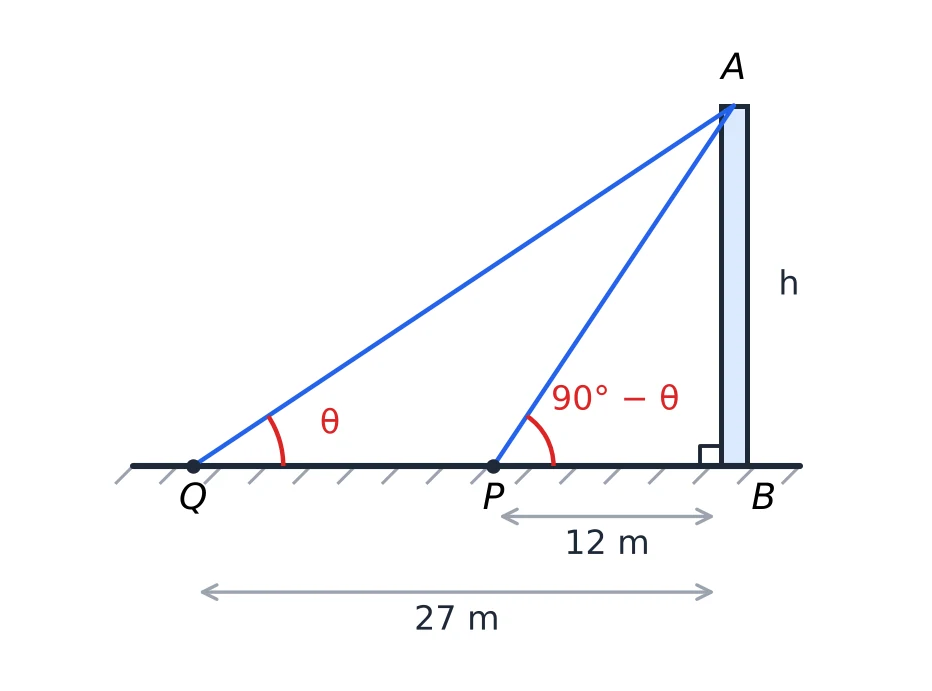
Why. Let the angle at the far point Q be , so the angle at the near point P is . The two triangles give and . But (complementary angles, see Chapter 15). So , which gives .
With the figure's numbers, m. You never need itself.
Points on opposite sides. The proof did not use the side, so still holds when the tower stands between the points. On opposite sides the two base angles add to 90°, so the angle at the top is 90°.
Going the other way. If the tower is 20 m high and one point is 16 m from the foot, the point where the angle is the complement is m from the foot, on the same line.
When the angles are asked. Find h first. With a = 4 m and b = 12 m, m, so at the far point and ; the near angle is 60°.
The height is not the average of the two distances. For 12 m and 27 m the average is 19.5 m: close to 18 m, and wrong.
Finding an Angle, and the Angle That Doubles
An angle from two distances. Find the height from the first triangle, then the second angle from the second triangle. From a point 84 m from the foot the elevation is 30°, so m. After walking 56 m towards the tower the man is 28 m from the foot, and , so .
Ratios of distances. The distances from the foot are and , so their ratio is and the height cancels. For 30° and 60° it is . For 30° and 45°, and also for 45° and 60°, it is .
The angle that doubles. Sometimes the angle at the far point C is and the angle at the near point D is , with pairs such as 15° and 30° or 22.5° and 45°, whose tangents you are not expected to know. Use the exterior angle again: , so . Triangle ACD has two equal angles, so AD = CD.
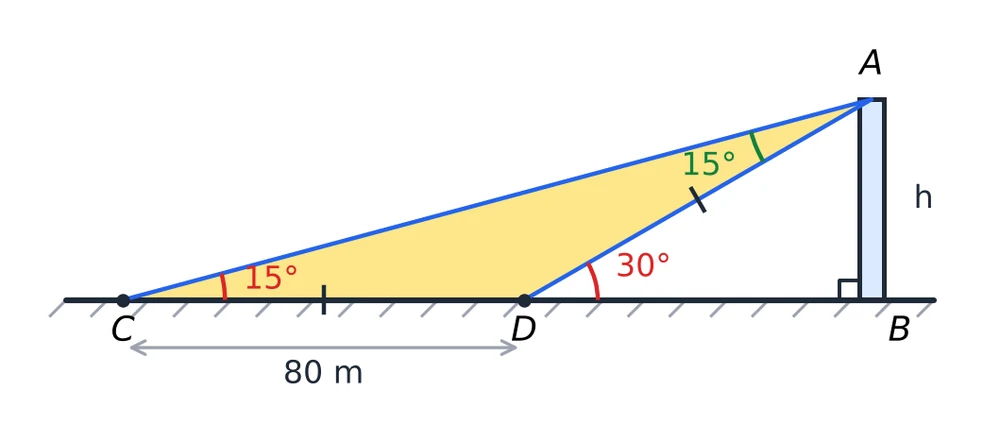
Triangle ABD now has the hypotenuse AD = CD and the angle at D, so
For 15° and 30° with a walk of 80 m, m. For 22.5° and 45° with a walk of 60 m, m. No value of is needed. The 30°-to-60° rule is this same fact with .
Two Boats or Two Cars Seen from One Tower
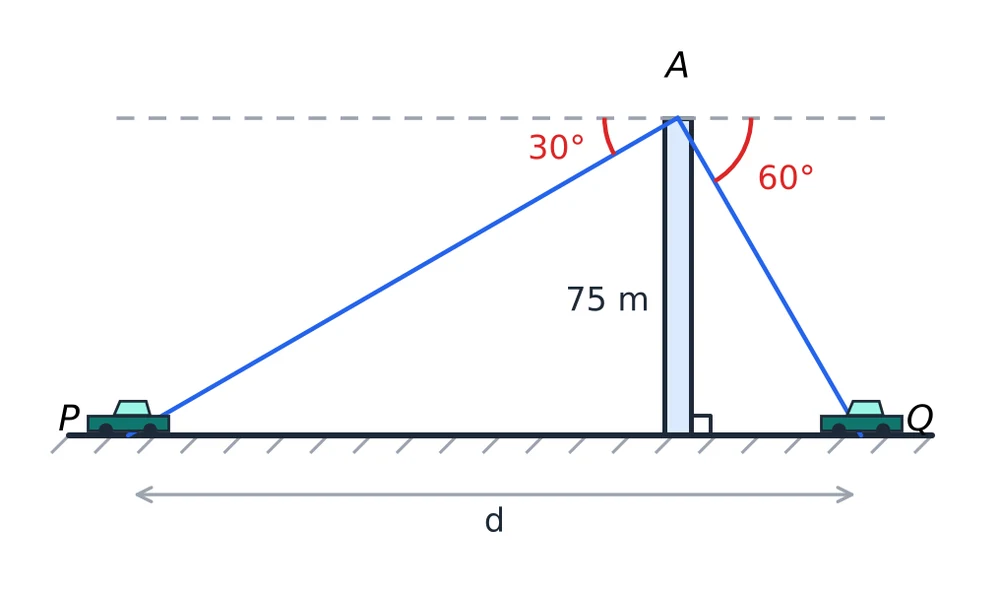
Now the observer is at the top. From the top A of a cliff of height h, two boats P and Q are seen at angles of depression and . The angle of depression at A equals the angle of elevation of A seen from each boat (alternate angles, see Angles of Elevation and Depression), so the picture is the two-point figure turned round and the same formulas apply:
- boats on the same side: , where , the bigger angle, belongs to the nearer boat
- boats on opposite sides:
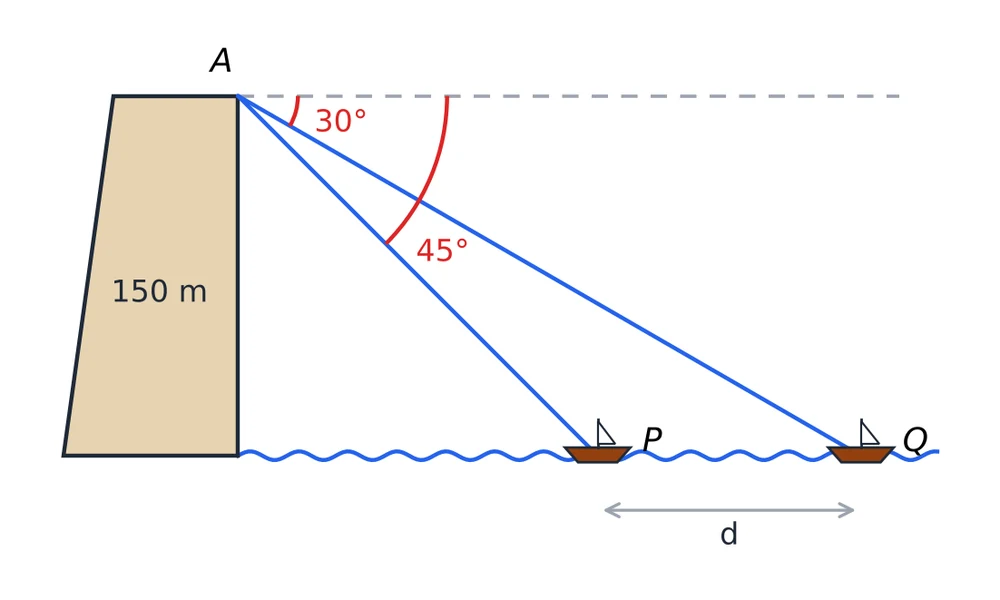
Same side. The cliff is 150 m high and the depressions are 30° and 45°. The nearer boat is 150 m from the foot (45°) and the farther one is m from it, so the boats are m apart, about 109.8 m.
Opposite sides. From the top of a 75 m tower, two cars on opposite sides of it, in a straight line with its foot, are seen at depressions of 60° and 30°. Their distances from the foot are m and m, so they are m apart.
The same figure answers how far one boat has moved when it is seen twice: first at 30° and later at 45°, a boat has come m closer to this cliff. Add a time and it becomes a speed question, which comes next.
[SSC Tip] The angle of depression is measured down from the horizontal through the eye, never from the vertical face of the cliff. If a question says the line of sight makes 60° with the cliff or the tower, the angle of depression is 30°.
An Aeroplane at a Fixed Height
An aeroplane flying horizontally stays at the same height h. An observer O on the ground sees it at an angle of elevation of 60°, and t seconds later at 30°. Drop perpendiculars PM and QN from the two positions to the ground. Both are equal to h, and the distance flown, PQ, equals MN.
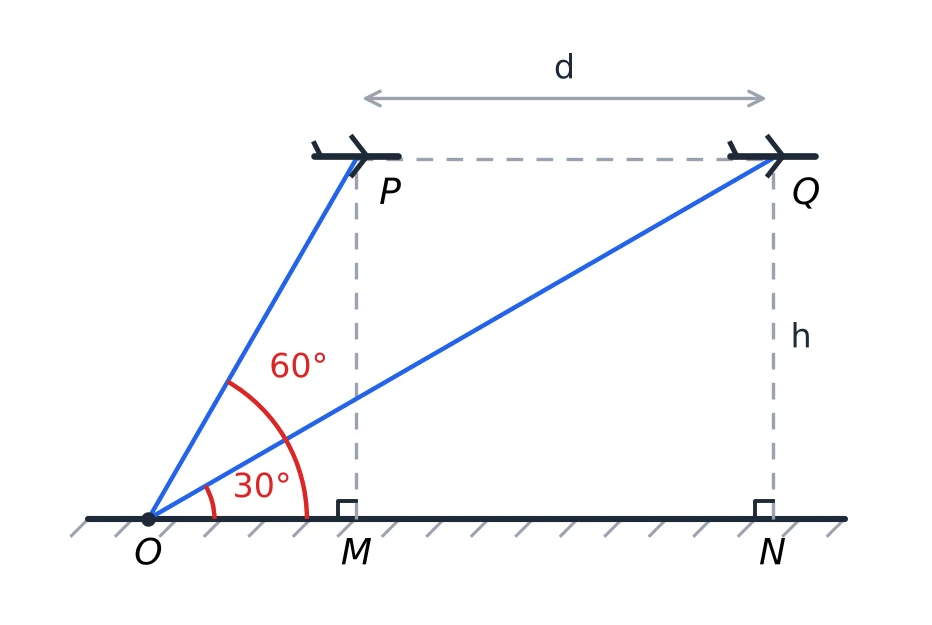
The two triangles give and , so
It is the same-side formula again, with the height now standing above the two points instead of below them. The speed is .
With numbers. The height is m and the angle falls from 60° to 30° in 12 seconds. Then OM = 900 m, ON = 2700 m, PQ = 1800 m and the speed is m/s.
Changing units. 1 m/s = 3.6 km/h (Chapter 10). To go from m/s to km/h multiply by ; to go back multiply by . So 150 m/s = 150 × 3.6 = 540 km/h.
Height from the speed. Turn it round. A plane flying at 720 km/h, which is 200 m/s, is seen at 60° and, 10 seconds later, at 30°. It flew 2000 m, so and m.
If the plane passes over the observer's head between the two sightings, the two positions are on opposite sides of O and the distances add: .
[SSC Tip] Check which unit the options use before you divide. Metres divided by seconds gives m/s; an option of 150 km/h beside the right answer, 540 km/h, is the unit change left out.
A Car or Boat Moving Towards a Tower
From the top of a tower, a car on a straight road leading to its foot is seen at an angle of depression , and some time later at . The car is coming towards the tower, so is bigger than . The question asks for its speed, or for the time it still needs to reach the foot.
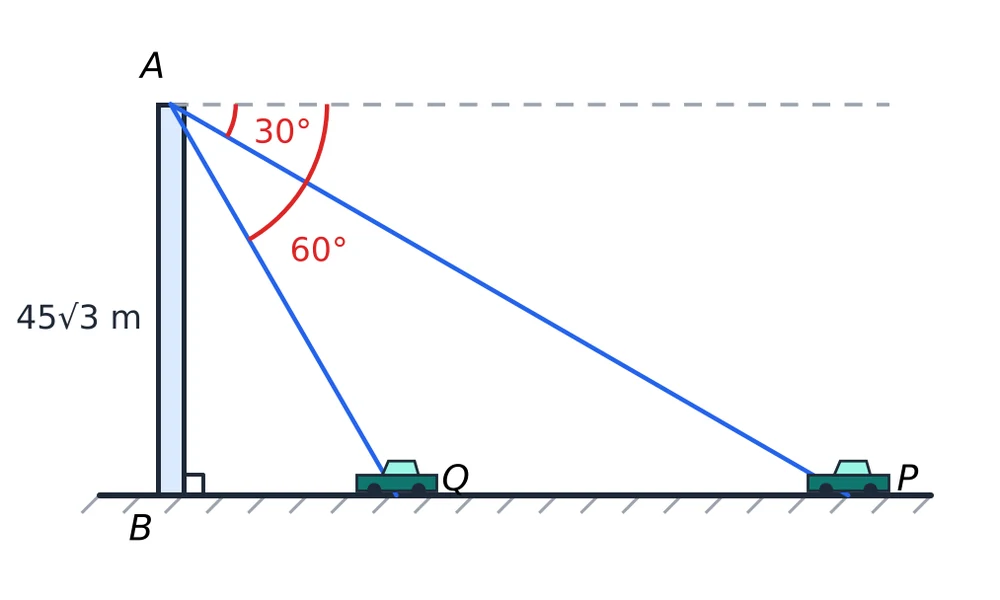
Speed. The distance covered is , as for two boats. If the tower is m high and the depression changes from 30° to 60° in 6 seconds, m. The speed is 15 m/s, or 54 km/h.
Time still needed. At a steady speed, time is in proportion to distance, so the height is not needed at all:
| Depression changes | Distance left : distance covered | Time left |
|---|---|---|
| 30° to 60° | 1 : 2 | |
| 30° to 45° | ||
| 45° to 60° |
So a car that takes 14 minutes to go from 30° to 60° needs 7 more minutes. A boat that goes from 30° to 45° in 10 minutes needs minutes more, about 13.66 minutes. That is longer than it has already taken, because at 45° the boat is still a full height away from the cliff. The last two rows match because in both the distance covered is times the distance left.
Read whether the question wants the time still needed or the total time from the first sighting. For 30° to 60° in 14 minutes they are 7 and 21 minutes.
A Balloon Rising, and a Man Walking Towards a Tower
A balloon. A balloon rises straight up from a point B at a steady speed, and an observer O stands d metres from B. This time the horizontal distance stays fixed and the height changes, so work with tan:
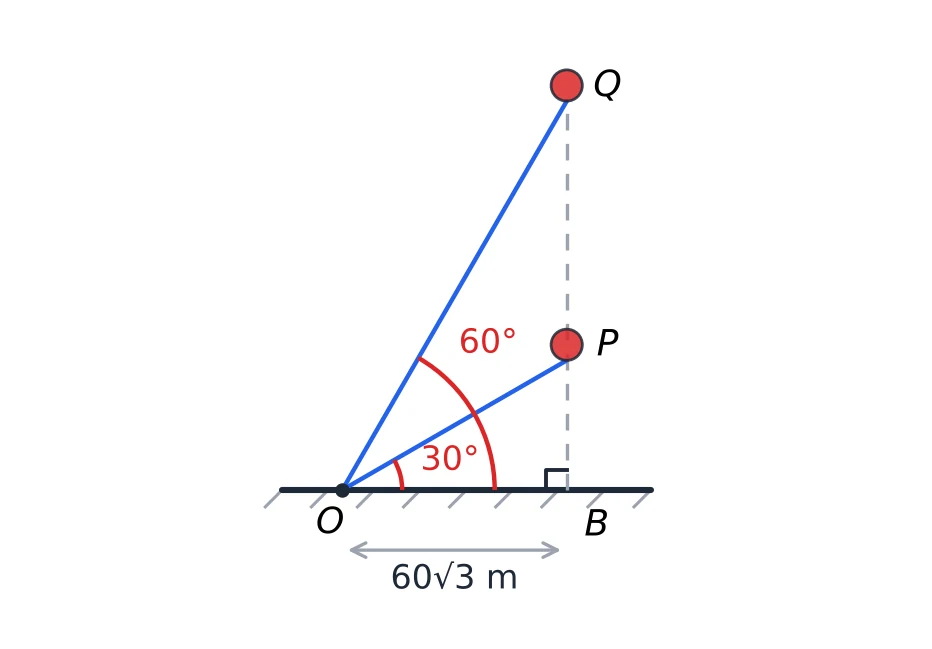
The observer is m from B and the elevation changes from 30° to 60°. The heights are m and m, so the balloon rose 120 m. At 3 m/s that took 40 seconds. Dividing 180 m by the speed would treat the balloon as if it had left the ground at the first sighting.
A man walking towards a tower. This is the same-side figure with two extras: his speed links the walk to the time, and his eyes are above the ground. The angles are measured at his eye, so the triangles stop at eye level and his eye height is added at the end (see Angles of Elevation and Depression).
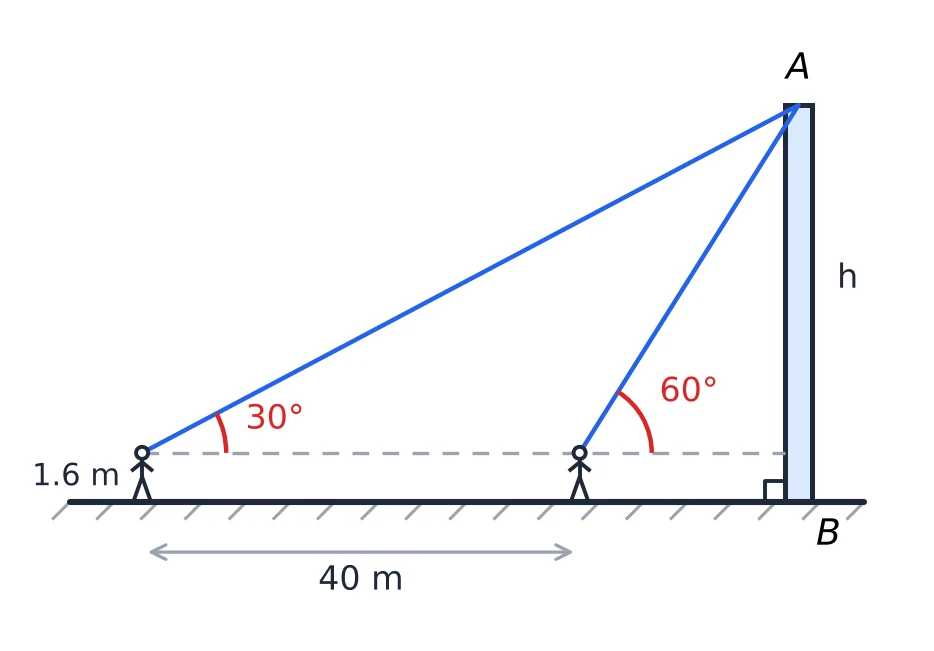
His eyes are 1.6 m above the ground and the angle changes from 30° to 60° after a walk of 40 m. Above eye level the height is m, so the tower is m high, about 36.24 m.
If he walks at 3.6 km/h, which is 1 m/s, the 40 m walk took 40 seconds, and by the 30°-to-60° rule he reaches the tower 20 seconds later.
Solved Examples
Question 1
A man standing on level ground sees the top of a tower at an angle of elevation of 30°. He walks 60 m straight towards the tower and the angle becomes 60°. What is the height of the tower? (a) m (b) m (c) m (d) 30 m
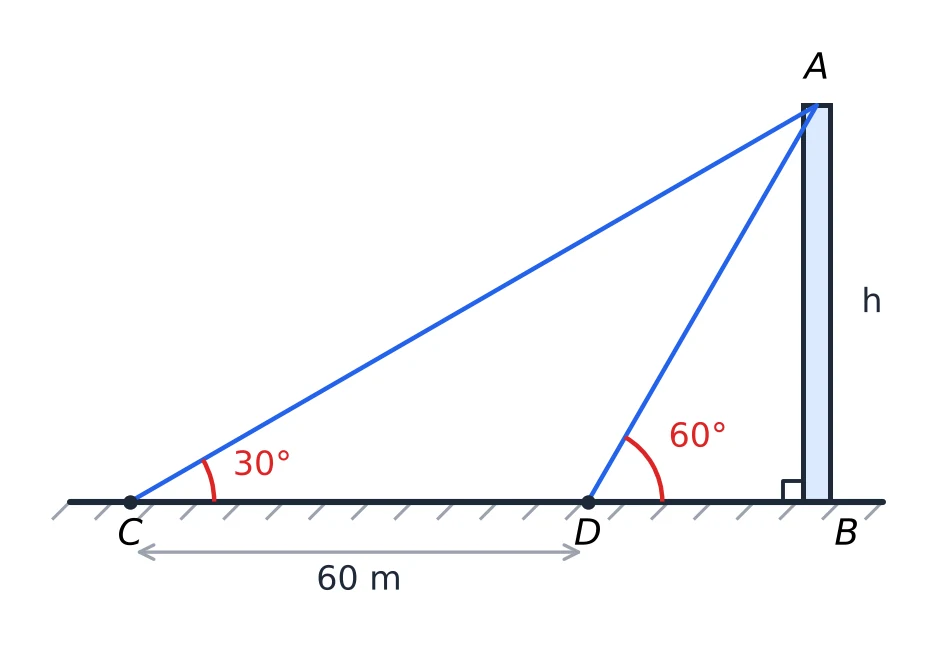
Answer. I draw the tower with both points on one side of it. With 30° and 60° the walk is twice the distance left, so the man is now 30 m from the foot. From the 60° triangle, m. So the height is (b) m. To check, the first point is 90 m away and , the same.
Question 2
From a point on the ground the angle of elevation of the top of a pillar is 30°. On walking 52 m towards the pillar, the angle becomes 60°. How far is the man now from the foot of the pillar? (a) 52 m (b) 78 m (c) m (d) 26 m
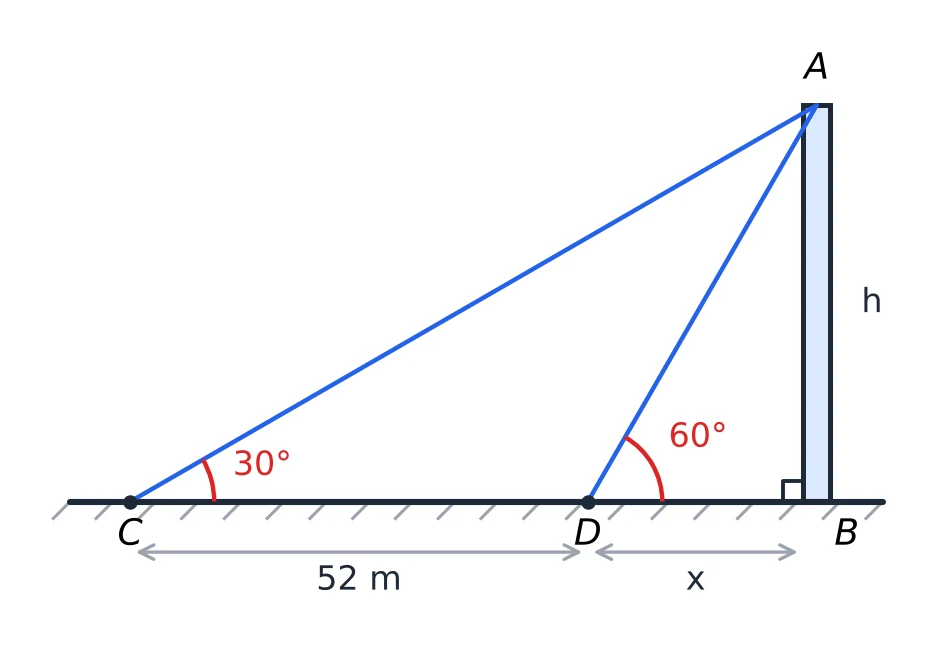
Answer. Say he is now x m from the foot. In the 60° triangle the height is . In the 30° triangle the height is . Setting them equal gives 3x = x + 52, so x = 26. He is (d) 26 m from the foot. That is half the walk, as the 30°-to-60° rule says; 78 m is where he started.
Question 3
The angle of elevation of the top of a tower changes from 45° to 60° when an observer walks 20 m towards it. Find the height of the tower. (Take ) (a) 47.32 m (b) 27.32 m (c) 34.64 m (d) 54.64 m
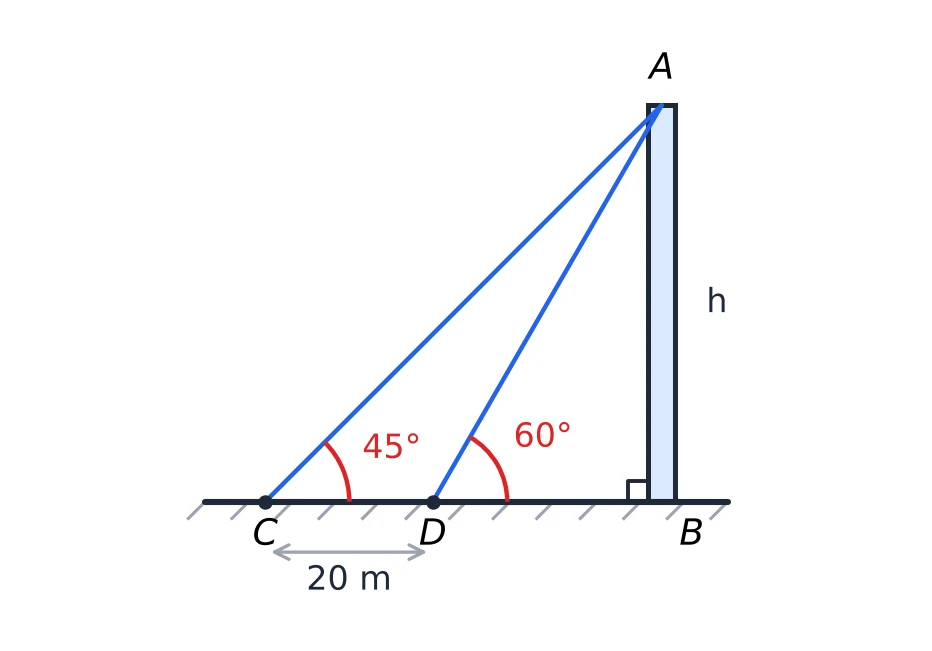
Answer. At the 45° point the distance from the foot equals the height h, and at the 60° point it is . The walk is the difference: , so and . Multiplying top and bottom by gives , which is (a) 47.32 m.
Question 4
A man on level ground sees the top of a building at an angle of elevation of 30°. After walking 100 m towards it, he sees the top at 45°. The height of the building is (a) m (b) m (c) m (d) m
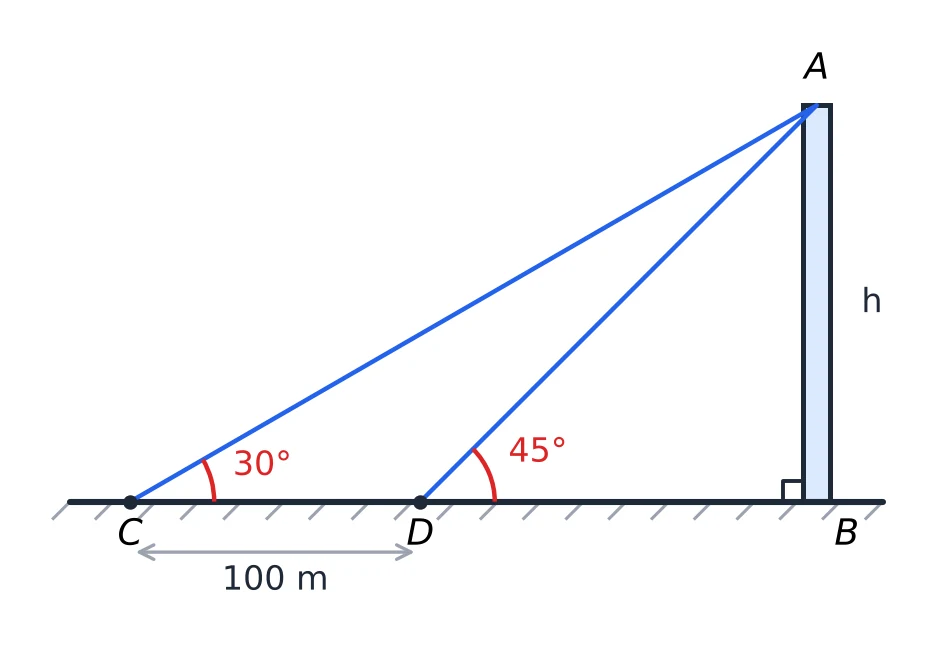
Answer. At 45° the distance left equals the height h. So the first point is h + 100 from the foot, and . That gives , so , which is (c) m, about 136.6 m. Rationalising with the wrong sign gives m, about 36.6 m.
Question 5
Two men on opposite sides of a tower measure the angles of elevation of its top as 30° and 60°. If the men are 200 m apart, the height of the tower is (a) m (b) m (c) 50 m (d) m
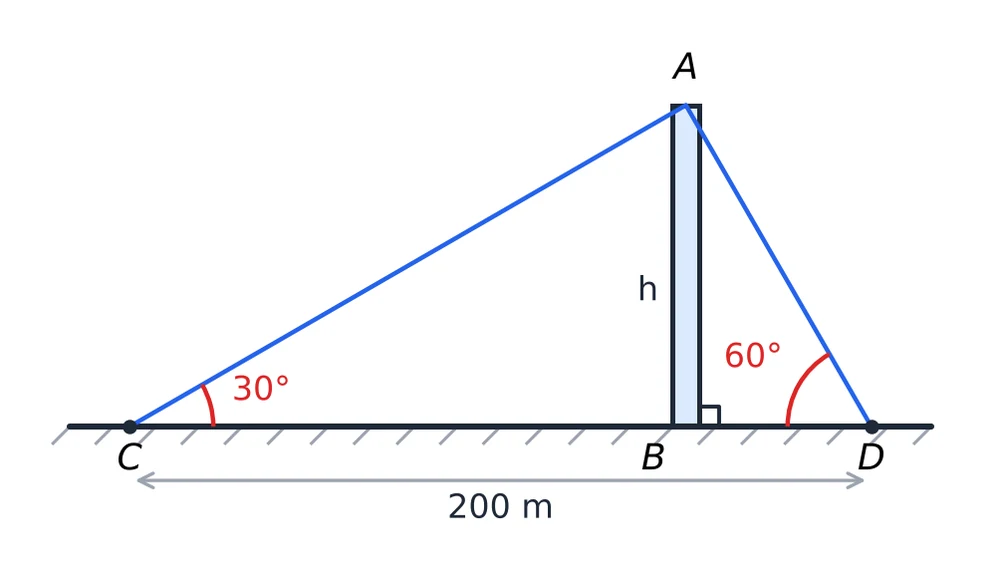
Answer. The tower is between them, so their distances from the foot add up to 200 m. These distances are (30°) and (60°): , so . The height is (a) m. Had the men stood on the same side, the answer would have been m.
Question 6
A tower 24 m high stands between two points C and D on level ground, all in one straight line. The angles of elevation of its top from C and D are 45° and 60°. How far apart are C and D? (a) m (b) m (c) 48 m (d) m
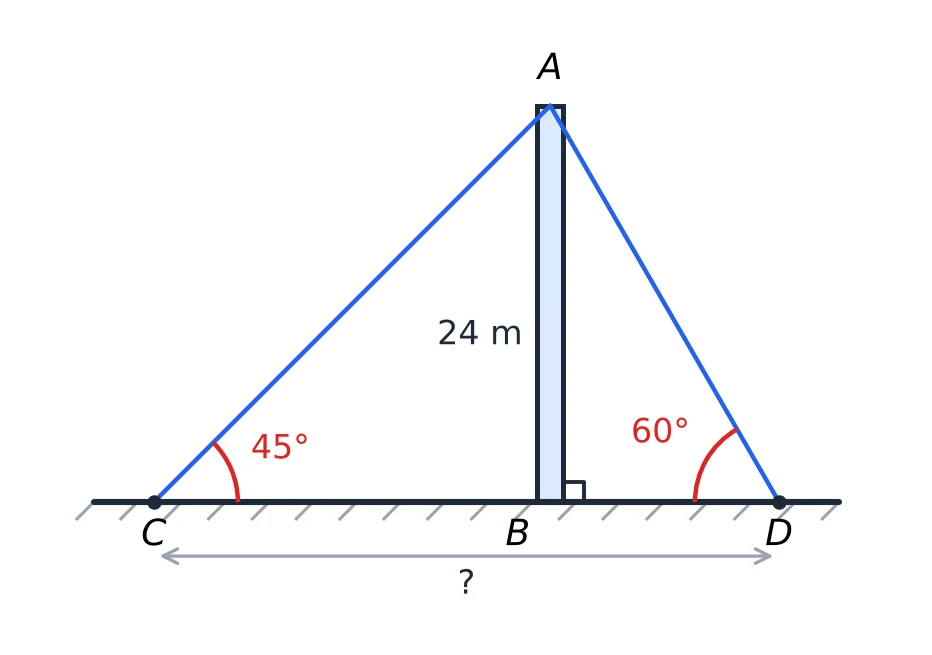
Answer. From C (45°) the distance to the foot equals the height, 24 m. From D (60°) it is m. The tower is between the points, so I add: m, which is (d) m, about 37.9 m.
Question 7
Two points P and Q are 4 m and 25 m from the foot of a tower, on the same straight line through the foot. The angles of elevation of the top of the tower from P and Q are complementary. The height of the tower is (a) 14.5 m (b) 10 m (c) 21 m (d) 12.5 m
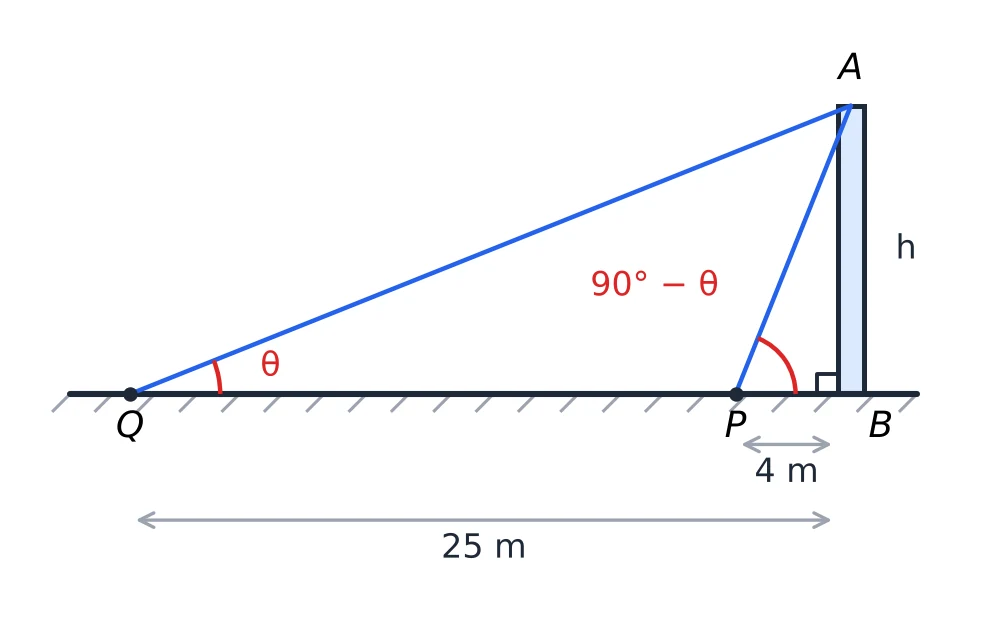
Answer. Let the angle at Q be , so the angle at P is . Then and . Since , I get , so and h = (b) 10 m. 14.5 m is the average of 4 and 25, which complementary angles do not give.
Question 8
The angle of elevation of the top of a 20 m tower from a point 10 m from its foot is . At what distance from the foot, on the same line, will the angle of elevation be ? (a) 30 m (b) m (c) 40 m (d) 5 m
Answer. For complementary angles the height squared equals the product of the two distances, so and b = 40. The new point is (c) 40 m from the foot. It makes sense: , so is more than 45°, its complement is less than 45°, and the point with the smaller angle must be farther out.
Question 9
From a point P on the ground the angle of elevation of the top of a 30 m tower is 30°. A man walks from P towards the tower for m. What is the angle of elevation of the top from his new position? (a) (b) (c) (d)
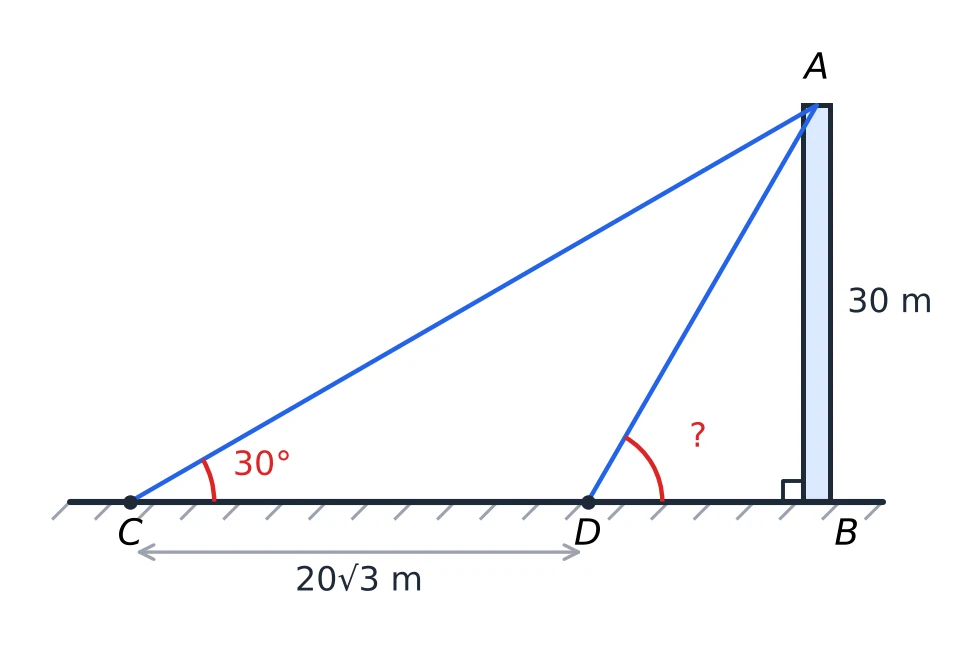
Answer. From P, the distance to the foot is m. After walking m he is m from the foot. Now , so the angle is (a) .
Question 10
The angles of elevation of the top of a tower from two points A and B on the same side of it, in line with its foot, are 30° and 60°. What is the ratio of the distances of A and B from the foot of the tower? (a) (b) (c) (d)
Answer. Each distance is h times the cot of its angle: A is away and B is away. Dividing, , so the ratio is (b) . Writing 1 : 3 puts the points the wrong way round: A, with the smaller angle, is the farther one.
Question 11
The angle of elevation of the top of a tower from a point on the ground is 15°. After walking 120 m towards the tower, the angle becomes 30°. The height of the tower is (a) 120 m (b) m (c) m (d) 60 m
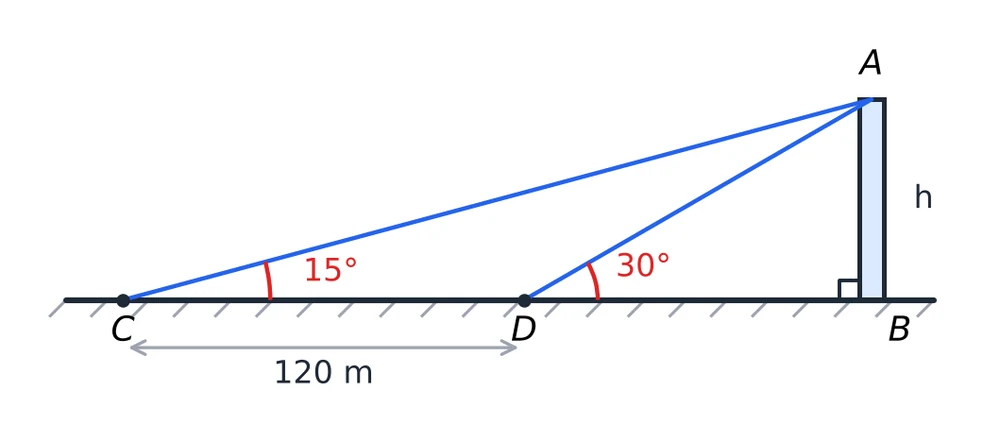
Answer. I don't need . Call the points C and D and the top A. At D the angle is 30°, which is the exterior angle of triangle ACD, so and . The triangle has two 15° angles, so AD = CD = 120 m. In the right triangle at the foot, , which is (d) 60 m.
Question 12
From the top of a lighthouse 90 m high, the angles of depression of two boats on the same side of it, in line with its foot, are 45° and 60°. How far apart are the boats? (a) m (b) m (c) m (d) m
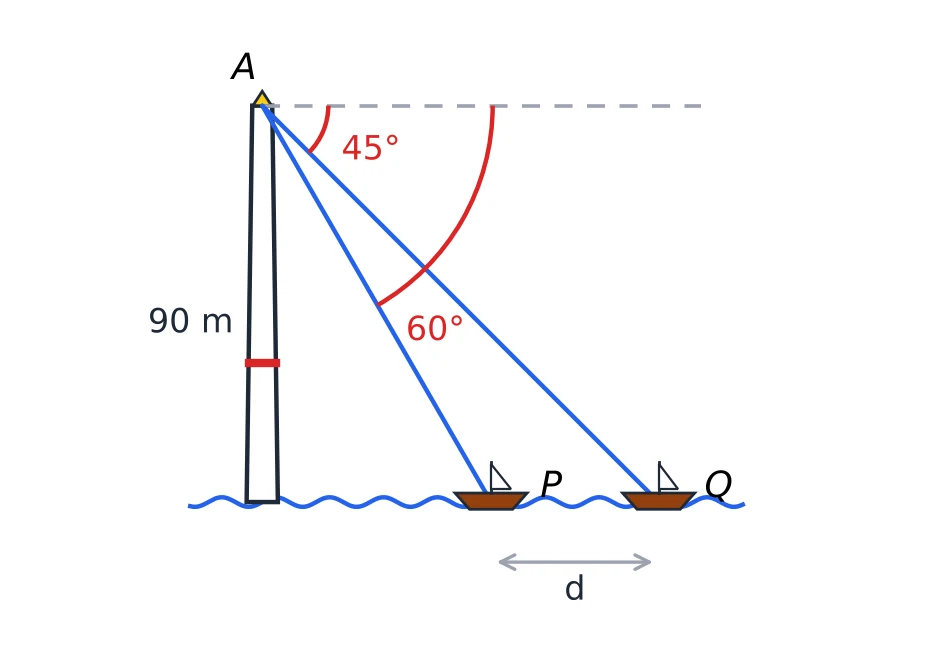
Answer. The depression from the top equals the elevation from each boat. The 45° boat is 90 m from the foot. The 60° boat is m from the foot. They are on the same side, so the gap is m, which is (c) m, about 38 m.
Question 13
Two ships are on opposite sides of a lighthouse 100 m high, in line with its foot. From the top of the lighthouse their angles of depression are 30° and 60°. The distance between the ships is (a) m (b) m (c) m (d) m
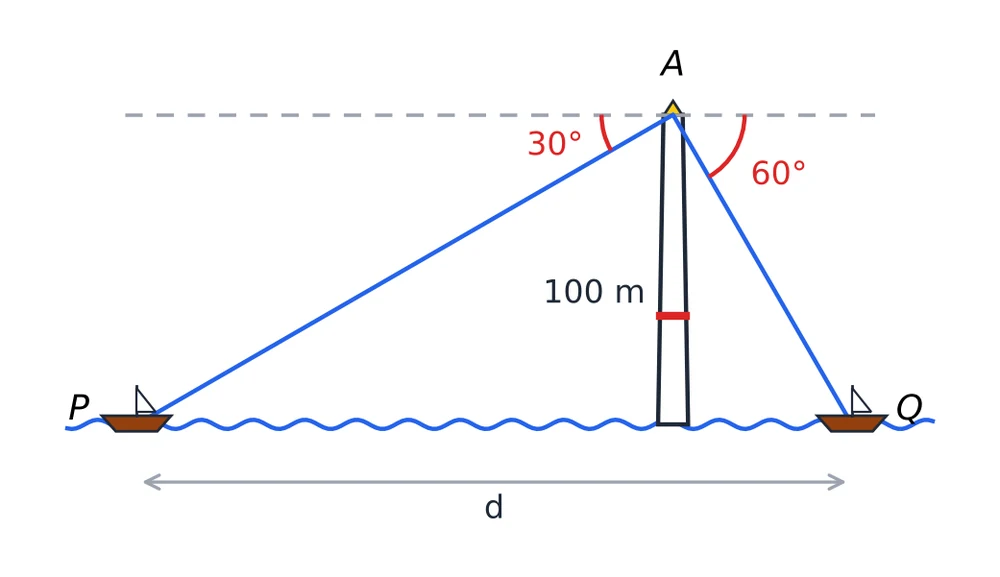
Answer. The ships are m and m from the foot, on opposite sides, so I add them: . Rationalising gives (a) m, about 231 m.
Question 14
From the top of a tower, the angles of depression of two cars on a straight road on the same side of the tower are 30° and 45°. The cars are 60 m apart. The height of the tower is (a) m (b) m (c) m (d) m
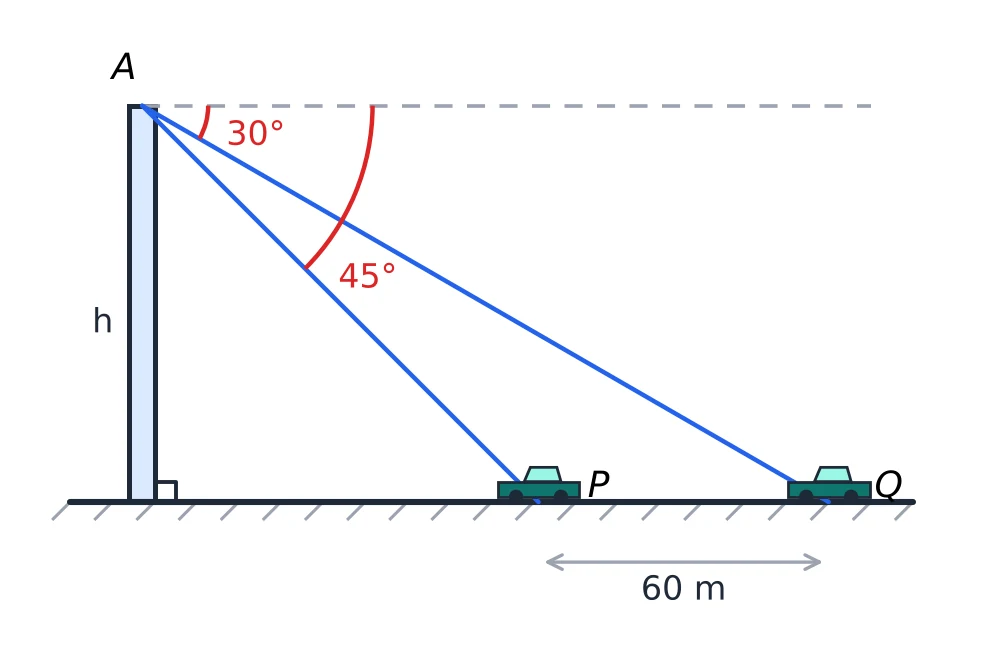
Answer. The 45° car is h from the foot and the 30° car is from it. The gap between them is , so , which is (b) m, about 82 m.
Question 15
An aeroplane flying horizontally at a height of m is seen from a point on the ground at an angle of elevation of 60°. After 12 seconds the angle of elevation is 30°. What is the speed of the aeroplane? (a) 125 km/h (b) 225 km/h (c) 900 km/h (d) 450 km/h
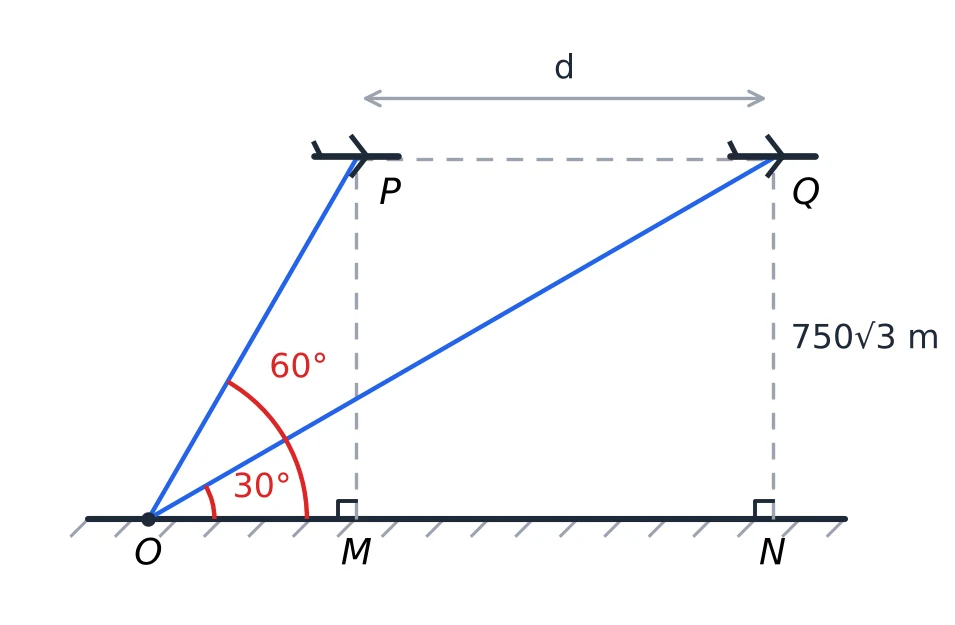
Answer. The horizontal distances of the plane from the point are m and m. It flew 2250 − 750 = 1500 m in 12 s, which is 125 m/s. In km/h, 125 × 3.6 = 450, so the speed is (d) 450 km/h. The option 125 km/h is the m/s figure with the wrong unit on it.
Question 16
An aeroplane flies horizontally at 540 km/h. From a point on the ground its angle of elevation is 45°, and 20 seconds later it is 30°. At what height is it flying? (a) m (b) m (c) m (d) m
Answer. First the speed in m/s: m/s, so in 20 s it flew 3000 m. At 45° and 30° its horizontal distances from the point are h and , so and . The height is (c) m, about 4098 m.
Question 17
From the top of a tower, a man sees a car coming towards the tower on a straight road. The angle of depression of the car changes from 30° to 60° in 16 minutes. How much more time will the car take to reach the foot of the tower, at the same speed? (a) 8 minutes (b) 16 minutes (c) 32 minutes (d) 4 minutes
Answer. With 30° and 60° the car's distance from the foot falls from to , that is from 3 parts to 1 part. It covered 2 parts in 16 minutes, so the last part takes (a) 8 minutes.
Question 18
From the top of a cliff, the angle of depression of a boat sailing straight towards the cliff changes from 45° to 60° in 8 minutes. How much longer will the boat take to reach the foot of the cliff? (a) minutes (b) minutes (c) minutes (d) 4 minutes
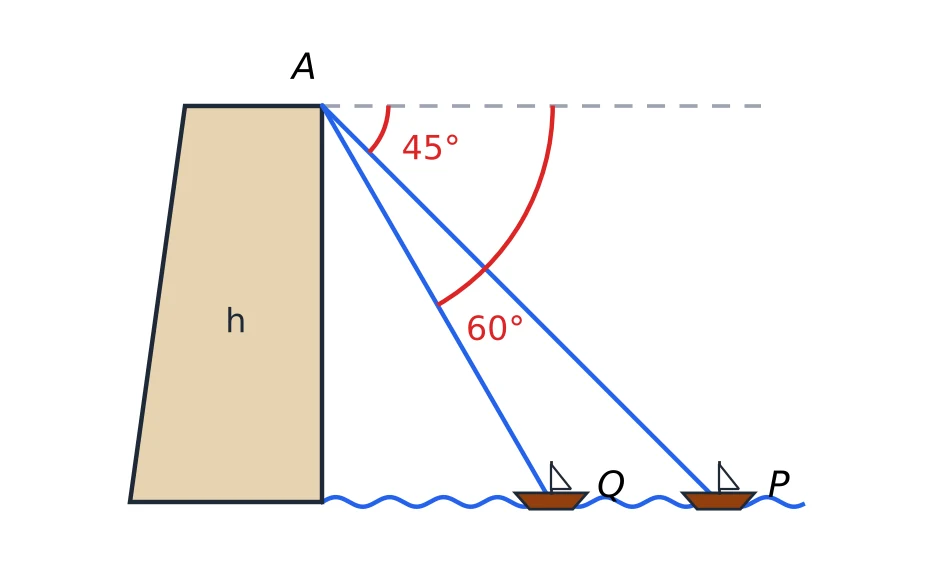
Answer. Let the cliff be h high. At 45° the boat is h from the foot; at 60° it is from it. In 8 minutes it covered , and it still has to go. So left : covered is , and the time left is minutes, about 10.9 minutes. The answer is (b) minutes.
Question 19
From the top of a tower m high, a car moving towards it is seen at an angle of depression of 30°. Ten seconds later the angle of depression is 60°. Find the speed of the car. (a) 10 km/h (b) 72 km/h (c) 36 km/h (d) 18 km/h
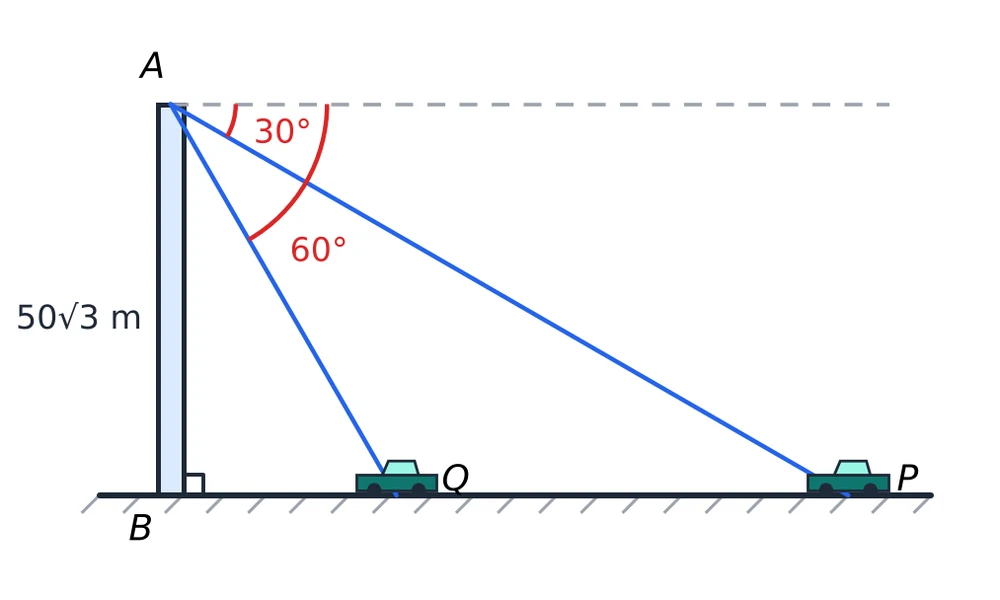
Answer. The car's distances from the foot are m and m. It covered 100 m in 10 seconds, which is 10 m/s, and 10 × 3.6 = 36. Its speed is (c) 36 km/h.
Question 20
A balloon rises straight up from a point B on the ground. An observer standing m from B sees it at an angle of elevation of 30°, and 50 seconds later at 60°. At what speed is the balloon rising? (a) 2.4 m/s (b) 0.8 m/s (c) 3.2 m/s (d) 1.6 m/s
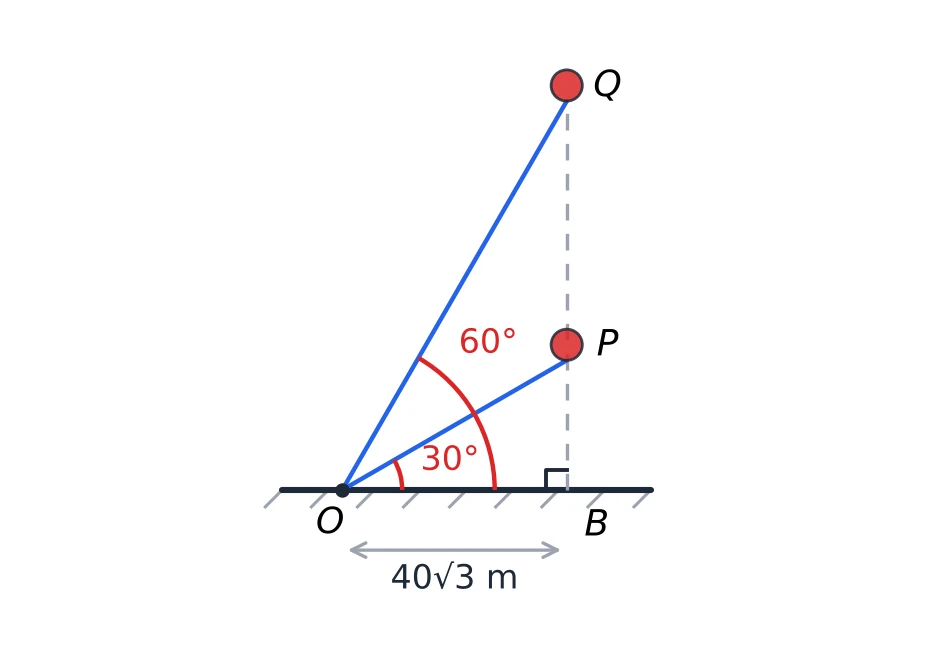
Answer. The horizontal distance stays m, so I use tan for the two heights: first m, then m. It rose 80 m in 50 seconds, which is (d) 1.6 m/s. Dividing 120 m by 50 s gives 2.4 m/s, but the balloon was already 40 m up at the first sighting.
Question 21
A boy whose eyes are 1.5 m above the ground sees the top of a tower at an angle of elevation of 30°. He walks m towards the tower and the angle becomes 60°. What is the height of the tower? (a) 31.5 m (b) 30 m (c) 28.5 m (d) 33 m
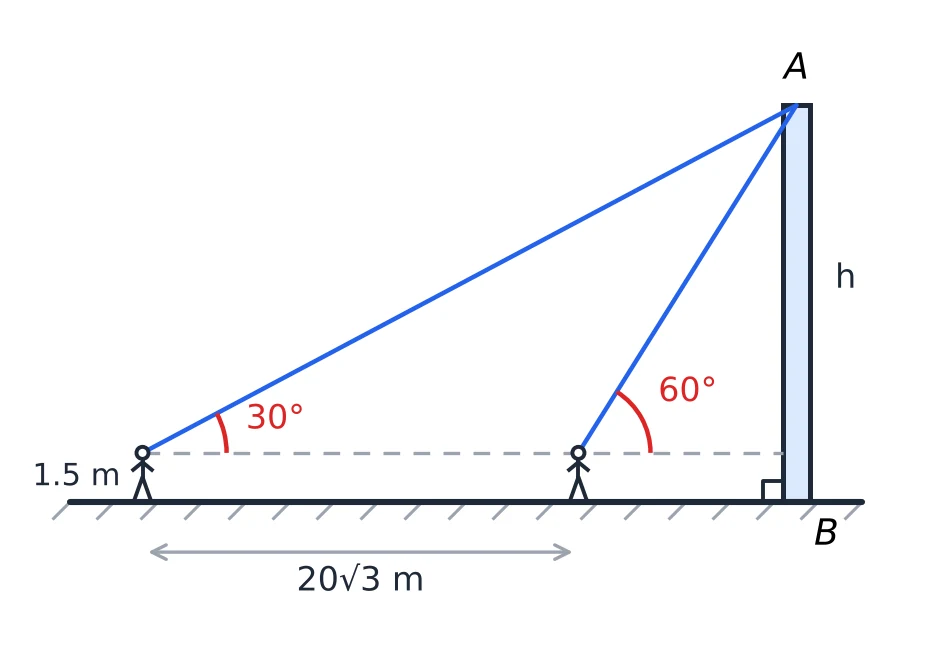
Answer. The angles are measured at his eye, so first I find how high the top is above his eyes. With 30° and 60° that is of the walk: m. Adding his eye height, the tower is 30 + 1.5 m, which is (a) 31.5 m.
Question 22
A man walking at 4.5 km/h towards a tower finds that the angle of elevation of its top changes from 30° to 60° in 2 minutes. Ignoring his height, find the height of the tower. (a) m (b) m (c) 75 m (d) m
Answer. First the walk. 4.5 km/h is m/s, and 2 minutes is 120 seconds, so he walked 150 m. With 30° and 60° the height is of the walk, m. The answer is (b) m. Taking 4.5 as m/s would make the walk 540 m and the height m.