
From a Roof: Elevation of the Top, Depression of the Foot
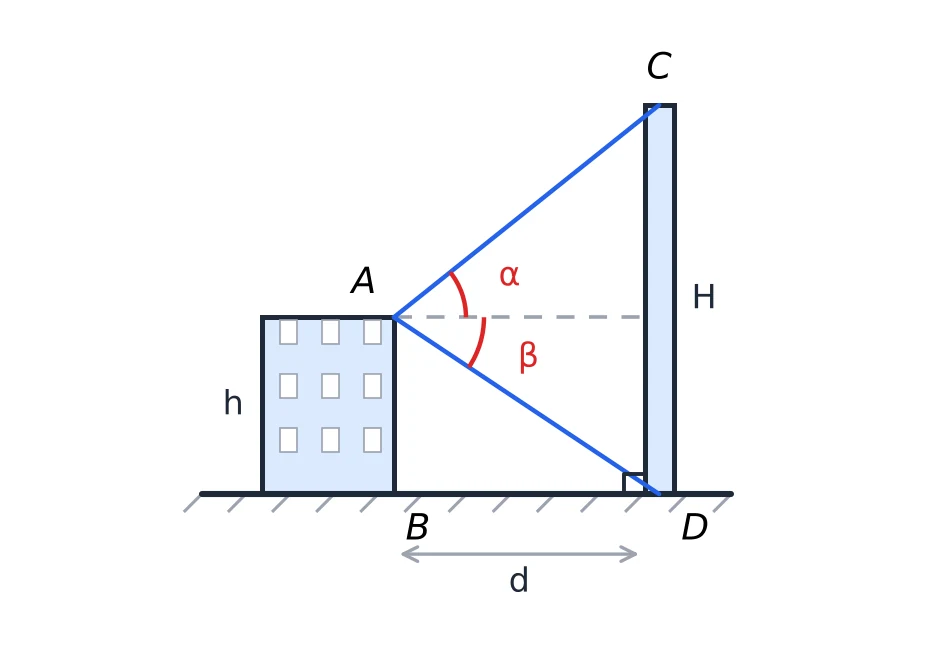
An observer stands on the roof of a building AB of height h and looks across at a taller tower CD. He sees the top C above his eye level, at an angle of elevation , and the foot D below it, at an angle of depression . Draw the horizontal AE from his eye to the tower. It cuts the tower into two parts:
- ED, below the line, equals the building: ED = AB = h
- CE, above the line, is the extra height of the tower
and AE = BD = d, the distance between the two.
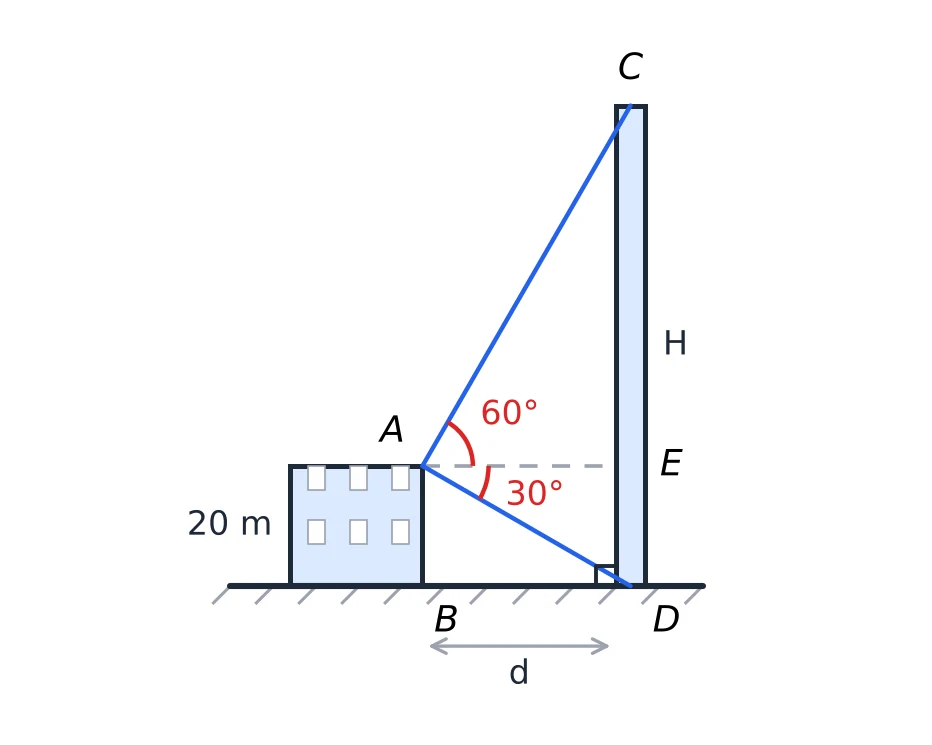
The depression gives the distance, and the elevation then gives the extra height:
With numbers. The building is 20 m high, the depression of the tower's foot is 30° and the elevation of its top is 60°. Then m, m, and the tower is 20 + 60 = 80 m high.
Work in this order: first the triangle with two known things (here the lower one, with h and ), then the other triangle, which shares d with it.
The same picture serves an observer at a window: use the height of the window in place of the roof. If the depression is 45°, d equals the eye height straight away.
A common error is to give CE, 60 m here, as the height of the tower. CE starts at eye level, so the part below the line, h, still has to be added.
Seen from the Top and the Foot of a Building
Now both angles are elevations of the same top C: one from the foot B of a building and one from its top A. The foot sees C at the bigger angle , the top at the smaller angle . With the tower H high, the building h high and the two d apart:
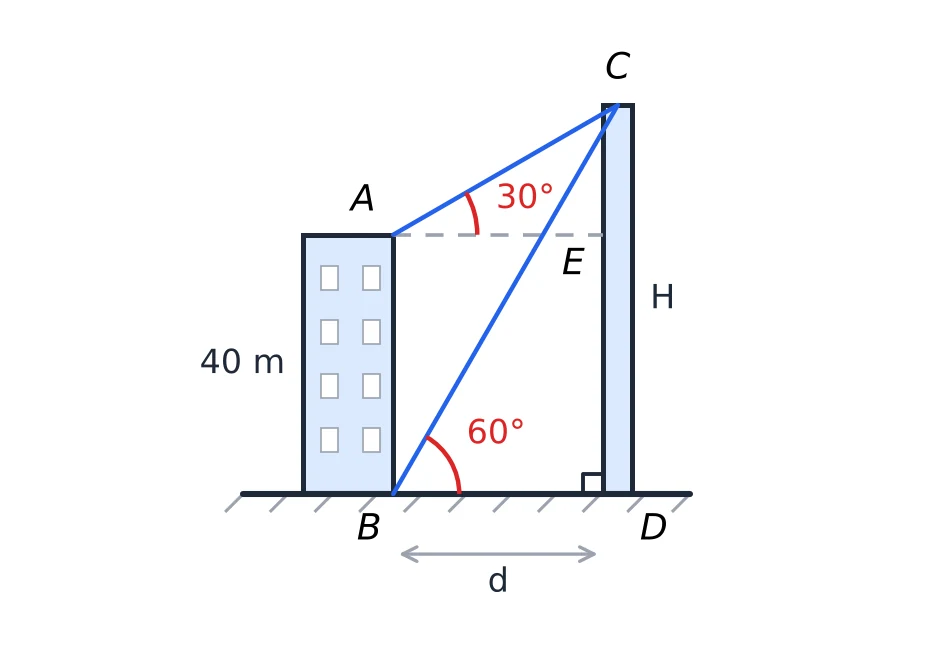
Dividing the second equation by the first removes d:
30° from the top, 60° from the foot. The ratio is , so H − h is a third of H and the building is two-thirds of the tower: . In the figure the building is 40 m, so the tower is 60 m and m.
45° from the top, 60° from the foot. Now , so . For a 16 m building the tower is m, about 37.86 m.
This is the same-side idea of Two Angles and Moving Objects turned on its side. The two observers stand one above the other instead of one behind the other, and the building's height plays the part of the walk.
From a Tall Tower: Depressions of the Top and Foot of a Shorter One
From the top A of a tall tower AB of height H, the top C and the foot D of a shorter building CD are seen at depressions and . The foot is lower, so its angle is the bigger one. Draw the horizontal from A and extend DC up to meet it at E. Then AE = BD = d and ED = H.
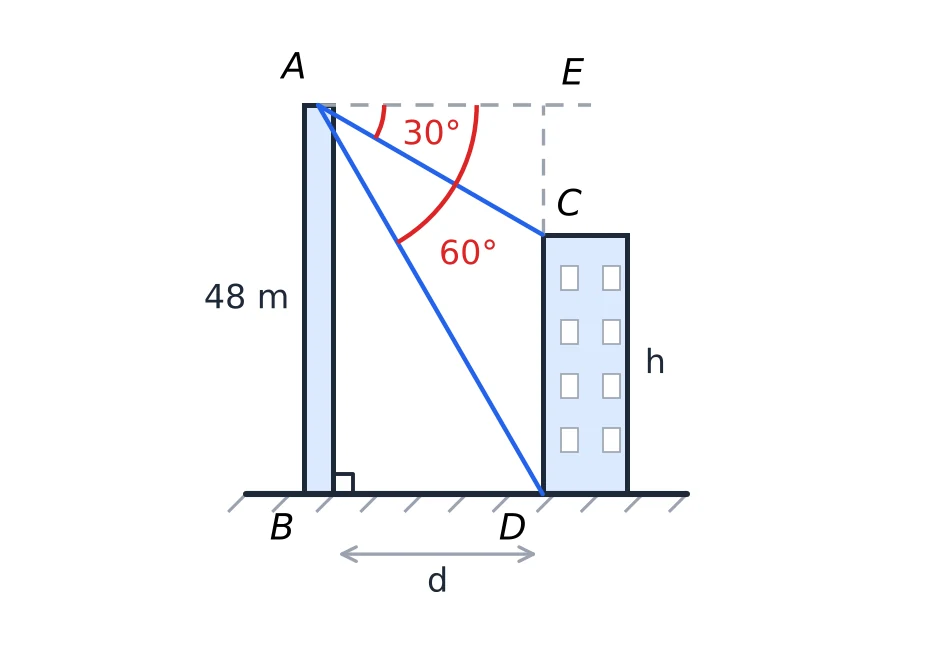
From the foot's triangle, . From the top's triangle, , and the building is what is left:
30° and 60°. , so . From a 48 m tower: m, EC = 16 m, and the building is 48 − 16 = 32 m.
30° and 45°. Now . From a 30 m tower the distance is 30 m, EC is m, and the building is m, about 12.68 m.
EC, 16 m in the first case, is the difference of the two heights. Some questions ask for exactly that difference and others for the building, so read the last line of the question again before choosing.
Two Towers Facing Each Other
Each top seen from the other's foot. Two towers of heights h and H stand d apart. From the foot of the first, the top of the second is seen at ; from the foot of the second, the top of the first is seen at . Each tower is d times the tan of the angle at which its own top is seen:
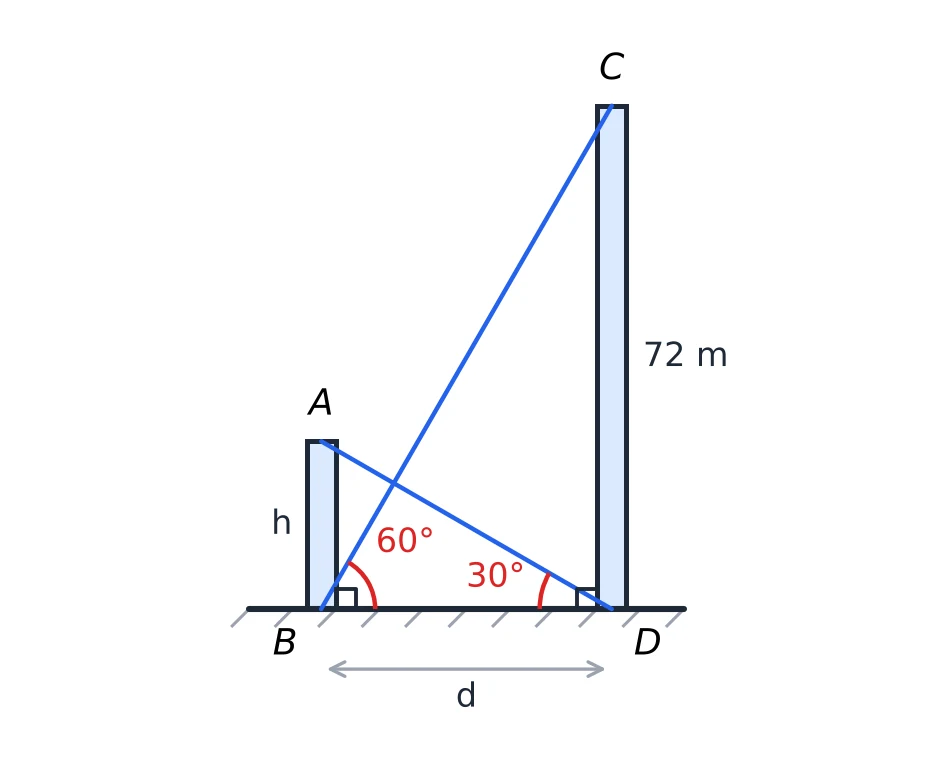
With 30° and 60° the heights are in the ratio . If the taller tower is 72 m, the shorter is 24 m, and they stand m apart. You do not need the distance first; the ratio does the work.
The angle at the top of the shorter one. From the top A of the shorter tower, the top C of the taller one is seen at an angle . Draw the horizontal AE to the taller tower. AE is the distance between the towers and CE is the difference of their heights, so
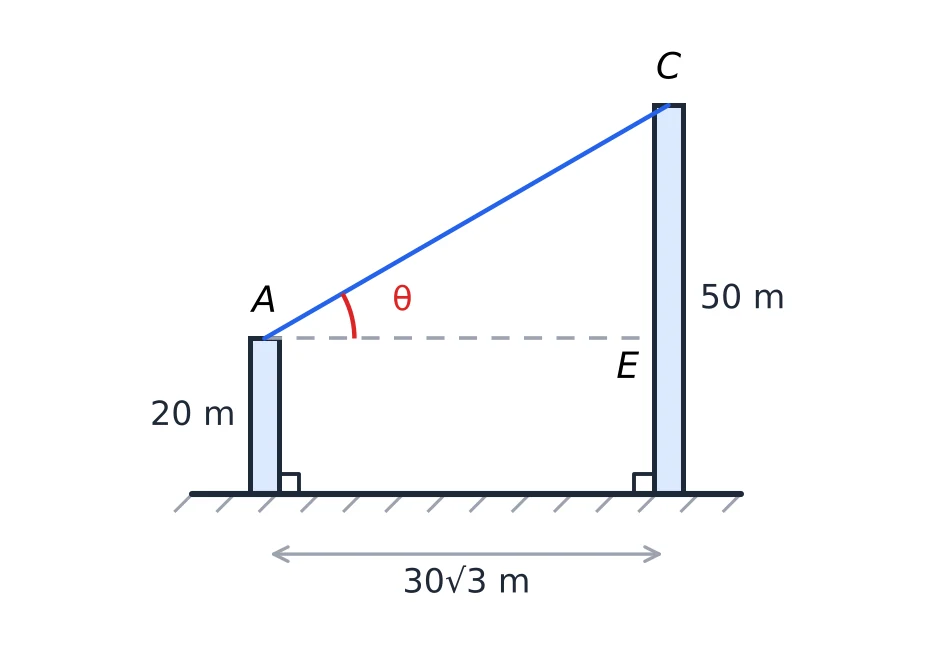
For towers of 20 m and 50 m standing m apart, , so , and the line AC joining the tops is m long. When only the heights and the gap are given and the length AC is asked, it is a Pythagoras question (see Shadows, Ladders, Strings and Slopes).
The opposite side here is the difference of the heights. Using the whole 50 m would give , which is not even a standard angle.
A Statue or Flagstaff on a Pedestal
A statue AC of height s stands on a pedestal of height p. From a point O on the ground, d metres from the pedestal, the top of the pedestal C (the foot of the statue) is seen at and the top of the statue A at . Both angles are measured from the same horizontal at O, so both triangles have the same base d:
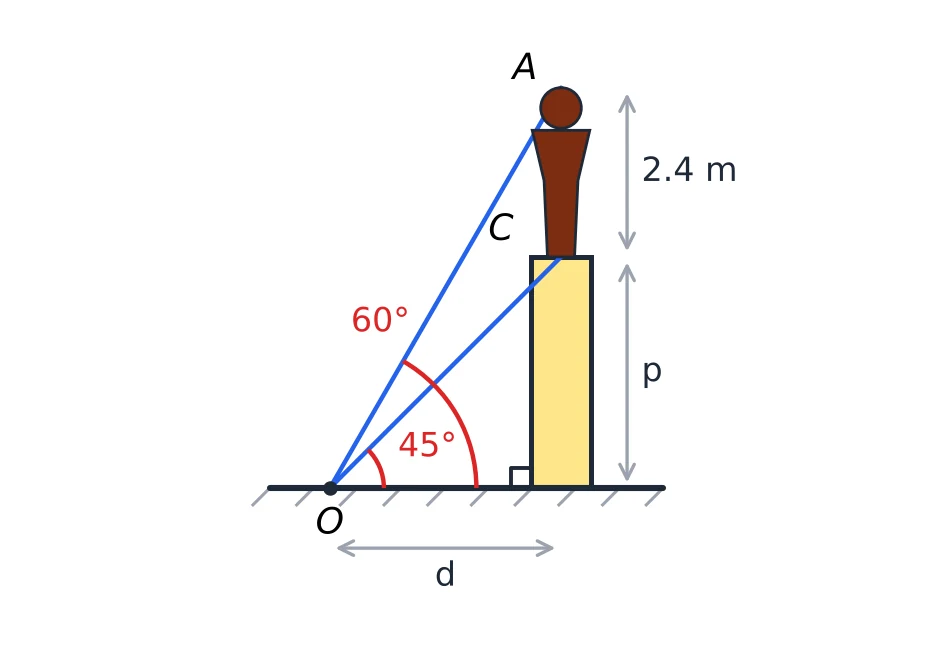
Usually s is given and p is wanted. Find d from the third equation, then p from the first.
With numbers. A statue 2.4 m tall stands on a pedestal, and the angles are 45° and 60°. Then , so m. The pedestal top is at 45°, so the pedestal is as high as d is long: m, about 3.28 m.
The same figure fits a flagstaff on a building, a pole on a tower, an antenna on a roof or a person standing on a platform. Name the lower part and the upper part, and the equations stay the same.
[SSC Tip] The question may ask for the pedestal, the statue or the total height, and all three can be among the options. In the example the total is m, about 5.68 m. Check which part the question names before you mark.
Quick Ratios for the Pedestal, and a Person on a Roof
30° and 60°. The pedestal is and the total is , three times as much. So the statue is twice the pedestal: s = 2p. A 6 m statue on such a pedestal stands on 3 m, and the observer is m away.
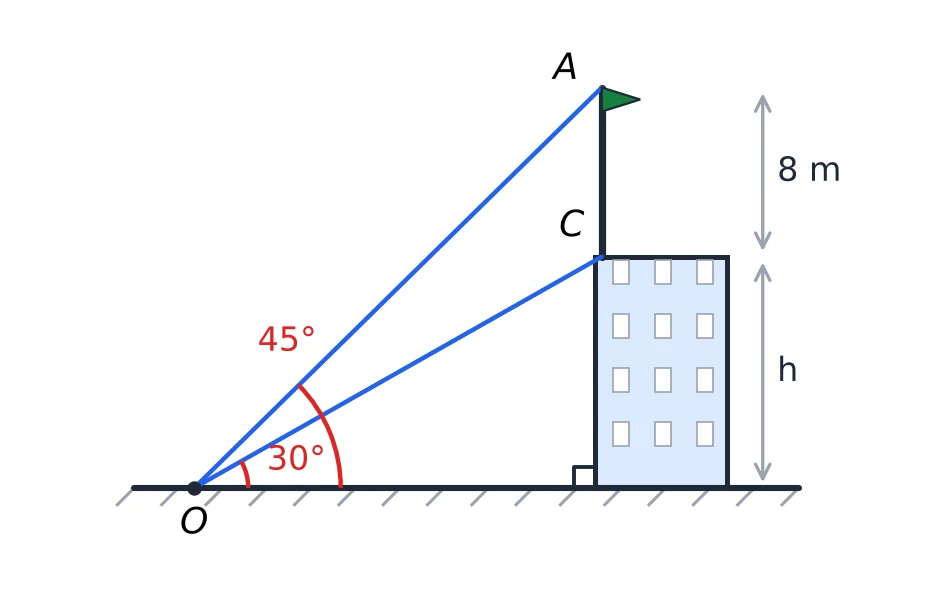
30° and 45°, or 45° and 60°. In both, the total height is times the lower part (for 30° and 45° it is d against ; for 45° and 60° it is against d). So the upper part is times the lower part:
For an 8 m flagstaff on a tower, with the bottom and top of the flagstaff seen at 30° and 45°, the tower is m, about 10.93 m.
A person on a roof. When the observer stands on a roof, his eyes are above the roof by nearly his own height, and the eye height above the ground is what the triangles use. A man whose eyes are 1.6 m above the roof of a 20 m building sees the top of a tower at 30° and its foot at 45°. His eyes are 21.6 m above the ground, so the tower is 21.6 m away and its top is m above his eyes. The tower is m high, about 34.07 m.
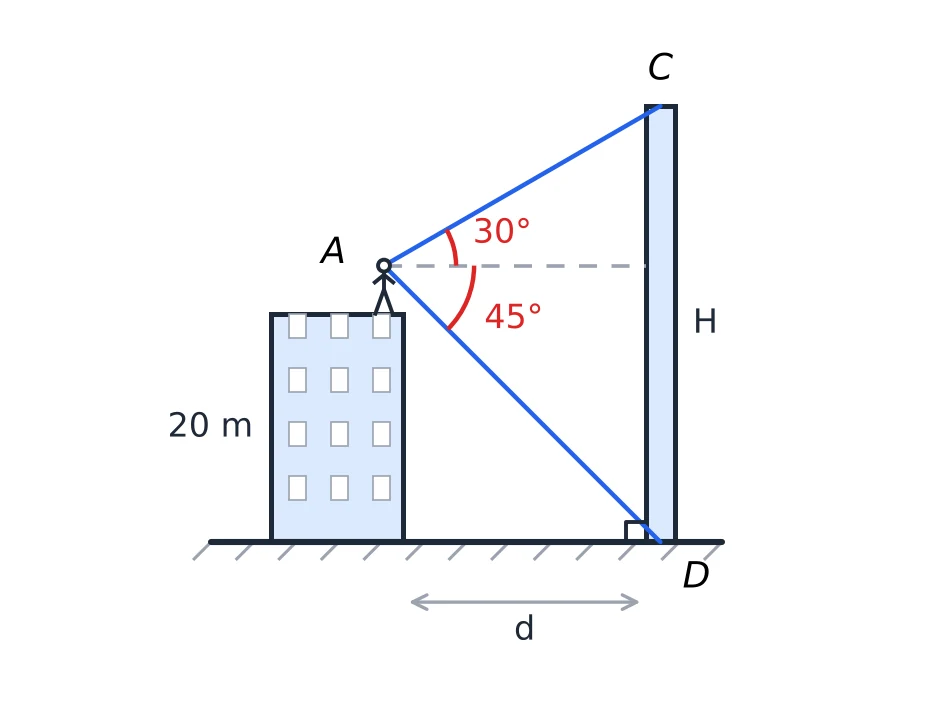
Leaving out the man's 1.6 m gives m, about 31.55 m, a different option.
A Point Between Two Towers or Poles
Two towers AB and CD stand on level ground, and a point P lies on the line joining their feet, between them. From P the tops are seen at angles and . Each tower gives its own distance from P, and the two distances make up the gap:
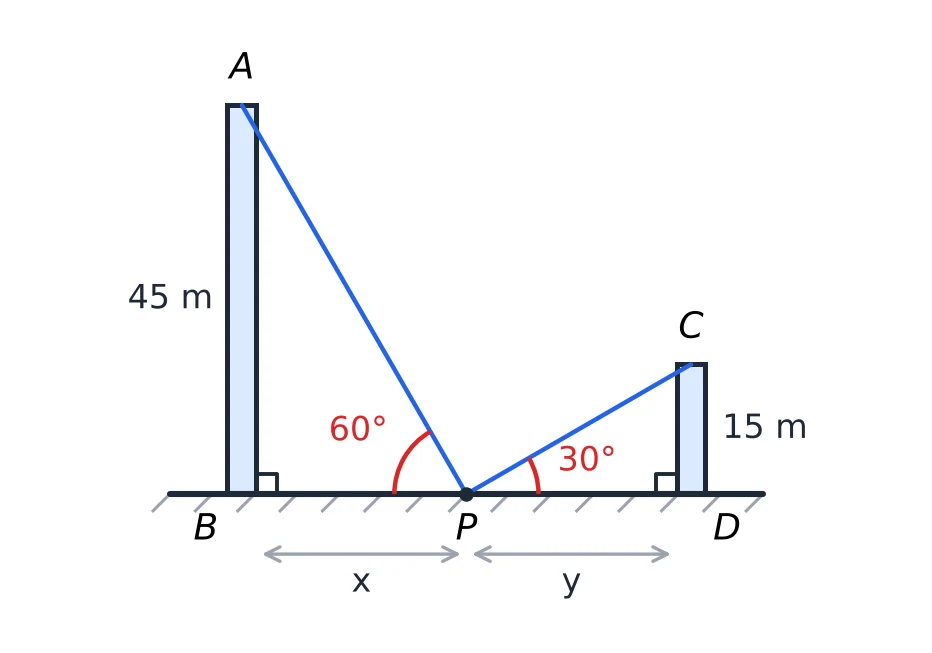
Unequal towers. Towers of 45 m and 15 m; from P the tops are seen at 60° and 30°. Then m and m, so P is exactly halfway and the towers are m apart.
Equal poles on both sides of a road. With it is the opposite-sides question of Two Angles and Moving Objects, and the width of the road is . For a road 40 m wide and angles of 60° and 30°, , so each pole is m high, and P is 10 m from one pole and 30 m from the other.
Equal angles. If both tops are seen at the same angle, the two triangles are similar, so the distances are in the ratio of the heights. For towers of 15 m and 35 m standing 100 m apart, P divides the 100 m in the ratio 15 : 35 = 3 : 7, so it is 30 m from the shorter tower.
Complementary angles from the midpoint. If P is the midpoint and the two angles add to 90°, then gives , that is . Towers of 16 m and 9 m must then stand 2 × 12 = 24 m apart.
A Lighthouse on a Cliff, and Boats Below
Seen from a boat. A lighthouse of height L stands at the edge of a cliff of height c. From a boat d metres from the cliff, the top of the cliff (the foot of the lighthouse) is seen at and the top of the lighthouse at . This is the statue on a pedestal again, with the cliff as the pedestal:
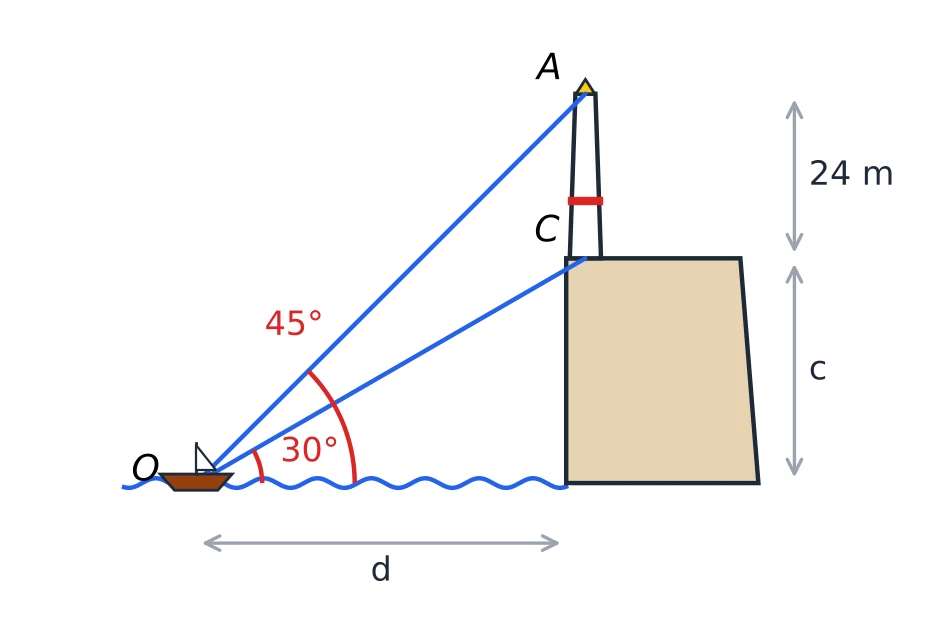
For a 24 m lighthouse with the angles 30° and 45°, the rule gives the cliff at once: m, about 32.78 m. The boat is m from the cliff.
The same angles given as depressions. The question may say that from the top of the lighthouse the boat is seen at a depression , and from its foot at a depression . By alternate angles these are the boat's angles of elevation of the two points, and the working above does not change.
Two boats. From the top of a lighthouse standing on a cliff, two boats in line with the foot are seen at two depressions. Use the total height, cliff plus lighthouse, as the height of the eye; then it is the two-boat question of Two Angles and Moving Objects. For a 20 m lighthouse on a 40 m cliff the eye is 60 m up, and boats on the same side at 30° and 60° are m apart.
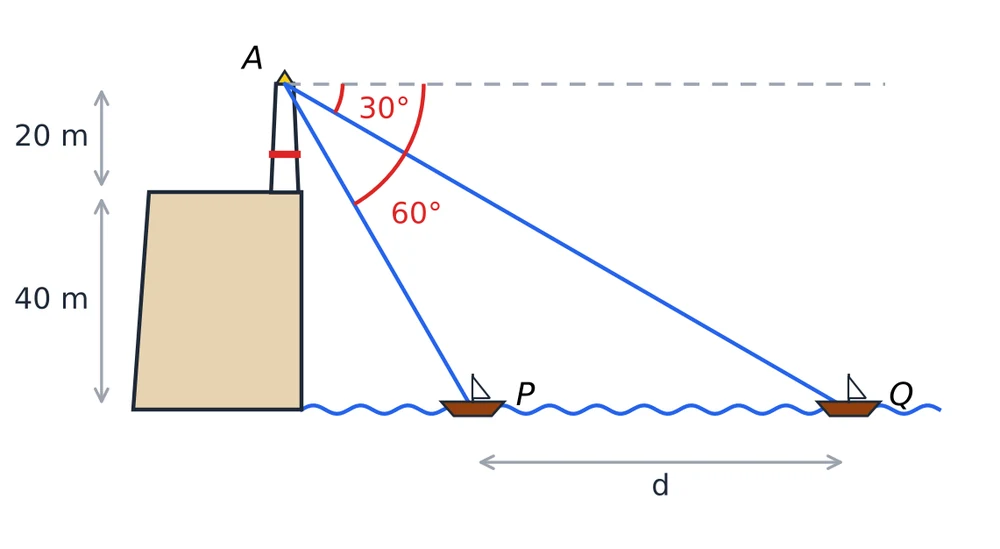
[SSC Tip] Using only the cliff (40 m) or only the lighthouse (20 m) as the height gives a neat but wrong answer, and both appear as options.
[Tier 2] The Reflection of a Cloud in a Lake
An observer O stands h metres above the still surface of a lake. A cloud P is H metres above the water. Still water acts as a mirror, so the reflection P' appears H metres below the surface, straight under the cloud.
From O the cloud is seen at an angle of elevation and its reflection at an angle of depression . Let x be the horizontal distance from O to the vertical line through the cloud. Measured from O's eye level, the cloud is H − h above and the reflection is H + h below:
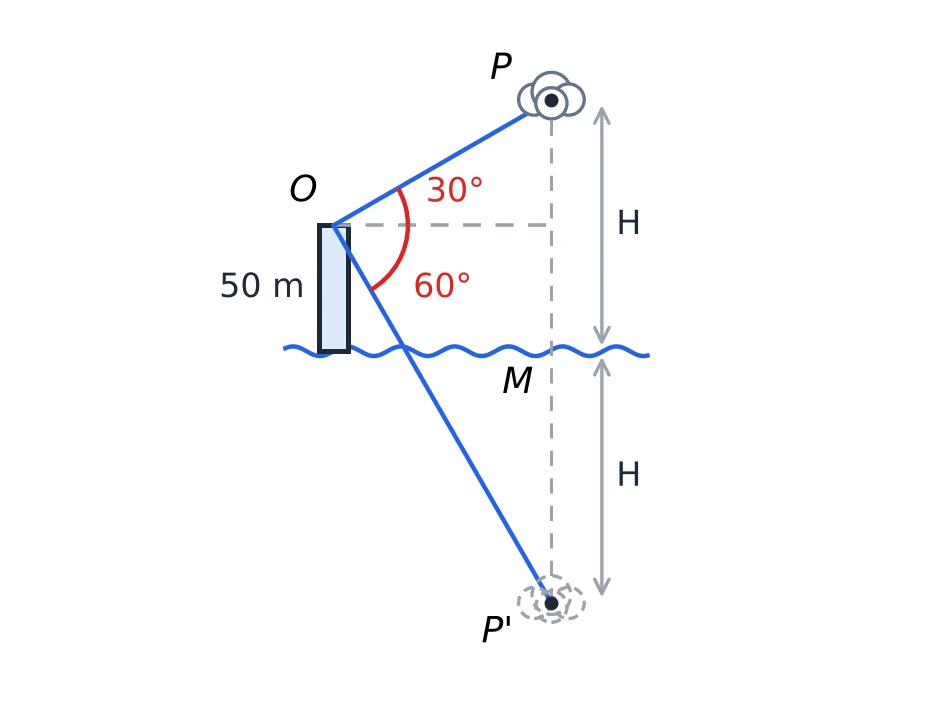
Dividing removes x:
30° and 60°. The ratio is 3, so H + h = 3(H − h), which gives H = 2h. With the observer 50 m above the lake, the cloud is 100 m above the water. Also m, and the cloud is m from the observer.
30° and 45°. Now the ratio is , so . From 20 m above the lake the cloud is m high, about 74.64 m. The pair 45° and 60° has the same ratio and gives the same answer.
The usual slip is to measure the reflection's depth from the observer's level instead of from the water, writing H − h for both. The reflection is as far below the water as the cloud is above it.
[Tier 2] Answers in , , h and d
Some questions give letters instead of numbers, and the options are formulas. Write the same equations as before, solve for the letter asked, and tidy up.
| Situation | Result |
|---|---|
| two points on the same side, d apart, angles | |
| two points on opposite sides, d apart | |
| from a roof h high: elevation of the top, depression of the foot | |
| from a tower H high: depressions and of the top and foot of a shorter one | |
| statue s high: angles (bottom) and (top) | |
| cloud seen from h above a lake: elevation , reflection |
The first row comes from . Write each cot as 1 over tan and take the common denominator: .
Checking an option with numbers. Put in angles whose answer you already know. For the roof case take h = 20, and : the first note gave a tower of 80 m, and . An option such as gives , so it is out.
Choose the test angles with care. With 30° and 60°, , so and give the same number although they are different formulas. A second pair, such as 30° and 45°, separates them.
The same results are sometimes printed with sines. Since (see Chapter 15), the first row can also be written .
Solved Examples
Question 1
From the top of a building 33 m high, the angle of elevation of the top of a tower is 30° and the angle of depression of its foot is 45°. What is the height of the tower? (a) m (b) m (c) m (d) m
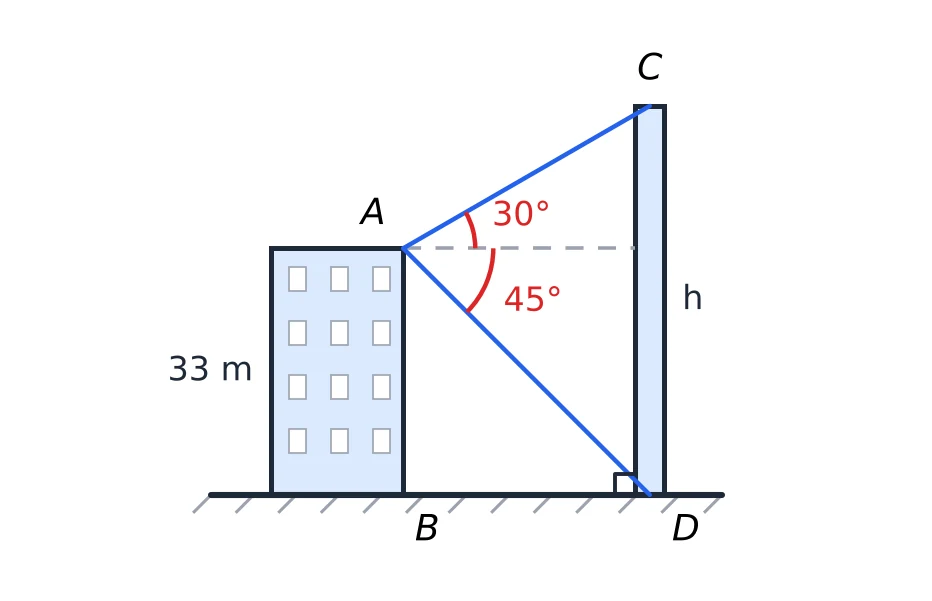
Answer. I draw the horizontal from the roof to the tower. Below it, the depression is 45°, so the distance between the two equals the building's height, 33 m. Above it, the tower rises another m. The tower is m, which is (a) m, about 52.05 m.
Question 2
From the top of a 24 m building, the angle of depression of the foot of a tower is 60° and the angle of elevation of its top is 30°. Find the height of the tower. (a) 48 m (b) 8 m (c) 32 m (d) 40 m
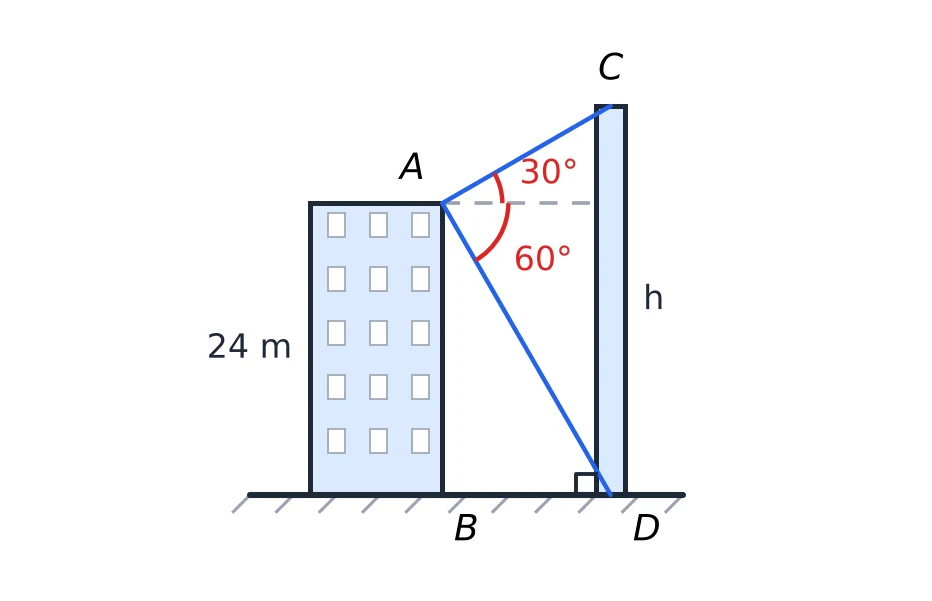
Answer. The depression gives the distance: m. The part of the tower above my eye level is m. Adding the 24 m below eye level, the tower is (c) 32 m. Mixing up tan and cot in the first step gives a distance of m and a tower of 48 m.
Question 3
From a window 12 m above the ground, the angle of elevation of the top of a building on the other side of the street is 60° and the angle of depression of its foot is 30°. The height of the building is (a) 36 m (b) 48 m (c) 60 m (d) 24 m
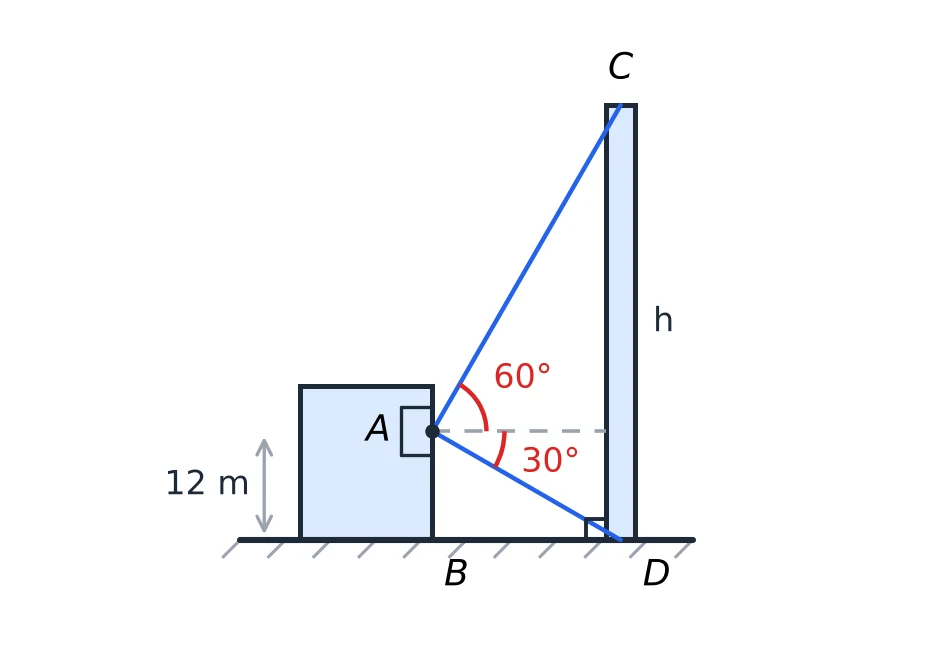
Answer. The street is m wide. The building rises m above the window's level. Adding the 12 m below the window gives (b) 48 m.
Question 4
The angles of elevation of the top of a tower from the top and the foot of a 30 m high building are 30° and 60°. What is the height of the tower? (a) 60 m (b) 90 m (c) m (d) 45 m
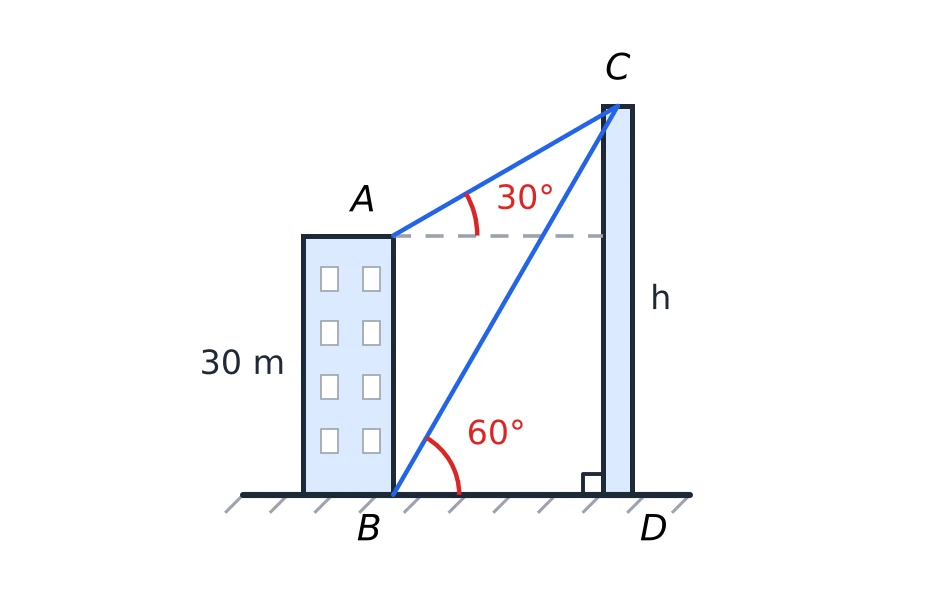
Answer. Let the tower be H and the distance d. From the foot, . From the top, , which is a third of H. So , which gives and H = (d) 45 m.
Question 5
The angles of elevation of the top of a tower from the top and the foot of a 12 m building are 45° and 60°. The height of the tower is (a) m (b) m (c) m (d) m
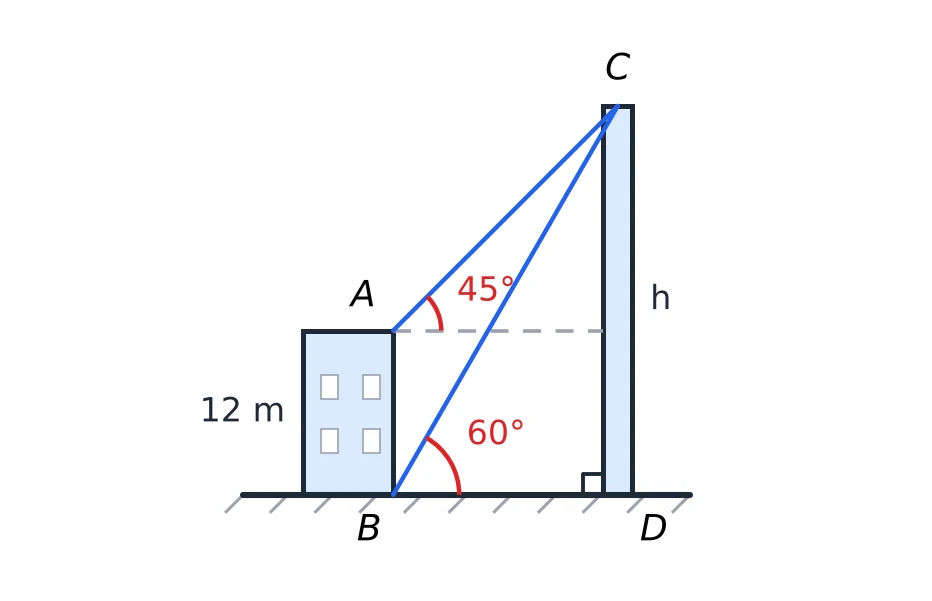
Answer. From the foot, . From the top the angle is 45°, so the part above the roof equals the distance: H − 12 = d. So , which gives and . That is (a) m, about 28.4 m.
Question 6
From the top of a tower 66 m high, the angles of depression of the top and the foot of a building are 30° and 60°. Find the height of the building. (a) 22 m (b) 44 m (c) 33 m (d) m
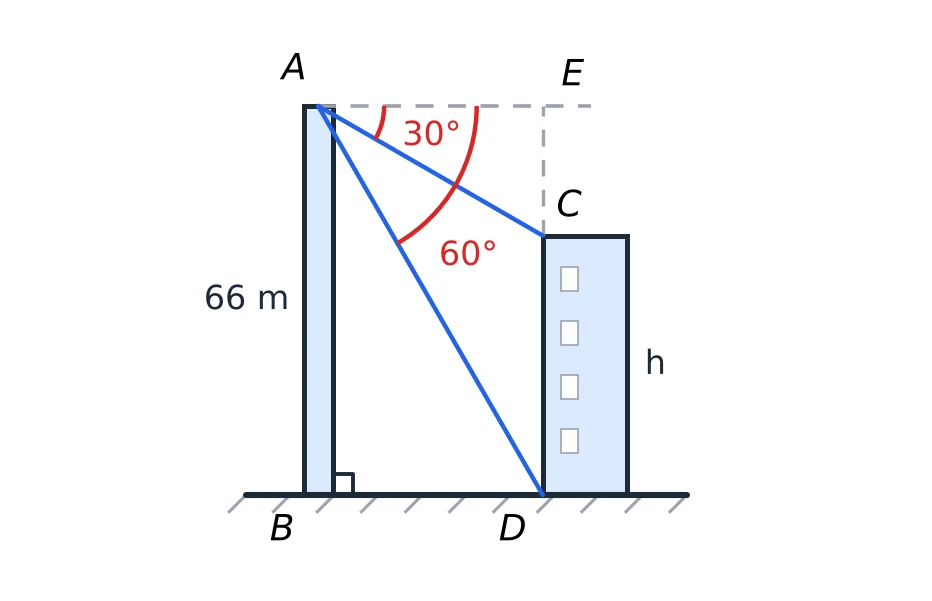
Answer. The foot is at 60°, so the building is m away. Its top is m below the tower's top. So the building is 66 − 22 = (b) 44 m. The 22 m is only the drop from the tower's top to the building's top.
Question 7
From the top of a 45 m tower, the angles of depression of the top and the foot of a building are 45° and 60°. How tall is the building? (a) m (b) m (c) m (d) 30 m
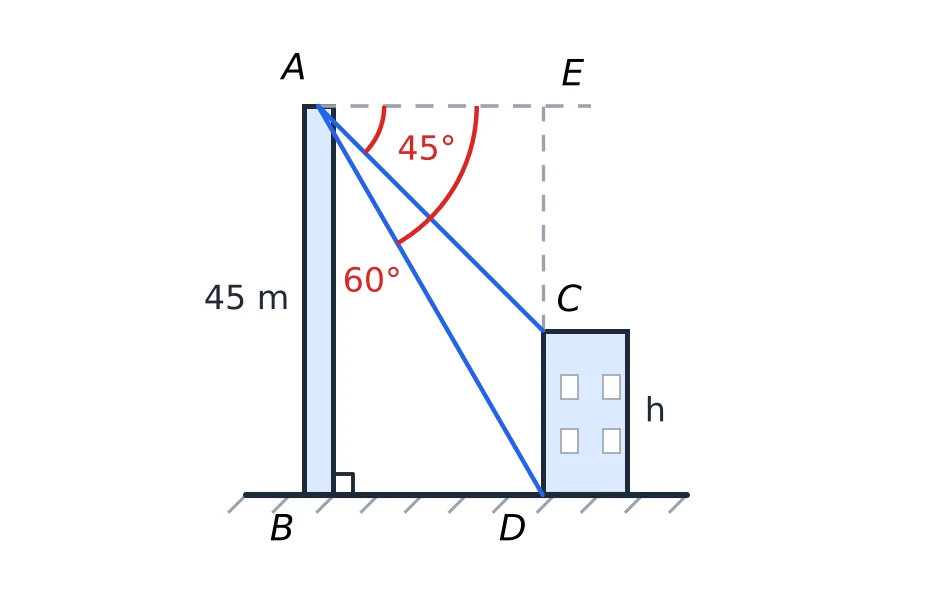
Answer. The distance between them is m. With a 45° depression to the building's top, the drop from my eye to that top equals the distance, m. The building is m, which is (c) m, about 19 m.
Question 8
From the foot of a tower, the angle of elevation of the top of a building is 30°, and from the foot of the building, the angle of elevation of the top of the tower is 60°. If the tower is 81 m high, how high is the building? (a) 40.5 m (b) m (c) 54 m (d) 27 m
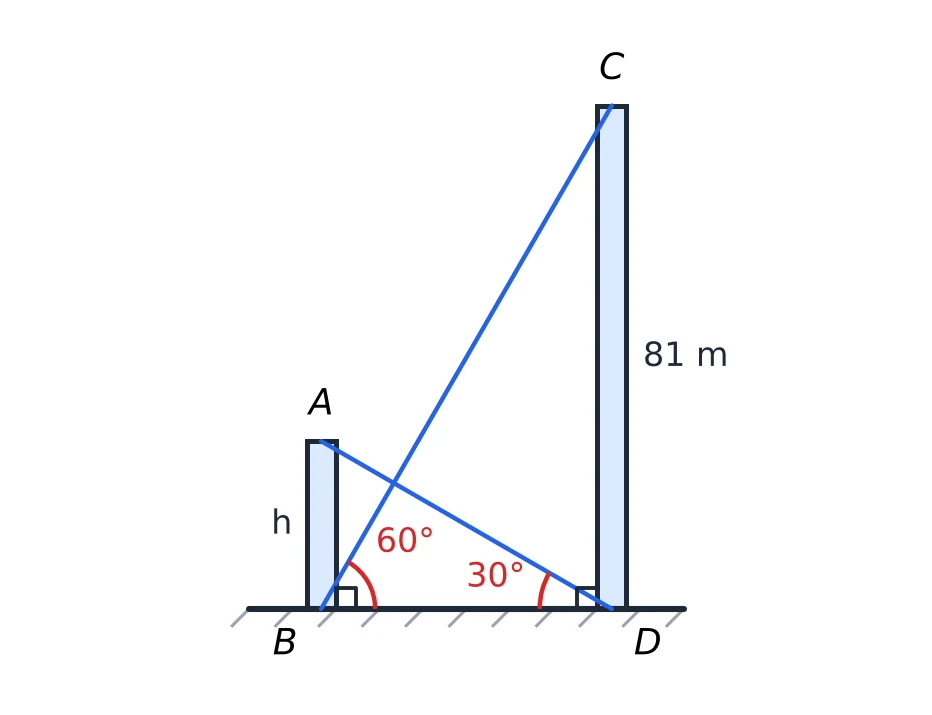
Answer. Both angles use the same base, the distance d between them. The tower is and the building is , so building : tower = 1 : 3. The building is , which is (d) 27 m.
Question 9
Two towers 25 m and 40 m high stand m apart. What is the angle of elevation of the top of the taller tower seen from the top of the shorter one? (a) (b) (c) (d)
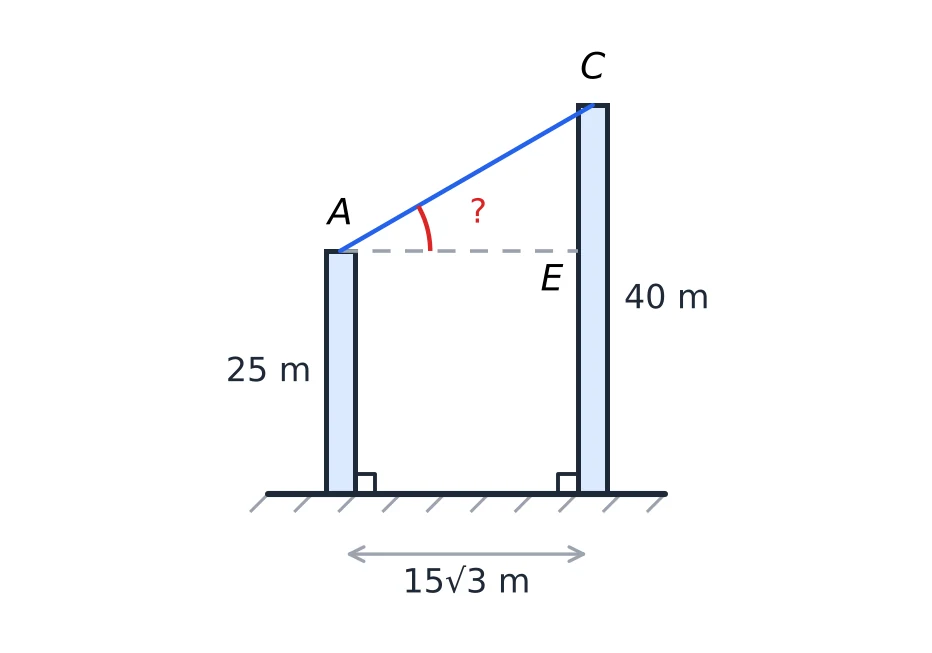
Answer. From the top of the shorter tower I draw the horizontal to the taller one. Along it the distance is m, and above it the taller tower rises 40 − 25 = 15 m. So , and the angle is (a) .
Question 10
A statue 3.6 m tall stands on a pedestal. From a point on the ground, the angle of elevation of the top of the statue is 60° and that of the top of the pedestal is 45°. What is the height of the pedestal? (a) m (b) m (c) m (d) m
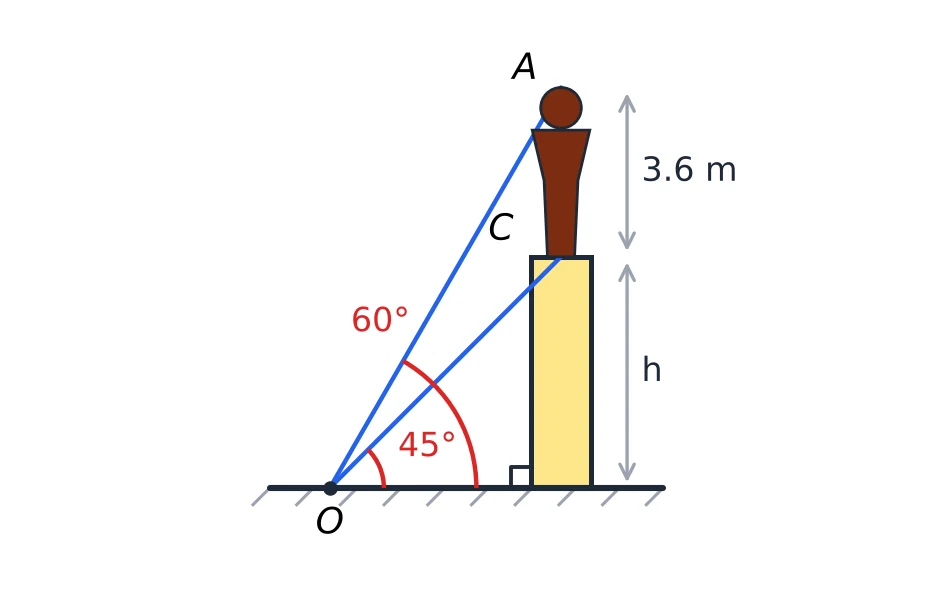
Answer. Let the point be d from the pedestal. The pedestal top is at 45°, so the pedestal is d high. The statue's top is at 60°, so the total height is . The statue is the difference: , which gives . The pedestal is (b) m, about 4.92 m.
Question 11
A mast stands at the front edge of the roof of a 12 m high building. From a point on the ground, the angles of elevation of the bottom and the top of the mast are 30° and 60°. What is the length of the mast? (a) 36 m (b) 12 m (c) 24 m (d) m
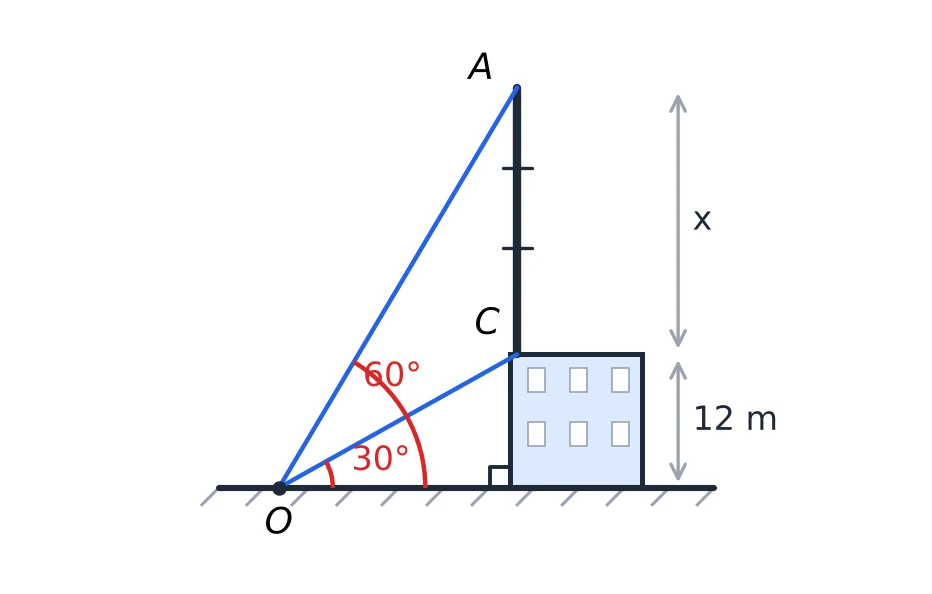
Answer. With 30° and 60° the total height is three times the lower part. The lower part is the building, 12 m, so the top of the mast is 36 m above the ground and the mast itself is 36 − 12 = (c) 24 m.
Question 12
A statue 7 m tall stands on a pillar. From a point on the ground, the angles of elevation of the foot and the top of the statue are 30° and 60°. How far is the point from the pillar? (a) m (b) 3.5 m (c) 10.5 m (d) m
Answer. With 30° and 60° the statue is twice the pillar, so the pillar is 3.5 m. From the 30° triangle, the distance is m, which is (d) m. To check: the top is 10.5 m up and .
Question 13
A man stands on the roof of a 28.5 m high building; his eyes are 1.5 m above the roof. He sees the top of a tower at an angle of elevation of 30° and its foot at an angle of depression of 60°. How tall is the tower? (a) 40 m (b) 38 m (c) 60 m (d) 41.5 m
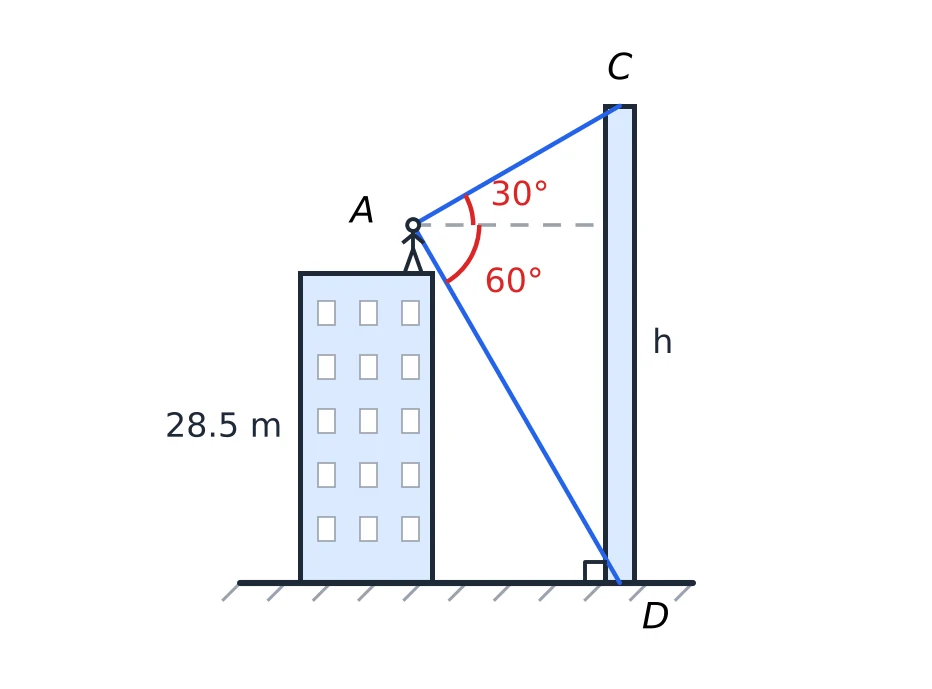
Answer. His eyes are 28.5 + 1.5 = 30 m above the ground, and that is the height I use. The tower is m away, and its top is m above his eyes. So the tower is 30 + 10 = (a) 40 m. Working with 28.5 m instead of 30 m gives 38 m.
Question 14
Two poles of equal height stand on either side of a road 56 m wide. From a point on the road between them, the angles of elevation of their tops are 60° and 30°. What is the height of each pole? (a) m (b) m (c) 14 m (d) 42 m
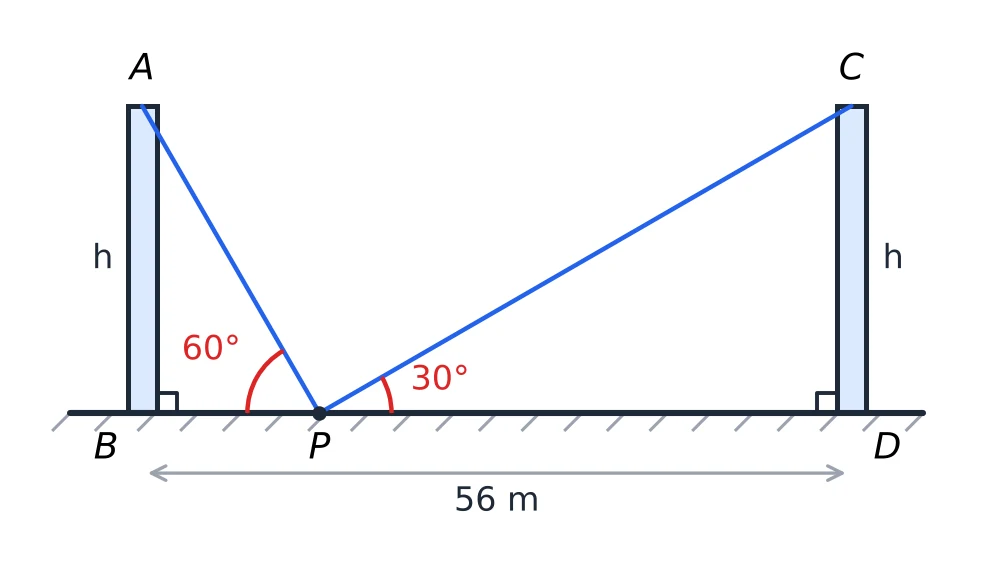
Answer. The point is from one pole and from the other, and the two add up to the width: . So m, which is (b) m. The point is 14 m from the first pole and 42 m from the second.
Question 15
Two towers stand m apart. The first is 30 m high. From a point between them, on the line joining their feet, the angle of elevation of the top of the first is 30° and that of the second is 60°. How high is the second tower? (a) 20 m (b) m (c) 60 m (d) 40 m
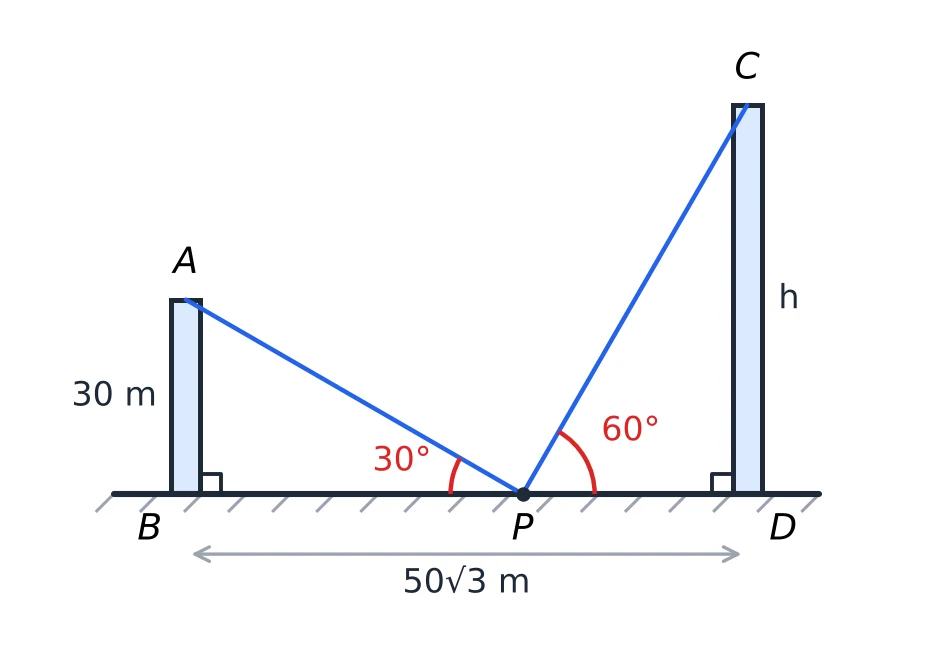
Answer. The point is m from the first tower, so it is m from the second. The second tower is m. The answer is (c) 60 m.
Question 16
The angles of elevation of the tops of two towers, seen from the midpoint of the line joining their feet, are complementary. The towers are 36 m and 16 m high. How far apart are they? (a) 48 m (b) 24 m (c) 52 m (d) 26 m
Answer. Let the half-distance be x. Then and , and for complementary angles . So , x = 24, and the towers are 2 × 24, that is (a) 48 m, apart. Stopping at x gives only half the distance.
Question 17
A lighthouse 20 m high stands on the edge of a cliff. From a boat at sea, the angle of elevation of the top of the lighthouse is 60° and that of the top of the cliff is 45°. Find the height of the cliff. (a) m (b) m (c) m (d) m
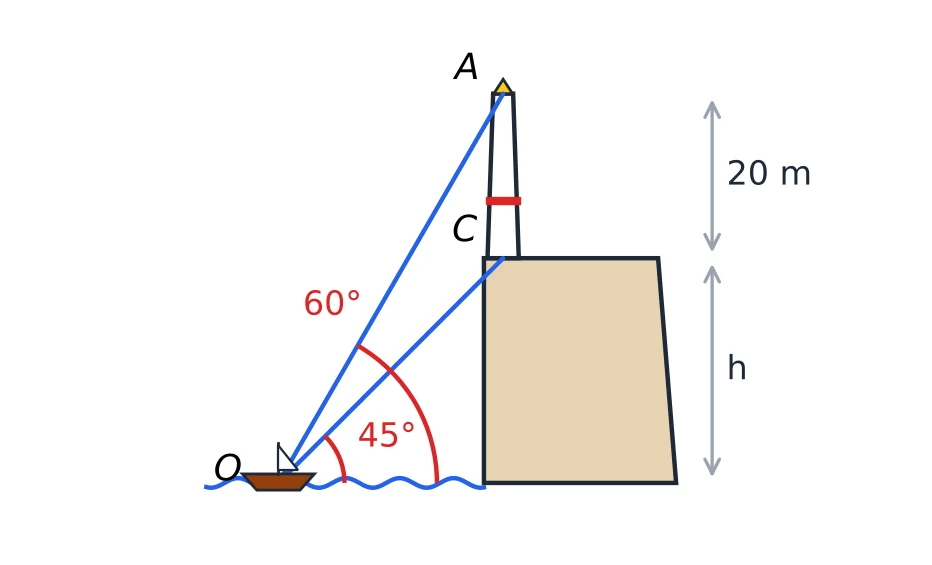
Answer. The cliff is the pedestal and the lighthouse is the statue. At 45° the cliff's height equals the boat's distance d, and at 60° the total is . The lighthouse is the difference: , so . The cliff is (d) m, about 27.3 m.
Question 18
An 18 m lighthouse stands on a 36 m cliff. From the top of the lighthouse, two boats on the same side, in line with the foot of the cliff, are seen at angles of depression of 60° and 30°. How far apart are the boats? (a) m (b) m (c) m (d) m
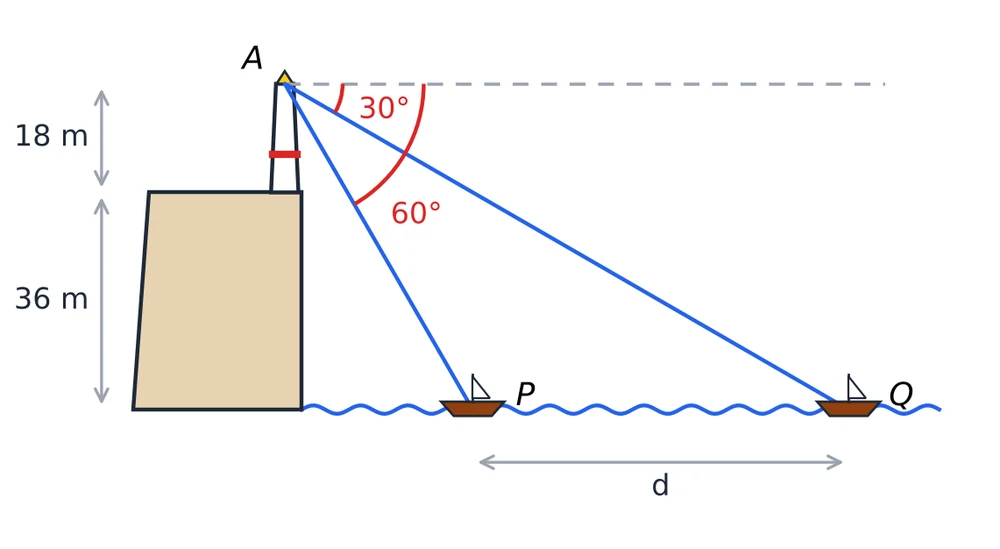
Answer. The eye is at the top of the lighthouse, 36 + 18 = 54 m above the sea. The boats are m and m from the foot of the cliff, so they are m apart. The answer is (b) m. Using the cliff alone gives m.
Question 19
[Tier 2] A man is 30 m above the surface of a lake. The angle of elevation of a cloud is 30° and the angle of depression of its reflection in the lake is 60°. What is the height of the cloud above the lake? (a) 45 m (b) 90 m (c) 60 m (d) m
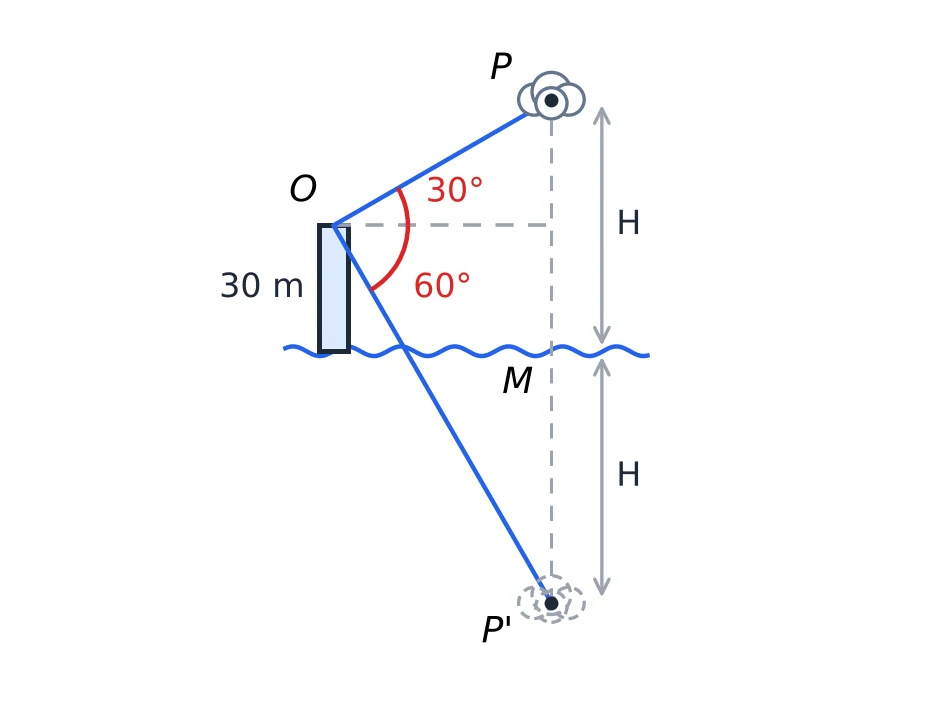
Answer. Let the cloud be H above the water and x away horizontally. Above the man's eye the cloud is . The reflection is H below the water, so it is H + 30 below his eye: . Dividing, , so H + 30 = 3H − 90 and H = (c) 60 m.
Question 20
[Tier 2] From a point 25 m above a lake, the angle of elevation of a helicopter is 45° and the angle of depression of its reflection in the lake is 60°. The height of the helicopter above the lake is (a) m (b) m (c) m (d) m
Answer. Above my level the helicopter is H − 25, which equals the horizontal distance x because the angle is 45°. Its reflection is H + 25 below my level, and that is . So , which gives and . That is (a) m, about 93.3 m.
Question 21
[Tier 2] From the top of a building of height h, the angle of elevation of the top of a tower is and the angle of depression of its foot is . The height of the tower is (a) (b) (c) (d)
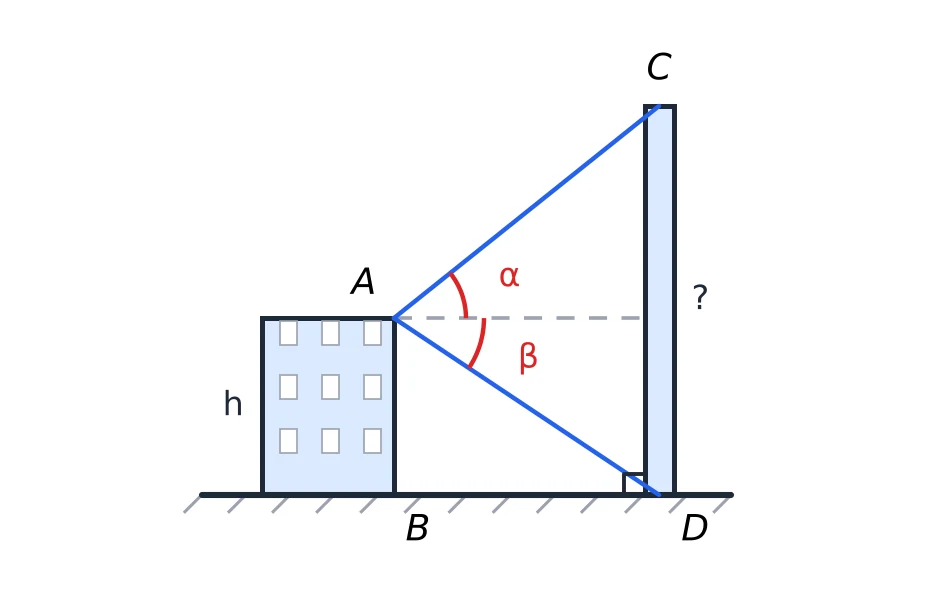
Answer. The depression gives the distance, . The part of the tower above the roof level is . Adding the part below, h, the tower is , which is (b) . A check with h = 20, and gives m, the answer worked out in the notes.
Question 22
[Tier 2] A statue of height s stands on a pedestal. From a point on the ground, the angles of elevation of the bottom and the top of the statue are and . The height of the pedestal is (a) (b) (c) (d)
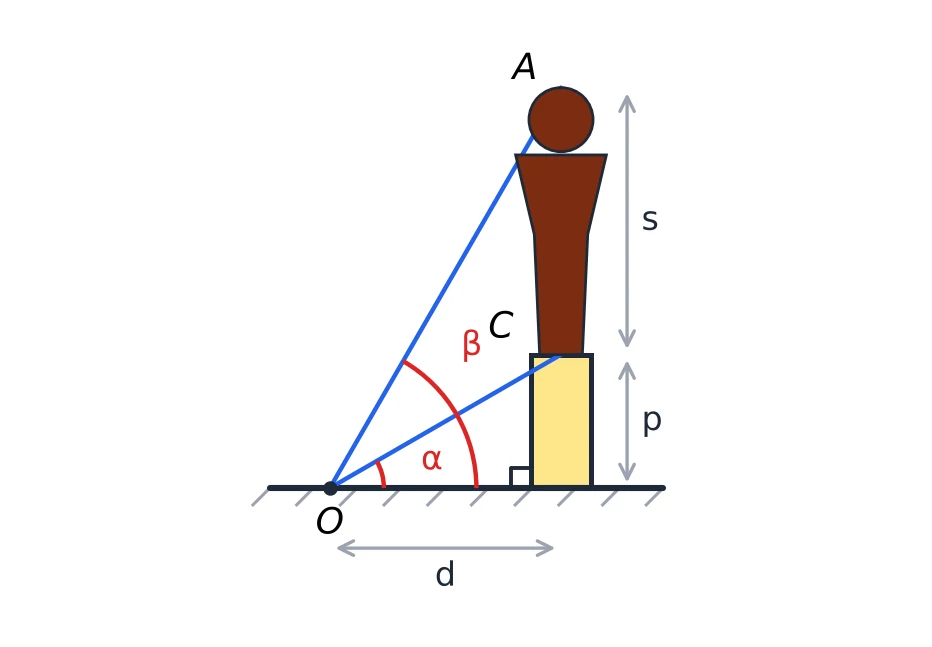
Answer. Let the point be d from the pedestal and the pedestal p high. Then and . Subtracting, , so , and gives (d) . The option with on top is the total height p + s.