
How to Use These Questions
The 32 questions below mix every type in this chapter, in no fixed order, the way a paper does: a shadow can follow an aeroplane, and a ladder can follow a statue. In CGL 2025 Tier 1 about one shift in every two or three had a question from this chapter, and each of them was one of these types. Before any working, draw the figure. Mark the right angle at the foot, the angle given (from the horizontal), the length you know, and the unknown as h, x or d. Then see what the triangles share: one height (two points, or a moving object) or one distance (a statue on a pedestal, a second tower, a reflection).
Answers are kept in surds unless the question names a value for . The three marked [Tier 2] are a lamp-post shadow, a cloud seen in a lake and an answer in , and d. A Tier 1 question here should take you under a minute in the exam; for any that took much longer, read its quick route in Shortcuts & Speed Methods and come back to it in a day or two.
Solved Examples
Question 1
From a point A on level ground, the angle of elevation of the top of a pole 7.5 m tall is , where . Find the distance of A from the foot of the pole and the length of the line of sight from A to the top.
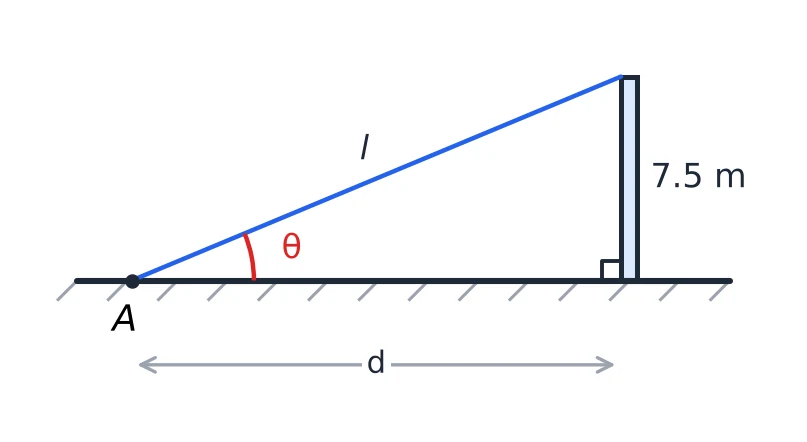
Answer. Tan is height over distance, so height : distance , and the 5-12-13 triplet makes the line of sight 13 parts. Here 5 parts are 7.5 m, so one part is 1.5 m. The distance is = 18 m, and the line of sight is = 19.5 m.
Question 2
From the top of a lighthouse, the angle of depression of a boat is , and the line of sight from the top to the boat is 150 m long. Find the height of the lighthouse and the distance of the boat from its foot. (Take .)
Answer. At the boat the angle of elevation of the top is also . The line of sight is the hypotenuse, 2 parts, so one part is 75 m. The height is opposite the , 1 part: 75 m. The distance is parts: = 129.9 m.
Question 3
The shadow of a tower is 24 m longer when the sun's altitude is than when it is . Find the height of the tower. (Take .)
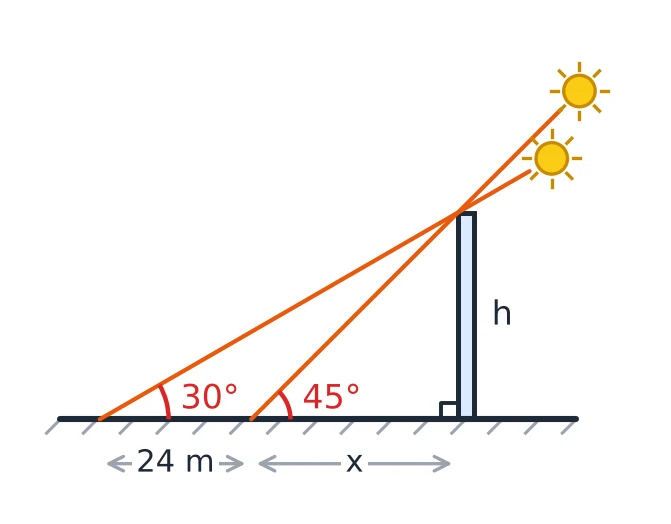
Answer. At the shadow equals the height h, and at it is . The difference is , so = 32.78 m.
Question 4
Two poles 9 m and 14 m tall stand upright on level ground. A straight wire joins their tops and makes an angle of with the horizontal. Find the length of the wire and the distance between the poles.
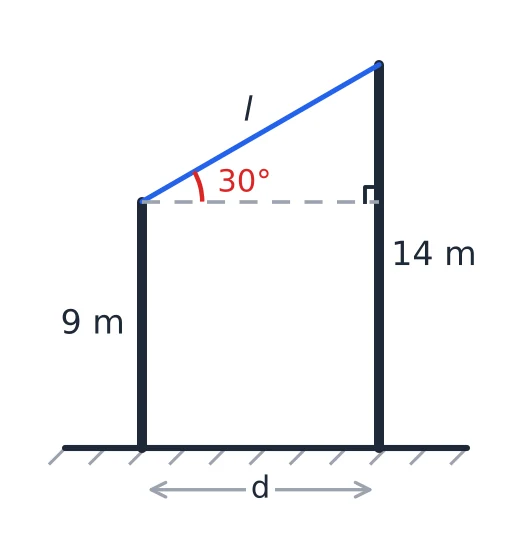
Answer. I draw a horizontal line from the top of the shorter pole across to the taller one. It cuts off m of the taller pole, and that 5 m is opposite the . So 5 m is 1 part: the wire, 2 parts, is 10 m, and the gap between the poles, parts, is m, about 8.66 m.
Question 5
From two points A and B on the same side of a tower, 20 m apart and in line with its foot, the angles of elevation of its top are and . Find the height of the tower and the distance of B from its foot. (Take .)
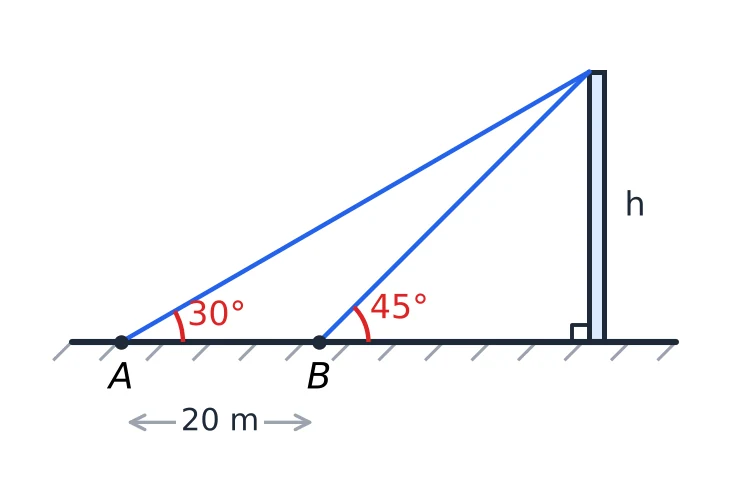
Answer. Both points see the same height h. B, at , is h from the foot, and A, at , is from it. So , which gives = 27.32 m. B is h from the foot, so it is also 27.32 m away.
Question 6
An aeroplane flying level at a height of m passes directly over an observer. Just before, its angle of elevation is ; 25 seconds later, on the other side, it is . Find its speed in km/h.
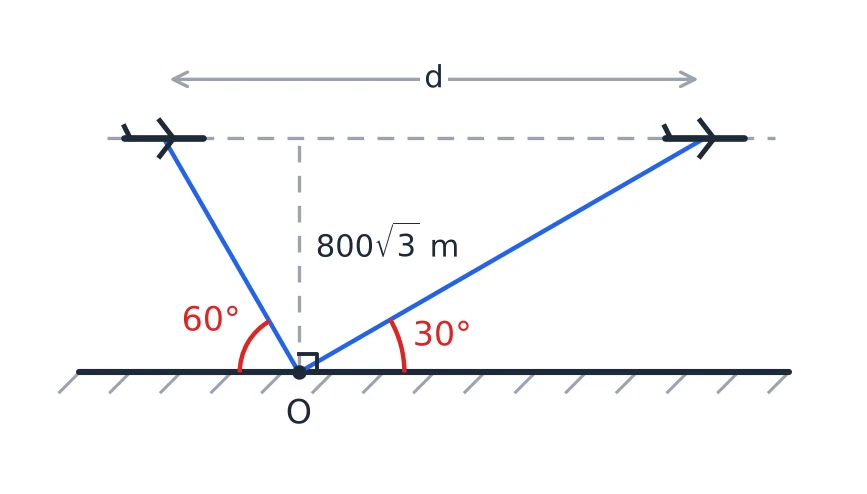
Answer. The plane crosses over the observer, so I add the two horizontal distances. Before: m on one side. After: m on the other. It flew 3200 m in 25 s, that is 128 m/s, and = 460.8 km/h.
Question 7
From the top of a building 18 m high, the angle of elevation of the top of a tower is and the angle of depression of its foot is . Find the height of the tower and the distance between the building and the tower. (Take .)
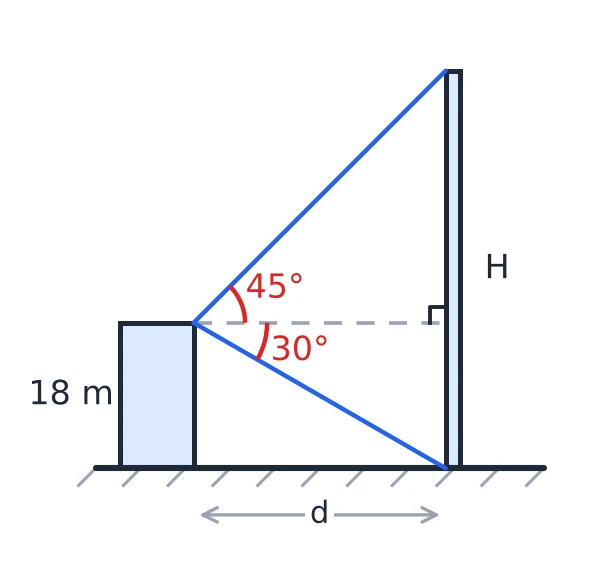
Answer. Below the eye line, the depression of the foot is , so the gap is m. Above the eye line the elevation is , so the tower rises another m above the roof level. The tower is = 49.18 m tall, and the gap is = 31.18 m.
Question 8
A man whose eyes are 1.7 m above the ground stands 30 m from a building and sees its top at an angle of elevation of . How tall is the building? (Take .)
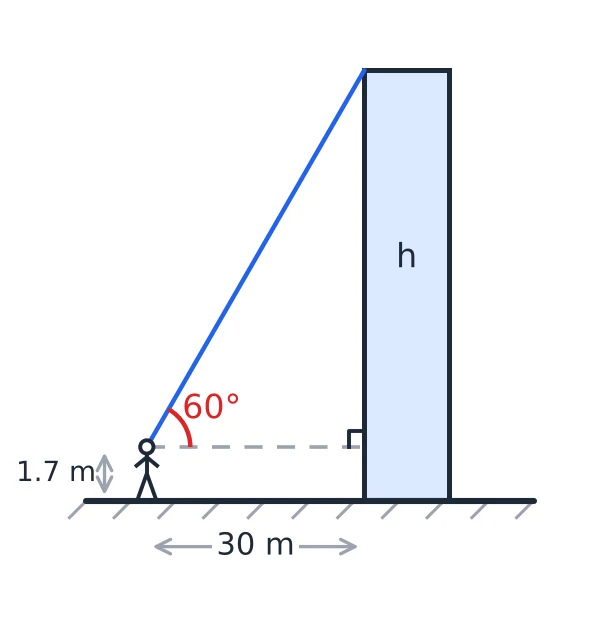
Answer. I work above his eye line first. There the building rises m. The eye line itself is 1.7 m above the ground, so the building is = 53.66 m tall.
Question 9
A tree breaks in a storm. The broken part makes an angle of with the part still standing, and its top touches the ground 9 m from the foot of the tree. Find the height of the tree before it broke. (Take .)
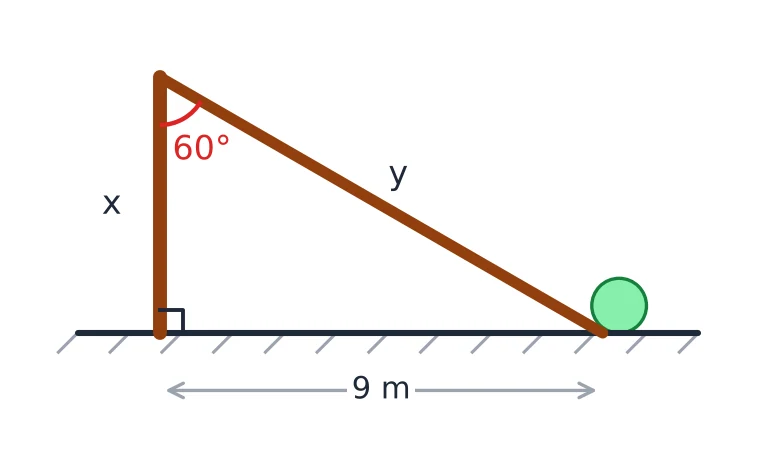
Answer. The is at the break, between the two parts, so the broken part makes with the ground. Now the standing part is m and the broken part is m. The tree was = 15.59 m tall.
Question 10
From an aeroplane flying 2.4 km above the ground, the angle of depression of a village is . How far is the village from the point on the ground directly below the aeroplane, and how far is it from the aeroplane? (Take .)
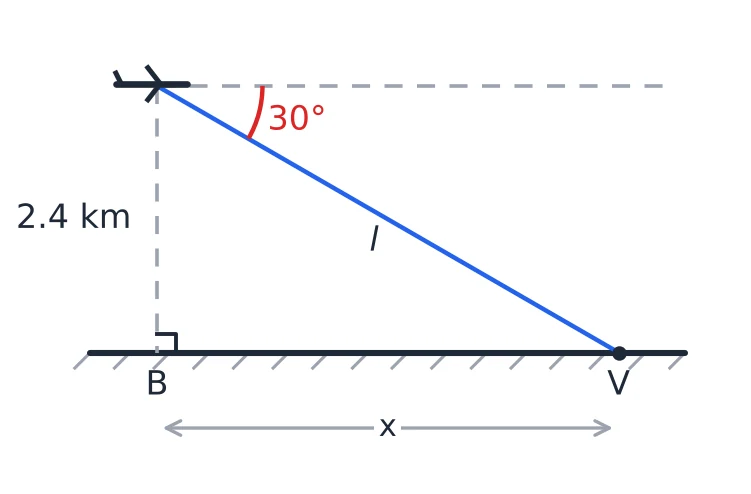
Answer. At the village, the angle of elevation of the plane is , so the height of 2.4 km is the 1-part side. The ground distance is parts: , about 4.16 km. The line of sight is 2 parts: 4.8 km.
Question 11
The angles of elevation of the top of a tower from two points 10 m and 30 m from its foot, on the same side and in line with it, are complementary. Find the height of the tower and the two angles.
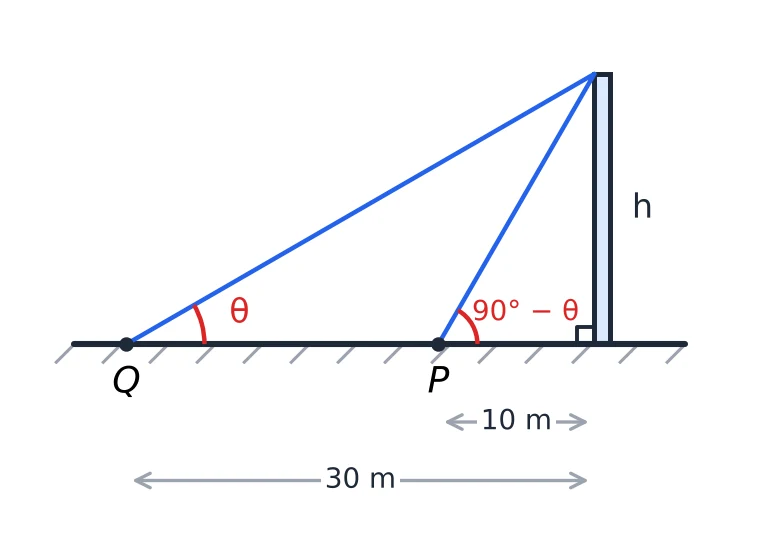
Answer. Complementary angles give , so h = m. From 10 m away, , so that angle is . From 30 m away, , so that one is . They add to , as they should.
Question 12
A balloon rises straight up from a point A at a steady 5 m/s. An observer stands on level ground 150 m from A. How long does the balloon take to go from an angle of elevation of to one of ? (Take .)
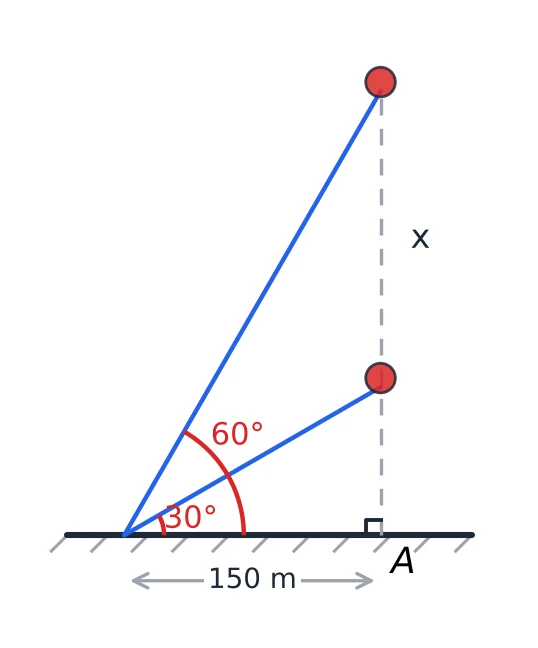
Answer. Here the observer's distance stays fixed at 150 m, so I find the two heights. At the balloon is m up, and at it is m up. It rises m between the two, which at 5 m/s takes = 34.64 seconds.
Question 13
A statue 5 m tall stands on a pedestal. From a point on the ground, the angle of elevation of the top of the pedestal is and that of the top of the statue is . Find the height of the pedestal. (Take .)
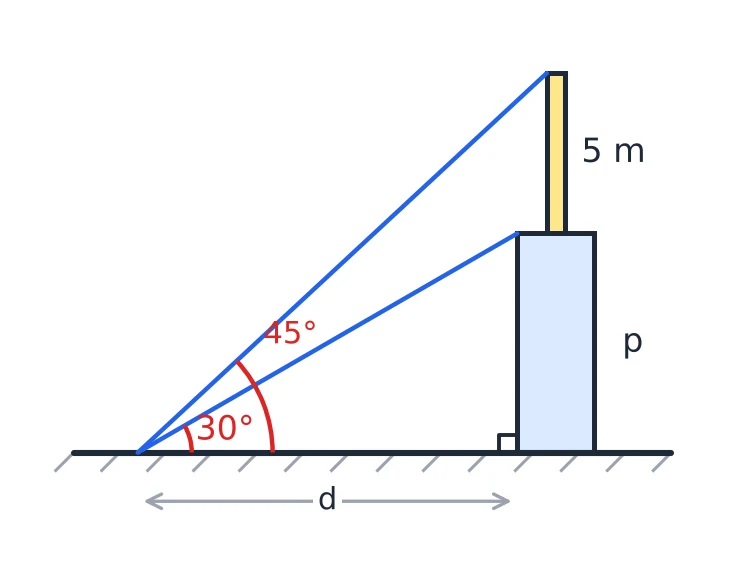
Answer. Both tops stand over the same distance d. At the top of the statue is d high, so . At the pedestal is , so . Then , , and = 6.83 m.
Question 14
A pole 6 m high casts a shadow m long on level ground. Find the sun's altitude. At the same moment a tower casts a shadow 15 m long; how tall is the tower?
Answer. , so the sun's altitude is . At that moment every height is times its shadow, so the tower is m, about 25.98 m.
Question 15
A ladder 13 m long leans against a wall and reaches a window 12 m above the ground. Its foot is then pulled away from the wall until the top is only 5 m above the ground. How far was the foot moved, and how far did the top slide down?
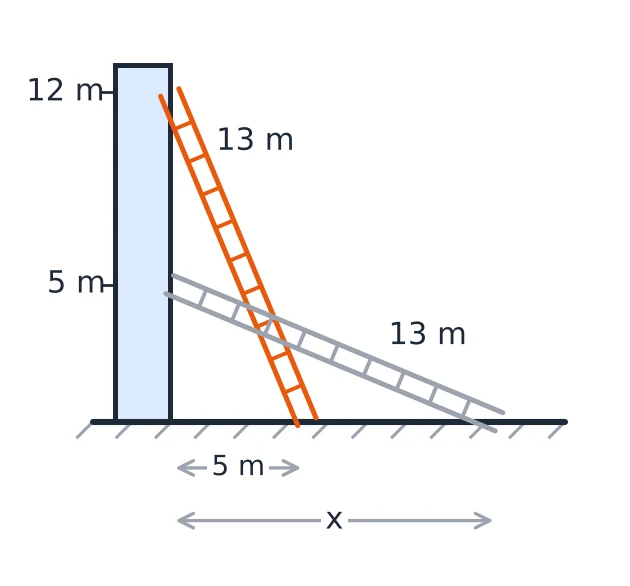
Answer. The ladder, the wall and the ground make a right triangle with hypotenuse 13 m (Pythagoras, see Chapter 12). At first the foot is m from the wall; afterwards it is m away. So the foot moved = 7 m, and the top slid from 12 m down to 5 m, also 7 m. Both positions are the 5-12-13 triangle, turned round.
Question 16
From the top of a cliff 84 m high, the angles of depression of two boats on the same side of the cliff are and . Find the distance between the boats. (Take .)
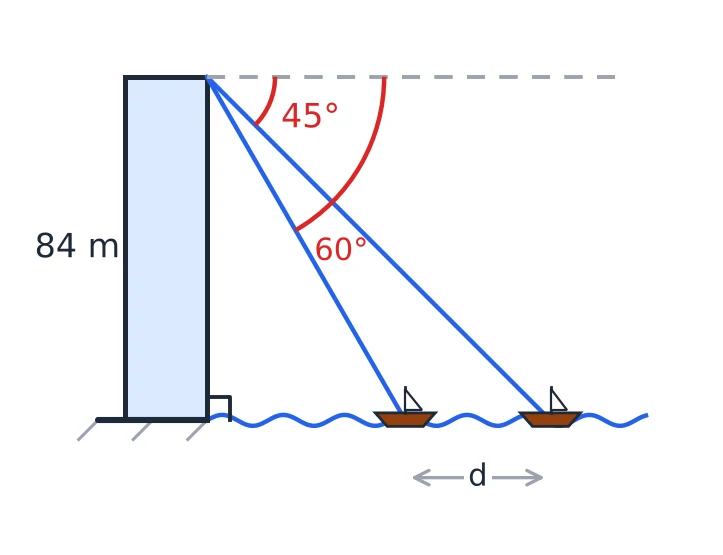
Answer. The larger angle belongs to the nearer boat. The boat at is m from the foot, and the boat at is 84 m from it. The boats are = 35.50 m apart.
Question 17
A truck moves at a steady speed along a straight road towards a tower. From the top of the tower, its angle of depression changes from to in 8 minutes. How much longer will it take to reach the foot of the tower? (Take .)
Answer. If the tower is h tall, the truck was away and is now h away. It covered in 8 minutes and has h still to go. The time left is = 10.93 minutes, about 10 minutes 56 seconds. I never needed the height of the tower.
Question 18
Two towers 28 m and 52 m tall stand facing each other on level ground. From the top of the shorter tower, the angle of elevation of the top of the taller one is . Find the distance between the towers and the length of the line joining their tops.
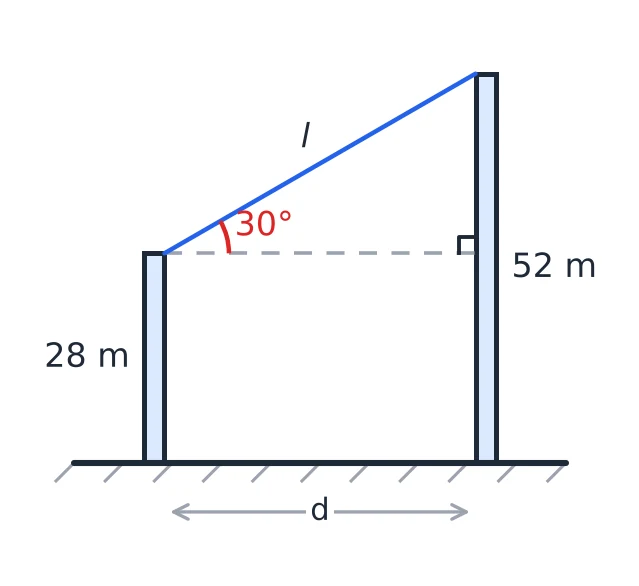
Answer. I draw a horizontal line from the top of the shorter tower. It meets the taller tower 28 m up and leaves 24 m above it, and that 24 m is opposite the . So 24 m is 1 part: the distance between the towers is parts, m, and the line joining the tops is 2 parts, 48 m.
Question 19
The angle of elevation of the top of a tower from a point 30 m from its foot is . Taking and , find the height of the tower.
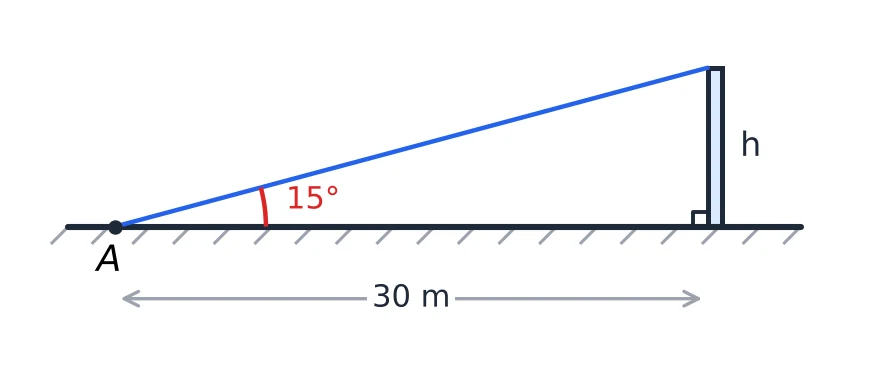
Answer. = 8.04 m. A height much smaller than the distance is just what a small angle like should give.
Question 20
A kite is flying 46.5 m above the ground. Its string is held 1.5 m above the ground, is pulled straight, and makes an angle of with the horizontal. Find the length of the string. (Take .)
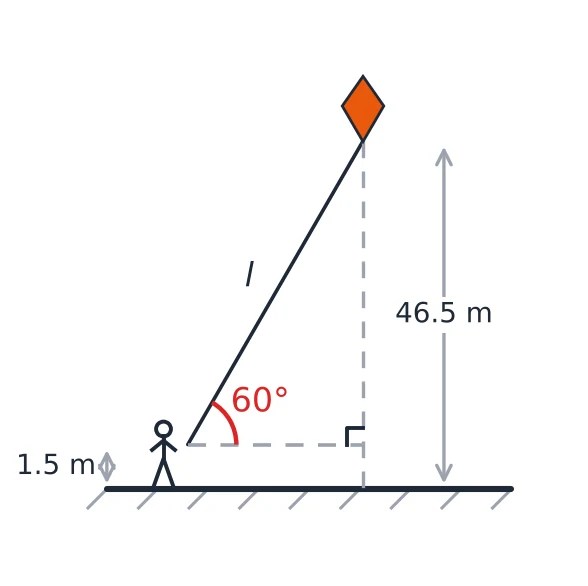
Answer. I measure from the hand, so the height in the triangle is m. The string is the hypotenuse: = 51.96 m.
Question 21
[Tier 2] A girl 1.6 m tall walks away from the foot of a lamp post at 1.2 m/s. The lamp is 4.8 m above the ground. Find the length of her shadow after 5 seconds.
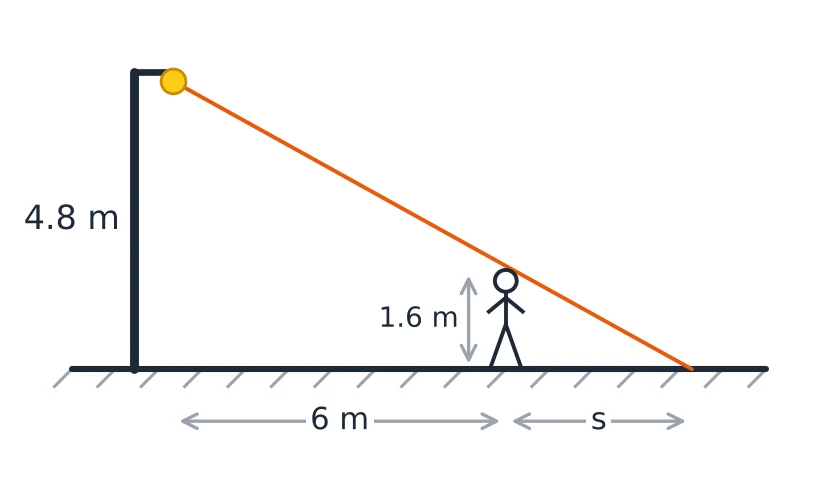
Answer. In 5 seconds she walks m. The ray from the lamp just touches her head and ends at the tip of her shadow, so the girl and the lamp post stand in two similar right triangles that share the angle at the tip. If her shadow is s m long, then . So , which gives , and her shadow is 3 m long.
Question 22
Two boats are on opposite sides of a lighthouse 75 m tall, in a straight line with its foot. From the top, the angles of depression of the boats are and . Find the distance between the boats. (Take .)
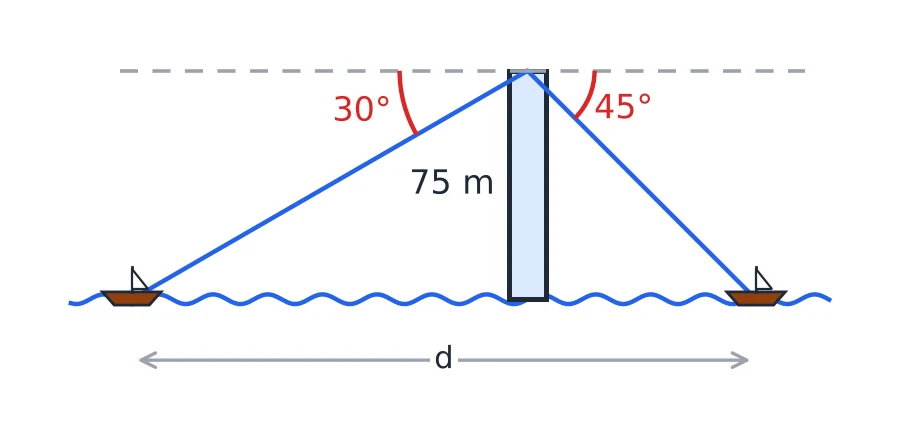
Answer. Each depression equals the elevation at its own boat. The boat at is 75 m from the foot, and the boat at is m from it. They are on opposite sides, so I add: = 204.9 m.
Question 23
Two poles of equal height stand on opposite sides of a road 72 m wide. From a point on the road between them, the angles of elevation of their tops are and . Find the height of the poles and the distances of the point from them.
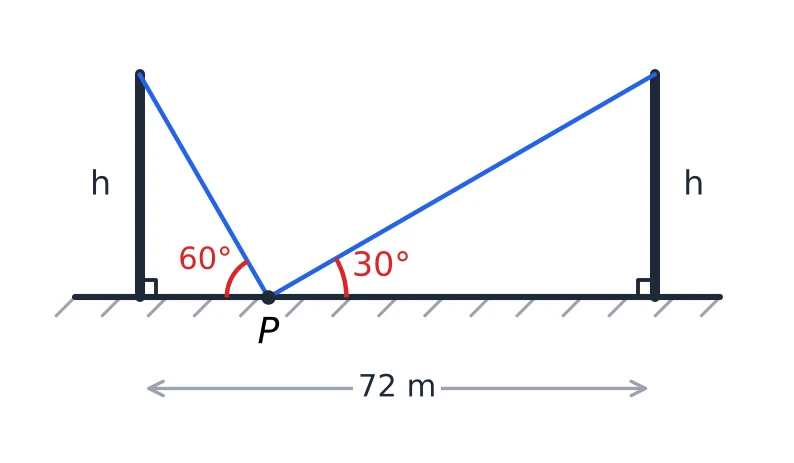
Answer. Call the height h. The point is from one pole and from the other, and together these fill the road: . So h = m, about 31.18 m. The point is = 18 m from the first pole and = 54 m from the other.
Question 24
A man walks briskly straight towards a tower at 6 km/h. In 2 minutes the angle of elevation of its top changes from to . Find the height of the tower, and how long he still needs to reach it at the same speed. (Take .)
Answer. First the walk in metres: m/s, and 2 minutes is 120 seconds, so he walks m. From to the walk is twice the distance left, so 100 m remain, and the height is = 173.2 m. The 100 m left is half of what he has walked, so it takes half the time: 1 minute.
Question 25
From the top of a hill, the angle of depression of a milestone on the level road below is , where . The milestone is 1.2 km from the point directly below the top of the hill. Find the height of the hill and the straight-line distance from the top to the milestone.
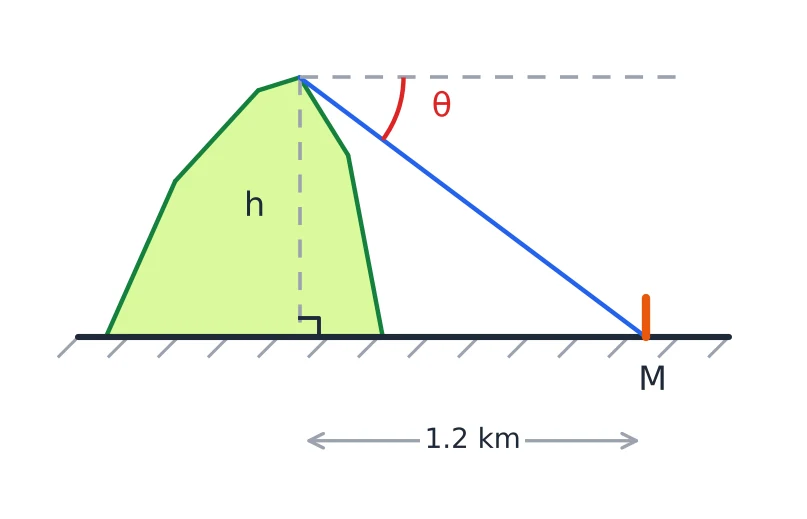
Answer. At the milestone the angle of elevation of the top is , so height : ground distance , and the 3-4-5 triplet makes the line of sight 5 parts. 4 parts are 1.2 km, so one part is 0.3 km. The hill is = 0.9 km (900 m) high, and the top is = 1.5 km from the milestone.
Question 26
From a window 15 m above the ground, the angle of elevation of the top of a tower across the street is . From the foot of the building, directly below the window, the angle of elevation of the same top is . Find the height of the tower and the width of the street. (Take .)
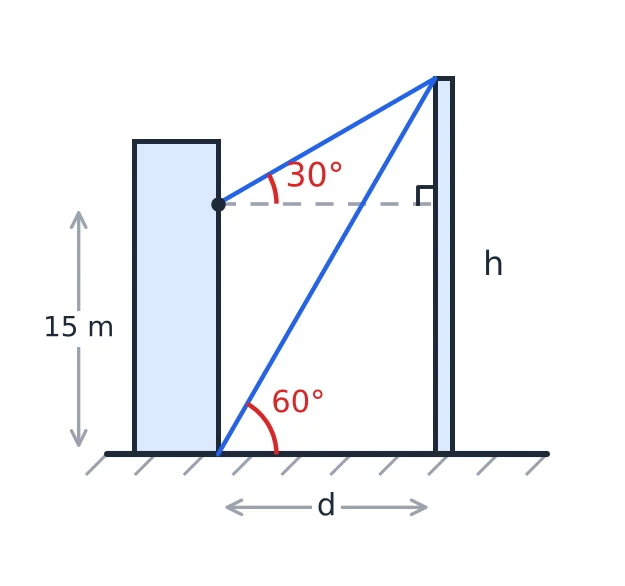
Answer. Let the street be d wide and the tower h tall. From the ground, . From the window the top is above the eye line, so . Taking the second from the first, , that is , so = 12.99 m. Then = 22.5 m.
Question 27
From a point 60 m from the foot of a tower, the angle of elevation of its top is . How far must one walk towards the tower for the angle to become , and how much farther for it to become ? (Take .)
Answer. The tower is m tall. At the distance equals the height, m, so the first walk is = 25.36 m. At the distance is m, so the second walk is = 14.64 m. The two walks make 40 m, twice the 20 m still left, which is the -to- rule again.
Question 28
The angle of elevation of the top of tower B from the foot of tower A is , and the angle of elevation of the top of A from the foot of B is . B is 45 m tall. Find the height of A and the distance between the towers.
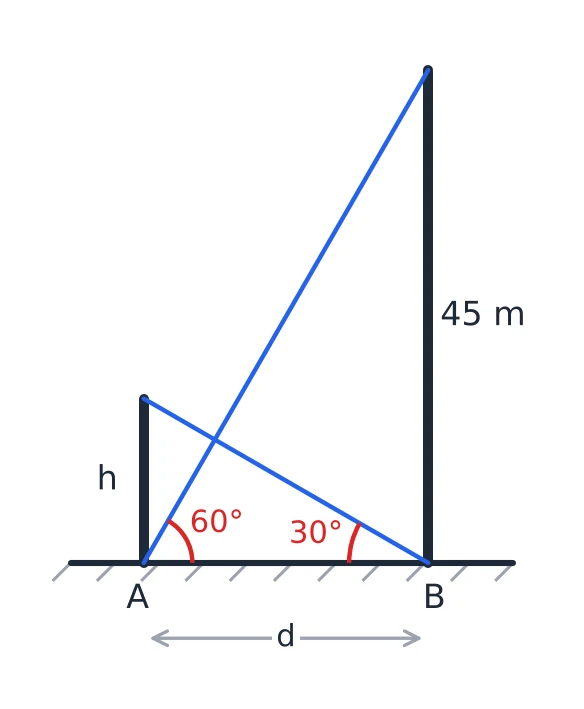
Answer. Both triangles stand on the same base d, the distance between the feet. From A's foot, , so d = m. From B's foot, the height of A is = 15 m. In one line: the heights are in the ratio .
Question 29
A straight road up a hill rises at a steady angle of to the horizontal. A cyclist rides up it at 14 km/h. How many metres higher is he after 3 minutes?
Answer. In 3 minutes he rides km, that is 700 m along the road. The road is the hypotenuse and the rise is opposite the , so he is = 350 m higher.
Question 30
From the top of a building 60 m high, the angles of depression of the top and the foot of a lamp post are and . Find the height of the lamp post and its distance from the building. (Take .)
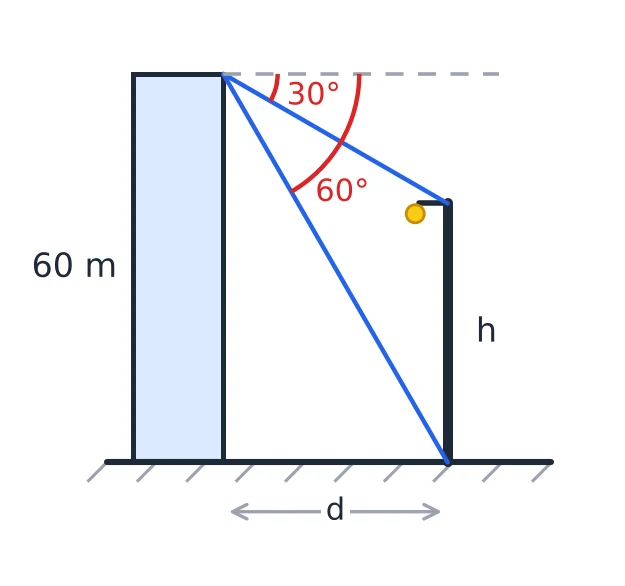
Answer. The foot gives the distance: m, about 34.64 m. The top of the post is below the roof's eye line by m, so the lamp post is = 40 m tall.
Question 31
[Tier 2] From a point 12 m above the surface of a lake, the angle of elevation of a cloud is , and the angle of depression of its reflection in the lake is . Find the height of the cloud above the lake. (Take .)
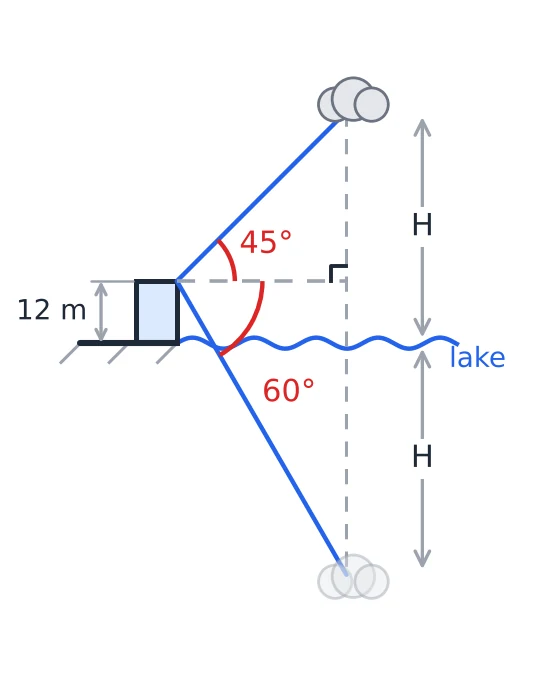
Answer. Let the cloud be H above the lake and x away horizontally. The reflection is as far below the surface as the cloud is above it, so it is H below. Seen from the point 12 m up, the cloud is above the eye line and the reflection is below it. So and . Taking the first from the second, , so . Then = 44.78 m.
Question 32
[Tier 2] From two points on the same side of a tower, d apart and in line with its foot, the angles of elevation of its top are and , with . Show that the height of the tower is .
Answer. The nearer point sees the larger angle , so it is from the foot, and the farther point is from it. Their gap is d: . Writing each cot as 1 over tan, , so . A quick test with , and : the formula gives , the same as from the -to- rule.