
The Sun's Altitude and a Shadow
The sun is so far away that its rays reach us as parallel straight lines. A ray that just grazes the top of a pole carries on to the ground, and the point where it lands is the end of the pole's shadow. The altitude of the sun (also called the angle of elevation of the sun) is the angle that this ray makes with the ground.
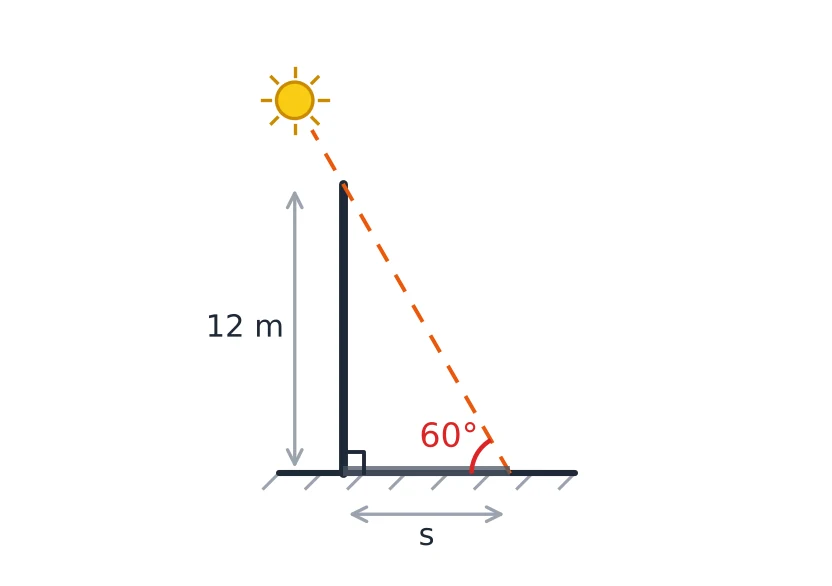
The pole, its shadow and the ray make a right triangle. The pole is opposite the sun's angle and the shadow is next to it, so
The pole in the figure is 12 m tall and the sun is at 60°, so the shadow is m, about 6.9 m.
Each standard angle has a shape worth knowing on sight:
| Sun's altitude | Length of the shadow |
|---|---|
| 60° | , shorter than the pole |
| 45° | h, equal to the pole |
| 30° | , longer than the pole |
Read the table backwards to find the angle. A tower whose shadow is as long as the tower means a sun at 45°. A shadow times the height means 30°. A 9 m pole with a shadow of m gives , so the sun is at 60°.
Height from a shadow. A flagstaff throws a 27 m shadow when the sun is at 30°. Its height is m.
A high sun gives a short shadow. That picture alone rules out an option such as m for the shadow of the 12 m pole above: with the sun at 60°, the shadow must be shorter than the pole.
Two Shadows at the Same Moment
At any one moment the sun is at the same altitude for every object in the same place, so all their shadow triangles have the same angle and are similar. Height and shadow keep the same ratio for each of them:
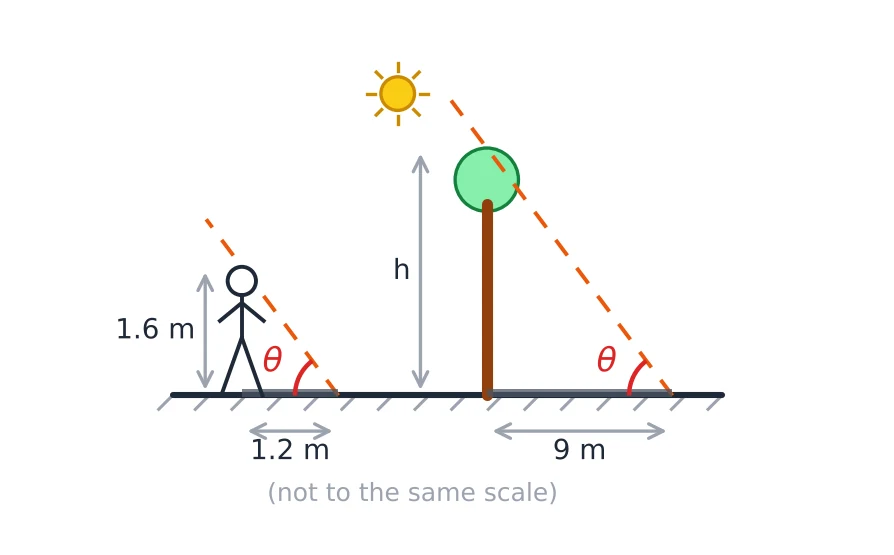
No angle is needed. A girl 1.6 m tall casts a shadow 1.2 m long, and at the same time a tree casts a shadow 9 m long. Then
The ratio is at that moment, a sun a little above 53°. You never need it in degrees; the ratio does the work.
This is the same proportion as in Chapter 4: a taller object, a longer shadow, in the same ratio.
Storeys of a building. If every storey has the same height, a building's height is proportional to its number of storeys, so storeys and shadows are in proportion too. A 6-storey building casts a 27 m shadow. A building of the same kind that casts a 45 m shadow at the same time has
The same object at two different times is another kind of question: the angle has changed, so the ratio has changed. That comes next.
[SSC Tip] Keep both ratios the same way up, height over shadow on both sides. Writing gives 6.75 m, and a question will often offer that wrong number.
The Shadow Grows as the Sun Goes Down
Through the afternoon the sun sinks, its altitude falls, and the shadow of a pole gets longer. For a pole of height h,
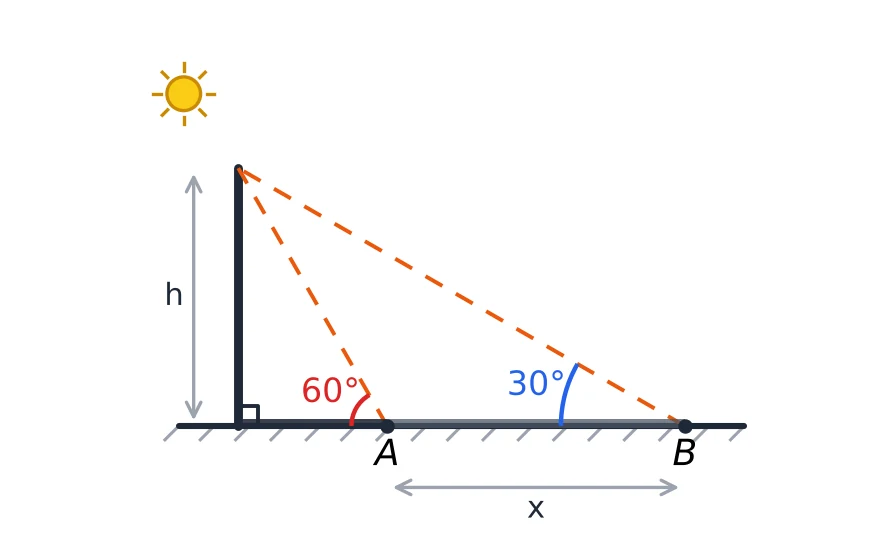
The second is three times the first, since . When the sun's altitude falls from 60° to 30°, the shadow becomes three times as long, and the increase AB in the figure is two of the old shadows:
For the 24 m pole in the figure, the shadow is m at 60° and m at 30°, so it grows by m.
The increase given, the height wanted. Turn the formula round: . If a tower's shadow is 40 m longer when the sun is at 30° than when it is at 60°, the tower is m tall.
From 45° to 30°. The shadow goes from h to , an increase of . A shadow 30 m longer means
after multiplying the top and the bottom by .
In the morning the sun climbs and the shadow shortens. From 30° to 60° it shrinks to a third, losing the same .
The general rule, increase , is the one used when an observer walks towards a tower, and it is worked through in Two Angles and Moving Objects.
A Lamp Post and a Person's Shadow
[Tier 2] A street lamp is not the sun. Its light starts from one point at a fixed height, so its rays spread out instead of running parallel, and the shadow of a person near it is found with similar triangles.
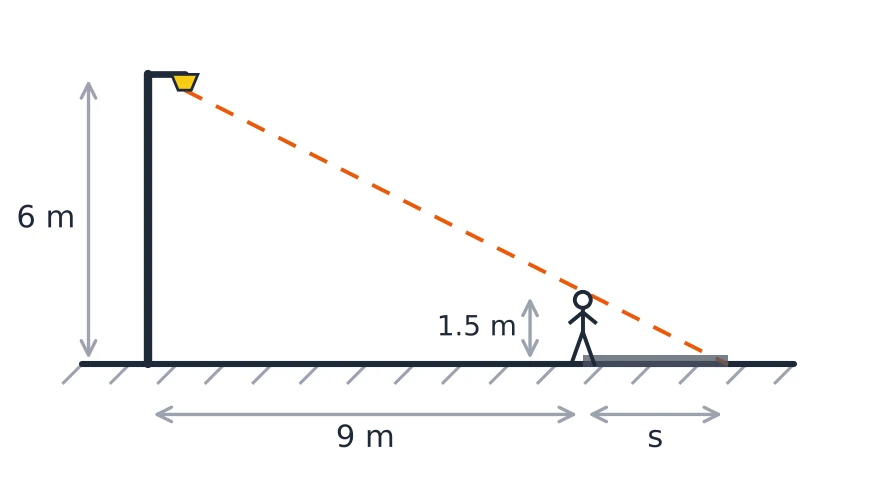
A lamp is fixed 6 m up a post. A man 1.5 m tall stands 9 m from the foot of the post, and his shadow is s m long. The ray from the lamp over his head lands at the end of his shadow. The small triangle (the man and his shadow) and the big triangle (the post and the whole distance 9 + s) share the angle at the tip, so
The end of the shadow is 9 + 3 = 12 m from the post.
A shorter form. Cross-multiplying in general gives
where H is the height of the lamp, h the height of the person and d the person's distance from the post. Here m.
Walking away. The formula shows that the shadow is a fixed fraction of d; here . If the man walks away from the post at 1.2 m/s, his shadow grows at 0.4 m/s, and the tip of the shadow moves at 1.2 + 0.4 = 1.6 m/s.
The mistake to avoid is , which treats the lamp as if it were the sun and gives 2.25 m.
A Ladder Against a Wall
A ladder leaning on a wall makes a right triangle with the ladder as the hypotenuse: the wall gives the height reached, and the ground from the wall to the foot is the base. The right angle is at the bottom of the wall.
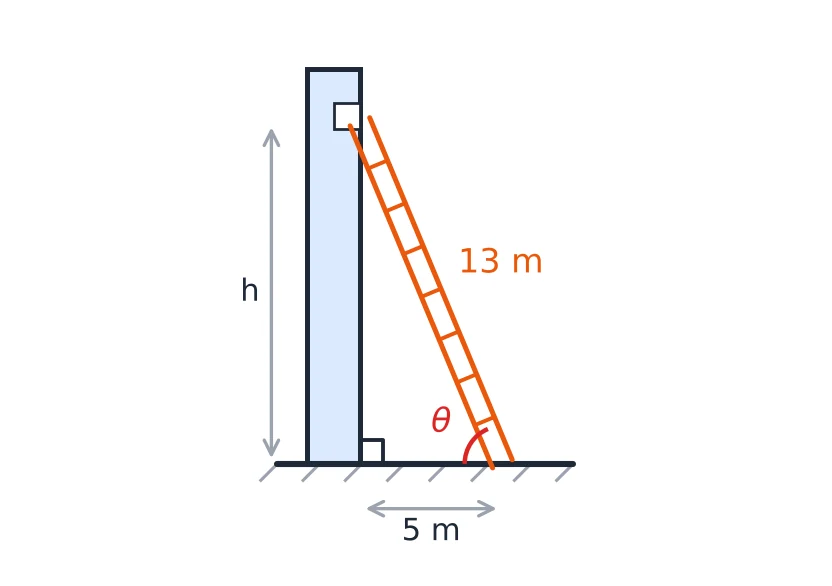
Three lengths, no angle. Pythagoras (see Chapter 12) joins them:
The ladder in the figure is 13 m long with its foot 5 m from the wall, so it reaches m up the wall. Triplets save the square root: 5, 12, 13 here; also 6, 8, 10; 8, 15, 17; 7, 24, 25.
An angle given. The angle the ladder makes with the ground is at its foot. The height is opposite it and the distance from the wall is next to it:
A 10 m ladder at 60° to the ground has its foot 5 m out and reaches m up. A ladder that reaches a window 6 m high at 60° is m long.
The angle with the wall. A ladder that makes 30° with the wall makes 60° with the ground. Change it first, or work at the top corner, where the wall is next to the angle and the distance from the wall is opposite it.
A quick check. The ladder is the longest side. It is always longer than the height it reaches and longer than the distance of its foot from the wall; an answer that breaks this has a side in the wrong place.
A Ladder Across a Street
A ladder stands with its foot at a point in a street between two buildings. Leaning one way, it reaches a window on one side; turned round with its foot in the same place, it reaches a window on the other side. The length of the ladder is the same both times, so there are two right triangles with the same hypotenuse.
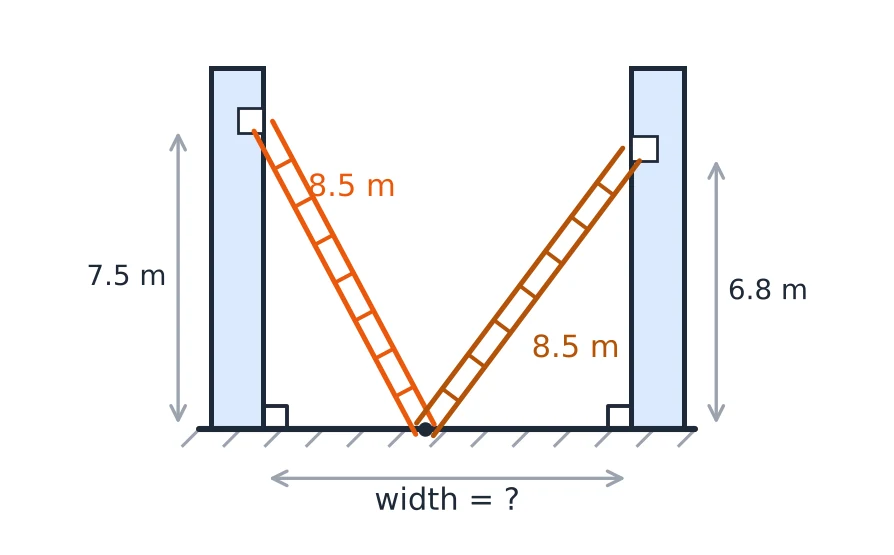
The width of the street is the sum of the two distances of the foot from the walls. In the figure the ladder is 8.5 m long and reaches windows 7.5 m and 6.8 m high:
So the street is 4 + 5.1 = 9.1 m wide. The two square roots come out exactly because 8.5, 7.5, 4 is the 8, 15, 17 triangle halved and 8.5, 6.8, 5.1 is the 3, 4, 5 triangle times 1.7.
With angles. If the ladder of length L makes angles and with the ground on the two sides,
A 16 m ladder making 60° on one side and 45° on the other spans m.
The higher window is reached when the ladder stands steeper, so it is on the side where the foot is nearer the wall. Adding the two heights, or subtracting the two foot distances, are the wrong turns to watch for.
A Ladder That Slides, and a Leaning Pole
When the top of a ladder slips down a wall, its foot is pushed out along the ground. The length does not change, so Pythagoras holds in both positions.
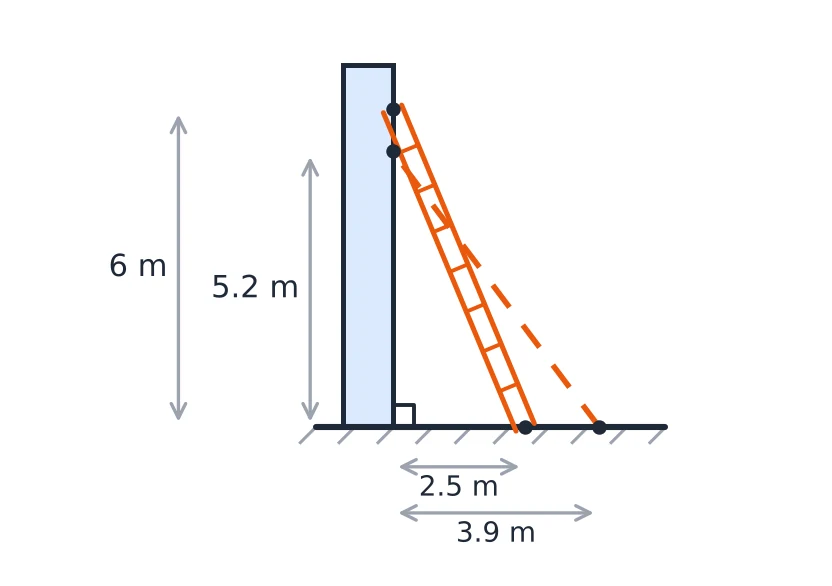
In the figure a 6.5 m ladder first stands with its foot 2.5 m from the wall, so its top is m up. The top slips 0.8 m, down to 5.2 m. Now the foot is m from the wall, so it has moved out 3.9 − 2.5 = 1.4 m. The top dropped 0.8 m but the foot moved 1.4 m: the two movements are not equal in general.
With angles. A ladder of length L slides from 60° with the ground to 30°. The top comes down , and the foot moves out , which is the same amount, because 60° and 30° swap their sine and cosine.
A pole leaning on a wall. A bamboo, a pole or a plank leaning on a wall is worked exactly like a ladder. A 12 m pole at 45° to the ground reaches m up, with its foot the same m out. A 12 m pole that makes 30° with the wall makes 60° with the ground: its foot is m from the wall and its top is m up.
[SSC Tip] Before choosing sin or cos, check whether the angle is with the ground or with the wall. For that last pole the two readings give 6 m and m, and a question may offer both.
Kite Strings and Balloons on a Rope
A kite string pulled tight is a straight line from the hand to the kite, so it is the hypotenuse of a right triangle. The height of the kite is the vertical side, and the angle the string makes with the ground is at the bottom corner.
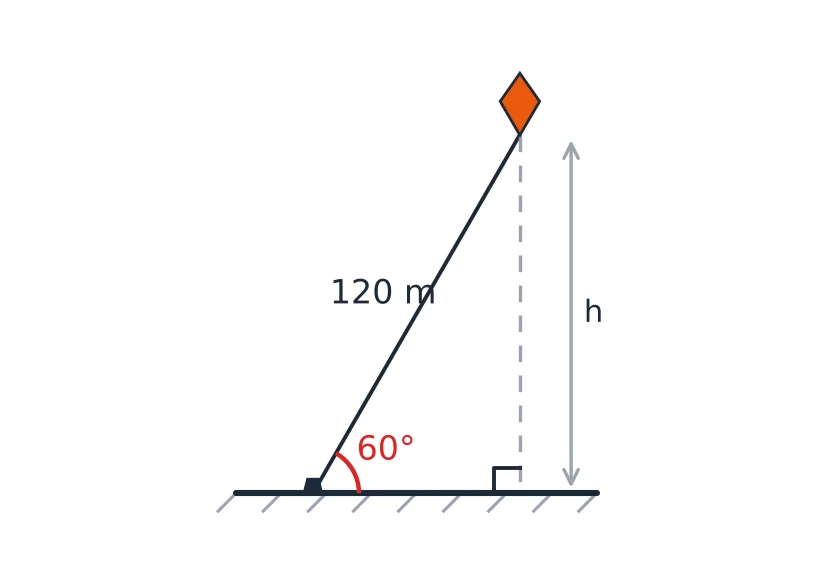
The kite in the figure flies on a 120 m string at 60°, so it is m high, about 103.9 m.
String needed. To fly a kite 45 m high with the string at 30°, the string must be m long. At 30° the string is always twice the height.
The hand above the ground. If the string is held 1.5 m above the ground, the triangle starts at the hand, and the kite is m above the ground. It is the same adjustment as adding an observer's eye height.
A balloon on a rope is the same picture. A balloon held 75 m up by a straight rope at 60° to the ground uses m of rope.
The string is taken as straight; any sag is ignored. And the string can never be shorter than the height of the kite, which is a fast way to discard an option.
Wires, Guy Ropes and a Rope down a Cliff
A wire from the top of a pole pulled tight to a peg in the ground (a guy wire), or a rope tied at the top of a cliff and pegged out on level ground, is again a hypotenuse. The pole or the cliff is the height, and the distance from its foot to the peg is the base.
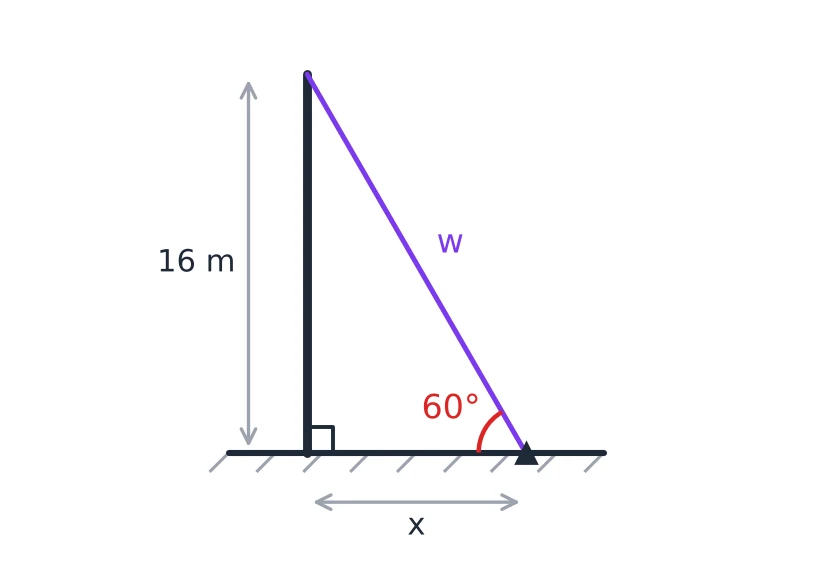
The pole in the figure is 16 m tall and the wire makes 60° with the ground. Then
The wire is exactly twice x: at 60° the base is half the hypotenuse.
The wire given. A wire 20 m long runs from the top of a pole to the ground at 30°. The pole is m tall, and the peg is m from its foot.
A rope down a cliff. A rope from the top of a 42 m cliff, pegged to level ground at 30°, is twice the height of the cliff: 84 m. Its peg is m from the foot of the cliff.
The angle from two lengths. A 26 m wire pegged 13 m from the foot of a pole has , so it makes 60° with the ground, and the pole is m tall.
Swap the wire for a line of sight and these are the triangles of Angles of Elevation and Depression, so the reading works the same way.
Two Poles and the Distance Between Their Tops
Two vertical poles of heights a and b stand d apart on level ground. Draw a horizontal line from the top of the shorter pole across to the taller one. It makes a right triangle whose legs are d and b − a, and the line joining the tops is its hypotenuse:
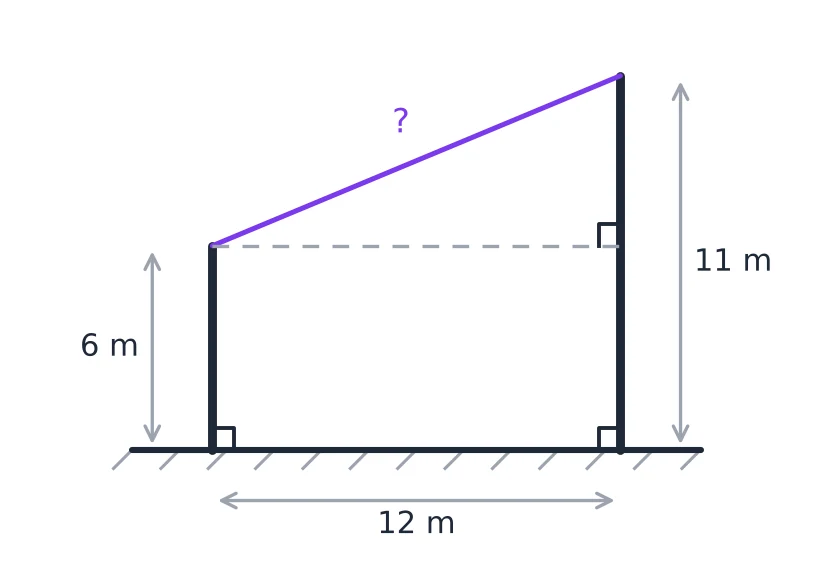
For poles 6 m and 11 m high standing 12 m apart, the difference in height is 5 m, so the tops are m apart.
A wire between the tops. If the wire joining the tops makes an angle with the horizontal, the same small triangle gives
Take poles 8 m and 20 m high whose tops are joined by a wire at 30° to the horizontal. The difference, 12 m, is opposite the 30°, so the wire is 24 m and the poles are m apart.
Use the difference, not the heights. Putting 11 m (or 6 m) into Pythagoras instead of 11 − 6 = 5 m is the mistake to avoid. For the poles above it gives m, which looks reasonable and is wrong.
Questions that look from the top of one tower at the top and foot of another, or from a point between two poles, are in Two Heights: Towers, Buildings and Statues.
Slopes and Ramps
A ramp, a sloping road or a hill path is a right triangle lying on its side. The sloping surface is the hypotenuse, the rise is the vertical side and the horizontal run is the base. The angle of the slope is at the bottom, between the ground and the ramp.
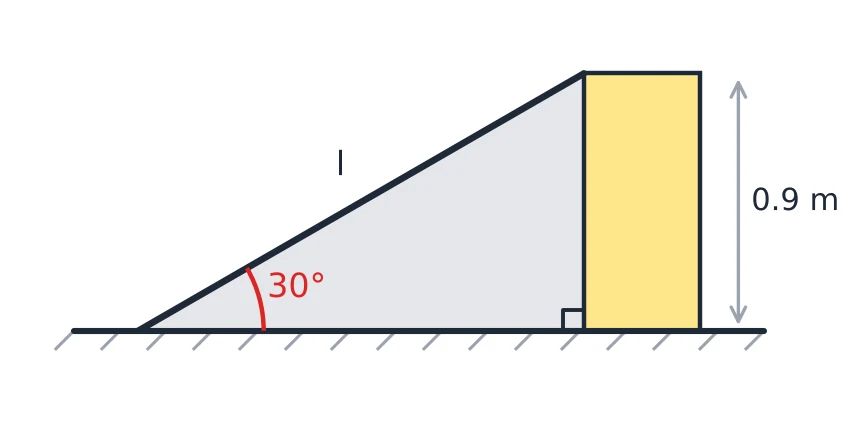
A ramp to a platform. A ramp up to a platform 0.9 m high is to make 30° with the ground. Its length is m, and it starts m from the platform. At 30° a ramp is always twice as long as its rise.
Steeper means shorter. A 45° ramp to the same platform would be only m long, but much harder to push a wheelchair up.
Walking up a slope. A path up a hill rises at 30°. Walking 500 m along it lifts you m, while you move m across the map. The distance walked is the hypotenuse, not the horizontal distance.
A slope given as a ratio. A ramp that rises 5 cm for every 12 cm of horizontal run has . To rise 0.6 m it needs a run of 1.44 m, and its length is the 13 side: 1.56 m.
Mark the rise, the run and the slope before you start. The run and the slope are easy to swap, and the choices usually include both.
A Tree Broken by the Wind
A storm snaps a tree at some height. The top part falls over until its tip touches the ground, while it stays joined to the stump at the break. That gives three pieces of a right triangle:
- the standing part a, which is vertical;
- the broken part b, the hypotenuse, from the break down to the tip;
- the distance d along the ground from the foot of the tree to the tip.
The whole tree was a + b, the standing part plus the broken part.
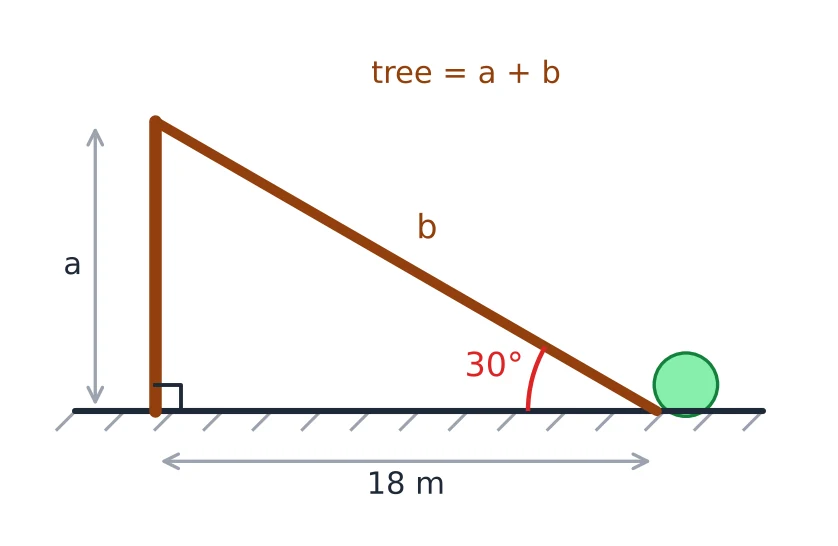
The angle given is usually the one the broken part makes with the ground, at the tip. Then
In the figure the tip lands 18 m from the foot, with the broken part at 30° to the ground. So m, m, and the tree was m tall, about 31.2 m.
At 30° the tree breaks at one third of its height. Since b = 2a, the whole tree is 3a. A 27 m tree whose top makes 30° with the ground broke 9 m up; the broken part is 18 m long and the tip is m from the foot.
At 60°, and . At 45°, a = d and .
The angle with the trunk. If the broken part makes 60° with the standing part, the angle at the tip is 30°. Read which two pieces the angle lies between.
The question may want the height of the whole tree, the height of the break or the length of the broken part, and all three are in the options. Underline the one asked.
Solved Examples
Question 1
A vertical pole 15 m high stands on level ground. How long is its shadow when the sun's altitude is 60°? (a) m (b) m (c) 30 m (d) 7.5 m
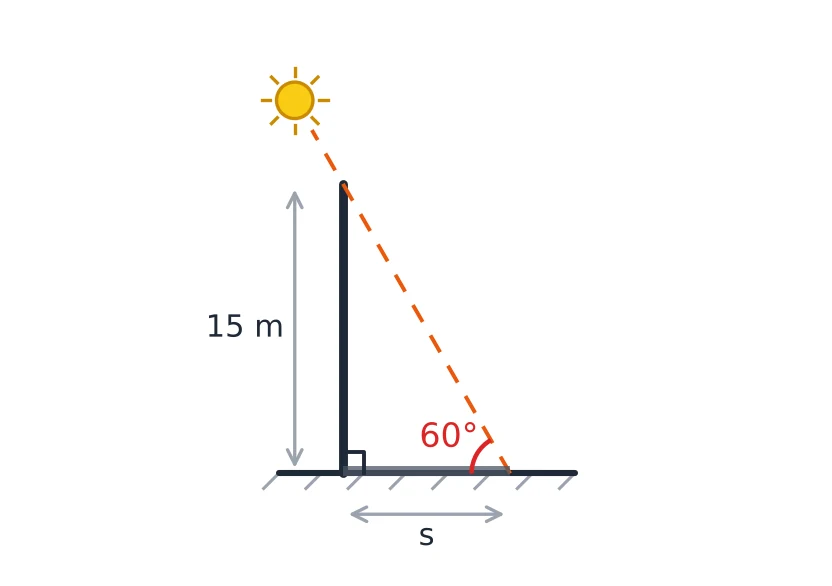
Answer. The pole is opposite the sun's 60° and the shadow is next to it, so the shadow is (b) m, about 8.7 m. A high sun makes a short shadow, so anything longer than 15 m is wrong straight away.
Question 2
A tower 33 m high casts a shadow m long. What is the angle of elevation of the sun? (a) (b) (c) (d)
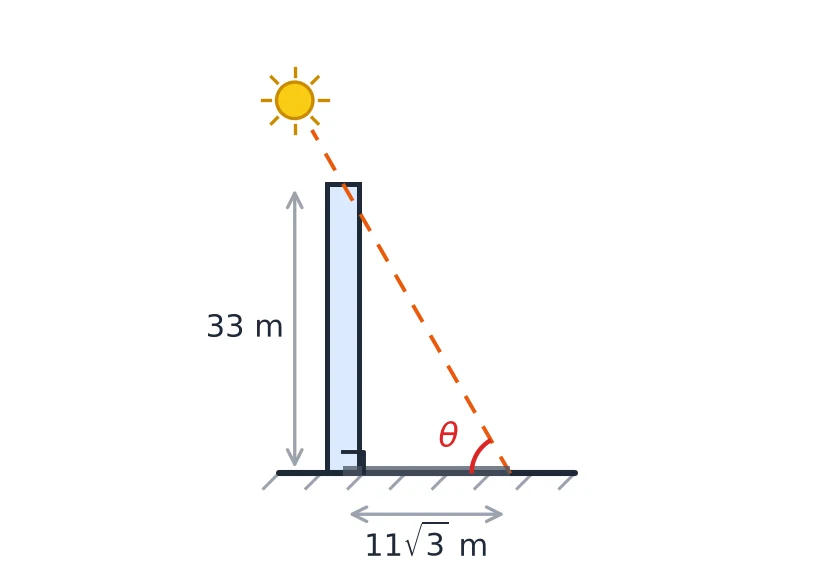
Answer. , so the sun is at (c) . The shadow, about 19 m, is shorter than the tower, which already told me the sun was above 45°.
Question 3
At a certain time the shadow of a flagstaff is 36 m long and the sun's altitude is 30°. How tall is the flagstaff? (a) m (b) m (c) 18 m (d) m
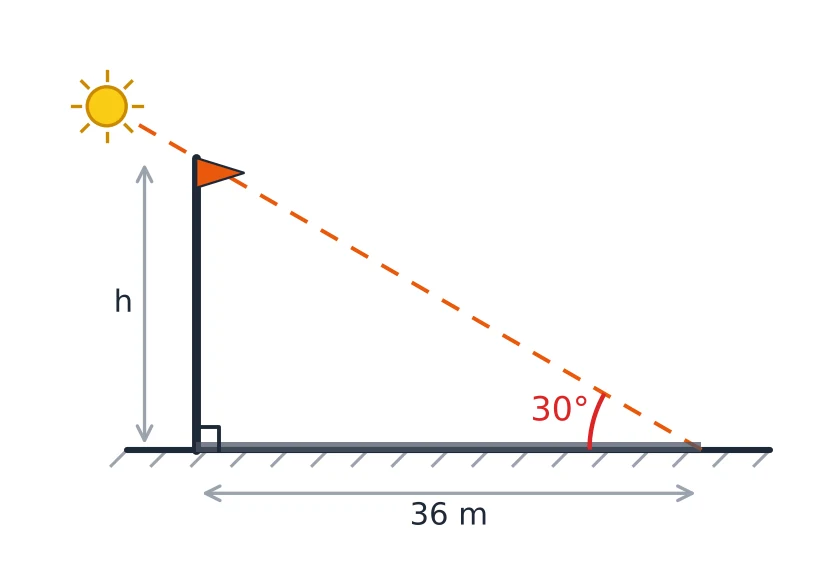
Answer. Height is shadow times tan of the sun's angle: (a) m. At 30° the shadow is times the height, and confirms it.
Question 4
A man 1.75 m tall casts a shadow 2.1 m long. At the same time a tree casts a shadow 18 m long. How tall is the tree? (a) 21.6 m (b) 12 m (c) 16.5 m (d) 15 m
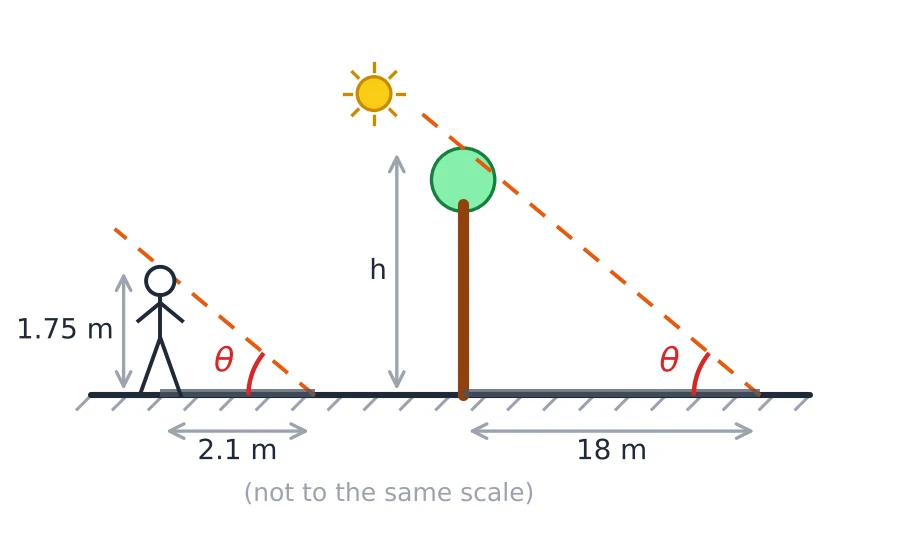
Answer. The sun is at the same angle for both, so height over shadow is the same for both: . So (d) 15 m. Turning one ratio upside down gives m.
Question 5
A building of 5 storeys casts a shadow 22.5 m long. At the same time another building, whose storeys are all of the same height as the first, casts a shadow 36 m long. How many storeys does it have? (a) 6 (b) 7 (c) 8 (d) 9
Answer. All the storeys are the same height, so the number of storeys goes up in step with the shadow. (c) 8. Another way: each storey casts m of shadow, and 36 ÷ 4.5 = 8.
Question 6
A tower is 30 m high. By how much is its shadow longer when the sun's altitude is 30° than when it is 60°? (a) m (b) m (c) m (d) 20 m
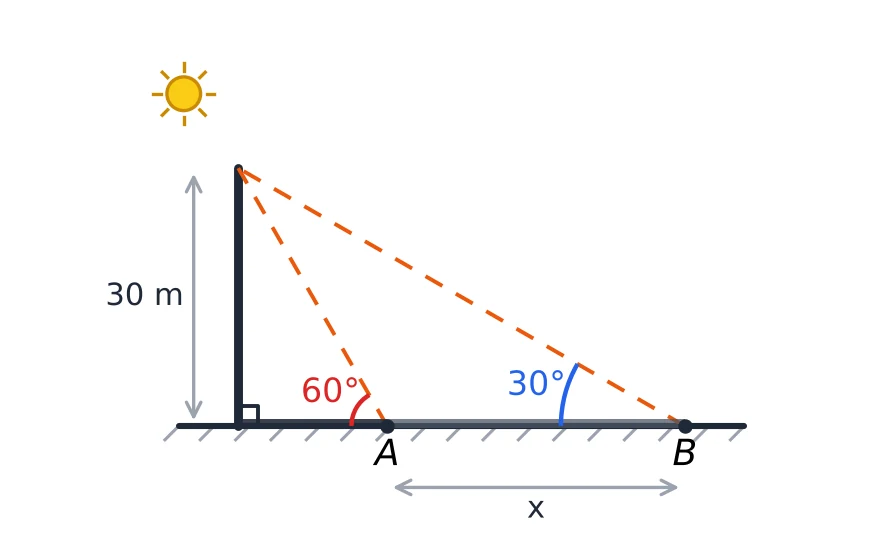
Answer. At 60° the shadow is m; at 30° it is m. The difference is (a) m. The short way: the increase is m.
Question 7
The shadow of a tower is 50 m longer when the sun's altitude is 30° than when it is 60°. What is the height of the tower? (a) 25 m (b) m (c) m (d) m
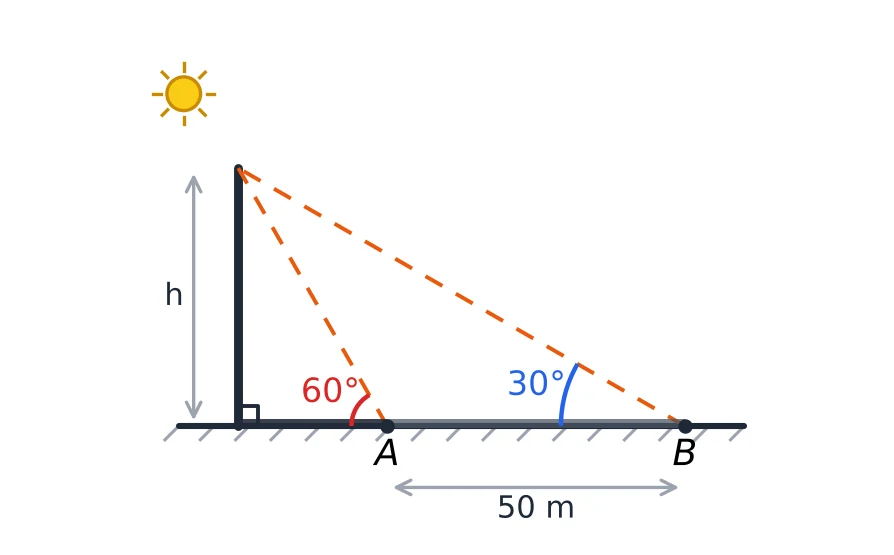
Answer. I call the height h. The two shadows are and , and their difference is . So , which gives h = (c) m, about 43.3 m.
Question 8
The shadow of a pole is 18 m longer when the sun's altitude is 30° than when it is 45°. How tall is the pole? (a) m (b) m (c) m (d) m
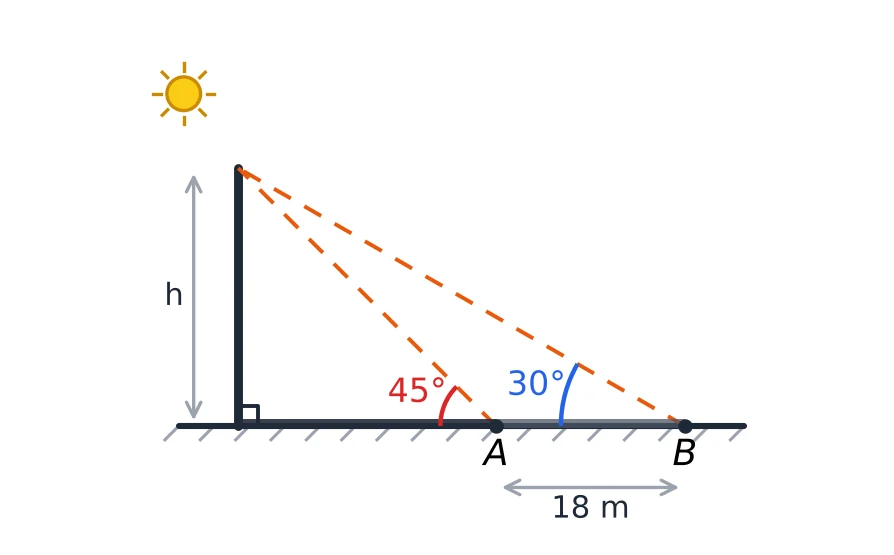
Answer. At 45° the shadow equals the height h; at 30° it is . The increase is , so . Multiplying the top and the bottom by makes the bottom 3 − 1 = 2, and h = (a) m, about 24.6 m.
Question 9
[Tier 2] A lamp is fixed at the top of a post 7.2 m high. A boy 1.2 m tall stands 10 m from the foot of the post. How long is his shadow? (a) 2 m (b) 1.67 m (c) 12 m (d) 6 m
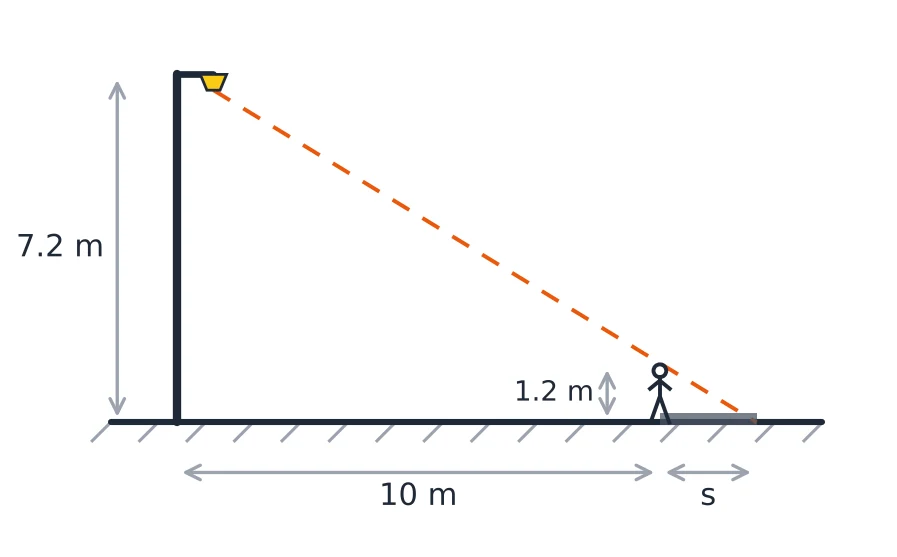
Answer. The light comes from one point, so I use similar triangles. The boy with his shadow s makes a small triangle; the post with the distance 10 + s makes a big one, with the same angle at the tip of the shadow. , so , then and s = (a) 2 m. The tip of the shadow is 12 m from the post.
Question 10
A ladder 26 m long rests against a wall and reaches a window 24 m above the ground. How far is the foot of the ladder from the wall? (a) 2 m (b) 10 m (c) 13 m (d) 12 m
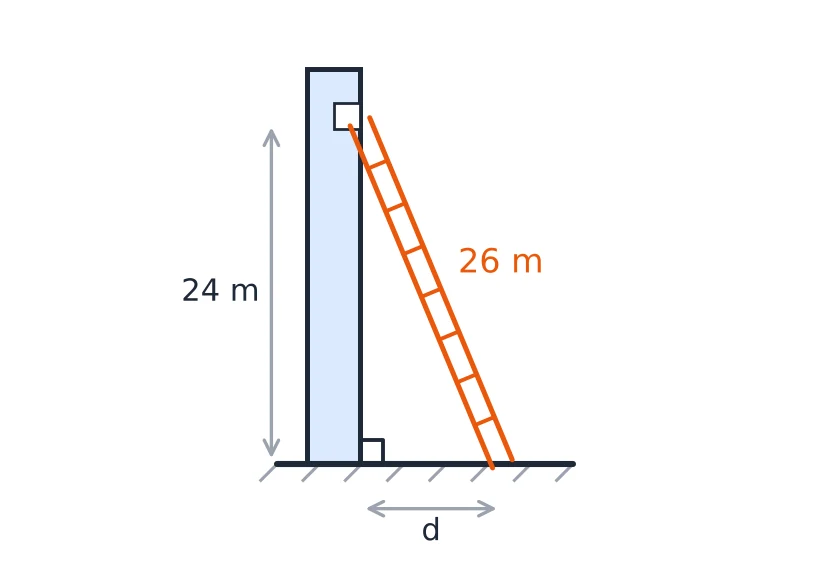
Answer. The ladder is the hypotenuse, so (b) 10 m. It is the 5, 12, 13 triangle doubled: 10, 24, 26.
Question 11
A ladder leaning against a wall makes an angle of 30° with the wall, and its top is 9 m above the ground. How long is the ladder? (a) 18 m (b) m (c) m (d) m
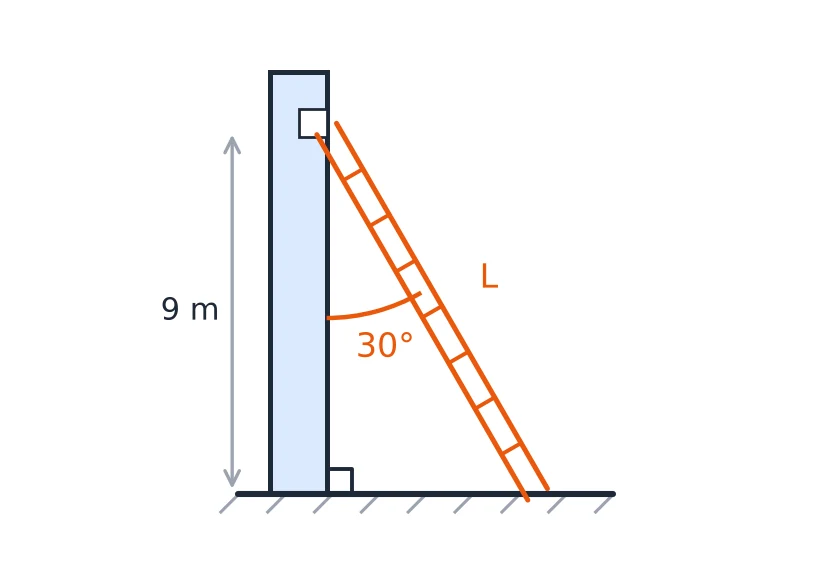
Answer. The 30° is at the top, between the wall and the ladder, so the ladder makes 60° with the ground. The 9 m height is opposite the 60°: (d) m. Working at the top gives the same, since the wall is next to the 30°: . Reading 30° as the angle with the ground would give 18 m.
Question 12
A ladder 10 m long has its foot at a point in a street. Leaning on one side, it reaches a window 8 m high. Turned to the other side, with its foot in the same place, it reaches a window m high. How wide is the street? (a) 1 m (b) 13 m (c) 11 m (d) 14 m
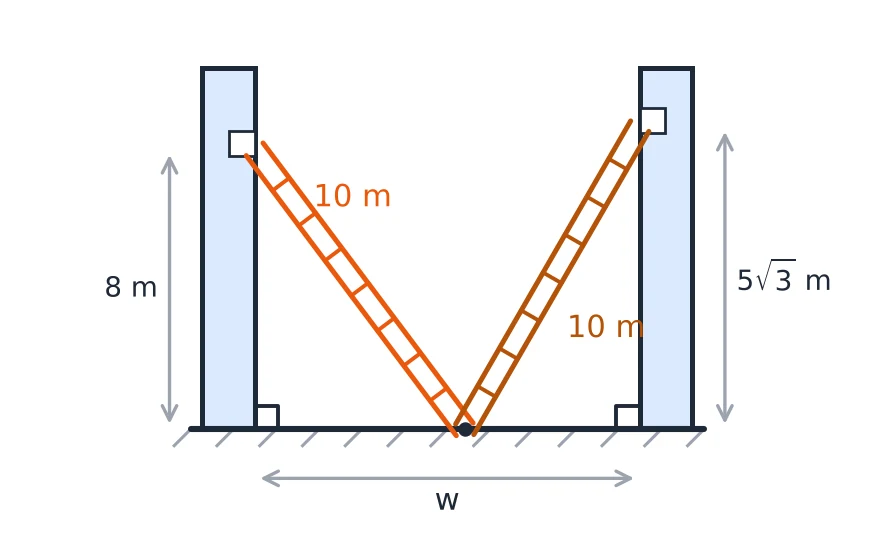
Answer. Each side is a right triangle with the 10 m ladder as hypotenuse. On the first side the foot is m from the wall. On the other side it is m from the wall (the ladder there stands at 60°). The street is 6 + 5 = (c) 11 m wide. 1 m is the difference of the two foot distances, which would put both walls on the same side.
Question 13
A ladder 14 m long stands with its foot at a point in a street. Leaning on one wall it makes 60° with the ground; turned to the opposite wall, it makes 30° with the ground. How wide is the street? (a) m (b) m (c) 14 m (d) m
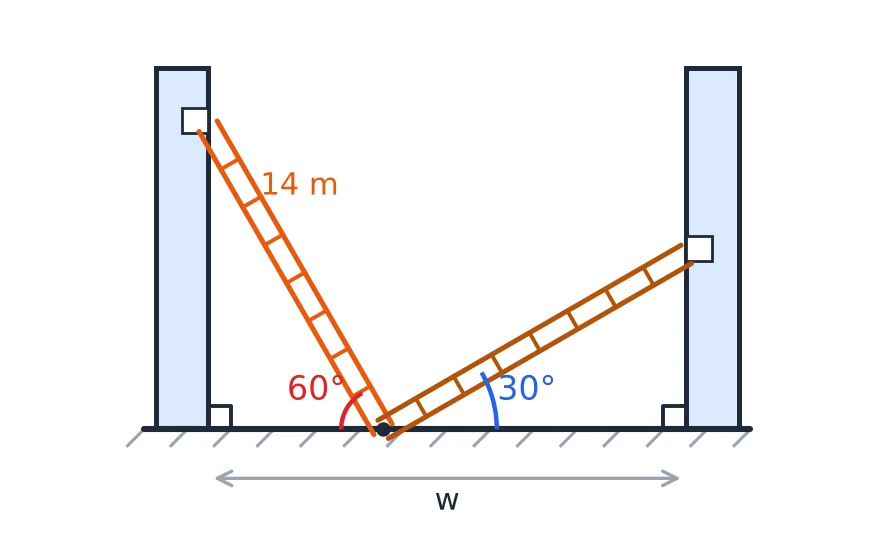
Answer. On each side the distance of the foot from the wall is the ladder times cos of its angle with the ground: m and m. The street is the two together, (a) m, about 19.1 m.
Question 14
A ladder 6.5 m long stands against a wall with its foot 1.6 m from the wall. The top slips 0.7 m down the wall. How far does the foot move away from the wall? (a) 0.7 m (b) 1.7 m (c) 3.3 m (d) 4.9 m
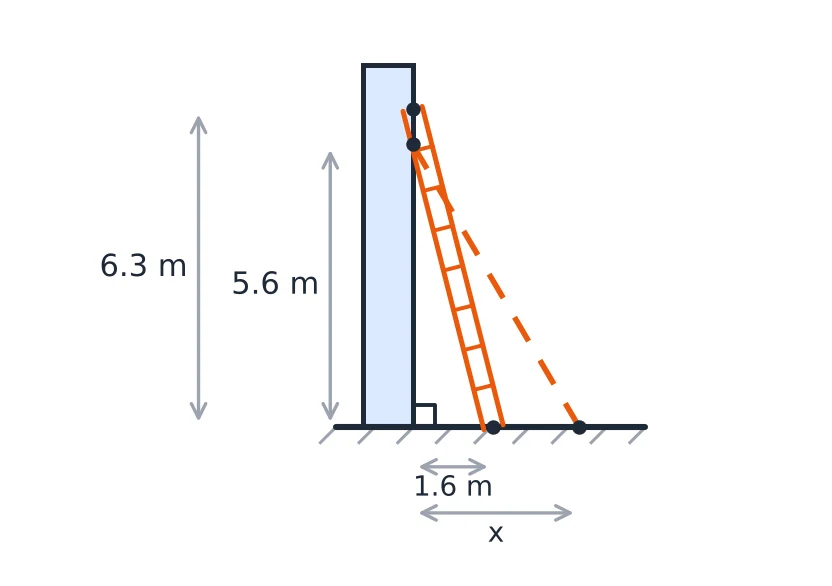
Answer. First position: the top is m up. It slips 0.7 m, to 5.6 m, so the new foot distance is m. The foot has moved 3.3 − 1.6 = (b) 1.7 m. 3.3 m is where the foot ends up, not how far it moved.
Question 15
A bamboo pole 14 m long leans against a wall and makes an angle of 60° with the wall. How far is its foot from the wall? (a) 7 m (b) m (c) m (d) m
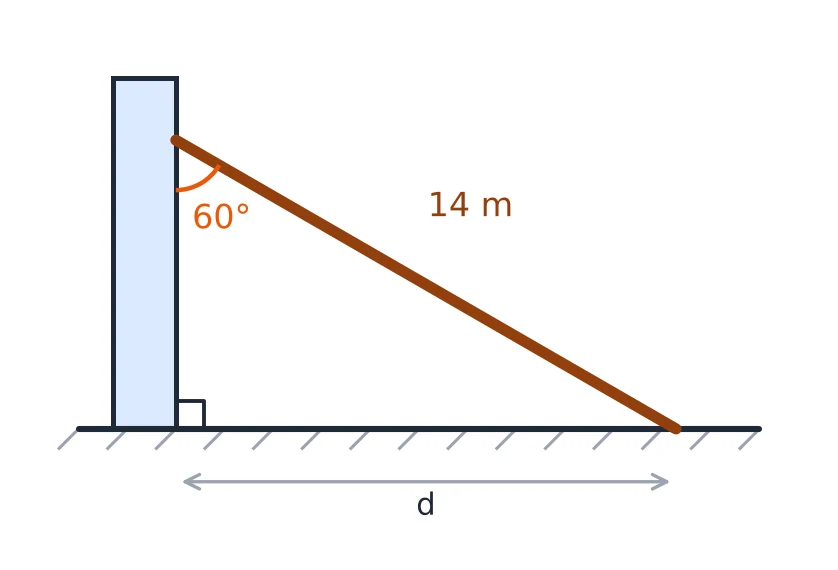
Answer. At the top, the wall is next to the 60° and the distance d along the ground is opposite it, so (b) m. Taking 60° as the angle with the ground would have given 7 m.
Question 16
A kite is flying on a string 96 m long. The string is straight and makes an angle of 60° with the ground. How high is the kite? (a) m (b) 48 m (c) m (d) m
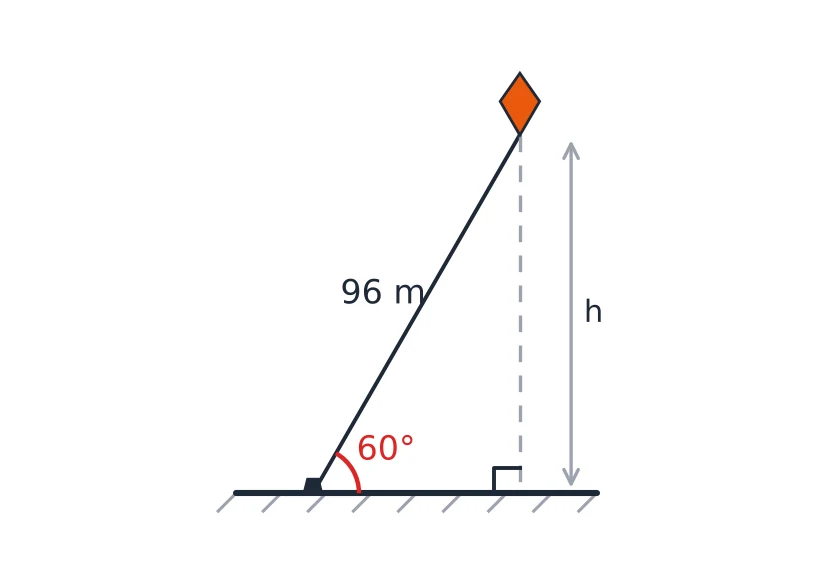
Answer. The string is the hypotenuse and the height is opposite the 60°: (a) m, about 83 m. 48 m is the distance along the ground to the point under the kite.
Question 17
A boy holds a kite string 1.5 m above the ground. The string is 80 m long and makes an angle of 45° with the horizontal. How high is the kite above the ground? (a) m (b) m (c) 81.5 m (d) m
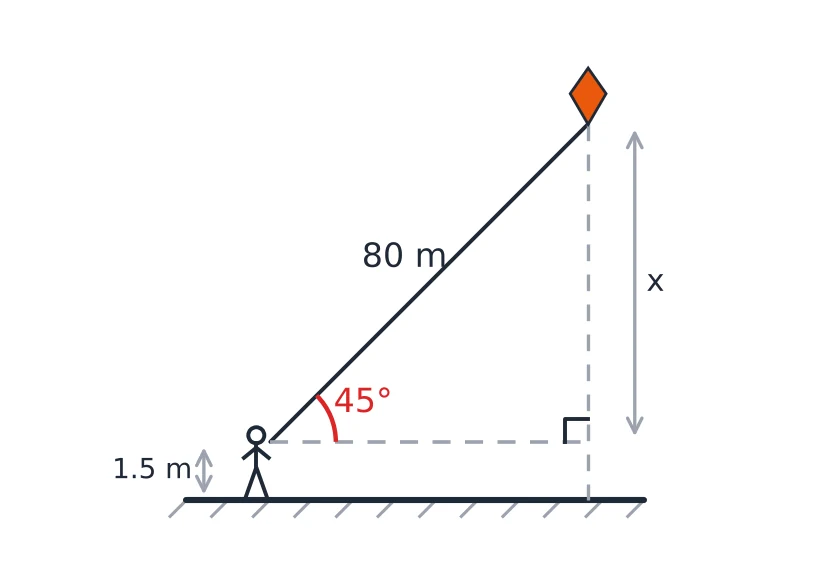
Answer. Above his hand the kite is m. His hand is already 1.5 m up, so the kite is (b) m above the ground, about 58.1 m.
Question 18
A wire is stretched from the top of a 12 m pole to a peg on the ground, making an angle of 60° with the ground. How long is the wire? (a) 24 m (b) m (c) m (d) m
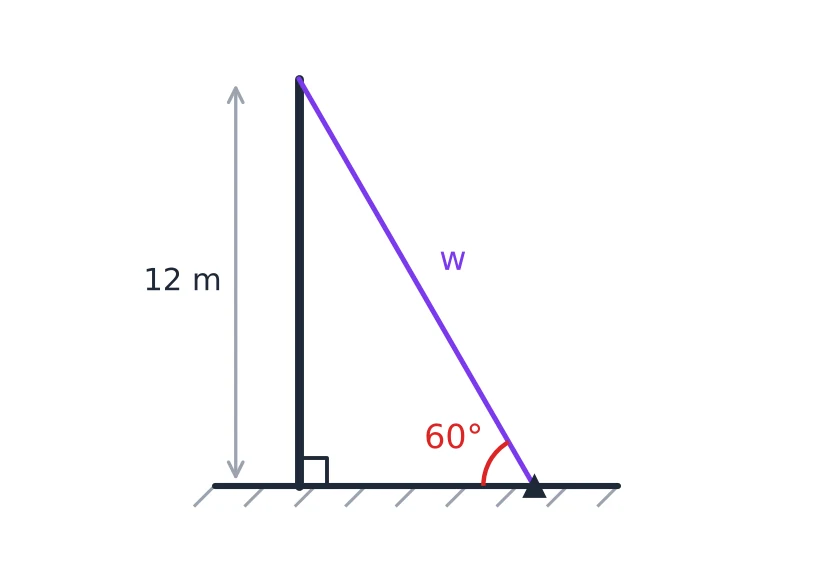
Answer. The wire is the hypotenuse and the pole is opposite the 60°, so (c) m, about 13.9 m. A wire at 60° is only a little longer than the pole; 24 m would fit a wire at 30°.
Question 19
A rope 60 m long is tied to the top of a vertical cliff and pulled tight to a peg on level ground. It makes an angle of 30° with the ground. How far is the peg from the foot of the cliff? (a) 30 m (b) m (c) m (d) m
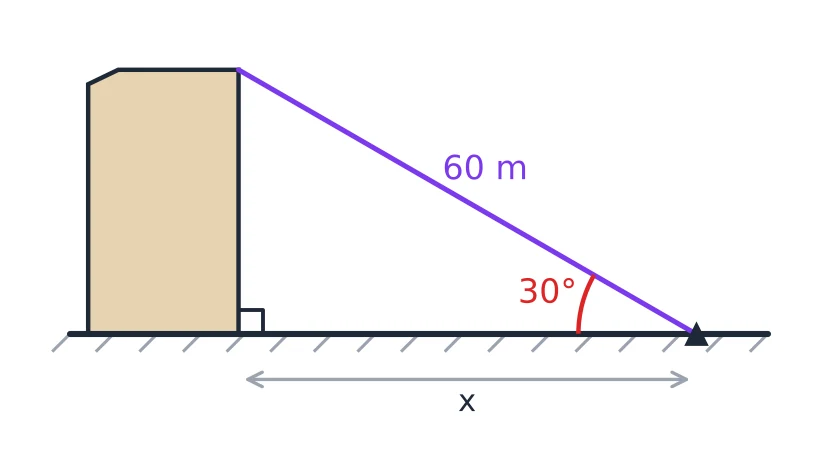
Answer. The rope is the hypotenuse. The cliff is opposite the 30°, so it is half the rope, 30 m. The peg distance is next to the 30°: (d) m. The 30 m among the options is the height of the cliff.
Question 20
Two vertical poles 7 m and 15 m high stand 15 m apart on level ground. What is the distance between their tops? (a) 17 m (b) m (c) 23 m (d) 8 m
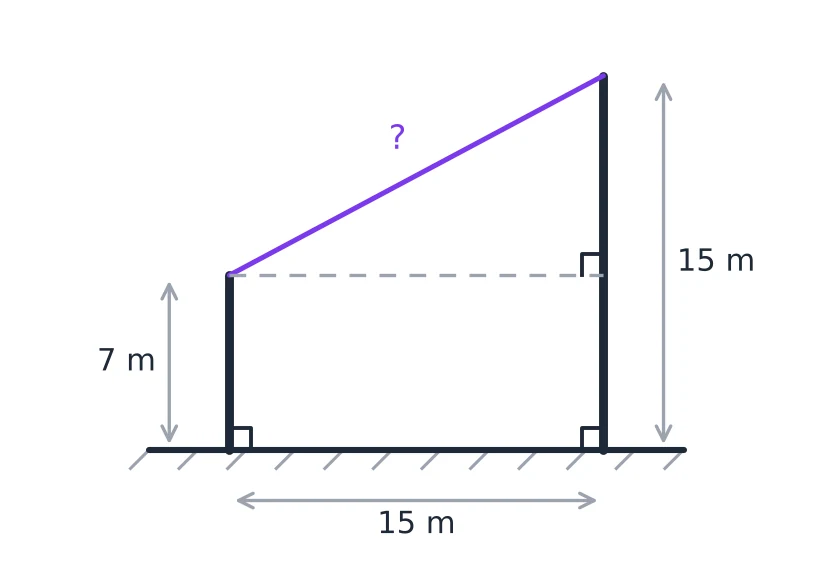
Answer. From the top of the 7 m pole I draw a horizontal line to the taller pole. It is 15 m long and meets the taller pole 7 m up, leaving 15 − 7 = 8 m above it. The line joining the tops is the hypotenuse: (a) 17 m.
Question 21
The tops of two vertical poles 10 m and 16 m high are joined by a straight wire that makes an angle of 30° with the horizontal. How long is the wire? (a) m (b) 12 m (c) m (d) 32 m
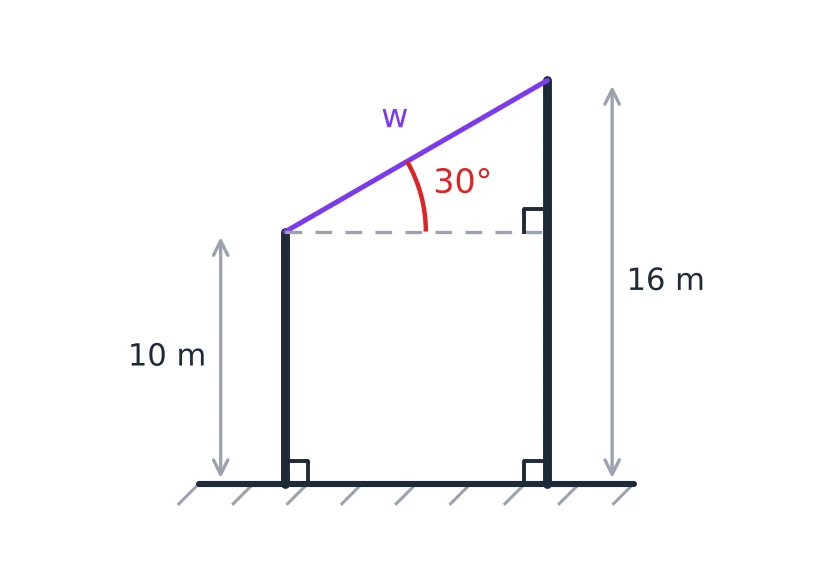
Answer. Only the difference in height matters: 16 − 10 = 6 m. That 6 m is opposite the 30° in the small triangle at the top, so the wire is (b) 12 m. The poles stand m apart.
Question 22
A ramp is to be built from the ground up to a platform 1.1 m high, making an angle of 30° with the ground. How long will the ramp be? (a) m (b) 0.55 m (c) 2.2 m (d) m
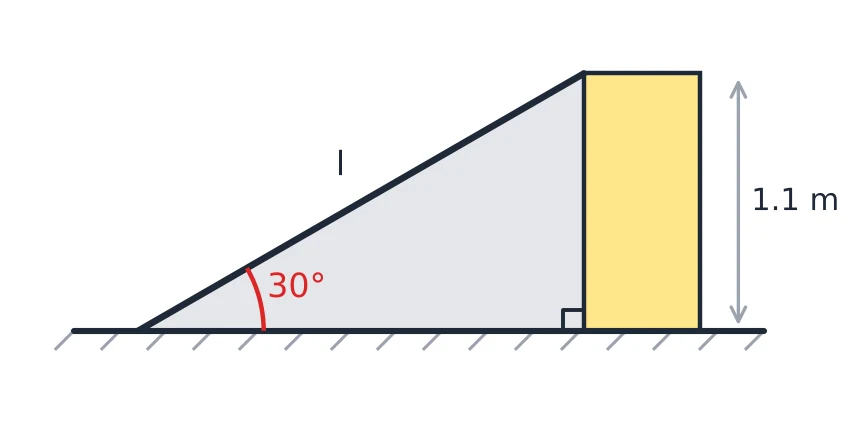
Answer. The ramp is the hypotenuse and the 1.1 m rise is opposite the 30°. At 30° the hypotenuse is twice the opposite side, so the ramp is (c) 2.2 m. m is the run along the ground, from the bottom of the ramp to the platform.
Question 23
A tree is broken by the wind. Its top touches the ground 15 m from the foot of the tree, and the broken part makes an angle of 30° with the ground. What was the height of the tree? (a) m (b) m (c) 30 m (d) m
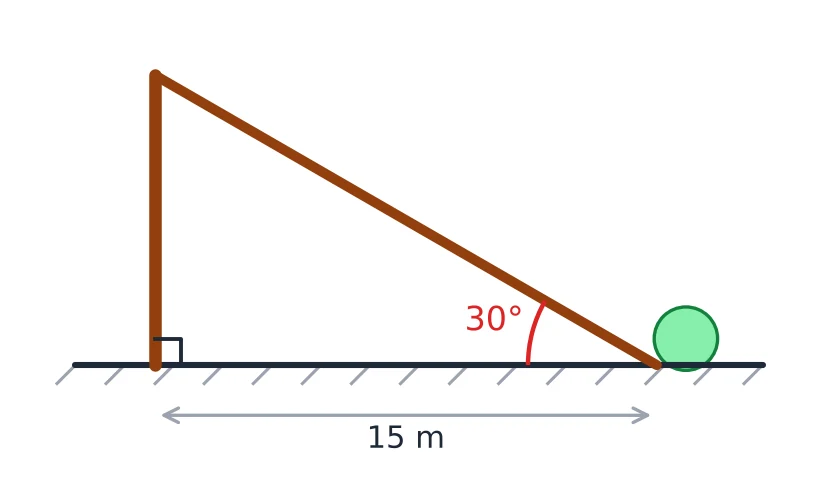
Answer. The standing part a is opposite the 30°, the 15 m along the ground is next to it, and the broken part b is the hypotenuse. So m and m. The tree was a + b = (d) m, about 26 m. m is only the broken part.
Question 24
A tree 24 m high breaks in a storm so that its top touches the ground, the broken part making an angle of 30° with the ground. At what height did the tree break? (a) 12 m (b) 16 m (c) m (d) 8 m
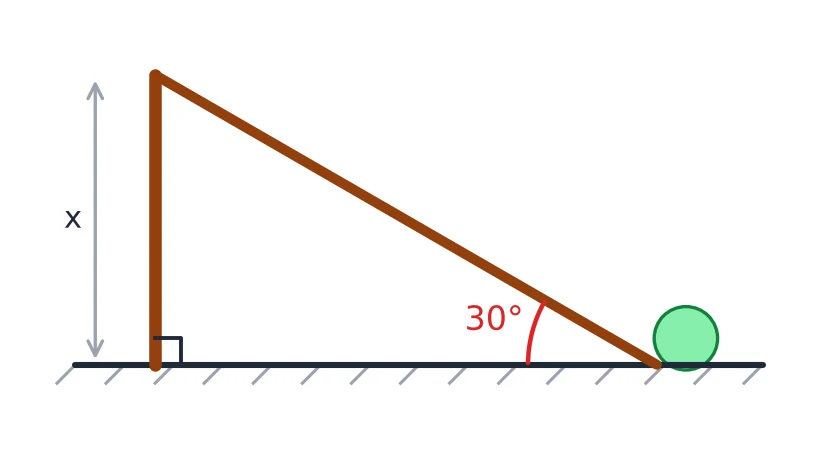
Answer. Let the break be x m up. The standing part x is opposite the 30° and the broken part, 24 − x, is the hypotenuse, so . That gives 24 − x = 2x, so 3x = 24 and x = (d) 8 m. 16 m is the length of the broken part.