
Elevation and Depression
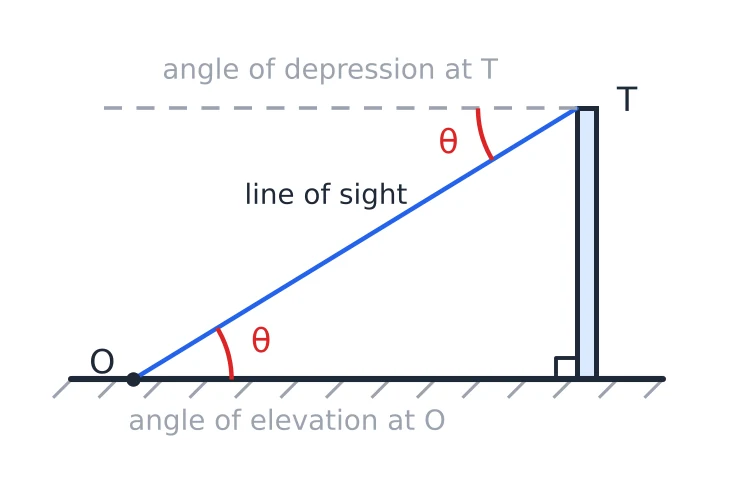
- The line of sight joins the eye to the object. Both angles are measured from the horizontal through the eye.
- Object above the eye: angle of elevation. Object below the eye: angle of depression.
- The depression of B seen from A equals the elevation of A seen from B (alternate angles), so mark it at the lower point.
- The right angle is at the foot of the tower.
The Two Triangles
- --: sides , with the shortest side opposite .
- --: sides .
- : at , ; at , ; at , .
- Line of sight: at , at , at .
- Height equal to distance means ; distance times the height means .
For example: 15 m from the foot at , the tower is m tall.
One Observer, One Object
- Eye height e: use in the triangle, then add e back for the full height.
- A ratio given: makes height : distance : line of sight .
- Other angles come with their values in the question: , .
- For decimals use and , at the last step only.
- An angle given from the vertical: the elevation or depression is minus it.
Shadows
- Shadow , where is the sun's altitude.
- At one moment, height : shadow is the same for every object.
- to : the shadow triples, growing by . From to , and again from to , it becomes times as long.
- to : it grows by .
- [Tier 2] Lamp at height L, person of height p at distance x from the post, shadow s: .
[SSC Tip] The sun's altitude is an angle of elevation, measured at the tip of the shadow.
Ladders, Strings, Slopes and Trees
- Ladder L at to the ground: foot from the wall, top up. Across a street: width .
- A sliding ladder keeps its length (Pythagoras).
- A kite string or a wire is the hypotenuse; measure the height from the hand.
- Wire between two poles: the difference of their heights is the upright side.
- Broken tree: standing part + broken part = tree. At with the ground, the tree was .
- Road or ramp at : rise = length .
Two Angles from Two Points
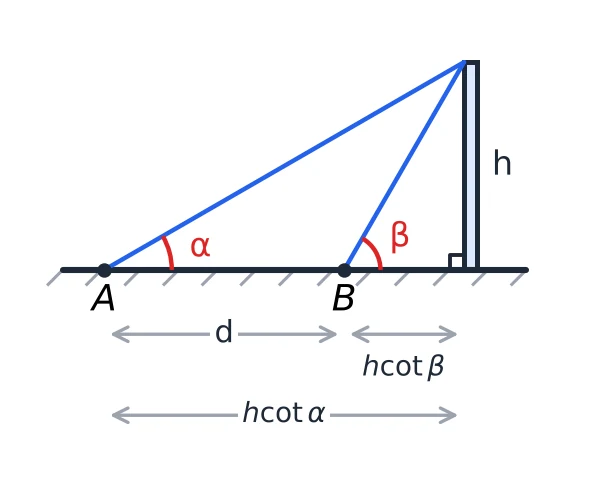
- Same side, d apart: . Opposite sides: .
- to : the walk is twice what is left, and the height is of the walk.
- Complementary angles from distances a and b: .
- Boats seen from a cliff: the same figure, with each depression moved down to its boat.
Speed and Time
- Speed = distance between the two positions divided by the time.
- Aeroplane at height h, to on one side: it flies . Passing overhead: add the two cots.
- Balloon rising from a point d away: it rises .
- Time still needed to reach the foot: for to , and for to or to .
- km/h gives m/s; m/s gives km/h.
Two Heights
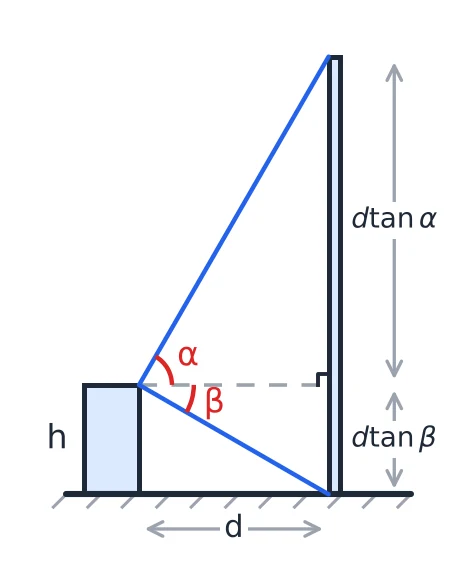
- From a building h tall: . Elevation with depression gives .
- Statue on a pedestal, one point: pedestal whole . For and the pedestal is half the statue.
- Two towers facing each other: difference of heights .
- A point between two poles: its two distances add up to the gap.
Tier 2 Extras
- [Tier 2] Cloud H above a lake, seen from h above the water, at elevation , with its reflection at depression : and , so . For and , .
- [Tier 2] Height from two points d apart on one side: .
- Check any answer in and by putting and , and then a second pair such as and , because two different formulas can agree at one pair.
Before the Exam
- Draw the figure; mark the right angle, the given angle and the known side.
- Slips to watch: tan and cot swapped ( for ), the eye height left out, the gap between two points used as a distance from the foot, a depression marked from the vertical, the line of sight given as the distance, and km/h mixed with m/s.
- Check: below the height is less than the distance.
About one CGL 2025 Tier 1 shift in two or three had a question from this chapter. Finish with the PYQ Practice Sets.