
Read the Sides off Two Triangles
Almost every heights and distances question in the exam is one right triangle, or two right triangles that share a side, with an angle of , or . The working is short, so the time goes in drawing the figure and choosing the side to start from. The methods below are quick routes for the usual question types, and most of them say where they stop working. Make a rough figure every time, even for a one-line question, because it shows at once which side is the height and which is the distance.
Fast way: learn the two triangles by their sides.
- In the -- triangle the sides are . The side opposite is 1 part, the side opposite is parts, and the hypotenuse is 2 parts.
- In the -- triangle the sides are . The height equals the distance, and the line of sight is times either.
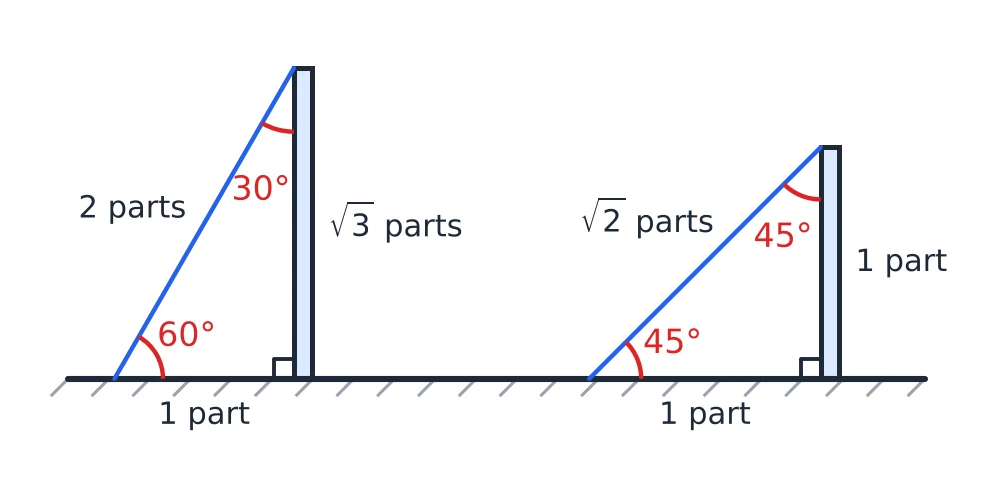
Find how many parts the known side is, work out one part, and scale up.
For example: a tower is seen at from a point 18 m from its foot. The distance is opposite the at the top, so 1 part = 18 m. The height is parts, that is m, and the line of sight is 2 parts, 36 m. No tan or cos is needed.
Where it fails: the parts go with the angles, not with the names height and distance. At the height is the 1 part; at the distance is. Mark the angle at the top of the tower as well before you scale.
Height from Distance and Back: One Multiplication
Fast way: with the angle of elevation at the observer, the height is and the distance is . For the three standard angles each is one step:
| Angle | Height from the distance | Distance from the height | Line of sight from the height |
|---|---|---|---|
To catch a tan and cot mix-up at once: below the height is shorter than the distance, and above it is longer.
For example: a kite is 42 m above the ground and its string, pulled straight, makes with the ground. The string is the line of sight, so it is m, about 48.5 m.
Where it fails: h in the table is measured from the eye, or from the hand that holds the string. When that point is above the ground, use the method for the observer's height further down.
A Depression Is the Same Angle at the Object
Fast way: the angle of depression from the top of a cliff to a boat equals the angle of elevation of the top from the boat. The horizontal through the eye and the ground are parallel, so the two are alternate angles. Mark the angle once, at the boat, and the question becomes an ordinary elevation question.
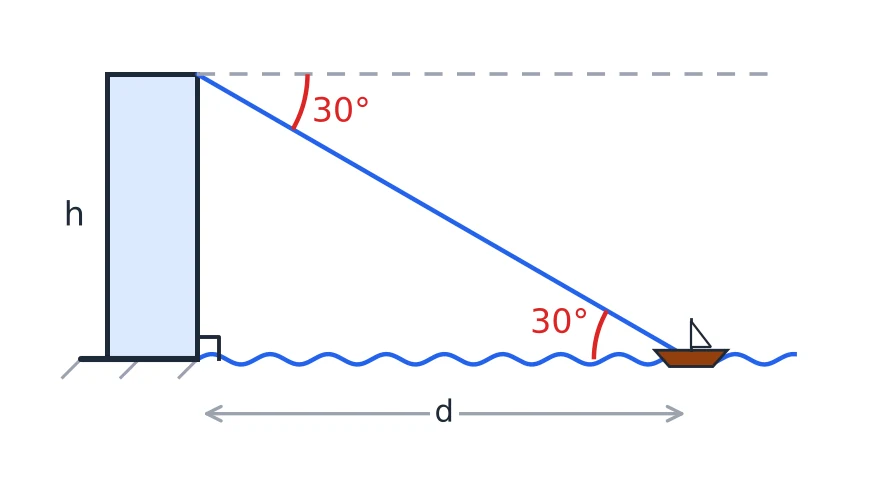
For example: from the top of a lighthouse 32 m high, a boat is seen at a depression of . At the boat the elevation is , so the boat is m from the foot and the line of sight is m.
Where it fails: a depression is measured down from the horizontal, never from the vertical. If a question gives the angle between the line of sight and the tower, the depression is minus that angle.
The Observer's Height: Work Above the Eye Line
Fast way: draw the horizontal through the eye. The right triangle sits above that line, so its upright side is the tower minus the eye height. Work in that triangle, then add the eye height back if the height from the ground is asked.
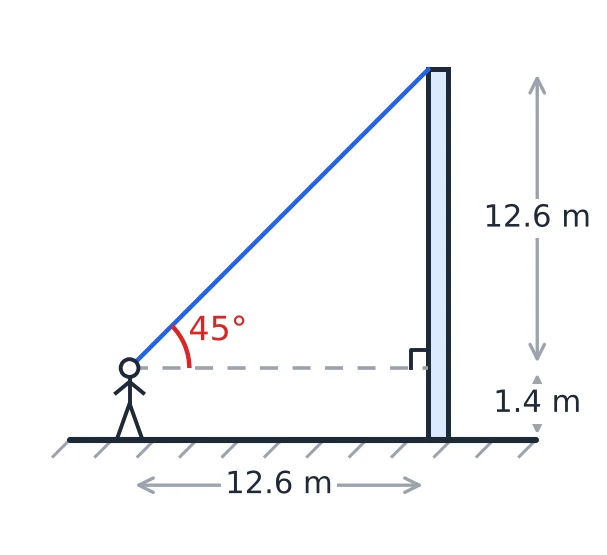
For example: a boy whose eyes are 1.4 m above the ground sees the top of a pole at from 12.6 m away. Above his eyes the pole rises 12.6 m (at the rise equals the distance), so the pole is m tall.
For a distance walked nothing changes: the eye height is the same at both points, so it drops out of the walk. Only a height measured from the ground needs it added.
[SSC Tip] If the question gives an eye height and your working never used it, look again. The answer without the eye height is a ready-made wrong option.
30° to 60°: The Walk Is Twice What Is Left
When to use it: an observer walks straight towards a tower and the angle of elevation goes from to , or a car or boat seen from the top goes from a depression of to .
Fast way: with height h, the first distance is and the second is , so the walk is , exactly twice the distance still left. Call the walk 2x. Then:
- the distance left to the foot is x, and the first distance is 3x;
- the height is , that is of the walk;
- the second line of sight, BT, equals the walk.
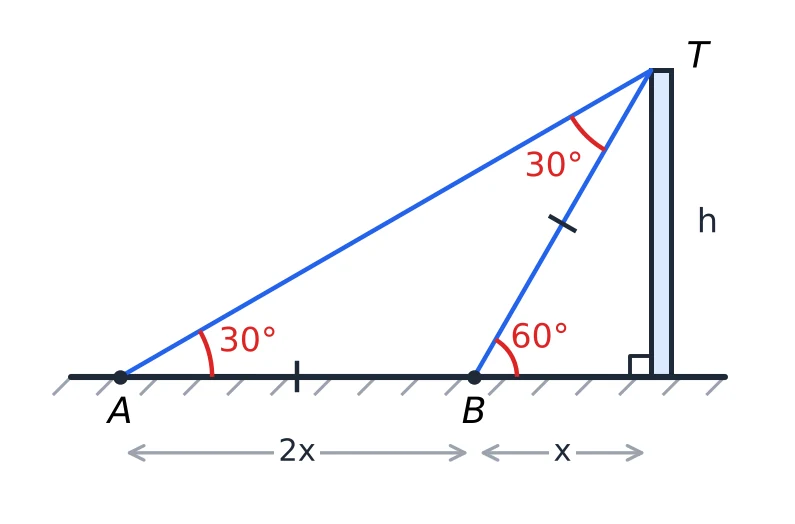
The last fact follows from the angle at the top. It is , the same as the angle at A, so triangle ABT is isosceles with AB = BT. The same is true whenever the second angle is double the first.
For example: walking 54 m towards a temple, a man sees the elevation of its top change from to . He is now 27 m from the foot, he started 81 m away, and the temple is m tall, about 46.77 m.
Where it fails: this is for and only. Other pairs need the next method.
Any Two Angles: One Line from the cot Values
Fast way: both points look at the same height h, so each one's distance from the foot is h times the cot of its angle.
- Same side, a distance d apart: , where is the larger angle, seen from the nearer point.
- Opposite sides, a distance d apart: .
Worked out once for the standard pairs, the height is , with k from this table:
| Angles | Same side | Opposite sides |
|---|---|---|
| and | ||
| and | ||
| and | ||
| and | not possible |
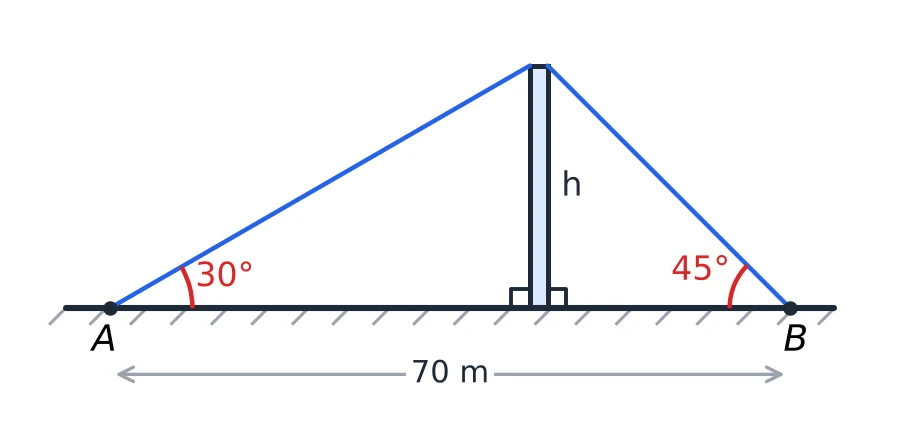
For example: A and B stand on opposite sides of a tower, 70 m apart, and see its top at and . Then m, about 25.62 m. Had they been on the same side, 70 m apart, the height would be m, about 95.62 m.
Where it fails: d here is the gap between the two points. If the question gives each point's distance from the foot, there is nothing to subtract; use at either point.
Complementary Angles: Multiply the Two Distances
When to use it: the angles of elevation of a top from two points add up to , and the distances of the points from the foot, a and b, are known. The points can be on the same side or on opposite sides.
Fast way: if the far point sees , then , and the near point sees , so . The product of tan and cot is 1, so
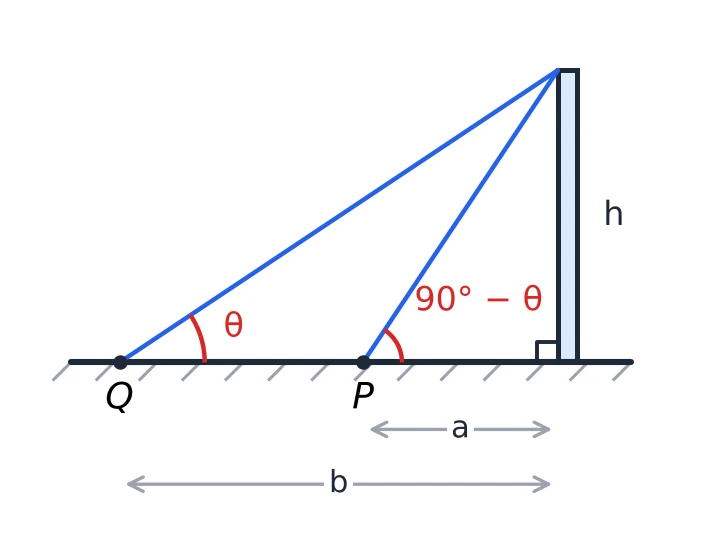
For example: the points are 8 m and 18 m from the foot. Then m, and the nearer point sees the larger angle.
Where it fails: a and b must be distances from the foot. If the question gives only the gap between the points, find each distance first. And the angles must add to exactly : with qualifies, with does not.
Shadows: One Sun, One Ratio
Fast way:
- A shadow is the distance side of the triangle: shadow , where is the sun's altitude (its angle of elevation). A shadow equal to the height means ; a shadow times the height means ; a height times the shadow means .
- At one moment the sun makes the same angle with everything, so height : shadow is the same for a man, a pole and a building.
- As the sun goes down from to to , each step makes the shadow times as long. From straight to it becomes 3 times as long, so it grows by twice the first shadow.
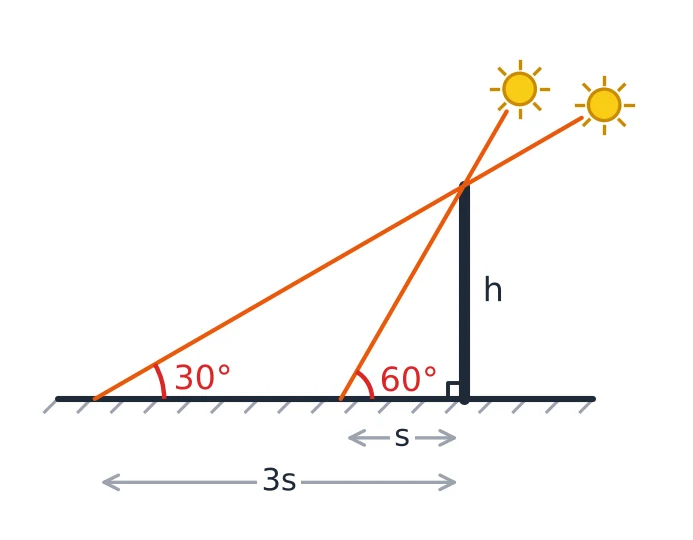
For example: a pole's shadow is 7 m long when the sun's altitude is . At it is m, longer by 14 m, and the pole is m tall.
Where it fails: the ratio rule needs the same moment, that is, the same sun angle. Shadows measured at different times need the angle at each time.
Broken Tree: The Whole Tree from Where the Top Lands
Fast way: the standing part, the ground and the broken part make a right triangle, and the broken part is its hypotenuse. If the top touches the ground d metres from the foot, making an angle with the ground, the tree was tall:
- at the broken part is twice the standing part, and the tree was ;
- at the tree was ;
- at the tree was .
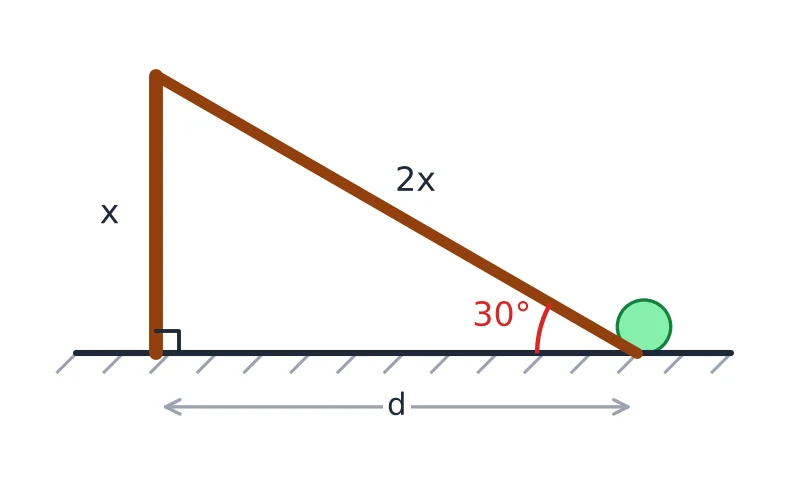
For example: the top touches the ground 12 m from the foot, at with the ground. The tree was m tall, about 20.78 m: m still standing and m broken off.
Where it fails: read which angle is given. If the broken part makes with the standing part, its angle with the ground is .
Ladder Across a Street: Add the Two Feet
Fast way: a ladder of length L making an angle with the ground has its foot from the wall and its top up the wall. If the same ladder, with its foot fixed, is turned to reach windows on both sides of a street, the street is the sum of the two foot distances, .
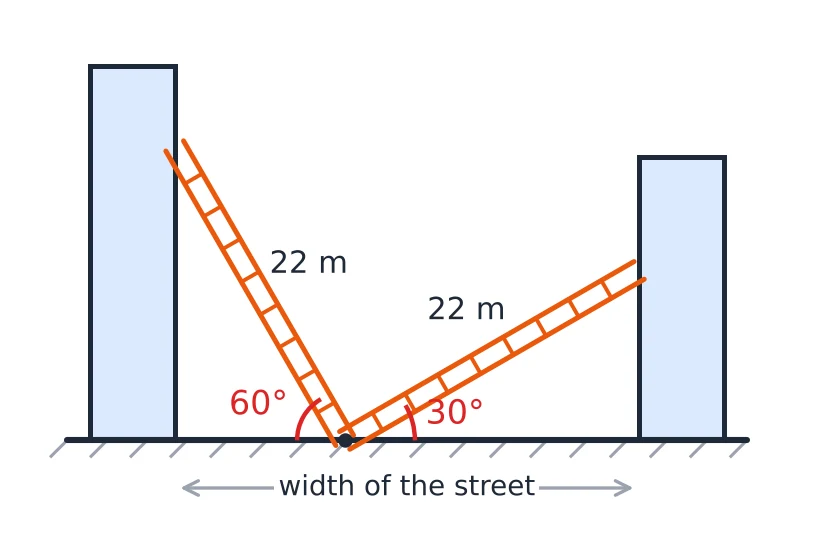
For example: a 22 m ladder makes with the ground against one wall and against the other. The street is m, about 30.05 m, and the windows are m and 11 m above the ground.
A ladder that slides down a wall keeps its length, so its length squared equals height squared plus foot distance squared, before and after the slide (Pythagoras, see Chapter 12).
The Time Still Needed to Reach the Foot
When to use it: a car or boat moves straight towards the foot of a tower at a steady speed, the angle of depression from the top changes in t minutes, and the question asks how much longer it will take to reach the foot.
Fast way: time goes with distance, so the height is never needed.
- to : the distance left is half the distance covered, so the time left is .
- to , or to : the distance left is times the distance covered, so the time left is , about .
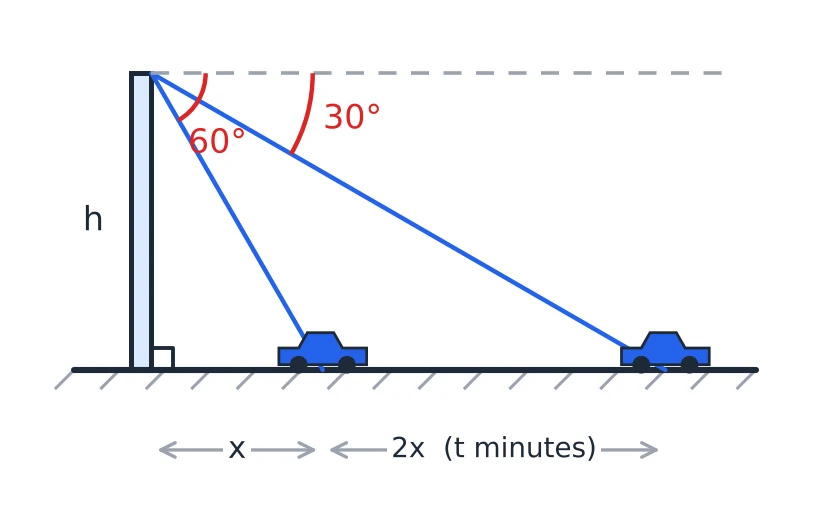
For example: the depression changes from to in 12 minutes, so the car needs 6 more minutes. If it changes from to in 22 minutes, the time left is minutes, about 30 minutes.
Where it fails: the car must move along the line through the foot, at one speed throughout.
[SSC Tip] For to , an option equal to t itself treats the time left as equal to the time already taken. The car is nearer now, so it needs less.
Speed from Two Angles
Fast way: for an aeroplane flying level at height h, the distance it covers while its elevation changes from to is
- if it stays on one side of the observer,
- if it passes overhead.
Speed is that distance divided by the time. From to on one side, the distance is . To change m/s into km/h, multiply by (see Chapter 10).
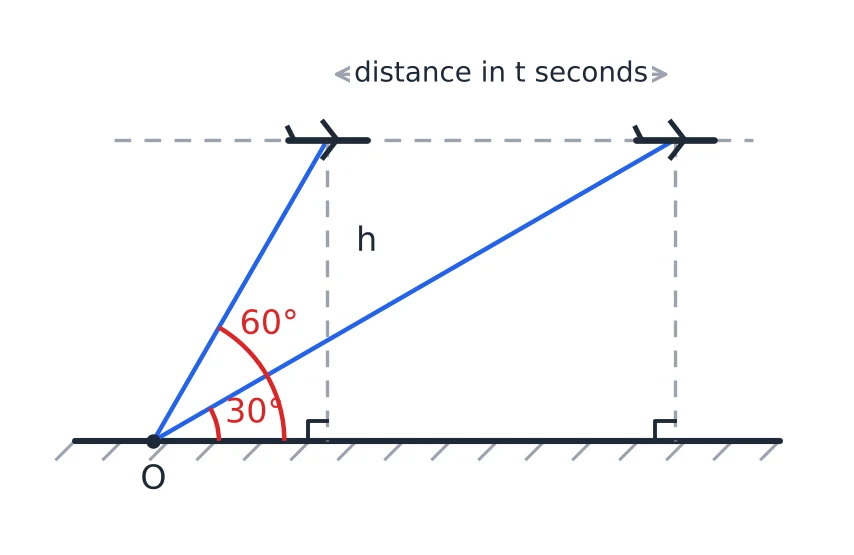
For example: an aeroplane flies level at m, and its elevation drops from to in 20 seconds. The distance is m, so the speed is 125 m/s, or km/h.
For a balloon rising straight up from a point d metres from the observer, the distance is fixed instead of the height, and the balloon rises between the two readings.
Statue on a Pedestal: Compare the tans
When to use it: from one point on the ground, the top of a pedestal (or a building) is seen at and the top of the statue (or flagstaff) on it at .
Fast way: both heights stand over the same distance d, so
- and : the ratio is , so the pedestal is half the statue.
- and , or and : the ratio is , so the pedestal is times the statue.
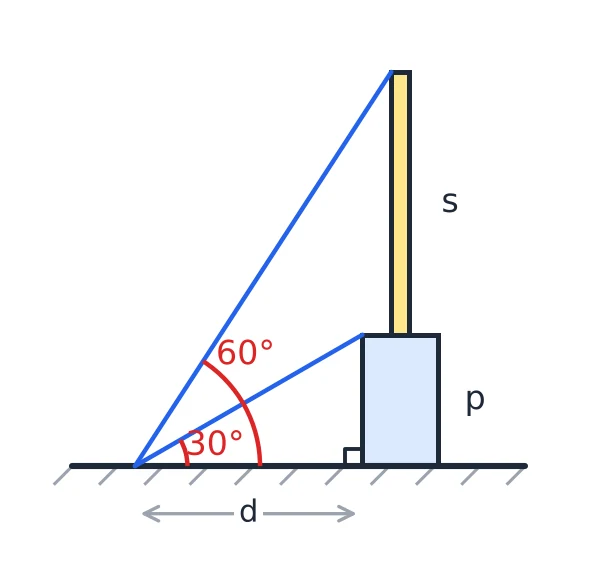
For example: a statue 4.2 m tall stands on a pedestal. From a point on the ground the top of the pedestal is at and the top of the statue at . The pedestal is 1 part out of 3 and the statue the other 2 parts, so the pedestal is 2.1 m.
Where it fails: both angles must be seen from the same point. If the observer moves between the two readings, go back to the two-angle methods.
Elevation of the Top, Depression of the Foot
When to use it: from the top of a building of height h, the top of a taller tower is seen at an elevation and its foot at a depression .
Fast way: the horizontal through the eye cuts the tower into h below and above, both over the same distance d. So
- elevation , depression : , so ;
- elevation , depression : , so ;
- elevation , depression : .
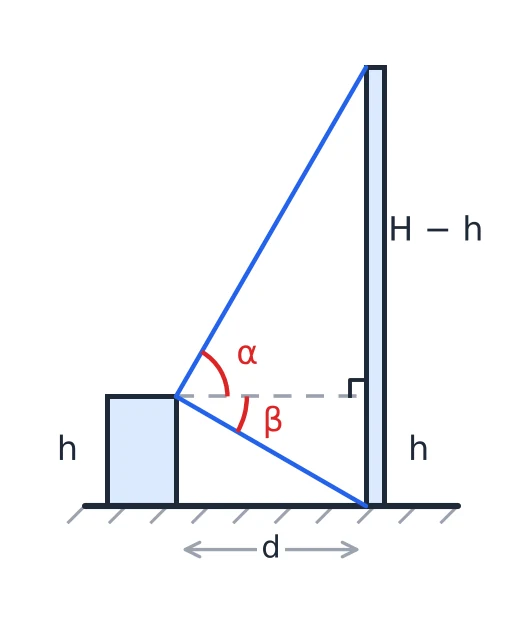
For example: the building is 21 m tall, the elevation is and the depression . The tower is m tall, and the two stand m apart.
Where it fails: if the second tower is shorter than the building, both angles are depressions. Then the shorter tower is , where is the depression of its top.
[SSC Tip] Swapping the two angles changes the answer from to . Before choosing, check which angle goes up to the top and which goes down to the foot.
Check the Answer against the Figure
Before marking an option, test it against the drawing:
- The line of sight is the longest side of its triangle, longer than both the height and the distance.
- Below the height is less than the distance; above it is more.
- Of two points looking at the same top, the nearer one sees the larger angle, so walking towards a tower always makes the angle grow.
- A shadow grows as the sun goes down, and a broken tree was always taller than the distance from its foot to the point where the top lands.
- In a same-side question the first distance is more than the walk.
For example: a tower is seen at from a point 45 m away, and one option is 77.94 m. That would make the height more than the distance at an angle below , so it cannot be right: it is , the cot answer. The height is m, about 25.98 m.
Decimal Options: Use 1.732 at the Last Step
Fast way: work in surds until the last line, then use these values:
| Surd | Value |
|---|---|
| 1.732 | |
| 0.577 | |
| 1.414 | |
| 0.732 | |
| 2.732 | |
| 0.866 |
Clear a surd from a denominator first: . Multiplying by 2.732 is quicker than dividing by 0.732.
The options also hint at the method. For the - and - pairs, a height found from a gap carries when the points are on the same side and when they are on opposite sides; a gap found from a height is the other way round.
For example: from the top of a 40 m cliff, two boats on the same side are seen at depressions of and . They are m apart. Against the options 29.28 m, 69.28 m, 109.28 m and 23.09 m, only the first fits; 69.28 m is , the far boat's distance from the foot.
Solved Examples
Each question below is solved with one of the methods above. Try it with a clock running first; four of the answers carry a time check to compare with.
Question 1
The top of a tower 69 m high is seen at an angle of elevation of from a point P on the ground. How far is P from the foot of the tower, and how long is the line of sight?
Answer. At the height is the side with parts. So one part is m. P is 1 part from the foot, m, and the line of sight is 2 parts, m.
Question 2
A girl whose eyes are 1.5 m above the ground stands m from a tree and sees its top at an angle of elevation of . Find the height of the tree.
Answer. Above her eye line the tree rises m. I add her eye height to get the full tree: = 16.5 m.
Time check: about 15 seconds.
Question 3
Walking 64 m straight towards a temple, a pilgrim sees the angle of elevation of its top change from to . Find the height of the temple and how far he still has to walk.
Answer. From to , the walk is twice what is left, so 32 m remain. The height is times what is left: m, about 55.43 m.
Time check: about 10 seconds.
Question 4
From two points on the same side of a tower, 40 m apart, the angles of elevation of its top are and . Find the height of the tower. (Take .)
Answer. For and on the same side, the height is times the gap: = 94.64 m. Checking it the long way: should be 40, and .
Question 5
The angles of elevation of the top of a pole from two points 4.5 m and 32 m from its foot, on the same straight line, are complementary. Find the height of the pole.
Answer. Complementary angles from distances a and b give = 12 m.
Question 6
At a certain moment a man 1.8 m tall casts a shadow 2.4 m long. At the same moment a building casts a shadow 32 m long. How tall is the building?
Answer. The sun is at the same angle for both, so height : shadow is for both. The building is = 24 m. I never needed the angle itself.
Question 7
The shadow of a tower is 40 m longer when the sun's altitude is than when it is . Find the height of the tower.
Answer. From to the shadow grows from to , an increase of . So and = m, about 34.64 m.
Question 8
A tree breaks in a storm. Its top touches the ground 7 m from the foot, and the broken part makes an angle of with the ground. How tall was the tree?
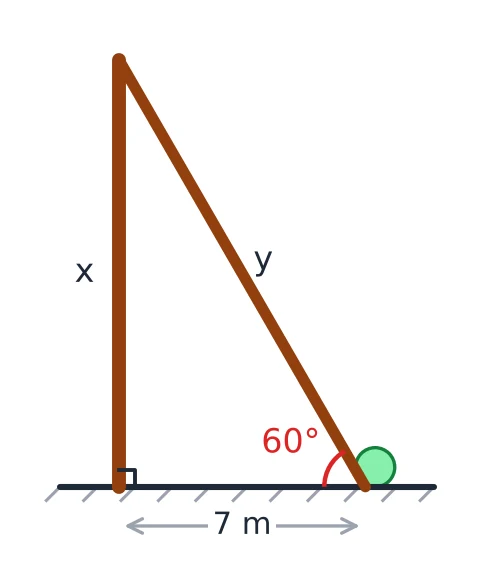
Answer. At the standing part is m and the broken part is m. The tree was = m, about 26.12 m. With the rule for it is one step: .
Question 9
The foot of an 18 m ladder is fixed at a point in a street. Leaning one way it reaches a window on one side, making with the ground; turned the other way it reaches a window on the other side, making with the ground. Find the width of the street. (Take .)
Answer. The width is the sum of the two foot distances: = 21.726 m, about 21.73 m.
Question 10
A man on top of a tower sees a car moving straight towards the tower at a steady speed. The angle of depression of the car changes from to in 18 minutes. How much longer will the car take to reach the foot of the tower?
Answer. From to the distance left is half the distance covered, so the time left is half of 18 minutes: 9 minutes.
Time check: about 5 seconds.
Question 11
From the top of a tower m high, the angle of depression of a car moving towards the tower changes from to in 12 seconds. Find the speed of the car in km/h.
Answer. The car covers m in 12 seconds, which is 5 m/s. In km/h that is = 18 km/h.
Question 12
A flagstaff stands on top of a building 15 m tall. From a point on the ground, the top of the building is seen at and the top of the flagstaff at . Find the length of the flagstaff. (Take .)
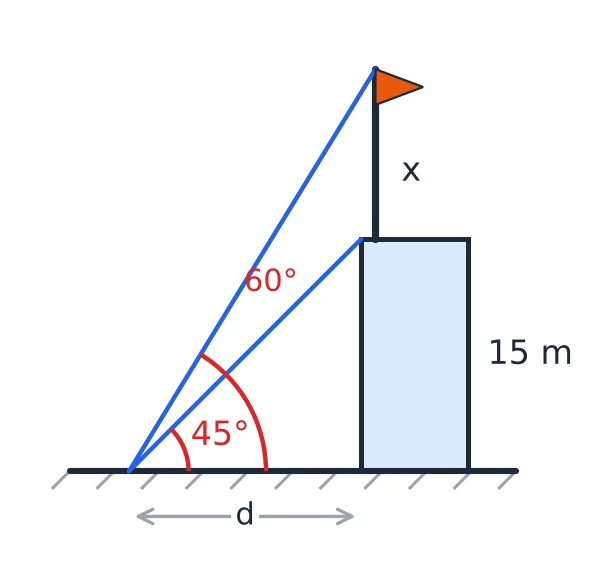
Answer. , so building : (building + flagstaff) . The top of the flagstaff is m up, and the flagstaff is = 10.98 m.
Question 13
From the top of a building 14 m high, the top of a tower is seen at an angle of elevation of and its foot at an angle of depression of . Find the height of the tower.
Answer. The part of the tower above the eye line, over the part below, is . The part below is 14 m (the building's height), so the part above is m and the tower is m, about 38.25 m.
Time check: about 20 seconds.
Question 14
Two men stand on opposite sides of a pillar 60 m high and see its top at angles of elevation of and . How far apart are they? (Take .)
Answer. Opposite sides, so I add the cots: = 138.56 m. The answer is more than , the farther man's own distance, as it must be.