
Circumference and Area of a Circle
Every circle question starts from the radius , the distance from the centre O to the circle. The diameter is twice the radius, , and the distance round the circle is the circumference .
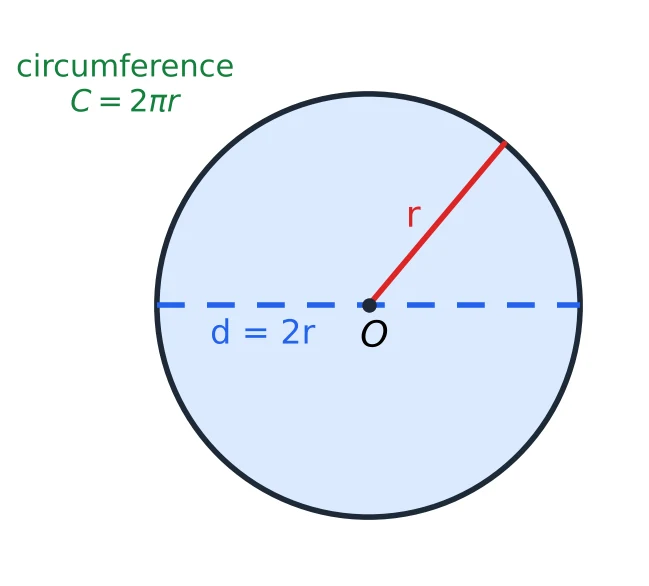
For every circle, big or small, the circumference divided by the diameter is the same number, called (pi), about 3.1416. So
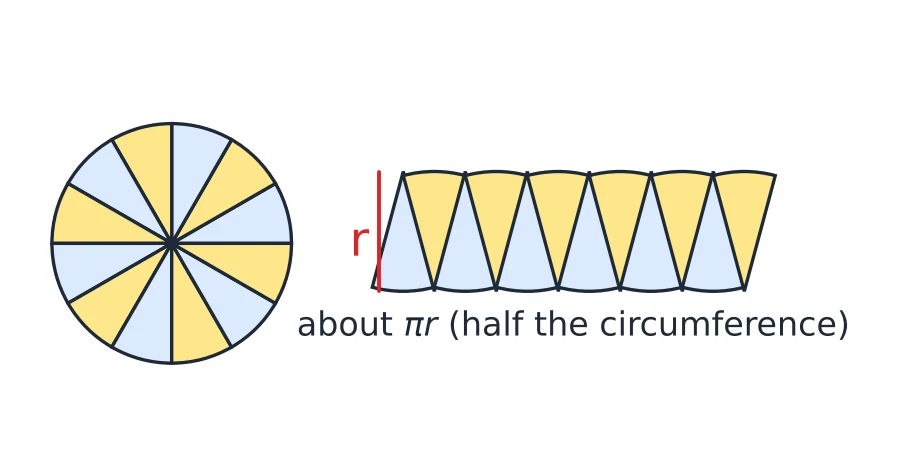
Why the area is . Cut the circle into many thin slices, like a pizza, and lay them side by side, pointing up and down in turn. Half the curved edges end up along the top and half along the bottom, so the shape is nearly a rectangle whose length is half the circumference, , and whose height is . The more slices, the closer it gets to a true rectangle.
Values worth knowing by heart (with ):
| Radius (cm) | 3.5 | 7 | 10.5 | 14 | 21 | 28 | 35 |
|---|---|---|---|---|---|---|---|
| Circumference (cm) | 22 | 44 | 66 | 88 | 132 | 176 | 220 |
| Area (cm²) | 38.5 | 154 | 346.5 | 616 | 1386 | 2464 | 3850 |
Seeing 154, 616 or 1386 among the options is a strong hint that the radius is 7, 14 or 21.
Doubling the radius doubles the circumference but makes the area 4 times as big (616 is 4 × 154).
Which Value of to Use
is not exactly or 3.14. Both are handy stand-ins for 3.14159… ( is 3.142857…, a shade too big). Choose by looking at the question and the options:
| What you see | Use |
|---|---|
| Radius or diameter a multiple of 7 (3.5, 7, 10.5, 14, 42 …) | |
| Options such as 22, 44, 154, 616, or fractions with 7 | |
| 'Take = 3.14', or options such as 314, 78.5, 62.8 | 3.14 |
| Options written with in them (, ) | leave as it is |
The same circle with all three. For r = 10 cm:
- with 3.14: C = 62.8 cm and A = 314 cm²;
- with : (about 62.86) cm and (about 314.29) cm²;
- in terms of : cm and cm².
When 314 and 314.29 sit side by side in the options, only the value of named in the question gives the key. If no value is named, the options decide.
Radius or diameter? Using the diameter as the radius is a very common slip in this chapter. 'A circular plate of diameter 28 cm' has r = 14 cm and area 616 cm². Taking 28 cm as the radius gives 2464 cm², four times too big, and that number will be among the options.
Working with quickly. Cancel the 7 first: , and . With 3.14, multiply by 3 and add the 0.14 part: 3.14 × 25 = 75 + 3.5 = 78.5.
[SSC Tip] If your answer still has a 7 in the denominator but every option is a clean number, you have probably used the wrong value of , or the diameter in place of the radius. Check that before picking the nearest option.
Working Backwards: Radius from the Circumference or the Area
Many questions give one measurement and ask for another. Go through the radius:
- C = 132 cm: cm, so cm².
- A = 616 cm²: , so r = 14 cm and C = 88 cm.
There is also a direct link: , and . So if the area (in cm²) is numerically equal to the circumference (in cm), then and r = 2 cm. If the area is times the circumference, r = 2k.
Circumference and diameter together. The circumference is a little more than 3 diameters, and SSC often gives a sum or a difference of the two.
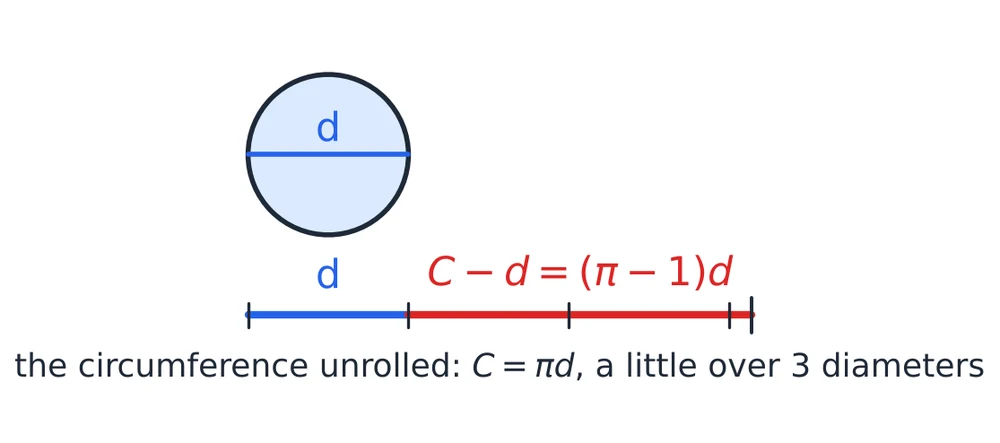
With :
If the circumference exceeds the diameter by 30 cm, then , so d = 14 cm and r = 7 cm. If C + r = 102 cm, then and r = 14 cm.
Perimeter means circumference. For a full circle the two words mean the same thing. 'The perimeter of a circular field' wants , not .
In a C − d question, write at once and divide. Writing and solving takes three lines, and that is where the arithmetic slips happen.
Semicircles
A semicircle is half a circle, cut along a diameter. Its area is half the circle's:
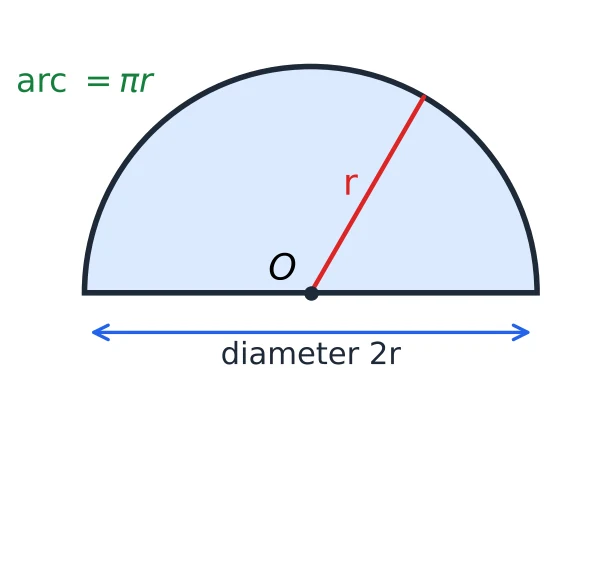
Its perimeter is the curved arc (half the circumference, ) plus the straight diameter :
For r = 14 cm: area = cm², the arc = 44 cm, and the perimeter = 44 + 28 = 72 cm. Going backwards, a semicircle with perimeter 54 cm has , so r = 10.5 cm, and its area is cm².
Where semicircles turn up. A semicircular protractor, window, plot or garden; fencing a semicircular plot (perimeter); a wire bent into a semicircle (its length is the whole perimeter, arc and diameter both). If only the curved edge is fenced, or the question asks for 'the length of the arc', leave out the .
- A wire 36 cm long is bent into a semicircle. Then , so r = 7 cm, and the area enclosed is cm².
- A semicircular plot of radius 35 m is fenced all round at ₹12 per metre. The boundary is 110 + 70 = 180 m, so the cost is ₹2,160. Fencing only the curved edge would need 110 m and cost ₹1,320.
[SSC Tip] 'Perimeter of a semicircle' always includes the diameter. The two wrong options are almost always (the arc only) and (the full circle). For r = 14 cm those are 44 cm and 88 cm, against the right answer of 72 cm.
Quadrants and Three-quarter Circles
A quadrant is a quarter of a circle, cut out by two radii at right angles:
The perimeter has the quarter arc and two radii. For r = 14 cm: area = 154 cm², arc = 22 cm, perimeter = 22 + 28 = 50 cm.
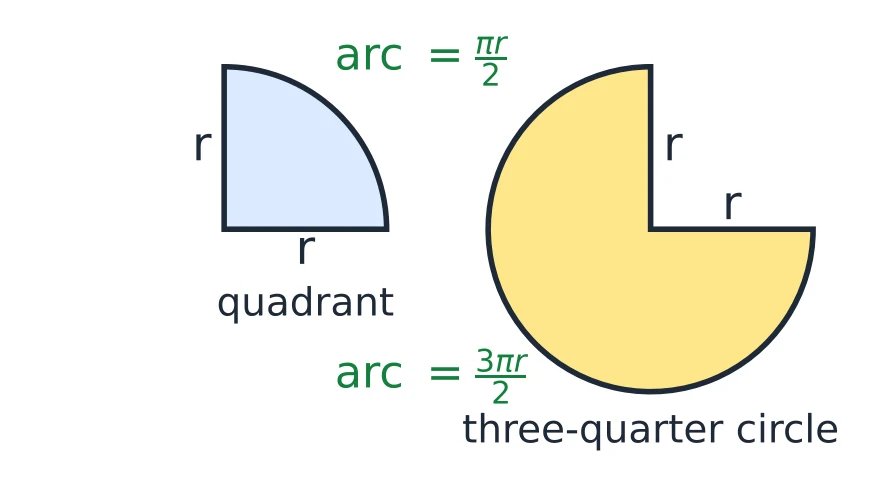
A three-quarter circle (a circle with one quadrant taken out) has area and perimeter . For r = 7 cm: area = 115.5 cm², perimeter = 33 + 14 = 47 cm.
All four shapes together, with :
| Shape | Area | Curved part | Perimeter |
|---|---|---|---|
| Circle | |||
| Semicircle | |||
| Three-quarter circle | |||
| Quadrant |
Any other slice of a circle (60°, 120° and so on) is a sector. Sectors come in Arcs, Sectors, Segments and Shaded Regions, with the same idea: the right fraction of the circle, plus two radii for the perimeter.
The full circle is the only one of these shapes with no straight edge. As soon as a circle is cut, add the straight edges to the perimeter: one diameter for a semicircle, two radii for a quadrant or a three-quarter circle.
Rings: The Area Between Two Circles
Two circles with the same centre (concentric circles) leave a ring between them, also called an annulus. With outer radius and inner radius :
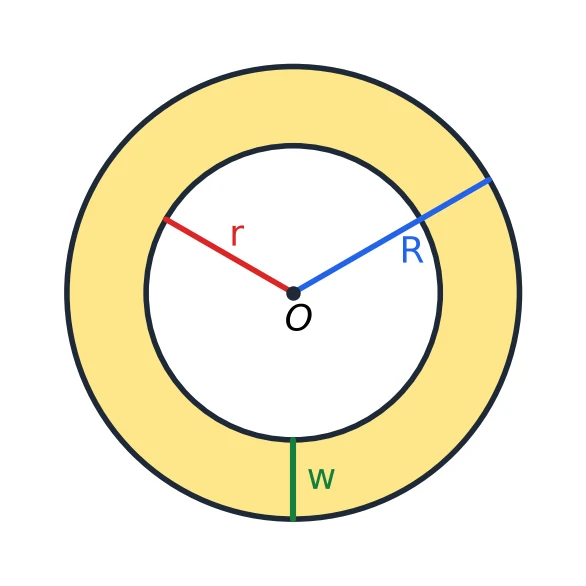
The width of the ring is . The factored form saves work: for R = 21 cm and r = 14 cm, the area is cm², with no squaring at all.
Circumferences. The difference of the two circumferences is . It depends only on the width, not on the size of the circles. So if the circumferences differ by 44 cm, the ring is cm wide, whatever the radii. The sum of the circumferences gives in the same way.
Another handy form: area of the ring = average of the two circumferences × width, because . A ring with circumferences 132 cm and 88 cm is 7 cm wide with an average circumference of 110 cm, so its area is 110 × 7 = 770 cm².
[Tier 2] A chord of the outer circle that touches the inner circle. Let chord AB of the outer circle touch the inner circle at T. The radius OT is perpendicular to the tangent AB, and T is the midpoint of AB. In right triangle OTB:
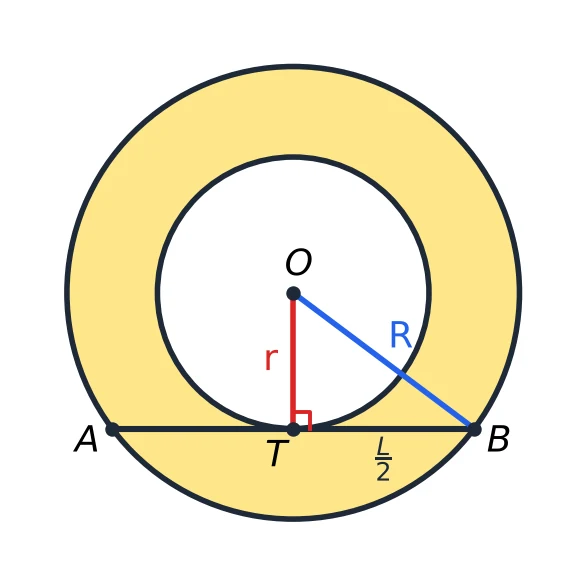
So the chord alone gives the ring's area. A 14 cm chord gives cm² without knowing either radius.
[SSC Tip] is not the area of the ring; it is a small circle as wide as the ring. Square first and then subtract, or use .
Circular Paths, Tracks and Their Cost
A path of equal width round a circular park is a ring. Read carefully whether the path is outside or inside the boundary.
- Path outside a park of radius : the outer radius is , and the area of the path is .
- Path inside, along the boundary: the inner radius is , and the area of the path is .
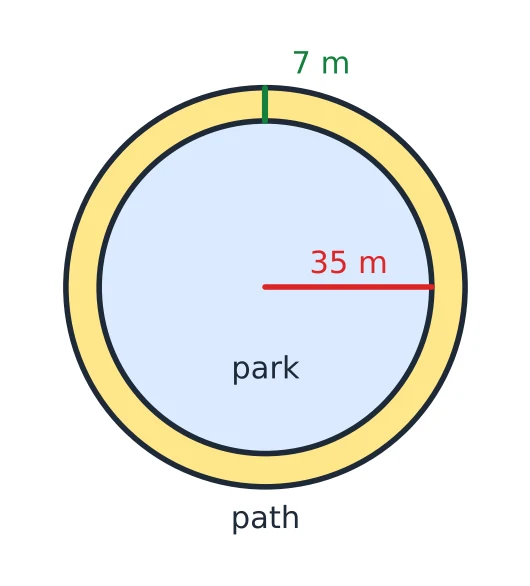
For a park of radius 35 m with a 7 m path outside: area of path = m². Gravelling it at ₹15 per m² costs 1694 × 15 = ₹25,410. Fencing the outer edge needs m of fence, which at ₹30 per m costs ₹7,920.
If the same 7 m path ran inside the park instead, its area would be m², which is smaller.
Running tracks. On a circular track of width , the outer edge is longer than the inner edge by . With an inner circumference of 440 m and a 7 m wide track, the outer edge is 440 + 44 = 484 m. The area of the track is the average circumference × width = 462 × 7 = 3234 m².
Rate per metre or per square metre? Fencing, a railing or a border strip is paid per metre of length, so it needs a circumference. Gravel, grass, tiles or paint is paid per square metre, so it needs an area. The options always contain the answer for the other one.
A shorter route: for a path outside, ; for a path inside, . Above, these are 7 × 77 = 539 and 7 × 63 = 441, and multiplying by is one more step.
Wheels: Distance, Revolutions and Speed
When a wheel rolls without slipping, each full turn (one revolution) carries it forward by exactly its circumference. A point P that touches the road at the start touches it again one circumference further on.
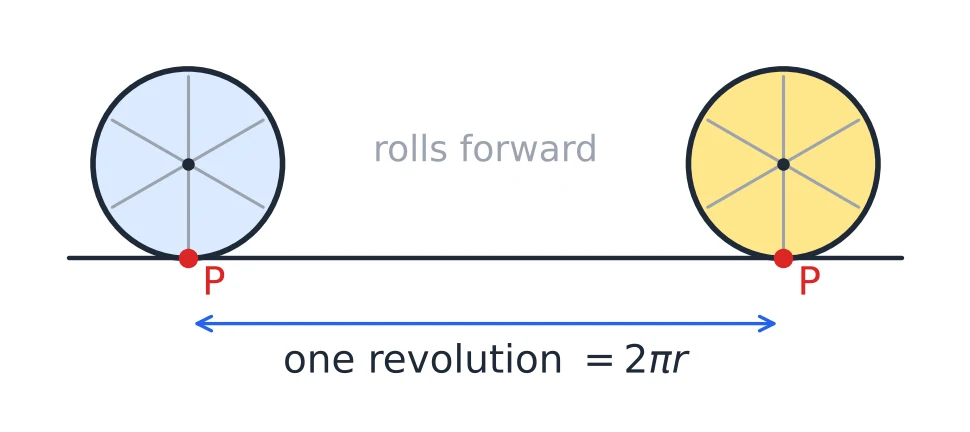
A wheel of diameter 70 cm has circumference cm = 2.2 m. To cover 1.1 km = 1100 m it turns times. In 750 revolutions it covers 750 × 2.2 = 1650 m.
Units first. The circumference is usually in cm and the distance in m or km. Change both to the same unit before dividing (1 km = 1000 m = 100000 cm). Most wrong options in wheel questions are off by a factor of 10 or 100.
Speed from revolutions per minute. If the wheel makes revolutions per minute (rpm), it covers circumferences every minute:
The 70 cm wheel at 300 rpm covers 300 × 2.2 = 660 m per minute. In an hour that is 660 × 60 = 39600 m, so the speed is 39.6 km/h. Going the other way, a cart moving at 33 km/h on these wheels covers 33000 ÷ 60 = 550 m per minute, so each wheel turns times a minute.
Revolutions use the circumference, never the area. And when the radius is given, the distance per turn is , not : taking doubles the number of revolutions.
Two Wheels, and the Tip of a Clock Hand
Front and back wheels. On a cart or a cycle, both wheels travel the same distance , so the smaller wheel has to turn more times:
Radii in the ratio 3 : 5 give revolutions in the ratio 5 : 3. The typical question is 'In what distance will the front wheel make 50 more revolutions than the back wheel?' Write
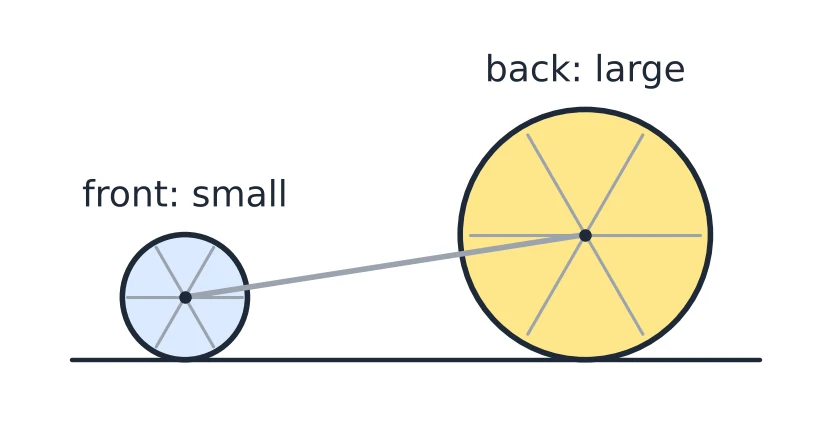
For a front wheel of radius 21 cm (circumference 132 cm = 1.32 m) and a back wheel of radius 42 cm (2.64 m): , so D = 132 m. Check: in 132 m the front wheel turns 100 times and the back wheel 50 times.
The tip of a clock hand. The tip of a hand of length moves round a circle of radius . The minute hand goes round once every 60 minutes, the hour hand once every 12 hours and the second hand once a minute.
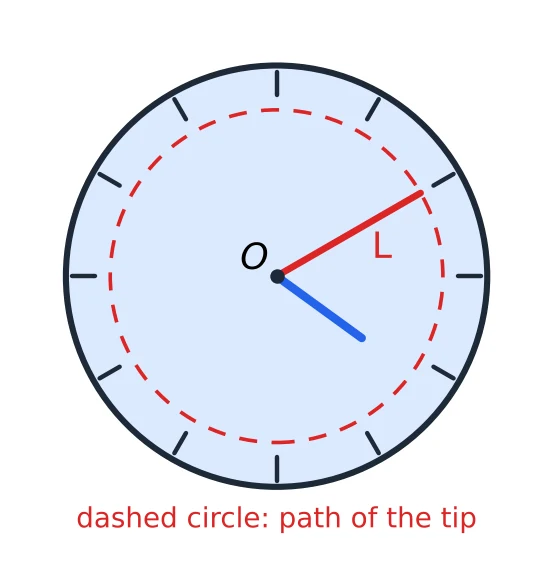
- Distance moved by the tip of the minute hand in minutes = .
- Distance moved by the tip of the hour hand in hours = .
A minute hand 7 cm long: its tip moves 44 cm in an hour, 11 cm in 15 minutes and 24 × 44 = 1056 cm in a day. An hour hand 3.5 cm long goes round twice a day, so its tip moves 2 × 22 = 44 cm in a day. The area swept by a hand is a sector, which comes in the next section.
How the Area Changes When the Radius Changes
If the radius is multiplied by , the circumference and the diameter are multiplied by , but the area is multiplied by :
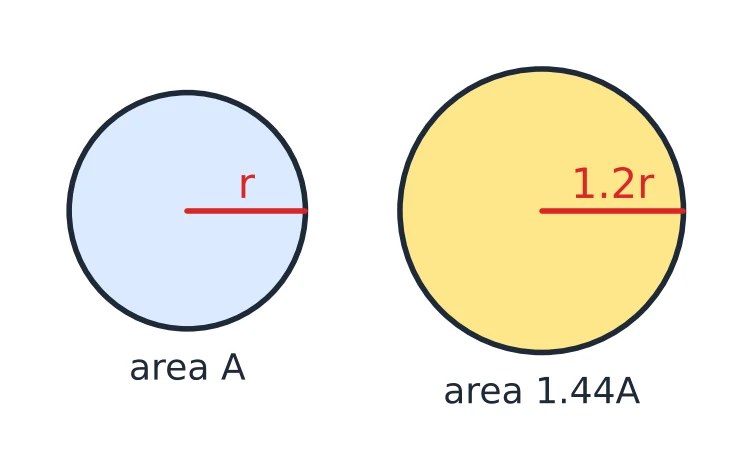
So a change of % in the radius changes the area by
This is the successive-change rule with , from Chapter 3.
| Radius | Area |
|---|---|
| up 10% | up 21% |
| up 20% | up 44% |
| up 50% | up 125% |
| doubled (up 100%) | 4 times (up 300%) |
| down 10% | down 19% |
| down 20% | down 36% |
| halved (down 50%) | down 75% |
The same table works for a change in the diameter or the circumference, since all three change together.
Going backwards. The area went up by 32.25%: it is now 1.3225 times, so the radius is times, an increase of 15%. The area fell by 51%: it is 0.49 times, so the radius is 0.7 times, a decrease of 30%.
Circumference with radius. With the radius up by 20%, the circumference also goes up by 20%, not 44%. Only the area squares.
[SSC Tip] The options for 'radius increased by 20%, area increased by?' nearly always include 20% and 40%. The radius change counts twice and the overlap is added: 20 + 20 + 4 = 44%.
Comparing Circles: Ratios and Equal Perimeters
For two circles with radii in the ratio :
- the diameters and the circumferences are also ;
- the areas are .
So areas in the ratio 16 : 25 mean radii and circumferences in the ratio 4 : 5, and circumferences in the ratio 2 : 3 mean areas in the ratio 4 : 9.
Finding the actual radii. Radii in the ratio 2 : 5 with circumferences that differ by 132 cm: write the radii as and , so , which gives and k = 7. The radii are 14 cm and 35 cm.
Adding circles. A circle whose area equals the sum of the areas of circles of radii 7 cm and 24 cm has , so r = 25 cm. A circle whose circumference equals the sum of two circumferences simply has the sum of the two radii.
A circle and a square with the same perimeter. Take a perimeter of 88 cm. The square has side 22 cm and area 484 cm². The circle has r = 14 cm and area 616 cm². The circle encloses more:
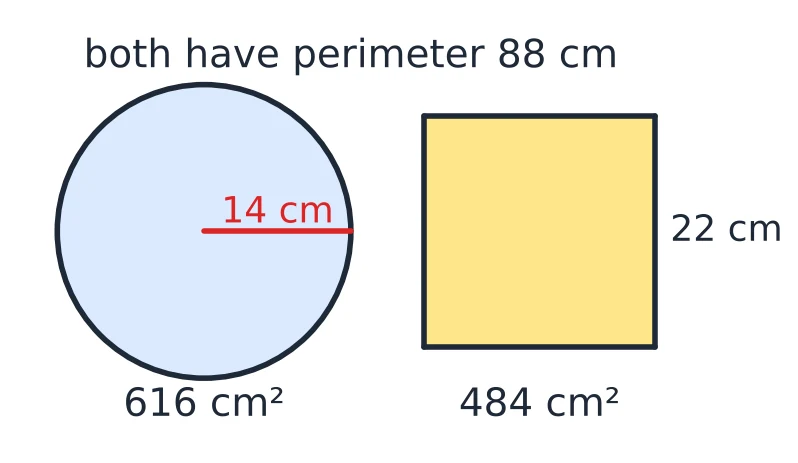
The other way round, a square and a circle with the same area: the square needs the longer boundary.
Ratios of areas come from squaring, so ratios of radii come from square roots. Areas 49 : 64 give radii 7 : 8, and circumferences 7 : 8 as well, not 49 : 64.
The Largest Circle in a Rectangle, and Coins Cut from a Sheet
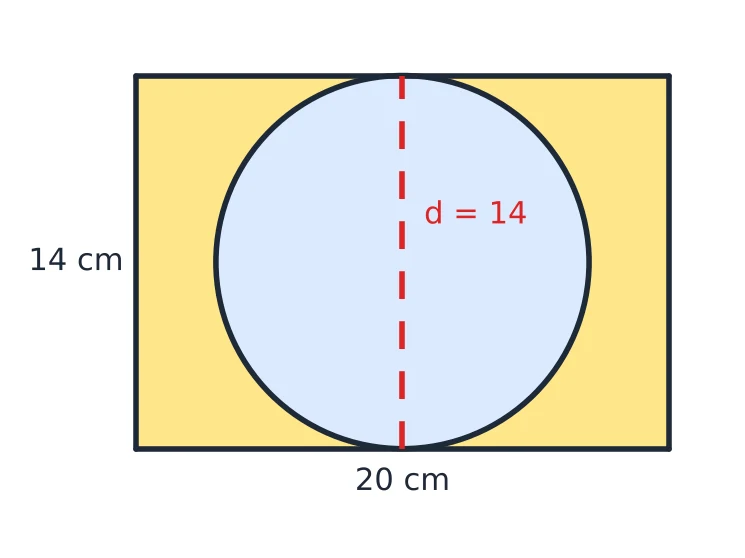
The largest circle. The biggest circle that fits in a rectangle touches the two longer sides, so its diameter is the shorter side. From a 20 cm by 14 cm sheet, the largest circle has diameter 14 cm, so r = 7 cm and its area is 154 cm²; the waste is 280 − 154 = 126 cm². In a square of side the largest circle has , and in a triangle it is the incircle (Regular Polygons and Combined Figures).
Many coins or discs from one sheet. When discs of diameter are cut in neat rows, each disc uses up a by square, so
From a 44 cm by 28 cm sheet, discs of diameter 4 cm: 11 × 7 = 77 discs. Their total area is cm², so 1232 − 968 = 264 cm² of the sheet is wasted.
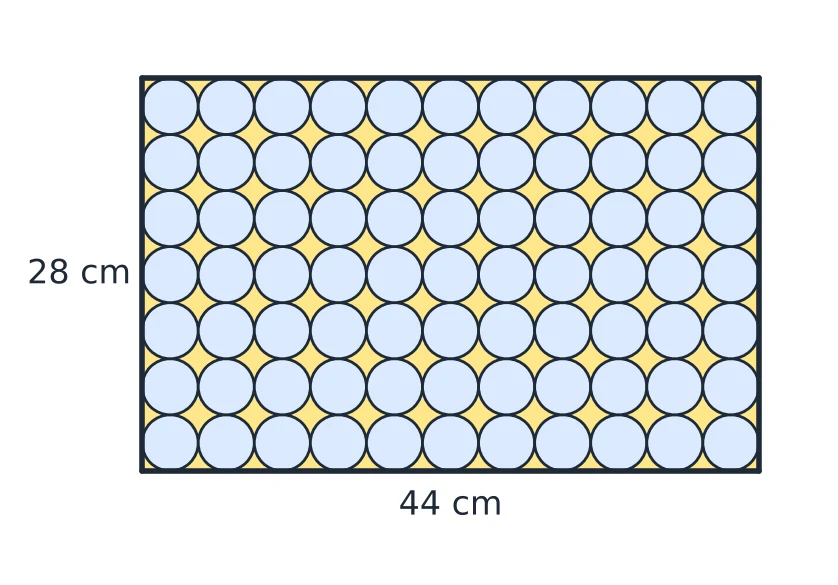
Do not divide the areas. discs is impossible, because the gaps between round discs cannot be used. In this neat-rows layout the waste is always of the sheet, which is (about 21%) with . Here .
When a side is not a multiple of the diameter, the leftover strip is wasted: a 45 cm by 30 cm sheet still gives only 11 × 7 = 77 discs of diameter 4 cm.
Solved Examples
Question 1
The circumference of a circle is 132 cm. What is its area? (Take .) (a) 1386 cm² (b) 693 cm² (c) 5544 cm² (d) 2772 cm²
Answer. First the radius: , so cm. Then the area: = (a) 1386 cm². Writing by mistake gives r = 42 cm and 5544 cm².
Question 2
The area of a circle is 2464 cm². What is its circumference? (Take .) (a) 88 cm (b) 352 cm (c) 176 cm (d) 132 cm
Answer. gives , so r = 28 cm. Circumference = = (c) 176 cm.
Question 3
A circular garden has radius 15 m. What is the cost of fencing it at ₹20 per metre? (Take = 3.14.) (a) ₹942 (b) ₹1,884 (c) ₹14,130 (d) ₹3,768
Answer. Fencing goes round the edge, so we need the circumference: 2 × 3.14 × 15 = 94.2 m. Cost = 94.2 × 20 = (b) ₹1,884. ₹14,130 uses the area (706.5 m²) instead of the length.
Question 4
The circumference of a circle exceeds its diameter by 45 cm. What is the radius of the circle? (Take .) (a) 21 cm (b) 22.5 cm (c) 7 cm (d) 10.5 cm
Answer. C − d = . So , giving d = 21 cm and r = (d) 10.5 cm. Check: C = 66 cm and 66 − 21 = 45.
Question 5
The sum of the circumference and the radius of a circle is 51 cm. What is the area of the circle? (Take .) (a) 616 cm² (b) 154 cm² (c) 44 cm² (d) 38.5 cm²
Answer. . So and r = 7 cm. Area = = (b) 154 cm².
Question 6
The perimeter of a semicircle is 126 cm. What is its area? (Take .) (a) 943.25 cm² (b) 1886.5 cm² (c) 471.625 cm² (d) 600.25 cm²
Answer. The perimeter of a semicircle is the arc plus the diameter: . So and r = 24.5 cm. Area = = (a) 943.25 cm².
Question 7
A plot is in the shape of a semicircle with area 2772 m². What length of fencing is needed to go all round it? (Take .) (a) 132 m (b) 264 m (c) 216 m (d) 174 m
Answer. , so and r = 42 m. All round means the curved edge and the straight edge: = (c) 216 m.
Question 8
What is the perimeter of a quadrant of a circle of radius 35 cm? (Take .) (a) 55 cm (b) 90 cm (c) 110 cm (d) 125 cm
Answer. A quadrant has a quarter arc and two straight radii. Arc = cm. Perimeter = 55 + 35 + 35 = (d) 125 cm.
Question 9
A garden is in the shape of three quarters of a circle of radius 14 m, as shown. What is the cost of fencing its whole boundary at ₹25 per metre? (Take .) (a) ₹2,350 (b) ₹1,650 (c) ₹2,200 (d) ₹2,000
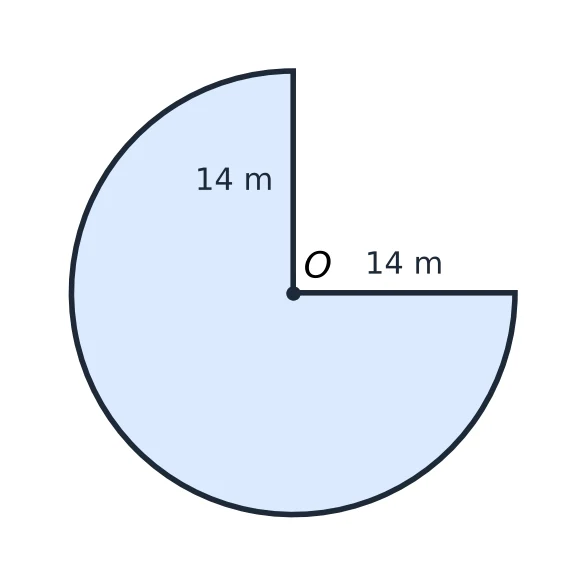
Answer. The boundary is three quarters of the circumference plus the two straight radii. Arc = m. Boundary = 66 + 14 + 14 = 94 m. Cost = 94 × 25 = (a) ₹2,350.
Question 10
Two concentric circles have radii 17.5 cm and 10.5 cm. What is the area of the ring between them? (Take .) (a) 962.5 cm² (b) 616 cm² (c) 346.5 cm² (d) 154 cm²
Answer. Use , which avoids squaring decimals: = (b) 616 cm². 154 cm² is , a circle as wide as the ring.
Question 11
The circumferences of two concentric circles are 154 cm and 110 cm. What is the area of the ring between them? (Take .) (a) 154 cm² (b) 1886.5 cm² (c) 924 cm² (d) 962.5 cm²
Answer. The radii are cm and cm. Ring = = (c) 924 cm². Quick check with the average circumference: 132 × 7 = 924.
Question 12
The area of a ring between two concentric circles is 1386 cm² and the ring is 7 cm wide. What is the radius of the outer circle? (Take .) (a) 28 cm (b) 31.5 cm (c) 63 cm (d) 35 cm
Answer. Area = and R − r = 7. So , which gives R + r = 63. Now R + r = 63 and R − r = 7, so R = 35 cm and r = 28 cm. The answer is (d) 35 cm. 28 cm is the inner radius; the question asks for the outer one.
Question 13
A circular park of radius 49 m has a path 7 m wide running round it on the outside. What is the cost of gravelling the path at ₹12 per m²? (Take .) (a) ₹27,720 (b) ₹24,024 (c) ₹1,848 (d) ₹4,224
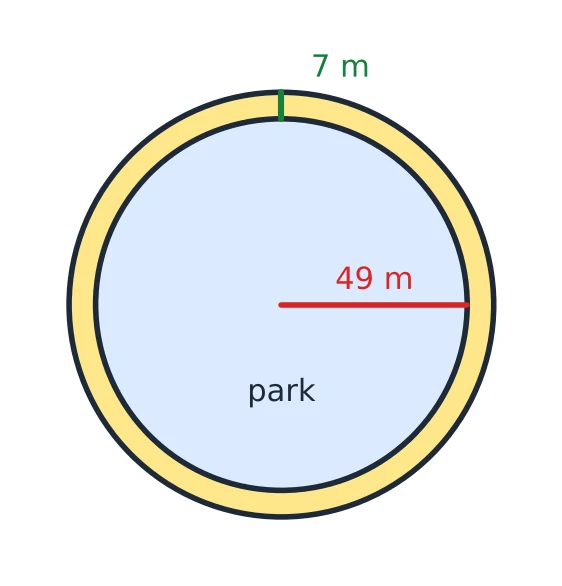
Answer. The path is a ring with inner radius 49 m and outer radius 49 + 7 = 56 m. Area = m². Cost = 2310 × 12 = (a) ₹27,720.
Question 14
A circular garden has circumference 220 m. A path 3.5 m wide runs round it along the inside of the boundary. What is the area of the path? (Take .) (a) 808.5 m² (b) 38.5 m² (c) 731.5 m² (d) 770 m²
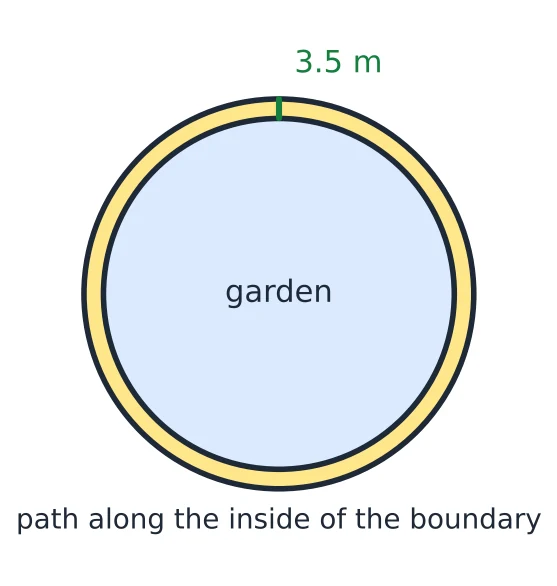
Answer. Radius of the garden = m. The path is inside, so the inner radius is 35 − 3.5 = 31.5 m. Area = = (c) 731.5 m². 770 m² multiplies the outer circumference by the width, but the average circumference is needed.
Question 15
The diameter of a wheel is 84 cm. How many revolutions does it make in covering 792 m? (Take .) (a) 150 (b) 300 (c) 600 (d) 3000
Answer. One revolution = circumference = cm. Change 792 m to cm: 79200 cm. Revolutions = = (b) 300.
Question 16
A wheel of radius 35 cm makes 225 revolutions per minute. What is the speed of the vehicle in km/h? (Take .) (a) 14.85 km/h (b) 59.4 km/h (c) 2.97 km/h (d) 29.7 km/h
Answer. One turn = cm = 2.2 m. In a minute: 225 × 2.2 = 495 m. In an hour: 495 × 60 = 29700 m = (d) 29.7 km/h.
Question 17
A car is moving at 99 km/h. Its wheels have a diameter of 70 cm. How many revolutions does each wheel make per minute? (Take .) (a) 375 (b) 750 (c) 1500 (d) 45,000
Answer. In one minute the car goes m. One revolution = cm = 2.2 m. Revolutions per minute = = (b) 750. 45,000 is the number in an hour, not a minute.
Question 18
The front wheel of a cart has a diameter of 70 cm and the back wheel a diameter of 1.05 m. In what distance will the front wheel make 50 more revolutions than the back wheel? (Take .) (a) 165 m (b) 660 m (c) 330 m (d) 110 m
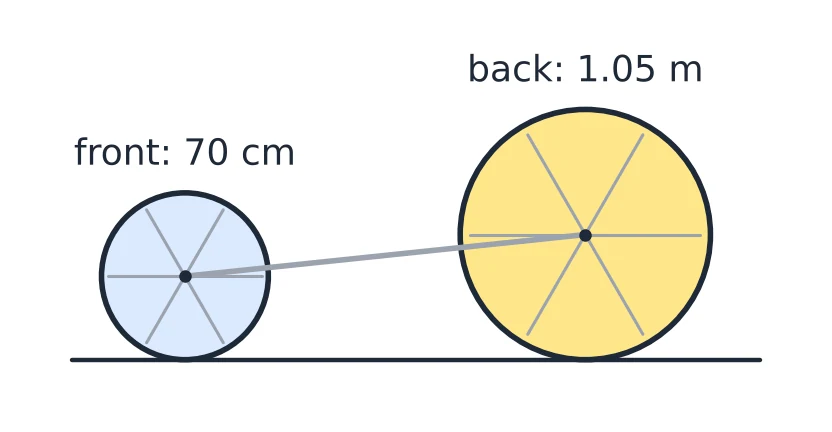
Answer. Circumferences: front = m, back = m. In a distance D, . The common denominator is 6.6: , so D = (c) 330 m. Check: in 330 m the front wheel turns 150 times and the back wheel 100 times.
Question 19
The minute hand of a clock is 3.5 cm long. How far does its tip move between 9:00 a.m. and 11:30 a.m.? (Take .) (a) 22 cm (b) 27.5 cm (c) 110 cm (d) 55 cm
Answer. Each hour the tip goes once round a circle of radius 3.5 cm, which is cm. From 9:00 to 11:30 is 2.5 hours, so the tip moves 2.5 × 22 = (d) 55 cm.
Question 20
The radius of a circle is increased by 30%. By what percentage does its area increase? (a) 60% (b) 30% (c) 69% (d) 169%
Answer. The new radius is 1.3 times the old, so the new area is times the old. That is an increase of (c) 69%. With the formula: .
Question 21
The circumference of a circle is decreased by 10%. By what percentage does its area decrease? (a) 19% (b) 20% (c) 10% (d) 21%
Answer. The circumference and the radius change together, so the radius is now 0.9 times. The area becomes times, a decrease of (a) 19%. With the formula: . 21% is the answer for an increase of 10%.
Question 22
The area of a circle increases by 96%. By what percentage does its circumference increase? (a) 48% (b) 96% (c) 20% (d) 40%
Answer. The new area is 1.96 times the old, so the radius (and with it the circumference) is times. The circumference goes up by (d) 40%.
Question 23
The areas of two circles are in the ratio 9 : 16, and their circumferences differ by 44 cm. What is the radius of the larger circle? (Take .) (a) 21 cm (b) 28 cm (c) 7 cm (d) 16 cm
Answer. Areas 9 : 16 means radii 3 : 4 (take square roots). Write the radii as 3k and 4k. The circumferences differ by , so k = 7. The larger radius is 4 × 7 = (b) 28 cm.
Question 24
How many circular discs of diameter 6 cm can be cut, in rows, from a rectangular sheet 66 cm by 42 cm? (a) 98 (b) 308 (c) 77 (d) 24
Answer. Each disc needs a 6 cm by 6 cm square of the sheet. Along the 66 cm side we get 66 ÷ 6 = 11 discs, and along the 42 cm side 42 ÷ 6 = 7. Total = 11 × 7 = (c) 77. Dividing the sheet's area by one disc's area gives 98, which ignores the wasted gaps between round discs.
Question 25
The largest possible circle is cut from a rectangular sheet 28 cm by 20 cm. What area of the sheet is left over? (Take = 3.14.) (a) 246 cm² (b) 314 cm² (c) 497.2 cm² (d) 280 cm²
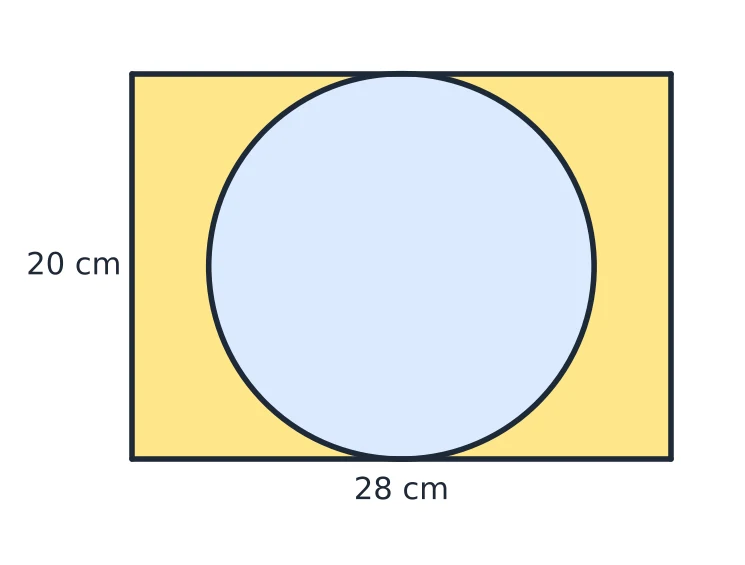
Answer. The largest circle has diameter equal to the shorter side, 20 cm, so r = 10 cm. Circle = 3.14 × 100 = 314 cm². Sheet = 28 × 20 = 560 cm². Left over = 560 − 314 = (a) 246 cm².