
Arc Length and Sector Area
A sector is the slice of a circle cut off by two radii, like a slice of pizza. The curved edge of the slice is an arc, and the angle between the two radii at the centre is the central angle .
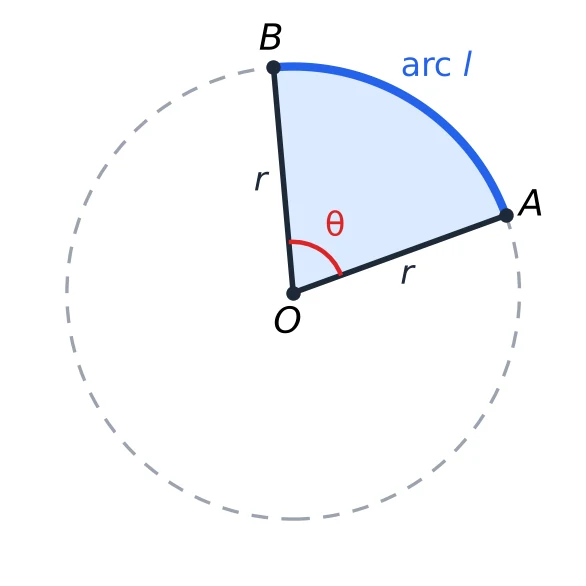
The whole circle has 360° at the centre, so a sector with angle is simply of the circle. Its arc is that fraction of the circumference, and its area is that fraction of the area:
You do not have to learn these as new formulas. Find the full circle first, then take the fraction.
| Angle at the centre | Fraction of the circle |
|---|---|
| 30° | |
| 45° | |
| 60° | |
| 72° | |
| 90° | (a quadrant) |
| 120° | |
| 180° | (a semicircle) |
| 270° |
- cm, : the circumference is cm and the area is cm². One-sixth of each gives an arc of 22 cm and a sector of 231 cm².
- cm, : one-eighth of 88 cm is 11 cm, and one-eighth of 616 cm² is 77 cm².
- cm, , with : one-fifth of 62.8 cm is 12.56 cm, and one-fifth of 314 cm² is 62.8 cm².
The semicircle and the quadrant from the circles section are just the 180° and 90° rows of this table.
Keep the full-circle values for the common radii ready (with ): gives 44 and 154, gives 88 and 616, gives 132 and 1386, gives 176 and 2464, and gives 220 and 3850. With these in hand, most sector questions become a single division.
Sector Area from the Arc, and Working Backwards
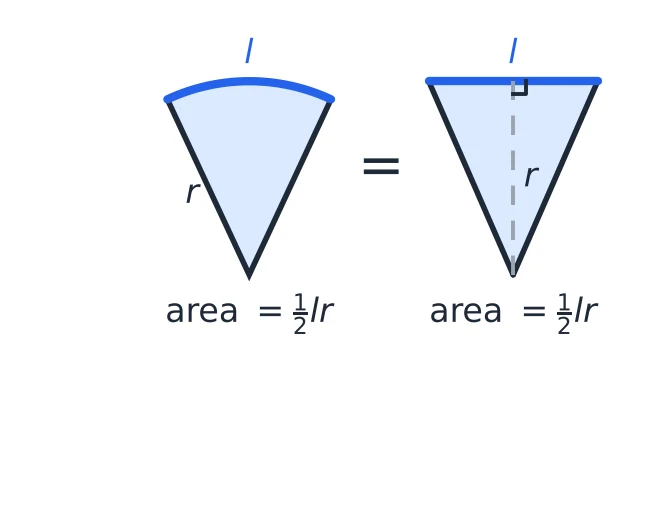
Divide the area formula by the arc formula: . So
This looks exactly like the area of a triangle with base and height , and that is no accident. Cut the sector into very thin slices: each slice is almost a thin triangle whose height is , and their bases add up to .
- Arc 22 cm, radius 21 cm: area cm², the same answer as before, with no at all.
- Area 154 cm² and arc 22 cm: cm.
Working backwards. SSC often gives the arc or the area and asks for the angle or the radius. Use the fraction idea in reverse.
- Angle from the arc: . An arc of 22 cm in a circle of radius 14 cm is of the circumference, so .
- Radius from the arc and the angle: an arc of 33 cm makes 135° at the centre. 135° is of the circle, so the circumference is cm and cm.
- Radius from the area and the angle: a 160° sector has area 616 cm². 160° is of the circle, so the whole circle is cm², and cm.
Same angle, different circles. The arc grows with and the area with . Two sectors with the same angle and radii in the ratio 2 : 3 have arcs in the ratio 2 : 3 and areas in the ratio 4 : 9.
Same arc, different circles. If is the same in both, then is the same, so the radii are in the inverse ratio of the angles.
[Tier 2] Angles in radians. If is given in radians, the 360 drops out: and area . A sector of radius 10 cm and angle 1.2 radians has an arc of 12 cm and an area of 60 cm².
When the arc and the radius are both given, is faster than finding the angle first, and it needs no value of .
Perimeter of a Sector; Minor and Major Sectors
The perimeter of a sector is its whole boundary: the arc plus the two radii.
- cm, : cm.
- A quadrant of radius 28 cm: cm.
From the perimeter back to the area. The perimeter of a sector of radius 7 cm is 25 cm. Take away the two radii and the arc is cm. Then the area is cm², and since 11 cm is of the 44 cm circumference, the angle is 90°.
Minor and major sectors. Two radii split a circle into two sectors. The smaller one, with angle , is the minor sector, and the rest, with angle , is the major sector. In the same way the circumference splits into a minor arc and a major arc.
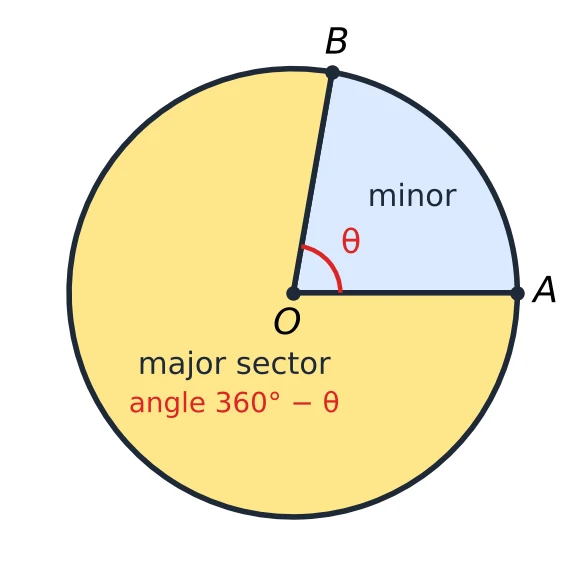
Take cm and a minor angle of 60°. The minor sector is 231 cm², so the major sector is cm². The minor arc is 22 cm, the major arc is cm, and the perimeter of the major sector is cm. The two sectors are in the ratio .
[SSC Tip] "Length of the arc" and "perimeter of the sector" are different questions. The perimeter adds , and the option without the is nearly always there. For a major sector, add the same to the major arc.
Area of a Segment
A chord cuts a circle into two segments: the smaller one between the chord and the minor arc (the minor segment), and the bigger one on the other side (the major segment).
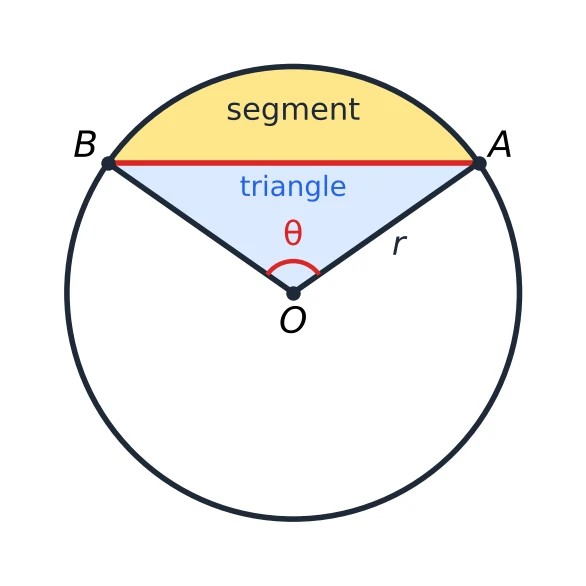
In the figure, the sector is made of two pieces: the triangle and the segment. So
The triangle has two sides equal to with the angle between them, so its area is . This is the formula from the triangles section. SSC keeps to standard angles:
| Area of | |
|---|---|
| 30° or 150° | |
| 60° or 120° | |
| 90° |
Putting the two pieces together:
Take cm and . The sector is cm², the triangle is cm², and the minor segment is cm². The major segment is cm².
Perimeter of a segment = arc + chord. For the 90° segment above, the arc is 22 cm and the chord is cm, so the perimeter is cm, about 41.8 cm.
Most mistakes happen in the triangle, not the sector. is right only for 90°. For 60° and 120° the triangle is , and for 30° and 150° it is .
Segments at 90°, 60° and 120°
These three angles cover nearly every segment question in SSC. For each one the chord and the triangle are fixed by alone.
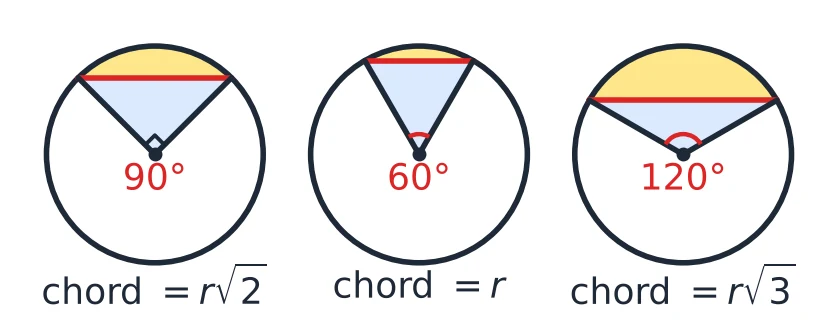
90°. The triangle is a right isosceles triangle with area , and the chord is .
With the bracket is , so the 90° segment is just . For cm that is cm², and the major segment is cm².
60°. The triangle is equilateral with side , because and the angle between them is 60°. So the chord equals the radius.
For cm: , about 102.67 − 84.87 = 17.80 cm².
120°. The triangle has two sides with 120° between them. Its area is again , because . The chord is , and it is from the centre.
For cm: cm², about 37.70 − 15.59 = 22.11 cm².
Reading the angle from the chord. A question may give the chord instead of the angle. A chord equal to means 60°, a chord of means 90°, and a chord of means 120°.
[SSC Tip] The 60° and 120° triangles have the same area, but the 120° sector is twice the 60° sector. A wrong option often uses where was needed, or the other way round, so fix the fraction of the circle before you touch the triangle.
Clock Hands, Pendulums and Wipers
Anything that turns about a fixed point sweeps out a sector. Turn the time or the swing into an angle first, and then use the sector formulas.
Clock hands.
- The minute hand turns 360° in 60 minutes, so 6° per minute.
- The hour hand turns 360° in 12 hours, so 30° per hour, which is 0.5° per minute.
- The second hand turns 6° per second.
The hand is the radius. The area it sweeps is a sector, and the distance moved by its tip is the arc.
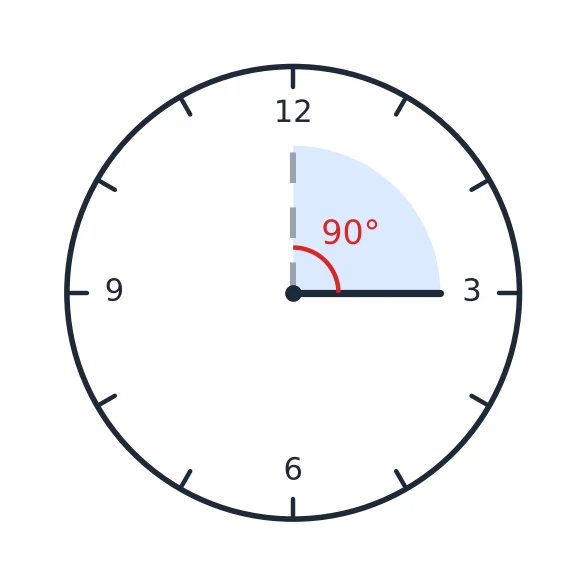
- A minute hand 28 cm long, in 15 minutes: the angle is , which is of the circle. Area swept cm², and the tip moves cm.
- An hour hand 10.5 cm long, from 8 o'clock to 12 o'clock: 4 hours, so . Area swept cm², and the tip moves cm.
Pendulums. The bob of a pendulum moves along an arc whose radius is the length of the pendulum. A pendulum 42 cm long swinging through 30° moves its bob cm in one swing.
Wipers and sprinklers. A wiper whose rubber blade runs along the whole arm sweeps a full sector. Often the blade covers only the outer part of the arm, and then the cleaned region is the part of a ring between two arcs:
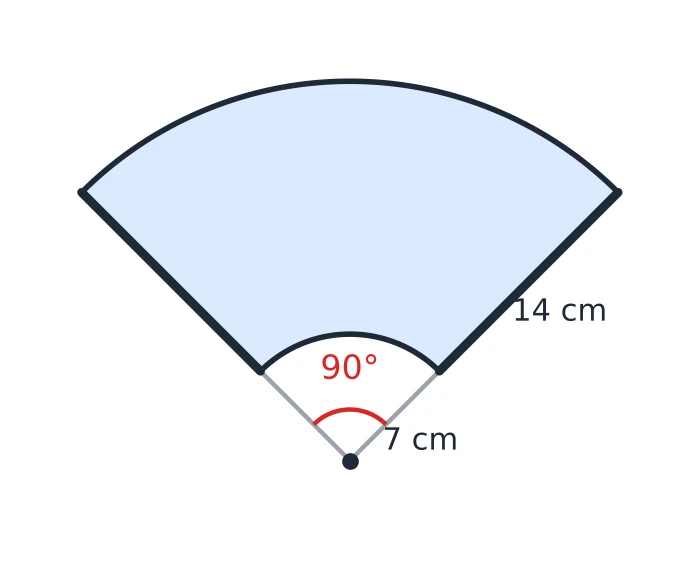
Here is the far end of the blade from the pivot and the near end. In the figure the blade runs from 7 cm to 21 cm and turns through 90°: area cm². Two wipers that do not overlap clean twice this.
[SSC Tip] The hour hand is the usual trap: in 35 minutes it turns only , not 30°. And "distance moved by the tip" asks for the arc, not the area.
Shaded Regions: Squares and Quarter Circles
Every shaded-region question follows one plan: shaded area = area of the whole figure − area of the unshaded pieces (or add up the pieces, if that is easier). Find each piece separately, mark the radii on a rough figure, and only then subtract. Most shaded figures in SSC are built from squares, quarter circles and semicircles.
Quarter circles at the four corners of a square. In a square of side , draw a quarter circle of radius at each corner. Each quarter circle touches its neighbours at the midpoints of the sides.
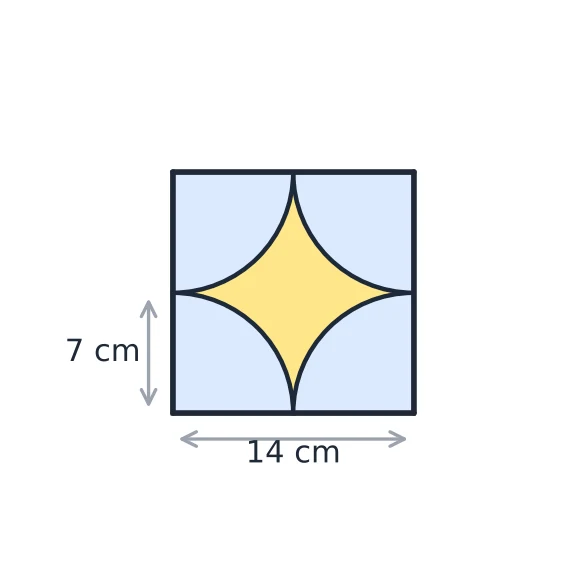
The four corner angles add up to 360°, so the four quarter circles together make one full circle of radius . The shaded star in the middle is
which is with . For cm: cm². Its boundary is the four quarter arcs, which together make one full circumference, cm.
Smaller quarter circles. If the radius is less than , the four corners still make one full circle, so the shaded part is . A square of side 20 cm with quarter circles of radius 7 cm at its corners leaves cm².
One quarter circle from a corner. With its centre at a corner and radius equal to the side , the quarter circle covers of the square, and the curved corner piece left over is . For cm: cm².
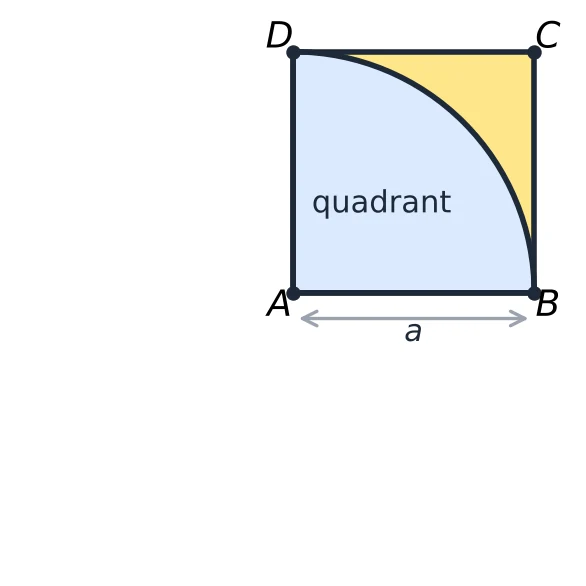
[SSC Tip] Count the angles at the centres, not the pieces. Equal quarter circles at the 4 corners of a square or rectangle make one full circle (360°), and equal sectors at the 3 corners of any triangle make one semicircle (180°). The same idea settles grazing questions later in this section.
Leaves and Flowers
The leaf from two quadrants. In a square of side , draw a quarter circle with centre and another with centre , both of radius . Both pass through and , and where they overlap they make a leaf along the diagonal .
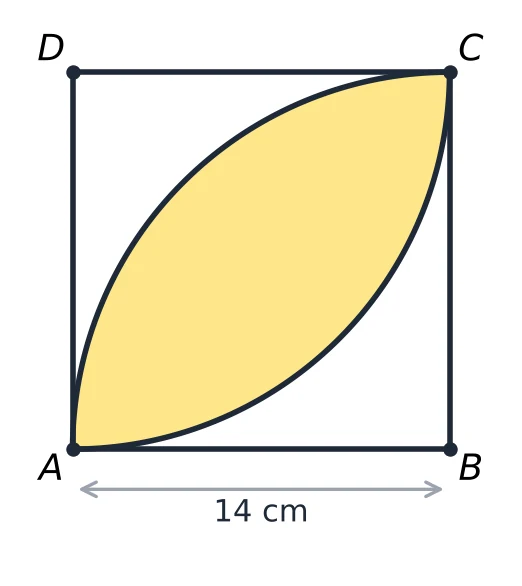
Each quarter circle is . Together they cover the whole square once and the leaf twice, so
With this is . Another way to see it: the diagonal cuts the leaf into two 90° segments of radius , each . For cm the leaf is cm², and the two unshaded corner pieces share cm². The leaf's perimeter is two quarter arcs: cm.
The flower from four semicircles. Draw a semicircle inwards on each side of a square of side . Each has radius , and neighbouring semicircles overlap in four petals that meet at the centre.
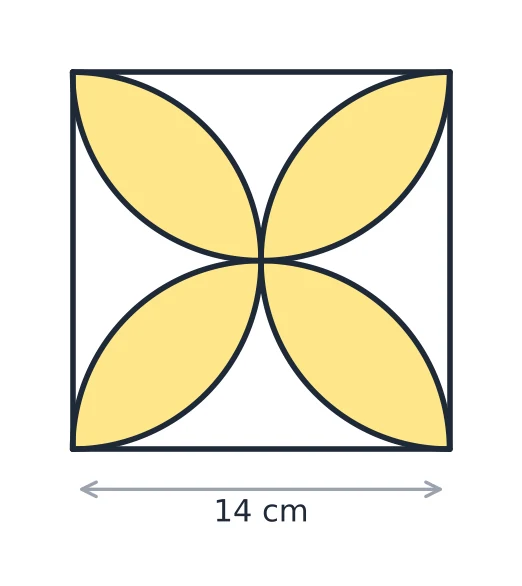
Each petal is two 90° segments of radius , so the flower is eight such segments:
That is the same as the leaf. For cm the flower is again 112 cm², and the part of the square outside the petals is again 84 cm².
A flower of four leaves. Split a big square into four small squares and put a leaf in each one. If the big square has side 42 cm, each small square has side 21 cm, each leaf is cm², and the four-leaf flower is cm².
Learn for a 90° segment (with ). A leaf is 2 of them, a petal is 2 of them and the four-petal flower is 8 of them, so each of these questions takes one line.
Touching Circles and the Gaps Between Them
Four equal circles. Four circles of radius sit in a square pattern, each touching its two neighbours. Join the centres and you get a square of side , with a quarter of each circle (90°) inside it.
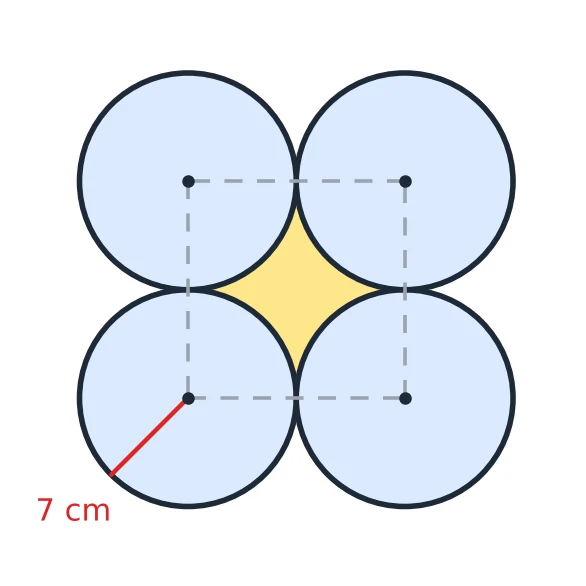
With this is . For cm: cm². It is the same picture as the square with quarter circles at its corners, just drawn with whole circles. The boundary of the gap is four quarter arcs, so its perimeter is cm.
If a square is drawn around the four circles, touching them all, its side is , and the part not covered by the circles is . For cm with : cm².
Three equal circles. Three circles of radius each touch the other two. The centres form an equilateral triangle of side , and each circle puts a 60° sector inside it. Three 60° sectors make 180°, which is half a circle.
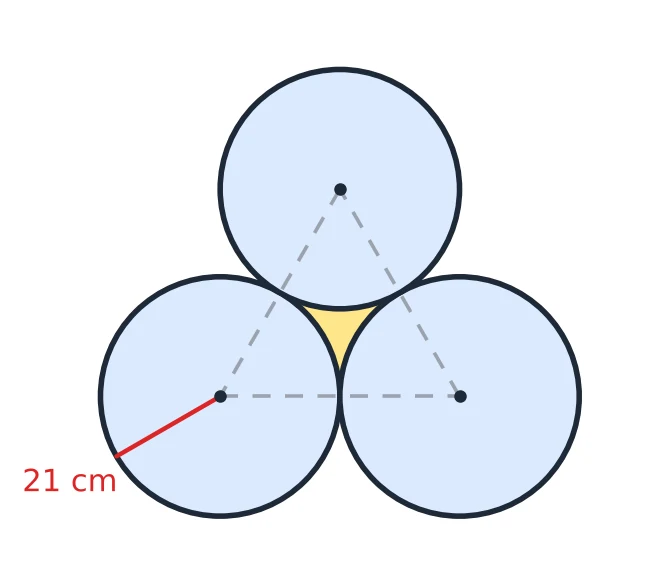
For cm: cm², about 763.83 − 693 = 70.83 cm². The gap's perimeter is three 60° arcs, half a circumference, so cm.
Circles in Squares, Squares in Circles, and Rectangles with Semicircles
Circle inside a square. The largest circle in a square of side has radius . The four corner pieces left over add up to
which is with , and each corner is a quarter of that. For cm with : cm², or 21.5 cm² per corner.
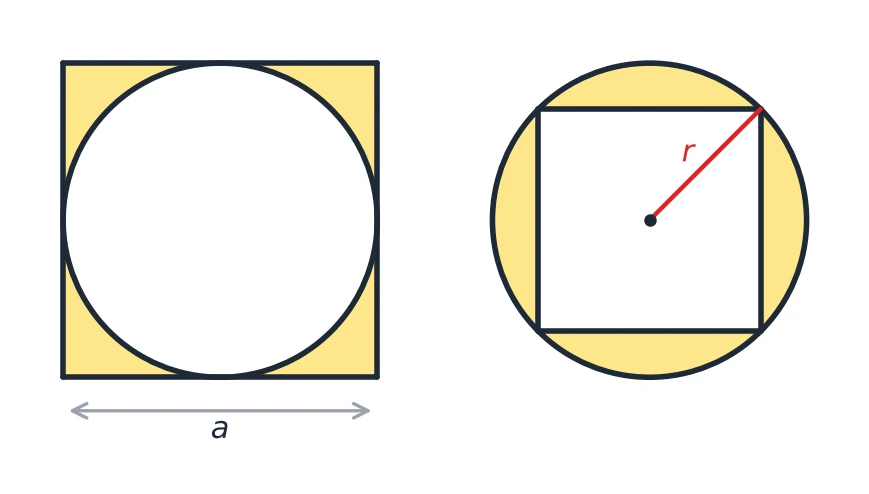
Compare this with the four circles of radius 5 cm in the same 20 cm square in the part above: they also leave 86 cm². Packing equal circles into a square always leaves the same area as one big circle, because the total area of the circles stays the same.
Square inside a circle. A square with its corners on a circle of radius has the diameter as its diagonal, so its area is . The four pieces left over are
which is with . For cm: cm², which is four 90° segments of 14 cm² each. In the same way, an equilateral triangle in a circle leaves , which is three 120° segments.
Rectangle with semicircles. A running track, or a field with round ends, is a rectangle with a semicircle on each of the two shorter sides. The two semicircles make one full circle of diameter .
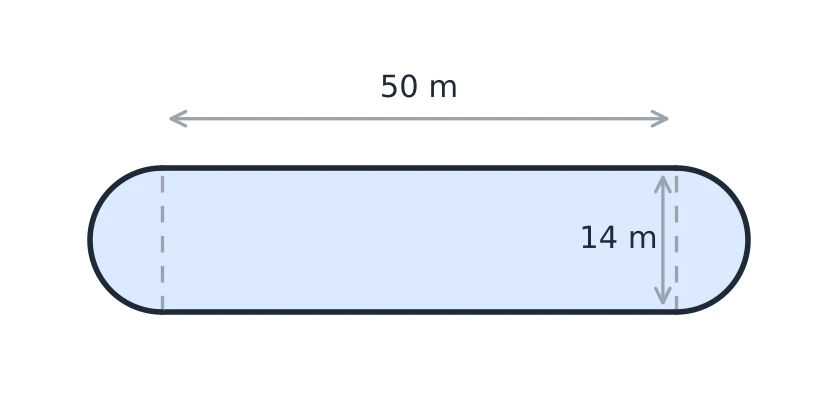
For m and m: area m², and perimeter m. The dashed sides of length are inside the shape, so they are not part of the perimeter. If the two semicircles are cut out of the rectangle instead, the area is m², while the perimeter is still .
[SSC Tip] In perimeter questions, trace the boundary with your finger. Inner lines (like the short sides of the track) do not count, and two semicircles on equal diameters make one full circumference.
Crescents and Lunes
Crescent from two circles. A small circle of radius sits inside a big circle of radius , touching it at one point. The moon-shaped part between them is a crescent.
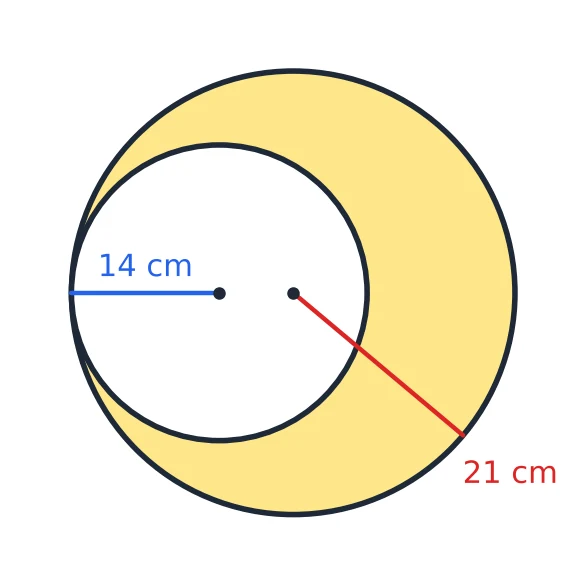
That is the same as a ring with those radii; only the shape is different. For cm and cm: cm². Its perimeter is both circumferences, cm.
Three semicircles on one line. Mark a point on a segment and draw semicircles on , and , all on the same side. The shaded region inside the big semicircle but outside the two small ones is
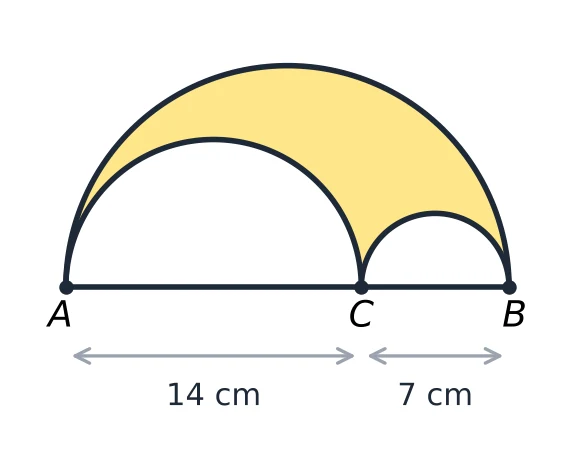
For cm and cm, so cm: cm². The short form agrees: cm². The perimeter is the three semicircular arcs, and since , the two small arcs together equal the big one. So the perimeter is cm.
[Tier 2] Lunes on a right triangle. Take a right triangle with the right angle at . Draw semicircles outwards on the legs and , and the semicircle on the hypotenuse that passes through (the circle through all three corners has as a diameter). The two crescent-shaped pieces outside the big semicircle are called lunes.
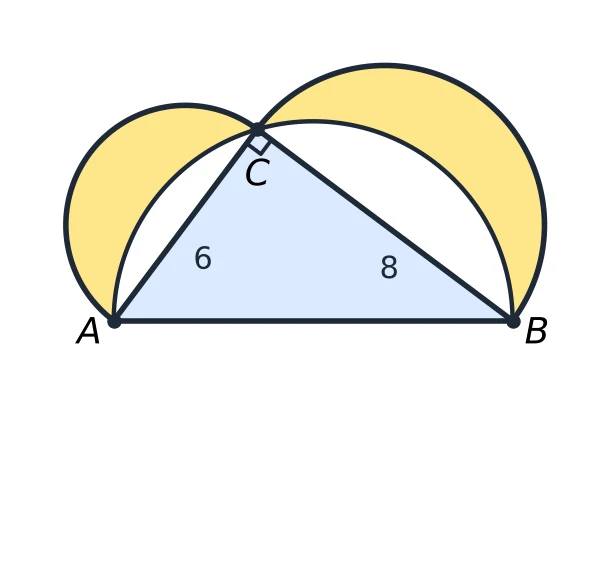
By Pythagoras the two small semicircles together equal the big one, so the curved parts cancel and
For legs 6 cm and 8 cm, the two lunes together are cm². The same idea works on a quadrant: a semicircle drawn outwards on the chord of a quadrant of radius cuts off a crescent equal to the quadrant's right triangle, .
In lune questions the curved parts cancel, so the answer has no in it. If your answer still has a , recheck which pieces you added and which you took away.
Grazing Animals
An animal tied with a rope of length can reach every point within of the peg, so it grazes a circle, or the part of a circle that lies inside the field. Each piece is a sector.
- Peg in the open: a full circle, .
- Tied at a corner of a rectangular or square field: the corner is 90°, so the cow grazes a quadrant, . This needs the rope to be no longer than either side.
- Tied at a corner of a triangular field with angle : a sector, . This needs the rope to be no longer than the distance from that corner to the opposite side.
- One animal at each corner, all with the same rope: the corner angles add up to the angle sum. Three animals at the corners of a triangle graze in all, and four at the corners of a quadrilateral graze . This works whatever the angles are, as long as no two patches overlap, which needs to be no more than each side.
A field 30 m by 20 m has a cow tied at one corner with a 14 m rope. The cow grazes m², and m² is left.
Three horses are tied at the corners of a triangular field with sides 13 m, 14 m and 15 m, each with a 6 m rope:
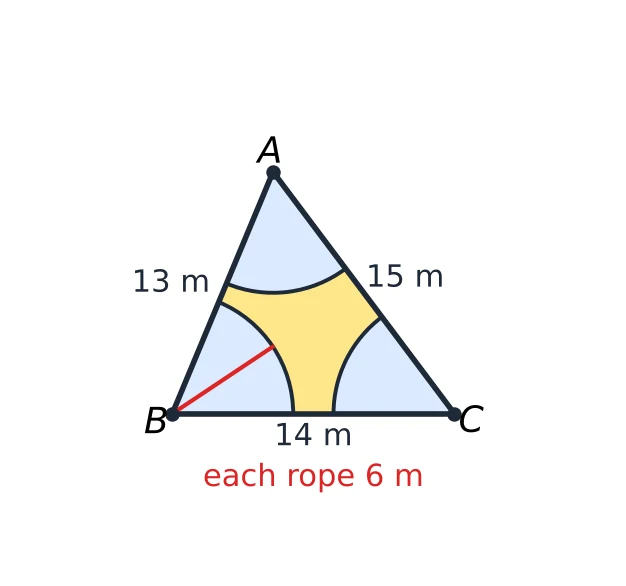
The field is 84 m² by Heron's formula (, from Triangles: Area and Perimeter). The horses graze , about 56.57 m², so about 27.43 m² is left. The ropes fit: 12 m is less than every side, and the shortest height of the field (11.2 m, onto the 15 m side) is more than 6 m.
Longer rope. If the rope at a corner grows from to , the extra area is a quarter of a ring, .
[Tier 2] Tied outside a shed. A cow is tied at the corner of a square shed of side 7 m, outside it, with a 14 m rope. Round it can sweep 270°, everything except the shed's own corner. When the rope wraps round or , 7 m of it is left, and that sweeps one more quarter circle on each side.
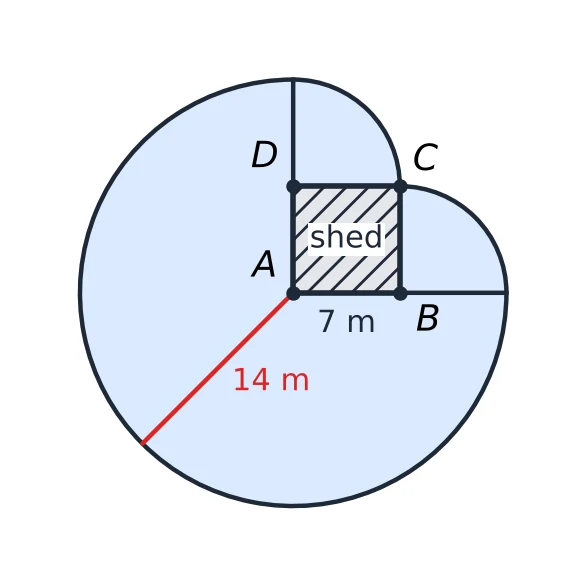
So the cow can graze 539 m².
Solved Examples
Question 1
A sector of a circle of radius 28 cm has a central angle of 45°. What is the length of its arc? (Take .) (a) 22 cm (b) 44 cm (c) 11 cm (d) 176 cm
Answer. 45° is one-eighth of the full 360°, so the arc is one-eighth of the whole circle's edge. The circumference is cm, and = (a) 22 cm.
Question 2
Find the area of a sector of a circle of radius 35 cm whose angle at the centre is 72°. (Take .) (a) 1540 cm² (b) 385 cm² (c) 770 cm² (d) 3850 cm²
Answer. 72° is of the circle. The whole circle is cm², so the sector is = (c) 770 cm².
Question 3
An arc of length 44 cm makes an angle at the centre of a circle of radius 42 cm. What is ? (Take .) (a) 60° (b) 30° (c) 120° (d) 45°
Answer. The full circumference is cm. The arc is of it, so the angle is of 360°, which is (a) 60°. 120° is what you get if you take 42 cm as the diameter.
Question 4
A sector with a central angle of 80° has an area of 308 cm². What is the radius of the circle? (Take .) (a) 14 cm (b) 21 cm (c) 42 cm (d) 10.5 cm
Answer. 80° is of the circle. So the whole circle is cm². Then gives , so = (b) 21 cm.
Question 5
The arc of a sector of a circle of radius 12 cm is 33 cm long. What is the area of the sector? (a) 396 cm² (b) 99 cm² (c) 264 cm² (d) 198 cm²
Answer. No need for the angle here. Area of a sector is half the arc times the radius: = (d) 198 cm². The data are fine: the arc is less than the full circumference, which is about 75.4 cm.
Question 6
What is the perimeter of a sector of a circle of radius 10.5 cm with a central angle of 120°? (Take .) (a) 22 cm (b) 32.5 cm (c) 43 cm (d) 65 cm
Answer. First the arc: 120° is of the circle, and the circumference is cm, so the arc is 22 cm. The perimeter also has the two radii: = (c) 43 cm.
Question 7
The perimeter of a sector of a circle of radius 7 cm is 32 cm. What is the area of the sector? (a) 112 cm² (b) 63 cm² (c) 126 cm² (d) 49 cm²
Answer. The perimeter is the arc plus two radii, so the arc is cm. Then area = half of arc × radius = = (b) 63 cm².
Question 8
In a circle of radius 42 cm, the minor sector has a central angle of 60°. What is the area of the major sector? (Take .) (a) 924 cm² (b) 5544 cm² (c) 2772 cm² (d) 4620 cm²
Answer. The major sector has the rest of the angle: , which is of the circle. The full circle is cm², so the major sector is = (d) 4620 cm². You can also take the minor sector, cm², away from 5544. 924 cm² is the minor sector, which the question did not ask for.
Question 9
Arcs of the same length subtend angles of 60° and 75° at the centres of two circles. What is the ratio of the areas of the two circles? (a) 25 : 16 (b) 16 : 25 (c) 5 : 4 (d) 4 : 5
Answer. Same arc means , so and . The smaller angle needs the bigger circle. Areas go with the square of the radius, so the ratio is (a) 25 : 16. 5 : 4 is only the ratio of the radii.
Question 10
A chord of a circle of radius 42 cm makes a right angle at the centre. What is the area of the minor segment? (Take .) (a) 1386 cm² (b) 504 cm² (c) 882 cm² (d) 5040 cm²
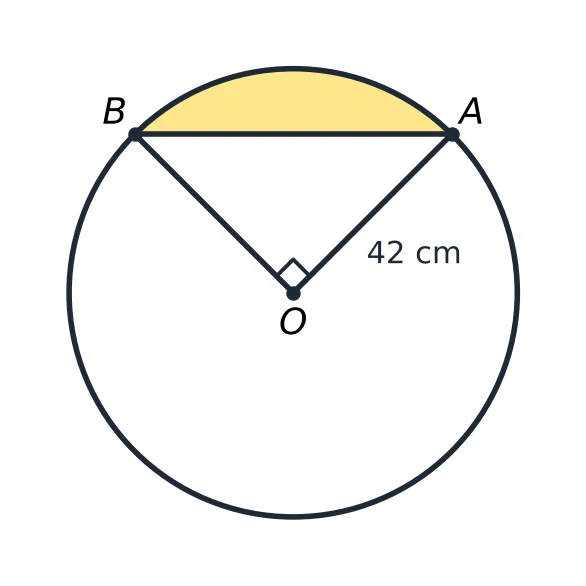
Answer. The minor segment is the quarter circle minus the right triangle. Quarter circle cm², triangle cm², so the segment is = (b) 504 cm². Quick check with the shortcut: .
Question 11
A chord of a circle of radius 18 cm is equal in length to the radius. What is the area of the minor segment? (a) cm² (b) cm² (c) cm² (d) cm²
Answer. A chord equal to the radius makes an equilateral triangle with the two radii, so the angle at the centre is 60°. Sector . Triangle . Segment = (c) cm². uses , which is only for 90°.
Question 12
A chord of a circle of radius 10 cm subtends an angle of 120° at the centre. Find the area of the minor segment. (Take and .) (a) 61.42 cm² (b) 104.67 cm² (c) 252.58 cm² (d) 9.08 cm²
Answer. Sector: 120° is one-third of the circle, so cm². Triangle: two sides of 10 cm with 120° between them, so cm². Segment = (a) 61.42 cm².
Question 13
The minute hand of a clock is 21 cm long. What area does it sweep between 9:10 and 9:35? (Take .) (a) 55 cm² (b) 288.75 cm² (c) 1155 cm² (d) 577.5 cm²
Answer. From 9:10 to 9:35 is 25 minutes, and the minute hand turns 6° every minute, so it turns . That is of the circle. The full circle is 1386 cm², so the area swept is = (d) 577.5 cm². 55 is the distance moved by the tip in cm, an arc and not an area.
Question 14
A pendulum swings through an angle of 36°, and its bob moves along an arc of 17.6 cm. What is the length of the pendulum? (Take .) (a) 14 cm (b) 56 cm (c) 28 cm (d) 35 cm
Answer. The pendulum's length is the radius of the arc. 36° is of 360°, so the full circumference would be cm. Then gives = (c) 28 cm.
Question 15
A car wiper has an arm 35 cm long. Its rubber blade covers only the outer 21 cm of the arm, and the arm turns through 120°. What area of glass does the blade clean? (Take .) (a) cm² (b) 1078 cm² (c) 462 cm² (d) 1617 cm²
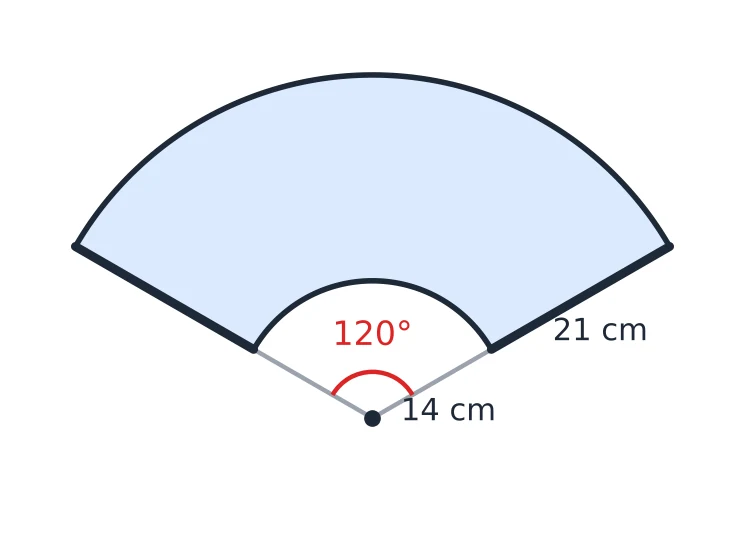
Answer. The blade runs from cm to 35 cm from the pivot, so it cleans the part of a ring between radii 14 cm and 35 cm. Area = (b) 1078 cm². cm² is the full sector of the arm, as if the blade ran right to the pivot.
Question 16
A square plot has side 35 m. At each corner there is a flower bed shaped like a quarter circle of radius 14 m, as shown, and the rest of the plot is to be turfed. What does the turfing cost at ₹20 per m²? (Take .) (a) ₹12,180 (b) ₹12,320 (c) ₹21,420 (d) ₹24,500
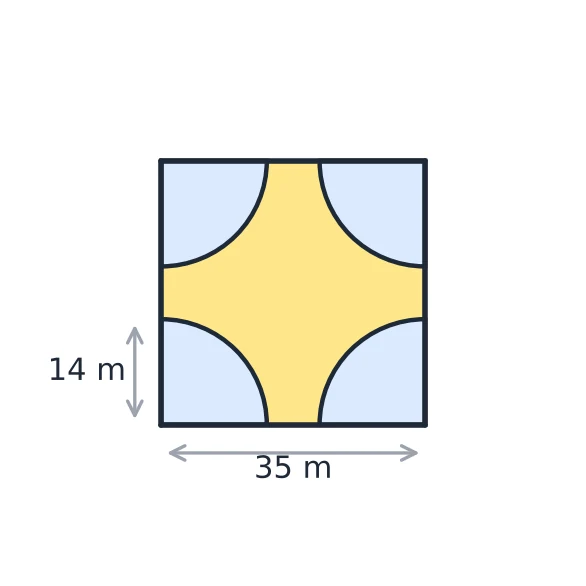
Answer. The four corner angles add up to 360°, so the four flower beds together make one full circle of radius 14 m: m². The plot is m², so the part to be turfed is m². Cost = (a) ₹12,180.
Question 17
is a square of side 28 cm. Quarter circles of radius 28 cm are drawn with centres and . What is the area of the shaded leaf? (Take .) (a) 616 cm² (b) 336 cm² (c) 224 cm² (d) 448 cm²
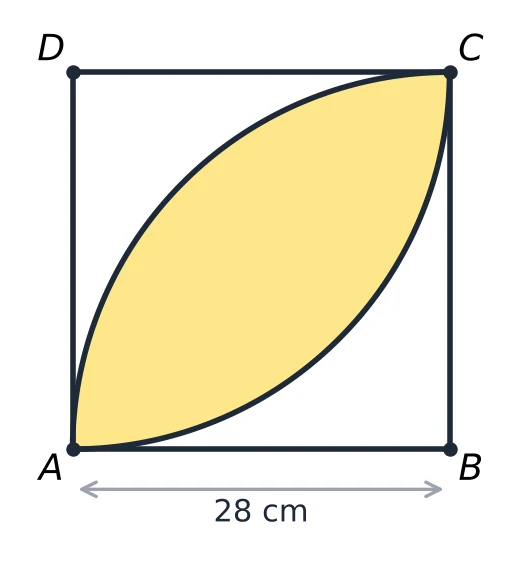
Answer. Each quarter circle is cm². The two together cover the square once and the leaf twice, so leaf = (d) 448 cm². Shortcut: .
Question 18
Four semicircles are drawn inside a square of side 10 cm, one on each side, as shown. What is the area of the shaded flower? (Take .) (a) 43 cm² (b) 57 cm² (c) 78.5 cm² (d) 28.5 cm²
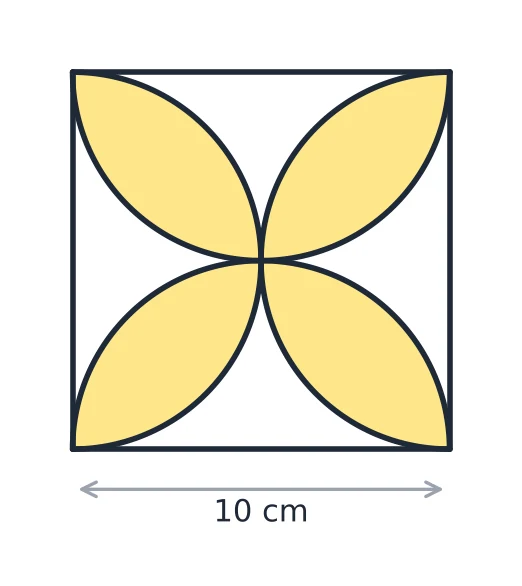
Answer. Each petal is made of two 90° segments of radius 5 cm. One such segment is cm². The flower has 8 of them: = (b) 57 cm².
Question 19
Four coins, each of radius 3.5 cm, are placed on a table so that each touches two others and their centres form a square. What is the area of the gap enclosed between them? (Take .) (a) 10.5 cm² (b) 38.5 cm² (c) 42 cm² (d) 49 cm²
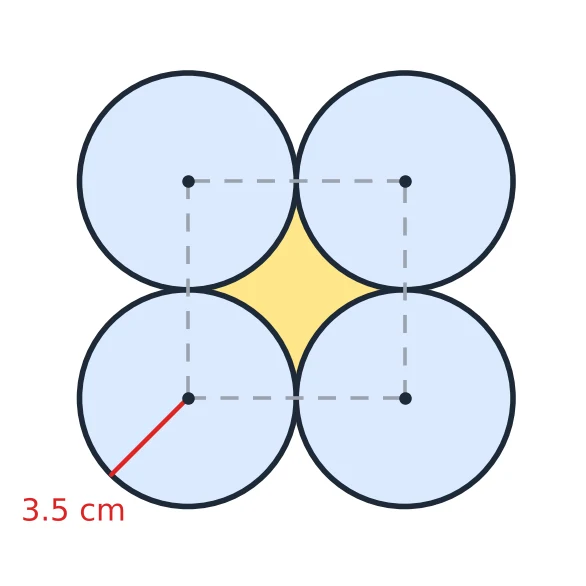
Answer. Join the centres: you get a square of side cm, with area 49 cm². Inside it each coin puts a quarter circle, and four quarters make one full coin: cm². The gap is = (a) 10.5 cm².
Question 20
Three circles of radius 14 cm each touch the other two. What is the area of the region enclosed between them? (Take .) (a) cm² (b) cm² (c) cm² (d) cm²
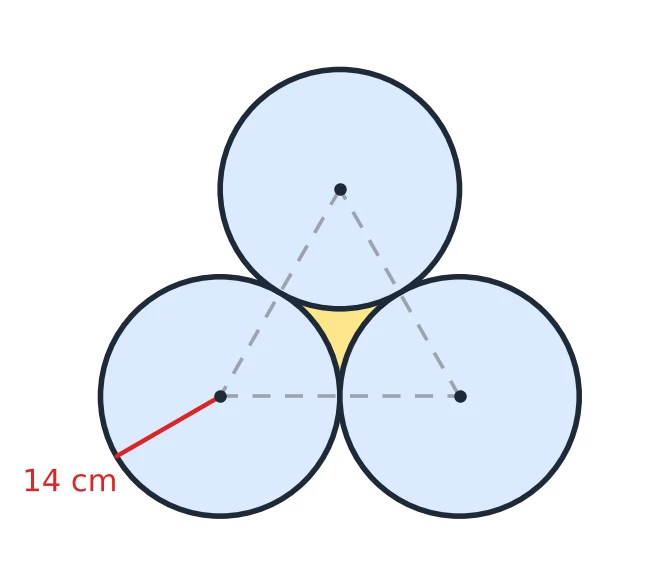
Answer. The centres form an equilateral triangle of side 28 cm, with area cm². Each circle puts a 60° sector inside the triangle, and the three sectors make a semicircle: cm². So the gap is (c) cm², about 31.5 cm².
Question 21
A square is drawn with all four corners on a circle of radius 14 cm. What is the area of the part of the circle outside the square? (Take .) (a) 392 cm² (b) 420 cm² (c) 56 cm² (d) 224 cm²
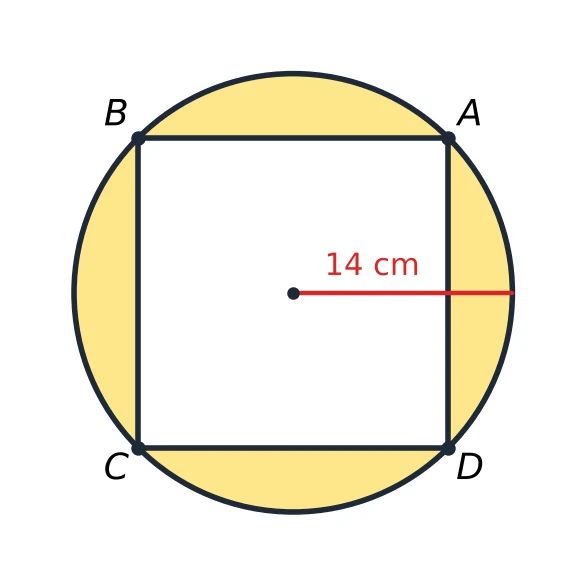
Answer. The diagonal of the square is a diameter, 28 cm, so the square's area is cm². The circle is cm². The part outside the square is = (d) 224 cm².
Question 22
A playground is a rectangle 70 m long and 42 m wide, with a semicircle on each of its two 42 m sides, outside it. What does it cost to fence the playground at ₹12 per metre? (Take .) (a) ₹4,272 (b) ₹3,264 (c) ₹4,848 (d) ₹1,680
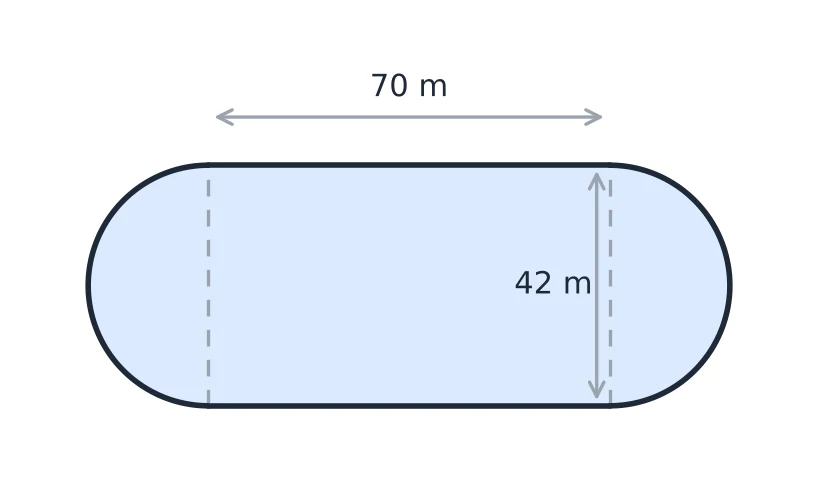
Answer. Walk round the boundary: two straight sides of 70 m, and two semicircles of diameter 42 m, which together make one full circle. Perimeter m. Cost = (b) ₹3,264.
Question 23
is a point on a segment with cm and cm. Semicircles are drawn on , and on the same side, as shown. What is the area of the shaded region? (Take .) (a) 115.5 cm² (b) 231 cm² (c) 308 cm² (d) 57.75 cm²
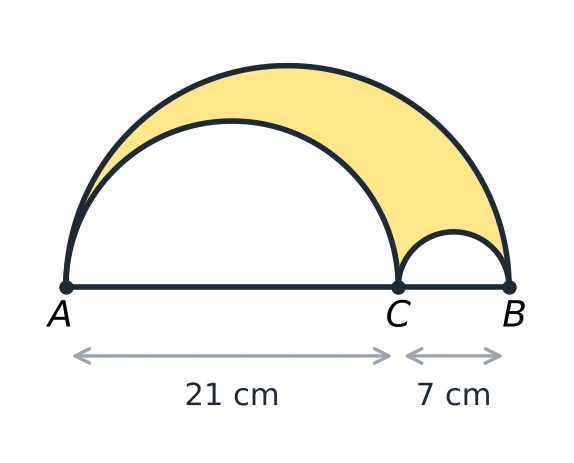
Answer. Big semicircle (diameter 28 cm) minus the two small ones (diameters 21 cm and 7 cm). Semicircle on a diameter is , so shaded = (a) 115.5 cm². Shortcut: gives the same.
Question 24
[Tier 2] is a right triangle with the right angle at , cm and cm. Semicircles are drawn outwards on and , and a semicircle on passes through . What is the total area of the two shaded lunes? (a) 108 cm² (b) cm² (c) 54 cm² (d) cm²
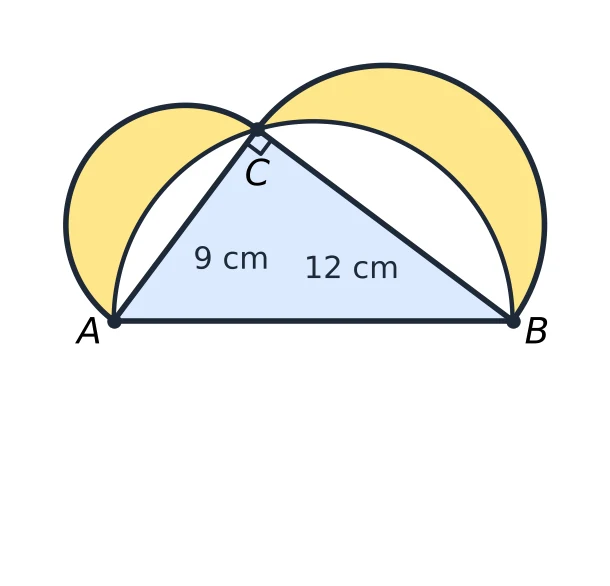
Answer. The two small semicircles together equal the big one, because . So when you add the two small semicircles and the triangle, then take away the big semicircle, all the curved parts cancel and only the triangle is left: = (c) 54 cm².
Question 25
A triangular field has sides 26 m, 28 m and 30 m. A horse is tied at each corner with a rope 7 m long. What area of the field is left ungrazed? (Take .) (a) 77 m² (b) 182 m² (c) 297.5 m² (d) 259 m²
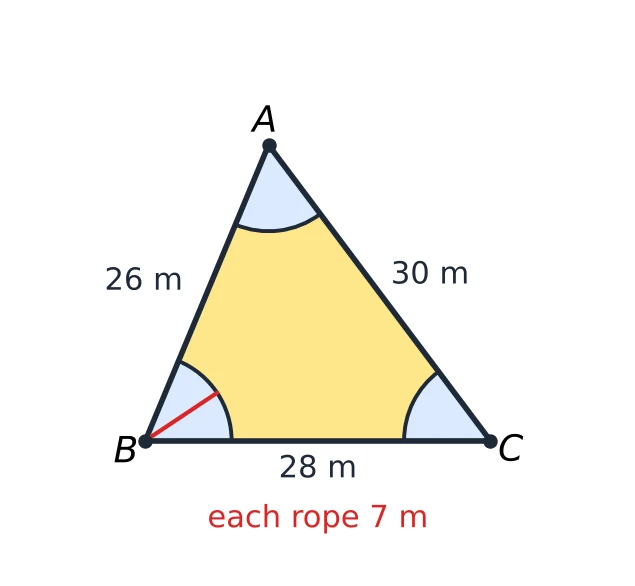
Answer. First the field, by Heron's formula: , and area m². The three corner angles add up to 180°, so the three horses together graze half a circle of radius 7 m: m². Left ungrazed: = (d) 259 m². The ropes fit, since 14 m is less than every side.
Question 26
A cow is tied at a corner of a rectangular field 40 m by 30 m with a rope 14 m long. If the rope is made 21 m long, how much more area can the cow graze? (Take .) (a) 192.5 m² (b) 346.5 m² (c) 154 m² (d) 770 m²
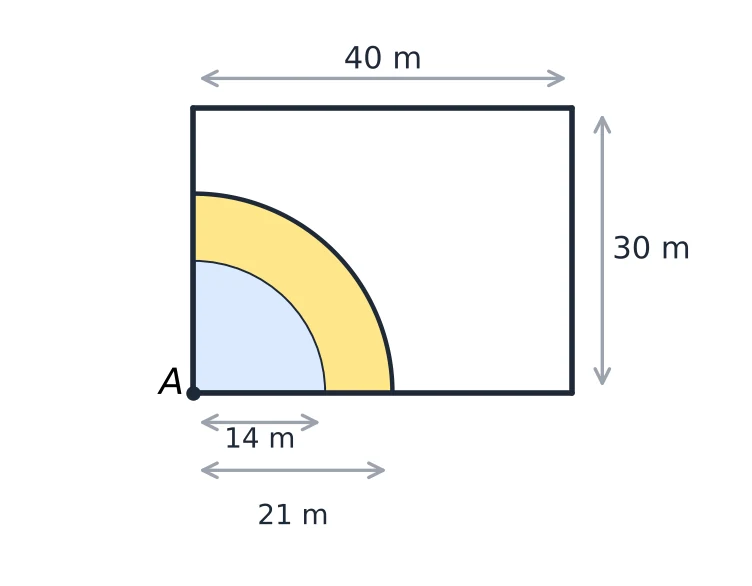
Answer. At a corner the cow grazes a quarter circle. Both ropes are shorter than the sides, so the extra area is the quarter of a ring between 14 m and 21 m: = (a) 192.5 m². 346.5 m² is the whole new quarter circle, not the extra part.