
How to Use These Questions
The 35 questions below jump from shape to shape on purpose. A sector can follow a path round a field, and a trapezium can follow a wheel, so the first job every time is to name the shape and the formula. After that, most answers take two or three lines.
Try each question on paper before you read the answer. Draw a rough figure even when one is printed, and write every given length on it. Look at the units before you start, because metres and centimetres mixed in one question catch many students, and decide early which value of the numbers want. A usual Tier 1 question here should take you about 45 seconds. If one takes much longer, find the fast route in the Shortcuts & Speed Methods section and come back to the question the next day.
Roughly a third of the questions are on circles, sectors, rings and shaded regions, a third on triangles and the four-sided figures, and the rest on paths, tiles and costs, regular polygons, figures inside figures, wheels and changes in area.
The ones marked [Tier 2] need an extra idea: a trapezium cut into a parallelogram and a triangle, a point inside an equilateral triangle, cross roads worked back from their cost, the octagon and the crescents. Tier 1 students should still try the first three, as the same tricks turn up in easier questions.
Solved Examples
Question 1
The diagonal of a square is 22 cm. Find its area and its perimeter.
Answer. Area = 242 cm². The side is cm, so the perimeter is cm, about 62.2 cm.
Question 2
The circumference of a circle is 45 cm more than its diameter. Find the area of the circle.
Answer. . So , which gives cm and cm. Area = 346.5 cm².
Question 3
Find the area of a triangle with sides 17 cm, 39 cm and 44 cm, and the altitude on its longest side.
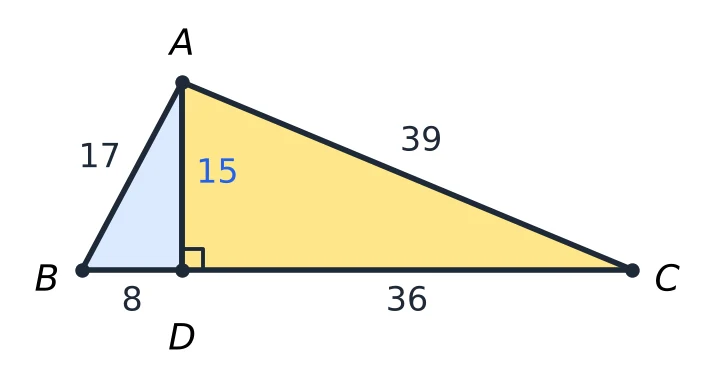
Answer. , and , , are 33, 11 and 6. Area . Break it into primes: , so the area is = 330 cm². The altitude on 44 is = 15 cm. The figure shows why: the triangle is an 8-15-17 and a 15-36-39 triangle glued along the altitude 15.
Question 4
A rectangular park is 50 m long and 36 m wide. A path 3 m wide runs along the inside of its boundary. Find the cost of paving the path at ₹25 per m².
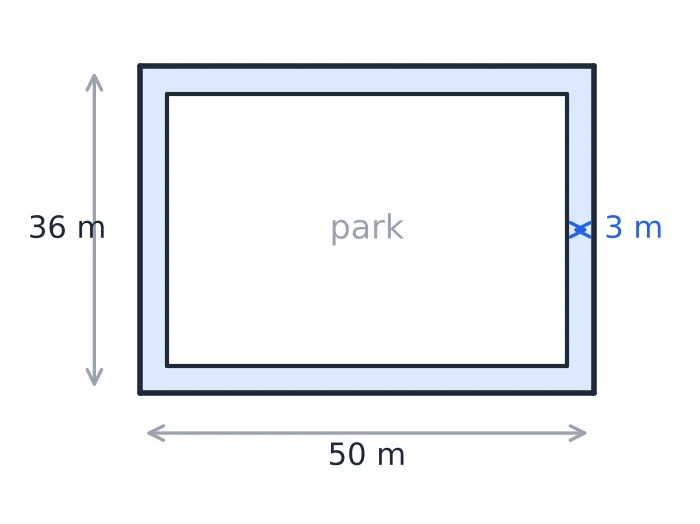
Answer. For a path inside, area m². Check: . Cost = ₹12,000.
Question 5
The area of an equilateral triangle is cm². Find its perimeter and its height.
Answer. gives , so cm. The perimeter is 60 cm and the height is = cm, about 17.3 cm.
Question 6
The wheels of a car have a diameter of 1.26 m. If each wheel makes 250 revolutions a minute, find the speed of the car in km/h.
Answer. One turn covers m. In a minute the car goes m, and in an hour m. That is 59.4 km/h.
Question 7
The adjacent sides of a parallelogram are 15 cm and 20 cm, and the distance between the longer sides is 9 cm. Find its area, and the distance between the shorter sides.
Answer. Take the longer side as the base: area = 180 cm². Now take the shorter side as the base: , so the distance between the shorter sides is 12 cm. A quick check: each height must be shorter than the slanting side it sits next to, and 9 < 15, 12 < 20.
Question 8
A circle is drawn inside a square, touching all four sides, and the square is drawn inside a larger circle, with its corners on that circle. If the smaller circle has an area of 154 cm², find the area of the square and of the larger circle.
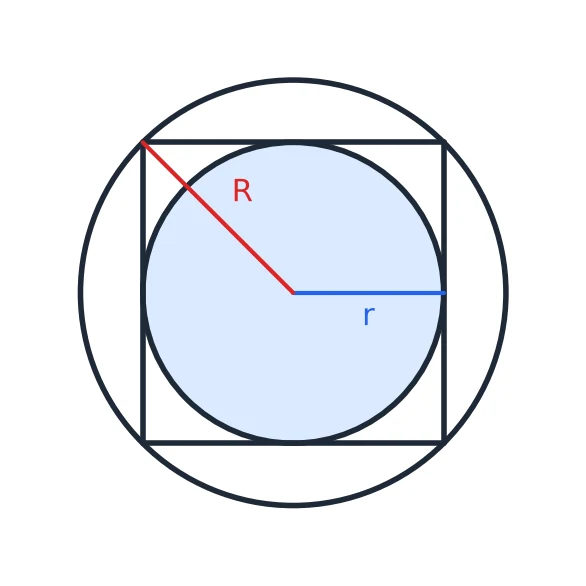
Answer. gives cm, so the side of the square is 14 cm and its area is 196 cm². The larger circle's radius is half the diagonal, cm, so its area is = 308 cm². The two circles are in the ratio 1 : 2, as the table in Shortcuts & Speed Methods says.
Question 9
The arc of a sector is 33 cm long, and the area of the sector is 231 cm². Find the radius and the angle at the centre.
Answer. Sector area , so and = 14 cm. The whole circumference is 88 cm, so the angle is = 135°.
Question 10
The length of a rectangle is increased by 40% and its breadth is decreased by 30%. Find the percentage change in its area.
Answer. . The area falls by 2%. With multipliers, , the same thing.
Question 11
Three coins, each of radius 7 cm, lie on a table so that each touches the other two. Find the area of the space enclosed between them. (Take .)
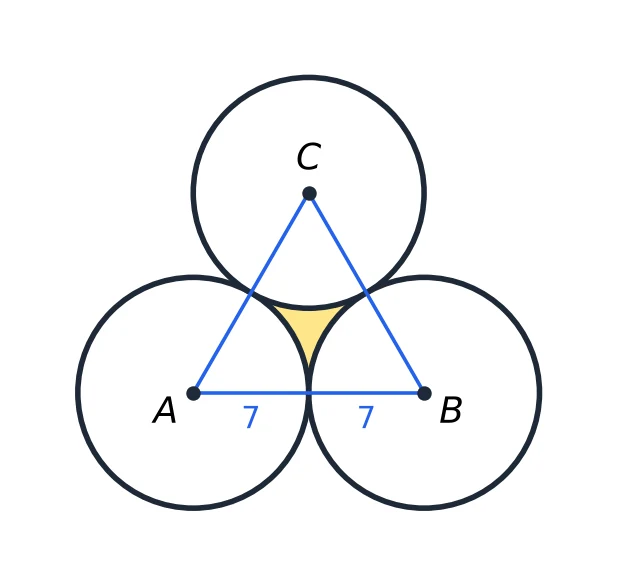
Answer. Join the centres. The triangle ABC is equilateral with side 14 cm, so its area is cm². At each corner the triangle holds a sector of a coin, and three sectors make a semicircle: cm². The space is = 7.868 cm².
Question 12
The perimeter of a semicircular protractor is 72 cm. Find its area.
Answer. The edge is the curved part plus the straight diameter: . So and cm. Area = 308 cm².
Question 13
A regular hexagon is drawn inside a circle of radius 10 cm, with its corners on the circle. Find the area of the part of the circle outside the hexagon. (Take and .)
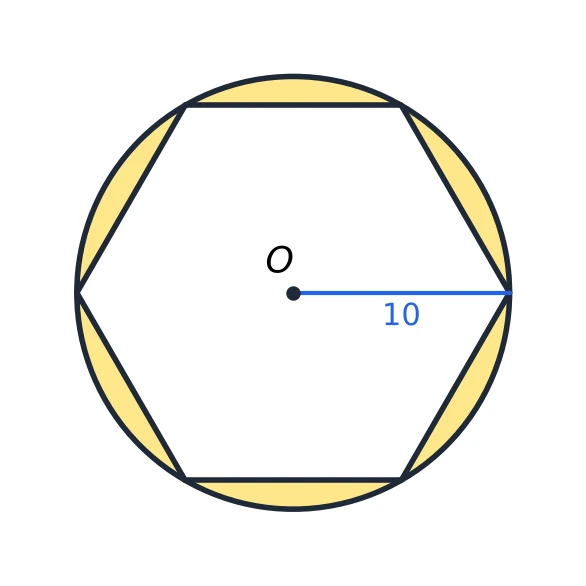
Answer. The side of the hexagon equals the radius, 10 cm. Hexagon cm², and the circle is cm². The part outside is = 54.2 cm².
Question 14
The hypotenuse of a right triangle is 26 cm and its area is 120 cm². Find the other two sides and the perimeter.
Answer. , so . , so . The sides are 24 cm and 10 cm, and the perimeter is = 60 cm.
Question 15
A room is 15 m long and 8.4 m wide. Its floor is to be covered with carpet 70 cm wide, costing ₹45 per metre. Find the length of carpet needed and the total cost.
Answer. Floor area m². The carpet is 0.7 m wide, so its length is = 180 m. Cost = ₹8,100.
Question 16
The sides of a triangle are 21 cm, 45 cm and 60 cm. Find its area, its inradius and its circumradius.
Answer. , and , , are 42, 18 and 3. Area = 378 cm². Inradius = 6 cm. Circumradius = 37.5 cm.
Question 17
Two circles have radii 20 cm and 21 cm. Find the radius of the circle whose area is the sum of their areas, and the radius of the circle whose circumference is the sum of their circumferences.
Answer. For the areas, , so = 29 cm. For the circumferences, , so = 41 cm. Mixing the two up is the trap: areas add as squares, circumferences add straight.
Question 18
The length of a rectangle is 7 cm more than its breadth. If the length is decreased by 4 cm and the breadth is increased by 3 cm, the area stays the same. Find the area.
Answer. Let the breadth be . Then , so and . The rectangle is 16 cm by 9 cm, with area 144 cm². The new shape is a 12 cm square with the same area.
Question 19 [Tier 2]
The parallel sides of a trapezium ABCD are AB = 25 cm and DC = 11 cm, and its other sides are AD = 13 cm and BC = 15 cm. Find its area.
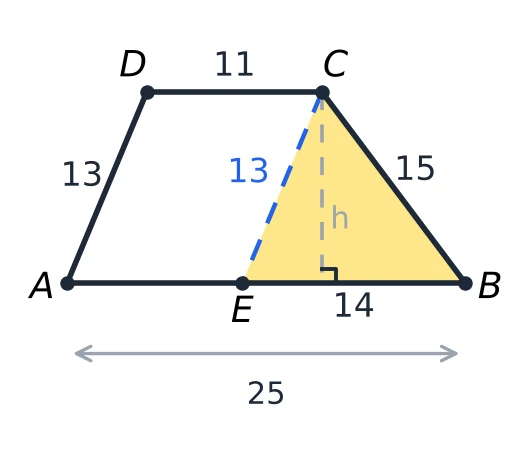
Answer. From C, draw CE parallel to DA, meeting AB at E. Then AECD is a parallelogram, so CE = 13 cm and AE = 11 cm, which leaves EB cm. Triangle EBC has sides 13, 14 and 15, so its area is 84 cm² and its height on EB is cm. That is also the height of the trapezium. Area = 216 cm².
Question 20
The front wheel of a cart has a radius of 28 cm and the back wheel a radius of 49 cm. How far has the cart gone when the front wheel has made 150 more revolutions than the back wheel?
Answer. The circumferences are 176 cm and 308 cm. If the distance is cm, then . Over a common denominator of 1232, that is , so cm = 616 m. Check: the front wheel turns 350 times and the back wheel 200 times.
Question 21
The legs of a right triangle are 28 cm and 45 cm. Find the area of its incircle and the area of the triangle outside the incircle. (Take .)
Answer. The hypotenuse is 53 cm (28-45-53 is a triplet). The inradius is cm, so the incircle has area = 314 cm². The triangle has area cm², so the part outside the circle is = 316 cm².
Question 22
A chord of a circle of radius 21 cm makes a right angle at the centre. Find the areas of the minor and the major segments.
Answer. The quarter circle is cm², and the triangle formed by the two radii is cm². Minor segment = 126 cm². Major segment = 1260 cm².
Question 23
A pendulum 24 cm long swings through an angle of . Find the length of the arc described by its tip. (Take .)
Answer. Arc = 31.4 cm.
Question 24
When the radius of a circle is increased by 4 cm, its area increases by 125%. Find the original radius.
Answer. The new area is 2.25 times the old, so the new radius is times the old one. The extra 4 cm is half of the old radius, so the radius was 8 cm. Check: from 8 cm to 12 cm, the area goes from to , which is 2.25 times.
Question 25
A circular park has a diameter of 63 m. A path 3.5 m wide runs round it on the inside, along the edge. Find the area of the path and the cost of paving it at ₹20 per m².
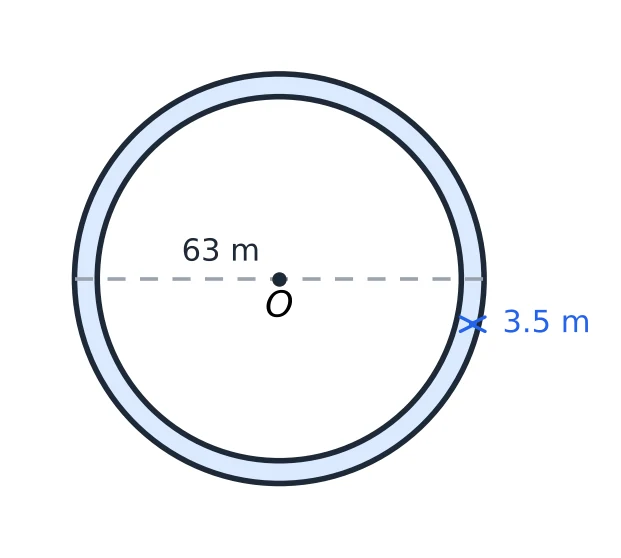
Answer. m and m. Area = 654.5 m². Cost = ₹13,090.
Question 26 [Tier 2]
P is a point inside an equilateral triangle ABC. The perpendicular distances from P to the three sides are 4 cm, 6 cm and 8 cm. Find the area of the triangle.
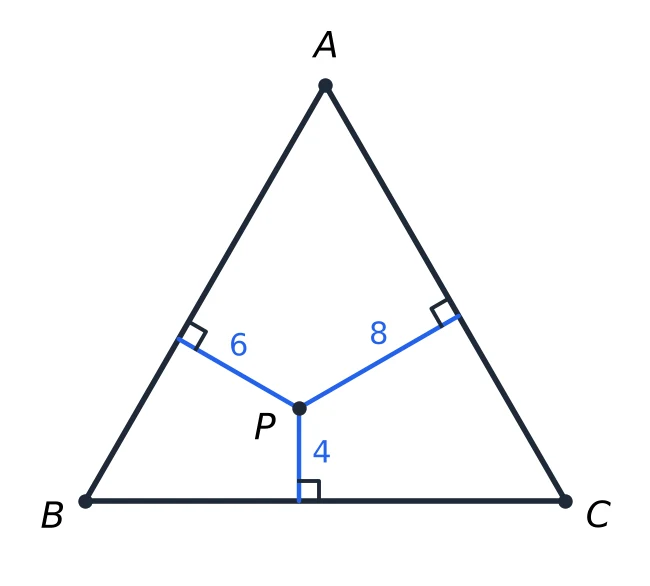
Answer. Join P to A, B and C. The big triangle splits into three triangles, each with a side as its base: . So the height of the triangle is just the sum, cm. Area = cm². Where P sits does not matter.
Question 27 [Tier 2]
A rectangular lawn is 90 m long and 60 m wide. Two roads of equal width run through its middle, one parallel to each side. Gravelling the roads at ₹20 per m² costs ₹8,820. Find the width of the roads.
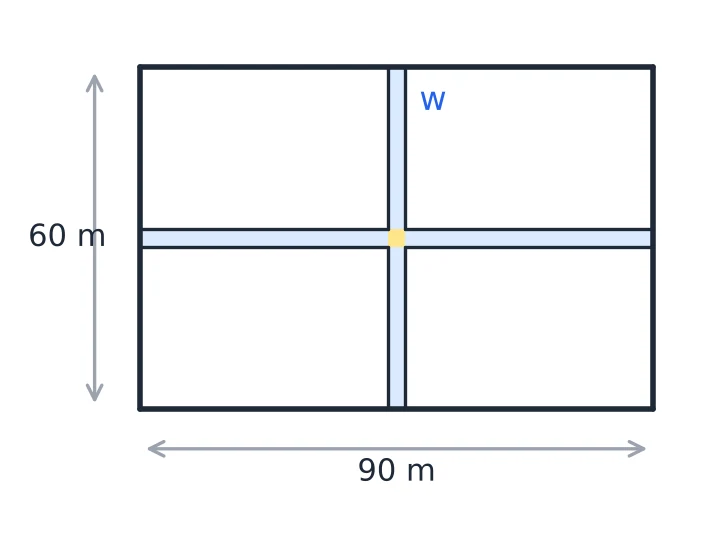
Answer. The roads cover m². So , which is , or . A road 147 m wide is wider than the lawn, so the width is 3 m.
Question 28
The perimeter of a rhombus is 52 cm and one of its diagonals is 10 cm. Find its area.
Answer. Each side is 13 cm. Half the known diagonal is 5, so half the other is , and the other diagonal is 24 cm. Area = 120 cm².
Question 29 [Tier 2]
Find the area of a regular octagon of side 4 cm. (Take .)
Answer. Picture the octagon as a square with its four corners cut off. Each cut-off corner is a right isosceles triangle with hypotenuse 4, so its legs are cm. The square's side is cm. Area . That is cm², about 77.25 cm², and it matches .
Question 30
Circular discs of radius 3.5 cm are cut from a rectangular sheet 49 cm by 35 cm, in rows and columns. How many discs can be cut, and how much of the sheet is wasted?
Answer. Each disc needs a 7 cm by 7 cm square. That gives = 35 discs. They cover cm² of the cm² sheet, so the waste is 367.5 cm². (Each square wastes its four corners, of it, and agrees.)
Question 31 [Tier 2]
ABC is a right triangle with , AB = 18 cm and AC = 24 cm, and its corners lie on a circle with BC as diameter. Semicircles are drawn outwards on AB and AC. Find the total area of the two crescents (the parts of the small semicircles outside the big circle).
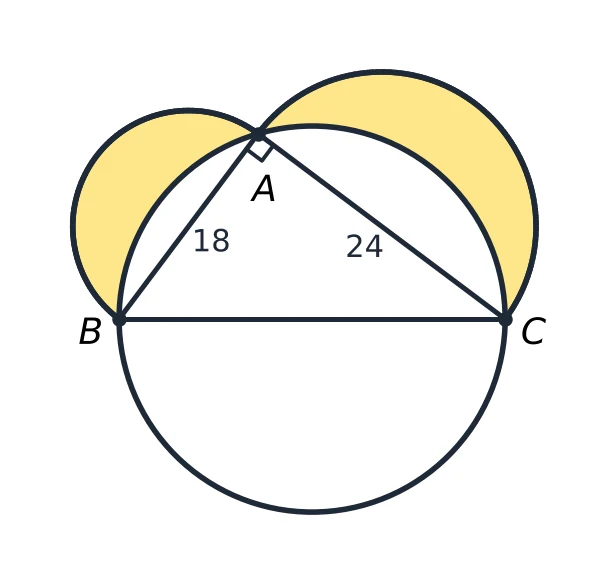
Answer. BC = 30 cm. The two small semicircles together have area , which is exactly the half of the big circle above BC, because . That half circle is the triangle plus the two thin segments over AB and AC. Take those two segments away from the small semicircles and you are left with the crescents. So the crescents equal the half circle minus the two segments, which is just the triangle. The area is = 216 cm², with no in it at all.
Question 32
An equilateral triangle is drawn inside a circle of radius 8 cm, with its corners on the circle. Find the area of the triangle and the area of the circle outside it. (Leave the answer in terms of .)
Answer. For an equilateral triangle , so cm. Triangle = cm². The circle is cm², so the part outside is cm², about 117.9 cm².
Question 33
An isosceles triangle has a perimeter of 50 cm, and each of its equal sides is 17 cm. Find its area.
Answer. The base is cm. The altitude to the base cuts it in half, so it is cm. Area = 120 cm². The formula gives the same.
Question 34
A horse is tied to a corner of a rectangular field 50 m by 35 m with a rope 21 m long. Find the area it can graze and the area it cannot. How much more can it graze if the rope is made 28 m long?
Answer. The corner is a right angle, so the horse grazes a quarter circle: = 346.5 m². It cannot graze = 1403.5 m². With a 28 m rope (still shorter than both sides), it grazes m², which is 269.5 m² more.
Question 35
A square and a rectangle have the same perimeter. The rectangle is 34 cm long and 22 cm wide. Which has the larger area, and by how much?
Answer. The perimeter is cm, so the square has side 28 cm and area 784 cm². The rectangle has area cm². The square is bigger by 36 cm², which is , just as the rule says.