
The Basic Formula: Half of Base Times Height
Almost every triangle question in this chapter comes back to one formula. Pick any side and call it the base. The height (also called the altitude) is the perpendicular distance from the opposite vertex to the line of that base. Then
The usual symbol for the area of a triangle is .
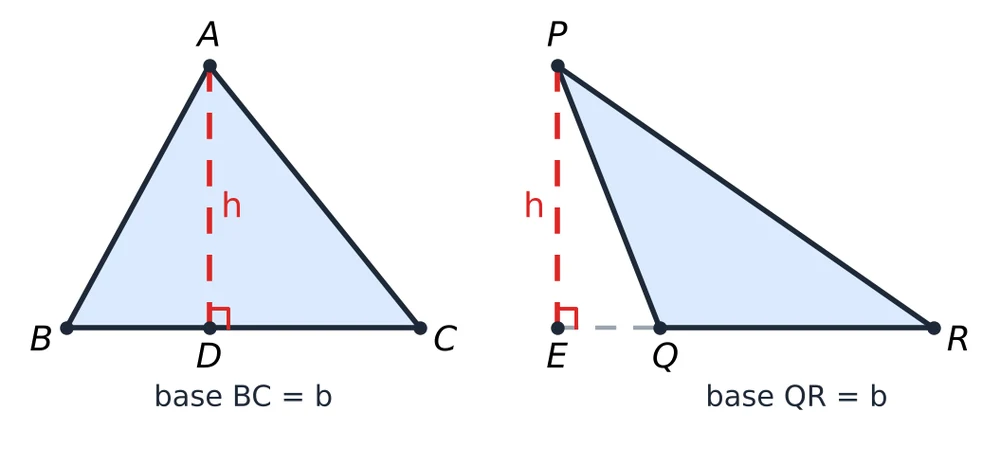
Why the half. Take two copies of the same triangle, turn one round and put them together along a side. They make a parallelogram with the same base and the same height, whose area is base × height. One triangle is half of it.
Where the height falls. In an acute triangle the foot of the height lands on the base itself (D in the left figure). If the angle at one end of the base is obtuse, the foot lands outside, on the base extended (E in the right figure). Nothing changes in the formula: the area of triangle PQR is still half of QR times PE.
A triangle with base 16 cm and height 9 cm has area cm².
Height from the area. Turn the formula round:
A triangle of area 54 cm² standing on a 12 cm base has height cm. In the same way, .
Perimeter is simply the sum of the three sides, a + b + c. Half of it is called the semi-perimeter, written s. It shows up in Heron's formula and in the inradius formula below, so get used to finding it first.
Units. Lengths in cm give areas in cm², lengths in m give m². Keep both lengths in the same unit before multiplying. Two conversions come up in cost questions: 1 m² = 10,000 cm² and 1 hectare = 10,000 m².
[SSC Tip] Two wrong answers sit in the options almost every time: the one that forgets the half (exactly double the right answer) and the one that uses a slanting side as the height. The height must meet the base at 90°.
Heron's Formula: Area from the Three Sides
When all three sides are known but no height is given, use Heron's formula. First find the semi-perimeter, half the perimeter:
Then
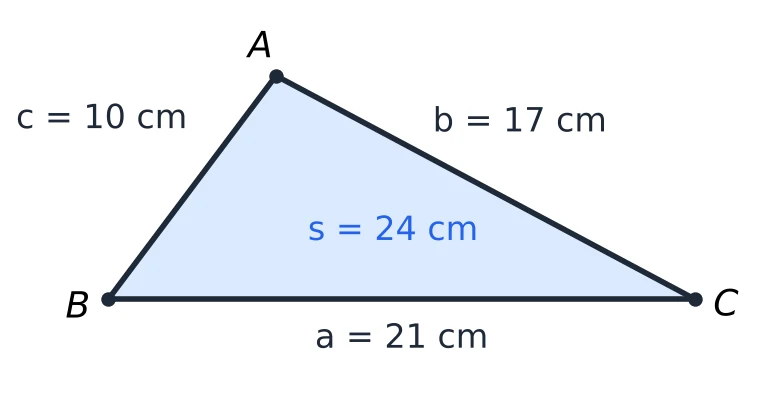
A full example. Sides 10 cm, 17 cm and 21 cm. The perimeter is 48 cm, so s = 24. The three brackets are s − a = 24 − 21 = 3, s − b = 24 − 17 = 7 and s − c = 24 − 10 = 14. So
Do not multiply everything out. Pair the factors so that squares appear: 24 × 3 = 72 = 36 × 2 and 7 × 14 = 98 = 49 × 2. The product is 36 × 49 × 4, and its square root is 6 × 7 × 2 = 84 cm².
Two quick checks.
- The three brackets always add up to s: (s − a) + (s − b) + (s − c) = 3s − 2s = s. Here 3 + 7 + 14 = 24, so the subtraction was right.
- If any bracket comes out zero or negative, the "triangle" does not exist. That is the triangle inequality: each side must be shorter than the other two put together.
Heights from Heron. Once the area is known, every height follows from . In the 10, 17, 21 triangle the height on the 21 cm side is cm, and the height on the 10 cm side is 16.8 cm.
Worth remembering. The triangle 13, 14, 15 also has area 84 (s = 21, and ). The isosceles triangles 5, 5, 6 and 5, 5, 8 both have area 12. Any multiple of these is just as quick: double every side and the area becomes four times (more on that in the scaling part below).
[SSC Tip] Before starting Heron, check whether the sides are a Pythagorean triplet. Sides 11, 60 and 61 satisfy , so the triangle is right-angled and the area is just cm². For equal sides, the equilateral and isosceles formulas below are faster too.
Right Triangles: Legs, Hypotenuse and the Altitude to the Hypotenuse
In a right triangle the two shorter sides (the legs) meet at 90°, so one of them is the base and the other is the height. That makes the area very quick:
where a and b are the legs and c is the hypotenuse (Pythagoras).
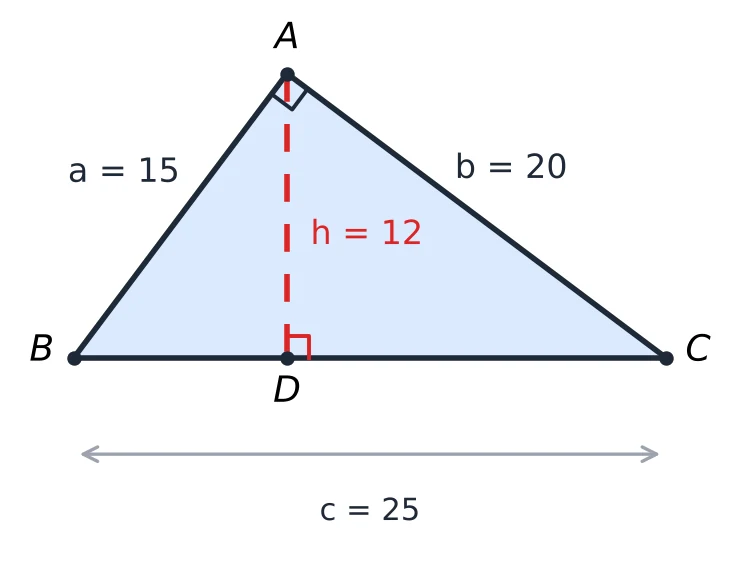
With legs 15 cm and 20 cm, the hypotenuse is cm, the area is cm² and the perimeter is 15 + 20 + 25 = 60 cm.
The altitude to the hypotenuse. Now take the hypotenuse as the base. The area does not change, so , which gives
In the figure, cm. This altitude also cuts the hypotenuse into and , and (see Chapter 12).
Triplets save time. Most SSC right triangles are built on 3, 4, 5; 5, 12, 13; 8, 15, 17; 7, 24, 25; 20, 21, 29; 9, 40, 41; 12, 35, 37; 11, 60, 61, or a multiple of one of them. Spot the triplet and skip the square root.
Hypotenuse and perimeter given, area wanted. You know a + b (perimeter minus c) and . Since and ,
Perimeter 84 cm and hypotenuse 37 cm: a + b = 47, so cm². You never needed the legs (they are 12 and 35). The same identity runs backwards: from the area and the hypotenuse you get a + b, and then the perimeter.
So "area and hypotenuse given, find the perimeter" looks hard but is two lines: , take the root, add c. Do not try to find each leg first.
Equilateral Triangles: Area, Height and Perimeter
All three sides equal a, all three angles 60°. The height from any vertex falls on the midpoint of the opposite side, so it cuts the triangle into two right triangles with hypotenuse a and base . Pythagoras gives the height:
and then half of base times height gives the area:
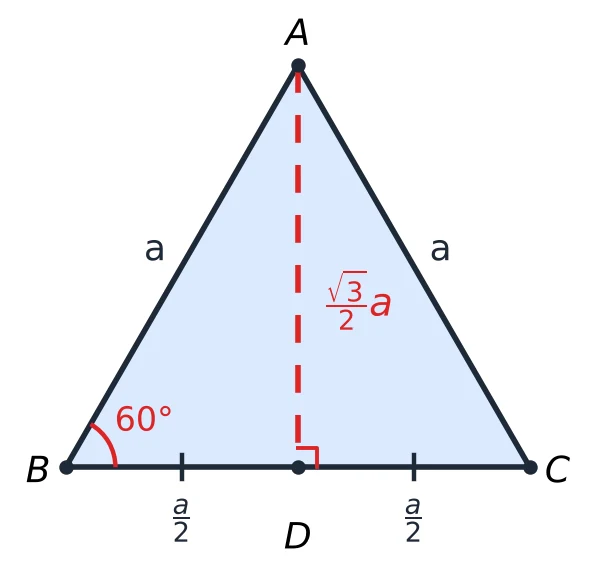
Side 12 cm: height cm (about 10.39 cm) and area cm² (about 62.35 cm²). Perimeter 3a = 36 cm.
Area straight from the height. Since , putting this into gives
A height of 9 cm gives cm². Rationalise by multiplying top and bottom by : .
Side and perimeter from the area. Work backwards. An equilateral triangle of area cm² has , so , a = 24 cm and the perimeter is 72 cm. When the area carries a , it cancels, and is just 4 times the number in front.
| Know | Side | Height | Area |
|---|---|---|---|
| side a | a | ||
| height h | h | ||
| perimeter P |
The inradius and circumradius of an equilateral triangle are and ; they come up with the inradius formula below.
If the options are decimals, use . A common slip is in place of ; that answer is three times too big and is usually one of the options.
Isosceles Triangles:
Let the two equal sides be a and the base be b. The height from the top vertex is also the median, so it lands on the midpoint of the base. Each half is a right triangle with hypotenuse a and base :
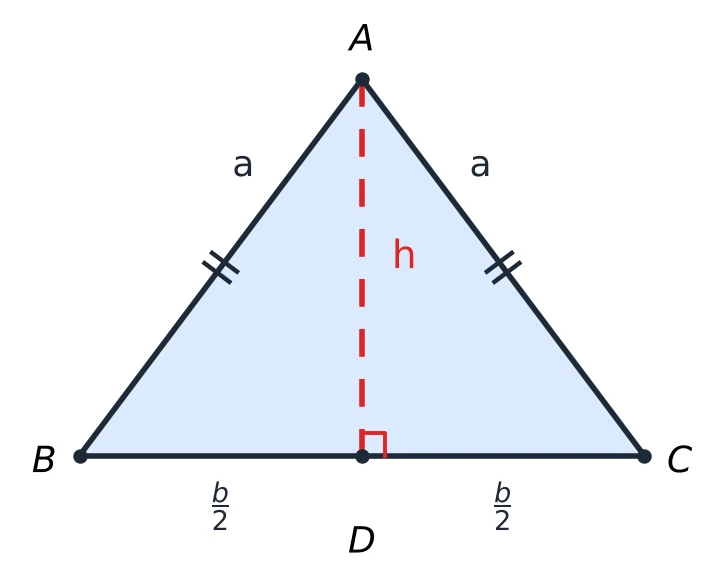
Equal sides 15 cm and base 18 cm: the height is cm and the area is cm². By the formula, cm². Both routes agree; finding the height first is usually easier to get right.
Isosceles right triangle. Legs a, a and hypotenuse . The area is , which is also in terms of the hypotenuse c. Legs of 9 cm give an area of 40.5 cm² and a hypotenuse of cm.
Base from the area: there can be two answers. Equal sides 10 cm and area 48 cm². Call half the base x and the height h. Then and . Adding and subtracting twice the second equation,
so x + h = 14 and the difference is 2. Either x = 8, h = 6 (base 16 cm) or x = 6, h = 8 (base 12 cm). Both triangles, 10, 10, 16 and 10, 10, 12, really have area 48 cm².
Perimeter questions. If the perimeter and the base are given, the equal sides are each. If the perimeter and one equal side are given, the base is P − 2a. Then use the height.
In the two-answer case the options usually show only one of the two bases. Pick the one that is there. If both are there, read the question again for a hint such as "the base is longer than the equal sides".
Two Sides and the Included Angle:
Sometimes you are given two sides and the angle between them, and no height. Drop the height from A onto the side CB. In the right triangle that forms, the height is . So
where C is the angle between the two sides a and b.
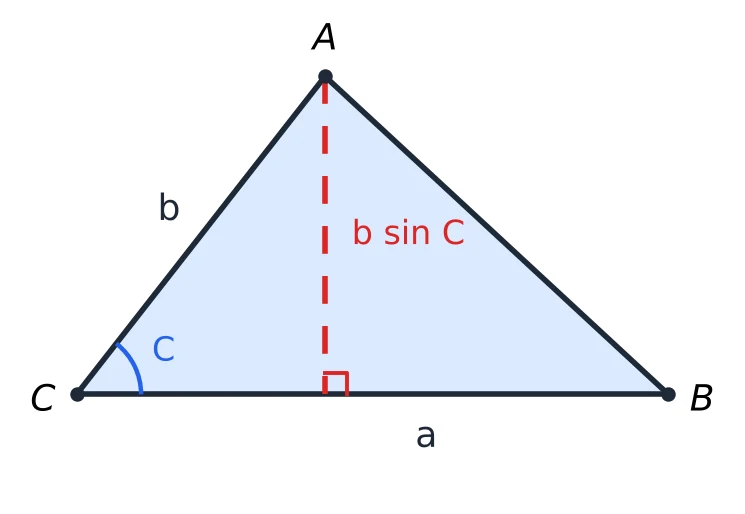
For this formula you only need six sine values (the ratio itself is taught in Chapter 15):
| C | 30° | 45° | 60° | 90° | 120° | 150° |
|---|---|---|---|---|---|---|
| 1 |
Notice that 120° has the same sine as 60°, and 150° the same as 30°. An obtuse angle gives the same area as its supplement.
Examples.
- Sides 8 cm and 10 cm with 30° between them: cm².
- Sides 6 cm and 10 cm with 120° between them: cm².
- Put a = b and C = 60° and you get , the equilateral formula again.
The biggest area. Since is at most 1 (at 90°), two sides of 8 cm and 10 cm can enclose at most cm². That happens when they are at right angles. "Maximum area of a triangle with two given sides" always means this.
The same idea gives the area of a parallelogram as , which you will meet in the quadrilaterals section.
[SSC Tip] The angle must be the one between the two given sides. If a question gives sides AB and AC, you need angle A. If it gives angle B instead, find the missing side or angle first.
Area with the Inradius and Circumradius: and
The inradius. The incircle touches all three sides, and its centre I is at the same distance r from each of them. Join I to the three vertices. The triangle breaks into three triangles IBC, ICA and IAB with bases a, b, c and the same height r:
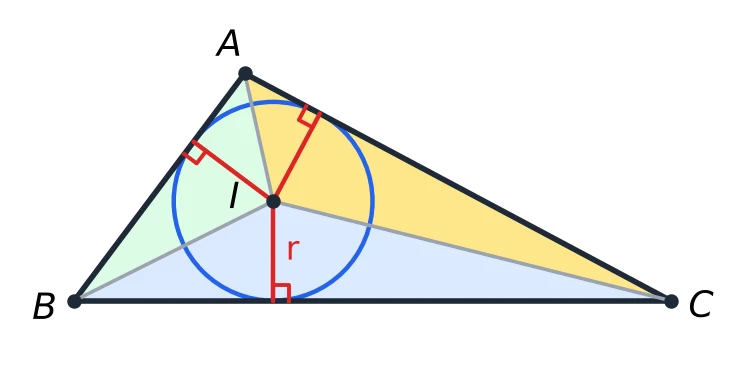
For the 10, 17, 21 triangle (area 84, s = 24) the inradius is cm. And a triangle of perimeter 36 cm with inradius 3 cm has area 3 × 18 = 54 cm², whatever its sides are.
The circumradius. The circumcircle passes through all three vertices. Its radius R satisfies
(proved in Chapter 12). For the same triangle, cm, which is 10.625 cm.
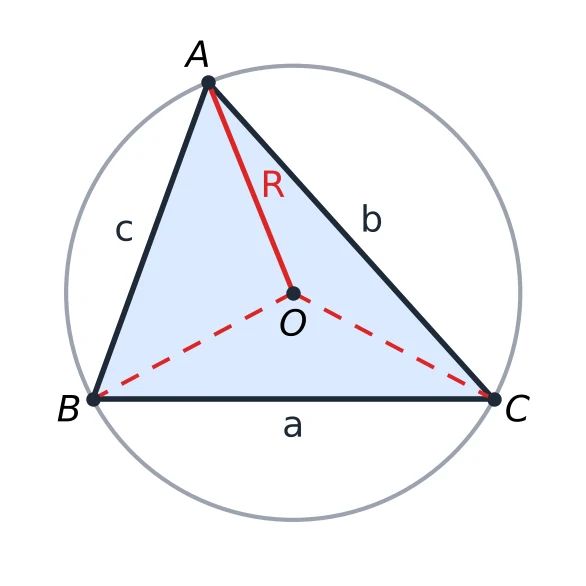
Two special cases to know by heart.
- Right triangle with legs a, b and hypotenuse c: and (the hypotenuse is a diameter). For 5, 12, 13: r = 2 cm and R = 6.5 cm. Check with : 30 = 2 × 15.
- Equilateral triangle of side a: and . In terms of r, the area is . Side cm gives r = 3 cm, R = 6 cm and area cm².
Keep the half in : it uses the semi-perimeter. Using the full perimeter gives an inradius half the right size (or an area twice the right size), and that wrong value is always among the options.
Finding a Side or an Altitude, and Sides in a Ratio
Three heights, one area. Each side has its own height: on side a, on side b, on side c. Since each pair gives the same area,
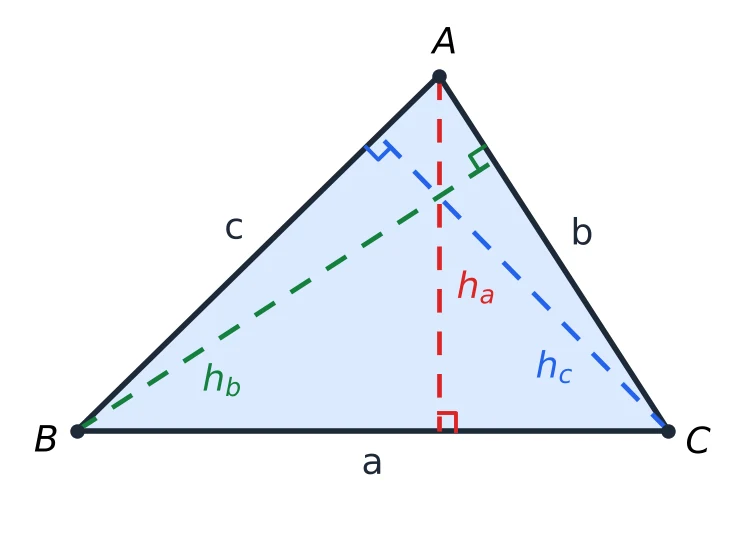
Two things follow.
- Side from a height, or height from a side: . A triangle of area 150 cm² whose two heights are 10 cm and 12 cm has those heights on sides of cm and cm.
- The heights go the opposite way to the sides: . The longest side has the shortest height. For sides 4, 5, 6, the heights are in the ratio . Multiply by 60 (the LCM) to get 15 : 12 : 10.
Sides in a ratio. Write the sides as multiples of one unknown k.
Perimeter given. Sides in the ratio 3 : 4 : 5 and perimeter 48 cm: 3k + 4k + 5k = 12k = 48, so k = 4 and the sides are 12, 16 and 20 cm. That is a right triangle (a 3, 4, 5 triplet), so the area is cm².
Area given. Find the area of the "ratio triangle" first, then remember that the area grows as (the next part explains why). Sides in the ratio 10 : 17 : 21 have area , because 10, 17, 21 has area 84. If the actual area is 1344 cm², then , k = 4, the sides are 40, 68, 84 cm and the perimeter is 192 cm.
With an area given, it is that you find, not k. Taking k = 16 in the example above would give sides of 160, 272 and 336 cm, four times too long. Always take the square root before multiplying the ratio.
Scaling a Triangle, and Percentage Change in Area
Multiply every side of a triangle by k. The shape stays the same, every height is also multiplied by k, and so
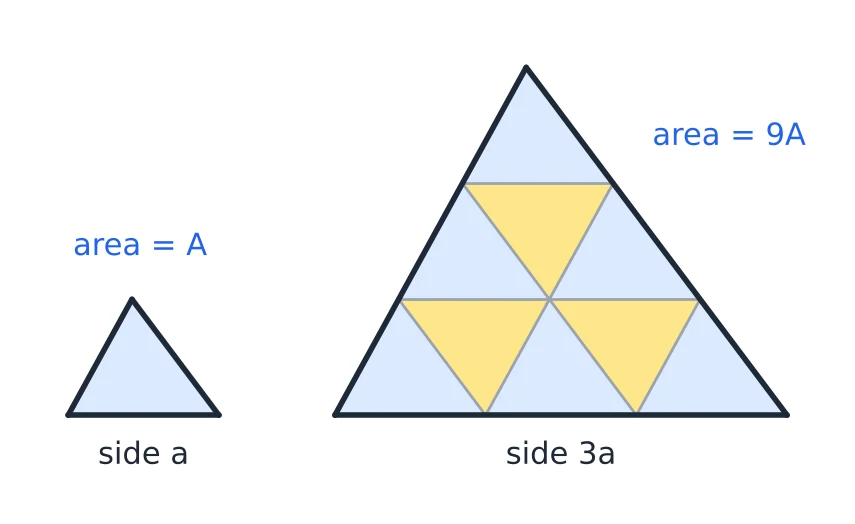
The figure shows it with k = 3: the big triangle is made of 9 copies of the small one. This is the same rule as "areas of similar triangles are in the ratio of the squares of their sides".
Same percentage change on every side. Each side up by 20% means k = 1.2, so the area becomes times: an increase of 44%. The perimeter goes up by only 20%. Each side down by 10% means k = 0.9 and : the area falls by 19%. The same works for an equilateral triangle, a right triangle or any other shape.
Going backwards. If the area becomes 4 times, each side has doubled (). If the area goes up by 21%, the factor is 1.21 and each side went up by 10%, since .
Different changes in base and height. Area is half of base times height, so the two changes multiply. If the base changes by x% and the height by y%, the area changes by
(a decrease counts as negative). This is the successive-change rule from Chapter 3 (Percentage). Base up 20% and height down 10%: 20 − 10 + = 10 − 2 = 8% increase. Check with factors: 1.2 × 0.9 = 1.08.
[SSC Tip] Watch "becomes" and "increases by". If every side is tripled, the area becomes 9 times, so it increases by 8 times the old area, which is 800%. Both 900% and 800% will be in the options; only one matches the wording.
Medians, Midpoints and Triangles Between the Same Parallels
These are area questions with almost no arithmetic. Each one rests on the same idea: triangles with equal bases and the same height have equal areas.
A median halves the area. The median AD goes to the midpoint of BC. Triangles ABD and ACD have equal bases (BD = DC) and the same height from A, so each is half of triangle ABC. Draw all three medians and you get six small triangles of equal area, each of the whole.
Joining the midpoints gives quarters. D, E and F are the midpoints of BC, CA and AB. The segments DE, EF and FD cut triangle ABC into four triangles that are all congruent, so
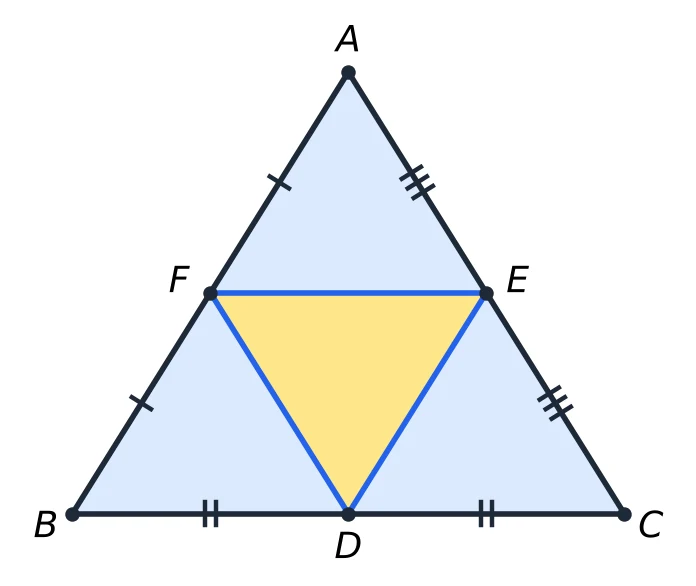
Do it again inside DEF and the next triangle is of ABC. If ABC is 100 cm², DEF is 25 cm² and the one inside DEF is 6.25 cm². The perimeter of DEF is half the perimeter of ABC, because each side of DEF is half a side of ABC (the midpoint theorem).
Same base, same parallels. If A and D lie on a line parallel to BC, triangles ABC and DBC have the same base and the same height, so they have the same area, however different they look.
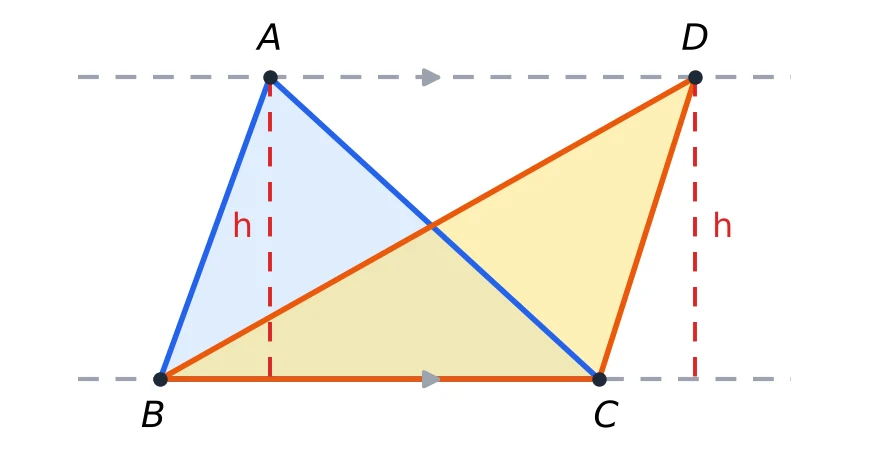
A triangle and a parallelogram on the same base and between the same parallels: the triangle is half the parallelogram.
A point on the base. If D on BC makes BD : DC = 2 : 3, then triangles ABD and ADC share the height from A, so their areas are also in the ratio 2 : 3. With area(ABC) = 60 cm², they are 24 cm² and 36 cm².
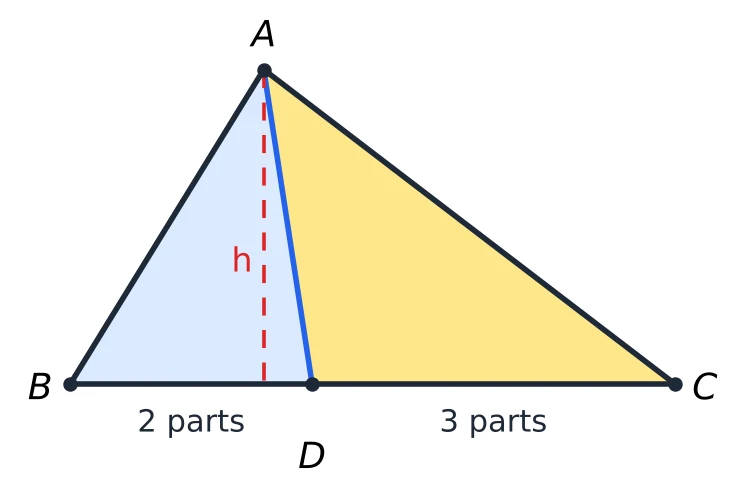
[Tier 2] The triangle made from the medians. If a triangle is drawn with its three sides equal to the three medians of triangle ABC, its area is of ABC. So when only the medians are given, find the area of the "median triangle" (by Heron or a triplet) and multiply by .
Perimeter, Fencing and the Cost of Levelling or Turfing
Cost questions are area or perimeter questions with one more multiplication at the end. The only thing to decide is which one the rate goes with.
| Job | Depends on | Cost |
|---|---|---|
| Fencing, putting a border or a wire round | Perimeter (m) | perimeter × rate per metre |
| Levelling, turfing, ploughing, gravelling, paving | Area (m²) | area × rate per m² |
A full example. A triangular park has sides 25 m, 51 m and 52 m.
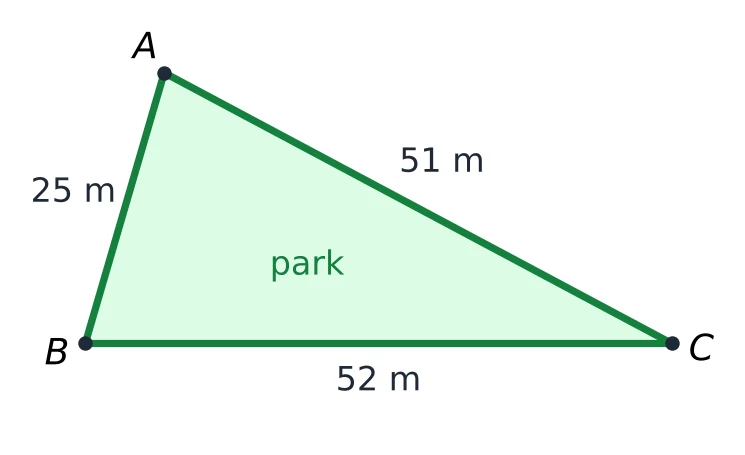
- Perimeter = 25 + 51 + 52 = 128 m, so s = 64 m.
- Area by Heron: . Here 64 is a square, and 12 × 13 × 39 = 12 × 3 × 13 × 13 = 36 × 169, so the area is 8 × 6 × 13 = 624 m².
- Turfing at ₹12 per m² costs 624 × 12 = ₹7,488.
- Fencing at ₹35 per metre costs 128 × 35 = ₹4,480.
- If a 3 m gap is left for a gate, only 125 m is fenced and the fencing costs 125 × 35 = ₹4,375.
Working backwards. The cost and the rate give the area (or the perimeter). For an equilateral plot, the perimeter gives the side straight away, and the area gives the side through .
Perimeter questions on their own. Most need one of these:
- the third side from the perimeter and two sides (then often Heron);
- equal sides of an isosceles triangle, each;
- the side of an equilateral triangle, ;
- the perimeter of a right triangle from its area and hypotenuse, using .
Units in cost questions. A rate per hectare needs the area in hectares (divide m² by 10,000). A rate in paise must be turned into rupees (100 paise = ₹1). Do these conversions before multiplying, not after.
Solved Examples
Question 1
The area of a triangle is 135 cm² and its base is 18 cm. What is the height on this base? (a) 7.5 cm (b) 15 cm (c) 30 cm (d) 17 cm
Answer. Area is half of base times height, so height = = (b) 15 cm. Without doubling the area you get 7.5 cm, which is the trap here.
Question 2
Find the area of a triangle whose sides are 25 cm, 39 cm and 56 cm. (a) 840 cm² (b) 210 cm² (c) 420 cm² (d) 480 cm²
Answer. No height is given, so use Heron. The perimeter is 120 cm, so s = 60. The brackets are 60 − 25 = 35, 60 − 39 = 21 and 60 − 56 = 4 (they add up to 60, good). Now break the numbers so squares show up: 60 = 4 × 15, 35 = 5 × 7, 21 = 3 × 7. So the product is , and its square root is 4 × 15 × 7 = (c) 420 cm². If you slip in one bracket, the three brackets will not add up to s, so always do that check.
Question 3
The sides of a triangle are 11 cm, 13 cm and 20 cm. What is the length of the altitude drawn to the 11 cm side? (a) 6 cm (b) 6.6 cm (c) 24 cm (d) 12 cm
Answer. First the area. s = , and the brackets are 11, 9 and 2. So cm². Then the altitude on the 11 cm side is = (d) 12 cm.
Question 4
In a right triangle the two sides containing the right angle are 7 cm and 24 cm. Find the length of the perpendicular from the right-angle vertex to the hypotenuse. (a) 3.36 cm (b) 12.5 cm (c) 13.44 cm (d) 6.72 cm
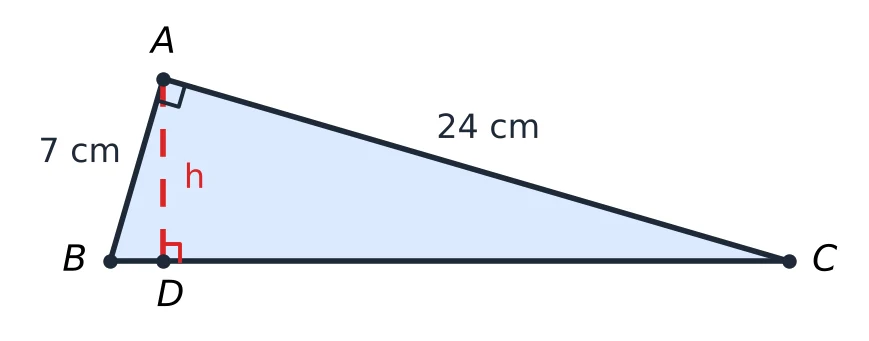
Answer. The hypotenuse is cm (the 7, 24, 25 triplet). The area is cm². Taking the hypotenuse as the base, , so = (d) 6.72 cm. 12.5 cm is the median to the hypotenuse (half of 25), not the altitude.
Question 5
The perimeter of a right triangle is 40 cm and its hypotenuse is 17 cm. What is its area? (a) 60 cm² (b) 120 cm² (c) 240 cm² (d) 30 cm²
Answer. The two legs add up to 40 − 17 = 23 cm. Square it: , that is 529 = 289 + 2ab, so 2ab = 240 and ab = 120. The area is half of ab = (a) 60 cm². (The legs are 8 and 15, but you never needed them.)
Question 6
The height of an equilateral triangle is 15 cm. What is its area? (a) cm² (b) cm² (c) cm² (d) cm²
Answer. Use . Multiply top and bottom by : = (c) cm². Check another way: the side is , and .
Question 7
The area of an equilateral triangle is cm². What is its perimeter? (a) 33 cm (b) 66 cm (c) 22 cm (d) 44 cm
Answer. Set . The cancels, so and a = 22 cm. The perimeter is 3 × 22 = (b) 66 cm.
Question 8
An isosceles triangle has equal sides of 41 cm each and a base of 18 cm. What is its area? (a) 369 cm² (b) 720 cm² (c) 180 cm² (d) 360 cm²
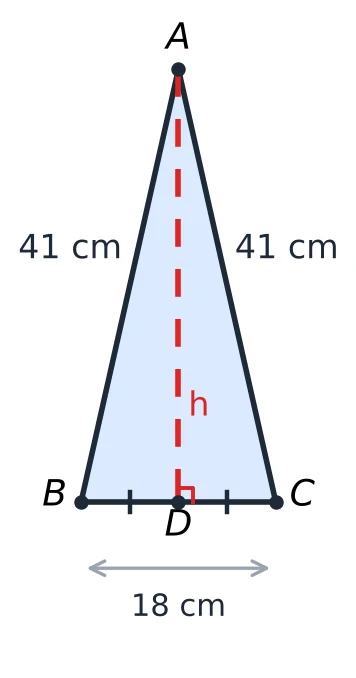
Answer. The height from the top vertex cuts the base into two halves of 9 cm. In each half, cm (a 9, 40, 41 triplet). Area = = (d) 360 cm². 369 cm² uses the slant side 41 as if it were the height.
Question 9
The perimeter of an isosceles triangle is 64 cm and its base is 24 cm. Find its area. (a) 192 cm² (b) 240 cm² (c) 384 cm² (d) 96 cm²
Answer. The two equal sides share 64 − 24 = 40 cm, so each is 20 cm. Half the base is 12 cm, so the height is cm. Area = = (a) 192 cm².
Question 10
The area of an isosceles right triangle is 72 cm². What is its perimeter? (a) cm (b) cm (c) cm (d) 36 cm
Answer. Both legs are equal, say a. The area is , so and a = 12 cm. The hypotenuse is cm. Perimeter = 12 + 12 + = (c) cm.
Question 11
Two sides of a triangle are 12 cm and 9 cm, and the angle between them is 150°. What is the area of the triangle? (a) 54 cm² (b) 27 cm² (c) cm² (d) 13.5 cm²
Answer. Area = , and . So area = = (b) 27 cm². uses , which is the sine of 60° or 120°, not 150°.
Question 12
Find the inradius of a triangle with sides 20 cm, 21 cm and 29 cm. (a) 3 cm (b) 14.5 cm (c) 12 cm (d) 6 cm
Answer. Check first: , so it is a right triangle. Area = cm² and s = cm. So = (d) 6 cm. The right-triangle shortcut agrees: .
Question 13
Find the circumradius of a triangle whose sides are 10 cm, 10 cm and 12 cm. (a) 6.25 cm (b) 3 cm (c) 12.5 cm (d) 6 cm
Answer. Area first. Half the base is 6, so the height is cm and the area is cm². Then = (a) 6.25 cm.
Question 14
The inradius of an equilateral triangle is 4 cm. What is its area? (a) cm² (b) cm² (c) cm² (d) cm²
Answer. For an equilateral triangle , so cm. Then area = = (c) cm². Faster: area = .
Question 15
The sides of a triangle are in the ratio 7 : 24 : 25 and its perimeter is 112 cm. Find its area. (a) 84 cm² (b) 336 cm² (c) 672 cm² (d) 168 cm²
Answer. The parts add to 7 + 24 + 25 = 56, and 112 ÷ 56 = 2. So the sides are 14, 48 and 50 cm. Since 7, 24, 25 is a triplet, the triangle is right-angled with legs 14 and 48. Area = = (b) 336 cm². Multiplying 84 by k = 2 instead of gives 168 cm².
Question 16
The sides of a triangle are in the ratio 3 : 4 : 5 and its area is 216 cm². What is its perimeter? (a) 432 cm (b) 36 cm (c) 48 cm (d) 72 cm
Answer. Take the sides as 3k, 4k, 5k. It is a right triangle, so area = . Then gives , so k = 6. The perimeter is 12k = (d) 72 cm.
Question 17
A triangle has sides in the ratio 13 : 14 : 15 and a perimeter of 210 cm. What is its area? (a) 2100 cm² (b) 420 cm² (c) 84 cm² (d) 1050 cm²
Answer. The parts add to 42, and 210 ÷ 42 = 5, so the sides are 65, 70 and 75 cm. The 13, 14, 15 triangle has area 84 cm², and multiplying every side by 5 multiplies the area by . Area = 84 × 25 = (a) 2100 cm². (Heron directly: s = 105, and .)
Question 18
Each side of a triangle is increased by 25%. By what percentage does its area increase? (a) 25% (b) 50% (c) 56.25% (d) 62.5%
Answer. Every side is multiplied by 1.25, so the area is multiplied by . The increase is 0.5625 of the old area, that is (c) 56.25%. By the successive-change rule: 25 + 25 + = 56.25.
Question 19
The base of a triangle is increased by 20% and its height is decreased by 20%. What happens to its area? (a) It does not change (b) It decreases by 4% (c) It increases by 4% (d) It decreases by 40%
Answer. Area is half of base times height, so multiply the factors: 1.2 × 0.8 = 0.96. The new area is 96% of the old one, so (b) It decreases by 4%. By the rule, 20 − 20 + = −4. "No change" is the trap: +20% and −20% do not cancel.
Question 20
The area of an equilateral triangle increases by 69%. By what percentage has each side increased? (a) 30% (b) 13% (c) 34.5% (d) 69%
Answer. The area is multiplied by 1.69. Area goes with the square of the side, so the side is multiplied by . Each side has gone up by (a) 30%.
Question 21
D, E and F are the midpoints of the sides of triangle ABC, whose area is 160 cm². P, Q and R are the midpoints of the sides of triangle DEF. What is the area of triangle PQR? (a) 40 cm² (b) 20 cm² (c) 5 cm² (d) 10 cm²
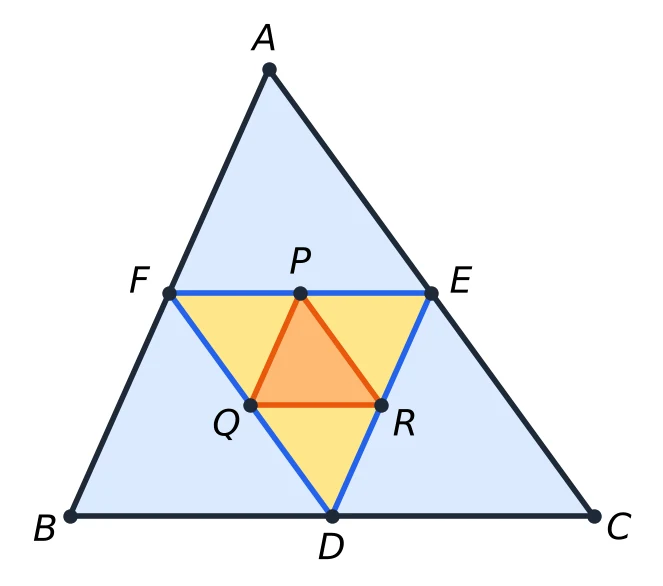
Answer. Joining the midpoints of a triangle's sides gives a triangle with a quarter of its area. So DEF = cm², and doing it again, PQR = = (d) 10 cm².
Question 22
D is a point on side BC of triangle ABC such that BD : DC = 3 : 5, and E is the midpoint of AD. If the area of triangle ABC is 96 cm², find the area of triangle BED. (a) 36 cm² (b) 30 cm² (c) 18 cm² (d) 24 cm²
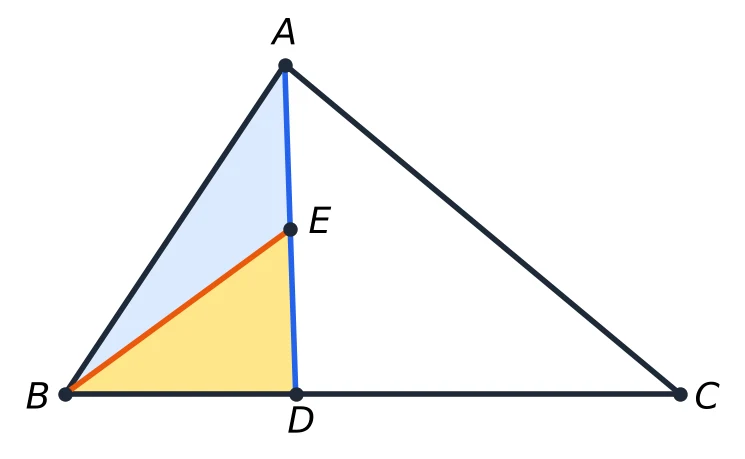
Answer. Triangles ABD and ADC have the same height from A, so their areas are in the ratio of their bases, 3 : 5. So ABD = cm². In triangle ABD, BE is a median (E is the midpoint of AD), and a median halves the area. So BED = = (c) 18 cm².
Question 23
A triangular field has sides 51 m, 52 m and 53 m. What will it cost to turf it at ₹8 per m²? (a) ₹4,680 (b) ₹9,360 (c) ₹1,248 (d) ₹18,720
Answer. Turfing goes with area. s = , and the brackets are 27, 26 and 25. Write the product as prime pieces: 78 × 26 × 27 × 25 = . Its square root is 2 × 9 × 13 × 5 = 1170 m². Cost = 1170 × 8 = (b) ₹9,360. ₹1,248 is the perimeter (156 m) times the rate, which would be the fencing cost.
Question 24
An equilateral triangular plot has an area of m². What is the cost of fencing it at ₹25 per metre? (a) ₹1,000 (b) ₹1,500 (c) ₹4,500 (d) ₹3,000
Answer. From , and a = 40 m. Fencing needs the perimeter: 3 × 40 = 120 m. Cost = 120 × 25 = (d) ₹3,000.
Question 25
[Tier 2] The three medians of a triangle are 9 cm, 12 cm and 15 cm long. What is the area of the triangle? (a) 72 cm² (b) 54 cm² (c) 40.5 cm² (d) 96 cm²
Answer. A triangle with sides equal to the medians has of the area of the original. Here 9, 12, 15 is a right triangle (3, 4, 5 times 3), so its area is cm². The original is = (a) 72 cm². 54 cm² stops at the median triangle.