
Pick the Value of Pi from the Options
Mensuration questions are mostly one formula and some clean arithmetic, so you save time by naming the shape at once, choosing the value of pi the options want, and keeping the numbers small. Each method below ends with the cases where it gives a wrong answer. Draw a rough figure every time and write the given lengths on it.
When to use it: any circle, semicircle, sector or ring question where the value of is not stated.
Fast way: look at the options before you start.
- Options that are multiples of 11 or 22 (44, 154, 616, 1386), or have a 7 in the denominator: use . The radius will nearly always be a multiple of 7 or of 3.5, so the 7 cancels.
- Options like 31.4, 78.5, 125.6, 314 or 28.26: use . The radius is then usually a multiple of 5 or 10.
- Options with written in them, like cm²: keep as a letter and never multiply it out.
Values worth knowing by heart, with :
| Radius | Circumference | Area |
|---|---|---|
| 3.5 | 22 | 38.5 |
| 7 | 44 | 154 |
| 10.5 | 66 | 346.5 |
| 14 | 88 | 616 |
| 21 | 132 | 1386 |
| 28 | 176 | 2464 |
| 35 | 220 | 3850 |
Going back from the circumference , the radius is . Going back from the area , .
Question 1
The area of a circular plate is 1256 cm². Its circumference is: (a) 125.6 cm (b) 132 cm (c) 62.8 cm (d) 251.2 cm
Answer. Three options are multiples of 3.14, and 1256 is . So take . Then , cm and = 125.6 cm, option (a). If you got 251.2 cm, you used the diameter as the radius.
Time check: about 15 seconds.
When it does not work:
- If the question states the value of , use that one, even when the numbers come out untidy.
- The two values differ by less than 0.1%, so when two options are that close (say 154 and 153.86), the stated value decides. If nothing is stated, SSC means .
- The table is only for . With 3.14, a radius of 10 gives 62.8 and 314.
[SSC Tip] With the circumference known, the area is , which is the same as . A circumference of 88 cm gives cm² straight away.
Area Scale Factor and Percentage Change
When to use it: the sides or the radius of a figure change by a factor or a percentage, and the change in area is asked.
Fast way:
- If every length of a figure is multiplied by , the perimeter is multiplied by and the area by . Double the radius and the area becomes 4 times; triple the side of a square and the area becomes 9 times.
- If one length changes by and the other by , the area changes by
Write a decrease as a negative number. This works for a rectangle (length and breadth), a triangle (base and height) and a parallelogram.
- When every length goes up by (the side of a square, the radius of a circle), put : the area goes up by percent. So 10% gives 21%, 20% gives 44% and 30% gives 69%.
- To keep the area unchanged when one length goes up by , the other must come down by percent. Up 25% means down 20%; up 50% means down .
Question 2
The length of a rectangle is increased by 35% and its breadth is decreased by 20%. By what percentage does its area change?
Answer. Put and : . The area goes up by 8%. A quick check with multipliers: .
Time check: about 10 seconds.
When it does not work:
- If a length changes by a fixed amount (say 3 cm more), there is no percentage shortcut. Find the new area directly.
- The perimeter does not follow . A 20% increase in every side raises the perimeter by exactly 20%.
- A circle has only one length, the radius, but it is used twice in . So use , not .
- Going backwards (area up 44%, find the change in the radius), take the square root of the multiplier: , so the radius went up 20%, not 22%.
Equilateral Triangle in One Line
When to use it: an equilateral triangle with any one of side, height, perimeter or area given, and another one asked.
Fast way: everything comes from the side . The height splits the base into two halves, so .
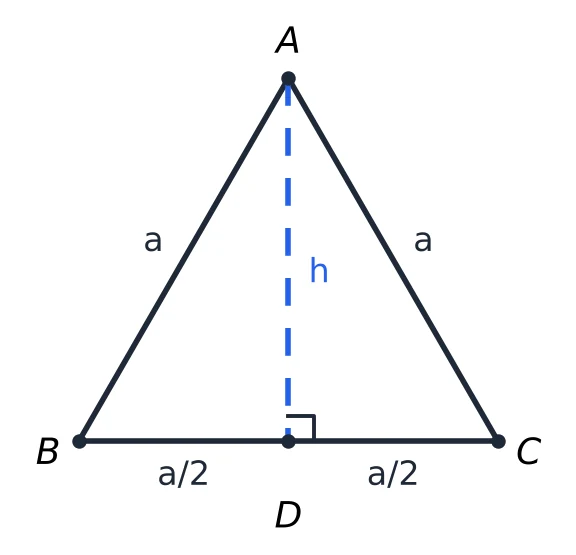
- Area and perimeter .
- From the height straight to the area: area , and the side is .
- From the perimeter : area . A perimeter of 30 cm gives cm².
- From the area: if the area is , then .
Question 3
The height of an equilateral triangle is 9 cm. Find its area and its perimeter.
Answer. Area , so the area is cm², about 46.8 cm². The side is cm, so the perimeter is cm.
Time check: about 15 seconds.
When it does not work:
- These formulas are for an equilateral triangle only. For an isosceles triangle with equal sides and base , the area is .
- Watch where the root goes: area from the height is , not . With the wrong one gives , three times too big.
[SSC Tip] The area of an equilateral triangle with a whole-number side always carries . Unless the question asks for a decimal, an option without is out.
Heron's Formula with Triplet Triangles
When to use it: the three sides of a triangle are given, and the area or an altitude is asked.
Fast way: first check whether the sides belong to a known family.
- A right triangle? If , the area is just . Check the triplets 3-4-5, 5-12-13, 8-15-17, 7-24-25, 20-21-29 and 9-40-41, and their multiples.
- The 13-14-15 family. This triangle is two right triangles, 5-12-13 and 9-12-15, joined along the altitude 12. So its area is . Sides , , give an area of .
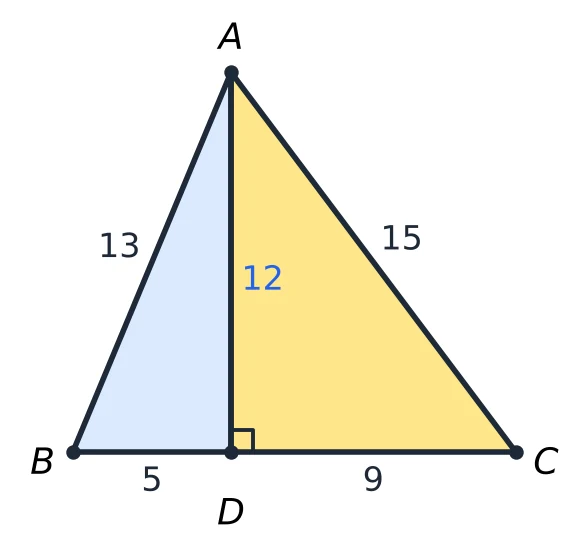
- Other glued pairs: 10-17-21 is 6-8-10 and 8-15-17 joined along the altitude 8 (area 84). Isosceles ones are two copies of one right triangle: 13-13-10 has area 60 and 37-37-24 has area 420.
- Otherwise, Heron: and area . Break each factor into primes before you multiply; the square root is then easy.
Question 4
Find the area of a triangle with sides 39 cm, 42 cm and 45 cm, and its altitude on the 42 cm side.
Answer. 39, 42, 45 is 13, 14, 15 times 3. So the area is = 756 cm². In the basic triangle, the altitude on the side 14 is 12, so here it is = 36 cm. Heron agrees: and .
Time check: about 15 seconds.
When it does not work:
- Scaling multiplies the area by , not . Sides 6.5, 7 and 7.5 are the family with , so the area is , not 42.
- 13, 14, 16 or 12, 14, 15 are not in the family. Use Heron for them.
- Check the triangle rule first. Sides 4, 6 and 11 make no triangle at all, because .
Right Triangle: Area and the Altitude ab/c
When to use it: a right triangle where the area, the hypotenuse or the altitude to the hypotenuse is asked.
Fast way: with legs and and hypotenuse , the area can be written two ways, and , where is the altitude to the hypotenuse. Put them equal:
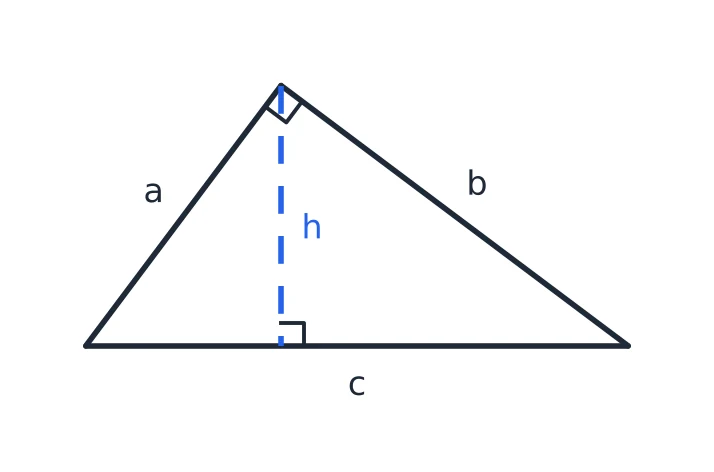
- Inradius and circumradius (the hypotenuse is a diameter).
- Hypotenuse and area known: and . This gives both legs without solving a quadratic.
Question 5
The two shorter sides of a right triangle are 33 cm and 44 cm. Find its area and the altitude to the hypotenuse.
Answer. 33, 44, 55 is 3-4-5 times 11, so . Area = 726 cm². Altitude = 26.4 cm. As a bonus, the inradius is cm.
Time check: about 15 seconds.
When it does not work:
- and must be the legs, the two sides that make the right angle. If the hypotenuse and one leg are given, find the other leg first.
- is the altitude to the hypotenuse only. The altitude to one leg is simply the other leg.
- The altitude to the hypotenuse is shorter than both legs. If your answer is longer than a leg, something went wrong.
Rectangle Sides from Two Clues
When to use it: two of perimeter, area and diagonal of a rectangle are given, and the sides or the third one is asked.
Fast way: work with and instead of solving a quadratic. Since :
- Perimeter and area: , then . With and area 120, , , so the sides are 15 and 8 (and the diagonal is 17).
- Perimeter and diagonal: .
- Once you have and , add them and halve to get .
Question 6
The diagonal of a rectangular plot is 41 m and its area is 360 m². Find its perimeter and its sides.
Answer. , so and the perimeter is 98 m. Next, , so . Adding, , so the sides are 40 m and 9 m.
Time check: about 30 seconds.
When it does not work:
- The perimeter is . Halve it before you square.
- If comes out negative, the data are impossible; read the question again.
- For a square , so , which is the familiar area .
Of all rectangles with the same perimeter, the square has the largest area, and it beats the rectangle by exactly .
Path Around or Inside a Field in One Formula
When to use it: a path (or a border, a verandah, a margin) of the same width runs along all four sides of a rectangular field, outside it or inside it.
Fast way: the area of the path is its width times the length of its middle line (the dashed line in the figure).
- Path outside an field: area .
- Path inside: area .
- Square field of side : outside , inside .
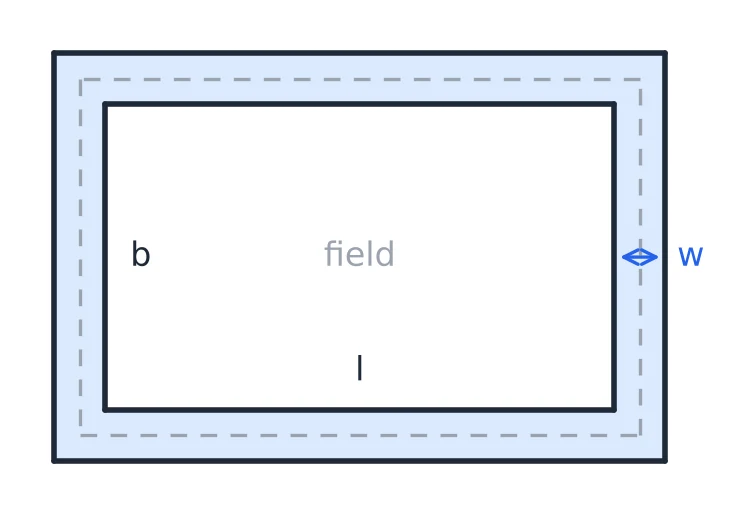
Why it works: the big rectangle minus the field is , which is the same thing. The is the four corner squares.
Question 7
A rectangular garden 60 m long and 40 m wide has a path 2.5 m wide all round it on the outside. Find the cost of paving the path at ₹12 per m².
Answer. Area m². Cost = ₹6,300. Check: .
Time check: about 20 seconds.
When it does not work:
- Outside or inside only changes the sign of the in the bracket. Read the question twice for the word.
- If the path runs along only some of the sides, there are no corner squares. Add the strips one by one.
- An inside path must be narrower than half the shorter side. A 25 m wide path inside a 40 m wide garden is impossible.
- The outer boundary of an outside path is , which is what you fence.
Cross Roads Through the Middle
When to use it: two roads (or paths, or strips of carpet) of width cross in the middle of a rectangular field, one parallel to the length and one parallel to the breadth.
Fast way:
The two strips are and , but the square where they cross (yellow in the figure) is inside both strips, so it gets counted twice. Take it away once. The grass left over, in four pieces, is .
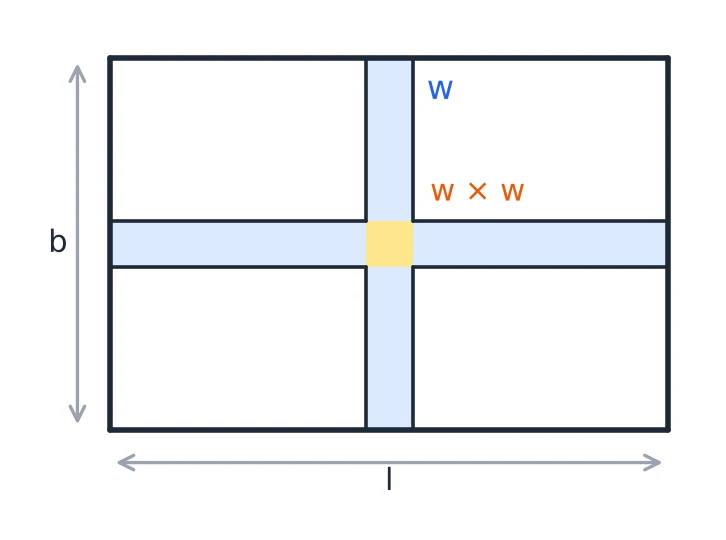
Question 8
A park measures 80 m by 55 m. Two roads, each 4 m wide, run through the middle of the park, one parallel to each side. Find the cost of gravelling the roads at ₹15 per m².
Answer. Area m². Cost = ₹7,860. A check: the grass left is m², and .
Time check: about 15 seconds.
When it does not work:
- Forgetting the gives the usual wrong option, here 540 m² and ₹8,100.
- If both roads run the same way (both parallel to the length), they never cross. The area is .
- Two roads along two edges that meet at a corner also overlap in one square, so the same formula works for them.
Largest Square Tile by HCF
When to use it: a floor is to be covered with identical square tiles without cutting any, and the largest tile or the least number of tiles is asked.
Fast way:
- Write both sides in the same unit, usually cm.
- The side of the largest tile is the HCF of the length and the breadth. (Quick HCF methods are in Chapter 1.)
- Least number of tiles . This is the same as floor area divided by tile area, but the numbers stay small.
- If the tile size is given, number of tiles = floor area ÷ area of one tile, as long as the tiles fit exactly.
- Carpet of width : length of carpet = floor area ÷ , and the cost is that length times the rate per metre.
Question 9
A room is 6 m 24 cm long and 4 m 32 cm wide. Find the least number of identical square tiles that will cover its floor exactly.
Answer. In cm the sides are 624 and 432, and . So the largest tile is 48 cm by 48 cm, and the number of tiles is = 117.
Time check: about 30 seconds (most of it on the HCF).
When it does not work:
- Mixing units: 6 m 24 cm is 624 cm, not 6.24 cm or 62.4 cm. Convert before the HCF.
- The least number of tiles needs the largest tile, which is the HCF. The LCM has nothing to do with it.
- If a fixed tile size does not divide a side, some tiles must be cut, and area ÷ tile area only gives the minimum count.
For a carpet, change its width to metres first. A room 12 m by 9 m needs m of carpet 75 cm wide.
Rhombus and Trapezium Without a Height
When to use it: a rhombus with its diagonals or side given, or a trapezium whose height is hidden.
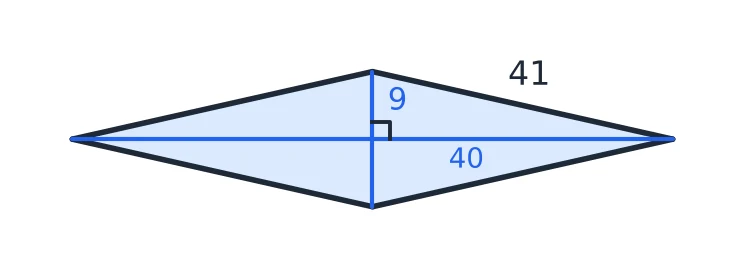
Fast way (rhombus): the diagonals cut each other in half at right angles. So a side is the hypotenuse of a right triangle whose legs are the two half-diagonals.
- Area , side , perimeter .
- Side and one diagonal known: half of the other diagonal is .
- Height .
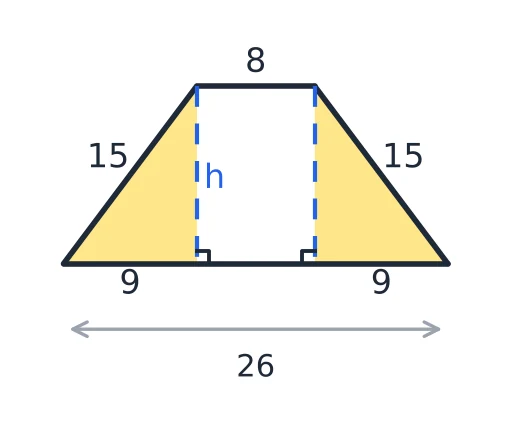
Fast way (trapezium): area , and the height is . In an isosceles trapezium, drop a height from each end of the shorter side. Each overhang is , and the height comes from Pythagoras with the slant side.
Question 10
A rhombus has side 41 cm and one diagonal 18 cm. Find its area.
Answer. Half the known diagonal is 9, so half the other one is (the 9-40-41 triplet). The other diagonal is 80 cm, and the area is = 720 cm².
Question 11
The parallel sides of an isosceles trapezium are 26 cm and 8 cm, and each slant side is 15 cm. Find its area.
Answer. Each overhang is cm, so the height is cm. Area = 204 cm².
When it does not work:
- needs diagonals that cross at right angles: a rhombus, a square or a kite. For a parallelogram or a rectangle, use base times height.
- The overhang trick needs equal slant sides. If they are unequal, slide one slant side across to make a triangle with sides (slant 1, slant 2, ). Its height, found with Heron, is the height of the trapezium.
Regular Hexagon as Six Equilateral Triangles
When to use it: a regular hexagon with its side, perimeter, a diagonal or a circle given.
Fast way: join the centre to the six corners. The angle at the centre is for each piece, so you get six equilateral triangles, each of side .
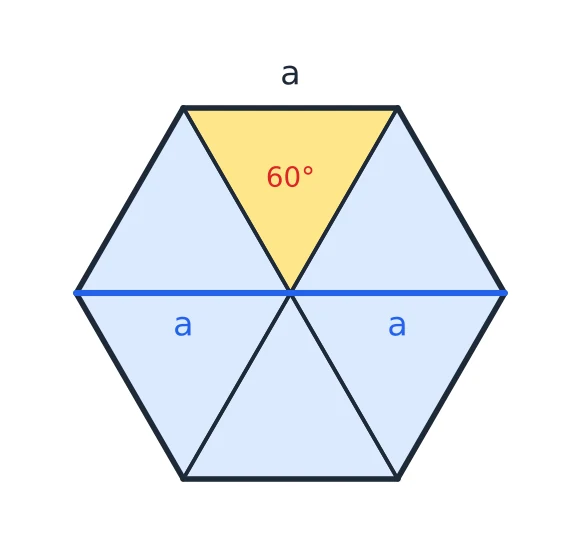
- Area , and perimeter .
- Longest diagonal (two triangle sides in a straight line, the blue line); shorter diagonal .
- The circle through the corners has radius ; the circle inside has radius , the height of one triangle.
- Joining every other corner gives an equilateral triangle with exactly half the hexagon's area.
Question 12
The longest diagonal of a regular hexagon is 16 cm. Find its area.
Answer. The side is cm. Area = cm².
Time check: about 10 seconds.
When it does not work:
- Only the hexagon splits into equilateral triangles from its centre. For other regular polygons the centre angle is not . [Tier 2] A regular octagon of side has area .
- The shorter diagonal is , not . Check which diagonal the question gives.
Circles Inside and Around Regular Figures
When to use it: a circle is drawn inside a square, an equilateral triangle or a regular hexagon (touching every side), or around it (through every corner).
Fast way: learn this table once. The radius of the circle inside is , and of the circle around is .
| Figure (side ) | Circle areas, inside : around | ||
|---|---|---|---|
| Square | 1 : 2 | ||
| Equilateral triangle | 1 : 4 | ||
| Regular hexagon | 3 : 4 |
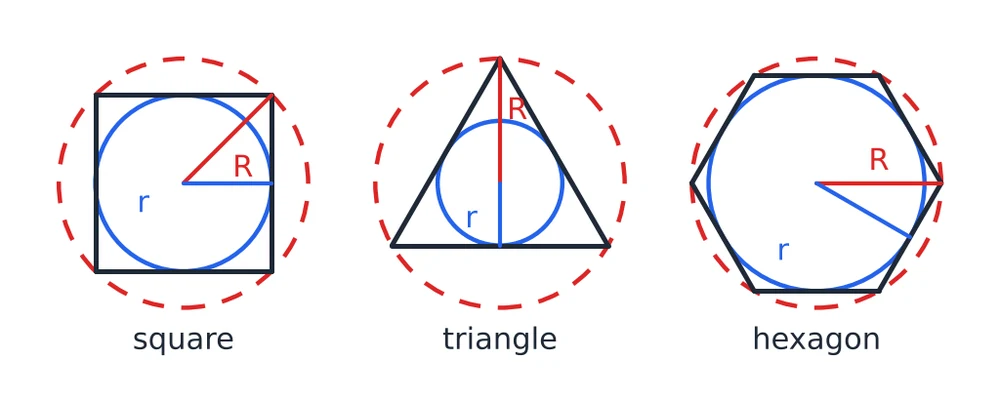
- A square drawn inside a circle of radius has diagonal , so its area is .
- Right triangle: and .
Question 13
An equilateral triangle has side 21 cm. Find the areas of the circles drawn around it and inside it.
Answer. , so the outer circle has area = 462 cm². The inner circle has a quarter of that area (the ratio is 1 : 4), which is 115.5 cm².
Time check: about 20 seconds.
When it does not work:
- A rectangle has no circle touching all four sides. The largest circle inside it has a diameter equal to the breadth.
- For a triangle that is not equilateral or right-angled, use area and area (Triangles: Area and Perimeter).
- In the triangle , but in the square . Swapping the two is the usual slip.
Wire Bent into Another Shape
When to use it: a wire in one shape is opened out and bent into another, and the new side, radius or area is asked.
Fast way: the length of the wire, which is the perimeter, stays the same. Area does not.
- Square of side into a circle: , so . A square of side 11 becomes a circle of radius 7.
- Circle of radius into a square: side .
- Into an equilateral triangle: side = perimeter ÷ 3. Into a rectangle with sides in the ratio : = perimeter ÷ 2, then split it in that ratio.
- For the same length of wire, a circle encloses the most area, then a square, then an equilateral triangle.
Question 14
A wire bent into a square encloses an area of 484 cm². It is opened and bent into a circle. Find the area of the circle.
Answer. The side of the square is 22 cm, so the wire is 88 cm long. gives cm, and the area is = 616 cm². That is 132 cm² more than the square, as expected, since the circle always wins.
Time check: about 20 seconds.
When it does not work:
- A semicircle's boundary includes the diameter: with . Taking alone is the usual trap.
- If part of the wire is cut off first, or used for a diagonal or a spoke, take that away before you find the new perimeter.
Ring Area with (R + r)(R - r)
When to use it: the region between two circles with the same centre: a circular path or track, a border round a circular park, a washer.
Fast way:
is the width of the ring and is the sum of the two radii. Multiplying these two small numbers is much quicker than squaring both radii.
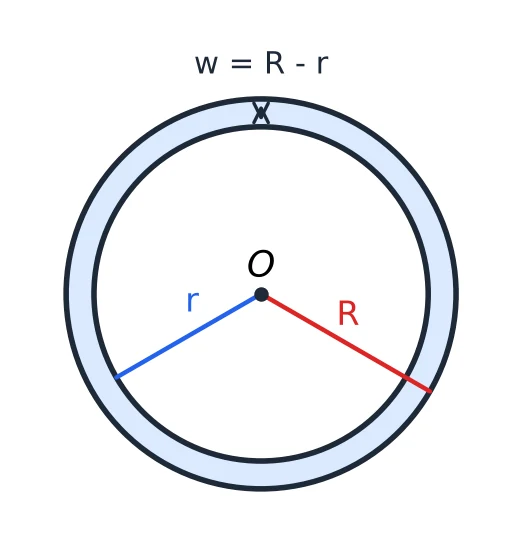
- A path of width round a circular park of radius : area .
- From the two circumferences: , so the width comes straight from the difference.
Question 15
The inner and outer edges of a circular running track are 264 m and 308 m long. Find the width of the track and its area.
Answer. m and m, so the width is 7 m. Area = 2002 m².
Time check: about 20 seconds.
When it does not work:
- is wrong. It is the area of a small circle whose radius is the width. Here it would give 154 m².
- Check whether the path is outside or inside the park. For a path inside, the park's radius is and .
Wheels: Revolutions = Distance ÷ Circumference
When to use it: a wheel rolls along a road, and the number of turns, the distance, the radius or the speed is asked.
Fast way: in one full turn, a wheel moves forward by its circumference.
- Put the distance and the radius in the same unit first. 1 km = 1000 m = 100000 cm.
- Speed: distance covered in a minute = revolutions per minute × circumference. To turn metres per minute into km/h, multiply by .
- Two wheels over the same road: their numbers of revolutions are in the inverse ratio of their radii. The smaller wheel turns more often.
Question 16
A cycle wheel has a diameter of 70 cm. How many revolutions does it make in going 1.32 km? If it turns 300 times a minute, what is the speed of the cycle in km/h?
Answer. Circumference cm. 1.32 km is 132000 cm, so the wheel turns = 600 times. At 300 turns a minute it goes m each minute, which is = 39.6 km/h.
Time check: about 25 seconds.
When it does not work:
- Diameter or radius: taking 70 cm as the radius gives a circumference of 440 cm and only 300 revolutions, half the right answer.
- Revolutions are full turns. If the division leaves a remainder and the question asks for complete revolutions, drop the fraction.
A Sector Is a Fraction of the Circle
When to use it: an arc, a sector or the perimeter of a sector, with the angle at the centre given, or an arc with the radius given.
Fast way: turn the angle into a fraction of first, then take that fraction of the whole circle.
| Angle | 30° | 45° | 60° | 72° | 90° | 120° | 135° |
|---|---|---|---|---|---|---|---|
| Fraction |
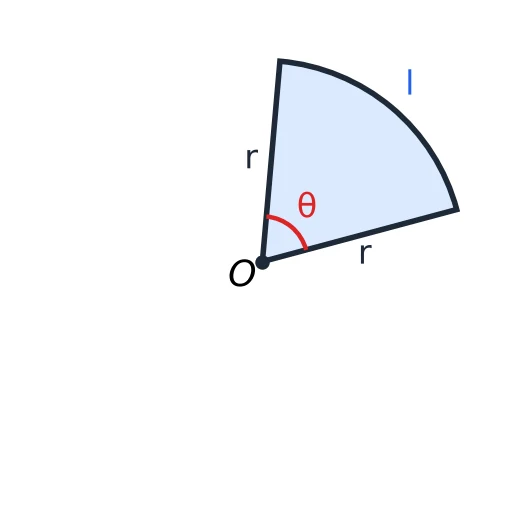
- Arc and sector area .
- No angle needed: sector area , like a triangle with base and height .
- Perimeter of a sector .
- Angle from the arc and the radius: .
Question 17
A sector of a circle of radius 63 cm has an angle of at the centre. Find its arc length, its area and its perimeter.
Answer. is of the circle. The whole circumference is cm, so the arc is = 44 cm. Now use the no-angle formula: area = 1386 cm², which saves squaring 63. Perimeter = 170 cm.
Time check: about 20 seconds.
When it does not work:
- The perimeter of a sector is not just the arc. Add the two radii.
- A major sector uses , not .
- needs the arc length, not the chord.
Clock Hands Sweep Sectors
When to use it: the area swept by a clock hand, or the distance moved by its tip, in a given time.
Fast way: a hand sweeps a sector, and the time gives the fraction.
- The minute hand goes round once in 60 minutes, so it turns a minute.
- The hour hand goes round once in 12 hours, so it turns an hour, which is a minute.
- Minute hand of length in minutes: area swept , and the tip moves .
- Hour hand in hours: the fraction is .
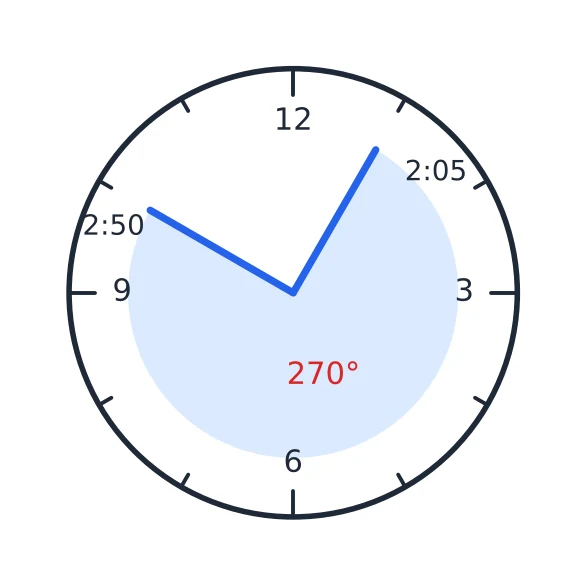
Question 18
The minute hand of a clock is 7 cm long. Find the area it sweeps from 2:05 pm to 2:50 pm, and the distance moved by its tip.
Answer. That is 45 minutes, which is of a turn (). Area = 115.5 cm². The tip moves = 33 cm.
Time check: about 15 seconds.
When it does not work:
- The hour hand is 12 times slower. Using a minute for it is the usual trap.
- The angle between the two hands at a given time is a different question (it is a reasoning topic). Here only one hand and its sweep matter.
- Over more than an hour the minute hand goes round more than once. In 1 hour 15 minutes it sweeps circles.
Four Quarter Circles Make One Circle
When to use it: shaded regions with quarter circles at the corners of a square, a circle inside a square, or equal circles touching inside a square.
Fast way: count how many whole circles the curved pieces make, and take that from the square. Each corner of a square is , so four corner pieces of the same radius make exactly one circle.
- Quarter circles of radius at the corners of a square of side : shaded middle , which is with .
- A circle inside a square: the four corners left over have the same total, .
- Four equal circles of radius that touch each other, centres at the corners of a square of side : the gap in the middle is .
- Two quarter circles of radius drawn from opposite corners of a square of side make a leaf: leaf .
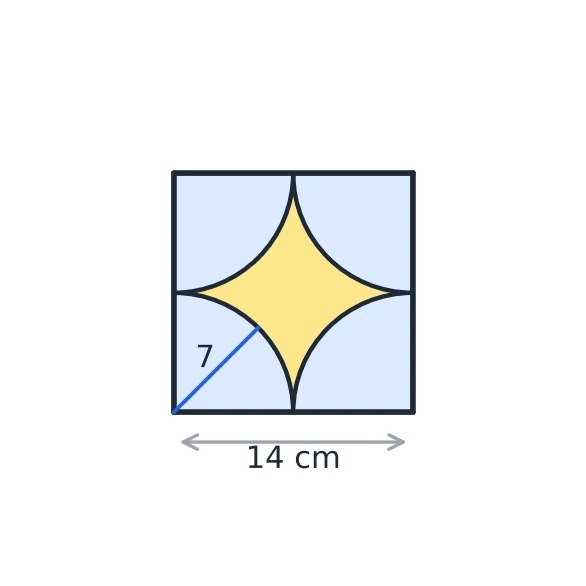
Question 19
In a square of side 14 cm, a quarter circle of radius 7 cm is drawn at each corner. Find the area of the part of the square not covered by them. Also find the area of the leaf formed by two quarter circles of radius 14 cm drawn from opposite corners of the same square.
Answer. The four quarters make one circle of radius 7, area 154 cm². Uncovered part = 42 cm² (and agrees). Each quarter circle of radius 14 is cm², so the leaf is = 112 cm².
Time check: about 20 seconds.
When it does not work:
- The pieces must have the same radius to add up to whole circles. With different radii, find each sector on its own.
- In a triangle the corner angles add up to , not , so the corner pieces make only half a circle. That is the next method.
Grazing at the Corners of a Triangle
When to use it: animals tied at the corners of a triangular field with equal ropes, or equal sectors drawn at the three corners of a triangle.
Fast way: each animal grazes a sector whose angle is the angle of the field at its corner. The three angles of a triangle add up to , so the three sectors together make exactly one semicircle:
You never need the separate angles.
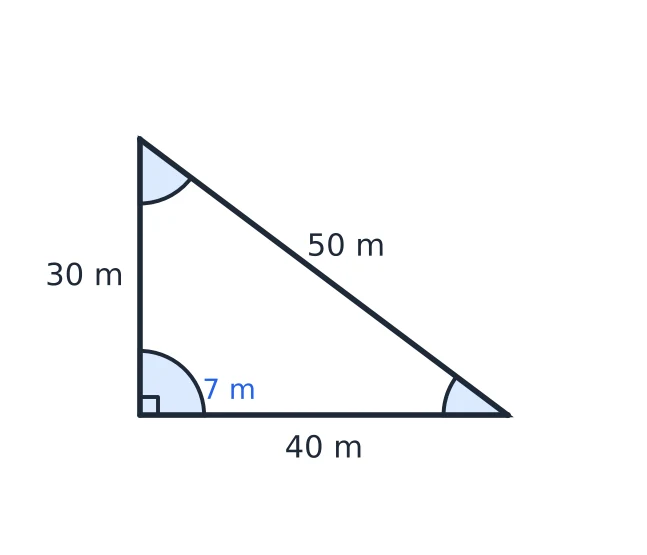
- A four-sided field: the angles add up to , so the four sectors make one full circle, . An -sided field gives circles.
- Area not grazed = area of the field minus the area grazed.
- One animal at a corner of a rectangular field grazes a quarter circle, .
Question 20
A triangular field has sides 30 m, 40 m and 50 m. A horse is tied at each corner with a rope 7 m long. Find the area grazed and the area left ungrazed.
Answer. 30-40-50 is a right triangle, so the field is m². The three sectors make a semicircle of radius 7: = 77 m² grazed. Ungrazed = 523 m².
Time check: about 20 seconds.
When it does not work:
- The rope must be at most half the shortest side, or two sectors overlap and the shortcut double counts. Here .
- With unequal ropes, work out each sector separately with its own angle.
- An animal tied outside a square shed at one corner can go round the outside, so it grazes , three quarters of a circle.
Elimination by Size
When to use it: whenever the options are far apart, and as a last check on every answer.
Fast way: before you work it out, estimate.
- A part is smaller than the whole: a segment is smaller than its sector, a path is smaller than the field, a ring is smaller than the outer circle.
- A circle inside a square fills about 79% of it, so the four corners left over are about 21%.
- Rough sizes: an equilateral triangle is about , a regular hexagon about , a circle about . Use and .
- Units: an area is in cm² or m², a length in cm or m. An option that is the right number for the perimeter is a trap in an area question.
- Shape tags: an equilateral triangle or a hexagon with a whole-number side has in its area; a circle answer has or is a multiple of 22.
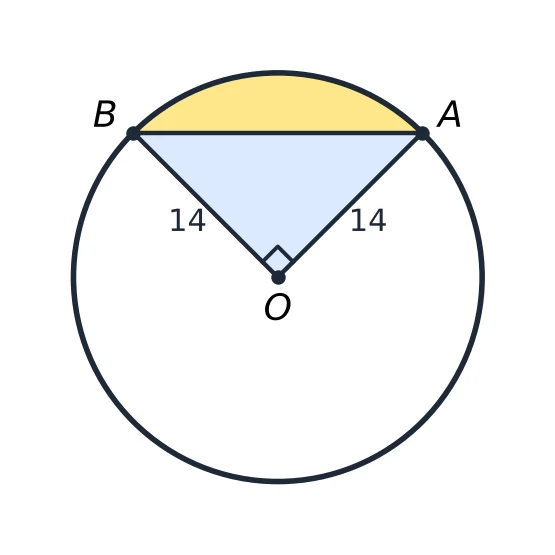
Question 21
A chord AB of a circle of radius 14 cm makes a right angle at the centre O. The area of the smaller segment cut off by AB is: (a) 154 cm² (b) 98 cm² (c) 56 cm² (d) 252 cm²
Answer. The quarter circle (the sector) is cm², and the segment is only a part of it, so (a) and (d) are out. (b) 98 cm² is the triangle OAB itself, . That leaves (c) 56 cm², and confirms it.
Time check: about 10 seconds.
When it does not work:
- If two options are close, say 56 and 58, estimating cannot separate them. Do the full working.
- A printed figure may not be drawn to scale. Estimate from the numbers, not from the picture.
[SSC Tip] Most wrong options in mensuration belong to a short list: perimeter for area, diameter for radius, for , the left out, the forgotten for cross roads, the diameter left out of a semicircle's boundary, and for a ring. If your answer matches one of these, check that step once more.