
Regular Polygons: Perimeter and Area from Triangles
A polygon is regular when all its sides are equal and all its angles are equal. The equilateral triangle (3 sides) and the square (4 sides) are the ones you already know. SSC also asks about the regular hexagon (6 sides) and, in Tier 2, the regular octagon (8 sides). One idea handles all of them.
Perimeter. A regular polygon with sides, each of length , has perimeter . Questions often hide inside an angle. Each exterior angle of a regular polygon is , and each interior angle is 180° minus the exterior angle. So if each interior angle is 150°, the exterior angle is 30°, , and a side of 5 cm gives a perimeter of 12 × 5 = 60 cm.
Area from triangles. Join the centre O to every vertex. The polygon breaks into identical isosceles triangles. Each one has a side as its base, and its height is the perpendicular from O to that side. This perpendicular is called the apothem. It is also the radius of the circle that fits inside the polygon.
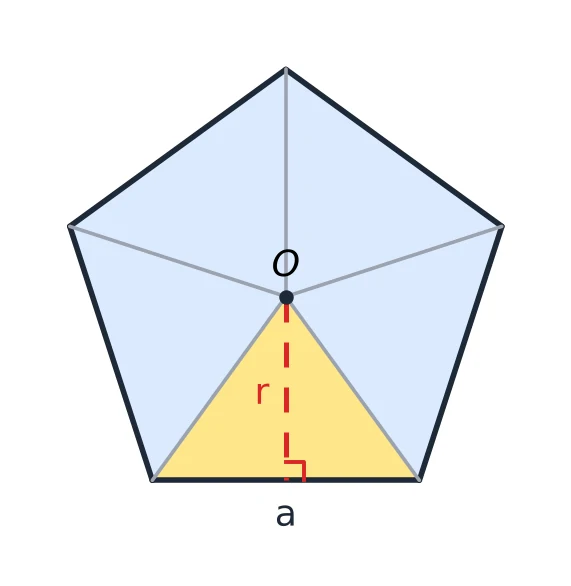
This is the same rule as for a triangle (in Triangles: Area and Perimeter): area = inradius × semi-perimeter. A regular pentagon of side 8 cm has an apothem of about 5.5 cm, so its area is about cm².
Area from the circumradius. The distance from O to a vertex is the circumradius . Each of the triangles has two sides equal to with the angle between them, so its area is (the rule; the sine values are in the triangles section). Multiplying by :
| Regular polygon | Angle at O | Area in terms of | |
|---|---|---|---|
| Square | 4 | 90° | |
| Hexagon | 6 | 60° | |
| Octagon | 8 | 45° | |
| Dodecagon (12 sides) | 12 | 30° |
So a regular 12-sided figure drawn in a circle of radius 10 cm has area 3 × 100 = 300 cm², a little less than the circle's 314 cm².
[SSC Tip] The triangles from the centre are isosceles, not equilateral. Only in the hexagon (angle at O = 60°) is the side equal to . For a pentagon or an octagon, never use for one of these triangles.
The Regular Hexagon: Six Equilateral Triangles
In a regular hexagon the angle at the centre is . Each of the six triangles from O is isosceles with a 60° angle at the top, so it is equilateral, and all its sides equal the side of the hexagon. Almost every hexagon question is built on this one picture.
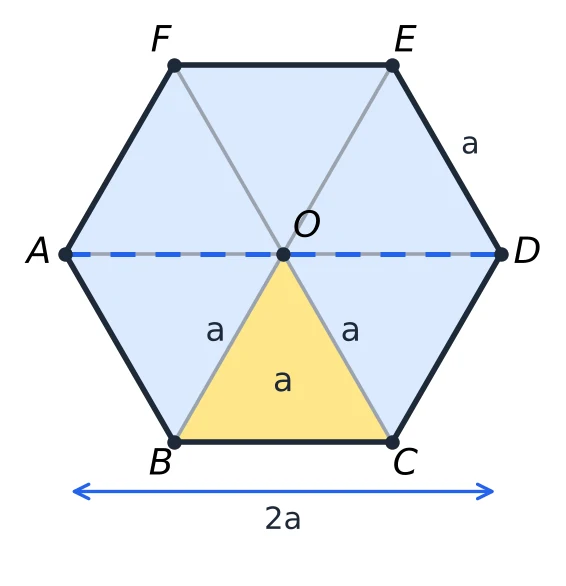
The rest can be read off the figure:
- Perimeter = 6a.
- Circumradius R = a, since O is the same distance from every vertex.
- Longest diagonal AD passes through O and is two sides of the small triangles: AD = 2a. There are three of these.
- Short diagonal such as AC (skipping one vertex): AC = .
- Distance between two opposite sides (BC and EF) = two heights of the small triangles = . This is also twice the inradius.
- Each interior angle is 120°.
For a side of 7 cm: area = cm² (about 127.3 cm²), perimeter 42 cm, longest diagonal 14 cm, and the distance between opposite sides cm.
Going backwards. If the area is cm², then , so and a = 10 cm. If the longest diagonal is given, the side is and the area is . If the distance between opposite sides is , the side is .
[SSC Tip] One small triangle has area , and the options often show that value, or three times it, next to the right one. Count the triangles: the hexagon has six. A quick size check: is about 2.6, so a hexagon of side is about .
Inside a Hexagon: Diagonals, Triangles and Cut Corners
The six-triangle picture also answers questions about pieces of a hexagon. Take hexagon ABCDEF with side and area .
Triangle ACE. Joining alternate vertices gives an equilateral triangle with side (each of its sides is a short diagonal). Its area is , which is exactly half the hexagon. The three corner triangles ABC, CDE and EFA share the other half, so each one is of the hexagon, the same as one central triangle.
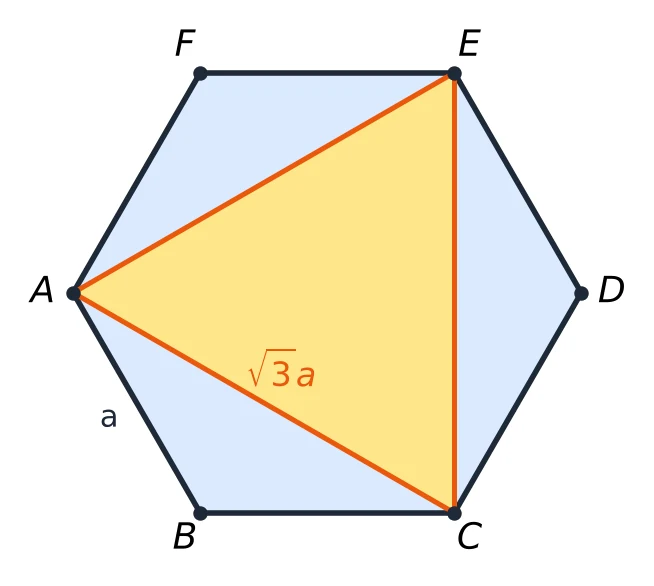
Other pieces. The longest diagonal AD cuts the hexagon into two equal trapeziums. In ABCD the parallel sides are and and the height is , so its area is , half again. BCEF is a rectangle with sides and .
| Piece | Share of the hexagon |
|---|---|
| One central triangle such as OAB | |
| Corner triangle ABC | |
| Triangle ACE | |
| Trapezium ABCD | |
| Rectangle BCEF |
So if H = 90 cm², triangle ABC is 15 cm², triangle ACE is 45 cm² and rectangle BCEF is 60 cm².
Cutting a hexagon from a triangle. Take an equilateral triangle of side and cut off an equilateral triangle of side at each corner. What is left has six sides of length and all its angles are 120°, so it is a regular hexagon of side . The big triangle holds 9 small triangles of side (area grows as the square of the side, and ). The corners take 3 and the hexagon keeps 6, so the hexagon is of the triangle.
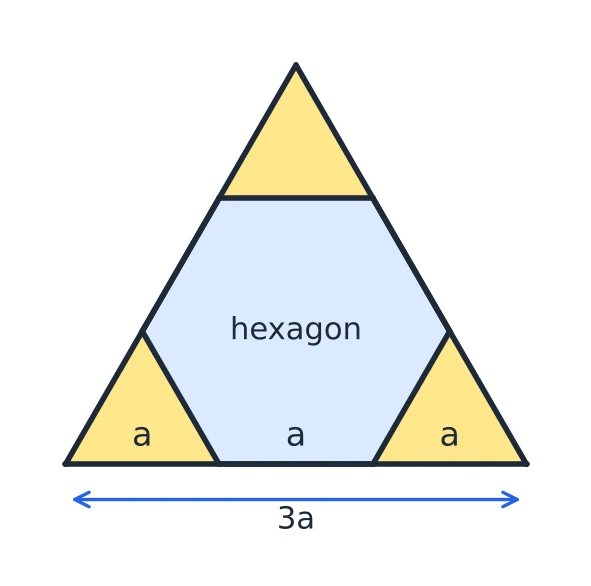
A triangle of side 12 cm gives a hexagon of side 4 cm and area cm², two thirds of the triangle's cm².
Counting small equilateral triangles of side is the quickest way into any hexagon-piece question: the hexagon is 6 of them, triangle ACE is 3, each corner triangle is 1 and rectangle BCEF is 4.
[Tier 2] The Regular Octagon
Each interior angle of a regular octagon is 135° and each exterior angle is 45°. The neat way to get its area is to fit it inside a square.
Put the octagon in a square so that four of its sides lie along the sides of the square. The four corners left over are right isosceles triangles whose long side (the hypotenuse) is a side of the octagon, . So each short side is , and the square has side .
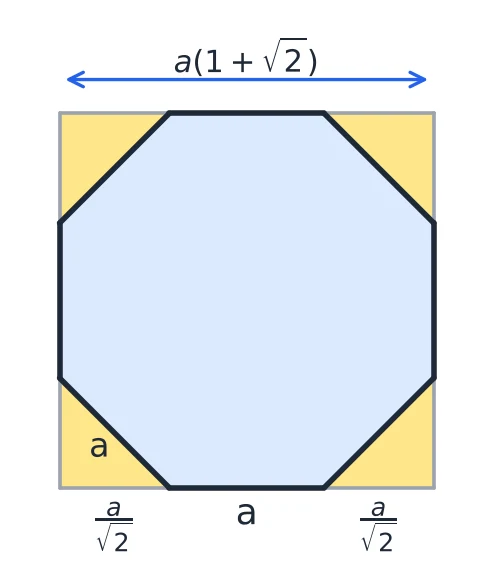
Area of the octagon = square − four corners:
The same picture gives:
- the distance between two opposite sides = the side of the square = , which is also twice the inradius;
- the perimeter = 8a;
- from the circumradius, area = (the table in the first part).
For a side of 3 cm: area = cm², about 43.5 cm², and the distance between opposite sides is cm, about 7.24 cm.
Octagon cut from a square. SSC also turns the picture around: equal corners are cut off a square of side to leave a regular octagon. If each cut-off short side is , the octagon's side is , and along one side of the square . So
A square of side 10 cm gives an octagon of side cm, about 4.14 cm.
A size check: is about 4.83, so an octagon of side is a little under . For a side of 3 cm the answer must be a little under 45 cm²; the option , about 21.7, has lost the factor 2.
Circles and Squares, One Inside the Other
Two pictures cover every square-and-circle question. The thing to watch is which length becomes the diameter.
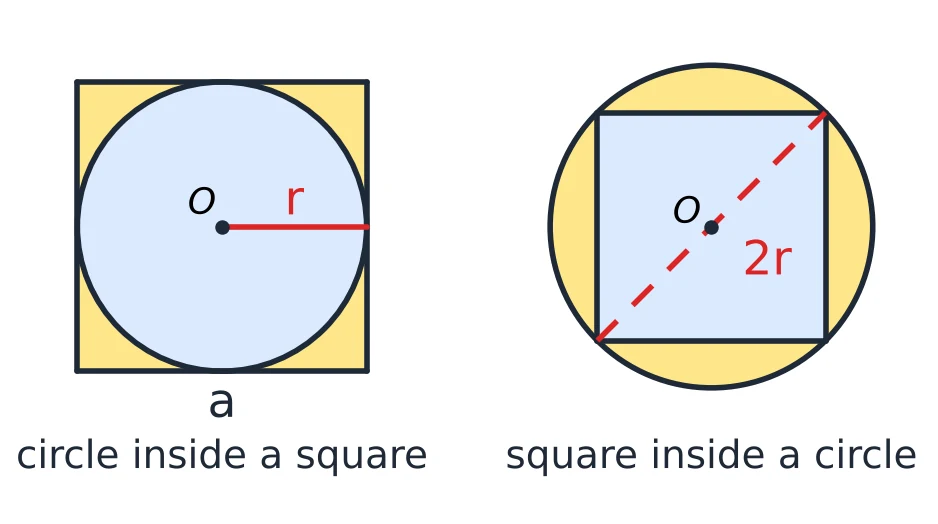
A circle inside a square (its incircle) touches all four sides. Its diameter runs from one side to the opposite side, so the diameter is the side :
A circle around a square (its circumcircle) passes through all four corners. Its diameter is a diagonal of the square, :
A square inside a circle of radius . Now start from the circle. The diagonal of the square is the diameter , and the area of a square is half its diagonal squared:
So a circle of radius 7 cm holds a square of area 98 cm², and a circle of radius 10 cm holds a square of area 200 cm².
Ratios worth remembering. They do not depend on the size.
- Circumcircle : incircle of the same square = = 2 : 1 (the radii are ).
- Square : its incircle = , which is 14 : 11 with .
- Square : its circumcircle = , which is 7 : 11.
With a square of side 20 cm and = 3.14: the incircle has area 3.14 × 100 = 314 cm², the circumcircle 3.14 × 200 = 628 cm², and the ring between them 314 cm², the incircle's area once more. That is no accident: .
[SSC Tip] Given the diagonal of a square, the circumcircle's radius is simply ; you never need the side. Given the side, the incircle's radius is . Mixing up these two gives an area exactly 2 times too big or too small, and that wrong value is always among the options.
Circles with an Equilateral Triangle
In an equilateral triangle the centroid, incentre and circumcentre are one point O. O lies on each height and cuts it in the ratio 2 : 1, which gives both radii at once:
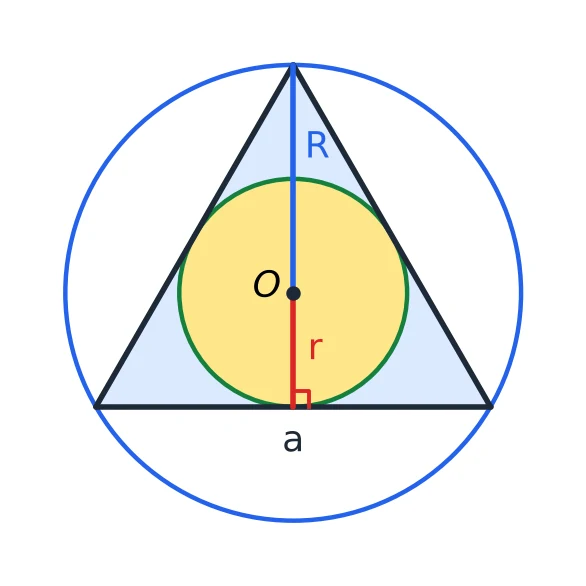
Areas. The incircle is and the circumcircle is . Since R = 2r, the circumcircle is 4 times the incircle (incircle : circumcircle = 1 : 4). The ring between them is
For a = cm: h = 9 cm, r = 3 cm and R = 6 cm. The incircle is cm², the circumcircle cm² and the ring cm².
Starting from the circle. An equilateral triangle drawn inside a circle of radius has side and area
An equilateral triangle drawn around a circle of radius has side and area . For a circle of radius 12 cm, the triangle inside has area cm² and the triangle outside cm², again 1 : 4.
The height of the triangle is , and also . When a question gives the height, the radii are one third and two thirds of it, with no square roots needed. And when it gives the side, remember is the small one: an answer that uses for the incircle is 4 times too big.
Circles with a Regular Hexagon and with a Right Triangle
Regular hexagon of side . The circumcircle passes through the vertices, and the six-triangle picture shows R = a. The incircle touches the middle of each side, so is the height of one small equilateral triangle: .
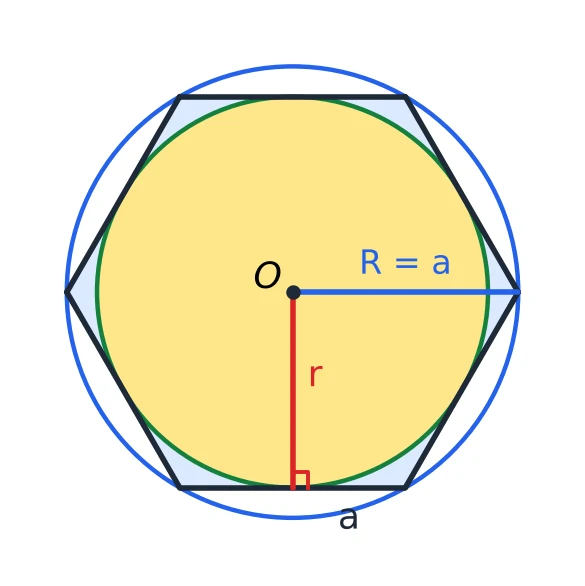
So the circumcircle has area and the incircle , giving circumcircle : incircle = 4 : 3. The hexagon itself fills of its circumcircle, about 83%. For a side of 4 cm: circumcircle cm², incircle cm², and the ring between them cm².
Right triangle with legs , and hypotenuse . The angle in a semicircle is 90°, so the hypotenuse is a diameter of the circumcircle:
The first form of comes from the equal tangents drawn from each vertex, the second from area = .
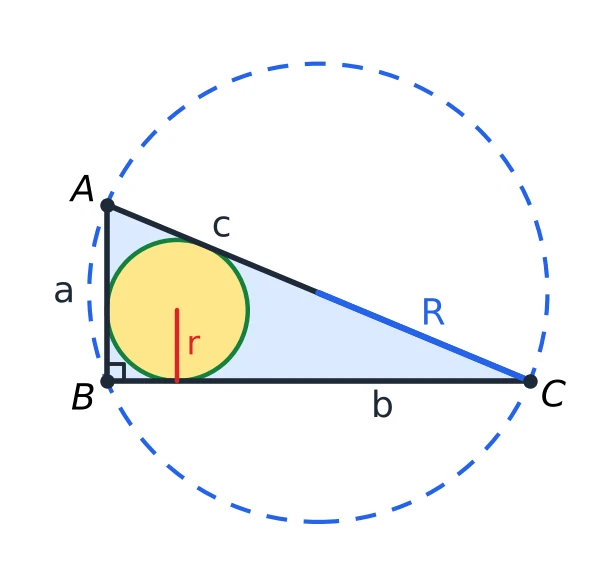
For the 5, 12, 13 triangle: R = 6.5 cm and = 2 cm. Adding the two formulas gives a neat check, : here 2 + 6.5 = 8.5, which is half of 5 + 12.
Any other triangle. Use and , with the area from Heron's formula (both are in Triangles: Area and Perimeter). For sides 13, 14 and 15 cm: Δ = 84 cm² and s = 21 cm, so r = 4 cm and cm.
In a right triangle, R is always half the hypotenuse and the circumcentre is the midpoint of the hypotenuse. Taking half of a leg, or using as if the triangle were equilateral, are the slips the options are built on.
Squares Inside Squares, and Shapes Repeated Inside Each Other
Joining the midpoints of a square. Join the midpoints P, Q, R and S of the sides of square ABCD of side . PQRS is a square whose side is the hypotenuse of a corner triangle with legs , so its side is and
The four corner triangles make up the other half, each.
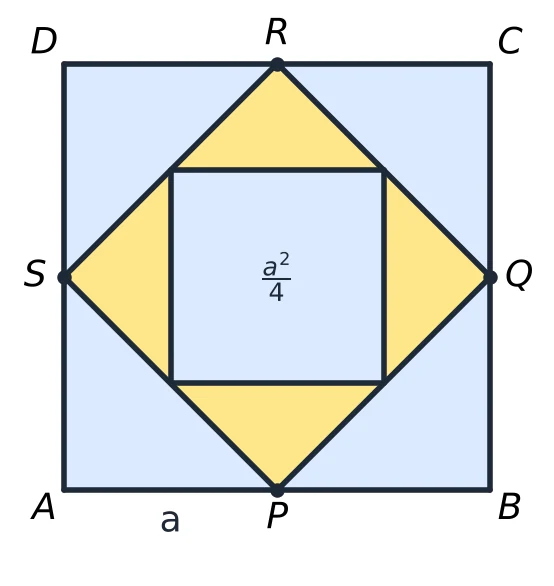
Repeat the step and the area halves every time: and so on. The sides shrink by a factor each time, and so do the perimeters. Starting with a side of 12 cm (area 144 cm²), the next three squares have areas 72, 36 and 18 cm², and the last of them has side cm.
Other shapes. The midpoints of a rectangle give a rhombus whose diagonals are the rectangle's sides, so its area is , half again. The midpoints of any quadrilateral give a parallelogram with half the area. The midpoints of a triangle give a triangle with a quarter of the area (Triangles: Area and Perimeter).
Circles and squares taking turns. Put a circle in a square, a square in that circle, a circle in that square, and so on. Each new circle has times the radius of the one before, so it has half the area, just like the squares. A circle of radius 10 cm holds a square of area 200 cm², and the circle inside that square has radius cm and area cm², half of .
[Tier 2] Squares in a semicircle and in a quadrant. A square of side stands on the diameter of a semicircle of radius , with its two top corners on the arc. From the centre O, a top corner is across and up, so
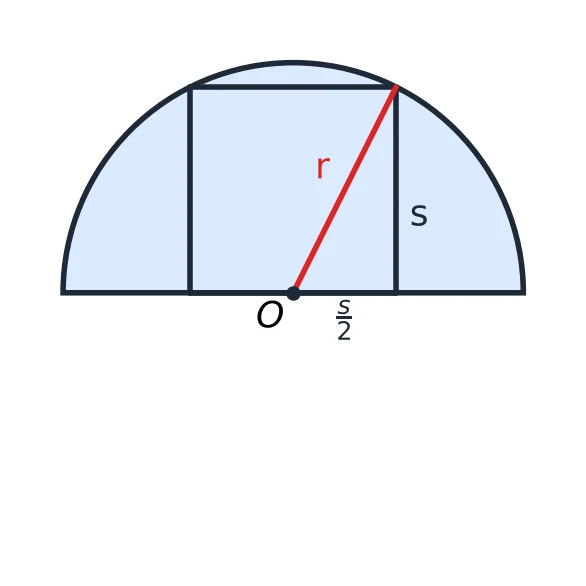
A square in a quadrant, with one corner at the centre and the opposite corner on the arc, has diagonal , so its area is . For r = 5 cm, the square in the semicircle is 20 cm² and the square in the quadrant is 12.5 cm².
Inscribed and Circumscribed Figures: Ratios at a Glance
Ratio questions ('the ratio of the areas of the circumcircle and the incircle of …') need no numbers at all. Keep this table handy. Here is the side.
| Figure | Incircle radius | Circumcircle radius | Areas, circum : in | |
|---|---|---|---|---|
| Square | 2 : 1 | |||
| Equilateral triangle | 2 : 1 | 4 : 1 | ||
| Regular hexagon | 4 : 3 | |||
| Right triangle (legs , , hypotenuse ) | depends on the sides | depends on the sides |
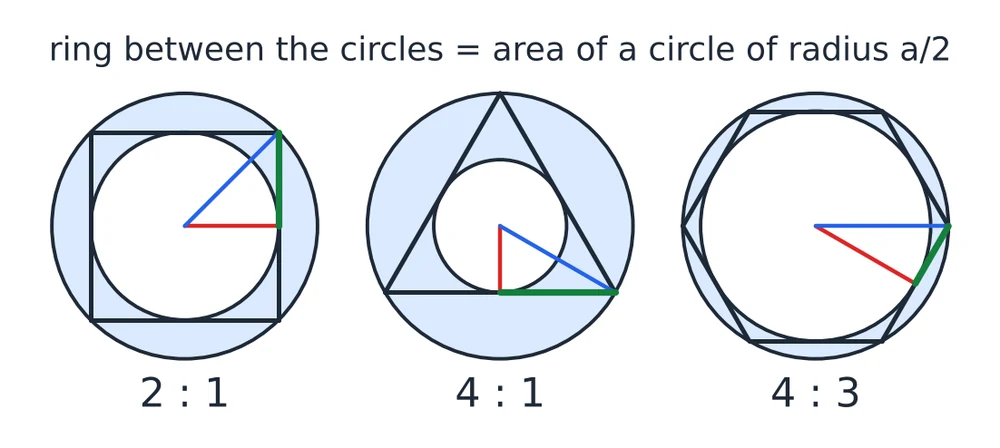
One rule for every regular polygon. In each shape above, the inradius (red), half a side (green) and the circumradius (blue) make a right triangle. So , and the ring between the circumcircle and the incircle always has area
which is the area of a circle whose diameter is one side. For a square, a triangle or a hexagon of side 7 cm, the ring is cm² in every case.
How much of its circumcircle a shape fills:
| Shape inside a circle of radius | Area of the shape | Shape : circle |
|---|---|---|
| Square | (7 : 11) | |
| Equilateral triangle | ||
| Regular hexagon |
The other way round, a circle inside a square fills (11 : 14) of the square.
[SSC Tip] A ratio never depends on the size, so pick an easy side. For an equilateral triangle take : then r = 1 and R = 2, and the areas are and , so 1 : 4 is clear at once.
Wire Bent into Another Shape
When a wire is bent into a new shape, its length does not change. So the perimeter of the new shape equals the perimeter of the old one, while the areas are usually different. Two steps every time: find the length of the wire from the first shape, then use it as the perimeter of the second shape.
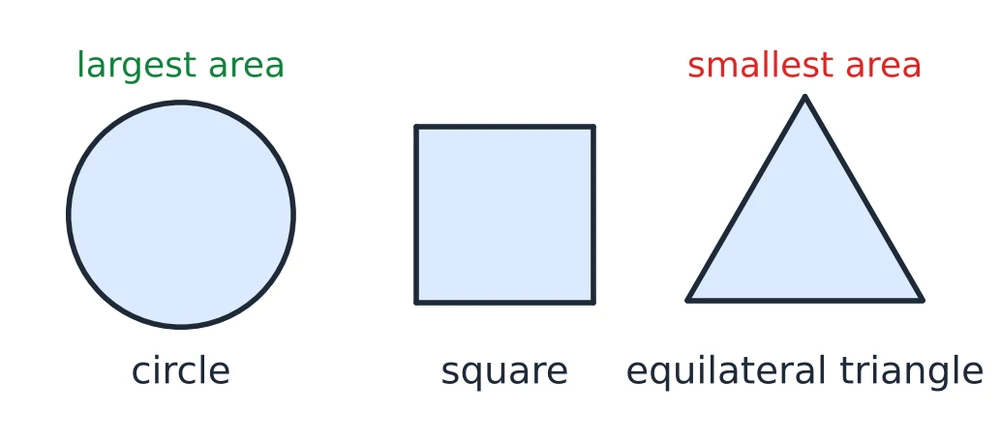
For a wire of length :
| Shape | Side or radius | Area |
|---|---|---|
| Equilateral triangle | ||
| Square | ||
| Regular hexagon | ||
| Circle |
For the same perimeter, the more sides a regular shape has, the more area it holds, and the circle holds the most of all. Among rectangles with a fixed perimeter, the square has the largest area.
Circle to square. A wire bent into a circle of radius 49 cm has length cm. Bent into a square, each side is 77 cm and the area is 5929 cm². The circle had cm², which is 1617 cm² more. For the same wire, circle : square is always , which is 14 : 11.
Triangle to circle. An equilateral triangle of side 44 cm (area cm², about 838.3 cm²) uses 132 cm of wire. As a circle, gives r = 21 cm, and the area becomes cm².
Rectangle to square. A wire bent into a rectangle 20 cm by 12 cm (area 240 cm²) is 64 cm long. As a square its side is 16 cm and its area 256 cm². The square always gains, and the gain is , here cm².
A wire bent into a semicircle has to cover the curved arc and the straight diameter: its length is . Using only is the usual slip.
Combined Figures: L-shapes, Frames and Borders
Most odd-looking figures in SSC are a few rectangles or triangles joined together, or a big shape with a piece missing. There are two ways to find the area, and each one checks the other.
L-shapes. The plot below is a 16 m by 12 m rectangle with a 9 m by 7 m corner missing.
- Subtract: 16 × 12 − 9 × 7 = 192 − 63 = 129 m².
- Split along the dashed line: 16 × 5 + 7 × 7 = 80 + 49 = 129 m².
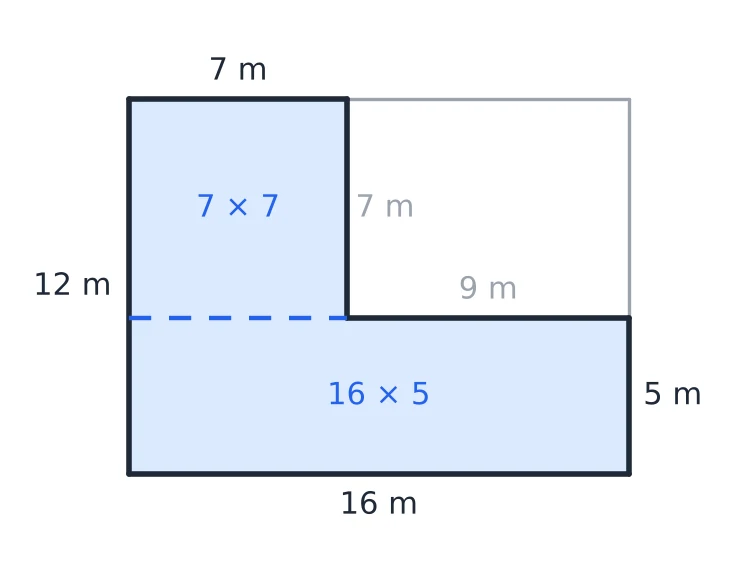
The perimeter is where people slip. Walking round the L, the inner edges of 9 m and 7 m exactly replace the missing parts of the top and the right side. So the perimeter equals that of the full rectangle: 16 + 5 + 9 + 7 + 7 + 12 = 56 m = 2(16 + 12). When the piece is cut from the middle of a side instead (a notch, as in a U-shape), the two inner walls are extra, and the perimeter goes up by twice the depth of the notch.
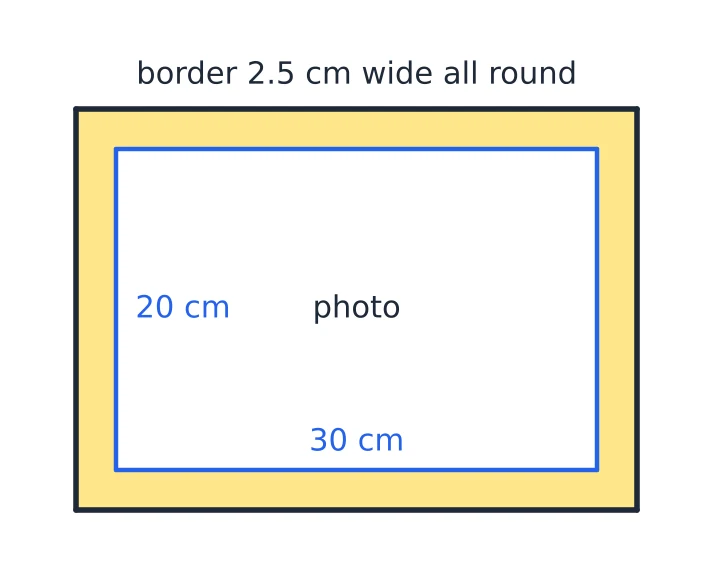
Frames and borders. A photo by with a border of width all round sits inside a rectangle by :
A 30 cm by 20 cm photo with a 2.5 cm border: 35 × 25 − 600 = 875 − 600 = 275 cm². This is the same sum as a path round a field, and the cost works the same way.
Rectangles with triangles. A house-shaped wall is a rectangle with a triangle on top, so add the two areas; a shape with a triangular cut-out needs a subtraction. A 12 m by 8 m wall with an equilateral triangle of side 12 m on top has area m², about 158.4 m².
In the border formula, the term is the four corner squares. Writing only leaves out the corners, and that wrong value is usually one of the options.
Solved Examples
Question 1
Each interior angle of a regular polygon is 140° and its perimeter is 72 cm. What is the length of each side? (a) 9 cm (b) 8 cm (c) 12 cm (d) 7.2 cm
Answer. Interior angle 140° means each exterior angle is 180° − 140° = 40°. The exterior angles always add up to 360°, so there are 360 ÷ 40 = 9 sides. The perimeter 72 cm is shared by 9 equal sides, so each side is (b) 8 cm. 9 cm is the number of sides, not the side.
Question 2
A regular pentagon has side 12 cm, and the perpendicular distance from its centre to each side is 8.26 cm. What is its area? (a) 495.6 cm² (b) 99.12 cm² (c) 247.8 cm² (d) 49.56 cm²
Answer. Join the centre to the five corners. That makes 5 equal triangles, each with base 12 cm and height 8.26 cm. One triangle is cm², and five of them make (c) 247.8 cm². The short way: .
Question 3
What is the area of a regular hexagon of side 8 cm? (a) cm² (b) cm² (c) cm² (d) cm²
Answer. A regular hexagon is six equilateral triangles with the same side. One triangle of side 8 cm has area cm². Six of them: = (a) cm².
Question 4
The area of a regular hexagon is cm². What is the length of its longest diagonal? (a) 3 cm (b) cm (c) 9 cm (d) 6 cm
Answer. Set the area formula equal to the given area: . The cancels on both sides, so , and a = 3 cm. The longest diagonal goes through the centre and is two sides long: 2 × 3 = (d) 6 cm.
Question 5
The distance between two opposite sides of a regular hexagon is 12 cm. What is its area? (a) cm² (b) cm² (c) cm² (d) cm²
Answer. The gap between opposite sides is two heights of the small equilateral triangles, which is . So , giving cm and . Area = = (a) cm².
Question 6
ABCDEF is a regular hexagon with perimeter 132 cm. What is the area of triangle ACE? (a) cm² (b) cm² (c) cm² (d) cm²
Answer. Each side is 132 ÷ 6 = 22 cm, so the hexagon has area cm². Triangle ACE (joining every second corner) is exactly half of the hexagon, so it is (c) cm². Check another way: ACE is equilateral with side , so its area is .
Question 7
Three equal corners are cut off an equilateral triangle of side 15 cm so that a regular hexagon is left. What is the area of the hexagon? (a) cm² (b) cm² (c) cm² (d) cm²
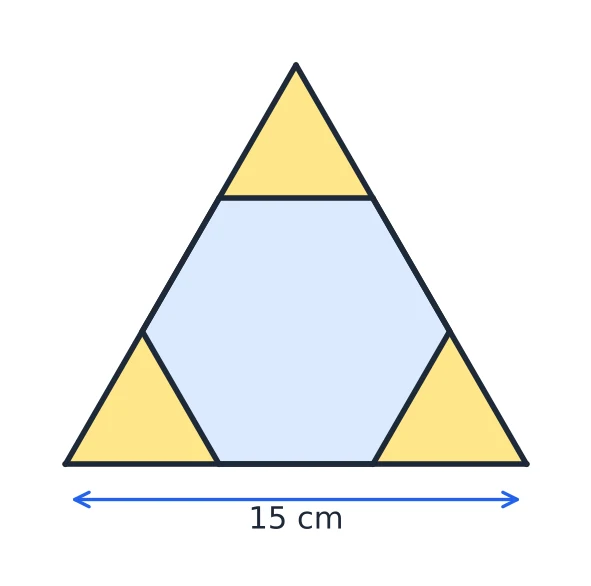
Answer. For the hexagon to be regular, each side of the triangle must be cut into three equal parts, so the hexagon's side is 15 ÷ 3 = 5 cm. Its area is = (b) cm². Quick check: the hexagon is two thirds of the big triangle, and .
Question 8
[Tier 2] What is the area of a regular octagon of side 5 cm? (a) cm² (b) cm² (c) cm² (d) cm²
Answer. Use area = . With a = 5: = (d) cm², about 120.7 cm². To see why: the octagon sits in a square of side , and four corner triangles with legs are cut off, together 25 cm². is the full square before the corners go.
Question 9
[Tier 2] Four equal right-angled corners are cut off a square of side 12 cm so that a regular octagon is left. What is the side of the octagon? (a) cm (b) 4 cm (c) cm (d) 6 cm
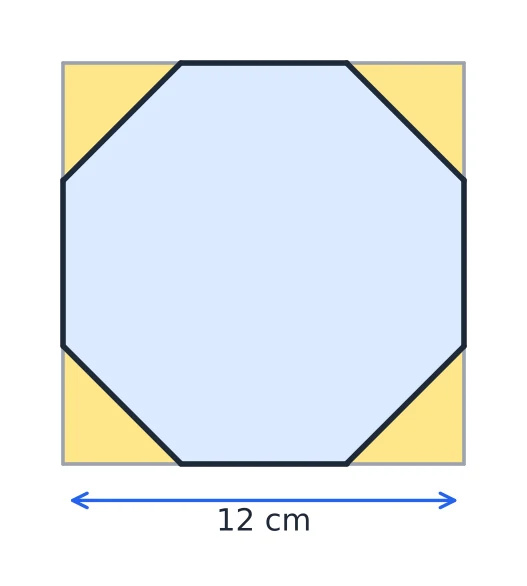
Answer. Call each short side of a cut-off corner . The corner is a right isosceles triangle, so the octagon's side (its long side) is . Along one side of the square: , so . The octagon's side is = (a) cm, about 4.97 cm. 4 cm cuts the side into three equal parts, but then the slanted sides would be longer than 4 cm.
Question 10
A square has side 14 cm. What is the area of the ring between its circumcircle and its incircle? (Take .) (a) 308 cm² (b) 616 cm² (c) 154 cm² (d) 77 cm²
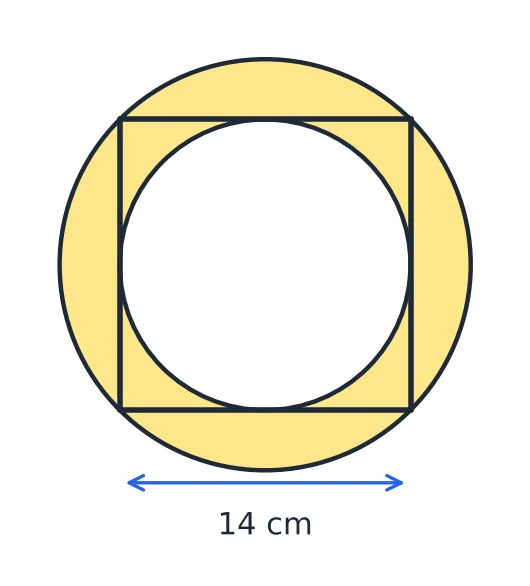
Answer. The incircle has radius half the side, r = 7 cm, so . The circumcircle has the diagonal as diameter, so and . Ring = = (c) 154 cm². It equals the incircle's own area, as it always does for a square.
Question 11
A square is drawn inside a circle of circumference 88 cm with all four corners on the circle. What is the area of the square? (Take .) (a) 196 cm² (b) 392 cm² (c) 616 cm² (d) 784 cm²
Answer. From , r = 14 cm, so the diameter is 28 cm. The diameter is the square's diagonal, and a square's area is half its diagonal squared: = (b) 392 cm². Same thing as . 784 cm² takes the diameter as the side.
Question 12
What is the area of the circle inscribed in an equilateral triangle of side 21 cm? (Take .) (a) 462 cm² (b) 231 cm² (c) 346.5 cm² (d) 115.5 cm²
Answer. For an equilateral triangle, , so . Area = = (d) 115.5 cm². 462 cm² is the circumcircle, which is 4 times the incircle.
Question 13
An equilateral triangle is drawn inside a circle of radius 8 cm, with its corners on the circle. What is the area of the triangle? (a) cm² (b) cm² (c) cm² (d) cm²
Answer. The circle is the triangle's circumcircle, so and cm. Area = = (c) cm². Shortcut: area = .
Question 14
What is the area of the ring between the circumcircle and the incircle of an equilateral triangle of side 12 cm? (a) cm² (b) cm² (c) cm² (d) cm²
Answer. and . Ring = = (a) cm². The quick rule gives the same: the ring round any regular polygon is .
Question 15
What is the area of the circle inscribed in a regular hexagon of side 14 cm? (Take .) (a) 616 cm² (b) 154 cm² (c) 231 cm² (d) 462 cm²
Answer. The incircle touches the middle of each side, so its radius is the height of one small equilateral triangle: cm, and . Area = = (d) 462 cm².
Question 16
A right triangle has legs 21 cm and 28 cm. What is the area of its incircle? (Take .) (a) 616 cm² (b) 154 cm² (c) 962.5 cm² (d) 38.5 cm²
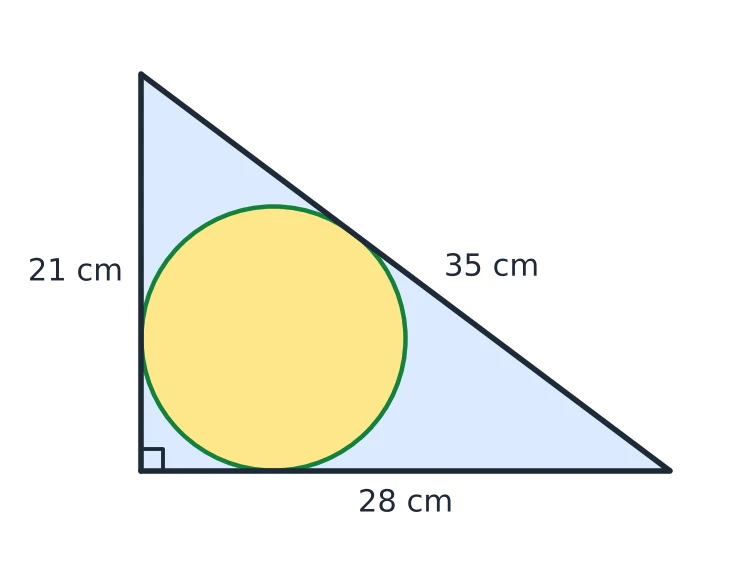
Answer. The hypotenuse is cm. Inradius of a right triangle: cm. Area = = (b) 154 cm².
Question 17
ABCD is a square of side 16 cm. Joining the midpoints of its sides gives square PQRS, and joining the midpoints of the sides of PQRS gives square WXYZ. What is the area of WXYZ? (a) 64 cm² (b) 128 cm² (c) 32 cm² (d) 192 cm²
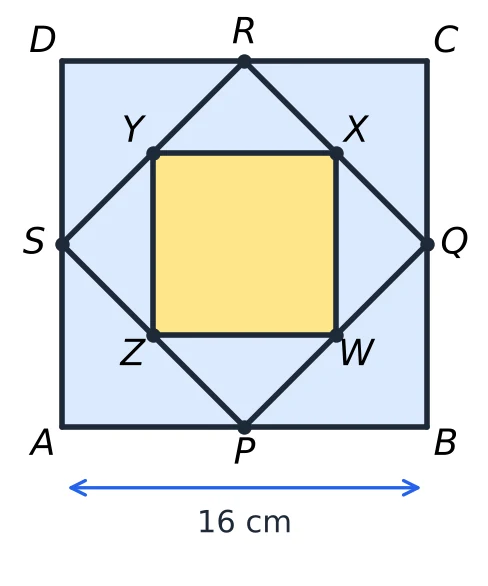
Answer. Each midpoint square has half the area of the square it sits in. ABCD is 256 cm², PQRS is 128 cm², and WXYZ is half of that: (a) 64 cm². WXYZ has side 8 cm, exactly half of 16: each step shrinks the side by a factor , and two steps make . 128 cm² is PQRS, one step too early.
Question 18
[Tier 2] A square stands on the diameter of a semicircle of radius 10 cm, with its two upper corners on the arc. What is the area of the square? (a) 100 cm² (b) 200 cm² (c) 80 cm² (d) 50 cm²
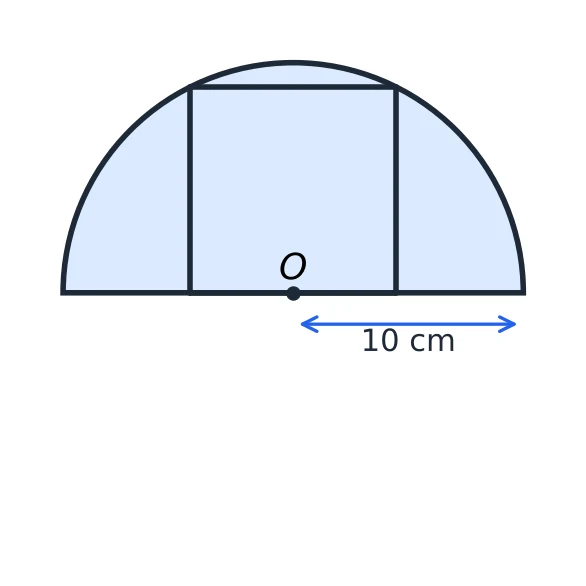
Answer. Let the side be . The centre O is the midpoint of the diameter, so an upper corner is across from O and up. That corner is on the arc, so , which gives and = (c) 80 cm².
Question 19
A wire is bent into a circle of radius 35 cm. If the same wire is bent into a square, what is the area of the square? (Take .) (a) 3850 cm² (b) 12100 cm² (c) 4900 cm² (d) 3025 cm²
Answer. Length of the wire = circumference = cm. As a square, each side is 220 ÷ 4 = 55 cm, so the area is 55 × 55 = (d) 3025 cm². 3850 cm² is the circle's area (the circle always holds more).
Question 20
A wire in the shape of a rectangle 32 cm by 18 cm is bent into a square. By how much does the enclosed area increase? (a) 25 cm² (b) 49 cm² (c) 625 cm² (d) 100 cm²
Answer. Length of the wire = 2(32 + 18) = 100 cm, so the square has side 25 cm and area 625 cm². The rectangle had 32 × 18 = 576 cm². Increase = 625 − 576 = (b) 49 cm². Shortcut: the gain is .
Question 21
A wire bent into an equilateral triangle encloses an area of cm². The same wire is bent into a circle. What is the area of the circle? (Take .) (a) 346.5 cm² (b) 12474 cm² (c) 3118.5 cm² (d) 1559.25 cm²
Answer. From : and a = 66 cm, so the wire is 3 × 66 = 198 cm long. As a circle, gives r = 31.5 cm. Area = = (c) 3118.5 cm².
Question 22
A square and an equilateral triangle have the same perimeter. What is the ratio of the area of the square to the area of the triangle? (a) (b) (c) 9 : 16 (d) 3 : 4
Answer. Take the perimeter as 12 units, a number both 3 and 4 divide. The square has side 3 and area 9. The triangle has side 4 and area . Ratio = . Multiply both sides by : , which is (a) . The square holds more, as it should with more sides.
Question 23
A 20 m by 15 m rectangular plot has a 12 m by 8 m rectangle removed from one corner, as shown. What is the area of the L-shaped plot that is left? (a) 96 m² (b) 204 m² (c) 300 m² (d) 140 m²
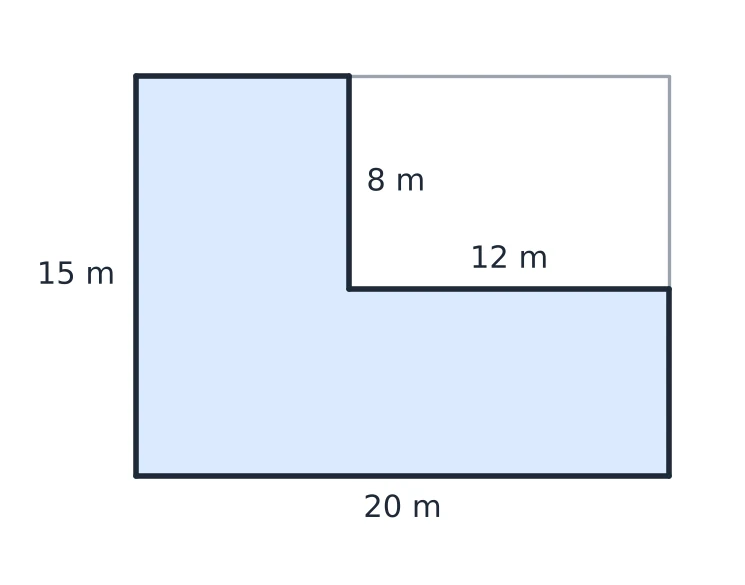
Answer. Whole rectangle minus the missing corner: 20 × 15 − 12 × 8 = 300 − 96 = (b) 204 m². Check by splitting: the bottom strip is 20 m by 7 m (15 − 8 = 7), which is 140 m², and the upright part on the left is 8 m by 8 m (20 − 12 = 8), which is 64 m². 140 + 64 = 204.
Question 24
A picture 36 cm by 24 cm has a frame 4 cm wide all round it. What is the area of the frame? (a) 480 cm² (b) 1408 cm² (c) 240 cm² (d) 544 cm²
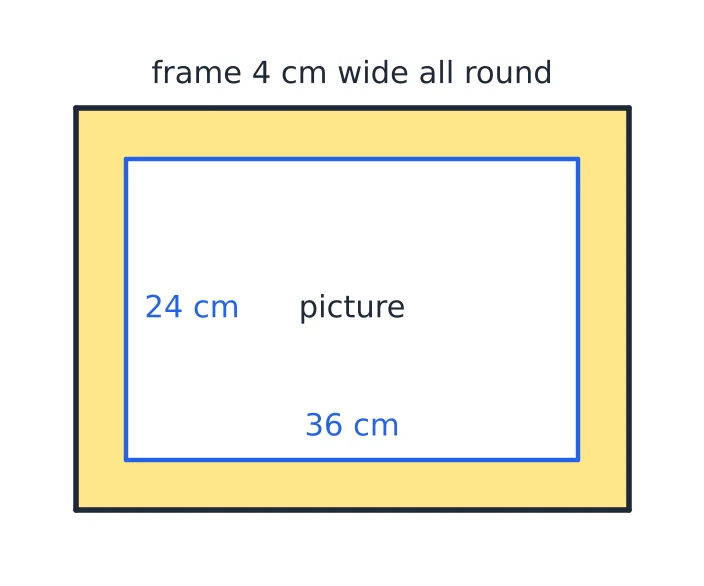
Answer. With the frame, the outside measures (36 + 8) by (24 + 8) = 44 cm by 32 cm, which is 1408 cm². The picture is 36 × 24 = 864 cm². Frame = 1408 − 864 = (d) 544 cm². By the formula, .