
Rectangles: Area, Perimeter and Diagonal
A rectangle has four right angles, so its length l and breadth b serve as a base and a height for each other.
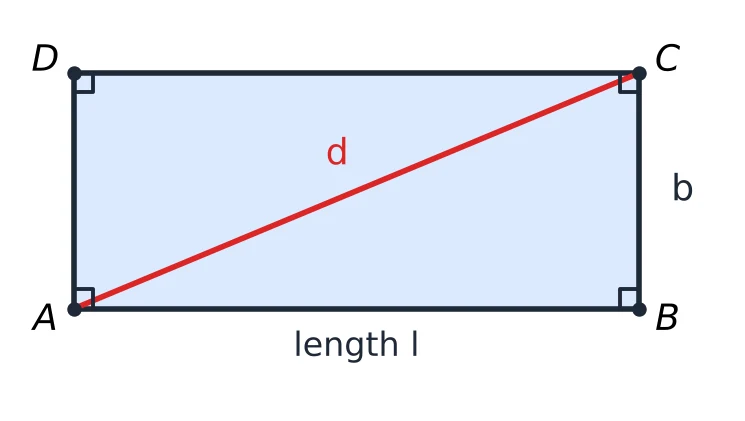
The diagonal comes from Pythagoras in triangle ABC, and the two diagonals are equal. A rectangle 24 cm by 10 cm has area 240 cm², perimeter 68 cm and diagonal cm.
Sides from the perimeter and the area. Perimeter 42 cm and area 108 cm² mean l + b = 21 and lb = 108. You want two numbers that add to 21 and multiply to 108: 12 and 9. So the rectangle is 12 cm by 9 cm, and its diagonal is 15 cm. In the exam it is usually quicker to test the options than to solve a quadratic.
Sides from the diagonal and the area. Two identities do all the work:
Diagonal 13 cm and area 60 cm²: , so l + b = 17; , so l − b = 7. Then l = 12 cm and b = 5 cm, and the perimeter is 34 cm.
The first identity also runs the other way. Perimeter 34 cm and diagonal 13 cm give
without finding the sides at all.
Sides in a ratio. Length : breadth = 4 : 3 and perimeter 84 cm: 2(4k + 3k) = 14k = 84, so k = 6. The sides are 24 cm and 18 cm, the area is 432 cm² and the diagonal is 5k = 30 cm (a 3, 4, 5 triangle again).
Here l + b is half the perimeter, not the perimeter. Using the full 42 in the example above gives no sensible pair of sides. In the diagonal-and-area type, the usual slip is forgetting the 2 in 2 × Area.
Squares: Side, Diagonal, and the Largest Area for a Fixed Perimeter
For a square of side a:
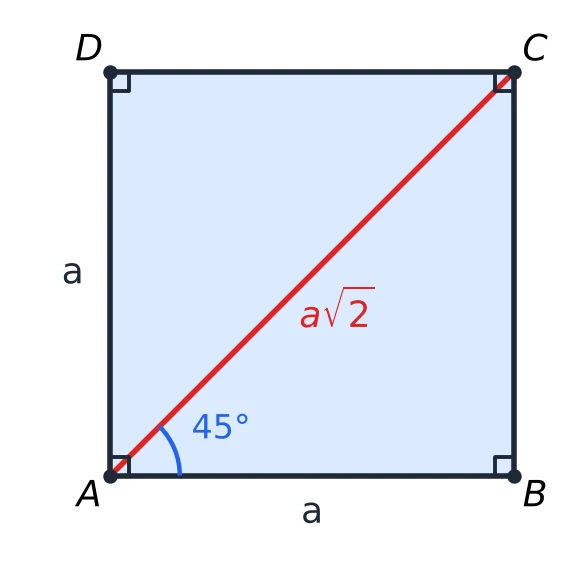
Since , the area can be found straight from the diagonal:
A square with diagonal 24 cm has area cm². Its side is cm and its perimeter cm. In general the perimeter is .
Going the other way, a square plot of area 3025 m² has side m, perimeter 220 m and diagonal m.
The square on the diagonal. A square drawn on the diagonal of another square has twice its area, because its side is .
A wire bent into a new shape. When a wire is bent from one shape into another, its length, which is the perimeter, stays the same. A wire bent into an 18 cm by 12 cm rectangle is 2(18 + 12) = 60 cm long. Bent into a square, each side is 15 cm and the area becomes 225 cm², more than the rectangle's 216 cm².
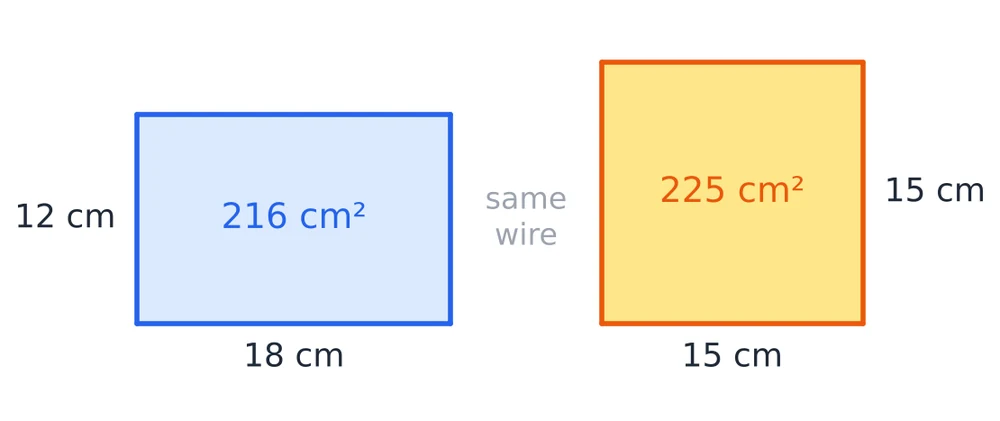
The square wins. Among all rectangles with the same perimeter, the square has the largest area. The gap is exactly : here , and 225 − 216 = 9. Turned round, among rectangles with the same area the square has the smallest perimeter. So the largest area a rectangle of perimeter P can have is .
The area from the diagonal is , not . To check any square formula quickly, put a = 1: then the diagonal is , the perimeter 4 and the area 1.
Percentage Change in the Area of a Rectangle or Square
Area is length × breadth, so a change in each side multiplies the area by both factors. If the length changes by x% and the breadth by y%, the area changes by
with a decrease counted as negative. This is the successive-change rule from Chapter 3 (Percentage).
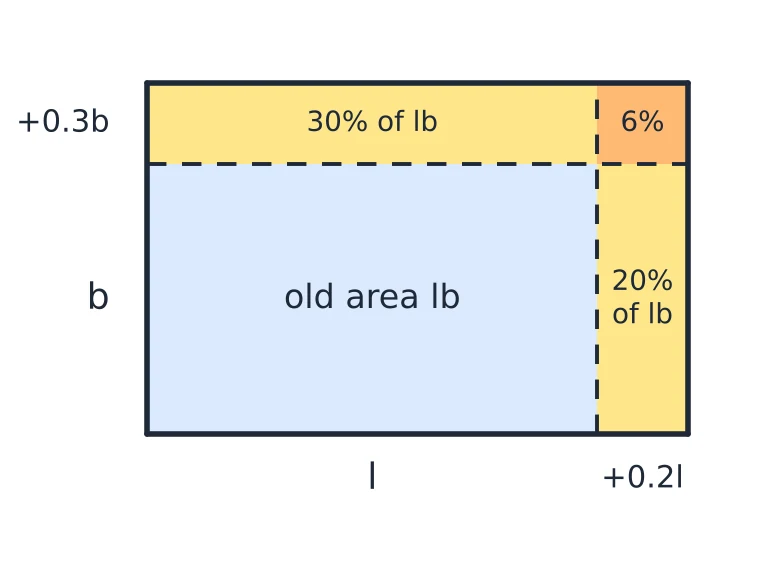
The figure shows where the formula comes from. With the length up 20% and the breadth up 30%, the new rectangle is the old area plus a strip worth 20% of it, a strip worth 30% of it, and a small corner worth . Total increase: 20 + 30 + 6 = 56%. Factor check: 1.2 × 1.3 = 1.56.
Squares. Both sides change together, so x = y. Side up 10%: 10 + 10 + 1 = 21%. Side down 10%: −10 − 10 + 1 = −19%. If the diagonal or the perimeter of a square goes up by 20%, the side goes up by 20% too, and the area by 44%.
Up and down by the same percentage. Length up x% and breadth down x%: the area always falls, by percent. Up 30% and down 30% means a fall of 9% (1.3 × 0.7 = 0.91).
Keeping the area the same. If the length goes up by x%, the breadth must come down by
Length up 25%: breadth down . For a decrease, put 100 − x below the line: length down 20% needs the breadth up .
[SSC Tip] The two percentages are never simply added. A 20% rise and a 30% rise make 56%, not 50%, and a 20% rise with a 20% fall is a 4% fall, not "no change".
Paths Around and Inside a Rectangular Field
A path of the same width w all the way round runs along the edges of a rectangular field of length l and breadth b. Whatever the question, find the path's area as big rectangle minus small rectangle.
Path outside the field. The path adds w at both ends of each side, so the outer rectangle is (l + 2w) by (b + 2w).
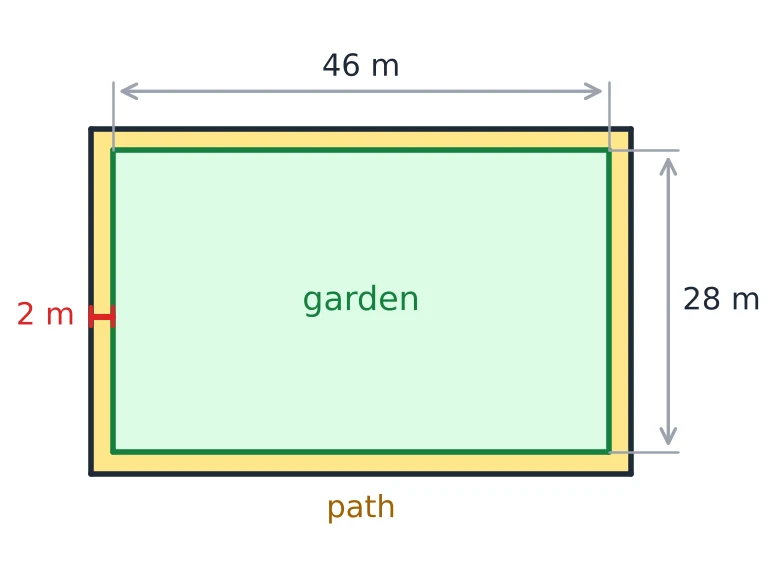
A garden 46 m by 28 m with a 2 m path round the outside: the outer rectangle is 50 m by 32 m, so the path is 1600 − 1288 = 312 m². By the formula, 2 × 2 × (46 + 28 + 4) = 4 × 78 = 312.
Path inside the field. Now the field is the outer rectangle and the part left inside is (l − 2w) by (b − 2w).
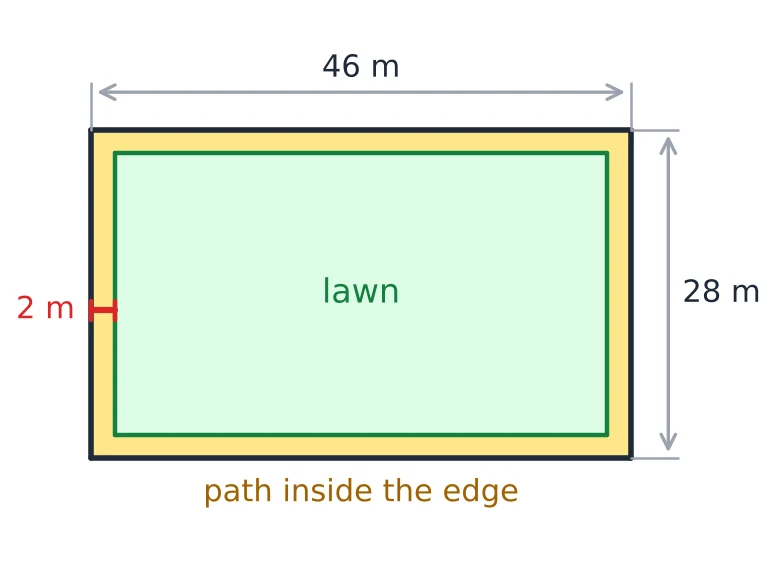
The same garden with the 2 m path inside: the lawn left is 42 m by 24 m = 1008 m², so the path is 1288 − 1008 = 280 m². Formula: 4 × (74 − 4) = 280.
Square fields. Put l = b = a. A path outside has area 4w(a + w) and a path inside has area 4w(a − w). A square lawn of side 25 m with a 1.5 m path round it: 4 × 1.5 × 26.5 = 159 m². Check: .
Cost of the path is its area times the rate per m². Finding the width from the path's area means a quadratic in w; in the exam, put each option into the formula and see which one fits.
[SSC Tip] The corners are the trap. Four strips along the sides make only 2w(l + b). For a path outside, the four corner squares add another ; for a path inside, the corners get counted twice, so comes off. The option 2w(l + b) is nearly always there to catch you.
Two Cross Roads Through a Field
Two roads of width w run through a rectangular field, one parallel to the length and one parallel to the breadth. The road along the length is a strip l by w, and the road along the breadth is a strip b by w. They cross in a small w by w square that belongs to both strips, so it must be counted only once:
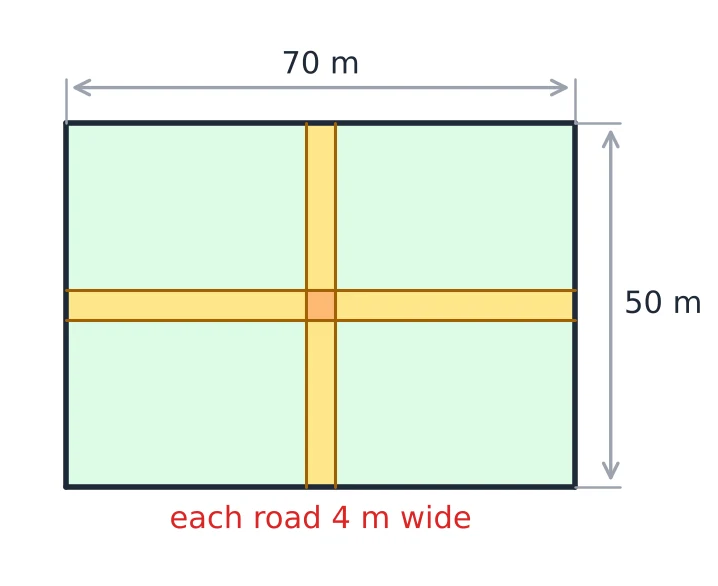
A lawn 70 m by 50 m with two roads 4 m wide: 4 × 70 + 4 × 50 − 16 = 480 − 16 = 464 m². Gravelling the roads at ₹20 per m² costs 464 × 20 = ₹9,280.
The lawn that is left is : slide the four green pieces together and they make one rectangle. Here 66 × 46 = 3036 m², and 3500 − 464 = 3036 agrees.
Position does not matter. The roads do not have to pass through the middle. As long as each one runs parallel to a side, all the way across, and they cross once, the area is the same w(l + b − w).
Different widths. If the road along the length is wide and the road along the breadth is wide, they overlap in a by rectangle:
One road only, or two roads that do not cross (both parallel to the length, say), need no subtraction: just add the strips.
Roads plus a path. Some questions put cross roads inside a field and a path round the outside as well. Work out the two parts separately with their own formulas and then add; the roads stop at the edge of the field, so nothing is shared between them.
The answer w(l + b), without taking away , is nearly always one of the options (480 m² in the example). It counts the crossing square twice. Cost questions hide the same trap: 480 × 20 = ₹9,600 instead of ₹9,280.
Fencing, Levelling, Flooring and Painting a Floor
Cost questions on rectangles and squares come in two kinds, and the rate's unit tells you which.
| Job | Uses | Cost |
|---|---|---|
| Fencing, a boundary wall, wire round the field | Perimeter (m) | perimeter × rate per metre |
| Levelling, ploughing, flooring, painting a floor, gravelling | Area (m²) | area × rate per m² |
A field with both. A field 120 m by 80 m:
- its perimeter is 2(120 + 80) = 400 m, so fencing at ₹35 per metre costs ₹14,000;
- its area is 9600 m², so levelling at ₹2.50 per m² costs ₹24,000.
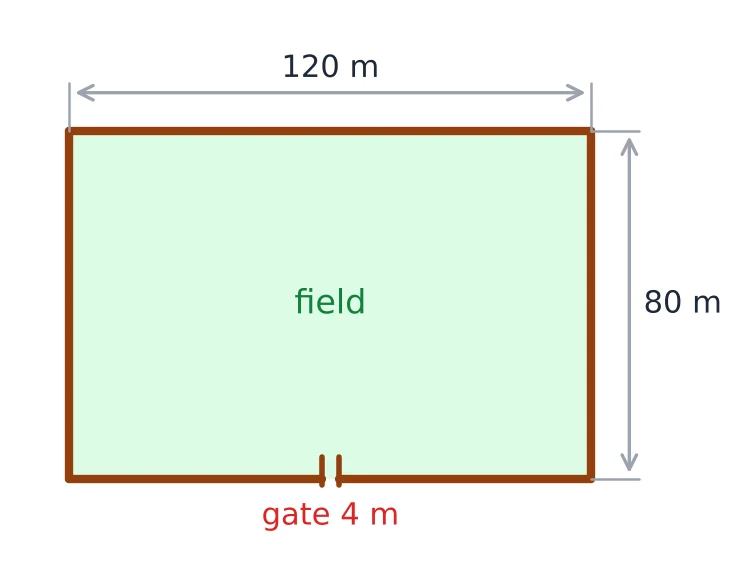
A gate is not fenced. With a 4 m gate the fence is 396 m long and costs 396 × 35 = ₹13,860.
Several rounds of wire. "Fenced with 3 rounds of wire" means the wire is 3 × perimeter long: 1200 m for this field.
Working backwards. The cost of fencing a square park at ₹15 per metre is ₹3,600. The perimeter is m, so the side is 60 m and the area 3600 m², which is 0.36 hectare.
Painting a floor is an area job. A floor 6 m by 4.5 m painted at ₹80 per m² costs 27 × 80 = ₹2,160. Painting the four walls of a room uses the area and belongs to 3D mensuration (Chapter 14).
Two jobs, one question. Many questions give the cost of one job to find the field, then ask the cost of the other. Fencing cost → perimeter → sides (with a ratio or a second fact) → area → levelling cost. Keep each step's unit in view.
Convert units before multiplying: 1 hectare = 10,000 m², 100 paise = ₹1, and 1 m² = 10,000 cm². A rate per hectare with the area left in m² puts the answer off by a factor of 10,000.
Carpeting a Floor with a Carpet of Given Width
Carpet comes in a roll of fixed width and is sold by length. To cover a floor, the carpet's area must equal the floor's area, so
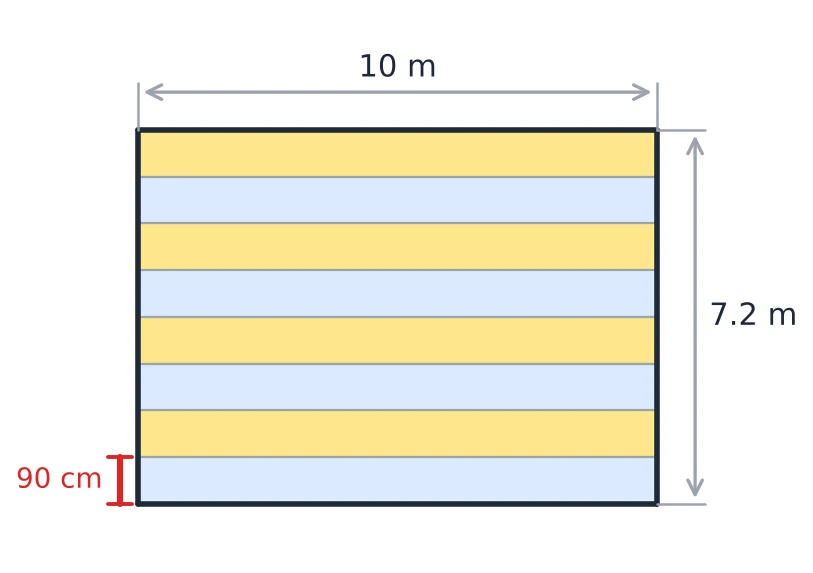
A room 10 m by 7.2 m, carpet 90 cm wide, at ₹65 per metre. Change the width to metres first: 90 cm = 0.9 m. The floor is 72 m², so the carpet is m long and costs 80 × 65 = ₹5,200.
The figure shows the same thing as strips. Laid along the 10 m side, strips are needed, each 10 m long, and 8 × 10 = 80 m again.
If the rate is per m², the width does not matter: the cost is just floor area × rate.
A border left bare. If the carpet leaves a margin of 50 cm all round, it covers only (10 − 1) m by (7.2 − 1) m = 9 × 6.2 = 55.8 m². That is the path-inside idea from above, seen from the other side.
Working backwards. Carpeting a room 16 m long with carpet 80 cm wide at ₹50 per metre costs ₹11,000. The carpet is m long, so its area is 220 × 0.8 = 176 m², and the breadth of the room is m.
Same carpet, two rooms. If the same carpet covers two floors, the lengths add up; if the rate is the same, so do the costs. Find each floor area separately, add, then divide by the width.
[SSC Tip] The width is nearly always in cm and the rate per metre. Dividing by 90 instead of 0.9 gives a carpet a hundred times too short, so check that the length makes sense for the room.
Tiles: How Many, and the Largest Square Tile
How many tiles. If the tiles fit exactly,
with both areas in the same unit. A hall 8 m by 6 m paved with tiles 40 cm by 30 cm: in cm the floor is 800 × 600 = 4,80,000 cm² and one tile is 1200 cm², so the number is . They fit exactly because 800 ÷ 40 = 20 and 600 ÷ 30 = 20, and 20 × 20 = 400 is a quick check.
The largest square tile. To pave a floor with whole square tiles and no cutting, the tile's side must divide both the length and the breadth exactly. The largest such tile has side equal to the HCF of the length and the breadth (HCF is in Chapter 1). The largest tile also gives the least number of tiles:
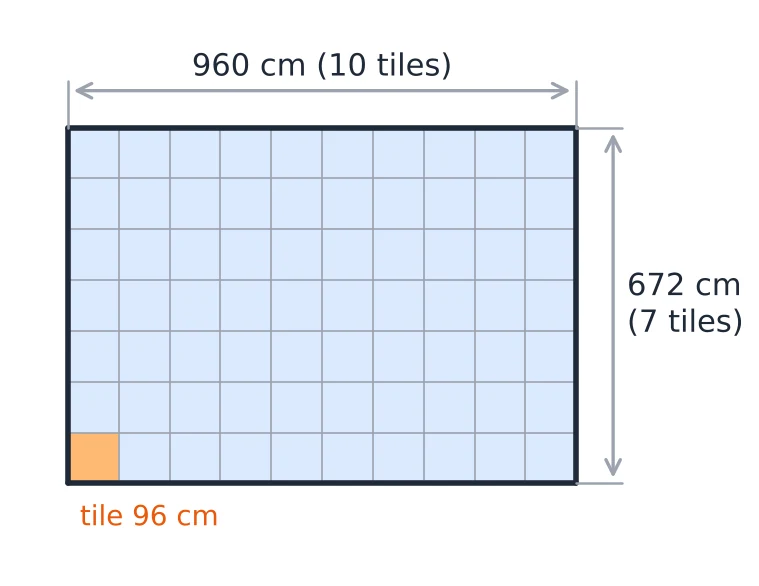
A floor 9.60 m by 6.72 m: in cm, 960 and 672. Subtracting repeatedly, 960 − 672 = 288, then 672 − 2 × 288 = 96, and 96 divides 288. So HCF = 96 and the largest tile is 96 cm square. The floor takes 10 tiles along the length and 7 along the breadth: 10 × 7 = 70 tiles.
Cost of tiling is the number of tiles × price per tile (or area × rate per m², if the rate is given that way).
The opposite question. The smallest square that can be made by putting rectangular tiles 12 cm by 8 cm side by side has side LCM(12, 8) = 24 cm, and it uses tiles.
Change metres to centimetres before taking the HCF. HCF(9.60, 6.72) is awkward; HCF(960, 672) is quick. And "largest tile" or "least number of tiles" both mean HCF, while "smallest square from given tiles" means LCM.
Parallelograms: Base × Height, Both Heights, and an Angle
Cut a triangle off one end of a parallelogram and move it to the other end, and you get a rectangle with the same base and the same height. So
where the height is the perpendicular distance between the base and the side opposite it.
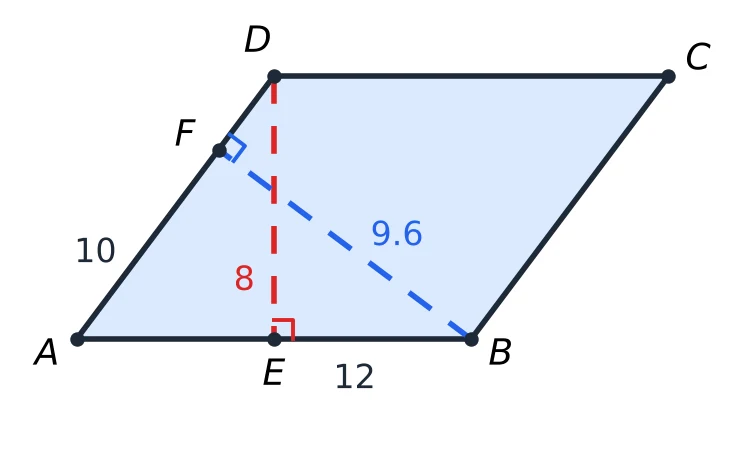
Two bases, two heights. Each pair of parallel sides has its own height, and both products give the same area:
In the figure AB = 12 cm, AD = 10 cm and the height on AB is DE = 8 cm. The area is 12 × 8 = 96 cm², so the height on AD is cm. The longer side has the shorter height, just as in a triangle.
Two sides and the angle between them. With sides a and b and an angle between them, the height on a is , so
This is twice the triangle formula from Triangles: Area and Perimeter, because a diagonal splits the parallelogram into two equal triangles. Sides 10 cm and 7 cm give 35 cm² at 30°, cm² at 60°, cm² at 45°, and 70 cm² at 90°, when the parallelogram becomes a rectangle and the area is the largest possible.
Other facts.
- Perimeter = 2(a + b).
- Each diagonal cuts it into two triangles of half the area, and the two diagonals together cut it into four triangles of equal area.
- [Tier 2] The diagonals satisfy . This helps when one diagonal is given and the other is needed.
The slant side is not the height. Multiplying the two sides (12 × 10 = 120 in the example) works only for a rectangle; for any other parallelogram it gives too much.
Rhombuses: Diagonals, Side, Height and Perimeter
A rhombus is a parallelogram with all four sides equal. Its diagonals bisect each other at right angles, so they cut it into four equal right triangles with legs and . Everything follows from that:
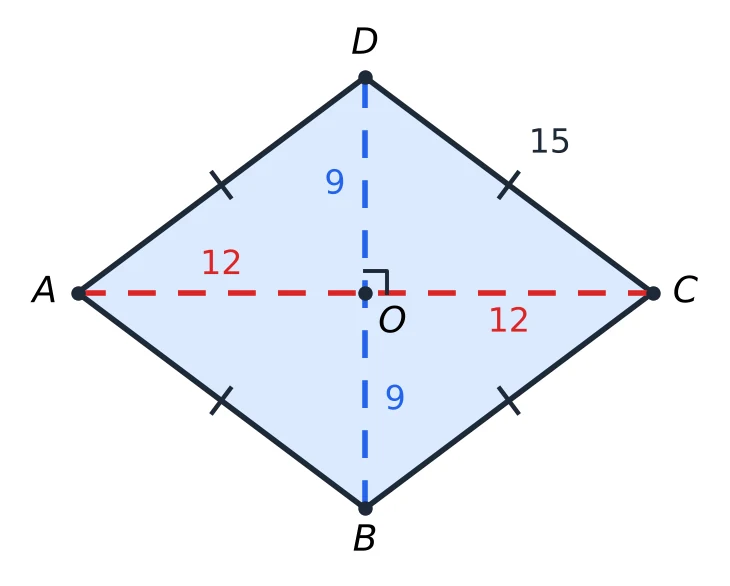
Diagonals 24 cm and 18 cm: the area is cm². The half-diagonals are 12 and 9, so the side is 15 cm (a 9, 12, 15 triangle) and the perimeter is 60 cm.
Height. A rhombus is a parallelogram, so its area is also side × height. Here the height is cm.
One diagonal and the side. Side 25 cm and one diagonal 30 cm: half of that diagonal is 15, so the other half-diagonal is and the other diagonal is 40 cm. Area = cm².
Side and an angle. Area = . With an angle of 60°, the shorter diagonal equals the side, since it cuts the rhombus into two equilateral triangles, and the area is . Side 8 cm gives cm².
A handy identity. . In the first example, 576 + 324 = 900 = 4 × 225.
Perimeter given. Divide by 4 for the side, then use one diagonal to get the other, as above.
[SSC Tip] The area is half the product of the diagonals, not the product. And the side comes from the half-diagonals; putting the whole diagonals into Pythagoras gives a side twice too long (30 cm instead of 15 cm here).
Trapeziums: Parallel Sides and Height
A trapezium has one pair of parallel sides, a and b, a distance h apart. A diagonal cuts it into two triangles with bases a and b and the same height h, so
that is, the average of the parallel sides times the height. Parallel sides 18 cm and 12 cm, 7 cm apart: area = cm².
Turning it round. , and a missing parallel side is minus the other one.
Isosceles trapezium. The non-parallel sides (the legs) are equal. Drop perpendiculars from both ends of the shorter parallel side; each leaves an overhang of at the ends of the longer side.
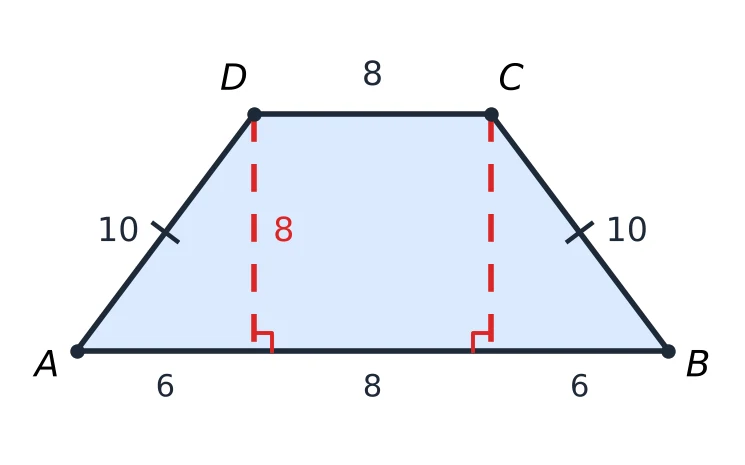
Parallel sides 20 cm and 8 cm, legs 10 cm: the overhang is 6 cm on each side, so cm and the area is cm². The perimeter is 20 + 8 + 10 + 10 = 48 cm.
Right trapezium. One leg is perpendicular to the parallel sides, so that leg is the height.
[Tier 2] All four sides known. Through C draw CE parallel to DA. Then AECD is a parallelogram, so AE = DC = b and EC = AD. Triangle EBC has sides a − b, AD and BC, and its height is the trapezium's height.
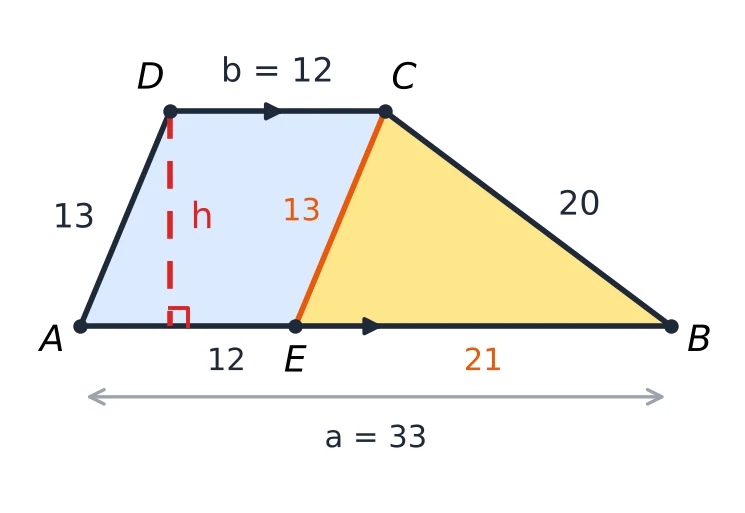
Parallel sides 33 cm and 12 cm, legs 13 cm and 20 cm: triangle EBC has sides 21, 13 and 20. Heron gives s = 27 and area cm². So cm, and the trapezium's area is cm².
[SSC Tip] Add the two parallel sides, never a parallel side and a leg. And keep the half: (a + b) × h alone is double the area, and that value is usually an option.
Kites and Any Quadrilateral
Kite. A kite has two pairs of equal adjacent sides (AB = AD and CB = CD). Its diagonals cross at right angles, so, as in a rhombus,
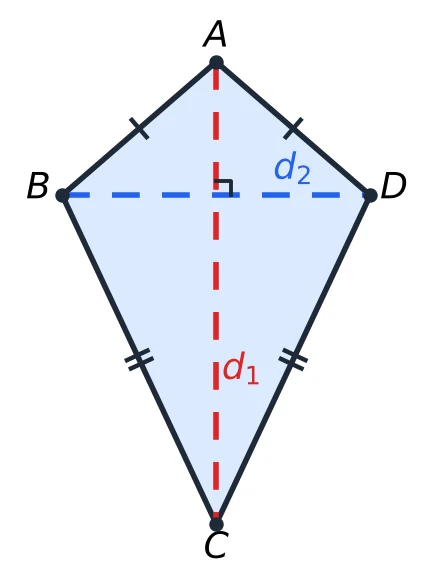
Diagonals 16 cm and 9 cm give 72 cm². In fact any quadrilateral whose diagonals are perpendicular has area ; the square, the rhombus and the kite are the ones you will meet. For a square both diagonals are d, which gives again.
Any quadrilateral, split by a diagonal. Diagonal AC cuts quadrilateral ABCD into triangles ABC and ADC, which share the base AC. If the perpendiculars from B and D to AC (the offsets) are and ,
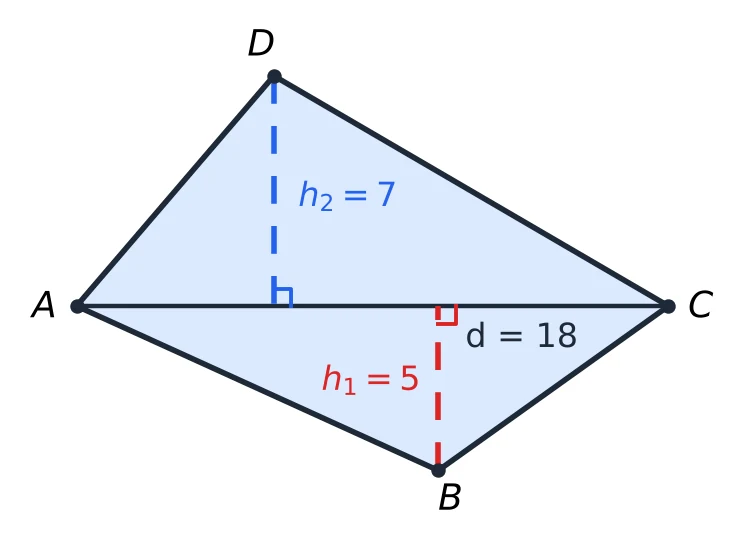
Diagonal 18 m with offsets 5 m and 7 m: area = m². Surveyors measure fields this way.
Four sides and a diagonal. Split along the diagonal and use Heron (or a triplet) on each triangle. ABCD with AB = 5 cm, BC = 12 cm, CD = 14 cm, DA = 15 cm and diagonal AC = 13 cm: triangle ABC is the 5, 12, 13 right triangle (area 30 cm²) and triangle ACD has sides 13, 14, 15 (area 84 cm²). Total 114 cm².
Which formula for which shape
| Shape | Area |
|---|---|
| Rectangle | l × b |
| Square | or |
| Parallelogram | base × height, or |
| Rhombus | , or side × height |
| Trapezium | |
| Kite | |
| Any quadrilateral |
The formula needs perpendicular diagonals. The diagonals of a rectangle or of a general parallelogram are not perpendicular, so the formula gives a wrong answer for them.
Solved Examples
Question 1
The length of a rectangle is 63 cm and its diagonal is 65 cm. What is its area? (a) 4095 cm² (b) 1008 cm² (c) 504 cm² (d) 1040 cm²
Answer. The diagonal, the length and the breadth make a right triangle. Breadth = . Quick trick: , so the breadth is 16 cm. Area = 63 × 16 = (b) 1008 cm². 4095 cm² multiplies the length by the diagonal, which is not a side.
Question 2
The diagonal of a rectangle is 25 cm and its area is 168 cm². What is its perimeter? (a) 31 cm (b) 50 cm (c) 62 cm (d) 74 cm
Answer. Use . So l + b = 31 cm, and the perimeter is 2 × 31 = (c) 62 cm. (The sides are 24 and 7.)
Question 3
The length and breadth of a rectangle are in the ratio 5 : 3 and its perimeter is 96 cm. What is its area? (a) 540 cm² (b) 2160 cm² (c) 480 cm² (d) 600 cm²
Answer. Take the sides as 5k and 3k. Perimeter = 2(5k + 3k) = 16k = 96, so k = 6. The sides are 30 cm and 18 cm, and the area is 30 × 18 = (a) 540 cm². Writing 8k = 96, as if the perimeter had only one length and one breadth, gives 2160 cm².
Question 4
The diagonal of a square is 26 cm. What is its area? (a) 676 cm² (b) 169 cm² (c) cm² (d) 338 cm²
Answer. Area of a square = = (d) 338 cm². Check: the side is , and .
Question 5
A square and a rectangle have the same perimeter. The rectangle is 40 cm by 24 cm. By how much does the area of the square exceed the area of the rectangle? (a) 8 cm² (b) 64 cm² (c) 256 cm² (d) 128 cm²
Answer. The perimeter is 2(40 + 24) = 128 cm, so the square has side 32 cm and area 1024 cm². The rectangle's area is 40 × 24 = 960 cm². The difference is (b) 64 cm². Shortcut: the gap is always .
Question 6
A wire is bent into a rectangle 26 cm long and 18 cm wide. The same wire is then bent into a square. What is the area of the square? (a) 468 cm² (b) 1936 cm² (c) 484 cm² (d) 121 cm²
Answer. The wire's length is the rectangle's perimeter, 2(26 + 18) = 88 cm. As a square, each side is cm, so the area is = (c) 484 cm².
Question 7
The length of a rectangle is increased by 35% and its breadth is decreased by 20%. What happens to its area? (a) It increases by 8% (b) It increases by 15% (c) It decreases by 8% (d) It increases by 12%
Answer. Multiply the factors: 1.35 × 0.8 = 1.08, so (a) It increases by 8%. By the rule, 35 − 20 + = 15 − 7 = 8. "Increases by 15%" just takes 20 from 35.
Question 8
The length of a rectangle is increased by 25%. By what percentage must its breadth be decreased so that the area stays the same? (a) 25% (b) 15% (c) (d) 20%
Answer. The length is multiplied by , so the breadth must be multiplied by to keep the product the same. That is a fall of , or (d) 20%. Formula: . Taking 25% off the breadth would leave 1.25 × 0.75 = 0.9375 of the area, too little.
Question 9
A rectangular garden 48 m long and 30 m wide has a path 3.5 m wide all round it on the outside. What is the cost of gravelling the path at ₹12 per m²? (a) ₹6,552 (b) ₹7,140 (c) ₹5,964 (d) ₹24,420
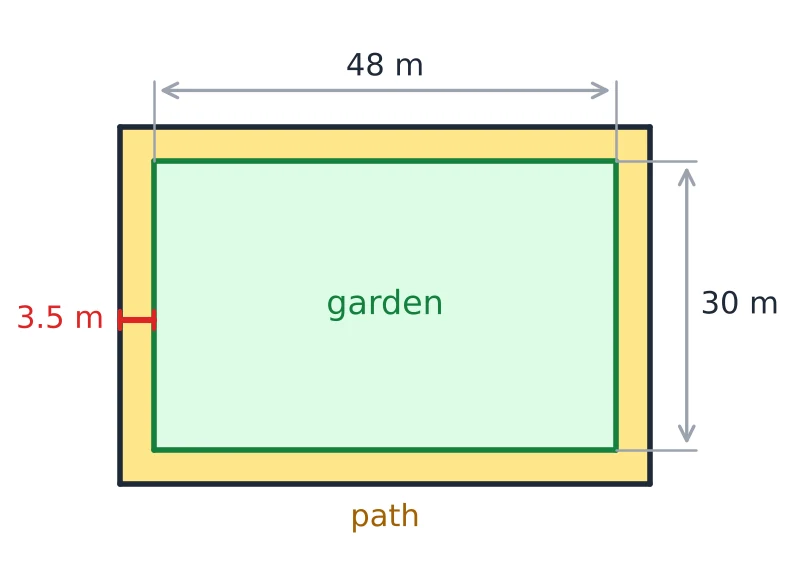
Answer. The garden with the path is (48 + 7) m by (30 + 7) m = 55 m by 37 m = 2035 m². The garden alone is 48 × 30 = 1440 m². So the path is 2035 − 1440 = 595 m². (Formula: 2 × 3.5 × (48 + 30 + 7) = 7 × 85 = 595.) Cost = 595 × 12 = (b) ₹7,140.
Question 10
A square lawn of side 52 m has a path 3 m wide running along its edges on the inside. What is the area of the path? (a) 624 m² (b) 660 m² (c) 588 m² (d) 552 m²
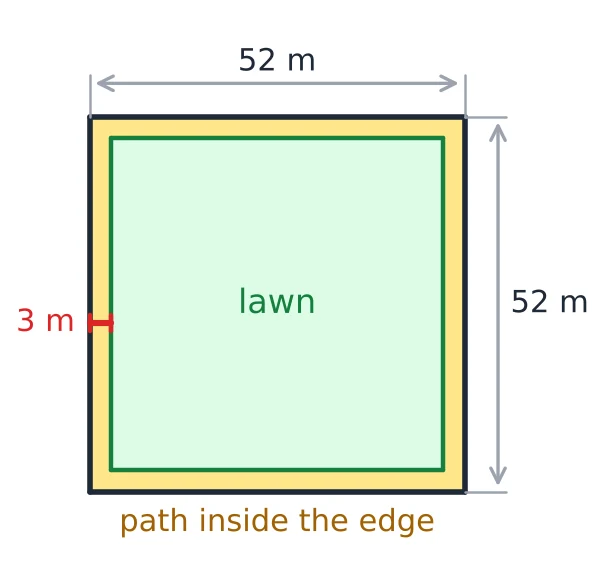
Answer. The part left in the middle is a square of side 52 − 2 × 3 = 46 m. Path = = (c) 588 m². (Formula for a square: 4w(a − w) = 12 × 49 = 588.)
Question 11
A park 96 m long and 64 m wide has two roads, each 4 m wide, running through its middle, one parallel to the length and the other parallel to the breadth. What is the cost of paving the roads at ₹25 per m²? (a) ₹15,600 (b) ₹16,000 (c) ₹15,200 (d) ₹7,800
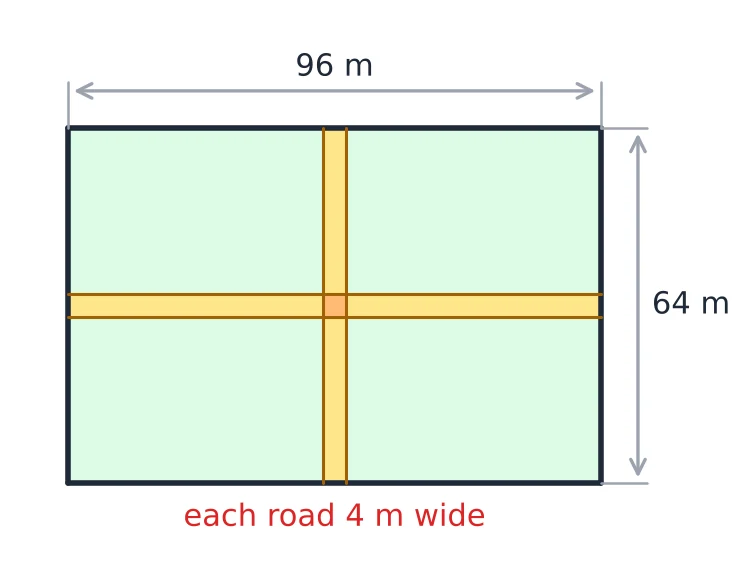
Answer. Road along the length: 96 × 4 = 384 m². Road along the breadth: 64 × 4 = 256 m². They share the 4 m by 4 m square where they cross, which must be counted once, so the roads cover 384 + 256 − 16 = 624 m². Cost = 624 × 25 = (a) ₹15,600.
Question 12
A path of uniform width runs round the outside of a rectangular field 42 m long and 28 m wide. The area of the path is 456 m². How wide is the path? (a) 2 m (b) 4 m (c) 2.5 m (d) 3 m
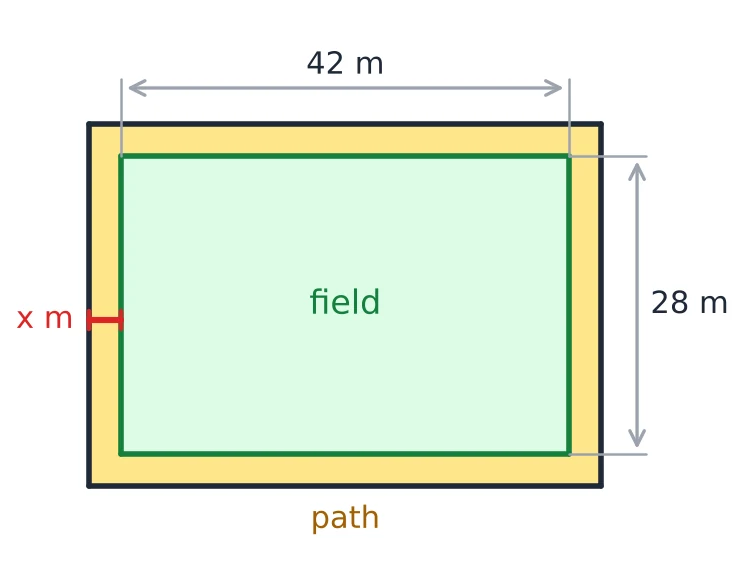
Answer. Path area = 2w(l + b + 2w) = 2w(70 + 2w). Try the options. w = 2 gives 4 × 74 = 296; w = 4 gives 8 × 78 = 624; w = 2.5 gives 5 × 75 = 375; w = 3 gives 6 × 76 = 456. So the width is (d) 3 m. (Solving directly: , that is .)
Question 13
The sides of a rectangular field are in the ratio 3 : 2 and its area is 5400 m². What is the cost of fencing it at ₹16 per metre? (a) ₹2,400 (b) ₹4,800 (c) ₹86,400 (d) ₹4,000
Answer. Sides 3k and 2k give area , so and k = 30. The field is 90 m by 60 m, and its perimeter is 2(90 + 60) = 300 m. Fencing costs 300 × 16 = (b) ₹4,800. ₹2,400 fences only half the boundary, 90 + 60.
Question 14
The cost of fencing a square park at ₹12.50 per metre is ₹5,000. What is the area of the park? (a) 16 hectares (b) 0.25 hectare (c) 1 hectare (d) 4 hectares
Answer. Perimeter = m, so each side is 100 m and the area is 100 × 100 = 10,000 m². Since 1 hectare = 10,000 m², the area is (c) 1 hectare.
Question 15
A room is 14 m long and 9 m wide. What is the cost of covering its floor with a carpet 70 cm wide at ₹55 per metre? (a) ₹6,930 (b) ₹99 (c) ₹4,851 (d) ₹9,900
Answer. Floor area = 14 × 9 = 126 m². The carpet is 70 cm = 0.7 m wide, so its length must be m. Cost = 180 × 55 = (d) ₹9,900. Dividing by 70 without changing cm to m gives ₹99.
Question 16
Carpeting a room 18 m long with a carpet 75 cm wide at ₹40 per metre costs ₹11,520. What is the breadth of the room? (a) 12 m (b) 16 m (c) 12.5 m (d) 15 m
Answer. Length of carpet = m. Its area is 288 × 0.75 = 216 m², which is the floor area. Breadth = = (a) 12 m.
Question 17
A hall 24 m long and 15 m wide is to be paved with rectangular tiles 40 cm by 30 cm. How many tiles are needed? (a) 300 tiles (b) 30,000 tiles (c) 3000 tiles (d) 2400 tiles
Answer. Work in cm. Along the length, 2400 ÷ 40 = 60 tiles; along the breadth, 1500 ÷ 30 = 50 tiles. So (c) 3000 tiles are needed. By areas: .
Question 18
The floor of a room is 10 m 50 cm long and 8 m 25 cm wide. What is the least number of square tiles of equal size that will cover it exactly? (a) 75 tiles (b) 154 tiles (c) 1386 tiles (d) 308 tiles
Answer. The fewest tiles means the largest tile, whose side is the HCF of 1050 cm and 825 cm. 1050 − 825 = 225; 825 = 3 × 225 + 150; 225 = 150 + 75; and 75 divides 150. So the HCF is 75 cm. Tiles: (1050 ÷ 75) × (825 ÷ 75) = 14 × 11 = (b) 154 tiles.
Question 19
The adjacent sides of a parallelogram are 18 cm and 12 cm. The distance between the longer sides is 10 cm. What is the distance between the shorter sides? (a) 10 cm (b) 12 cm (c) 20 cm (d) 15 cm
Answer. Area = longer side × its height = 18 × 10 = 180 cm². The same area is shorter side × its height, so the distance between the shorter sides is = (d) 15 cm. The shorter sides are farther apart, as expected.
Question 20
Two adjacent sides of a parallelogram are 14 cm and 9 cm, and the angle between them is 150°. What is its area? (a) 63 cm² (b) 126 cm² (c) cm² (d) 31.5 cm²
Answer. Area of a parallelogram = = 14 × 9 × = 126 × = (a) 63 cm². 31.5 cm² uses the triangle formula, with its extra half.
Question 21
The area of a rhombus is 840 cm² and one of its diagonals is 40 cm. What is its perimeter? (a) 164 cm (b) 116 cm (c) 58 cm (d) 232 cm
Answer. Area = , so cm. The half-diagonals are 20 and 21, so the side is cm. Perimeter = 4 × 29 = (b) 116 cm.
Question 22
The perimeter of a rhombus is 100 cm and one of its diagonals is 14 cm. What is its area? (a) 672 cm² (b) 350 cm² (c) 336 cm² (d) 168 cm²
Answer. Side = cm. Half of the known diagonal is 7, so the other half-diagonal is and the other diagonal is 48 cm. Area = = (c) 336 cm².
Question 23
The area of a trapezium is 405 cm² and its parallel sides are 32 cm and 22 cm. What is the distance between the parallel sides? (a) 7.5 cm (b) 30 cm (c) 13.5 cm (d) 15 cm
Answer. = (d) 15 cm.
Question 24
An isosceles trapezium has parallel sides 30 cm and 14 cm, and each non-parallel side is 17 cm. What is its area? (a) 330 cm² (b) 660 cm² (c) 374 cm² (d) 352 cm²
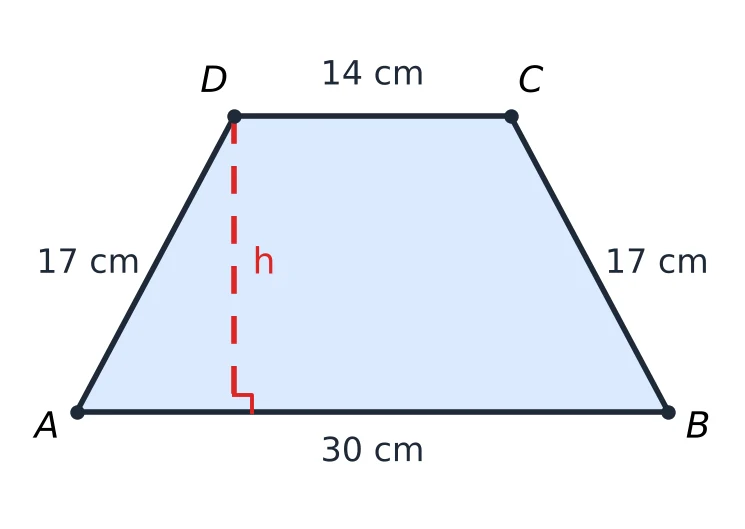
Answer. The overhang on each side is cm. So the height is cm. Area = = (a) 330 cm².
Question 25
[Tier 2] The parallel sides of a trapezium are 30 cm and 9 cm, and its non-parallel sides are 10 cm and 17 cm. What is its area? (a) 312 cm² (b) 195 cm² (c) 156 cm² (d) 84 cm²
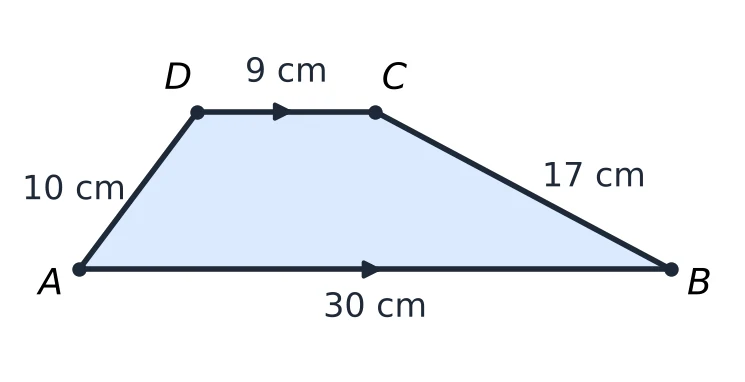
Answer. Draw a line from C parallel to the 10 cm side. It cuts off a triangle with sides 30 − 9 = 21, 10 and 17. Heron: s = 24, and cm². Its height on the 21 cm side is cm, and that is the trapezium's height too. Area = = (c) 156 cm². 84 cm² is only the small triangle.