
Triangles: Area
- Area ; any side can be the base.
- Heron: , area .
- Isosceles (equal sides , base ): .
- Two sides and the angle between them: .
- Area .
- 13-14-15 has area 84; sides times give area times .
- A median halves the area; joining the midpoints leaves one quarter.
- Trap: altitude . Keep the 2.
Equilateral and Right Triangles
- Equilateral, side : height , area .
- From the height: area . From the perimeter: .
- , , height .
- A point inside: the three perpendiculars add up to the height.
- Right triangle: area , altitude to the hypotenuse , , .
- .
- Triplets: 5-12-13, 8-15-17, 7-24-25, 20-21-29, 9-40-41, 12-35-37.
- Trap: , not .
Rectangles and Squares
- Rectangle: area , perimeter , diagonal .
- Two clues: and .
- Square: area , perimeter , diagonal .
- Same perimeter: the square has the largest area, ahead by .
- Wire bent into a new shape: the perimeter stays the same, the area changes.
- Trap: halve the perimeter to get before squaring.
- Trap: an area question with a perimeter-sized option is a decoy.
Paths, Tiles and Cost
- Path outside: . Inside: .
- Square field: outside , inside .
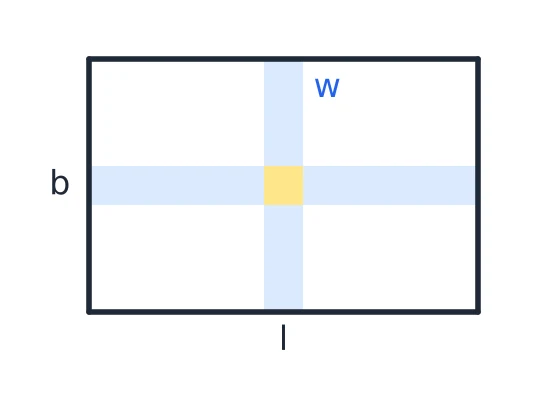
- Cross roads: ; the yellow square is counted once.
- Largest square tile: HCF of the sides, in one unit.
- Carpet length = floor area ÷ carpet width.
- Cost = area × rate (flooring) or perimeter × rate (fencing).
- Trap: change m to cm first, and remember the .
Parallelogram, Rhombus and Trapezium
- Parallelogram: base × height, each side with its own height; also .
- Rhombus: area , side , height = area ÷ side.
- Trapezium: . Isosceles: each overhang is .
- Unequal slant sides: the triangle with sides (slant, slant, ) has the same height.
- Kite: . Any quadrilateral: .
- Trap: does not work for a parallelogram or a rectangle.
Regular Polygons
- Hexagon, side : six equilateral triangles, area , perimeter .
- Longest diagonal , shorter one .
- Circle around a hexagon has radius ; circle inside has radius .
- Joining alternate corners gives a triangle of half the hexagon's area.
- Any regular polygon: area .
- Hexagon and triangle with equal perimeters: areas 3 : 2.
- [Tier 2] Octagon: .
- Trap: the shorter diagonal is not .
Inscribed and Circumscribed Figures
- Square, side : , ; circle areas 1 : 2.
- Equilateral triangle: , ; 1 : 4.
- Hexagon: , ; 3 : 4.
- Square inside a circle of radius : area .
- Midpoints of a square joined: half the area.
- Largest circle in a rectangle: diameter = breadth.
- Same wire: the circle encloses most, then the square, then the triangle.
- Trap: in a square but in a triangle.
Circle Area and Circumference
- and .
- Options in multiples of 22: use . Multiples of 3.14: use 3.14. shown: keep it.
- : 44 and 154. : 88 and 616. : 132 and 1386.
- .
- Adding areas: . Adding circumferences: .
- Discs from a sheet: each needs a square.
- Trap: diameter used as radius.
Semicircles, Quadrants and Rings
- Semicircle: area , perimeter .
- Quadrant: area , perimeter .
- Ring: .
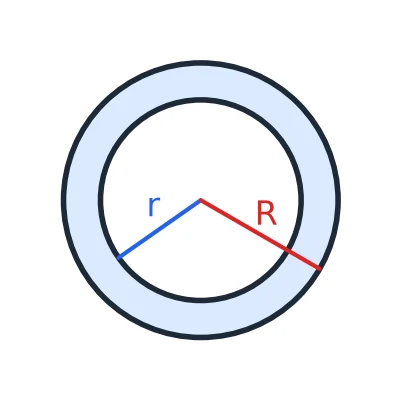
- Path of width round a circle of radius : .
- Width from two circumferences: .
- Trap: is wrong.
- Trap: a semicircle's perimeter includes the diameter.
Wheels and Revolutions
- One revolution covers one circumference, .
- Revolutions . Use one unit: 1 km = 100000 cm.
- Distance per minute = revolutions per minute × circumference. Metres per minute × gives km/h.
- Two wheels on the same road: revolutions are in the inverse ratio of the radii.
- Front wheel more turns than the back: .
- Trap: taking the diameter as the radius halves the count.
- Trap: forgetting to change km into cm.
Arcs and Sectors
- Take the fraction of the circle: arc , area .
- Sector area .
- Perimeter of a sector = arc + .
- Clock: minute hand a minute, hour hand an hour.
- Grazing: corner of a rectangle gives a quarter circle; the three corners of a triangle give one semicircle; four corners of a quadrilateral give one circle.
- Trap: a major sector uses .
- Trap: the perimeter needs both radii.
Segments and Shaded Regions
- Segment = sector minus triangle. At the triangle is ; at and it is .
- Major segment = circle minus minor segment.
- Four quarter circles at the corners of a square make one circle: shaded middle .
- Three touching circles: gap = equilateral triangle on the centres minus one semicircle.
- Leaf from two quadrants of a square: .
- [Tier 2] Crescents on the legs of a right triangle equal the triangle.
- Trap: find each piece, then add or subtract.
Change in Area
- Every length times : perimeter times , area times .
- One length up , the other up : area changes by percent (a fall is negative).
- Every length up : area up percent. 10 gives 21, 20 gives 44, 30 gives 69.
- To keep the area fixed, the other length falls by .
- Backwards: area times 2.25 means lengths times .
- Trap: the perimeter changes by , not .
Before the Exam
- Read the units first: cm or m, area or perimeter, rate per m² or per metre.
- Choose from the options, and draw a quick figure with every length on it.
- Size check: a part is smaller than the whole, and an altitude is shorter than the sides beside it.
- Usual decoys: perimeter for area, diameter for radius, for , no , no , a semicircle without its diameter.
- Practise with the PYQ Practice Sets of this chapter, at about 45 seconds a question.