In a right triangle the other two angles are acute, so the ratios met so far stop at 90°. SSC papers also ask for values such as sin120∘, cos210∘ or tan315∘. For these the angle is drawn on a pair of axes.
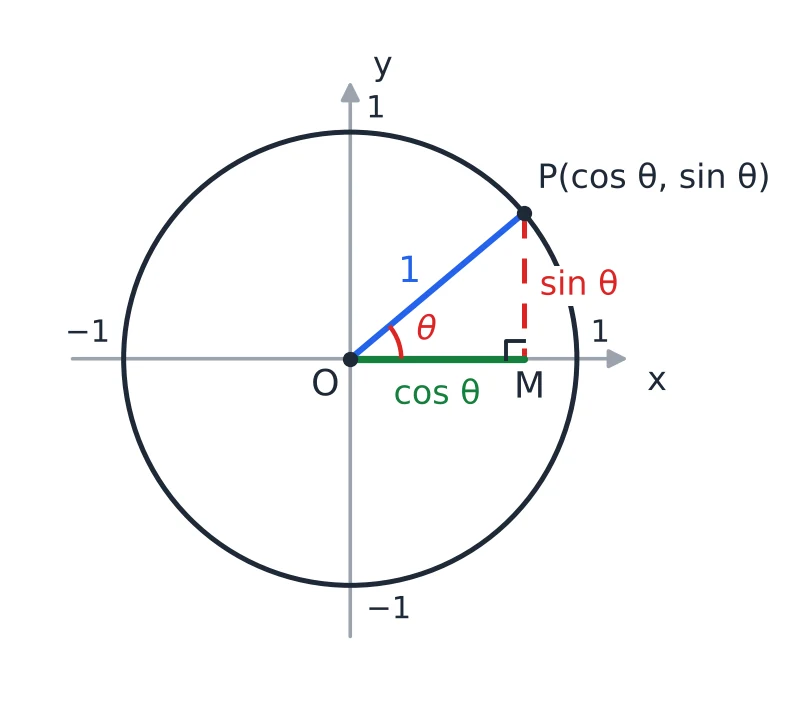
Start on the positive x-axis and turn anticlockwise through an angle θ. Take a point P on the turning arm at a distance r from the origin O, with coordinates (x, y). Then
sinθ=rycosθ=rxtanθ=xy
and r is always positive. For an acute angle, x is the adjacent side, y the opposite side and r the hypotenuse, so these are the old definitions. With r = 1 the point is simply P(cosθ,sinθ).
P stays on a circle of radius 1, so neither coordinate can go above 1 or below −1. That is why sinθ and cosθ lie between −1 and 1 for every angle, not only for acute ones.
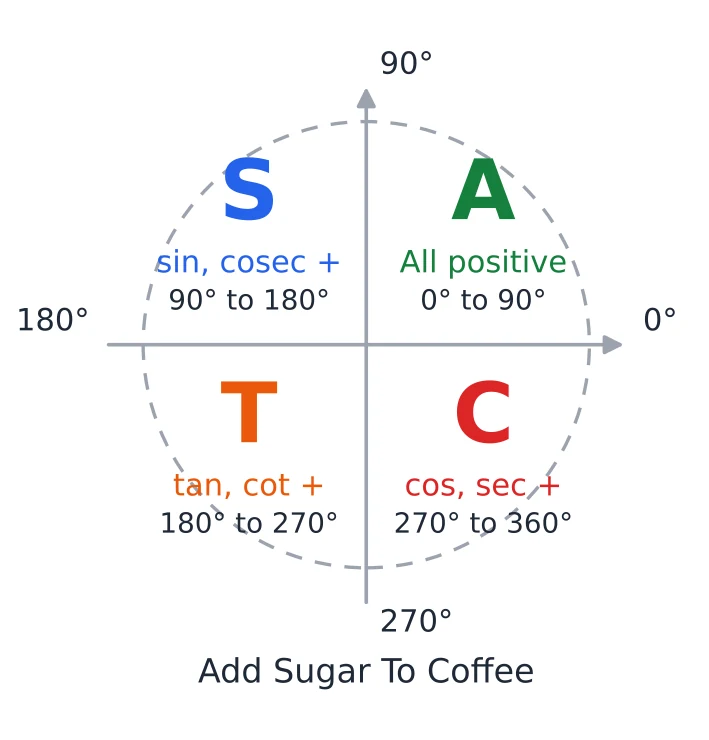
Signs in the four quadrants. The axes cut the plane into four quadrants, numbered anticlockwise. As P goes round, x and y change sign, and the ratios change with them.
Quadrant
Angle
x
y
Positive ratios
I
0° to 90°
+
+
all six
II
90° to 180°
−
+
sin and cosec only
III
180° to 270°
−
−
tan and cot only
IV
270° to 360°
+
−
cos and sec only
Read the positive ratios anticlockwise from the first quadrant: All, Sin, Tan, Cos. The usual memory line is Add Sugar To Coffee. A reciprocal always has the same sign as its partner, so cosec follows sin, sec follows cos and cot follows tan.
160° is in the second quadrant: sin160∘ is positive, while cos160∘ and tan160∘ are negative.
250° is in the third quadrant: only tan250∘ and cot250∘ are positive.
340° is in the fourth quadrant: cos340∘ is positive, and sin340∘ and tan340∘ are negative.
Angles on the axes. At 0°, 90°, 180°, 270° and 360° the point P sits on an axis, at (1, 0), (0, 1), (−1, 0), (0, −1) and back at (1, 0). The values come straight from these coordinates:
θ
0°
90°
180°
270°
360°
sinθ
0
1
0
−1
0
cosθ
1
0
−1
0
1
tanθ
0
not defined
0
not defined
0
So cos180∘+sin270∘=−1+(−1)=−2. The tangent has no value at 90° or 270°, because x = 0 there.
Allied Angles with 180° and 360°
Angles such as 180∘−θ, 180∘+θ, 360∘−θ and 90∘+θ are called allied angles of θ. Their ratios are the ratios of θ itself, with a sign in front.
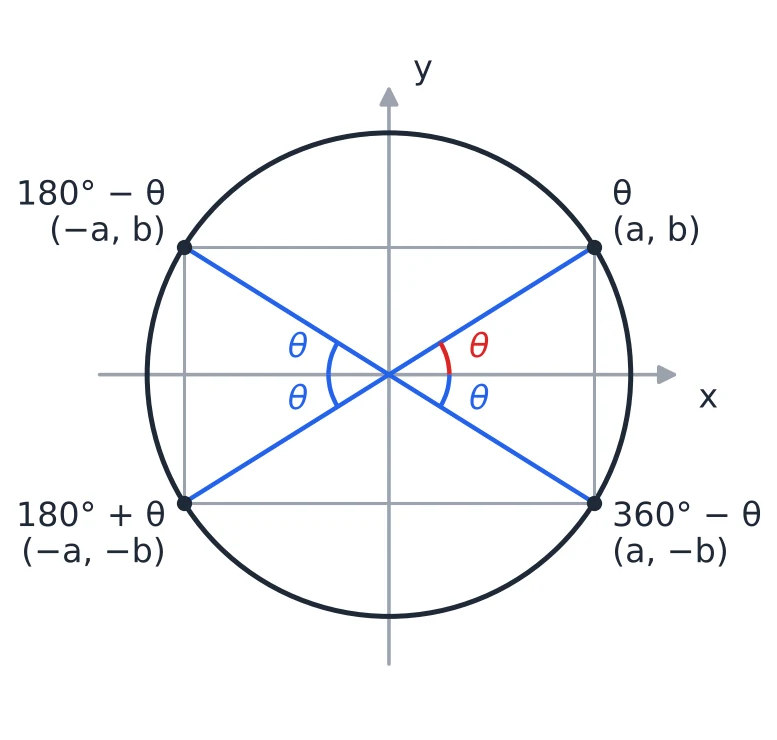
In the figure P makes an acute angle θ and has coordinates (a, b) on a circle of radius 1. The point for 180∘−θ is the mirror image of P in the y-axis, so it is (−a, b). The point for 180∘+θ is straight across O, at (−a, −b), and the point for 360∘−θ is the mirror image in the x-axis, at (a, −b).
You don't have to learn nine lines. One rule covers all of them: with 180° or 360°, the ratio keeps its name and the sign comes from the quadrant. Treat θ as acute, see which quadrant the whole angle falls in, and take the sign from Add Sugar To Coffee. For cos(180∘+θ) the angle is in the third quadrant, where cos is negative, so cos(180∘+θ)=−cosθ.
Values to know. Write the angle as 180° or 360° plus or minus 30°, 45° or 60°. Values at 120°, 135° and 150° are asked in Tier 1 as well as Tier 2.
Angle
Written as
sin
cos
tan
120°
180° − 60°
23
−21
−3
135°
180° − 45°
21
−21
−1
150°
180° − 30°
21
−23
−31
210°
180° + 30°
−21
−23
31
225°
180° + 45°
−21
−21
1
240°
180° + 60°
−23
−21
3
300°
360° − 60°
−23
21
−3
315°
360° − 45°
−21
21
−1
330°
360° − 30°
−21
23
−31
The numbers are always those of 30°, 45° or 60°; only the signs change. So sin150∘+cos300∘=21+21=1, while tan135∘×tan240∘=(−1)×3=−3.
An obtuse angle from its ratio. In a triangle one angle may be more than 90°, and sine is positive in the second quadrant as well. So sinA=21 allows A = 30° or A = 150°, while cosA=−21 fixes A = 120°. A cosine or a tangent settles which angle it is; a sine alone does not.
Angles of a triangle. A + B + C = 180°, so A + B = 180° − C, and
sin(A+B)=sinCcos(A+B)=−cosCtan(A+B)=−tanC
The minus sign on cos and tan is the part that gets dropped.
Allied Angles with 90° and 270°
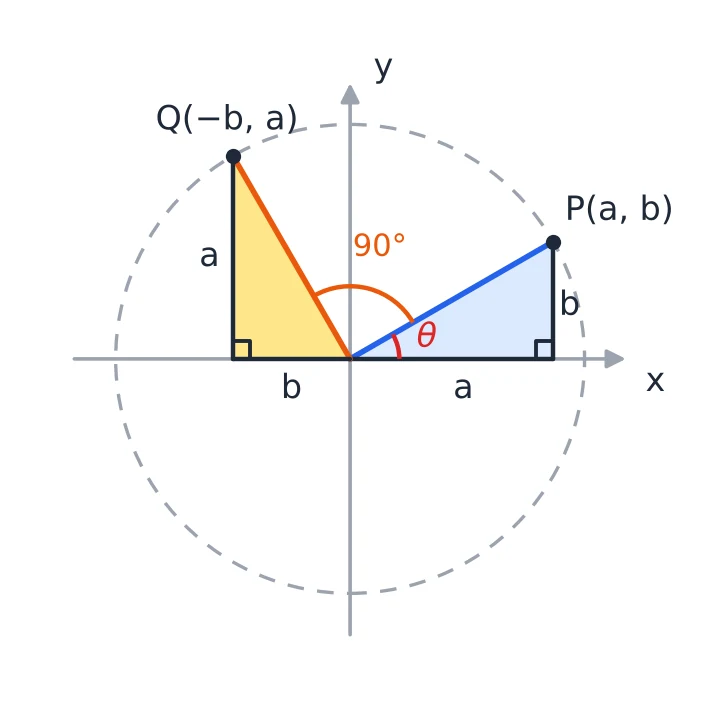
Now turn OP through a further 90°. In the figure P(a, b) moves to Q(−b, a). The two shaded triangles are the same triangle turned on its side, so a and b swap places and one of them picks up a minus sign.
The rule: with 90° or 270°, the ratio changes to its partner (sin to cos, tan to cot, sec to cosec, and back), and the sign still comes from the quadrant of the whole angle.
90∘−θ
90∘+θ
270∘−θ
270∘+θ
sin
cosθ
cosθ
−cosθ
−cosθ
cos
sinθ
−sinθ
−sinθ
sinθ
tan
cotθ
−cotθ
cotθ
−cotθ
The first column is the complementary-angle rule from Standard Angles and Complementary Angles. Take cos(270∘−θ): the ratio changes to sin, and 270∘−θ is in the third quadrant, where cos is negative, so the answer is −sinθ.
Two ways to split an angle. 120° is 180° − 60° and also 90° + 30°. The first split gives sin120∘=sin60∘, the second gives sin120∘=cos30∘, and both are 23. Use whichever split you see first.
Simplifying a mixed expression. Change each factor on its own, write its sign in front, and only then cancel:
[SSC Tip] In a long product, write every factor with its sign first and count the minus signs at the end: an even number gives a plus, an odd number a minus. Carrying the signs through each line of working is where most of the mistakes happen.
Negative Angles and Angles Larger than 360°
A negative angle is turned clockwise. The arm for −θ is the mirror image of the arm for θ in the x-axis, so (a, b) becomes (a, −b):
sin(−θ)=−sinθcos(−θ)=cosθtan(−θ)=−tanθ
Only cos and its reciprocal sec ignore the minus sign. So cos(−60∘)=21, sin(−30∘)=−21 and tan(−45∘)=−1.
Large angles. One full turn of 360° brings the arm back to where it started, so adding or removing whole turns changes nothing:
sin(n×360∘+θ)=sinθ
and the same holds for every ratio. Divide the angle by 360, keep the remainder, and use the allied-angle rules on the remainder.
1020 = 2 × 360 + 300, so sin1020∘=sin300∘=−23.
765 = 2 × 360 + 45, so cos765∘=cos45∘=21.
sin(−1050∘)=−sin1050∘, and 1050 = 2 × 360 + 330, so the value is −sin330∘=−(−21)=21.
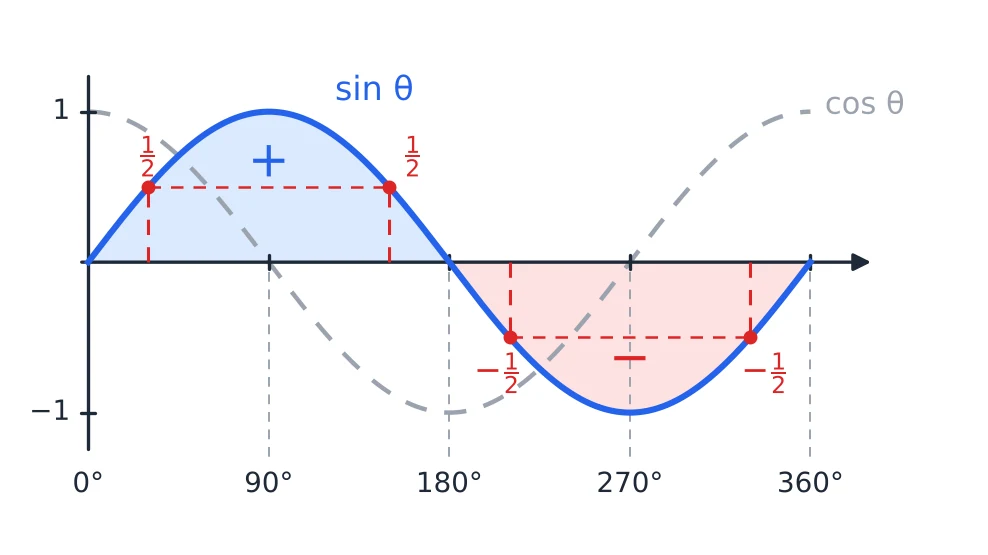
The graph shows why this works. sinθ rises from 0 to 1 at 90°, comes back to 0 at 180°, goes down to −1 at 270° and returns to 0 at 360°; after that the same wave repeats. The red dots mark sin30∘=sin150∘=21 and sin210∘=sin330∘=−21: each height is reached twice in one turn. The dashed curve for cosθ is the same wave moved 90° to the left.
Tangent repeats every 180°. Since tan(180∘+θ)=tanθ, you may remove 180°s from a tangent or a cotangent. 930 = 5 × 180 + 30, so tan930∘=tan30∘=31.
[SSC Tip] Remove 180°s only for tan and cot. For sin and cos a half turn flips the sign: sin210∘=−21 although sin30∘=21. With sin and cos, take away full turns of 360° only.
Compound Angles: Sine and Cosine of A + B and A − B
For the sum or the difference of two angles:
sin(A+B)=sinAcosB+cosAsinB
sin(A−B)=sinAcosB−cosAsinB
cos(A+B)=cosAcosB−sinAsinB
cos(A−B)=cosAcosB+sinAsinB
To keep them apart: the sine formula mixes the ratios (sin with cos) and keeps the sign of A ± B; the cosine formula keeps like with like (cos with cos, sin with sin) and flips the sign.
A ratio does not split over a sum.cos(30∘+60∘)=cos90∘=0, but cos30∘+cos60∘=23+1. Every right-hand side above is made of products, never a plain sum of two ratios.
A + B from given ratios. Let sinA=54 and cosB=135, with A and B acute. The triangles give cosA=53 and sinB=1312. Then
sin(A+B)=54×135+53×1312=6520+36=6556
cos(A+B)=53×135−54×1312=6515−48=−6533
The cosine is negative, so A + B is more than 90°. That is possible, since each angle is above 50°. A quick check: 56² + 33² = 3136 + 1089 = 4225 = 65².
Folding a formula back up. When a question shows the right-hand side, spot the pattern and write it as one ratio:
sin48∘cos18∘−cos48∘sin18∘=sin30∘=21
cos70∘cos25∘+sin70∘sin25∘=cos45∘=21
Sum times difference. Multiply the two sine formulas and write cos2A=1−sin2A, cos2B=1−sin2B. This gives two short results:
The sign in the denominator is always the opposite of the sign on top.
Finding A + B. If tanA=41 and tanB=53, with A and B acute, then
tan(A+B)=1−20341+53=20172017=1
so A + B = 45°, though neither angle is a standard one.
15° and 75°. Write 15° = 45° − 30°:
sin15∘=21×23−21×21=223−1
cos15∘=21×23+21×21=223+1
tan15∘=1+311−31=3+13−1=2(3−1)2=2−3
Since 75° = 90° − 15°, the values of 75° are the same numbers swapped:
15°
75°
sin
223−1
223+1
cos
223+1
223−1
tan
2−3
2+3
Some options clear the root from the bottom: 223−1=46−2 and 223+1=46+2. As decimals sin15∘≈0.26 and cos15∘≈0.97, which tells you at once which form belongs to which.
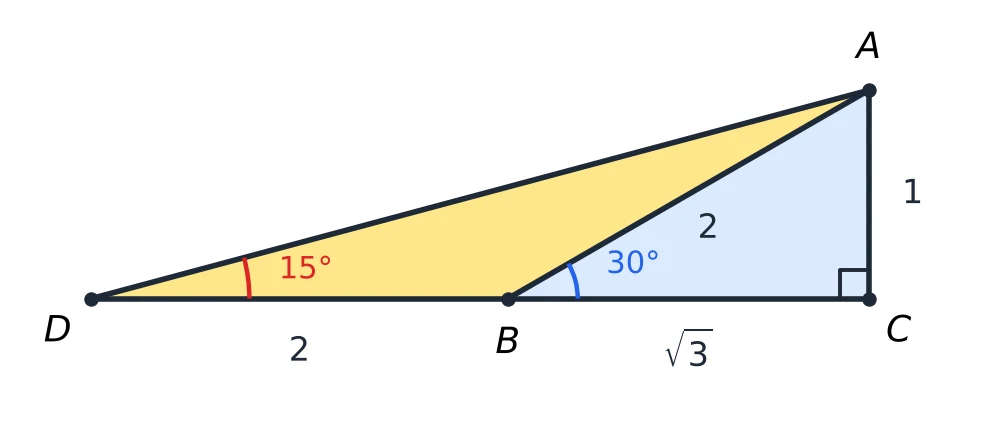
A picture of the tangent. Take the 30°-60°-90° triangle ABC with AC = 1, BC = 3 and AB = 2, and extend CB to D so that BD = BA = 2. Triangle ABD is isosceles with ∠ABD=150∘, so each of its base angles is 15°. In the right triangle ADC,
tan15∘=DCAC=2+31=2−3tan75∘=ACDC=2+3
Three facts follow: tan15∘+tan75∘=4, tan75∘−tan15∘=23 and tan15∘tan75∘=1.
105°. Combine with the allied rules: 105° = 180° − 75°, so sin105∘=sin75∘=223+1 and cos105∘=−cos75∘=221−3. Expanding cos(60∘+45∘) gives the same negative value.
Tangent Forms with 45°
Put A = 45° in the tangent formulas. Since tan45∘=1,
tan(45∘+θ)=1−tanθ1+tanθtan(45∘−θ)=1+tanθ1−tanθ
Multiply the top and the bottom of the first one by cosθ and it reads
cosθ−sinθcosθ+sinθ=tan(45∘+θ)
So 1−tan15∘1+tan15∘=tan60∘=3, and cos10∘−sin10∘cos10∘+sin10∘=tan55∘. When the plus sign is at the bottom, the angle is 45∘−θ instead.
Two angles adding to 45°. If A + B = 45°, then tan(A+B)=1, so
So (1+tan20∘)(1+tan25∘)=2 and (1+tan5∘)(1+tan40∘)=2, though none of these tangents is a neat number. Dividing the first line by tanAtanB gives the cotangent version, (cotA−1)(cotB−1)=2; for instance (cot10∘−1)(cot35∘−1)=2.
A long product breaks into such pairs. In (1+tan1∘)(1+tan2∘)⋯(1+tan44∘), pair 1° with 44°, 2° with 43°, and so on. That makes 22 pairs, each worth 2, so the product is 222.
Two angles adding to 90°. Now tanAtanB=1, so the denominator in tan(A−B) is 1 + 1 = 2:
tan(A−B)=2tanA−tanB⇒tanA−tanB=2tan(A−B)
With A = 70° and B = 20° this gives tan70∘−tan20∘=2tan50∘.
Double Angles
Put B = A in the compound-angle formulas and call the angle θ:
sin2θ=2sinθcosθ
cos2θ=cos2θ−sin2θ=2cos2θ−1=1−2sin2θ
tan2θ=1−tan2θ2tanθ
The three forms of cos2θ come from replacing sin2θ by 1−cos2θ, or cos2θ by 1−sin2θ. Pick the form that uses the ratio the question gives you. Dividing by cos2θ+sin2θ (which is just 1) puts sine and cosine in terms of tanθ alone:
sin2θ=1+tan2θ2tanθcos2θ=1+tan2θ1−tan2θ
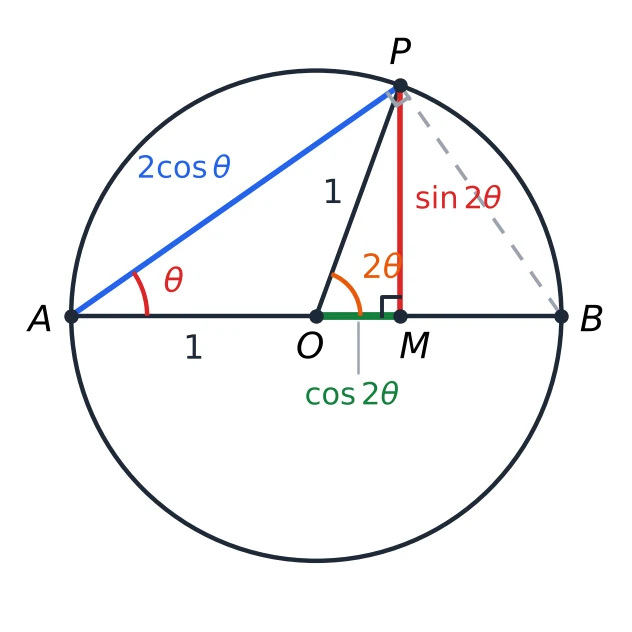
Where they come from. In the figure AB is a diameter of a circle of radius 1 and ∠PAB=θ. The angle at the centre is twice the angle at the circumference, so ∠POB=2θ, which makes PM=sin2θ and OM=cos2θ. The angle APB in the semicircle is 90°, so AP=ABcosθ=2cosθ. Now PM=APsinθ=2sinθcosθ. Also AM=APcosθ=2cos2θ, and AM=1+OM, which gives cos2θ=2cos2θ−1.
From one ratio to the double angle. If cosθ=1312 with θ acute, then sinθ=135 and
sin2θ=2×135×1312=169120
cos2θ=2×169144−1=169119
tan2θ=119120, the sine divided by the cosine.
If only tanθ is given, use the tan forms. With tanθ=21: sin2θ=1+411=54, cos2θ=1+411−41=53 and tan2θ=1−411=34.
Reading the formulas backwards. Spot the double-angle shape and write it as one ratio of the doubled angle:
2sin15∘cos15∘=sin30∘=21, so sin15∘cos15∘=41
cos215∘−sin215∘=cos30∘=23
2cos222.5∘−1=cos45∘=21
1−tan215∘2tan15∘=tan30∘=31
[SSC Tip] When the doubled angle goes past 90°, the sign changes. cos260∘−sin260∘=cos120∘=−21 (check: 41−43). An expression built from squares can still have a negative value.
Removing the 1: Half-Angle Forms
From the last two forms of cos2θ:
1−cos2θ=2sin2θ1+cos2θ=2cos2θ
Each one gets rid of the 1 and halves the angle. Comparing them with sin2θ=2sinθcosθ, or with each other:
Square roots open the same way, from the inside out. For 0∘<θ<45∘:
2+2+2cos4θ=2+4cos22θ=2+2cos2θ=4cos2θ=2cosθ
[Tier 2] Triple Angles, and the Angles 18° and 36°
sin3θ=3sinθ−4sin3θcos3θ=4cos3θ−3cosθ
tan3θ=1−3tan2θ3tanθ−tan3θ
They come from writing 3θ=2θ+θ and using the double-angle results. The sine formula starts with 3 sin, the cosine formula with 4 cos cubed. If you are unsure which way round, test at θ=30∘: 3×21−4×81=1=sin90∘.
Read them backwards as well:
3sin10∘−4sin310∘=sin30∘=21
4cos320∘−3cos20∘=cos60∘=21
If sinθ=41, then sin3θ=43−4×641=1611.
The value of 18°. Let θ=18∘. Then 5θ=90∘, so 2θ=90∘−3θ and sin2θ=cos3θ:
2sinθcosθ=4cos3θ−3cosθ
Divide by cosθ and write cos2θ=1−sin2θ: 2sinθ=1−4sin2θ, that is 4sin2θ+2sinθ−1=0. The positive root of this quadratic is
sin18∘=45−1≈0.309
which is also cos72∘. From it,
cos36∘=1−2sin218∘=1−86−25=45+1≈0.809
which is also sin54∘. Multiplying the two, sin18∘cos36∘=165−1=41.
A paper may give sin18∘ and ask for cos18∘: cos218∘=1−166−25=1610+25, so cos18∘=410+25.
[Tier 2] Products and Sums of Sines and Cosines
Adding and subtracting the compound-angle formulas turns a product into a sum:
2sinAcosB=sin(A+B)+sin(A−B)
2cosAcosB=cos(A−B)+cos(A+B)
2sinAsinB=cos(A−B)−cos(A+B)
Read backwards, with C = A + B and D = A − B, they turn a sum into a product:
If a factor of 60° is thrown in as well, multiply by its value: sin20∘sin40∘sin60∘sin80∘=83×23=163.
Solved Examples
Question 1
Which of the following is negative? (a) sin160∘ (b) tan230∘ (c) cos310∘ (d) cos130∘
Answer. I only need the quadrant of each angle. 160° is in the second quadrant, where sine is positive. 230° is in the third, where tan is positive. 310° is in the fourth, where cos is positive. 130° is in the second quadrant, and cos is negative there, so the answer is (d) cos130∘.
Question 2
What is the value of sin120∘+cos150∘+tan135∘? (a) −1 (b) 1 (c) 3−1 (d) 0
Answer. I write each angle as 180° minus a standard angle. sin120∘=sin60∘=23. Cos is negative in the second quadrant, so cos150∘=−cos30∘=−23. Tan is negative there too: tan135∘=−tan45∘=−1. The first two cancel, which leaves (a) −1. Keeping a plus sign on tan135∘ would give 1.
Question 3
If sinθ=2920 and θ lies between 90° and 180°, what is tanθ? (a) 2120 (b) −2921 (c) −2120 (d) −2021
Answer. First the size, then the sign. cos2θ=1−841400=841441, so the size of cosθ is 2921 (20, 21, 29 is a Pythagorean triplet). θ is in the second quadrant, where cos is negative, so cosθ=−2921. Then tanθ=2920÷(−2921) = (c) −2120.
Question 4
What is the value of sec1200∘? (a) 2 (b) −2 (c) −32 (d) 32
Answer. I take out the full turns: 1200 = 3 × 360 + 120, so sec1200∘=sec120∘. Sec has the same sign as cos, and 120° is in the second quadrant, where cos is negative. cos120∘=−cos60∘=−21, so sec120∘ = (b) −2.
Question 5
What is the value of tan(−1035∘)? (a) 1 (b) −1 (c) 3 (d) −31
Answer. Tan takes the minus sign outside: tan(−1035∘)=−tan1035∘. Now 1035 = 2 × 360 + 315, and tan315∘=−tan45∘=−1 (fourth quadrant). So the value is −(−1) = (a) 1. A shorter way: adding three full turns (1080°) to −1035° gives 45°, and tan45∘=1 at once.
Answer. I change one factor at a time. On top: sin(180∘−θ)=sinθ, cos(90∘+θ)=−sinθ, and tan(270∘−θ)=cotθ (270° turns tan into cot, and tan is positive in the third quadrant). At the bottom: cos(360∘−θ)=cosθ, sin(−θ)=−sinθ and cot(180∘+θ)=cotθ. There is one minus sign on top and one below, so they cancel. sinθ and cotθ also cancel, and what is left is cosθsinθ = (d) tanθ.
Question 7
In a triangle ABC (C is not a right angle), what is the value of tan(A+B)+tanC? (a) 2tanC (b) −2tanC (c) 0 (d) 1
Answer. The three angles add up to 180°, so A + B = 180° − C. Tan is negative in the second quadrant, so tan(180∘−C)=−tanC. Adding tanC to it gives (c) 0. The condition on C is there because tan90∘ has no value.
Question 8
What is the value of cos165∘? (a) 223+1 (b) −223+1 (c) −223−1 (d) 223−1
Answer. 165° = 180° − 15°, and cos is negative in the second quadrant, so cos165∘=−cos15∘. Now cos15∘=cos(45∘−30∘)=21×23+21×21=223+1. So the answer is (b) −223+1. The size makes sense: 165° is close to 180°, so the cosine should be close to −1, and 2.832.73≈0.97.
Question 9
If sinA=178 and cosB=54, where A and B are acute, what is sin(A+B)? (a) 8577 (b) 8536 (c) 8513 (d) 8584
Answer. I need all four ratios first. 8, 15, 17 is a triplet, so cosA=1715, and from 3, 4, 5, sinB=53. Then sin(A+B)=sinAcosB+cosAsinB=178×54+1715×53=8532+45 = (a) 8577.
Question 10
What is the value of sin25∘cos35∘+cos25∘sin35∘? (a) 21 (b) 21 (c) sin10∘ (d) 23
Answer. This is the right-hand side of sin(A+B) with A = 25° and B = 35°. So it equals sin60∘ = (d) 23. With a minus sign in the middle it would have been sin(25∘−35∘)=−sin10∘.
Question 11
If tanA=2 and tanB=3, where A and B are acute, what is A + B? (a) 45° (b) 135° (c) 120° (d) 150°
Answer.tan(A+B)=1−2×32+3=−55=−1. Each tangent is more than 1, so each angle is more than 45°, and their sum lies between 90° and 180°. In that range the tangent is −1 only at 135°, so A + B = (b) 135°. Reading the −1 as 1 leads to 45°, which is too small for two angles that are each above 45°.
Question 12
What is the value of tan75∘+cot75∘? (a) 23 (b) 2 (c) 4 (d) 2+3
Answer.tan75∘=2+3, and cot75∘=tan15∘=2−3. When I add them the roots cancel: (c) 4. Another way is tanθ+cotθ=2cosec2θ=2cosec150∘=2×2.
Question 13
What is the value of (1+tan13∘)(1+tan32∘)? (a) 2 (b) 1 (c) 4 (d) 2
Answer. 13° + 32° = 45°, so tan(13∘+32∘)=1. Cross-multiplying the tangent formula gives tan13∘+tan32∘+tan13∘tan32∘=1. Opening the brackets gives 1 plus exactly these three terms, so the product is 1 + 1 = (a) 2. I never needed the value of tan13∘ itself.
Question 14
tan65∘−tan25∘ is equal to (a) tan40∘ (b) 2tan40∘ (c) 2tan50∘ (d) 21tan40∘
Answer. 65° and 25° add up to 90°, so tan65∘tan25∘=tan65∘cot65∘=1. Now tan40∘=tan(65∘−25∘)=1+1tan65∘−tan25∘. Multiplying both sides by 2: tan65∘−tan25∘ = (b) 2tan40∘.
Question 15
What is the value of cos12∘−sin12∘cos12∘+sin12∘−tan57∘? (a) 1 (b) 2tan57∘ (c) −1 (d) 0
Answer. I divide the top and the bottom of the fraction by cos12∘. It becomes 1−tan12∘1+tan12∘, which is tan(45∘+12∘)=tan57∘. Taking away tan57∘ leaves (d) 0.
Question 16
If sinθ=419 and θ is acute, what is sin2θ? (a) 4118 (b) 1681360 (c) 1681720 (d) 16811519
Answer.θ is acute and 9, 40, 41 is a triplet, so cosθ=4140. Then sin2θ=2×419×4140 = (c) 1681720. Doubling the sine to 4118 is the slip to avoid; sin2θ and 2sinθ are different things.
Question 17
If tanθ=3, what is cos2θ? (a) −54 (b) 54 (c) 53 (d) −53
Answer. Only tan is given, so I use cos2θ=1+tan2θ1−tan2θ=1+91−9 = (a) −54. The minus sign is right: tanθ=3 means θ is more than 45°, so 2θ is more than 90° and its cosine is negative.
Question 18
What is the value of cos275∘−sin275∘? (a) 23 (b) −23 (c) −21 (d) 21
Answer. This is cos2θ with θ=75∘, so it equals cos150∘. 150° is in the second quadrant, where cos is negative, so cos150∘=−cos30∘ = (b) −23. The sign makes sense, because sin75∘ is bigger than cos75∘.
Question 19
If cos2θ=91 and θ is acute, what is tanθ? (a) 54 (b) 51 (c) 25 (d) 52
Answer. I use tan2θ=1+cos2θ1−cos2θ=91098=54. θ is acute, so tanθ is positive and equals (d) 52. If you stop at 54, you have found tan2θ.
Question 20
1+sin2θ−cos2θ1+sin2θ+cos2θ is equal to (a) tanθ (b) sin2θ (c) cotθ (d) cos2θ
Answer. I turn each 1±cos2θ into a square. Top: 1+cos2θ+sin2θ=2cos2θ+2sinθcosθ=2cosθ(cosθ+sinθ). Bottom: 1−cos2θ+sin2θ=2sin2θ+2sinθcosθ=2sinθ(sinθ+cosθ). The brackets cancel and I get sinθcosθ = (c) cotθ. To check, I put θ=30∘: the top is 23+3, the bottom 21+3, and their ratio is 3=cot30∘. Checking at 45° would not help here, because tan45∘ and cot45∘ are both 1.
Question 21
What is the value of 1+tan215∘1−tan215∘? (a) 23 (b) 21 (c) 3 (d) 31
Answer. The shape 1+tan2θ1−tan2θ is cos2θ. With θ=15∘ it is cos30∘ = (a) 23. There is no need to square 2−3.
Question 22
[Tier 2] If cosθ=32, what is cos3θ? (a) 2722 (b) −2722 (c) 2 (d) 2732
Answer.cos3θ=4cos3θ−3cosθ=4×278−2=2732−54 = (b) −2722. In the cosine formula the cube comes first; writing it the sine way round gives the same number with the wrong sign.
Question 23
[Tier 2] Given sin18∘=45−1, what is the value of sin272∘−sin218∘? (a) 21 (b) 45−1 (c) 83−5 (d) 45+1
Answer.sin72∘=cos18∘, so the expression is cos218∘−sin218∘=cos36∘, and cos36∘=1−2sin218∘. Now sin218∘=166−25=83−5, so cos36∘=1−43−5=41+5, which is (d) 45+1.
Question 24
[Tier 2] What is the value of sin10∘sin50∘sin70∘? (a) 83 (b) 161 (c) 81 (d) 41
Answer. The angles are θ, 60∘−θ and 60∘+θ with θ=10∘. So the product is 41sin30∘=41×21 = (c) 81.
Question 25
[Tier 2] What is the value of cos65∘+cos55∘sin65∘+sin55∘? (a) 31 (b) 3 (c) 1 (d) 32
Answer. I change both sums into products. The half-sum of the angles is 60° and the half-difference is 5°, so the top is 2sin60∘cos5∘ and the bottom is 2cos60∘cos5∘. The 2cos5∘ cancels, leaving tan60∘ = (b) 3.
Ready to test your knowledge?
Take a quick interactive quiz on this topic —
free, works without login.