Degrees and Radians
- π radians =180∘. Degrees to radians: ×180π; radians to degrees: ×π180.
- 1∘=60′ and 1′=60′′, so 22∘30′=22.5∘=8π.
- One radian is about 57.3∘.
- Arc l=rθ and sector 21r2θ, with θ in radians.
- Clock: the minute hand turns 6∘ a minute, the hour hand 21∘. The hands are ∣30h−5.5m∣ degrees apart; above 180∘, take it from 360∘.
For example: in 20 minutes the minute hand turns 120∘, which is 32π.
Trigonometric Ratios
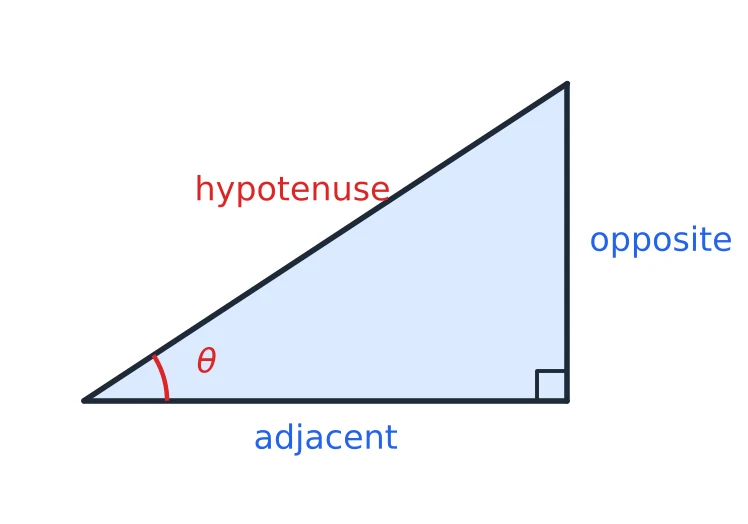
- sinθ=hypotenuseopposite, cosθ=hypotenuseadjacent, tanθ=adjacentopposite=cosθsinθ.
- Cosec, sec and cot are the reciprocals of sin, cos and tan.
- One ratio given: draw the triangle and find the third side with a triplet (5-12-13, 8-15-17, 7-24-25, 20-21-29, 9-40-41).
- From 0∘ to 90∘, sin and tan rise and cos falls; sin and cos never pass 1.
Sec goes with cos and cosec with sin, so the pairs cross over.
Standard Angle Values
- sinθ at 0∘, 30∘, 45∘, 60∘, 90∘ is 40, 41, 42, 43, 44; cosθ is the same row backwards.
- tanθ: 0, 31, 1, 3, not defined.
- With squares, use 0, 41, 21, 43, 1 for sin2θ and 0, 31, 1, 3 for tan2θ.
- Not defined: tan90∘, sec90∘, cot0∘, cosec0∘.
[SSC Tip] 31 and 3 often sit side by side in the options. tan30∘ is the smaller one, less than 1.
Complementary Angles
- sin(90∘−θ)=cosθ, tan(90∘−θ)=cotθ, sec(90∘−θ)=cosecθ, and the other way round.
- sinA=cosB with both angles acute means A+B=90∘.
- tanθtan(90∘−θ)=1: long products of tan give 1.
- sin2θ+sin2(90∘−θ)=1: a sum of squares is the number of pairs, plus 21 for 45∘.
- In a triangle, sin2B+C=cos2A.
A product with cos90∘ in it is 0, however long it is.
Finding the Angle
- Bring the equation to one ratio equal to a standard value, read off the angle, then solve for θ: 2cos3θ=1 gives 3θ=60∘ and θ=20∘.
- Two equations in A+B and A−B: find both sums, then add and subtract.
- A sin equal to a cos: add the two angles and set the sum to 90∘.
- A quadratic in sinθ or cosθ: factorise, and drop any root above 1.
Last step every time: check that the angle lies in the range the question allows.
Identities and Simplification
- sin2θ+cos2θ=1, sec2θ−tan2θ=1, cosec2θ−cot2θ=1.
- secθ−tanθ=secθ+tanθ1, and the same for cosec and cot.
- sin4θ+cos4θ=1−2sin2θcos2θ; for sixth powers the 2 becomes 3.
- 1±sinθ leads to sec and tan; 1±cosθ leads to cosec and cot.
To choose between options, test at 45∘. If two options agree there, test again at 30∘ or 60∘.
Values from a Given Condition
- sinθ+cosθ=p gives sinθcosθ=2p2−1.
- secθ+tanθ=p gives secθ−tanθ=p1 and sinθ=p2+1p2−1.
- tanθ given: divide the top and the bottom by cosθ.
- tanθ+cotθ=2 gives θ=45∘.
- acosθ+bsinθ=c gives asinθ−bcosθ=±a2+b2−c2.
- sinθ+sin2θ=1 gives sinθ=cos2θ.
Maximum and Minimum Values
- asinθ+bcosθ runs from −a2+b2 to a2+b2; a constant outside shifts both ends.
- asin2θ+bcos2θ lies between a and b.
- atan2θ+bcot2θ≥2ab and asec2θ+bcosec2θ≥(a+b)2.
- sinθcosθ≤21 and sin2θ+cos4θ≥43.
The AM-GM value counts only if it can be reached: cos2θ+36sec2θ has least value 37, not 12.
Allied Angles
- Positive ratios: all in the first quadrant, sin and cosec in the second, tan and cot in the third, cos and sec in the fourth.
- 180∘±θ and 360∘−θ keep the ratio; 90∘±θ and 270∘±θ switch to the co-ratio.
- Take off whole turns of 360∘ first. cos(−θ)=cosθ but sin(−θ)=−sinθ.
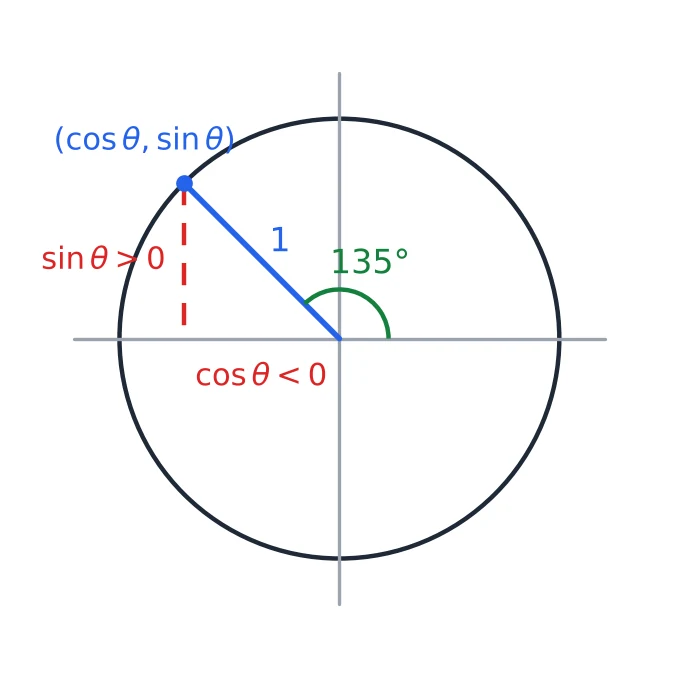
For example: at 135∘, sin135∘=21 and cos135∘=−21, as the figure shows.
Compound and Double Angles
- sin(A±B)=sinAcosB±cosAsinB and cos(A±B)=cosAcosB∓sinAsinB.
- tan15∘=2−3, tan75∘=2+3.
- A+B=45∘: (1+tanA)(1+tanB)=2.
- sin2θ=2sinθcosθ; cos2θ=1−2sin2θ=2cos2θ−1.
- [Tier 2] sin3θ=3sinθ−4sin3θ, cos3θ=4cos3θ−3cosθ, sin18∘=45−1.
Before the Exam
- Write the standard table and the triplets on rough paper first.
- Read the options before working; test at 45∘, then at 30∘ or 60∘.
- Watch for the usual slips: sin and cos swapped, 31 for 3, the sign in the second quadrant, a missing π, cos(A+B) split up, and a+b as a maximum.
- Angles of elevation and depression come in Chapter 16, using the values of 30∘, 45∘ and 60∘ from here.
Then work through the PYQ Practice Sets of this chapter at under a minute a question.
