Most trigonometry questions in the exam need only three or four lines of working, and the options sit close together, so the time goes in choosing the route. The methods below are the quick routes for this chapter, from the table of standard values to maximum values and allied angles, and each one says where it stops working. Two habits help with all of them: know the standard values without looking anything up, and read the four options before you start, because their shape often tells you which method the question wants.
Fast way: write 0, 1, 2, 3, 4 under 0∘, 30∘, 45∘, 60∘, 90∘. Divide each by 4 and take the square root: that is the sin row. The cos row is the same five values read backwards, and tan is sin divided by cos.
θ
0∘
30∘
45∘
60∘
90∘
sinθ
0
21
21
23
1
cosθ
1
23
21
21
0
tanθ
0
31
1
3
not defined
Cosec, sec and cot are the reciprocals of sin, cos and tan, so they need no rows of their own. When an expression has only squares, skip the roots: sin2θ runs 0, 41, 21, 43, 1, and tan2θ runs 0, 31, 1, 3.
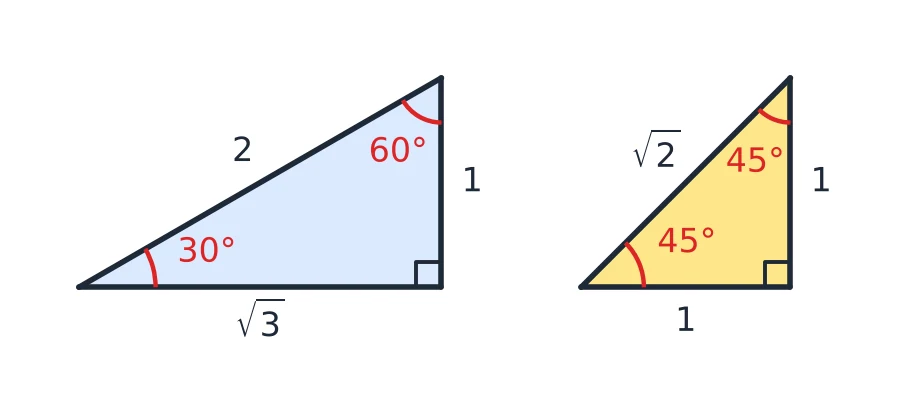
If a value slips your mind in the exam, draw the half square (sides 1, 1 and 2) or the half equilateral triangle (sides 1, 3 and 2) and read it off.
For example:2sin245∘+3tan260∘−4cos230∘=2×21+3×3−4×43=1+9−3=7.
Where it fails:
tan90∘, sec90∘, cot0∘ and cosec0∘ are not defined. If one of them turns up in your working, read the question again.
An angle given in radians must be changed first: 6π=30∘, 4π=45∘, 3π=60∘, 2π=90∘.
Degrees, Radians and Clock Hands
Fast way:
π radians =180∘. To go from degrees to radians multiply by 180π, and back by π180. Cancel the 180 against the angle first: 135∘=180135π=43π.
One radian is about 57.3∘ (it is 57∘16′22′′ if π is taken as 722).
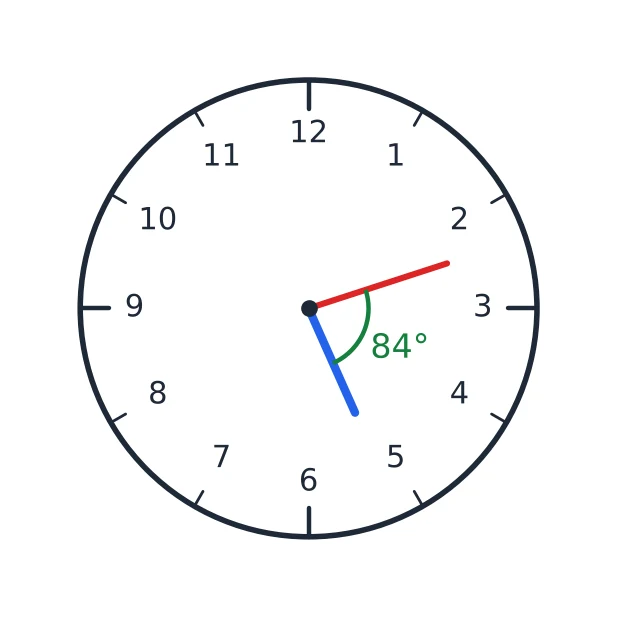
The minute hand of a clock turns 6∘ a minute and the hour hand 21∘ a minute. At h hours and m minutes the hands are ∣30h−5.5m∣ degrees apart; if that is more than 180∘, take it away from 360∘.
For example: at 5:12 the hands are ∣150−66∣=84∘ apart, and 84∘=18084π=157π radians.
Where it fails:
Minutes are sixtieths of a degree: 40∘30′ is 40.5∘, not 40.3∘.
The arc l=rθ and the sector area 21r2θ need θ in radians. With degrees, use 360∘θ×2πr (see Chapter 13).
One Ratio Given: Draw the Triangle
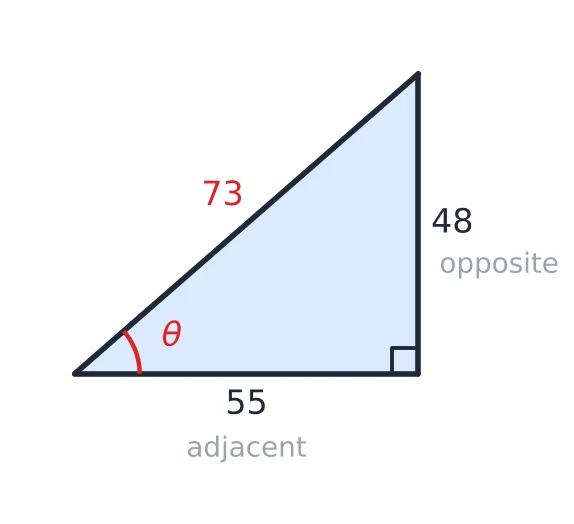
Fast way: put the two numbers of the ratio on the two sides it names (sin: opposite over hypotenuse, cos: adjacent over hypotenuse, tan: opposite over adjacent), find the third side, and read off every other ratio. These Pythagorean triplets save the square root:
3-4-5, 5-12-13, 8-15-17, 7-24-25, 20-21-29, 9-40-41, 12-35-37, 11-60-61, 28-45-53, 33-56-65, 48-55-73, 13-84-85, 39-80-89, 65-72-97, and their multiples.
For example:tanθ=5548. The hypotenuse is 73, so sinθ=7348, cosθ=7355, and secθ+tanθ=5573+48=55121=511.
Where it fails:
Read which sides the ratio uses. cosecθ=513 puts 13 on the hypotenuse and 5 on the opposite side, so the adjacent side is 12. Adding the squares would treat 13 as a short side.
If the third side is not a whole number, keep the root: sinθ=73 gives an adjacent side of 49−9=210.
The triangle gives sizes only. For an angle beyond 90∘, the sign comes from the quadrant (see the method for allied angles below).
When tan Is Given, Divide by cos
When to use it:tanθ (or cotθ) is given, and every term of the expression has sin and cos to the same total power.
Fast way: divide the top and the bottom by cosθ. Every cosθsinθ becomes tanθ:
csinθ+dcosθasinθ+bcosθ=ctanθ+datanθ+b
With squares, divide by cos2θ; a plain number k then becomes ksec2θ=k(1+tan2θ). When cotθ is given, divide by sinθ instead.
For example:3tanθ=2. Then 3sinθ+2cosθ6sinθ−cosθ=3×32+26×32−1=43.
With squares, only tan2θ is needed. For tanθ=21, tan2θ=21 and 3−sin2θsin2θ+2cos2θ=3(1+tan2θ)−tan2θtan2θ+2=425=85.
Where it fails: if the powers do not match, as in cosθsinθ+1, dividing does not clear it. Draw the triangle instead.
Complementary Pairs in Long Products and Sums
Fast way: pair each angle with the one that makes 90∘ with it.
tanθtan(90∘−θ)=tanθcotθ=1, so a product such as tan1∘tan2∘⋯tan89∘ is 1. The middle term is tan45∘=1.
sin2θ+sin2(90∘−θ)=1, and the same for cos2. So a sum of squares is the number of pairs, plus 21 if 45∘ is one of the angles.
Count the terms first: from a to b in steps of d there are db−a+1 terms.
A product with cos90∘ (or sin0∘) anywhere in it is 0.
For example:sin210∘+sin215∘+⋯+sin280∘ has 580−10+1=15 terms: 7 pairs and the middle term sin245∘. The sum is 7+21=721.
Where it fails:
Every angle needs its partner. In cos215∘+cos225∘+⋯+cos285∘ the 85∘ has no 5∘, so cos285∘ is left over with no standard value. If that happens, check the first and last angles again.
A sum running up to 90∘ or starting at 0∘ has one more term to add: sin290∘=1, sin20∘=0.
[SSC Tip] Long products of tan or cot pair up to 1. The same product of sin or cos does not: sin1∘sin89∘ is sin1∘cos1∘, which is not 1. If a long product of sines or cosines is asked, look for a cos90∘ or sin0∘ in it that makes the whole product 0.
Equal Co-ratios Mean the Angles Add to 90°
Fast way: if sinA=cosB, tanA=cotB or secA=cosecB, with both angles acute, then A+B=90∘. Add the two angles and set the sum equal to 90∘; there is no need to change either ratio.
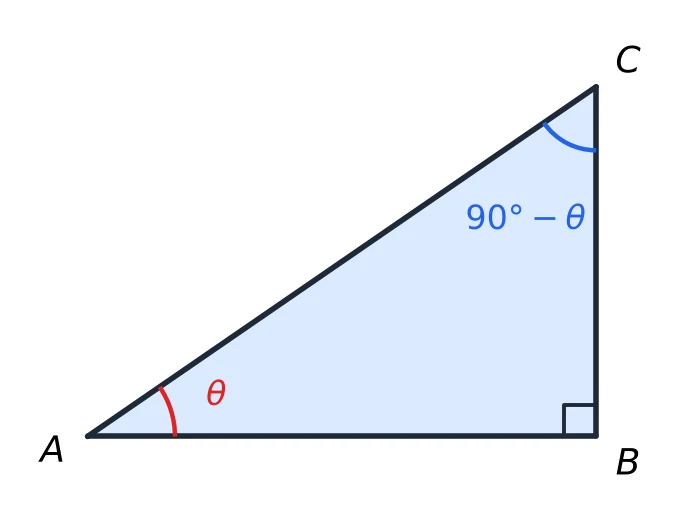
In the figure, the side opposite θ is the side next to the angle 90∘−θ. That is why sinθ=cos(90∘−θ) and tanθ=cot(90∘−θ).
For example:sin(2θ+10∘)=cos(3θ−25∘) gives 5θ−15∘=90∘, so θ=21∘. The two angles are 52∘ and 38∘, both acute.
Inside a triangle, A+B+C=180∘, so 2B+C=90∘−2A. This turns sin2B+C into cos2A and tan2A+B into cot2C.
Where it fails:
sinA=sinB means A=B for acute angles. Add the angles only when the two ratios are a co-pair: sin with cos, tan with cot, sec with cosec.
Check that both angles come out acute. A negative angle or one above 90∘ means a slip in the working.
Test the Options at 45°, Then at 30° or 60°
When to use it: the question asks which option equals an expression in θ, or asks for a value that does not depend on θ.
Fast way: put θ=45∘, where sinθ=cosθ=21 and tanθ=1. Work out the question and the four options at that angle, and keep only the options that match.
When two options tie: at 45∘, sin equals cos, tan equals cot and sec equals cosec, so two options that differ only by such a swap always agree there. Test again at 30∘ or 60∘.
For example:tanθ+sinθ1+secθ, with options cosecθ, secθ, sinθ and cotθ.
At 45∘: 1+211+2=2+1(1+2)2=2. Both cosecθ and secθ give 2.
At 30∘: multiplying the top and the bottom by 23, 31+211+32=2+323+4=2. Now cosec30∘=2 but sec30∘=32, so the answer is cosecθ.
Where it fails:
With a condition in the question, only an angle that satisfies it may be used. If sinθ=2cosθ is given, 45∘ is not allowed, since there sin and cos are equal.
Some expressions break at 45∘: anything with 1−tanθ or sinθ−cosθ in a denominator. Start at 30∘ for those.
0∘ and 90∘ are quick, but they leave tan, sec or cot undefined. Use them only when every term stays defined.
So the shape of the question tells you the shape of the answer: 1±sinθ leads to sec and tan, and 1±cosθ leads to cosec and cot.
Expression (θ acute)
Value
1−sinθ1+1+sinθ1
2sec2θ
1−cosθ1+1+cosθ1
2cosec2θ
1−sinθ1−1+sinθ1
2tanθsecθ
1−sinθ1+sinθ
secθ+tanθ
1+cosθ1−cosθ
cosecθ−cotθ
secθ−tanθ1
secθ+tanθ
For example:secθ−tanθsecθ+tanθ. Dividing by secθ−tanθ is the same as multiplying by secθ+tanθ, so the fraction inside is (secθ+tanθ)2 and the root is secθ+tanθ. Multiplying the top and the bottom by cosθ shows the same thing: the fraction is 1−sinθ1+sinθ, the fourth row of the table. Any option in cosec and cot can be crossed out at a glance.
Where it fails: the lines with a square root take θ as acute, so that secθ+tanθ and the others are positive. For an angle in another quadrant the root may need a minus sign.
Fourth and Sixth Powers in One Line
Write x=sin2θcos2θ. Then:
sin4θ+cos4θ=1−2x
sin6θ+cos6θ=1−3x
sin4θ−cos4θ=sin2θ−cos2θ, since the other factor sin2θ+cos2θ is 1
sec4θ−tan4θ=sec2θ+tan2θ, for the same reason
The first two give a result that holds for every θ: 2(sin6θ+cos6θ)−3(sin4θ+cos4θ)+1=2−6x−3+6x+1=0.
For example: if sinθcosθ=72, then x=494 and sin6θ+cos6θ=1−4912=4937.
Where it fails:sin4θ+cos4θ is not 1. It lies between 21 and 1, and sin6θ+cos6θ lies between 41 and 1; the low ends come at 45∘.
The Partner of sec + tan Is Its Reciprocal
Fast way:(secθ+tanθ)(secθ−tanθ)=sec2θ−tan2θ=1. So if secθ+tanθ=p:
secθ−tanθ=p1
adding the two and halving, secθ=21(p+p1)=2pp2+1
subtracting and halving, tanθ=2pp2−1, and then sinθ=secθtanθ=p2+1p2−1
The same works for cosec and cot: if cosecθ+cotθ=q, then cosecθ−cotθ=q1 and cosθ=q2+1q2−1.
For example:secθ+tanθ=9. Then secθ−tanθ=91, secθ=21(9+91)=941, tanθ=940 and sinθ=4140.
Where it fails:
Only sec with tan, and cosec with cot, multiply to 1. A condition like sinθ+cosθ=p needs the next method.
For an acute angle, p is more than 1. With p<1, tanθ comes out negative.
sin + cos Given: Square It
Fast way: if sinθ+cosθ=p, squaring gives 1+2sinθcosθ=p2, so
sinθcosθ=2p2−1
Everything else follows from this one value:
tanθ+cotθ=sinθcosθ1=p2−12
secθ+cosecθ=sinθcosθsinθ+cosθ=p2−12p
(sinθ−cosθ)2=2−p2
sin3θ+cos3θ=p(1−sinθcosθ)
If sinθ−cosθ=q is given instead, sinθcosθ=21−q2.
For example:sinθ+cosθ=811. Then sinθcosθ=21(64121−1)=12857, so tanθ+cotθ=57128, and sinθ−cosθ=±2−64121=±87.
Where it fails:
p can never be more than 2, about 1.414. No angle has sinθ+cosθ=710, since 710 is about 1.43.
Squaring loses the sign: sinθ−cosθ is negative below 45∘ and positive above it.
Number Plus Its Reciprocal Equal to 2
A positive number plus its reciprocal is at least 2, and equals 2 only when the number is 1 (see Chapter 11). So:
tanθ+cotθ=2 gives tanθ=1 and θ=45∘; then tannθ+cotnθ=2 for every power n.
sinθ+cosecθ=2 gives sinθ=1 and θ=90∘; cosθ+secθ=2 gives θ=0∘.
For any other value k, square it: tan2θ+cot2θ=k2−2.
A related condition: sinθ+sin2θ=1 means sinθ=1−sin2θ=cos2θ. Then cos2θ+cos4θ=sinθ+sin2θ=1, and a long expression in powers of cos2θ can be built up from that.
For example: if tanθ+cotθ=2, then θ=45∘, and tan13θ+sin2θ=1+21=23.
Where it fails: a sum such as tanθ+cotθ=1.5 is impossible. With a positive tan the sum is at least 2, and with a negative tan it is at most −2.
Same a and b in Two Lines: Square and Add
Fast way: if x=acosθ+bsinθ and y=asinθ−bcosθ, then
x2+y2=a2+b2
because the cross terms 2absinθcosθ cancel. So when one of the two is given, the other is ±a2+b2−(the given value)2.
The same idea removes θ from other pairs. x=asecθ+btanθ and y=atanθ+bsecθ give x2−y2=a2−b2, using sec2θ−tan2θ=1.
For example:7cosθ+24sinθ=15. Then 7sinθ−24cosθ=±49+576−225=±400=±20.
When the given value is exactly a2+b2, the partner is 0, and that fixes θ: 8cosθ+15sinθ=17 gives 8sinθ−15cosθ=0, so tanθ=815.
Where it fails:
The second line must swap sin and cos and change one sign. 6cosθ+8sinθ and 6sinθ+8cosθ do not square-add to 100.
The data never fix the sign, so the answer stays ± unless the range of θ is given.
Largest and Smallest Value of a sin + b cos
Fast way:
−a2+b2≤asinθ+bcosθ≤a2+b2
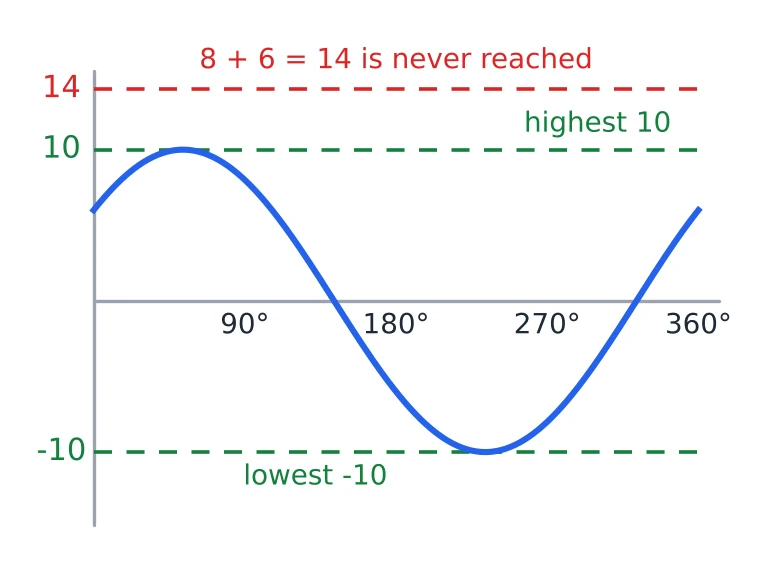
A constant added outside just moves both ends. With a triplet the root costs nothing: 28sinθ+45cosθ runs from −53 to 53.
The graph shows 8sinθ+6cosθ through a full turn. It touches 10 and −10 and never comes near 14.
For example:8sinθ−15cosθ+3 lies between −17+3=−14 and 17+3=20.
Where it fails:
The maximum is not a+b, because sin and cos never reach 1 at the same angle.
If θ must stay between 0∘ and 90∘, the low end changes. There 8sinθ+6cosθ runs only from 6 (at 0∘) up to 10.
Both ratios must be of the same angle. 3sin2θ+4cosθ is a different problem.
[SSC Tip] The largest and smallest values sit the same distance either side of the constant, so their sum is twice the constant. In the example, 20+(−14)=6.
Squared sin and cos Together: Between a and b
Fast way: write asin2θ+bcos2θ=b+(a−b)sin2θ. As sin2θ goes from 0 to 1, the value goes from b to a. So 5sin2θ+9cos2θ always lies between 5 and 9.
For example: the same rewriting finds an angle. 6sin2θ+2cos2θ=5 becomes 2+4sin2θ=5, so sin2θ=43, θ=60∘ and tanθ=3.
Two more ranges worth knowing: sinθcosθ never goes above 21, and sin4θ+cos4θ lies between 21 and 1.
Where it fails: both terms must be squares of the same angle. asin2θ+bcosθ is a quadratic in cosθ, and its range has to be found the long way.
The AM-GM Least Value for tan and cot Squares
For positive numbers, px+xq≥2pq, with equality when px=xq (the AM-GM rule, see Chapter 11). Since tan2θcot2θ=1:
atan2θ+bcot2θ≥2ab
asec2θ+bcosec2θ=(a+b)+atan2θ+bcot2θ≥(a+b)2
sin2θ+cosec2θ≥2 and cos2θ+sec2θ≥2
For example:16tan2θ+9cot2θ≥2144=24, and 4sec2θ+25cosec2θ≥(2+5)2=49.
Where it fails: the equality has to be possible. For cos2θ+4sec2θ the rule says 4, but that needs cos2θ=2. Since cos2θ cannot pass 1, the least value comes at cos2θ=1 (that is, θ=0∘) and is 1+4=5. With tan and cot there is no such problem, because tan2θ can take any positive value. None of these expressions has a largest value.
Allied Angles: Sign First, Then the Ratio
Fast way:
Remove whole turns: take away 360∘ as many times as you can. For a negative angle, use sin(−θ)=−sinθ, cos(−θ)=cosθ and tan(−θ)=−tanθ.
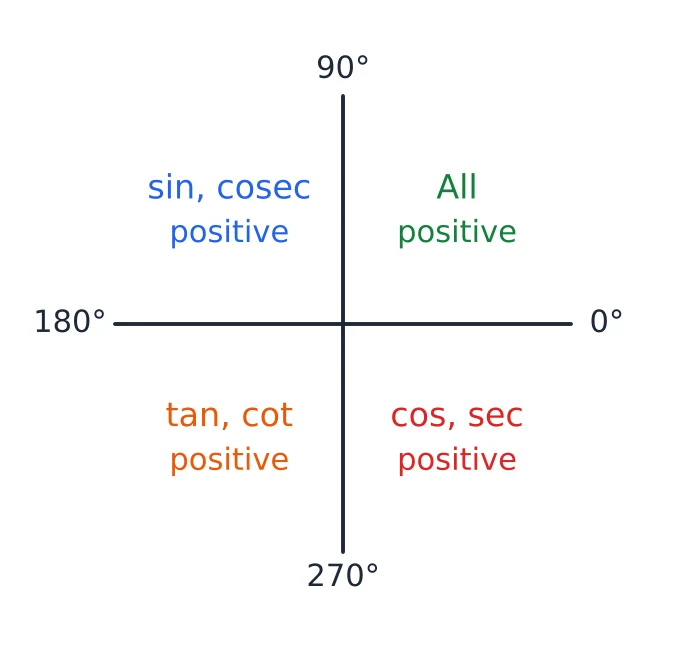
Find the quadrant and write down the sign from the figure.
Write the angle as 180∘±θ or 360∘−θ and keep the same ratio, or as 90∘±θ or 270∘±θ and switch to the co-ratio (sin to cos, tan to cot, sec to cosec).
A common way to remember the signs, going anticlockwise from the first quadrant, is All, Sin, Tan, Cos.
For example:sin1290∘. Take off 3×360∘=1080∘ to leave 210∘, which is in the third quadrant, where sin is negative. As 210∘=180∘+30∘, sin1290∘=−sin30∘=−21.
Where it fails:
The sign belongs to the quadrant of the original angle, not to 30∘. Writing sin210∘=21 is the usual slip.
With 90∘+θ the ratio switches and the sign still follows the quadrant: cos(90∘+θ)=−sinθ.
Values of 15° and 75°, and Pairs That Add to 45°
From 45∘−30∘ and 45∘+30∘:
Ratio
15∘
75∘
sin
223−1
223+1
cos
223+1
223−1
tan
2−3
2+3
Quick facts from the table: tan15∘+tan75∘=4, tan15∘tan75∘=1 and sin15∘cos15∘=41. Also tan22.5∘=2−1 and tan67.5∘=2+1.
Pairs adding to 45°: if A+B=45∘, then tanA+tanB=1−tanAtanB, which rearranges to (1+tanA)(1+tanB)=2. In cot form, (cotA−1)(cotB−1)=2.
For example:tan275∘+tan215∘=(tan75∘+tan15∘)2−2tan75∘tan15∘=16−2=14.
Where it fails:
tan15∘ is not tan45∘−tan30∘, and sin75∘ is not sin45∘+sin30∘. A ratio of a sum needs the compound-angle formula.
The product 2 needs tan(A+B)=1: A+B=45∘ or 225∘. For A+B=135∘ it is (1−tanA)(1−tanB)=2 instead.
Double Angles Straight from tan
With t=tanθ:
sin2θ=1+t22tcos2θ=1+t21−t2tan2θ=1−t22t
So with t=qp, sin2θ=p2+q22pq and cos2θ=p2+q2q2−p2, with no triangle to draw. Three short simplifications come from the same formulas: sin2θ1−cos2θ=tanθ, sin2θ1+cos2θ=cotθ and 1+cos2θ1−cos2θ=tan2θ.
For example:tanθ=32 gives sin2θ=4+912=1312 and cos2θ=139−4=135.
Where it fails:
sin2θ is not 2sinθ. At θ=30∘, sin60∘=23 while 2sin30∘=1.
tan2θ is not defined when t=1, since 2θ is then 90∘.
Throw Out Impossible Options First
Before any working, cross out what cannot be true:
sinθ and cosθ lie between −1 and 1, while secθ and cosecθ are never between −1 and 1. An option cosθ=25 or secθ=43 is out.
For acute angles, sin and tan grow as the angle grows, and cos shrinks. Below 45∘, cosθ>sinθ; above it, sinθ>cosθ.
sinθ+cosθ is at most 2, and for an acute angle it is more than 1.
Wrong options are usually made from a short list of slips: sin and cos values swapped, 31 written for 3, the reciprocal ratio, a minus sign lost in the second quadrant, an answer in radians without its π, cos(A+B) taken as cosA+cosB, and a+b given as the maximum in place of a2+b2. When two options differ by one of these slips, the answer is usually one of that pair.
For example: which is larger, sin1 or cos1, with the angle in radians? One radian is about 57∘, past 45∘, so sin1 is larger.
Where it fails: these checks narrow the field but seldom pick the answer alone. If two options both pass, work the question out.
Solved Examples
Every question that follows is solved with one of the methods in this section. A few carry a time check; the rest should take about as long once the method is familiar.
Question 1
Find the value of cosec245∘+sec230∘3tan230∘+4cos245∘.
Answer. Everything is squared, so I use the squared values straight away: tan230∘=31, cos245∘=21, cosec245∘=2, sec230∘=34. The top is 1+2=3 and the bottom is 2+34=310, so the value is 3×103 = 109.
Time check: about 15 seconds.
Question 2
Find, in radians, the smaller angle between the hands of a clock at 7:20.
Answer.∣30×7−5.5×20∣=∣210−110∣=100∘, which is less than 180∘, so it stays. In radians, 180100π = 95π.
Question 3
If cosecθ=1385 and θ is acute, find secθ−tanθ.
Answer. Cosec is hypotenuse over opposite, so the opposite side is 13 and the hypotenuse 85. The triplet 13-84-85 gives the adjacent side as 84. Then secθ−tanθ=8485−8413=8472 = 76.
Question 4
If 5cotθ=2, find 5cosθ−sinθ10cosθ+3sinθ.
Answer. Here cot is given, so I divide the top and the bottom by sinθ: 5cotθ−110cotθ+3=2−14+3 = 7.
Question 5
Find cos29∘+cos218∘+cos227∘+⋯+cos281∘+cos290∘.
Answer. From 9∘ to 81∘ in steps of 9 there are 981−9+1=9 terms: four pairs adding to 90∘ (9∘ with 81∘, 18∘ with 72∘, 27∘ with 63∘, 36∘ with 54∘) and the middle term cos245∘=21. The last term cos290∘ is 0, not 1. The sum is 421.
Time check: about 20 seconds.
Question 6
If sin(5θ−8∘)=cos(3θ+18∘), where both angles are acute, find sec(3θ+30∘).
Answer. A sin equal to a cos means the angles add to 90∘: 8θ+10∘=90∘, so θ=10∘. (The angles are 42∘ and 48∘.) Then sec(30∘+30∘)=sec60∘ = 2.
Question 7
Which of these equals (cosecθ−sinθ)(secθ−cosθ)(tanθ+cotθ): 1, tanθ, sinθcosθ or 2?
Answer. I put θ=45∘: (2−21)2×2=21×2=1. That rules out sinθcosθ (which is 21 there) and 2, but tan45∘ is also 1, so I try 60∘: (32−23)(2−21)(3+31)=231×23×34=1. It is 1 again while tan60∘=3, so the expression equals 1.
Question 8
If 1+sinθ1+1−sinθ1=8 and θ is acute, find θ.
Answer. The two denominators are a conjugate pair, so the sum is 1−sin2θ2=2sec2θ. Then 2sec2θ=8, secθ=2 and θ = 60∘.
Answer. Straight from the formula: sinθ=p2+1p2−1=36+136−1 = 3735. (The long way: secθ−tanθ=61, so secθ=1237 and tanθ=1235.)
Time check: about 10 seconds.
Question 11
If cosecθ−cotθ=72, find cosθ.
Answer. The partner is the reciprocal: cosecθ+cotθ=27. Adding and halving, cosecθ=21(27+72)=2853; subtracting and halving, cotθ=2845. So cosθ=cosecθcotθ = 5345.
Question 12
If sinθ−cosθ=71, find tanθ+cotθ.
Answer. Squaring, 1−2sinθcosθ=491, so sinθcosθ=4924. And tanθ+cotθ=sinθcosθsin2θ+cos2θ=sinθcosθ1 = 2449.
Question 13
If sinθ+cosecθ=25 and θ is acute, find cosθ+secθ.
Answer. A number plus its reciprocal equal to 25 means the number is 2 or 21. A sine cannot be 2, so sinθ=21 and θ=30∘. Then cosθ+secθ=23+32=233+4 = 237.
Question 14
If 5cosθ+12sinθ=13, find tanθ.
Answer. Square and add with the partner: (5sinθ−12cosθ)2=25+144−169=0. So 5sinθ=12cosθ and tanθ = 512.
Question 15
Find the greatest and least values of 12sinθ−35cosθ+7.
Answer.144+1225=37 (the 12-35-37 triplet), so the sin and cos part runs from −37 to 37. Adding 7, the greatest value is 44 and the least is −30.
Time check: about 15 seconds.
Question 16
Find the least value of 36sec2θ+25cosec2θ.
Answer. With a=36 and b=25, the least value is (36+25)2=(6+5)2 = 121. Writing it as 61+36tan2θ+25cot2θ shows where it comes from: the last two terms are at least 2900=60.
Question 17
Find the value of tan1215∘+cos(−690∘).
Answer.1215∘−1080∘=135∘, in the second quadrant, where tan is negative, so tan1215∘=−tan45∘=−1. Cos does not care about the minus sign: cos(−690∘)=cos690∘=cos(720∘−30∘)=cos30∘=23. The sum is −1+23 = 23−2.
Question 18
Find tan75∘−tan15∘tan75∘+tan15∘.
Answer.tan75∘=2+3 and tan15∘=2−3, so the top is 4 and the bottom is 23. The value is 32.
Time check: about 10 seconds.
Question 19
If tanθ=31, find sin2θ+cos2θ.
Answer. With p=1 and q=3: sin2θ=1+92×3=53 and cos2θ=109−1=54. The sum is 57.
Ready to test your knowledge?
Take a quick interactive quiz on this topic —
free, works without login.