How to Use These Questions

The 35 questions below mix every part of this chapter in no fixed order, the way a paper does: a clock angle can follow an identity, and an allied angle can follow a maximum value. Before any working, decide what kind of question it is, because that picks the method: a ratio given (draw the triangle), a condition given (square it, or use the reciprocal partner), an expression to simplify (test at 45∘45^\circ, then 30∘30^\circ or 60∘60^\circ), or an angle beyond 90∘90^\circ (sign first).

The five marked [Tier 2] use triple angles, a product of cosines, sin⁡18∘\sin 18^\circ and longer eliminations. A Tier 1 question of this kind should take you under a minute; if one takes longer, find its quick route in Shortcuts & Speed Methods and try it again the next day.

Solved Examples

Question 1

The minute hand of a clock is 21 cm long. How far does its tip move in 40 minutes? (Take π=227\pi = \frac{22}{7}.)

Answer. In 40 minutes the minute hand turns 40×6∘=240∘40 \times 6^\circ = 240^\circ, which is 240180π=4π3\frac{240}{180}\pi = \frac{4\pi}{3} radians. The tip moves along an arc, so l=rθ=21×43×227=28×227l = r\theta = 21 \times \frac{4}{3} \times \frac{22}{7} = 28 \times \frac{22}{7} = 88 cm.

Question 2

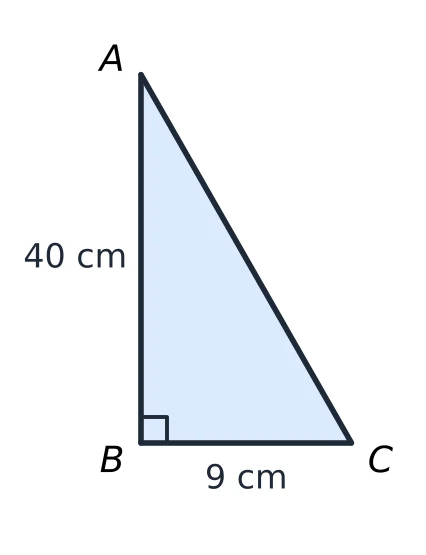
In triangle ABC, right-angled at B, AB = 40 cm and BC = 9 cm. Find sec⁡Acosec⁡C−tan⁡Acot⁡C\sec A\operatorname{cosec} C - \tan A\cot C.

Right triangle ABC with AB 40 cm and BC 9 cm

Answer. First the hypotenuse: AC=1600+81=1681=41AC = \sqrt{1600 + 81} = \sqrt{1681} = 41 cm (the 9-40-41 triplet). At A the opposite side is BC = 9 and the adjacent side is AB = 40; at C it is the other way round. So sec⁡A=4140\sec A = \frac{41}{40}, cosec⁡C=4140\operatorname{cosec} C = \frac{41}{40}, tan⁡A=940\tan A = \frac{9}{40} and cot⁡C=940\cot C = \frac{9}{40}. The value is 16811600−811600=16001600\frac{1681}{1600} - \frac{81}{1600} = \frac{1600}{1600} = 1. This is no accident: A+C=90∘A + C = 90^\circ, so cosec⁡C=sec⁡A\operatorname{cosec} C = \sec A and cot⁡C=tan⁡A\cot C = \tan A, and the expression is just sec⁡2A−tan⁡2A\sec^2 A - \tan^2 A.

Question 3

Find the value of 3cosec⁡260∘+2cot⁡230∘−sec⁡245∘4cos⁡245∘+tan⁡260∘\frac{3\operatorname{cosec}^2 60^\circ + 2\cot^2 30^\circ - \sec^2 45^\circ}{4\cos^2 45^\circ + \tan^2 60^\circ}.

Answer. I write the squared values first: cosec⁡260∘=43\operatorname{cosec}^2 60^\circ = \frac{4}{3}, cot⁡230∘=3\cot^2 30^\circ = 3, sec⁡245∘=2\sec^2 45^\circ = 2, cos⁡245∘=12\cos^2 45^\circ = \frac{1}{2}, tan⁡260∘=3\tan^2 60^\circ = 3. The top is 4+6−2=84 + 6 - 2 = 8 and the bottom is 2+3=52 + 3 = 5, so the value is 85\frac{8}{5}.

Question 4

If cosec⁡θ+cot⁡θ=3\operatorname{cosec}\theta + \cot\theta = 3, find sin⁡θ+cos⁡θ\sin\theta + \cos\theta.

Answer. The partner is the reciprocal: cosec⁡θ−cot⁡θ=13\operatorname{cosec}\theta - \cot\theta = \frac{1}{3}. Adding, 2cosec⁡θ=1032\operatorname{cosec}\theta = \frac{10}{3}, so cosec⁡θ=53\operatorname{cosec}\theta = \frac{5}{3} and sin⁡θ=35\sin\theta = \frac{3}{5}. Subtracting, 2cot⁡θ=832\cot\theta = \frac{8}{3}, so cot⁡θ=43\cot\theta = \frac{4}{3}. Then cos⁡θ=cot⁡θ×sin⁡θ=43×35=45\cos\theta = \cot\theta \times \sin\theta = \frac{4}{3} \times \frac{3}{5} = \frac{4}{5}, and sin⁡θ+cos⁡θ\sin\theta + \cos\theta = 75\frac{7}{5}.

Question 5

Find sin⁡21∘+sin⁡23∘+sin⁡25∘+⋯+sin⁡289∘\sin^2 1^\circ + \sin^2 3^\circ + \sin^2 5^\circ + \cdots + \sin^2 89^\circ.

Answer. These are the odd angles from 1∘1^\circ to 89∘89^\circ, so there are 89−12+1=45\frac{89 - 1}{2} + 1 = 45 terms. They pair up to 90∘90^\circ (1∘1^\circ with 89∘89^\circ, 3∘3^\circ with 87∘87^\circ, …), giving 22 pairs, and the middle term sin⁡245∘=12\sin^2 45^\circ = \frac{1}{2} is left alone. The sum is 22+1222 + \frac{1}{2} = 221222\frac{1}{2}.

Question 6

If cos⁡θ1−sin⁡θ+cos⁡θ1+sin⁡θ=4\frac{\cos\theta}{1 - \sin\theta} + \frac{\cos\theta}{1 + \sin\theta} = 4 and θ\theta is acute, find θ\theta.

Answer. Over a common denominator the left side is cos⁡θ(1+sin⁡θ+1−sin⁡θ)1−sin⁡2θ=2cos⁡θcos⁡2θ=2sec⁡θ\frac{\cos\theta(1 + \sin\theta + 1 - \sin\theta)}{1 - \sin^2\theta} = \frac{2\cos\theta}{\cos^2\theta} = 2\sec\theta. So 2sec⁡θ=42\sec\theta = 4, sec⁡θ=2\sec\theta = 2, and θ\theta = 60∘60^\circ.

Question 7

Find the value of sin⁡150∘−5cos⁡300∘+7tan⁡225∘tan⁡135∘+3sin⁡210∘\frac{\sin 150^\circ - 5\cos 300^\circ + 7\tan 225^\circ}{\tan 135^\circ + 3\sin 210^\circ}.

Answer. One angle at a time, sign first:

  • 150∘150^\circ is in the second quadrant, where sin is positive: sin⁡150∘=sin⁡30∘=12\sin 150^\circ = \sin 30^\circ = \frac{1}{2}.
  • 300∘300^\circ is in the fourth, where cos is positive: cos⁡300∘=cos⁡60∘=12\cos 300^\circ = \cos 60^\circ = \frac{1}{2}.
  • 225∘225^\circ is in the third, where tan is positive: tan⁡225∘=tan⁡45∘=1\tan 225^\circ = \tan 45^\circ = 1.
  • tan⁡135∘=−tan⁡45∘=−1\tan 135^\circ = -\tan 45^\circ = -1 and sin⁡210∘=−sin⁡30∘=−12\sin 210^\circ = -\sin 30^\circ = -\frac{1}{2}.

The top is 12−52+7=5\frac{1}{2} - \frac{5}{2} + 7 = 5 and the bottom is −1−32=−52-1 - \frac{3}{2} = -\frac{5}{2}, so the value is −2-2.

Question 8

Express 47∘30′47^\circ 30' in radians.

Answer. 30′30' is half a degree, so the angle is 47.5∘=95247.5^\circ = \frac{95}{2} degrees. In radians that is 952×π180=95π360\frac{95}{2} \times \frac{\pi}{180} = \frac{95\pi}{360} = 19π72\frac{19\pi}{72}.

Question 9

If 15cos⁡2θ+2sin⁡θ=715\cos^2\theta + 2\sin\theta = 7 and θ\theta is acute, find cot⁡θ\cot\theta.

Answer. I change cos⁡2θ\cos^2\theta to 1−sin⁡2θ1 - \sin^2\theta so that only sin is left: 15−15sin⁡2θ+2sin⁡θ=715 - 15\sin^2\theta + 2\sin\theta = 7, that is 15sin⁡2θ−2sin⁡θ−8=015\sin^2\theta - 2\sin\theta - 8 = 0. This factorises as (5sin⁡θ−4)(3sin⁡θ+2)=0(5\sin\theta - 4)(3\sin\theta + 2) = 0. An acute angle has a positive sine, so sin⁡θ=45\sin\theta = \frac{4}{5}. Then cos⁡θ=35\cos\theta = \frac{3}{5} and cot⁡θ\cot\theta = 34\frac{3}{4}.

Question 10

If tan⁡A=34\tan A = \frac{3}{4} and tan⁡B=724\tan B = \frac{7}{24}, where A and B are acute, find tan⁡(A+B)\tan(A + B) and sin⁡(A+B)\sin(A + B).

Answer. tan⁡(A+B)=tan⁡A+tan⁡B1−tan⁡Atan⁡B=34+7241−732=25242532=3224\tan(A + B) = \frac{\tan A + \tan B}{1 - \tan A\tan B} = \frac{\frac{3}{4} + \frac{7}{24}}{1 - \frac{7}{32}} = \frac{\frac{25}{24}}{\frac{25}{32}} = \frac{32}{24} = 43\frac{4}{3}. It is positive, so A+BA + B is acute, and a tan of 43\frac{4}{3} belongs to the 3-4-5 triangle. So sin⁡(A+B)\sin(A + B) = 45\frac{4}{5}.

Question 11

Simplify cos⁡θcosec⁡θ+1+cos⁡θcosec⁡θ−1\frac{\cos\theta}{\operatorname{cosec}\theta + 1} + \frac{\cos\theta}{\operatorname{cosec}\theta - 1}.

Answer. I multiply the top and the bottom of each fraction by sin⁡θ\sin\theta, which turns the cosecs into 1s: sin⁡θcos⁡θ1+sin⁡θ+sin⁡θcos⁡θ1−sin⁡θ\frac{\sin\theta\cos\theta}{1 + \sin\theta} + \frac{\sin\theta\cos\theta}{1 - \sin\theta}. The denominators are a conjugate pair, so the sum is sin⁡θcos⁡θ×(1−sin⁡θ)+(1+sin⁡θ)1−sin⁡2θ=2sin⁡θcos⁡θcos⁡2θ\sin\theta\cos\theta \times \frac{(1 - \sin\theta) + (1 + \sin\theta)}{1 - \sin^2\theta} = \frac{2\sin\theta\cos\theta}{\cos^2\theta} = 2tan⁡θ2\tan\theta.

Question 12

Find the greatest and least values of sin⁡2θ+cos⁡θ\sin^2\theta + \cos\theta.

Answer. One term is squared and the other is not, so the a2+b2\sqrt{a^2 + b^2} rule does not apply. I write everything in c=cos⁡θc = \cos\theta: 1−c2+c=54−(c−12)21 - c^2 + c = \frac{5}{4} - \left(c - \frac{1}{2}\right)^2. The square is 0 when c=12c = \frac{1}{2} (θ=60∘\theta = 60^\circ), so the greatest value is 54\frac{5}{4}. The square is largest when c is as far from 12\frac{1}{2} as it can go, which is c=−1c = -1 (θ=180∘\theta = 180^\circ); then the value is 1−1−11 - 1 - 1 = −1-1.

Question 13 [Tier 2]

Find the value of cos⁡36∘cos⁡72∘\cos 36^\circ\cos 72^\circ.

Answer. I multiply and divide by sin⁡36∘\sin 36^\circ and use 2sin⁡xcos⁡x=sin⁡2x2\sin x\cos x = \sin 2x twice: sin⁡36∘cos⁡36∘cos⁡72∘=12sin⁡72∘cos⁡72∘=14sin⁡144∘\sin 36^\circ\cos 36^\circ\cos 72^\circ = \frac{1}{2}\sin 72^\circ\cos 72^\circ = \frac{1}{4}\sin 144^\circ. Since sin⁡144∘=sin⁡(180∘−36∘)=sin⁡36∘\sin 144^\circ = \sin(180^\circ - 36^\circ) = \sin 36^\circ, dividing by sin⁡36∘\sin 36^\circ leaves 14\frac{1}{4}.

Question 14

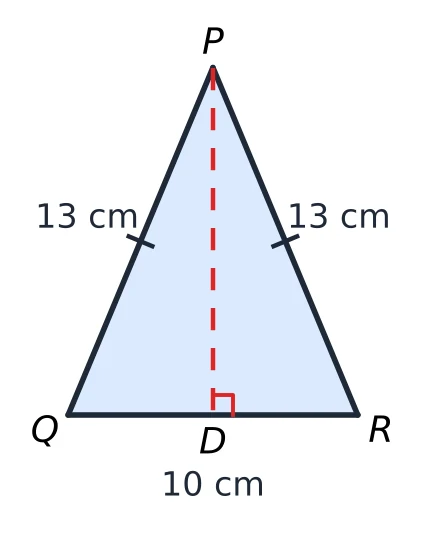
In triangle PQR, PQ = PR = 13 cm and QR = 10 cm. Find sin⁡Q\sin Q and tan⁡P2\tan\frac{P}{2}.

Isosceles triangle PQR with altitude PD

Answer. The altitude PD from P cuts QR in half, so QD = 5 cm, and triangle PDQ has hypotenuse 13 and one side 5. That makes PD = 12 cm (5-12-13). So sin⁡Q=PDPQ\sin Q = \frac{PD}{PQ} = 1213\frac{12}{13}. The altitude also cuts angle P in half, so in triangle PDQ the angle at P is P2\frac{P}{2}, with opposite side QD = 5 and adjacent side PD = 12. So tan⁡P2\tan\frac{P}{2} = 512\frac{5}{12}.

Question 15

If cos⁡(A+B)=0\cos(A + B) = 0 and sin⁡(A−B)=32\sin(A - B) = \frac{\sqrt{3}}{2}, where A and B are acute and A>BA > B, find A and B, and the value of tan⁡Atan⁡B\tan A\tan B.

Answer. cos⁡(A+B)=0\cos(A + B) = 0 gives A+B=90∘A + B = 90^\circ, and sin⁡(A−B)=32\sin(A - B) = \frac{\sqrt{3}}{2} gives A−B=60∘A - B = 60^\circ. Adding and halving, A=75∘A = 75^\circ and B=15∘B = 15^\circ. The two angles add to 90∘90^\circ, so tan⁡B=cot⁡A\tan B = \cot A and tan⁡Atan⁡B\tan A\tan B = 1. With the values, (2+3)(2−3)=4−3=1(2 + \sqrt{3})(2 - \sqrt{3}) = 4 - 3 = 1 agrees.

Question 16

Find the value of cos⁡38∘sin⁡52∘+tan⁡24∘cot⁡66∘−3tan⁡12∘tan⁡40∘tan⁡50∘tan⁡78∘sin⁡233∘+sin⁡257∘\frac{\cos 38^\circ}{\sin 52^\circ} + \frac{\tan 24^\circ}{\cot 66^\circ} - \frac{3\tan 12^\circ\tan 40^\circ\tan 50^\circ\tan 78^\circ}{\sin^2 33^\circ + \sin^2 57^\circ}.

Answer. Each pair of angles adds to 90∘90^\circ. cos⁡38∘=sin⁡52∘\cos 38^\circ = \sin 52^\circ, so the first fraction is 1, and tan⁡24∘=cot⁡66∘\tan 24^\circ = \cot 66^\circ, so the second is 1 too. In the last fraction, tan⁡12∘tan⁡78∘=1\tan 12^\circ\tan 78^\circ = 1 and tan⁡40∘tan⁡50∘=1\tan 40^\circ\tan 50^\circ = 1, so the top is 3; the bottom is sin⁡233∘+cos⁡233∘=1\sin^2 33^\circ + \cos^2 33^\circ = 1. The value is 1+1−31 + 1 - 3 = −1-1.

Question 17

If tan⁡θ+cot⁡θ=22\tan\theta + \cot\theta = 2\sqrt{2}, find tan⁡3θ+cot⁡3θ\tan^3\theta + \cot^3\theta.

Answer. With x=tan⁡θx = \tan\theta, I have x+1x=22x + \frac{1}{x} = 2\sqrt{2}, and the cube rule from algebra (see Chapter 11) gives x3+1x3=(x+1x)3−3(x+1x)=162−62x^3 + \frac{1}{x^3} = \left(x + \frac{1}{x}\right)^3 - 3\left(x + \frac{1}{x}\right) = 16\sqrt{2} - 6\sqrt{2} = 10210\sqrt{2}.

Question 18

Simplify tan⁡2θsec⁡θ−1+cot⁡2θcosec⁡θ−1\frac{\tan^2\theta}{\sec\theta - 1} + \frac{\cot^2\theta}{\operatorname{cosec}\theta - 1}, and find its least value for an acute angle θ\theta.

Answer. tan⁡2θ=sec⁡2θ−1=(sec⁡θ−1)(sec⁡θ+1)\tan^2\theta = \sec^2\theta - 1 = (\sec\theta - 1)(\sec\theta + 1), so the first fraction is sec⁡θ+1\sec\theta + 1. In the same way cot⁡2θ=(cosec⁡θ−1)(cosec⁡θ+1)\cot^2\theta = (\operatorname{cosec}\theta - 1)(\operatorname{cosec}\theta + 1), and the second fraction is cosec⁡θ+1\operatorname{cosec}\theta + 1. The sum is sec⁡θ+cosec⁡θ+2\sec\theta + \operatorname{cosec}\theta + 2. For the least value, AM-GM gives sec⁡θ+cosec⁡θ≥2sec⁡θcosec⁡θ\sec\theta + \operatorname{cosec}\theta \ge 2\sqrt{\sec\theta\operatorname{cosec}\theta}, and sec⁡θcosec⁡θ=1sin⁡θcos⁡θ\sec\theta\operatorname{cosec}\theta = \frac{1}{\sin\theta\cos\theta} is at least 2. Both become equalities at 45∘45^\circ, where the sum is 2+2\sqrt{2} + \sqrt{2}, so the least value is 2+222 + 2\sqrt{2}.

Question 19

Simplify sin⁡(180∘−θ)cos⁡(90∘+θ)tan⁡(270∘−θ)cos⁡(360∘−θ)sin⁡(90∘+θ)cot⁡(180∘+θ)\frac{\sin(180^\circ - \theta)\cos(90^\circ + \theta)\tan(270^\circ - \theta)}{\cos(360^\circ - \theta)\sin(90^\circ + \theta)\cot(180^\circ + \theta)}.

Answer. Taking θ\theta as a small acute angle, I find each quadrant and sign:

  • sin⁡(180∘−θ)=sin⁡θ\sin(180^\circ - \theta) = \sin\theta (second quadrant, sin positive)
  • cos⁡(90∘+θ)=−sin⁡θ\cos(90^\circ + \theta) = -\sin\theta (second quadrant, cos negative, and 90∘90^\circ switches the ratio)
  • tan⁡(270∘−θ)=cot⁡θ\tan(270^\circ - \theta) = \cot\theta (third quadrant, tan positive, and 270∘270^\circ switches the ratio)
  • cos⁡(360∘−θ)=cos⁡θ\cos(360^\circ - \theta) = \cos\theta, sin⁡(90∘+θ)=cos⁡θ\sin(90^\circ + \theta) = \cos\theta, cot⁡(180∘+θ)=cot⁡θ\cot(180^\circ + \theta) = \cot\theta

So the value is sin⁡θ×(−sin⁡θ)×cot⁡θcos⁡θ×cos⁡θ×cot⁡θ\frac{\sin\theta \times (-\sin\theta) \times \cot\theta}{\cos\theta \times \cos\theta \times \cot\theta} = −tan⁡2θ-\tan^2\theta.

Question 20

Find the value of (cot⁡11∘−1)(cot⁡34∘−1)(\cot 11^\circ - 1)(\cot 34^\circ - 1).

Answer. 11∘+34∘=45∘11^\circ + 34^\circ = 45^\circ, so cot⁡(A+B)=1\cot(A + B) = 1, which means cot⁡Acot⁡B−1cot⁡A+cot⁡B=1\frac{\cot A\cot B - 1}{\cot A + \cot B} = 1. Cross-multiplying, cot⁡Acot⁡B−cot⁡A−cot⁡B=1\cot A\cot B - \cot A - \cot B = 1. Adding 1 to both sides turns the left side into (cot⁡A−1)(cot⁡B−1)(\cot A - 1)(\cot B - 1), so the value is 2.

Question 21 [Tier 2]

If sin⁡θ=msin⁡ϕ\sin\theta = m\sin\phi and tan⁡θ=ntan⁡ϕ\tan\theta = n\tan\phi, show that cos⁡2θ=m2−1n2−1\cos^2\theta = \frac{m^2 - 1}{n^2 - 1}.

Answer. Dividing the first equation by the second gives cos⁡θ=mncos⁡ϕ\cos\theta = \frac{m}{n}\cos\phi. So sin⁡ϕ=sin⁡θm\sin\phi = \frac{\sin\theta}{m} and cos⁡ϕ=ncos⁡θm\cos\phi = \frac{n\cos\theta}{m}. Now ϕ\phi has to go, and sin⁡2ϕ+cos⁡2ϕ=1\sin^2\phi + \cos^2\phi = 1 does that: sin⁡2θm2+n2cos⁡2θm2=1\frac{\sin^2\theta}{m^2} + \frac{n^2\cos^2\theta}{m^2} = 1, that is sin⁡2θ+n2cos⁡2θ=m2\sin^2\theta + n^2\cos^2\theta = m^2. Writing sin⁡2θ=1−cos⁡2θ\sin^2\theta = 1 - \cos^2\theta gives 1+(n2−1)cos⁡2θ=m21 + (n^2 - 1)\cos^2\theta = m^2, so cos⁡2θ=m2−1n2−1\cos^2\theta = \frac{m^2 - 1}{n^2 - 1}.

Question 22

The angles of a triangle are in the ratio 2 : 5 : 8. Find the largest angle in radians.

Answer. The parts add to 15, so the largest angle is 815×180∘=96∘\frac{8}{15} \times 180^\circ = 96^\circ. Since 180∘180^\circ is π\pi radians, it is simply 815\frac{8}{15} of π\pi: 8π15\frac{8\pi}{15}.

Question 23

If sin⁡θ−cos⁡θ=713\sin\theta - \cos\theta = \frac{7}{13} and θ\theta is acute, find sin⁡θ+cos⁡θ\sin\theta + \cos\theta.

Answer. Squaring, 1−2sin⁡θcos⁡θ=491691 - 2\sin\theta\cos\theta = \frac{49}{169}, so 2sin⁡θcos⁡θ=1201692\sin\theta\cos\theta = \frac{120}{169}. Then (sin⁡θ+cos⁡θ)2=1+120169=289169(\sin\theta + \cos\theta)^2 = 1 + \frac{120}{169} = \frac{289}{169}. For an acute angle the sum is positive, so sin⁡θ+cos⁡θ\sin\theta + \cos\theta = 1713\frac{17}{13}.

Question 24

Find the greatest and least values of 15sin⁡θ−8cos⁡θ15\sin\theta - 8\cos\theta, and of 15sin⁡2θ+8cos⁡2θ15\sin^2\theta + 8\cos^2\theta.

Answer. For the first, 225+64=17\sqrt{225 + 64} = 17, so it runs from −17-17 to 17. The second has squares, so I write it as 8+7sin⁡2θ8 + 7\sin^2\theta; with sin⁡2θ\sin^2\theta going from 0 to 1, it runs from 8 to 15. The two look alike but need different methods: the first can go negative, the second never can.

Question 25

In triangle ABC, cos⁡B+C2=35\cos\frac{B + C}{2} = \frac{3}{5}. Find tan⁡A2\tan\frac{A}{2}.

Answer. The angles add to 180∘180^\circ, so B+C2=90∘−A2\frac{B + C}{2} = 90^\circ - \frac{A}{2} and cos⁡B+C2=sin⁡A2=35\cos\frac{B + C}{2} = \sin\frac{A}{2} = \frac{3}{5}. Half of a triangle's angle is acute, so cos⁡A2=45\cos\frac{A}{2} = \frac{4}{5}, and tan⁡A2\tan\frac{A}{2} = 34\frac{3}{4}.

Question 26

Simplify 1−cos⁡2θ+sin⁡2θ1+cos⁡2θ+sin⁡2θ\frac{1 - \cos 2\theta + \sin 2\theta}{1 + \cos 2\theta + \sin 2\theta}.

Answer. I use 1−cos⁡2θ=2sin⁡2θ1 - \cos 2\theta = 2\sin^2\theta, 1+cos⁡2θ=2cos⁡2θ1 + \cos 2\theta = 2\cos^2\theta and sin⁡2θ=2sin⁡θcos⁡θ\sin 2\theta = 2\sin\theta\cos\theta. The top becomes 2sin⁡θ(sin⁡θ+cos⁡θ)2\sin\theta(\sin\theta + \cos\theta) and the bottom 2cos⁡θ(cos⁡θ+sin⁡θ)2\cos\theta(\cos\theta + \sin\theta). The brackets cancel and the answer is tan⁡θ\tan\theta.

Question 27

Find the value of sin⁡1200∘cos⁡(−1050∘)\sin 1200^\circ\cos(-1050^\circ).

Answer. 1200∘−3×360∘=120∘1200^\circ - 3 \times 360^\circ = 120^\circ, in the second quadrant where sin is positive: sin⁡1200∘=sin⁡60∘=32\sin 1200^\circ = \sin 60^\circ = \frac{\sqrt{3}}{2}. For the cos, the minus sign goes away, and 1050∘−2×360∘=330∘1050^\circ - 2 \times 360^\circ = 330^\circ, in the fourth quadrant where cos is positive: cos⁡330∘=cos⁡30∘=32\cos 330^\circ = \cos 30^\circ = \frac{\sqrt{3}}{2}. The product is 34\frac{3}{4}.

Question 28

If 2cos⁡3θ−1=0\sqrt{2}\cos 3\theta - 1 = 0 and 3θ3\theta is acute, find θ\theta and the value of sin⁡2θ+tan⁡3θ\sin 2\theta + \tan 3\theta.

Answer. cos⁡3θ=12\cos 3\theta = \frac{1}{\sqrt{2}}, so 3θ=45∘3\theta = 45^\circ and θ=15∘\theta = 15^\circ. Then sin⁡30∘+tan⁡45∘=12+1\sin 30^\circ + \tan 45^\circ = \frac{1}{2} + 1 = 32\frac{3}{2}.

Question 29

If x=5sec⁡θ+2tan⁡θx = 5\sec\theta + 2\tan\theta and y=5tan⁡θ+2sec⁡θy = 5\tan\theta + 2\sec\theta, find x2−y2x^2 - y^2.

Answer. Squaring, x2=25sec⁡2θ+20sec⁡θtan⁡θ+4tan⁡2θx^2 = 25\sec^2\theta + 20\sec\theta\tan\theta + 4\tan^2\theta and y2=25tan⁡2θ+20sec⁡θtan⁡θ+4sec⁡2θy^2 = 25\tan^2\theta + 20\sec\theta\tan\theta + 4\sec^2\theta. The middle terms cancel when I subtract: x2−y2=21sec⁡2θ−21tan⁡2θ=21(sec⁡2θ−tan⁡2θ)x^2 - y^2 = 21\sec^2\theta - 21\tan^2\theta = 21(\sec^2\theta - \tan^2\theta) = 21.

Question 30 [Tier 2]

Find the value of 3sin⁡40∘−4sin⁡340∘4cos⁡340∘−3cos⁡40∘\frac{3\sin 40^\circ - 4\sin^3 40^\circ}{4\cos^3 40^\circ - 3\cos 40^\circ}.

Answer. The top is sin⁡3θ\sin 3\theta and the bottom is cos⁡3θ\cos 3\theta with θ=40∘\theta = 40^\circ, so the fraction is tan⁡120∘\tan 120^\circ. That is in the second quadrant, where tan is negative: tan⁡120∘=−tan⁡60∘\tan 120^\circ = -\tan 60^\circ = −3-\sqrt{3}.

Question 31

Find the value of (2sin⁡θ+3cos⁡θ)2+(3sin⁡θ−2cos⁡θ)2(2\sin\theta + 3\cos\theta)^2 + (3\sin\theta - 2\cos\theta)^2.

Answer. Expanding, the cross terms are +12sin⁡θcos⁡θ+12\sin\theta\cos\theta and −12sin⁡θcos⁡θ-12\sin\theta\cos\theta, so they cancel. What is left is 4sin⁡2θ+9cos⁡2θ+9sin⁡2θ+4cos⁡2θ=13(sin⁡2θ+cos⁡2θ)4\sin^2\theta + 9\cos^2\theta + 9\sin^2\theta + 4\cos^2\theta = 13(\sin^2\theta + \cos^2\theta) = 13, the same for every θ\theta.

Question 32

Find the value of sin⁡105∘+cos⁡105∘\sin 105^\circ + \cos 105^\circ.

Answer. 105∘=60∘+45∘105^\circ = 60^\circ + 45^\circ. So sin⁡105∘=32×12+12×12=3+122\sin 105^\circ = \frac{\sqrt{3}}{2} \times \frac{1}{\sqrt{2}} + \frac{1}{2} \times \frac{1}{\sqrt{2}} = \frac{\sqrt{3} + 1}{2\sqrt{2}}, and cos⁡105∘=12×12−32×12=1−322\cos 105^\circ = \frac{1}{2} \times \frac{1}{\sqrt{2}} - \frac{\sqrt{3}}{2} \times \frac{1}{\sqrt{2}} = \frac{1 - \sqrt{3}}{2\sqrt{2}}, which is negative, as it should be in the second quadrant. Adding, the 3\sqrt{3} terms cancel: 222\frac{2}{2\sqrt{2}} = 12\frac{1}{\sqrt{2}}.

Question 33

If sec⁡θ−tan⁡θ=13\sec\theta - \tan\theta = \frac{1}{\sqrt{3}}, find the acute angle θ\theta.

Answer. The partner is the reciprocal: sec⁡θ+tan⁡θ=3\sec\theta + \tan\theta = \sqrt{3}. Adding the two and halving, sec⁡θ=12(3+13)=12×43=23\sec\theta = \frac{1}{2}\left(\sqrt{3} + \frac{1}{\sqrt{3}}\right) = \frac{1}{2} \times \frac{4}{\sqrt{3}} = \frac{2}{\sqrt{3}}. So cos⁡θ=32\cos\theta = \frac{\sqrt{3}}{2} and θ\theta = 30∘30^\circ. As a check, tan⁡30∘=13\tan 30^\circ = \frac{1}{\sqrt{3}} and 23−13=13\frac{2}{\sqrt{3}} - \frac{1}{\sqrt{3}} = \frac{1}{\sqrt{3}}.

Question 34 [Tier 2]

Using sin⁡18∘=5−14\sin 18^\circ = \frac{\sqrt{5} - 1}{4}, find sin⁡254∘−sin⁡218∘\sin^2 54^\circ - \sin^2 18^\circ.

Answer. First, sin⁡54∘=cos⁡36∘\sin 54^\circ = \cos 36^\circ, since the angles add to 90∘90^\circ. And cos⁡36∘=1−2sin⁡218∘=1−2×6−2516=5+14\cos 36^\circ = 1 - 2\sin^2 18^\circ = 1 - 2 \times \frac{6 - 2\sqrt{5}}{16} = \frac{\sqrt{5} + 1}{4}. So sin⁡254∘−sin⁡218∘=(5+1)2−(5−1)216=4516\sin^2 54^\circ - \sin^2 18^\circ = \frac{(\sqrt{5} + 1)^2 - (\sqrt{5} - 1)^2}{16} = \frac{4\sqrt{5}}{16} = 54\frac{\sqrt{5}}{4}.

Question 35 [Tier 2]

If cos⁡4αcos⁡2β+sin⁡4αsin⁡2β=1\frac{\cos^4\alpha}{\cos^2\beta} + \frac{\sin^4\alpha}{\sin^2\beta} = 1, find cos⁡4βcos⁡2α+sin⁡4βsin⁡2α\frac{\cos^4\beta}{\cos^2\alpha} + \frac{\sin^4\beta}{\sin^2\alpha}.

Answer. I write a=cos⁡2αa = \cos^2\alpha and b=cos⁡2βb = \cos^2\beta, so the condition is a2b+(1−a)21−b=1\frac{a^2}{b} + \frac{(1 - a)^2}{1 - b} = 1. Multiplying by b(1−b)b(1 - b): a2(1−b)+(1−a)2b=b(1−b)a^2(1 - b) + (1 - a)^2b = b(1 - b). Expanding and cancelling leaves a2−2ab+b2=0a^2 - 2ab + b^2 = 0, so (a−b)2=0(a - b)^2 = 0 and a=ba = b. So cos⁡2α=cos⁡2β\cos^2\alpha = \cos^2\beta and sin⁡2α=sin⁡2β\sin^2\alpha = \sin^2\beta, and the second expression becomes cos⁡2β+sin⁡2β\cos^2\beta + \sin^2\beta = 1.