The Three Identities from One Right Triangle

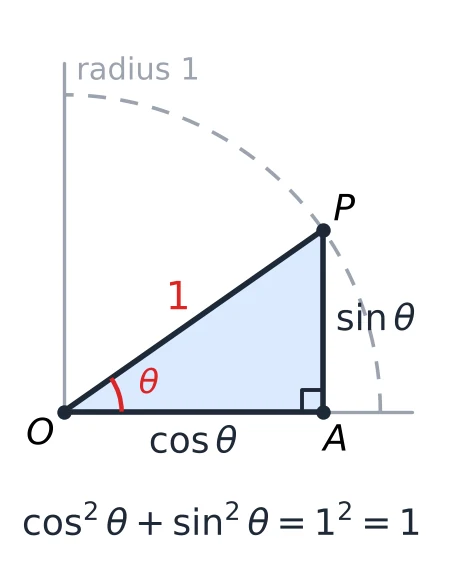
Take a right triangle OAP whose hypotenuse OP is 1 unit long, with the angle θ\theta at O. Then sin⁡θ=APOP=AP\sin\theta = \frac{AP}{OP} = AP and cos⁡θ=OAOP=OA\cos\theta = \frac{OA}{OP} = OA. So the two shorter sides are simply sin⁡θ\sin\theta and cos⁡θ\cos\theta.

Right triangle with hypotenuse 1 inside a quarter circle

Pythagoras on this triangle gives the first and most basic identity:

sin⁡2θ+cos⁡2θ=1\sin^2\theta + \cos^2\theta = 1

Here sin⁡2θ\sin^2\theta means (sin⁡θ)2(\sin\theta)^2, the square of the ratio. It does not mean sin⁡(θ2)\sin(\theta^2).

The other two identities come from dividing this one. Divide every term by cos⁡2θ\cos^2\theta:

sin⁡2θcos⁡2θ+1=1cos⁡2θ⇒tan⁡2θ+1=sec⁡2θ\frac{\sin^2\theta}{\cos^2\theta} + 1 = \frac{1}{\cos^2\theta} \Rightarrow \tan^2\theta + 1 = \sec^2\theta

Divide every term by sin⁡2θ\sin^2\theta instead:

1+cos⁡2θsin⁡2θ=1sin⁡2θ⇒1+cot⁡2θ=cosec⁡2θ1 + \frac{\cos^2\theta}{\sin^2\theta} = \frac{1}{\sin^2\theta} \Rightarrow 1 + \cot^2\theta = \operatorname{cosec}^2\theta

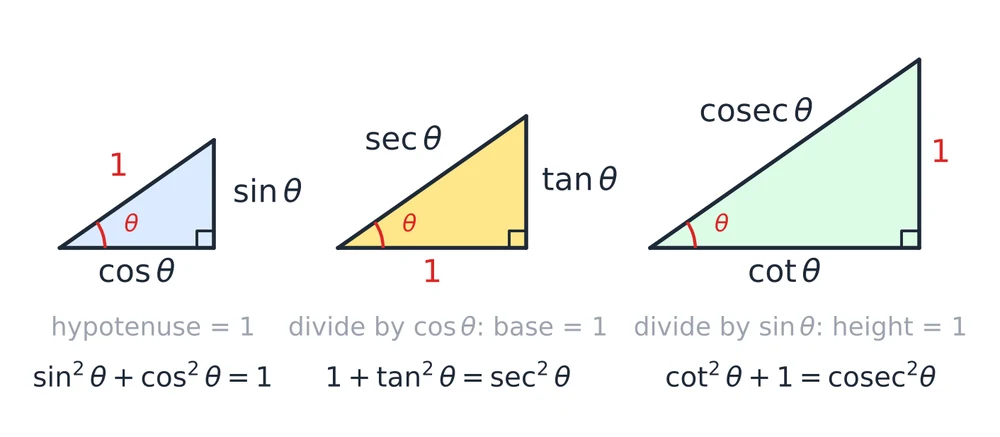
The same thing in pictures: shrink or stretch the first triangle until its base is 1, and its sides become 1, tan⁡θ\tan\theta and sec⁡θ\sec\theta; stretch it until its height is 1, and they become cot⁡θ\cot\theta, 1 and cosec⁡θ\operatorname{cosec}\theta. Pythagoras on each triangle gives one identity.

Three similar right triangles giving the three identities

A check with θ=30∘\theta = 30^\circ: sin⁡230∘+cos⁡230∘=14+34=1\sin^2 30^\circ + \cos^2 30^\circ = \frac{1}{4} + \frac{3}{4} = 1, and 1+tan⁡230∘=1+13=431 + \tan^2 30^\circ = 1 + \frac{1}{3} = \frac{4}{3}, which is sec⁡230∘\sec^2 30^\circ because sec⁡30∘=23\sec 30^\circ = \frac{2}{\sqrt{3}}.

These hold for every angle at which the ratios are defined. That is what makes them identities, and it is the difference between an identity and an equation such as sin⁡θ=12\sin\theta = \frac{1}{2}, which is true only for particular angles.

Every Rearrangement, and the Factor Forms

In questions the identities seldom appear in the shape you learnt them. Know each one in all its forms:

Identity Rearranged Factor form
sin⁡2θ+cos⁡2θ=1\sin^2\theta + \cos^2\theta = 1 sin⁡2θ=1−cos⁡2θ\sin^2\theta = 1 - \cos^2\theta, cos⁡2θ=1−sin⁡2θ\cos^2\theta = 1 - \sin^2\theta (1−sin⁡θ)(1+sin⁡θ)=cos⁡2θ(1 - \sin\theta)(1 + \sin\theta) = \cos^2\theta, (1−cos⁡θ)(1+cos⁡θ)=sin⁡2θ(1 - \cos\theta)(1 + \cos\theta) = \sin^2\theta
sec⁡2θ−tan⁡2θ=1\sec^2\theta - \tan^2\theta = 1 sec⁡2θ=1+tan⁡2θ\sec^2\theta = 1 + \tan^2\theta, tan⁡2θ=sec⁡2θ−1\tan^2\theta = \sec^2\theta - 1 (sec⁡θ−1)(sec⁡θ+1)=tan⁡2θ(\sec\theta - 1)(\sec\theta + 1) = \tan^2\theta
cosec⁡2θ−cot⁡2θ=1\operatorname{cosec}^2\theta - \cot^2\theta = 1 cosec⁡2θ=1+cot⁡2θ\operatorname{cosec}^2\theta = 1 + \cot^2\theta, cot⁡2θ=cosec⁡2θ−1\cot^2\theta = \operatorname{cosec}^2\theta - 1 (cosec⁡θ−1)(cosec⁡θ+1)=cot⁡2θ(\operatorname{cosec}\theta - 1)(\operatorname{cosec}\theta + 1) = \cot^2\theta

When you see 1 minus a square, or two brackets that differ only in a sign, look for one of these. A few lines show how fast they work:

  • (1−cos⁡2θ)cosec⁡2θ=sin⁡2θ×1sin⁡2θ=1(1 - \cos^2\theta)\operatorname{cosec}^2\theta = \sin^2\theta \times \frac{1}{\sin^2\theta} = 1
  • cos⁡2θ(1+tan⁡2θ)=cos⁡2θ×sec⁡2θ=1\cos^2\theta(1 + \tan^2\theta) = \cos^2\theta \times \sec^2\theta = 1
  • (sec⁡2θ−1)(1−sin⁡2θ)=tan⁡2θcos⁡2θ=sin⁡2θ(\sec^2\theta - 1)(1 - \sin^2\theta) = \tan^2\theta\cos^2\theta = \sin^2\theta
  • 11+tan⁡2θ+11+cot⁡2θ=cos⁡2θ+sin⁡2θ=1\frac{1}{1 + \tan^2\theta} + \frac{1}{1 + \cot^2\theta} = \cos^2\theta + \sin^2\theta = 1

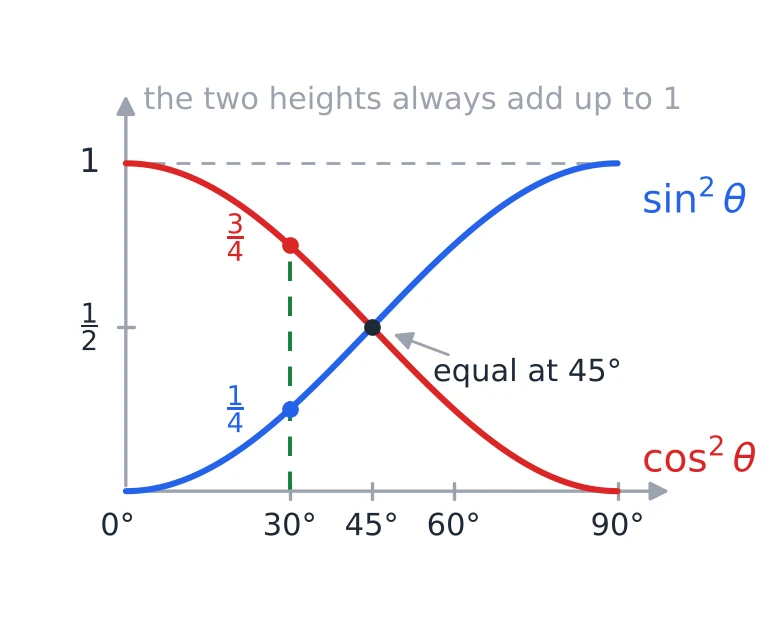
The graph shows sin⁡2θ\sin^2\theta and cos⁡2θ\cos^2\theta for angles from 0° to 90°. Whatever the angle, the two heights add up to 1. They are equal only at 45°, where each is 12\frac{1}{2}; that fact matters later, when options are tested at 45°.

Graphs of sin squared and cos squared adding to 1

Numbers work the same way. 5sin⁡237∘+5cos⁡237∘=55\sin^2 37^\circ + 5\cos^2 37^\circ = 5 and 7sec⁡220∘−7tan⁡220∘=77\sec^2 20^\circ - 7\tan^2 20^\circ = 7, without knowing any of the separate values. The angle can be anything, as long as it is the same angle in both terms.

Same angle only. sin⁡230∘+cos⁡260∘\sin^2 30^\circ + \cos^2 60^\circ is not 1. It is 14+14=12\frac{1}{4} + \frac{1}{4} = \frac{1}{2}. The identity joins sin⁡2\sin^2 and cos⁡2\cos^2 of one angle; for two different angles it says nothing (unless they are complementary, which is a separate rule, see Standard Angles and Complementary Angles).

Square of a sum is not a sum of squares. sin⁡2θ+cos⁡2θ=1\sin^2\theta + \cos^2\theta = 1 does not give sin⁡θ+cos⁡θ=1\sin\theta + \cos\theta = 1. At θ=45∘\theta = 45^\circ the sum sin⁡θ+cos⁡θ\sin\theta + \cos\theta is 2\sqrt{2}.

When Stuck, Write Everything in sin⁡θ\sin\theta and cos⁡θ\cos\theta

Most simplifications become routine once tan, cot, sec and cosec are replaced by sin and cos. In rough work write s for sin⁡θ\sin\theta and c for cos⁡θ\cos\theta to save time, and look for s2+c2s^2 + c^2 to turn into 1.

  • tan⁡θ+cot⁡θ=sc+cs=s2+c2sc=1sin⁡θcos⁡θ=sec⁡θcosec⁡θ\tan\theta + \cot\theta = \frac{s}{c} + \frac{c}{s} = \frac{s^2 + c^2}{sc} = \frac{1}{\sin\theta\cos\theta} = \sec\theta\operatorname{cosec}\theta
  • sec⁡θ−cos⁡θ=1c−c=1−c2c=s2c=sin⁡θtan⁡θ\sec\theta - \cos\theta = \frac{1}{c} - c = \frac{1 - c^2}{c} = \frac{s^2}{c} = \sin\theta\tan\theta
  • cosec⁡θ−sin⁡θ=1−s2s=c2s=cos⁡θcot⁡θ\operatorname{cosec}\theta - \sin\theta = \frac{1 - s^2}{s} = \frac{c^2}{s} = \cos\theta\cot\theta
  • sec⁡2θ+cosec⁡2θ=1c2+1s2=s2+c2s2c2=sec⁡2θcosec⁡2θ\sec^2\theta + \operatorname{cosec}^2\theta = \frac{1}{c^2} + \frac{1}{s^2} = \frac{s^2 + c^2}{s^2c^2} = \sec^2\theta\operatorname{cosec}^2\theta

The last line says that the sum and the product of sec⁡2θ\sec^2\theta and cosec⁡2θ\operatorname{cosec}^2\theta are equal. It looks odd, and it is asked on its own.

Combine two of them. From the second and third lines,

(sec⁡θ−cos⁡θ)(cosec⁡θ−sin⁡θ)=s2c×c2s=sc(\sec\theta - \cos\theta)(\operatorname{cosec}\theta - \sin\theta) = \frac{s^2}{c} \times \frac{c^2}{s} = sc

and since tan⁡θ+cot⁡θ=1sc\tan\theta + \cot\theta = \frac{1}{sc},

(sec⁡θ−cos⁡θ)(cosec⁡θ−sin⁡θ)(tan⁡θ+cot⁡θ)=1(\sec\theta - \cos\theta)(\operatorname{cosec}\theta - \sin\theta)(\tan\theta + \cot\theta) = 1

Grouping helps. sin⁡θ(1+tan⁡θ)+cos⁡θ(1+cot⁡θ)=s+s2c+c+c2s\sin\theta(1 + \tan\theta) + \cos\theta(1 + \cot\theta) = s + \frac{s^2}{c} + c + \frac{c^2}{s}. Pair each term with the one that has the other letter at the bottom:

(s+c2s)+(c+s2c)=s2+c2s+c2+s2c=1s+1c\left(s + \frac{c^2}{s}\right) + \left(c + \frac{s^2}{c}\right) = \frac{s^2 + c^2}{s} + \frac{c^2 + s^2}{c} = \frac{1}{s} + \frac{1}{c}

So the expression is cosec⁡θ+sec⁡θ\operatorname{cosec}\theta + \sec\theta.

Use this method when no identity jumps out at you. It always works, though it is not always the shortest road; with practice you will see the shorter routes in the next few topics.

The Reciprocal Pairs: sec⁡θ±tan⁡θ\sec\theta \pm \tan\theta and cosec⁡θ±cot⁡θ\operatorname{cosec}\theta \pm \cot\theta

Factorise sec⁡2θ−tan⁡2θ=1\sec^2\theta - \tan^2\theta = 1 as a difference of squares:

(sec⁡θ+tan⁡θ)(sec⁡θ−tan⁡θ)=1(\sec\theta + \tan\theta)(\sec\theta - \tan\theta) = 1

So sec⁡θ+tan⁡θ\sec\theta + \tan\theta and sec⁡θ−tan⁡θ\sec\theta - \tan\theta are reciprocals of each other. In the same way

(cosec⁡θ+cot⁡θ)(cosec⁡θ−cot⁡θ)=1(\operatorname{cosec}\theta + \cot\theta)(\operatorname{cosec}\theta - \cot\theta) = 1

Written in sin and cos the four expressions look quite different, and questions use both forms:

Expression In sin and cos Other form
sec⁡θ+tan⁡θ\sec\theta + \tan\theta 1+sin⁡θcos⁡θ\frac{1 + \sin\theta}{\cos\theta} cos⁡θ1−sin⁡θ\frac{\cos\theta}{1 - \sin\theta}
sec⁡θ−tan⁡θ\sec\theta - \tan\theta 1−sin⁡θcos⁡θ\frac{1 - \sin\theta}{\cos\theta} cos⁡θ1+sin⁡θ\frac{\cos\theta}{1 + \sin\theta}
cosec⁡θ+cot⁡θ\operatorname{cosec}\theta + \cot\theta 1+cos⁡θsin⁡θ\frac{1 + \cos\theta}{\sin\theta} sin⁡θ1−cos⁡θ\frac{\sin\theta}{1 - \cos\theta}
cosec⁡θ−cot⁡θ\operatorname{cosec}\theta - \cot\theta 1−cos⁡θsin⁡θ\frac{1 - \cos\theta}{\sin\theta} sin⁡θ1+cos⁡θ\frac{\sin\theta}{1 + \cos\theta}

The last column comes from multiplying top and bottom by the partner bracket. For example 1−sin⁡θcos⁡θ×1+sin⁡θ1+sin⁡θ=cos⁡2θcos⁡θ(1+sin⁡θ)=cos⁡θ1+sin⁡θ\frac{1 - \sin\theta}{\cos\theta} \times \frac{1 + \sin\theta}{1 + \sin\theta} = \frac{\cos^2\theta}{\cos\theta(1 + \sin\theta)} = \frac{\cos\theta}{1 + \sin\theta}.

Using the pairs.

  • 1sec⁡θ−tan⁡θ=sec⁡θ+tan⁡θ\frac{1}{\sec\theta - \tan\theta} = \sec\theta + \tan\theta, so 1sec⁡θ−tan⁡θ−tan⁡θ=sec⁡θ\frac{1}{\sec\theta - \tan\theta} - \tan\theta = \sec\theta.
  • 1cosec⁡θ−cot⁡θ−1sin⁡θ=(cosec⁡θ+cot⁡θ)−cosec⁡θ=cot⁡θ\frac{1}{\operatorname{cosec}\theta - \cot\theta} - \frac{1}{\sin\theta} = (\operatorname{cosec}\theta + \cot\theta) - \operatorname{cosec}\theta = \cot\theta.
  • cos⁡θ1−sin⁡θ\frac{\cos\theta}{1 - \sin\theta} is sec⁡θ+tan⁡θ\sec\theta + \tan\theta straight from the table.

When one member of a pair is given as a number, the other is its reciprocal: sec⁡θ+tan⁡θ=4\sec\theta + \tan\theta = 4 means sec⁡θ−tan⁡θ=14\sec\theta - \tan\theta = \frac{1}{4}. Finding sec⁡θ\sec\theta and sin⁡θ\sin\theta from there is done in Values from a Condition, Maximum and Minimum.

[SSC Tip] The reciprocal of a sum is not the sum of the reciprocals. 1sec⁡θ+tan⁡θ\frac{1}{\sec\theta + \tan\theta} is sec⁡θ−tan⁡θ\sec\theta - \tan\theta; writing it as cos⁡θ+cot⁡θ\cos\theta + \cot\theta adds the reciprocals separately, and that form can appear among the options.

Square Roots: Make the Bottom a Perfect Square

1−sin⁡θ1+sin⁡θ\sqrt{\frac{1 - \sin\theta}{1 + \sin\theta}} cannot be simplified as it stands. Multiply the top and the bottom inside the root by 1−sin⁡θ1 - \sin\theta, so that the bottom becomes 1−sin⁡2θ=cos⁡2θ1 - \sin^2\theta = \cos^2\theta:

1−sin⁡θ1+sin⁡θ=(1−sin⁡θ)21−sin⁡2θ=(1−sin⁡θ)2cos⁡2θ=1−sin⁡θcos⁡θ=sec⁡θ−tan⁡θ\sqrt{\frac{1 - \sin\theta}{1 + \sin\theta}} = \sqrt{\frac{(1 - \sin\theta)^2}{1 - \sin^2\theta}} = \sqrt{\frac{(1 - \sin\theta)^2}{\cos^2\theta}} = \frac{1 - \sin\theta}{\cos\theta} = \sec\theta - \tan\theta

For an acute angle both 1−sin⁡θ1 - \sin\theta and cos⁡θ\cos\theta are positive, so the square root comes off cleanly. SSC questions take θ\theta acute unless they say otherwise.

Check at θ=30∘\theta = 30^\circ: inside the root is 1/23/2=13\frac{1/2}{3/2} = \frac{1}{3}, so the left side is 13\frac{1}{\sqrt{3}}; the right side is 23−13=13\frac{2}{\sqrt{3}} - \frac{1}{\sqrt{3}} = \frac{1}{\sqrt{3}}.

The whole family is done the same way: multiply by whatever turns the bottom into a square.

Expression (θ\theta acute) Equals
1−sin⁡θ1+sin⁡θ\sqrt{\frac{1 - \sin\theta}{1 + \sin\theta}} sec⁡θ−tan⁡θ\sec\theta - \tan\theta
1+sin⁡θ1−sin⁡θ\sqrt{\frac{1 + \sin\theta}{1 - \sin\theta}} sec⁡θ+tan⁡θ\sec\theta + \tan\theta
1−cos⁡θ1+cos⁡θ\sqrt{\frac{1 - \cos\theta}{1 + \cos\theta}} cosec⁡θ−cot⁡θ\operatorname{cosec}\theta - \cot\theta
1+cos⁡θ1−cos⁡θ\sqrt{\frac{1 + \cos\theta}{1 - \cos\theta}} cosec⁡θ+cot⁡θ\operatorname{cosec}\theta + \cot\theta
sec⁡θ−1sec⁡θ+1\sqrt{\frac{\sec\theta - 1}{\sec\theta + 1}} cosec⁡θ−cot⁡θ\operatorname{cosec}\theta - \cot\theta
cosec⁡θ−1cosec⁡θ+1\sqrt{\frac{\operatorname{cosec}\theta - 1}{\operatorname{cosec}\theta + 1}} sec⁡θ−tan⁡θ\sec\theta - \tan\theta

Look carefully at the last two rows. A root with sec inside gives cosec and cot outside, and the other way round. Multiply the top and bottom inside by cos⁡θ\cos\theta and sec⁡θ−1sec⁡θ+1\frac{\sec\theta - 1}{\sec\theta + 1} turns into 1−cos⁡θ1+cos⁡θ\frac{1 - \cos\theta}{1 + \cos\theta}, the third row.

Two roots together. A root and its upside-down partner add or subtract neatly:

1−sin⁡θ1+sin⁡θ+1+sin⁡θ1−sin⁡θ=(sec⁡θ−tan⁡θ)+(sec⁡θ+tan⁡θ)=2sec⁡θ\sqrt{\frac{1 - \sin\theta}{1 + \sin\theta}} + \sqrt{\frac{1 + \sin\theta}{1 - \sin\theta}} = (\sec\theta - \tan\theta) + (\sec\theta + \tan\theta) = 2\sec\theta

and the second minus the first is 2tan⁡θ2\tan\theta. The cos pair gives 2cosec⁡θ2\operatorname{cosec}\theta and 2cot⁡θ2\cot\theta in the same way.

Adding Two Fractions: Cross-Multiply, Then Look for 1

Take sin⁡θ1+cos⁡θ+1+cos⁡θsin⁡θ\frac{\sin\theta}{1 + \cos\theta} + \frac{1 + \cos\theta}{\sin\theta}. Over the common denominator sin⁡θ(1+cos⁡θ)\sin\theta(1 + \cos\theta), the top is

sin⁡2θ+(1+cos⁡θ)2=sin⁡2θ+1+2cos⁡θ+cos⁡2θ=2+2cos⁡θ=2(1+cos⁡θ)\sin^2\theta + (1 + \cos\theta)^2 = \sin^2\theta + 1 + 2\cos\theta + \cos^2\theta = 2 + 2\cos\theta = 2(1 + \cos\theta)

The bracket (1+cos⁡θ)(1 + \cos\theta) cancels with the bottom and 2sin⁡θ=2cosec⁡θ\frac{2}{\sin\theta} = 2\operatorname{cosec}\theta is left. The cos copy, cos⁡θ1+sin⁡θ+1+sin⁡θcos⁡θ\frac{\cos\theta}{1 + \sin\theta} + \frac{1 + \sin\theta}{\cos\theta}, comes to 2sec⁡θ2\sec\theta by the same steps.

Bottoms 1+x1 + x and 1−x1 - x. The common denominator is 1−x21 - x^2, which one of the identities turns into a single square.

  • 11+sin⁡θ+11−sin⁡θ=21−sin⁡2θ=2sec⁡2θ\frac{1}{1 + \sin\theta} + \frac{1}{1 - \sin\theta} = \frac{2}{1 - \sin^2\theta} = 2\sec^2\theta
  • cos⁡θ1−sin⁡θ+cos⁡θ1+sin⁡θ=2cos⁡θcos⁡2θ=2sec⁡θ\frac{\cos\theta}{1 - \sin\theta} + \frac{\cos\theta}{1 + \sin\theta} = \frac{2\cos\theta}{\cos^2\theta} = 2\sec\theta
  • 11+cos⁡θ−11−cos⁡θ=−2cos⁡θsin⁡2θ=−2cot⁡θcosec⁡θ\frac{1}{1 + \cos\theta} - \frac{1}{1 - \cos\theta} = \frac{-2\cos\theta}{\sin^2\theta} = -2\cot\theta\operatorname{cosec}\theta
  • tan⁡θsec⁡θ−1+tan⁡θsec⁡θ+1=2tan⁡θsec⁡θsec⁡2θ−1=2sec⁡θtan⁡θ=2cosec⁡θ\frac{\tan\theta}{\sec\theta - 1} + \frac{\tan\theta}{\sec\theta + 1} = \frac{2\tan\theta\sec\theta}{\sec^2\theta - 1} = \frac{2\sec\theta}{\tan\theta} = 2\operatorname{cosec}\theta

A harder pair in tan and cot. tan⁡θ1−cot⁡θ+cot⁡θ1−tan⁡θ\frac{\tan\theta}{1 - \cot\theta} + \frac{\cot\theta}{1 - \tan\theta}. Write t for tan⁡θ\tan\theta, so cot⁡θ=1t\cot\theta = \frac{1}{t}. The first term is t1−1t=t2t−1\frac{t}{1 - \frac{1}{t}} = \frac{t^2}{t - 1} and the second is 1t(1−t)=−1t(t−1)\frac{1}{t(1 - t)} = -\frac{1}{t(t - 1)}. Together

t3−1t(t−1)=t2+t+1t=t+1+1t\frac{t^3 - 1}{t(t - 1)} = \frac{t^2 + t + 1}{t} = t + 1 + \frac{1}{t}

using t3−1=(t−1)(t2+t+1)t^3 - 1 = (t - 1)(t^2 + t + 1) from Chapter 11. So the value is 1+tan⁡θ+cot⁡θ=1+sec⁡θcosec⁡θ1 + \tan\theta + \cot\theta = 1 + \sec\theta\operatorname{cosec}\theta.

When the bottoms have tan or cot, it is often quicker to turn everything into sin and cos first: cos⁡θ1−tan⁡θ\frac{\cos\theta}{1 - \tan\theta} becomes cos⁡2θcos⁡θ−sin⁡θ\frac{\cos^2\theta}{\cos\theta - \sin\theta} after multiplying top and bottom by cos⁡θ\cos\theta.

Three-Term Fractions: Write the 1 as sec⁡2θ−tan⁡2θ\sec^2\theta - \tan^2\theta

tan⁡θ+sec⁡θ−1tan⁡θ−sec⁡θ+1\frac{\tan\theta + \sec\theta - 1}{\tan\theta - \sec\theta + 1} comes up often in CGL papers, and cross-multiplying gets nowhere. The way in is to replace the 1 on top by sec⁡2θ−tan⁡2θ\sec^2\theta - \tan^2\theta:

tan⁡θ+sec⁡θ−(sec⁡2θ−tan⁡2θ)=(sec⁡θ+tan⁡θ)−(sec⁡θ+tan⁡θ)(sec⁡θ−tan⁡θ)\tan\theta + \sec\theta - (\sec^2\theta - \tan^2\theta) = (\sec\theta + \tan\theta) - (\sec\theta + \tan\theta)(\sec\theta - \tan\theta)

=(sec⁡θ+tan⁡θ)(1−sec⁡θ+tan⁡θ)= (\sec\theta + \tan\theta)(1 - \sec\theta + \tan\theta)

The second bracket, 1−sec⁡θ+tan⁡θ1 - \sec\theta + \tan\theta, is exactly the bottom. It cancels:

tan⁡θ+sec⁡θ−1tan⁡θ−sec⁡θ+1=sec⁡θ+tan⁡θ=1+sin⁡θcos⁡θ\frac{\tan\theta + \sec\theta - 1}{\tan\theta - \sec\theta + 1} = \sec\theta + \tan\theta = \frac{1 + \sin\theta}{\cos\theta}

At θ=60∘\theta = 60^\circ (tan⁡θ=3\tan\theta = \sqrt{3}, sec⁡θ=2\sec\theta = 2) the fraction is 3+13−1=2+3\frac{\sqrt{3} + 1}{\sqrt{3} - 1} = 2 + \sqrt{3}, which is sec⁡60∘+tan⁡60∘\sec 60^\circ + \tan 60^\circ.

The cot and cosec copy. Writing 1 as cosec⁡2θ−cot⁡2θ\operatorname{cosec}^2\theta - \cot^2\theta,

cot⁡θ+cosec⁡θ−1cot⁡θ−cosec⁡θ+1=cosec⁡θ+cot⁡θ=1+cos⁡θsin⁡θ\frac{\cot\theta + \operatorname{cosec}\theta - 1}{\cot\theta - \operatorname{cosec}\theta + 1} = \operatorname{cosec}\theta + \cot\theta = \frac{1 + \cos\theta}{\sin\theta}

The same fraction in disguise. sin⁡θ−cos⁡θ+1sin⁡θ+cos⁡θ−1\frac{\sin\theta - \cos\theta + 1}{\sin\theta + \cos\theta - 1}: divide every term by cos⁡θ\cos\theta and it becomes tan⁡θ−1+sec⁡θtan⁡θ+1−sec⁡θ\frac{\tan\theta - 1 + \sec\theta}{\tan\theta + 1 - \sec\theta}, the first fraction above. So it also equals sec⁡θ+tan⁡θ\sec\theta + \tan\theta. Dividing by sin⁡θ\sin\theta instead shows that cos⁡θ−sin⁡θ+1cos⁡θ+sin⁡θ−1=cosec⁡θ+cot⁡θ\frac{\cos\theta - \sin\theta + 1}{\cos\theta + \sin\theta - 1} = \operatorname{cosec}\theta + \cot\theta.

When the 1 sits in front. 1+sec⁡θ−tan⁡θ1+sec⁡θ+tan⁡θ\frac{1 + \sec\theta - \tan\theta}{1 + \sec\theta + \tan\theta}: write the top as (sec⁡2θ−tan⁡2θ)+(sec⁡θ−tan⁡θ)=(sec⁡θ−tan⁡θ)(sec⁡θ+tan⁡θ+1)(\sec^2\theta - \tan^2\theta) + (\sec\theta - \tan\theta) = (\sec\theta - \tan\theta)(\sec\theta + \tan\theta + 1). The second bracket is the bottom, so the fraction is sec⁡θ−tan⁡θ=1−sin⁡θcos⁡θ\sec\theta - \tan\theta = \frac{1 - \sin\theta}{\cos\theta}.

In each case, choose the factorisation that produces a copy of the bottom; the rest is cancelling.

Products and Squares That Come Out as a Number

Some long expressions collapse to a plain number, or to something much shorter. Write them in sin and cos and expand.

(1+tan⁡θ+sec⁡θ)(1+cot⁡θ−cosec⁡θ)(1 + \tan\theta + \sec\theta)(1 + \cot\theta - \operatorname{cosec}\theta). In sin and cos the two brackets are

cos⁡θ+sin⁡θ+1cos⁡θandsin⁡θ+cos⁡θ−1sin⁡θ\frac{\cos\theta + \sin\theta + 1}{\cos\theta} \quad \text{and} \quad \frac{\sin\theta + \cos\theta - 1}{\sin\theta}

With a=sin⁡θ+cos⁡θa = \sin\theta + \cos\theta the tops are a+1a + 1 and a−1a - 1, whose product is

a2−1=(sin⁡θ+cos⁡θ)2−1=2sin⁡θcos⁡θa^2 - 1 = (\sin\theta + \cos\theta)^2 - 1 = 2\sin\theta\cos\theta

The bottoms multiply to sin⁡θcos⁡θ\sin\theta\cos\theta, so the product is 2, whatever θ\theta is. At 45° you can see it directly: (2+2)(2−2)=4−2=2(2 + \sqrt{2})(2 - \sqrt{2}) = 4 - 2 = 2.

(sin⁡θ+cosec⁡θ)2+(cos⁡θ+sec⁡θ)2(\sin\theta + \operatorname{cosec}\theta)^2 + (\cos\theta + \sec\theta)^2. Since sin⁡θcosec⁡θ=1\sin\theta\operatorname{cosec}\theta = 1, the first square is sin⁡2θ+2+cosec⁡2θ\sin^2\theta + 2 + \operatorname{cosec}^2\theta, and the second is cos⁡2θ+2+sec⁡2θ\cos^2\theta + 2 + \sec^2\theta. Adding,

1+4+cosec⁡2θ+sec⁡2θ=5+(1+cot⁡2θ)+(1+tan⁡2θ)=7+tan⁡2θ+cot⁡2θ1 + 4 + \operatorname{cosec}^2\theta + \sec^2\theta = 5 + (1 + \cot^2\theta) + (1 + \tan^2\theta) = 7 + \tan^2\theta + \cot^2\theta

The answer is not a plain number here, and it is easy to stop at 5 or to drop the two 1s that come with cosec⁡2θ\operatorname{cosec}^2\theta and sec⁡2θ\sec^2\theta.

(sec⁡θ+tan⁡θ−1)(sec⁡θ−tan⁡θ+1)(\sec\theta + \tan\theta - 1)(\sec\theta - \tan\theta + 1). Group as [sec⁡θ+(tan⁡θ−1)][sec⁡θ−(tan⁡θ−1)][\sec\theta + (\tan\theta - 1)][\sec\theta - (\tan\theta - 1)], a difference of squares:

sec⁡2θ−(tan⁡θ−1)2=sec⁡2θ−tan⁡2θ+2tan⁡θ−1=2tan⁡θ\sec^2\theta - (\tan\theta - 1)^2 = \sec^2\theta - \tan^2\theta + 2\tan\theta - 1 = 2\tan\theta

Quick ones. sin⁡θcosec⁡θ+cos⁡θsec⁡θ=sin⁡2θ+cos⁡2θ=1\frac{\sin\theta}{\operatorname{cosec}\theta} + \frac{\cos\theta}{\sec\theta} = \sin^2\theta + \cos^2\theta = 1. And (sec⁡θ−cos⁡θ)(cosec⁡θ−sin⁡θ)(tan⁡θ+cot⁡θ)=1(\sec\theta - \cos\theta)(\operatorname{cosec}\theta - \sin\theta)(\tan\theta + \cot\theta) = 1, worked out earlier in these notes.

When the options are all numbers, the expression must be a constant, so any convenient angle gives the answer. That check is set out in the part on testing options below.

Fourth and Sixth Powers

Treat sin⁡2θ\sin^2\theta and cos⁡2θ\cos^2\theta as two numbers a and b with a + b = 1, and use the algebra identities of Chapter 11.

Difference of fourth powers. a2−b2=(a−b)(a+b)a^2 - b^2 = (a - b)(a + b), and the second bracket is 1:

sin⁡4θ−cos⁡4θ=(sin⁡2θ−cos⁡2θ)(sin⁡2θ+cos⁡2θ)=sin⁡2θ−cos⁡2θ\sin^4\theta - \cos^4\theta = (\sin^2\theta - \cos^2\theta)(\sin^2\theta + \cos^2\theta) = \sin^2\theta - \cos^2\theta

This can also be written 1−2cos⁡2θ1 - 2\cos^2\theta or 2sin⁡2θ−12\sin^2\theta - 1, and the options may use any of the three forms. The sec and tan copy is sec⁡4θ−tan⁡4θ=sec⁡2θ+tan⁡2θ=1+2tan⁡2θ\sec^4\theta - \tan^4\theta = \sec^2\theta + \tan^2\theta = 1 + 2\tan^2\theta.

Sum of fourth powers. a2+b2=(a+b)2−2aba^2 + b^2 = (a + b)^2 - 2ab:

sin⁡4θ+cos⁡4θ=1−2sin⁡2θcos⁡2θ\sin^4\theta + \cos^4\theta = 1 - 2\sin^2\theta\cos^2\theta

Sum of sixth powers. a3+b3=(a+b)3−3ab(a+b)a^3 + b^3 = (a + b)^3 - 3ab(a + b):

sin⁡6θ+cos⁡6θ=1−3sin⁡2θcos⁡2θ\sin^6\theta + \cos^6\theta = 1 - 3\sin^2\theta\cos^2\theta

At θ=45∘\theta = 45^\circ, sin⁡2θcos⁡2θ=14\sin^2\theta\cos^2\theta = \frac{1}{4}, so sin⁡4θ+cos⁡4θ=12\sin^4\theta + \cos^4\theta = \frac{1}{2} and sin⁡6θ+cos⁡6θ=14\sin^6\theta + \cos^6\theta = \frac{1}{4}. Direct working agrees: 2×(12)4=122 \times \left(\frac{1}{\sqrt{2}}\right)^4 = \frac{1}{2}.

Combinations that cancel. Both formulas contain the same product. Call it x=sin⁡2θcos⁡2θx = \sin^2\theta\cos^2\theta; then

2(sin⁡6θ+cos⁡6θ)−3(sin⁡4θ+cos⁡4θ)=2−6x−3+6x=−12(\sin^6\theta + \cos^6\theta) - 3(\sin^4\theta + \cos^4\theta) = 2 - 6x - 3 + 6x = -1

so 2(sin⁡6θ+cos⁡6θ)−3(sin⁡4θ+cos⁡4θ)+1=02(\sin^6\theta + \cos^6\theta) - 3(\sin^4\theta + \cos^4\theta) + 1 = 0 for every θ\theta.

A longer one in the same spirit uses y=sin⁡θcos⁡θy = \sin\theta\cos\theta, with (sin⁡θ−cos⁡θ)2=1−2y(\sin\theta - \cos\theta)^2 = 1 - 2y and (sin⁡θ+cos⁡θ)2=1+2y(\sin\theta + \cos\theta)^2 = 1 + 2y:

3(sin⁡θ−cos⁡θ)4+6(sin⁡θ+cos⁡θ)2+4(sin⁡6θ+cos⁡6θ)=3(1−2y)2+6(1+2y)+4(1−3y2)=133(\sin\theta - \cos\theta)^4 + 6(\sin\theta + \cos\theta)^2 + 4(\sin^6\theta + \cos^6\theta) = 3(1 - 2y)^2 + 6(1 + 2y) + 4(1 - 3y^2) = 13

[SSC Tip] When the options are plain numbers, put θ=0∘\theta = 0^\circ (sin⁡θ=0\sin\theta = 0, cos⁡θ=1\cos\theta = 1). The long expression above becomes 3 + 6 + 4 = 13 in one line. Use 0° only if nothing in the question becomes undefined there, as tan⁡θ\tan\theta and sec⁡θ\sec\theta are fine at 0° but cot⁡θ\cot\theta and cosec⁡θ\operatorname{cosec}\theta are not.

Testing the Options by Putting In 45°, 30° or 60°

When the options are expressions in θ\theta, the right option equals the question at every angle. So put in one angle, find the value of the question, and keep only the options that give the same value.

Take sin⁡θ1+cos⁡θ+1+cos⁡θsin⁡θ\frac{\sin\theta}{1 + \cos\theta} + \frac{1 + \cos\theta}{\sin\theta} with the options 2sec⁡θ2\sec\theta, 2cosec⁡θ2\operatorname{cosec}\theta, 2tan⁡θ2\tan\theta and 2cot⁡θ2\cot\theta.

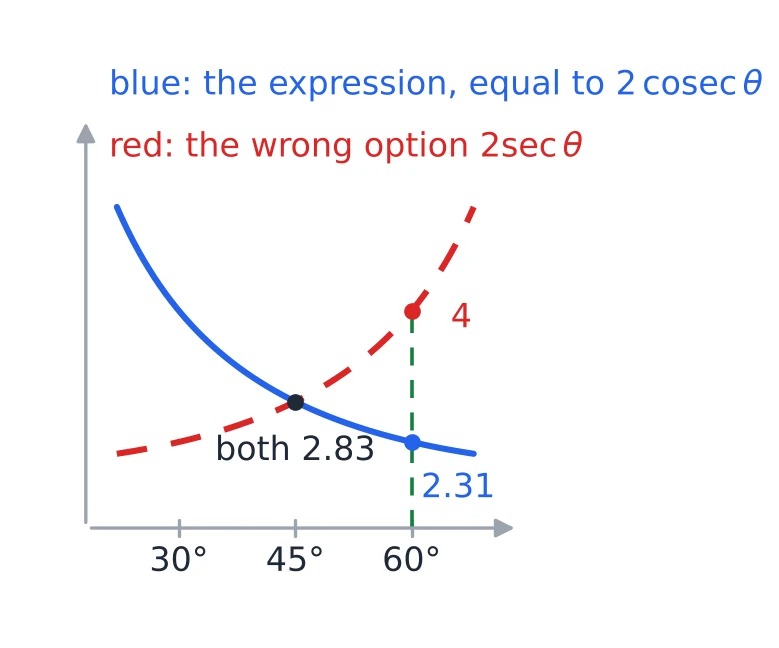
  • At 45°: sin⁡45∘1+cos⁡45∘=12+1=2−1\frac{\sin 45^\circ}{1 + \cos 45^\circ} = \frac{1}{\sqrt{2} + 1} = \sqrt{2} - 1 and its upside-down partner is 2+1\sqrt{2} + 1, so the question is 222\sqrt{2}. The options give 222\sqrt{2}, 222\sqrt{2}, 2 and 2. Two options drop out, but two survive.
  • At 60°: the question is 3/23/2+3/23/2=13+3=43\frac{\sqrt{3}/2}{3/2} + \frac{3/2}{\sqrt{3}/2} = \frac{1}{\sqrt{3}} + \sqrt{3} = \frac{4}{\sqrt{3}}. Now 2sec⁡60∘=42\sec 60^\circ = 4 while 2cosec⁡60∘=432\operatorname{cosec} 60^\circ = \frac{4}{\sqrt{3}}. The answer is 2cosec⁡θ2\operatorname{cosec}\theta.

Two option curves meet at 45 degrees, split at 60

When the check fails or misleads.

  • At 45°, sin⁡θ=cos⁡θ\sin\theta = \cos\theta, tan⁡θ=cot⁡θ\tan\theta = \cot\theta and sec⁡θ=cosec⁡θ\sec\theta = \operatorname{cosec}\theta. If two options differ only by such a swap, 45° cannot separate them. Use 30° or 60°.
  • The question may be undefined at the angle you pick. tan⁡θ1−cot⁡θ+cot⁡θ1−tan⁡θ\frac{\tan\theta}{1 - \cot\theta} + \frac{\cot\theta}{1 - \tan\theta} has 1−tan⁡45∘=01 - \tan 45^\circ = 0 at the bottom, so 45° tells you nothing there. Avoid 0° and 90° as well when tan, sec, cot or cosec appear.
  • Two different expressions can agree at one angle by chance. If more than one option survives, test a second angle before choosing.
  • Keep the values exact (23\frac{2}{\sqrt{3}}, not 1.15). Rounded decimals can make two different options look equal.

Order of work. Try 45° first, since its arithmetic is lightest. If two options are left, or the question breaks at 45°, switch to 60° or 30°. If the options are plain numbers, θ=0∘\theta = 0^\circ is often lighter still.

The check is a tool for multiple-choice questions only. In a question that asks you to prove or simplify fully, the algebra of the earlier parts is still needed, and the check simply confirms your final line.

Eliminating θ\theta

Two or three equations contain θ\theta, and the question asks for a relation between the other letters with no θ\theta in it. Make each ratio the subject, then use an identity those ratios satisfy.

x=asec⁡θx = a\sec\theta, y=btan⁡θy = b\tan\theta. Then sec⁡θ=xa\sec\theta = \frac{x}{a} and tan⁡θ=yb\tan\theta = \frac{y}{b}, and sec⁡2θ−tan⁡2θ=1\sec^2\theta - \tan^2\theta = 1 gives

x2a2−y2b2=1\frac{x^2}{a^2} - \frac{y^2}{b^2} = 1

With numbers, x=2sec⁡θx = 2\sec\theta and y=5tan⁡θy = 5\tan\theta give x24−y225=1\frac{x^2}{4} - \frac{y^2}{25} = 1, that is 25x2−4y2=10025x^2 - 4y^2 = 100.

x=acos⁡θx = a\cos\theta, y=bsin⁡θy = b\sin\theta gives x2a2+y2b2=1\frac{x^2}{a^2} + \frac{y^2}{b^2} = 1, this time from cos⁡2θ+sin⁡2θ=1\cos^2\theta + \sin^2\theta = 1. With cosec and cot the identity is cosec⁡2θ−cot⁡2θ=1\operatorname{cosec}^2\theta - \cot^2\theta = 1.

Three letters. x=rcos⁡tx = r\cos t, y=rsin⁡tcos⁡uy = r\sin t\cos u, z=rsin⁡tsin⁡uz = r\sin t\sin u. Here y and z share rsin⁡tr\sin t, so add their squares first:

y2+z2=r2sin⁡2t(cos⁡2u+sin⁡2u)=r2sin⁡2ty^2 + z^2 = r^2\sin^2 t(\cos^2 u + \sin^2 u) = r^2\sin^2 t

Now add x2=r2cos⁡2tx^2 = r^2\cos^2 t:

x2+y2+z2=r2(sin⁡2t+cos⁡2t)=r2x^2 + y^2 + z^2 = r^2(\sin^2 t + \cos^2 t) = r^2

The identity is used twice, once for each angle. Pair the two equations that share a factor first.

Sum and difference given. If x=sec⁡θ+tan⁡θx = \sec\theta + \tan\theta and y=sec⁡θ−tan⁡θy = \sec\theta - \tan\theta, then xy = 1 straight from the reciprocal pair. The cosec and cot pair works the same way.

[Tier 2] Two longer eliminations.

  • tan⁡θ+sin⁡θ=m\tan\theta + \sin\theta = m and tan⁡θ−sin⁡θ=n\tan\theta - \sin\theta = n. Then m2−n2=(m+n)(m−n)=4tan⁡θsin⁡θm^2 - n^2 = (m + n)(m - n) = 4\tan\theta\sin\theta, while mn=tan⁡2θ−sin⁡2θ=sin⁡2θ(sec⁡2θ−1)=tan⁡2θsin⁡2θmn = \tan^2\theta - \sin^2\theta = \sin^2\theta(\sec^2\theta - 1) = \tan^2\theta\sin^2\theta. So m2−n2=4mnm^2 - n^2 = 4\sqrt{mn}.
  • x=cosec⁡θ−sin⁡θx = \operatorname{cosec}\theta - \sin\theta and y=sec⁡θ−cos⁡θy = \sec\theta - \cos\theta. In sin and cos, x=cos⁡2θsin⁡θx = \frac{\cos^2\theta}{\sin\theta} and y=sin⁡2θcos⁡θy = \frac{\sin^2\theta}{\cos\theta}. So x2y=cos⁡3θx^2y = \cos^3\theta and xy2=sin⁡3θxy^2 = \sin^3\theta, which gives (x2y)23+(xy2)23=1(x^2y)^{\frac{2}{3}} + (xy^2)^{\frac{2}{3}} = 1.

Solved Examples

Question 1

What is (1+cot⁡2θ)(1−cos⁡θ)(1+cos⁡θ)(1 + \cot^2\theta)(1 - \cos\theta)(1 + \cos\theta) equal to? (a) 0 (b) 1 (c) cosec⁡2θ\operatorname{cosec}^2\theta (d) sin⁡2θ\sin^2\theta

Answer. The last two brackets multiply to 1−cos⁡2θ=sin⁡2θ1 - \cos^2\theta = \sin^2\theta, and the first bracket is cosec⁡2θ\operatorname{cosec}^2\theta. So the whole thing is cosec⁡2θsin⁡2θ\operatorname{cosec}^2\theta\sin^2\theta, which is (b) 1.

Question 2

sin⁡2θ1−cos⁡θ\frac{\sin^2\theta}{1 - \cos\theta} is equal to (a) 1+cos⁡θ1 + \cos\theta (b) 1−cos⁡θ1 - \cos\theta (c) 1+sin⁡θ1 + \sin\theta (d) cos⁡θ\cos\theta

Answer. I write the top as 1−cos⁡2θ=(1−cos⁡θ)(1+cos⁡θ)1 - \cos^2\theta = (1 - \cos\theta)(1 + \cos\theta). One bracket cancels with the bottom, and I am left with (a) 1+cos⁡θ1 + \cos\theta. A check at 60°: 34÷12=32\frac{3}{4} \div \frac{1}{2} = \frac{3}{2}, and 1+cos⁡60∘=321 + \cos 60^\circ = \frac{3}{2} too.

Question 3

sec⁡4θ−sec⁡2θ\sec^4\theta - \sec^2\theta is equal to (a) tan⁡4θ−tan⁡2θ\tan^4\theta - \tan^2\theta (b) 1+tan⁡4θ1 + \tan^4\theta (c) tan⁡2θ\tan^2\theta (d) tan⁡4θ+tan⁡2θ\tan^4\theta + \tan^2\theta

Answer. I take sec⁡2θ\sec^2\theta common: sec⁡2θ(sec⁡2θ−1)\sec^2\theta(\sec^2\theta - 1). The bracket is tan⁡2θ\tan^2\theta and the outside factor is 1+tan⁡2θ1 + \tan^2\theta, so I get (1+tan⁡2θ)tan⁡2θ(1 + \tan^2\theta)\tan^2\theta. Multiplying out gives (d) tan⁡4θ+tan⁡2θ\tan^4\theta + \tan^2\theta.

Question 4

sec⁡θcosec⁡θ−cot⁡θ\sec\theta\operatorname{cosec}\theta - \cot\theta is equal to (a) tan⁡θ\tan\theta (b) cot⁡θ\cot\theta (c) sin⁡θ\sin\theta (d) sec⁡θ\sec\theta

Answer. In sin and cos: 1sin⁡θcos⁡θ−cos⁡θsin⁡θ=1−cos⁡2θsin⁡θcos⁡θ=sin⁡2θsin⁡θcos⁡θ\frac{1}{\sin\theta\cos\theta} - \frac{\cos\theta}{\sin\theta} = \frac{1 - \cos^2\theta}{\sin\theta\cos\theta} = \frac{\sin^2\theta}{\sin\theta\cos\theta}. One sin⁡θ\sin\theta cancels and sin⁡θcos⁡θ\frac{\sin\theta}{\cos\theta} is left, which is (a) tan⁡θ\tan\theta.

Question 5

What is the value of (sec⁡θ−cos⁡θ)(cosec⁡θ−sin⁡θ)(tan⁡θ+cot⁡θ)(\sec\theta - \cos\theta)(\operatorname{cosec}\theta - \sin\theta)(\tan\theta + \cot\theta)? (a) 0 (b) 2 (c) 1 (d) sin⁡θcos⁡θ\sin\theta\cos\theta

Answer. I take the brackets one at a time. sec⁡θ−cos⁡θ=1−cos⁡2θcos⁡θ=sin⁡2θcos⁡θ\sec\theta - \cos\theta = \frac{1 - \cos^2\theta}{\cos\theta} = \frac{\sin^2\theta}{\cos\theta}, cosec⁡θ−sin⁡θ=cos⁡2θsin⁡θ\operatorname{cosec}\theta - \sin\theta = \frac{\cos^2\theta}{\sin\theta} and tan⁡θ+cot⁡θ=1sin⁡θcos⁡θ\tan\theta + \cot\theta = \frac{1}{\sin\theta\cos\theta}. The first two multiply to sin⁡θcos⁡θ\sin\theta\cos\theta, and the third cancels it, so the value is (c) 1. Stopping after two brackets leaves sin⁡θcos⁡θ\sin\theta\cos\theta, which is only part of the product.

Question 6

1sec⁡θ−tan⁡θ−1cos⁡θ\frac{1}{\sec\theta - \tan\theta} - \frac{1}{\cos\theta} is equal to (a) tan⁡θ\tan\theta (b) sec⁡θ\sec\theta (c) 2tan⁡θ2\tan\theta (d) cot⁡θ\cot\theta

Answer. sec⁡θ−tan⁡θ\sec\theta - \tan\theta and sec⁡θ+tan⁡θ\sec\theta + \tan\theta multiply to 1, so the first fraction is just sec⁡θ+tan⁡θ\sec\theta + \tan\theta. The second fraction is sec⁡θ\sec\theta. Subtracting, I am left with (a) tan⁡θ\tan\theta.

Question 7

cos⁡θ1−sin⁡θ−tan⁡θ\frac{\cos\theta}{1 - \sin\theta} - \tan\theta is equal to (a) cos⁡θ\cos\theta (b) 2tan⁡θ2\tan\theta (c) sec⁡θ\sec\theta (d) 1

Answer. I multiply the top and bottom of the first fraction by 1+sin⁡θ1 + \sin\theta: cos⁡θ(1+sin⁡θ)1−sin⁡2θ=cos⁡θ(1+sin⁡θ)cos⁡2θ=1+sin⁡θcos⁡θ\frac{\cos\theta(1 + \sin\theta)}{1 - \sin^2\theta} = \frac{\cos\theta(1 + \sin\theta)}{\cos^2\theta} = \frac{1 + \sin\theta}{\cos\theta}. That is sec⁡θ+tan⁡θ\sec\theta + \tan\theta, and taking away tan⁡θ\tan\theta gives (c) sec⁡θ\sec\theta.

Question 8

For an acute angle θ\theta, 1+sin⁡θ1−sin⁡θ−tan⁡θ\sqrt{\frac{1 + \sin\theta}{1 - \sin\theta}} - \tan\theta is equal to (a) cos⁡θ\cos\theta (b) sec⁡θ\sec\theta (c) sec⁡θ−2tan⁡θ\sec\theta - 2\tan\theta (d) 1

Answer. To make the bottom a square I multiply inside the root by 1+sin⁡θ1 + \sin\theta: (1+sin⁡θ)21−sin⁡2θ=1+sin⁡θcos⁡θ=sec⁡θ+tan⁡θ\sqrt{\frac{(1 + \sin\theta)^2}{1 - \sin^2\theta}} = \frac{1 + \sin\theta}{\cos\theta} = \sec\theta + \tan\theta. Taking away tan⁡θ\tan\theta leaves (b) sec⁡θ\sec\theta. Check at 30°: inside the root is 1+121−12=3\frac{1 + \frac{1}{2}}{1 - \frac{1}{2}} = 3, so the expression is 3−13=23\sqrt{3} - \frac{1}{\sqrt{3}} = \frac{2}{\sqrt{3}}, which is sec⁡30∘\sec 30^\circ.

Question 9

For an acute angle θ\theta, 1−cos⁡θ1+cos⁡θ+1+cos⁡θ1−cos⁡θ\sqrt{\frac{1 - \cos\theta}{1 + \cos\theta}} + \sqrt{\frac{1 + \cos\theta}{1 - \cos\theta}} is equal to (a) 2sec⁡θ2\sec\theta (b) 2cot⁡θ2\cot\theta (c) 2cosec⁡θ2\operatorname{cosec}\theta (d) 2

Answer. Making each bottom a square (1−cos⁡2θ=sin⁡2θ1 - \cos^2\theta = \sin^2\theta), the first root is 1−cos⁡θsin⁡θ=cosec⁡θ−cot⁡θ\frac{1 - \cos\theta}{\sin\theta} = \operatorname{cosec}\theta - \cot\theta and the second is 1+cos⁡θsin⁡θ=cosec⁡θ+cot⁡θ\frac{1 + \cos\theta}{\sin\theta} = \operatorname{cosec}\theta + \cot\theta. The cot terms cancel and (c) 2cosec⁡θ2\operatorname{cosec}\theta is left. Putting θ=45∘\theta = 45^\circ would not have settled this one, because 2sec⁡45∘2\sec 45^\circ and 2cosec⁡45∘2\operatorname{cosec} 45^\circ are both 222\sqrt{2}.

Question 10

For an acute angle θ\theta, sec⁡θ−1sec⁡θ+1\sqrt{\frac{\sec\theta - 1}{\sec\theta + 1}} is equal to (a) sec⁡θ−tan⁡θ\sec\theta - \tan\theta (b) cosec⁡θ+cot⁡θ\operatorname{cosec}\theta + \cot\theta (c) sec⁡θ+tan⁡θ\sec\theta + \tan\theta (d) cosec⁡θ−cot⁡θ\operatorname{cosec}\theta - \cot\theta

Answer. First I multiply the top and bottom inside by cos⁡θ\cos\theta: sec⁡θ−1sec⁡θ+1=1−cos⁡θ1+cos⁡θ\frac{\sec\theta - 1}{\sec\theta + 1} = \frac{1 - \cos\theta}{1 + \cos\theta}. Now it is the cos root, and multiplying inside by 1−cos⁡θ1 - \cos\theta gives 1−cos⁡θsin⁡θ\frac{1 - \cos\theta}{\sin\theta}, which is (d) cosec⁡θ−cot⁡θ\operatorname{cosec}\theta - \cot\theta. A sec inside the root gives cosec and cot outside, which is easy to get backwards.

Question 11

cot⁡θcosec⁡θ−1+cot⁡θcosec⁡θ+1\frac{\cot\theta}{\operatorname{cosec}\theta - 1} + \frac{\cot\theta}{\operatorname{cosec}\theta + 1} is equal to (a) 2cosec⁡θ2\operatorname{cosec}\theta (b) 2sec⁡θ2\sec\theta (c) 2tan⁡θ2\tan\theta (d) 2cot⁡θ2\cot\theta

Answer. I test the options. At 45°, cot⁡θ=1\cot\theta = 1 and cosec⁡θ=2\operatorname{cosec}\theta = \sqrt{2}, so the question is 12−1+12+1=(2+1)+(2−1)=22\frac{1}{\sqrt{2} - 1} + \frac{1}{\sqrt{2} + 1} = (\sqrt{2} + 1) + (\sqrt{2} - 1) = 2\sqrt{2}. That rules out 2tan⁡θ2\tan\theta and 2cot⁡θ2\cot\theta (both 2), but 2sec⁡θ2\sec\theta and 2cosec⁡θ2\operatorname{cosec}\theta are both 222\sqrt{2} there. So I try 60°, where cot⁡θ=13\cot\theta = \frac{1}{\sqrt{3}} and cosec⁡θ=23\operatorname{cosec}\theta = \frac{2}{\sqrt{3}}. Multiplying top and bottom of each fraction by 3\sqrt{3}, the question is 12−3+12+3=(2+3)+(2−3)=4\frac{1}{2 - \sqrt{3}} + \frac{1}{2 + \sqrt{3}} = (2 + \sqrt{3}) + (2 - \sqrt{3}) = 4. Now 2sec⁡60∘=42\sec 60^\circ = 4 but 2cosec⁡60∘=432\operatorname{cosec} 60^\circ = \frac{4}{\sqrt{3}}, so the answer is (b) 2sec⁡θ2\sec\theta.

Question 12

tan⁡θ1−cot⁡θ+cot⁡θ1−tan⁡θ\frac{\tan\theta}{1 - \cot\theta} + \frac{\cot\theta}{1 - \tan\theta} is equal to (a) sec⁡θcosec⁡θ\sec\theta\operatorname{cosec}\theta (b) 1+sec⁡θcosec⁡θ1 + \sec\theta\operatorname{cosec}\theta (c) sec⁡θcosec⁡θ−1\sec\theta\operatorname{cosec}\theta - 1 (d) 1+sin⁡θcos⁡θ1 + \sin\theta\cos\theta

Answer. 45° is no use here, because 1−tan⁡45∘=01 - \tan 45^\circ = 0. So I simplify, writing t for tan⁡θ\tan\theta. The first term is t1−1t=t2t−1\frac{t}{1 - \frac{1}{t}} = \frac{t^2}{t - 1} and the second is 1t(1−t)=−1t(t−1)\frac{1}{t(1 - t)} = -\frac{1}{t(t - 1)}. Together they make t3−1t(t−1)=t2+t+1t=t+1+1t\frac{t^3 - 1}{t(t - 1)} = \frac{t^2 + t + 1}{t} = t + 1 + \frac{1}{t}. That is 1+tan⁡θ+cot⁡θ1 + \tan\theta + \cot\theta, and since tan⁡θ+cot⁡θ=sec⁡θcosec⁡θ\tan\theta + \cot\theta = \sec\theta\operatorname{cosec}\theta, the answer is (b) 1+sec⁡θcosec⁡θ1 + \sec\theta\operatorname{cosec}\theta.

Question 13

cot⁡θ+cosec⁡θ−1cot⁡θ−cosec⁡θ+1\frac{\cot\theta + \operatorname{cosec}\theta - 1}{\cot\theta - \operatorname{cosec}\theta + 1} is equal to (a) 1+cos⁡θsin⁡θ\frac{1 + \cos\theta}{\sin\theta} (b) 1−cos⁡θsin⁡θ\frac{1 - \cos\theta}{\sin\theta} (c) 1+sin⁡θcos⁡θ\frac{1 + \sin\theta}{\cos\theta} (d) 1−sin⁡θcos⁡θ\frac{1 - \sin\theta}{\cos\theta}

Answer. I write the 1 on top as cosec⁡2θ−cot⁡2θ\operatorname{cosec}^2\theta - \cot^2\theta. Then the top is (cosec⁡θ+cot⁡θ)−(cosec⁡θ+cot⁡θ)(cosec⁡θ−cot⁡θ)=(cosec⁡θ+cot⁡θ)(1−cosec⁡θ+cot⁡θ)(\operatorname{cosec}\theta + \cot\theta) - (\operatorname{cosec}\theta + \cot\theta)(\operatorname{cosec}\theta - \cot\theta) = (\operatorname{cosec}\theta + \cot\theta)(1 - \operatorname{cosec}\theta + \cot\theta). The second bracket is the bottom, so it cancels, and cosec⁡θ+cot⁡θ\operatorname{cosec}\theta + \cot\theta is left. In sin and cos that is (a) 1+cos⁡θsin⁡θ\frac{1 + \cos\theta}{\sin\theta}.

Question 14

sin⁡θ−cos⁡θ+1sin⁡θ+cos⁡θ−1\frac{\sin\theta - \cos\theta + 1}{\sin\theta + \cos\theta - 1} is equal to (a) sec⁡θ−tan⁡θ\sec\theta - \tan\theta (b) cosec⁡θ+cot⁡θ\operatorname{cosec}\theta + \cot\theta (c) sec⁡θ+tan⁡θ\sec\theta + \tan\theta (d) cosec⁡θ−cot⁡θ\operatorname{cosec}\theta - \cot\theta

Answer. Dividing every term by cos⁡θ\cos\theta turns it into tan⁡θ−1+sec⁡θtan⁡θ+1−sec⁡θ\frac{\tan\theta - 1 + \sec\theta}{\tan\theta + 1 - \sec\theta}, which is the sec and tan three-term fraction. So it equals (c) sec⁡θ+tan⁡θ\sec\theta + \tan\theta. To be sure I check at 60°: 32−12+132+12−1=3+13−1=2+3\frac{\frac{\sqrt{3}}{2} - \frac{1}{2} + 1}{\frac{\sqrt{3}}{2} + \frac{1}{2} - 1} = \frac{\sqrt{3} + 1}{\sqrt{3} - 1} = 2 + \sqrt{3}, and sec⁡60∘+tan⁡60∘=2+3\sec 60^\circ + \tan 60^\circ = 2 + \sqrt{3} as well.

Question 15

What is the value of (1+tan⁡θ+sec⁡θ)(1+cot⁡θ−cosec⁡θ)(1 + \tan\theta + \sec\theta)(1 + \cot\theta - \operatorname{cosec}\theta)? (a) 0 (b) 1 (c) −1-1 (d) 2

Answer. The options are numbers, so the value is the same for every θ\theta and I can take θ=45∘\theta = 45^\circ: (1+1+2)(1+1−2)=(2+2)(2−2)=4−2=2(1 + 1 + \sqrt{2})(1 + 1 - \sqrt{2}) = (2 + \sqrt{2})(2 - \sqrt{2}) = 4 - 2 = 2. The algebra agrees. In sin and cos the tops are (sin⁡θ+cos⁡θ)+1(\sin\theta + \cos\theta) + 1 and (sin⁡θ+cos⁡θ)−1(\sin\theta + \cos\theta) - 1, whose product is (sin⁡θ+cos⁡θ)2−1=2sin⁡θcos⁡θ(\sin\theta + \cos\theta)^2 - 1 = 2\sin\theta\cos\theta, and the bottoms multiply to sin⁡θcos⁡θ\sin\theta\cos\theta. The value is (d) 2.

Question 16

(sin⁡θ+cosec⁡θ)2+(cos⁡θ+sec⁡θ)2(\sin\theta + \operatorname{cosec}\theta)^2 + (\cos\theta + \sec\theta)^2 is equal to (a) 5+tan⁡2θ+cot⁡2θ5 + \tan^2\theta + \cot^2\theta (b) 7+tan⁡2θ+cot⁡2θ7 + \tan^2\theta + \cot^2\theta (c) 9+tan⁡2θ+cot⁡2θ9 + \tan^2\theta + \cot^2\theta (d) 7+tan⁡θ+cot⁡θ7 + \tan\theta + \cot\theta

Answer. Expanding, (sin⁡θ+cosec⁡θ)2=sin⁡2θ+2+cosec⁡2θ(\sin\theta + \operatorname{cosec}\theta)^2 = \sin^2\theta + 2 + \operatorname{cosec}^2\theta, because sin⁡θcosec⁡θ=1\sin\theta\operatorname{cosec}\theta = 1. The second square is cos⁡2θ+2+sec⁡2θ\cos^2\theta + 2 + \sec^2\theta in the same way. Adding them: 1+4+cosec⁡2θ+sec⁡2θ1 + 4 + \operatorname{cosec}^2\theta + \sec^2\theta. Now cosec⁡2θ=1+cot⁡2θ\operatorname{cosec}^2\theta = 1 + \cot^2\theta and sec⁡2θ=1+tan⁡2θ\sec^2\theta = 1 + \tan^2\theta, so the total is (b) 7+tan⁡2θ+cot⁡2θ7 + \tan^2\theta + \cot^2\theta.

Question 17

sin⁡θ(1+tan⁡θ)+cos⁡θ(1+cot⁡θ)\sin\theta(1 + \tan\theta) + \cos\theta(1 + \cot\theta) is equal to (a) sec⁡θ+cosec⁡θ\sec\theta + \operatorname{cosec}\theta (b) sec⁡θcosec⁡θ\sec\theta\operatorname{cosec}\theta (c) 1 (d) sin⁡θ+cos⁡θ\sin\theta + \cos\theta

Answer. Here the 45° check settles it at once. At 45° the question is 12(1+1)+12(1+1)=22\frac{1}{\sqrt{2}}(1 + 1) + \frac{1}{\sqrt{2}}(1 + 1) = 2\sqrt{2}. The four options give 222\sqrt{2}, 2, 1 and 2\sqrt{2}, so only one fits: (a) sec⁡θ+cosec⁡θ\sec\theta + \operatorname{cosec}\theta. By algebra, sin⁡θ+cos⁡2θsin⁡θ=1sin⁡θ\sin\theta + \frac{\cos^2\theta}{\sin\theta} = \frac{1}{\sin\theta} and cos⁡θ+sin⁡2θcos⁡θ=1cos⁡θ\cos\theta + \frac{\sin^2\theta}{\cos\theta} = \frac{1}{\cos\theta}, which says the same.

Question 18

cos⁡4θ−sin⁡4θ\cos^4\theta - \sin^4\theta is equal to (a) 1−2cos⁡2θ1 - 2\cos^2\theta (b) 1−2sin⁡2θcos⁡2θ1 - 2\sin^2\theta\cos^2\theta (c) 2cos⁡2θ−12\cos^2\theta - 1 (d) 1

Answer. It is a difference of squares: (cos⁡2θ−sin⁡2θ)(cos⁡2θ+sin⁡2θ)(\cos^2\theta - \sin^2\theta)(\cos^2\theta + \sin^2\theta). The second bracket is 1, so I have cos⁡2θ−sin⁡2θ\cos^2\theta - \sin^2\theta. Writing sin⁡2θ\sin^2\theta as 1−cos⁡2θ1 - \cos^2\theta turns it into (c) 2cos⁡2θ−12\cos^2\theta - 1. The option 1−2cos⁡2θ1 - 2\cos^2\theta has the sign the wrong way round: at θ=0∘\theta = 0^\circ it gives −1, but cos⁡40∘−sin⁡40∘=1\cos^4 0^\circ - \sin^4 0^\circ = 1.

Question 19

What is the value of sin⁡6θ+cos⁡6θ+3sin⁡2θcos⁡2θ\sin^6\theta + \cos^6\theta + 3\sin^2\theta\cos^2\theta? (a) 0 (b) 1 (c) 3 (d) 1+6sin⁡2θcos⁡2θ1 + 6\sin^2\theta\cos^2\theta

Answer. sin⁡6θ+cos⁡6θ=1−3sin⁡2θcos⁡2θ\sin^6\theta + \cos^6\theta = 1 - 3\sin^2\theta\cos^2\theta, so adding 3sin⁡2θcos⁡2θ3\sin^2\theta\cos^2\theta brings it back to (b) 1. With numbers, at θ=0∘\theta = 0^\circ the expression is 0 + 1 + 0 = 1.

Question 20

What is the value of (sin⁡6θ+cos⁡6θ)−(sin⁡4θ+cos⁡4θ)+sin⁡2θcos⁡2θ(\sin^6\theta + \cos^6\theta) - (\sin^4\theta + \cos^4\theta) + \sin^2\theta\cos^2\theta? (a) 1 (b) −1-1 (c) 2sin⁡2θcos⁡2θ2\sin^2\theta\cos^2\theta (d) 0

Answer. I try θ=0∘\theta = 0^\circ first: (0+1)−(0+1)+0=0(0 + 1) - (0 + 1) + 0 = 0. But the option 2sin⁡2θcos⁡2θ2\sin^2\theta\cos^2\theta is also 0 at 0°, so one angle is not enough here. At 45° the expression is 14−12+14=0\frac{1}{4} - \frac{1}{2} + \frac{1}{4} = 0, while 2sin⁡2θcos⁡2θ=122\sin^2\theta\cos^2\theta = \frac{1}{2}. The formulas confirm it for every angle: with x=sin⁡2θcos⁡2θx = \sin^2\theta\cos^2\theta the expression is (1−3x)−(1−2x)+x(1 - 3x) - (1 - 2x) + x, and everything cancels. The value is (d) 0.

Question 21

If x=3sec⁡θx = 3\sec\theta and y=4tan⁡θy = 4\tan\theta, which relation is true for every θ\theta? (a) 16x2−9y2=14416x^2 - 9y^2 = 144 (b) 9x2−16y2=1449x^2 - 16y^2 = 144 (c) 16x2+9y2=14416x^2 + 9y^2 = 144 (d) 4x2−3y2=124x^2 - 3y^2 = 12

Answer. sec⁡θ=x3\sec\theta = \frac{x}{3} and tan⁡θ=y4\tan\theta = \frac{y}{4}. Using sec⁡2θ−tan⁡2θ=1\sec^2\theta - \tan^2\theta = 1: x29−y216=1\frac{x^2}{9} - \frac{y^2}{16} = 1. Multiplying through by 144 gives (a) 16x2−9y2=14416x^2 - 9y^2 = 144.

Question 22

If x=psin⁡αcos⁡βx = p\sin\alpha\cos\beta, y=psin⁡αsin⁡βy = p\sin\alpha\sin\beta and z=pcos⁡αz = p\cos\alpha, then (a) x2+y2−z2=p2x^2 + y^2 - z^2 = p^2 (b) x+y+z=px + y + z = p (c) x2+y2=p2x^2 + y^2 = p^2 (d) x2+y2+z2=p2x^2 + y^2 + z^2 = p^2

Answer. x and y both contain psin⁡αp\sin\alpha, so I add their squares first: x2+y2=p2sin⁡2α(cos⁡2β+sin⁡2β)=p2sin⁡2αx^2 + y^2 = p^2\sin^2\alpha(\cos^2\beta + \sin^2\beta) = p^2\sin^2\alpha. Then z2=p2cos⁡2αz^2 = p^2\cos^2\alpha, and adding gives p2(sin⁡2α+cos⁡2α)=p2p^2(\sin^2\alpha + \cos^2\alpha) = p^2. So (d) x2+y2+z2=p2x^2 + y^2 + z^2 = p^2.

Question 23

[Tier 2] If tan⁡θ+sin⁡θ=m\tan\theta + \sin\theta = m and tan⁡θ−sin⁡θ=n\tan\theta - \sin\theta = n (θ\theta acute), then m2−n2m^2 - n^2 is equal to (a) 4mn4mn (b) 2mn2\sqrt{mn} (c) 4mn4\sqrt{mn} (d) mn\sqrt{mn}

Answer. m2−n2=(m+n)(m−n)=2tan⁡θ×2sin⁡θ=4tan⁡θsin⁡θm^2 - n^2 = (m + n)(m - n) = 2\tan\theta \times 2\sin\theta = 4\tan\theta\sin\theta. Next, mn=tan⁡2θ−sin⁡2θ=sin⁡2θ(1cos⁡2θ−1)=sin⁡2θtan⁡2θmn = \tan^2\theta - \sin^2\theta = \sin^2\theta\left(\frac{1}{\cos^2\theta} - 1\right) = \sin^2\theta\tan^2\theta, so mn=tan⁡θsin⁡θ\sqrt{mn} = \tan\theta\sin\theta. Putting the two together, m2−n2m^2 - n^2 = (c) 4mn4\sqrt{mn}.

Question 24

[Tier 2] If x=cosec⁡θ−sin⁡θx = \operatorname{cosec}\theta - \sin\theta and y=sec⁡θ−cos⁡θy = \sec\theta - \cos\theta, what is the value of x2y2(x2+y2+3)x^2y^2(x^2 + y^2 + 3)? (a) 1 (b) 0 (c) 2 (d) 3

Answer. In sin and cos, x=cos⁡2θsin⁡θx = \frac{\cos^2\theta}{\sin\theta} and y=sin⁡2θcos⁡θy = \frac{\sin^2\theta}{\cos\theta}, so xy=sin⁡θcos⁡θxy = \sin\theta\cos\theta. Then x2+y2=cos⁡6θ+sin⁡6θsin⁡2θcos⁡2θ=1−3sin⁡2θcos⁡2θsin⁡2θcos⁡2θx^2 + y^2 = \frac{\cos^6\theta + \sin^6\theta}{\sin^2\theta\cos^2\theta} = \frac{1 - 3\sin^2\theta\cos^2\theta}{\sin^2\theta\cos^2\theta}, and adding 3 leaves 1sin⁡2θcos⁡2θ\frac{1}{\sin^2\theta\cos^2\theta}. Multiplying by x2y2=sin⁡2θcos⁡2θx^2y^2 = \sin^2\theta\cos^2\theta gives (a) 1. The 45° check agrees: there x=y=12x = y = \frac{1}{\sqrt{2}}, so the value is 14(12+12+3)=1\frac{1}{4}\left(\frac{1}{2} + \frac{1}{2} + 3\right) = 1.