Adding the two squares gives (sinθ+cosθ)2+(sinθ−cosθ)2=2, which links the sum and the difference directly: p2+q2=2.
From the product, everything else. Take sinθ+cosθ=3747. Then
sinθcosθ=21(13692209−1)=1369420
tanθ+cotθ=sinθcosθ1=4201369
(sinθ−cosθ)2=2−13692209=1369529, so sinθ−cosθ=±3723. Both signs are possible, since the angle may have sinθ=3735, cosθ=3712 or the other way round.
sin3θ+cos3θ=(sinθ+cosθ)(1−sinθcosθ), from a3+b3=(a+b)(a2−ab+b2).
sin4θ+cos4θ=1−2(sinθcosθ)2.
A quick look at the data. Since sinθcosθ is never more than 21 (shown in the part on the product, further down), p2=1+2sinθcosθ is at most 2. So a question with sinθ+cosθ=58 has no answer: 58=1.6 is more than 2≈1.414.
Given secθ+tanθ or cosecθ+cotθ
From Identities and Simplification, (secθ+tanθ)(secθ−tanθ)=1. So
secθ+tanθ=p⇒secθ−tanθ=p1
Add the two equations and halve, then subtract them and halve:
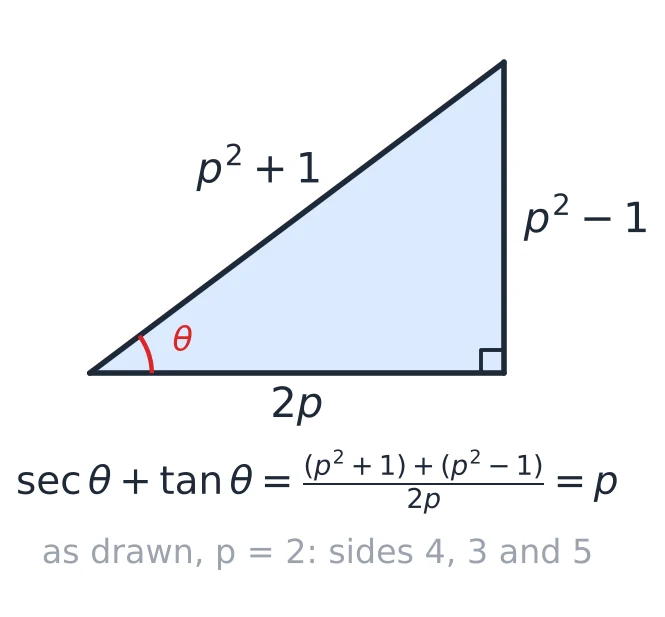
secθ=21(p+p1)=2pp2+1tanθ=21(p−p1)=2pp2−1
Dividing one by the other, sinθ=secθtanθ=p2+1p2−1.
The triangle explains all of these. Sides 2p, p2−1 and p2+1 always make a right triangle, since (2p)2+(p2−1)2=(p2+1)2. Every ratio can be read off it, including cosθ=p2+12p.
Take secθ+tanθ=3. Then secθ−tanθ=31, secθ=35, tanθ=34 and sinθ=54: the 3, 4, 5 triangle.
The cosec and cot version. If cosecθ+cotθ=p, then cosecθ−cotθ=p1, cosecθ=2pp2+1, cotθ=2pp2−1 and cosθ=p2+1p2−1. With p = 5, cosθ=2624=1312.
The difference given. Turn it over first. secθ−tanθ=72 means secθ+tanθ=27, so p=27 and
sinθ=p2+1p2−1=49+449−4=5345
after multiplying the top and bottom by 4.
[SSC Tip]p2+12p is cosθ. When sinθ is asked, that value is the wrong option to watch for; look at which side of the triangle is opposite θ.
A Ratio Plus Its Reciprocal Equal to 2
For a positive number x, x+x1=2 means x2−2x+1=0, that is (x−1)2=0, so x = 1 (see Chapter 11). Applied to a ratio and its reciprocal:
Given
Forces
So θ is
tanθ+cotθ=2
tanθ=1
45°
sinθ+cosecθ=2
sinθ=1
90°
cosθ+secθ=2
cosθ=1
0°
After that every power of the ratio is 1, so the questions built on these are quick:
tanθ+cotθ=2⇒tan7θ+cot7θ=1+1=2, and also sinθ+cosθ=2.
sinθ+cosecθ=2⇒sin5θ+cosec5θ=2, and also cosθ=0.
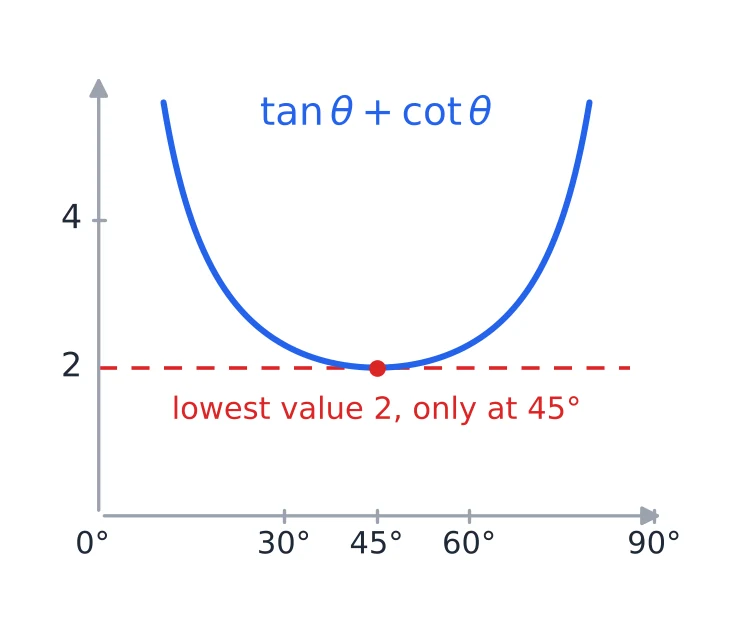
The graph shows the other side of the same fact: for an acute angle, tanθ+cotθ is never below 2. So a condition such as tanθ+cotθ=23 has no acute angle at all.
Other values of tanθ+cotθ. Since tanθ+cotθ=sinθcosθ1, a given value hands you the product at once. tanθ+cotθ=6 gives sinθcosθ=61, and then (sinθ+cosθ)2=1+31=34. Squaring the condition gives tan2θ+cot2θ=62−2=34, because the middle term is 2tanθcotθ=2.
A Condition Like sinθ+sin2θ=1
Move one term across and look for an identity:
sinθ=1−sin2θ=cos2θ
So the condition really says sinθ=cos2θ, and anything in cos2θ can now be turned into sines. For instance
cos2θ+cos4θ=sinθ+(cos2θ)2=sinθ+sin2θ=1
Higher powers. Cube the result: (cos2θ+cos4θ)3=1. Expanded with (a+b)3=a3+3a2b+3ab2+b3, that is
cos6θ+3cos8θ+3cos10θ+cos12θ=1
A question that shows a long sum like this is really asking you to spot the cube. With coefficients 1, 2, 1 it is a square instead.
Other ratios. With cos2θ=sinθ, cot2θ=sin2θcos2θ=sin2θsinθ=cosecθ. Squaring, cot4θ=cosec2θ=1+cot2θ, so cot4θ−cot2θ=1.
The cos version.cosθ+cos2θ=1 gives cosθ=sin2θ, and everything above repeats with sin and cos swapped; for example sin2θ+sin4θ=1.
Such a condition does belong to a real angle. sinθ+sin2θ=1 is a quadratic in sinθ whose positive root is sinθ=25−1≈0.618, which is about 38°. You never need the angle itself; the identity does all the work.
A Value of tanθ Given: Divide Through by cosθ
Suppose 5tanθ=4 and you want 5sinθ+2cosθ5sinθ−3cosθ. Every term on the top and the bottom has exactly one sin or cos in it. Divide each term by cosθ:
5tanθ+25tanθ−3=4+24−3=61
There is no need to find sinθ and cosθ separately.
The rule. When every term has the same total power of sin and cos, either all first powers or all second powers, divide by that power of cosθ to bring in tanθ, or of sinθ to bring in cotθ.
cotθ given: with 3cotθ=2, divide by sinθ: 3cosθ−sinθ3cosθ+sinθ=3cotθ−13cotθ+1=2−12+1=3.
Second powers: with tanθ=3, divide by cos2θ: cos2θ+3sinθcosθ2sin2θ+sinθcosθ=1+3tanθ2tan2θ+tanθ=1+918+3=1021.
A lone 1: write it as sin2θ+cos2θ so that every term is a second power. With tanθ=3,
Working backwards. If sinθ−cosθsinθ+cosθ=7, divide the top and bottom by cosθ: tanθ−1tanθ+1=7, so tanθ+1=7tanθ−7 and tanθ=34. A statement like 4sinθ=3cosθ is simply tanθ=43 in another form.
Divide every term, top and bottom. Dividing only the top changes the value of the fraction. When the terms are not all of one power, as in cosθ1+sinθ, draw the right triangle instead (see Angles, Radians and Trigonometric Ratios).
Squares That Add Up: acosθ−bsinθ and asinθ+bcosθ
Expand both squares:
(acosθ−bsinθ)2=a2cos2θ−2absinθcosθ+b2sin2θ
(asinθ+bcosθ)2=a2sin2θ+2absinθcosθ+b2cos2θ
Add them. The middle terms cancel, and a2(cos2θ+sin2θ)+b2(sin2θ+cos2θ) is left:
(acosθ−bsinθ)2+(asinθ+bcosθ)2=a2+b2
So when one of the pair is given as c, the other is ±a2+b2−c2. For an acute angle with a and b positive, asinθ+bcosθ is positive, so it takes the + sign.
Take 3cosθ−sinθ=1. Here a2+b2=3+1=4, so (3sinθ+cosθ)2=4−1=3 and 3sinθ+cosθ=3. The angle 30° fits the condition, and it checks: 3×23−21=1, while 3×21+23=3.
Matching the pair. The two expressions have the same a and b, with sin and cos swapped and the minus sign moved. 3cosθ−4sinθ pairs with 3sinθ+4cosθ, not with 4sinθ+3cosθ. Check the match before using the rule.
As an elimination. If x=asinθ+bcosθ and y=acosθ−bsinθ, then x2+y2=a2+b2 for every θ.
When the given value is the largest possible. If 3sinθ+4cosθ=5, the partner is 25−25=0. So 3cosθ−4sinθ=0, which means tanθ=43. This is exactly the angle at which 3sinθ+4cosθ is greatest, as the part on greatest and least values shows.
Conditions in sin2θ and cos2θ, and Rearranging a Condition
3sin2θ+7cos2θ=4 has two squares in it, but they are tied by sin2θ+cos2θ=1. Replace one of them:
3(1−cos2θ)+7cos2θ=4⇒3+4cos2θ=4⇒cos2θ=41
So cosθ=21, θ=60∘ and tanθ=3. A quick way to see the second step: three of the seven cos2θ join the three sin2θ to make 3.
Sec and tan are tied by sec2θ=1+tan2θ, and the same idea works: sec2θ+tan2θ=7 gives 1+2tan2θ=7, so tan2θ=3 and θ=60∘.
Rearranging a condition. If cosθ+sinθ=2cosθ, then sinθ=(2−1)cosθ. Multiply both sides by 2+1; since (2+1)(2−1)=1,
(2+1)sinθ=cosθ⇒cosθ−sinθ=2sinθ
The condition with cos on the right turns into the same shape with sin. On the way it also gives tanθ=2−1.
[Tier 2] Powers of sec from tan2θ. Given tan2θ=1−e2, find secθ+tan3θcosecθ. Write
tan3θcosecθ=tan2θ×sinθtanθ=tan2θsecθ
Then the whole expression is secθ(1+tan2θ)=sec3θ. Since sec2θ=1+tan2θ=2−e2, the answer is (2−e2)23.
Greatest and Least Value of asinθ+bcosθ
The rule from the squares that add up says, for every θ,
(asinθ+bcosθ)2=a2+b2−(acosθ−bsinθ)2≤a2+b2
since a square cannot be negative. Taking square roots,
−a2+b2≤asinθ+bcosθ≤a2+b2
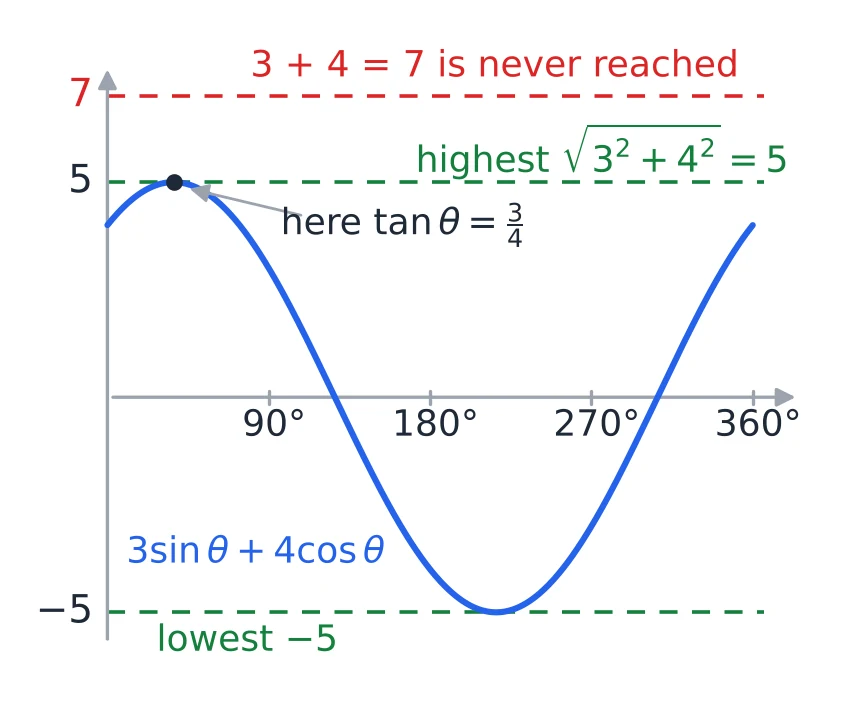
Both ends are actually reached. The bracket acosθ−bsinθ is 0 when tanθ=ba, and that happens at two angles 180∘ apart. At one of them the expression equals a2+b2; at the other, where sine and cosine have both changed sign, it equals −a2+b2.
For 3sinθ+4cosθ the greatest value is 9+16=5, reached when tanθ=43, and the least is −5. The sum of the coefficients, 7, is never reached, because sinθ and cosθ cannot both be 1 at the same angle.
Signs and constants.
5sinθ−12cosθ also lies between −13 and 13. A minus sign inside does not change a2+b2.
3sinθ+4cosθ+7 lies between 7 − 5 = 2 and 7 + 5 = 12. An added constant shifts the whole range.
sinθ+cosθ lies between −2 and 2, with the top at θ=45∘.
3sinθ+cosθ has greatest value 3+1=2, at θ=60∘.
These limits are over all angles, which is what such questions ask for unless they restrict θ.
[SSC Tip] Do not add the coefficients. The greatest value of asinθ+bcosθ is a2+b2, which is less than a + b whenever a and b are both positive; a + b is the wrong option to watch for.
Between a and b: asin2θ+bcos2θ, and the Product sinθcosθ
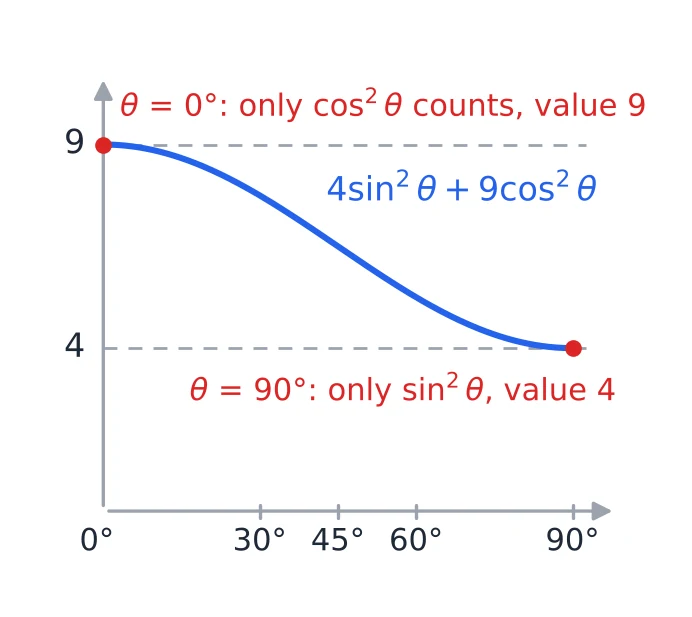
Write asin2θ+bcos2θ=b+(a−b)sin2θ. As sin2θ runs from 0 to 1, the value runs from b to a. So the expression always lies between a and b: the smaller of the two is its least value and the larger is its greatest.
4sin2θ+9cos2θ is 9 at θ=0∘ and 4 at θ=90∘, so its least value is 4 and its greatest is 9. Compare 4sinθ+9cosθ, with no squares, whose greatest value is 97 by the earlier rule. The squares change the method completely.
An added constant works as before: 5+3sin2θ lies between 5 and 8.
The product.(sinθ−cosθ)2≥0 gives 1−2sinθcosθ≥0, so
sinθcosθ≤21
with equality at θ=45∘. Squaring, sin2θcos2θ≤41. This fixes the ranges of the power sums from Identities and Simplification:
sin4θ+cos4θ=1−2sin2θcos2θ lies between 21 and 1
sin6θ+cos6θ=1−3sin2θcos2θ lies between 41 and 1
The least values come at 45° and the greatest at 0° or 90°.
Mixed powers.sin2θ+cos4θ=1−cos2θ+cos4θ. Put x=cos2θ, which lies between 0 and 1:
1−x+x2=43+(x−21)2
So the value lies between 43, when cos2θ=21, and 1, when x is 0 or 1.
A Number Plus Its Reciprocal Is at Least 2
For any positive x, x+x1≥2, because x+x1−2=x(x−1)2, which is never negative. Equality holds only at x = 1. With the ratios:
sin2θ+cosec2θ≥2, equal only at θ=90∘
cos2θ+sec2θ≥2, equal only at θ=0∘
tan2θ+cot2θ≥2, equal only at θ=45∘
atan2θ+bcot2θ. The two terms multiply to ab, a fixed number. When two positive numbers have a fixed product, their sum is least when they are equal, and then each is ab (Chapter 11). So
atan2θ+bcot2θ≥2ab
For instance 2tan2θ+8cot2θ≥216=8. The least value 8 comes when 2tan2θ=8cot2θ, that is when tan4θ=4 and tan2θ=2.
All six squares.sin2θ+cos2θ+tan2θ+cot2θ+sec2θ+cosec2θ is 1+tan2θ+cot2θ+(1+tan2θ)+(1+cot2θ)=3+2(tan2θ+cot2θ), which is at least 3 + 4 = 7.
Check that the equal point can happen. The bound 2ab is the true least value only if the two terms can be equal. For sin2θ+4cosec2θ, equality would need sin2θ=2, which is impossible. Writing x=sin2θ, the expression x+x4 keeps falling as x rises to 1, so its least value comes at sin2θ=1 and is 1 + 4 = 5, not 4. With tan and cot the problem never arises, because tan2θ can be any positive number.
Values a Ratio Can Never Take
In a right triangle the hypotenuse is the longest side, and that fixes where each ratio can lie.
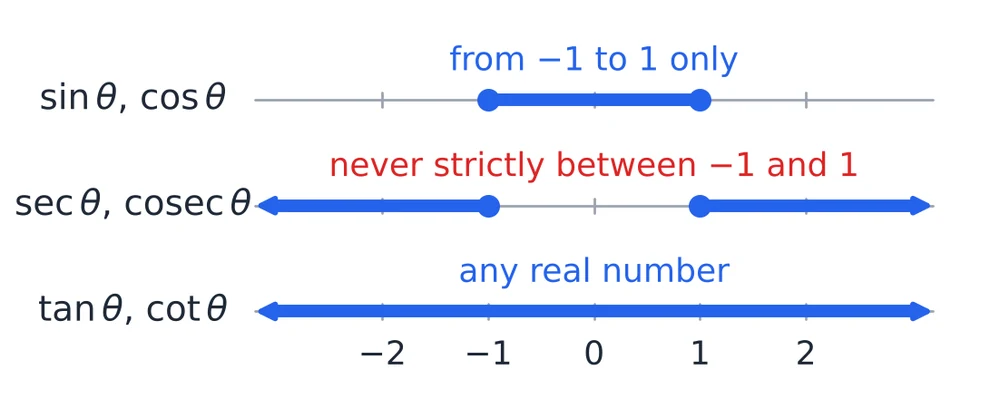
sinθ and cosθ lie from −1 to 1 (from 0 to 1 for acute angles). So sinθ=67 and cosθ=2 are impossible.
secθ and cosecθ are never strictly between −1 and 1. secθ=53 and cosecθ=32 are impossible, while secθ=2 is fine.
tanθ and cotθ can be any real number. tanθ=100 is possible; θ is then just under 90°.
Rejecting a root.2sin2θ+3sinθ−2=0 factorises as (2sinθ−1)(sinθ+2)=0. sinθ=−2 is impossible, so sinθ=21 and θ=30∘ for an acute angle.
Conditions with letters.sec2θ=(x+y)24xy, with x and y positive, can hold only when x = y. The reason: (x+y)2−4xy=(x−y)2≥0, so the right side is at most 1, while sec2θ is at least 1. Both can be true only when the right side is exactly 1. In the same way sinθ=2xyx2+y2 needs x = y, since x2+y2≥2xy. And cosθ=x+x1 is impossible for every real x, because x+x1 is either at least 2 or at most −2.
[SSC Tip] Look at the numbers before solving. A sine of 1.2, or sinθ+cosθ=1.42 (just more than 2≈1.414), means the data are impossible, and an option of that kind can be struck out at once.
Solved Examples
Question 1
If sinθ+cosθ=1013, what is the value of sinθcosθ? (a) 10069 (b) 103 (c) 20069 (d) 200269
Answer. I square both sides: 1+2sinθcosθ=100169. So 2sinθcosθ=10069 and sinθcosθ = (c) 20069. The value 10069 is twice the product, so I make sure to halve it.
Question 2
If sinθ−cosθ=41, what is the value of sinθcosθ? (a) 3215 (b) 1615 (c) 41 (d) 3217
Answer. Squaring, 1−2sinθcosθ=161. The minus sign in the middle matters here: 2sinθcosθ=1−161=1615, so the product is (a) 3215.
Question 3
If sinθ+cosθ=79, what is the value of tanθ+cotθ? (a) 4916 (b) 79 (c) 4932 (d) 1649
Answer. First the product: 1+2sinθcosθ=4981, so sinθcosθ=4916. Then tanθ+cotθ=sinθcosθsin2θ+cos2θ=sinθcosθ1 = (d) 1649. Stopping at 4916 gives the product, which is only the halfway point.
Question 4
If secθ+tanθ=25, what is the value of sinθ? (a) 2921 (b) 2920 (c) 2129 (d) 2021
Answer. The partner is secθ−tanθ=52. Adding the two equations: 2secθ=25+52=1029, so secθ=2029. Subtracting: 2tanθ=1021, so tanθ=2021. Then sinθ=secθtanθ = (a) 2921. The triangle is 20, 21, 29, and 2920 would be cosθ.
Question 5
If cosecθ+cotθ=9, what is the value of cosθ? (a) 419 (b) 4140 (c) 4041 (d) 409
Answer.cosecθ−cotθ=91. Adding, 2cosecθ=9+91=982, so cosecθ=941; subtracting, 2cotθ=980, so cotθ=940. Now cosθ=cosecθcotθ = (b) 4140. The formula p2+1p2−1=8280 gives the same in one line.
Question 6
If secθ−tanθ=71, what is the value of cosθ? (a) 2524 (b) 725 (c) 257 (d) 724
Answer. I turn the difference over: secθ+tanθ=7. Adding the two, 2secθ=7+71=750, so secθ=725. Then cosθ is its reciprocal, (c) 257.
Question 7
If tanθ+cotθ=2, what is the value of tan100θ+cot100θ? (a) 2100 (b) 2 (c) 1 (d) 100
Answer. A number plus its reciprocal is 2 only when the number is 1. So tanθ=1 and cotθ=1, and any power of 1 is 1. The answer is 1 + 1 = (b) 2.
Question 8
If tanθ+cotθ=5, what is the value of tan2θ+cot2θ? (a) 25 (b) 27 (c) 21 (d) 23
Answer. Squaring, tan2θ+2tanθcotθ+cot2θ=25. The middle term is 2, because tanθcotθ=1. So tan2θ+cot2θ=25−2 = (d) 23.
Question 9
If sinθ+sin2θ=1, what is the value of tan4θ+tan2θ? (a) 1 (b) 0 (c) 2 (d) 21
Answer. The condition says sinθ=1−sin2θ=cos2θ. So tan2θ=cos2θsin2θ=sinθsin2θ=sinθ, and then tan4θ=sin2θ. The expression is sin2θ+sinθ, which is the given condition, so it equals (a) 1.
Question 10
If cosθ+cos2θ=1, what is the value of sin12θ+3sin10θ+3sin8θ+sin6θ+2sin4θ+2sin2θ−2? (a) 0 (b) 2 (c) 1 (d) 3
Answer. The condition gives cosθ=1−cos2θ=sin2θ, so sin2θ+sin4θ=cosθ+cos2θ=1. The first four terms have coefficients 1, 3, 3, 1, so they make the cube (sin4θ+sin2θ)3=1. The next two are 2(sin4θ+sin2θ)=2. So the value is 1 + 2 − 2 = (c) 1.
Question 11
If 3tanθ=4, what is the value of 3sinθ+cosθ3sinθ−2cosθ? (a) 32 (b) 52 (c) 51 (d) 25
Answer. Every term has one sin or cos, so I divide the top and the bottom by cosθ: 3tanθ+13tanθ−2=4+14−2 = (b) 52. I never needed sinθ and cosθ themselves.
Question 12
If sinθ−cosθsinθ+cosθ=5, what is the value of sin2θ−cos2θ? (a) 1312 (b) 23 (c) 513 (d) 135
Answer. Dividing the top and the bottom by cosθ: tanθ−1tanθ+1=5, so tanθ+1=5tanθ−5 and tanθ=23. Now I write sin2θ−cos2θ over sin2θ+cos2θ (which is 1) and divide by cos2θ: tan2θ+1tan2θ−1=49+149−1=135. The answer is (d) 135.
Question 13
If sinθ−cosθ=2cosθ, then sinθ+cosθ is equal to (a) 2sinθ (b) 2cosθ (c) −2sinθ (d) 2tanθ
Answer. From the condition, sinθ=(2+1)cosθ. I multiply both sides by 2−1, using (2+1)(2−1)=1: (2−1)sinθ=cosθ. So cosθ=2sinθ−sinθ, which rearranges to sinθ+cosθ = (a) 2sinθ.
Question 14
If 5sinθ+12cosθ=13, what is the value of tanθ? (a) 512 (b) 135 (c) 125 (d) 1213
Answer. The partner expression is 5cosθ−12sinθ, and the squares of the two add to 52+122=169. Since the given one is already 13, the partner is 169−169=0. So 5cosθ=12sinθ, and tanθ=cosθsinθ = (c) 125. (13 is also the greatest value 5sinθ+12cosθ can take.)
Question 15
If 2cosθ−sinθ=1 (θ acute), what is the value of 2sinθ+cosθ? (a) 1 (b) 2 (c) 5 (d) 3
Answer. The two expressions pair up, so their squares add to 22+12=5. That gives (2sinθ+cosθ)2=5−1=4, and for an acute angle it is positive, so it equals (b) 2. A check: sinθ=53, cosθ=54 fits the condition (58−53=1), and then 56+54=2.
Question 16
If 2sin2θ+5cos2θ=3 (θ acute), what is the value of tanθ? (a) 21 (b) 3 (c) 2 (d) 2
Answer. Two of the five cos2θ join the two sin2θ to make 2, so the condition reads 2+3cos2θ=3. That gives cos2θ=31 and sin2θ=32. So tan2θ=2 and tanθ = (d) 2. Taking tan2θ the other way up gives 21, which is cotθ.
Question 17
[Tier 2] If cosecθ=x+4x1 (x>0), then cosecθ+cotθ is equal to (a) 2x or 2x1 (b) x or x1 (c) 2x only (d) 4x1
Answer. I find cot2θ=cosec2θ−1=x2+21+16x21−1=x2−21+16x21=(x−4x1)2. So cotθ=±(x−4x1), the sign depending on whether x is more or less than 21. Adding to cosecθ gives either 2x or 2x1, so the answer is (a) 2x or 2x1. For x = 2, cosecθ=817, cotθ=815 and the sum is 4, which is 2x.
Question 18
If 2cos2θ+5cosθ−3=0 and θ is acute, what is θ? (a) 30° (b) 45° (c) 60° (d) No acute angle satisfies it
Answer. It is a quadratic in cosθ: (2cosθ−1)(cosθ+3)=0. cosθ=−3 is impossible because cosine never goes below −1, so cosθ=21 and θ is (c) 60°.
Question 19
What is the greatest value of 7sinθ+24cosθ? (a) 31 (b) 17 (c) 25 (d) 24
Answer. The greatest value of asinθ+bcosθ is a2+b2=49+576=625 = (c) 25. Adding the coefficients to get 31 would need sinθ and cosθ to be 1 together, which never happens.
Question 20
What is the least value of 6sinθ−8cosθ+3? (a) −7 (b) −11 (c) −5 (d) 3
Answer.6sinθ−8cosθ runs between −36+64=−10 and 10; the minus sign inside makes no difference. Adding 3 shifts this to between −7 and 13, so the least value is (a) −7.
Question 21
Which of these values can 6sin2θ+11cos2θ never take? (a) 6 (b) 8.5 (c) 11 (d) 12
Answer. I write it as 6+5cos2θ. Since cos2θ runs from 0 to 1, the expression runs from 6 (at 90°) to 11 (at 0°), and every value in between comes up on the way. So 6, 8.5 and 11 are all possible, and (d) 12 is not.
Question 22
What is the least value of 49tan2θ+4cot2θ? (a) 53 (b) 28 (c) 14 (d) 9
Answer. The two terms multiply to 49×4=196, a fixed number, since tan2θcot2θ=1. Their sum is least when they are equal, at 2196 = (b) 28. That happens when tan2θ=72, which is a real angle, so 28 is actually reached.
Question 23
What is the least value of 16sec2θ+49cosec2θ? (a) 121 (b) 65 (c) 56 (d) 11
Answer. I change to tan and cot: 16(1+tan2θ)+49(1+cot2θ)=65+16tan2θ+49cot2θ. The last two terms are at least 216×49=56, so the total is at least 65 + 56 = (a) 121. The quick form is (16+49)2=112.
Question 24
What is the least value of tan2θ+cot2θ+sec2θ+cosec2θ? (a) 4 (b) 2 (c) 6 (d) 8
Answer.sec2θ=1+tan2θ and cosec2θ=1+cot2θ, so the expression is 2+2(tan2θ+cot2θ). The bracket is never less than 2 and equals 2 at 45°. So the least value is 2 + 4 = (c) 6.
Question 25
What is the least value of sin2θ+36cosec2θ? (a) 12 (b) 37 (c) 36 (d) 6
Answer. The quick rule would say 236=12, but that needs sin2θ=36cosec2θ, that is sin4θ=36, which is impossible. So I write x=sin2θ (between 0 and 1) and look at x+x36. As x grows towards 1 the value keeps falling, so the least value is at sin2θ=1: 1 + 36 = (b) 37.
Question 26
If sec2θ=(x+y)24xy, where x and y are positive, then which must be true? (a) x>y (b) x<y (c) x=2y (d) x=y
Answer.sec2θ is never less than 1. But (x+y)2−4xy=(x−y)2, which is 0 or more, so (x+y)24xy is never more than 1. Both can hold only when the fraction is exactly 1, that is when (x−y)2=0, so (d) x=y (and then θ=0∘).
Ready to test your knowledge?
Take a quick interactive quiz on this topic —
free, works without login.