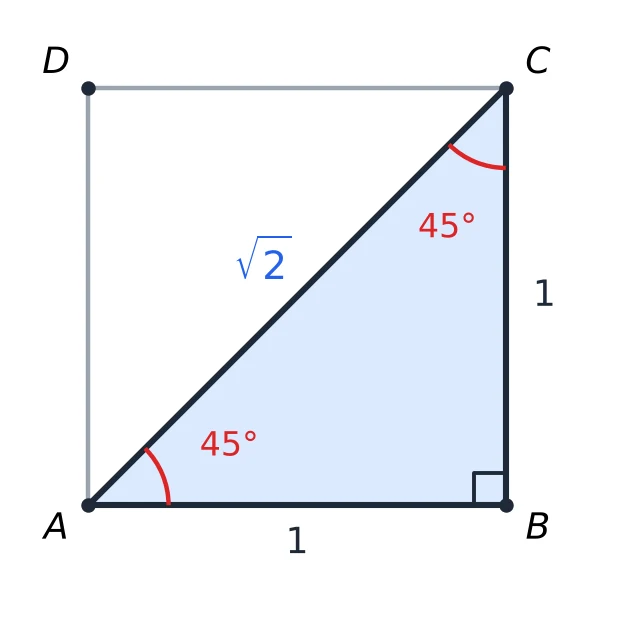
Cut a square of side 1 along a diagonal. Each half is a right triangle with two equal sides of length 1, so its two acute angles are equal: 45° each. The diagonal is 12+12=2.
At either 45° angle the opposite and adjacent sides are both 1 and the hypotenuse is 2, so
sin45∘=21cos45∘=21tan45∘=1
cosec45∘=2sec45∘=2cot45∘=1
Rationalised, 21=22, which is about 0.707. Options may print either form, so treat them as the same number.
45° is the only acute angle where the sine equals the cosine, because only there are the opposite and adjacent sides equal. For the same reason it is the only acute angle with tanθ=1.
Sides of any 45-45-90 triangle. They are in the ratio 1:1:2. A leg of 7 cm gives a hypotenuse of 72 cm. A hypotenuse of 10 cm gives legs of 210=52 cm, and the area of that triangle is 21×52×52=25 cm².
Squares of the values.sin245∘=(21)2=21 and sec245∘=(2)2=2. Squaring 21 squares the root as well, so the answer is 21; writing 41 (squaring as if the root were a 2) is a slip to avoid. As a check, sin245∘+cos245∘=21+21=1.
The 30° and 60° Values: Half an Equilateral Triangle
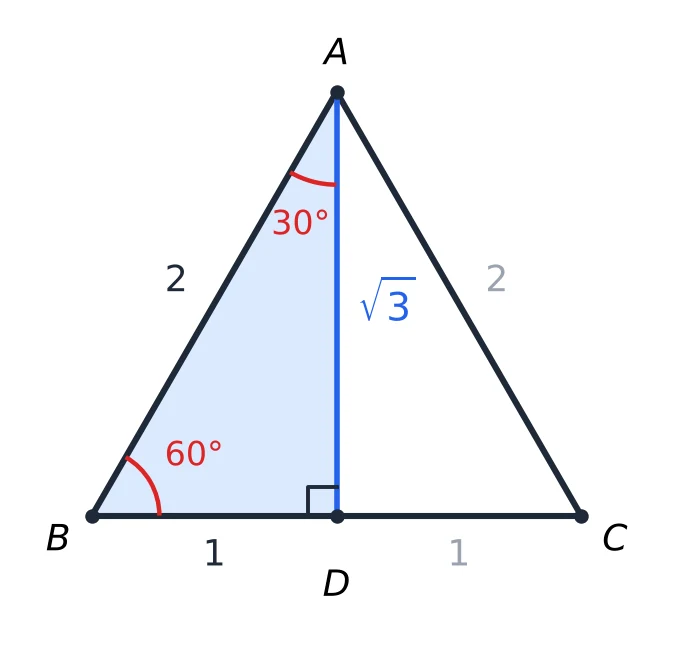
Take an equilateral triangle ABC of side 2. All its angles are 60°. The altitude AD meets BC at its midpoint and cuts the top angle in half, so triangle ABD has 30° at A, 60° at B and 90° at D, with AB = 2, BD = 1 and AD=4−1=3.
At 30° (angle A): the opposite side is BD = 1, the adjacent side is AD=3 and the hypotenuse is 2.
sin30∘=21cos30∘=23tan30∘=31
At 60° (angle B): the opposite side is AD=3 and the adjacent side is BD = 1.
sin60∘=23cos60∘=21tan60∘=3
The reciprocals follow: cosec30∘=2, sec30∘=32, cot30∘=3, and cosec60∘=32, sec60∘=2, cot60∘=31.
Look at the pairs: sin30∘=cos60∘ and tan30∘=cot60∘. That is because 30° and 60° add up to 90°; the notes on complementary angles further down explain it.
Sides of any 30-60-90 triangle. They are in the ratio 1:3:2, facing 30°, 60° and 90°. The side facing 30° is half the hypotenuse. A hypotenuse of 14 cm gives sides of 7 cm and 73 cm. If the side facing 60° is 9 cm, the shortest side is 39=33 cm and the hypotenuse is 63 cm.
The values 31 and 3 are easy to swap in a hurry. Picture the triangle: 60° is the steeper angle, so it has the bigger tan, 3≈1.73, while tan30∘≈0.58.
The Table of Standard Values, and How to Remember It
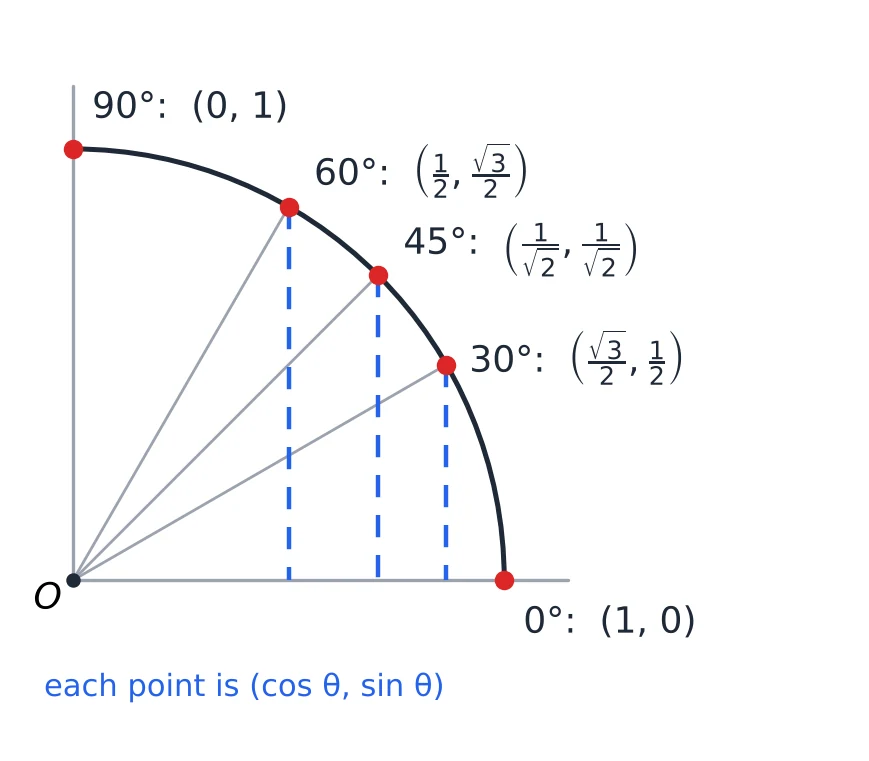
For 0° and 90°, use a circle of radius 1. A point on it at angle θ sits at (cosθ,sinθ): its distance across is the cosine and its height is the sine, as shown in Angles, Radians and Trigonometric Ratios. At 0° the point is (1, 0), so cos0∘=1 and sin0∘=0. At 90° it is (0, 1), so cos90∘=0 and sin90∘=1.
All the values together:
0°
30°
45°
60°
90°
sin
0
21
21
23
1
cos
1
23
21
21
0
tan
0
31
1
3
not defined
cosec
not defined
2
2
32
1
sec
1
32
2
2
not defined
cot
not defined
3
1
31
0
How to remember the sine row. Write 0, 1, 2, 3, 4. Take the square root of each and divide by 2:
20,21,22,23,24that is0,21,21,23,1
The cosine row is the same five numbers read backwards. The tan row is sine divided by cosine: 0, 31, 1, 3, and then 01 at 90°. The last three rows are the first three turned upside down.
Values that are not defined. Division by zero has no answer, so tan90∘=01 and sec90∘=cos90∘1 are not defined; nor are cot0∘ and cosec0∘. Some books write these as infinity, and an option saying ‘not defined’, ‘undefined’ or ‘infinite’ means the same thing. Zero itself is a proper value: tan0∘=0 and cot90∘=0.
[SSC Tip] When one option says ‘not defined’, look for a term that divides by cos90∘ or sin0∘. One such term makes the whole expression undefined, however neatly the other terms add up.
Working Out Expressions with Standard Angles
Replace each ratio by its value from the table, then simplify. Two habits help: square the whole value, root and all, and clear roots from the bottom at the end.
A fraction with roots. Simplify the top and the bottom separately, then divide:
sec30∘tan60∘+cot60∘=323+31=3234=2
Squaring.cos230∘=43, cosec245∘=2, sec230∘=34 and tan260∘=3. One slip is writing cos230∘ as 43, squaring the 2 but not the root.
Rationalising. Multiply top and bottom by the root: 31=33, 32=323 and 21=22. The options may show either form.
With 0° and 90°. A term multiplied by cos90∘, sin0∘ or tan0∘ is 0. A term that is 1 is easy to drop by accident: in sin90∘+cos0∘+tan45∘ every term is 1, and the value is 3.
Same angle or not.sin2θ+cos2θ=1 needs the same angle in both terms. sin230∘+cos230∘=1, but sin230∘+cos260∘=41+41=21.
A Ratio of a Sum Is Not a Sum of Ratios
The standard values show at once that a trigonometric ratio does not split over a plus sign or a multiple:
sin(30∘+60∘)=sin90∘=1, but sin30∘+sin60∘=21+3, about 1.37.
cos(60∘−30∘)=cos30∘=23, but cos60∘−cos30∘=21−3, which is negative.
sin(2×30∘)=sin60∘=23, but 2sin30∘=1.
tan(2×30∘)=3, but 2tan30∘=32.
So sin(A+B)=sinA+sinB and sin2A=2sinA. The correct formulas for sin(A+B), cos2A and the rest are in Allied, Compound and Double Angles. If an answer came from opening a bracket this way, it is wrong.
Testing a formula at a standard angle. Put θ=30∘ into a claimed formula and see whether both sides agree.
cos2θ=1−2sin2θ: the left side is cos60∘=21 and the right side is 1−2×41=21. They agree.
1−tan2θ2tanθ at θ=30∘ is 2/32/3=3, which is tan60∘. So this expression gives the tan of the double angle.
sin2θ=2sinθ fails at once: 23 on the left, 1 on the right.
One angle that agrees does not prove a formula, but one angle that disagrees is enough to throw it out. Identities and Simplification uses this test to check the options of a simplification question, and shows when two options can agree at the same angle.
Finding the Angle from Its Value
Between 0° and 90° the sine keeps rising, so each value of the sine belongs to exactly one angle there; the same holds for cosine and tan. Read the table backwards: sinθ=23 means θ=60∘, and tanθ=31 means θ=30∘.
A multiple of the angle inside. Find the whole bracket first, then θ.
2cos2θ=1: cos2θ=21, so 2θ=60∘ and θ=30∘.
tan(θ−10∘)=31: θ−10∘=30∘, so θ=40∘.
3sin(2θ+10∘)=23: sin(2θ+10∘)=233=23, so 2θ+10∘=60∘ and θ=25∘.
Stopping at 2θ=60∘ and writing 60° as the answer is the slip to avoid.
A square.4cos2θ=3 gives cosθ=23 (the positive root, since the angle is acute), so θ=30∘.
Sine and cosine in one equation. Divide by cosθ to get tan.
sinθ=cosθ gives tanθ=1, so θ=45∘.
3sinθ=cosθ gives tanθ=31, so θ=30∘.
A quadratic in sin or cos.2sin2θ−3sinθ+1=0 factorises as (2sinθ−1)(sinθ−1)=0, so sinθ=21 or 1, which means θ=30∘ or 90°. If the question says θ is acute, only 30° is left. A root such as sinθ=2 is thrown out, since a sine is never more than 1.
Then use the angle. Once θ is known, the rest is the table. If 2cos2θ=1, then θ=30∘ and
sin3θ+cos3θ=sin90∘+cos90∘=1+0=1
Two Equations in A + B and A − B
Some questions give two equations, one in A + B and one in A − B. Turn each one into an angle with the table, then add and subtract.
If tan(A+B)=1 and sin(A−B)=21, with both brackets acute, then
A+B=45∘,A−B=30∘⇒2A=75∘,2B=15∘
So A = 37.5° = 37°30′ and B = 7.5° = 7°30′. An answer in degrees and minutes is quite normal here; write half a degree as 30 minutes, not 50.
A second one: cos(A+B)=0 and tan(A−B)=3 give A + B = 90° and A − B = 60°, so A = 75° and B = 15°. The ratios of 75° and 15° themselves are found in Allied, Compound and Double Angles.
With a multiple of A.sin(2A−B)=1 and tan(A+B)=3 give
2A−B=90∘,A+B=60∘
Adding the two removes B: 3A = 150°, so A = 50° and B = 10°.
Checks before you answer.
With A and B both positive, A + B is larger than A − B. If your table reading makes A − B the bigger one, B would come out negative, so re-read which equation holds which bracket.
Check that each bracket is in the range the question allows. In these questions the brackets are between 0° and 90°, which is why each value gives one angle only.
Put your A and B back into both equations. It takes a few seconds and catches a reading of 23 as cos60∘ instead of cos30∘.
Complementary Angles
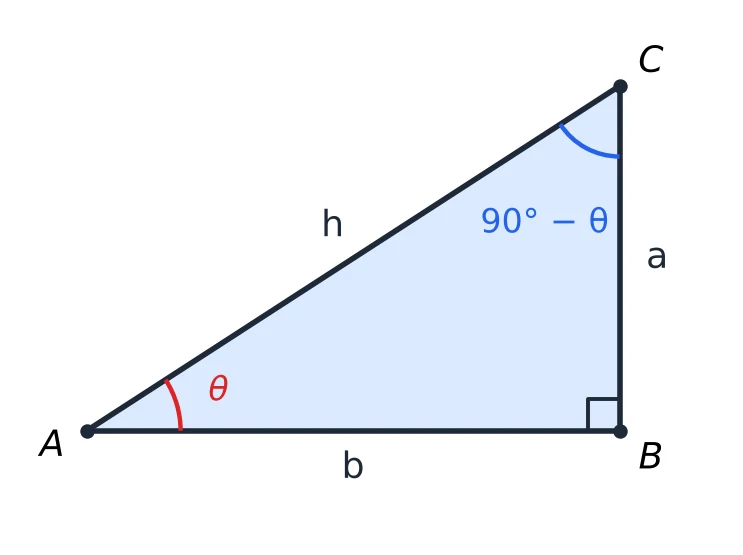
Two angles are complementary when they add up to 90°. The two acute angles of a right triangle are complementary: if one is θ, the other is 90∘−θ.
In the figure the side a is opposite θ but next to the angle 90∘−θ at C. So the one fraction ha is both the sine of θ and the cosine of 90∘−θ. The same happens with every ratio:
sin(90∘−θ)=cosθcos(90∘−θ)=sinθ
tan(90∘−θ)=cotθcot(90∘−θ)=tanθ
sec(90∘−θ)=cosecθcosec(90∘−θ)=secθ
The ‘co’ in cosine, cotangent and cosecant stands for complement: the cosine of an angle is the sine of its complement. Each ratio turns into its ‘co’ partner, and the partner turns back. The table agrees: sin30∘=cos60∘=21 and tan60∘=cot30∘=3.
Using it. Look for two angles that add up to 90°, rewrite one of them, and things cancel.
cos23∘sin67∘=cos23∘cos23∘=1
cos48∘−sin42∘=cos48∘−cos48∘=0
sec70∘sin20∘=sec70∘cos70∘=1
tan26∘tan64∘=tan26∘cot26∘=1
With squares.sin232∘+sin258∘=sin232∘+cos232∘=1, and sec240∘−cot250∘=sec240∘−tan240∘=1. Identities and Simplification has these two identities.
[SSC Tip] The rule needs angles that add up to 90°, not the same angle. sin50∘ and cos50∘ are different numbers, while sin50∘ and cos40∘ are equal. Check the sum of the two angles before cancelling anything.
Finding an Angle from a Complementary Pair
If A and B are acute and sinA=cosB, then sinA=sin(90∘−B). Between 0° and 90° each value of the sine belongs to one angle only, so
A=90∘−B,that isA+B=90∘
The same is true when tanA=cotB or secA=cosecB.
Solving for the unknown. Add the two angles and set the sum equal to 90°.
sin4θ=cos(θ+15∘): 4θ+θ+15∘=90∘, so 5θ=75∘ and θ=15∘. Check: sin60∘=cos30∘.
sec4θ=cosec(θ−20∘): 5θ−20∘=90∘, so θ=22∘. The two angles are 88° and 2°, both acute, as they must be.
The tempting mistake is to set the two angles equal, as in 4θ=θ+15∘, which gives 5°. Equal angles go with equal ratios of the same name (sinA=sinB); a sine equal to a cosine needs angles that add up to 90°.
When A + B = 90° is given. Then
sinA=cosB and tanA=cotB, so sinAsecB=1 and tanAtanB=1;
sin2A+sin2B=sin2A+cos2A=1.
If also sinA=257, then cosB=257 as well; the 7, 24, 25 triangle then gives tanB=724.
An angle and a relation. If A + B = 90° and A = 3B + 10°, then 4B + 10° = 90°, so B = 20° and A = 70°. Questions of this kind may hide the 90° behind a ratio: ‘sinA=cosB and A = 3B + 10°’ is the same question.
Long Products: Pair Each Angle with Its Complement
Products of tan, or of cot. Since tan(90∘−θ)=cotθ,
tanθtan(90∘−θ)=tanθcotθ=1
So in tan1∘tan2∘tan3∘⋯tan89∘ the factors pair off: tan1∘ with tan89∘, tan2∘ with tan88∘, and so on up to tan44∘ with tan46∘. Each pair is 1, and the factor left in the middle is tan45∘=1, so the whole product is 1. A product of cotangents behaves the same way.
A shorter product works the same, as long as you watch for a factor with no partner. In tan15∘tan30∘tan40∘tan50∘tan75∘, 15° pairs with 75° and 40° with 50°, and tan30∘=31 is left over. That is the value of the product.
A product with a zero factor. If one factor is 0, the whole product is 0, however long it is.
cos1∘cos2∘cos3∘⋯cos100∘ contains cos90∘=0, so it equals 0. You never need the cosines above 90°.
(2sin1∘−1)(2sin2∘−1)⋯(2sin89∘−1) contains 2sin30∘−1=0, so it is 0 too.
Before multiplying anything, scan the factors for one that vanishes at a standard angle.
Which pairs give 1. A ratio times the reciprocal of its partner: tan with tan, cot with cot, sin with sec, cos with cosec. sin20∘sec70∘=cos70∘sin20∘=1, but sin20∘sin70∘=sin20∘cos20∘, which is not 1.
Logarithms. The log of a product is the sum of the logs, so
The answer is 0, not 1: the 1 is the product, and the question asks for its log.
Long Sums of Squares
Pairing works for sums of squares as well, because
sin2θ+sin2(90∘−θ)=sin2θ+cos2θ=1
and in the same way cos2θ+cos2(90∘−θ)=1.
Take sin26∘+sin212∘+sin218∘+⋯+sin284∘.
Count the terms. From 6° to 84° in steps of 6° there are 684−6+1=14 terms.
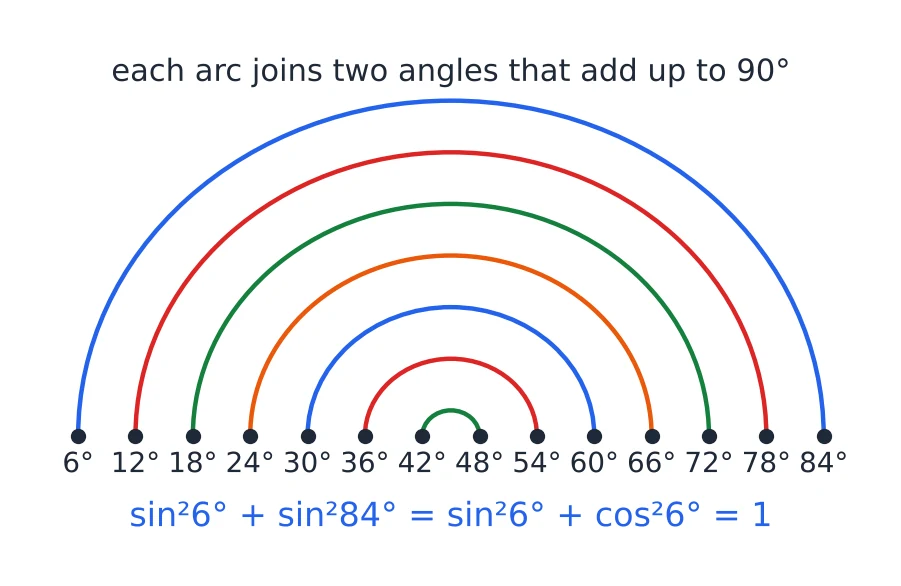
Pair them. 6° with 84°, 12° with 78°, and so on inwards: 7 pairs, each worth 1.
Add. The sum is 7.
When 45° is in the list. It has no partner, and sin245∘=cos245∘=21. In cos23∘+cos26∘+⋯+cos287∘ there are 29 terms: 14 pairs and cos245∘ in the middle, so the sum is 14+21=1421.
Both answers are half the number of terms. That shortcut holds whenever the first and last angles add up to 90°.
When the list runs to 90°. Then the ends no longer pair up, so count with care. In sin215∘+sin230∘+sin245∘+sin260∘+sin275∘+sin290∘, the pairs (15°, 75°) and (30°, 60°) make 2, sin245∘=21 and sin290∘=1, so the sum is 321, not half of 6. If 0° and 90° are both present, they pair like any other two: cos20∘+cos290∘=1+0=1.
Sums of plain sines do not pair at all: sin10∘+sin80∘ is not 1. The squares are what make the pairs work.
[SSC Tip] Count the terms with (last − first) ÷ step + 1 instead of by eye, and check whether 45° or 90° is in the list. Each of them changes the answer by a half or a whole.
Angles of a Triangle
The three angles of any triangle add up to 180°. Halve this: 2A+B+C=90∘, so
2B+C=90∘−2A
The half-angles 2B+C and 2A are complementary, and every complementary rule applies:
sin2B+C=cos2Acos2B+C=sin2Atan2A+B=cot2C
So tan2B+Ctan2A=1 in every triangle. If A=60∘, then 2B+C=60∘ and sec2B+C=2; the rule gives the same as cosec2A=cosec30∘=2.
Which half goes with which. The angle outside the bracket is the one missing from it: 2A+B pairs with 2C, 2A+C with 2B. Matching 2A+B with 2A is the error to avoid.
A right-angled triangle. If C=90∘, then A + B = 90° with no halving at all: sinA=cosB, tanAtanB=1 and sin2A+sin2B=1.
Angles given in a ratio. Angles in the ratio 1 : 1 : 2 are 45°, 45° and 90°, so for that triangle sinAcosB+sinC=21+1=23.
Without halving, the angles are not complementary. B + C = 180° − A is the supplement of A, not its complement. Then sin(B+C)=sinA, but cos(B+C)=−cosA, with a minus sign. These need angles above 90° and are done in Allied, Compound and Double Angles.
Solved Examples
Question 1
What is the value of 3tan230∘+sec245∘−4cos260∘? (a) 3 (b) 2 (c) 1 (d) 4
Answer. From the table, tan230∘=31, sec245∘=(2)2=2 and cos260∘=41. So the value is 3×31+2−4×41=1+2−1=(b) 2.
Question 2
What is the value of tan45∘+sec60∘sin60∘+cos30∘? (a) 3 (b) 23 (c) 32 (d) 31
Answer. The top is 23+23=3. The bottom is 1 + 2 = 3, since sec60∘=2. So the value is 33, which is (d) 31 after cancelling one 3.
Question 3
Which of these is not defined? (a) sin90∘ (b) cot90∘ (c) sec90∘ (d) cosec90∘
Answer.sec90∘=cos90∘1=01, which has no value. The others are fine: sin90∘=1, cot90∘=sin90∘cos90∘=0 and cosec90∘=1. So the answer is (c) sec90∘.
Question 4
If θ=30∘, what is the value of 1+tan2θ1−tan2θ? (a) 21 (b) 23 (c) 31 (d) 2
Answer.tan230∘=31. So the top is 32, the bottom is 34, and the value is 32÷34=(a) 21. This is cos60∘, the cosine of 2θ; Allied, Compound and Double Angles shows why.
Question 5
What is the value of sin(45∘+45∘)−(sin45∘+sin45∘)? (a) 0 (b) 1−2 (c) 2−1 (d) 1
Answer. The first part is sin90∘=1. The second is 21+21=22=2. So the value is (b) 1−2, a negative number. Getting 0 means sin(45∘+45∘) was opened up as sin45∘+sin45∘, which is not allowed.
Question 6
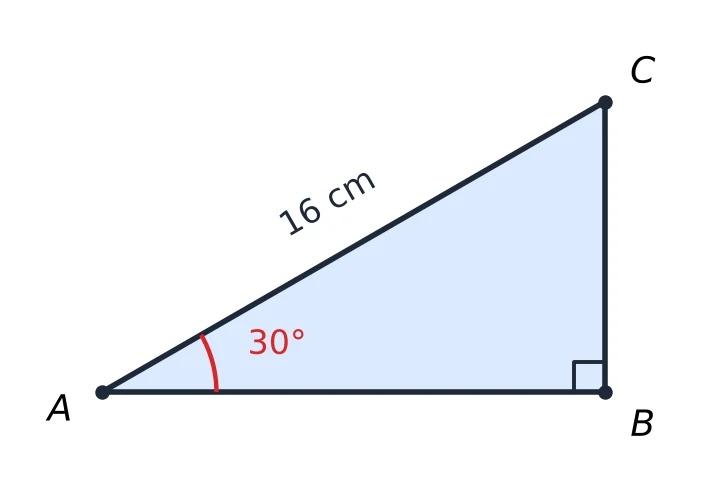
In triangle ABC, right-angled at B, ∠A=30∘ and AC = 16 cm. What is AB + BC? (a) 83 cm (b) 16(3+1) cm (c) 8(3−1) cm (d) 8(3+1) cm
Answer. AC is the hypotenuse. BC faces the 30° angle, so BC=ACsin30∘=16×21=8 cm. AB is next to the 30° angle, so AB=ACcos30∘=16×23=83 cm. Together they make 83+8=(d) 8(3+1) cm.
Question 7
If 3sec2θ=2 and 2θ is acute, what is θ? (a) 15∘ (b) 30∘ (c) 60∘ (d) 7.5∘
Answer. Dividing by 3: sec2θ=32, so cos2θ=23. That makes 2θ=30∘, and θ=(a) 15∘. 30° is the value of 2θ, not of θ.
Question 8
If cos(2θ−30∘)=21 and 2θ−30∘ is acute, what is tanθ? (a) 3 (b) 31 (c) 1 (d) 0
Answer.cos60∘=21, so 2θ−30∘=60∘, which gives 2θ=90∘ and θ=45∘. Then tanθ=tan45∘=(c) 1.
Question 9
If 2cos2θ+cosθ−1=0 and 0∘<θ<90∘, what is θ? (a) 30∘ (b) 60∘ (c) 45∘ (d) 180∘
Answer. This is a quadratic in cosθ. It factorises as (2cosθ−1)(cosθ+1)=0, so cosθ=21 or cosθ=−1. Between 0° and 90° the cosine is positive, so cosθ=21 and θ=(b) 60∘.
Question 10
If sin(A+B)=1 and cos(A−B)=23, where A > B and both brackets lie between 0° and 90°, what are A and B? (a) A = 60°, B = 30° (b) A = 45°, B = 45° (c) A = 30°, B = 60° (d) A = 75°, B = 15°
Answer.sin(A+B)=1 gives A + B = 90°, and cos(A−B)=23 gives A − B = 30°. Adding, 2A = 120°, so A = 60° and then B = 30°. The answer is (a) A = 60°, B = 30°. Reading 23 as the cosine of 60° would lead to 75° and 15°.
Question 11
If cos(A+B)=21 and tan(A−B)=31, where A > B and A + B is acute, what is B? (a) 30∘ (b) 45∘ (c) 22.5∘ (d) 15∘
Answer. From the table, A + B = 60° and A − B = 30°. Subtracting the second from the first, 2B = 30°, so B = (d) 15∘. A is 45°.
Question 12
The angles A, B and C of a triangle are in the ratio 1 : 2 : 3. What is sinA+cosB+sinC? (a) 1 (b) 23 (c) 2 (d) 1+23
Answer. 1 + 2 + 3 = 6 parts share 180°, so the angles are 30°, 60° and 90°. Then sin30∘+cos60∘+sin90∘=21+21+1=(c) 2.
Question 13
What is the value of cos53∘sin37∘+3tan28∘tan62∘−cos225∘−cos265∘? (a) 3 (b) 4 (c) 2 (d) 5
Answer. Each pair of angles adds up to 90°. cos53∘=sin37∘, so the first term is 1. tan62∘=cot28∘, so 3tan28∘tan62∘=3. And cos65∘=sin25∘, so the last two terms are −(cos225∘+sin225∘)=−1. Total: 1 + 3 − 1 = (a) 3.
Question 14
If sin(3θ−12∘)=cos(θ+22∘), where both angles are acute, what is θ? (a) 17∘ (b) 24∘ (c) 20∘ (d) 26∘
Answer. A sine equal to a cosine means the two angles are complementary: (3θ−12∘)+(θ+22∘)=90∘. So 4θ+10∘=90∘ and θ=(c) 20∘. Check: the angles are 48° and 42°, which add up to 90°. Setting the two angles equal instead gives 17°, and that is wrong.
Question 15
If tan2A=cot(A−18∘), where 2A is acute, what is A? (a) 18∘ (b) 36∘ (c) 24∘ (d) 54∘
Answer. The tan of one angle equals the cot of the other, so the angles are complementary: 2A+(A−18∘)=90∘, which gives 3A = 108° and A = (b) 36∘. Check: 2A = 72° and A − 18° = 18°, which add up to 90°.
Question 16
A and B are complementary angles and tanA=6091. What is secB? (a) 60109 (b) 10960 (c) 10991 (d) 91109
Answer. Since B = 90° − A, secB=sec(90∘−A)=cosecA. From tanA=6091 the hypotenuse is 8281+3600=11881=109, so cosecA=91109, and secB=(d) 91109. Working out secA by mistake gives 60109.
Question 17
What is the value of tan9∘tan32∘tan58∘tan81∘sin60∘? (a) 23 (b) 1 (c) 3 (d) 21
Answer. 9° pairs with 81° and 32° with 58°. tan9∘tan81∘=tan9∘cot9∘=1, and in the same way tan32∘tan58∘=1. Only sin60∘ is left, so the value is (a) 23.
Question 18
What is the value of (sin1∘−cos1∘)(sin2∘−cos2∘)⋯(sin89∘−cos89∘)? (a) 1 (b) −1 (c) 0 (d) 21
Answer. One of the brackets is sin45∘−cos45∘=0. A product with a zero factor is 0, so the value is (c) 0. There is no need to look at the other 88 brackets.
Question 19
What is the value of sin22∘+sin24∘+sin26∘+⋯+sin288∘? (a) 245 (b) 22 (c) 44 (d) 21
Answer. From 2° to 88° in steps of 2° there are 288−2+1=44 terms. The first and last add up to 90°, and so does every pair working inwards: 2° with 88°, 4° with 86°, up to 44° with 46°. 45 is odd, so 45° is not in the list. That makes 22 pairs, each equal to 1, and the sum is (b) 22.
Question 20
What is the value of sin210∘+sin220∘+sin230∘+⋯+sin290∘? (a) 4 (b) 29 (c) 9 (d) 5
Answer. There are 9 terms. Pairing 10° with 80°, 20° with 70°, 30° with 60° and 40° with 50° gives 4 pairs, worth 4. The last term, sin290∘, has no partner and equals 1. So the sum is (d) 5. Half the number of terms would give 29, but that shortcut needs the first and last angles to add up to 90°.
Question 21
What is the value of logtan1∘+logtan2∘+logtan3∘+⋯+logtan89∘? (a) 0 (b) 1 (c) −1 (d) 289
Answer. Adding logs is the same as taking the log of the product, so the sum is log(tan1∘tan2∘⋯tan89∘). The product is 1, because the angles pair off as tanθcotθ=1 and the middle factor is tan45∘=1. And log1=(a) 0.
Question 22
If A, B and C are the angles of a triangle, then sin2A+B is equal to (a) sin2C (b) cos2C (c) cosC (d) sinC
Answer. A + B + C = 180°, so 2A+B=90∘−2C. Then sin2A+B=sin(90∘−2C)=(b) cos2C.
Question 23
In triangle ABC, ∠A=60∘. What is cos2B+C? (a) 23 (b) 0 (c) 1 (d) 21
Answer. B + C = 180° − 60° = 120°, so 2B+C=60∘ and the value is cos60∘=(d) 21. The rule cos2B+C=sin2A=sin30∘ gives the same.
Question 24
In triangle ABC, right-angled at C, tanA=3. What is sinAcosB+cosAsinB? (a) 43 (b) 23 (c) 1 (d) 21
Answer.tanA=3 means A = 60°, and since C = 90°, B = 30°. So the value is sin60∘cos30∘+cos60∘sin30∘=43+41=(c) 1.
Ready to test your knowledge?
Take a quick interactive quiz on this topic —
free, works without login.