
Degrees, Minutes and Seconds
An angle measures how far a line has turned about a point. One full turn is 360°, so a straight angle is 180° and a right angle is 90°. An angle smaller than 90° is acute; one between 90° and 180° is obtuse.
For finer measurement each degree is split into 60 minutes and each minute into 60 seconds:
1° = 60′ (minutes), 1′ = 60″ (seconds), so 1° = 3600″
These minutes and seconds measure turning, not time, but you add and subtract them exactly like the hours, minutes and seconds of a clock.
From degrees, minutes and seconds to a decimal. Divide the minutes by 60 and the seconds by 3600.
- 25°30′ = 25 + 30/60 = 25.5°
- 18°45′36″ = 18 + 45/60 + 36/3600 = 18 + 0.75 + 0.01 = 18.76°
From a decimal to degrees and minutes. Multiply the decimal part by 60.
- 32.4° = 32° + (0.4 × 60)′ = 32°24′
- 47.85° = 47°51′, because 0.85 × 60 = 51
Reading 32.4° as 32°40′ is the slip to watch for. The .4 is four-tenths of a degree, and four-tenths of 60 minutes is 24 minutes.
Adding and subtracting. Work unit by unit, carrying or borrowing 60 as you would with time. To find the complement of 36°48′25″, write 90° as 89°59′60″ and subtract:
89°59′60″ − 36°48′25″ = 53°11′35″
In a triangle with two angles 63°24′ and 48°51′, the two add up to 111°75′, which is 112°15′. The third angle is 180° − 112°15′ = 67°45′.
Before an angle in degrees and minutes can be changed into radians (the next unit), it has to be written as a single number of degrees, either as a decimal or as a fraction. 25°40′, for example, is degrees, which is degrees.
The Radian
Degrees are not the only unit for angles. Draw a circle of radius r and measure along its edge an arc whose length is also r. The angle this arc makes at the centre is called one radian (1 rad).
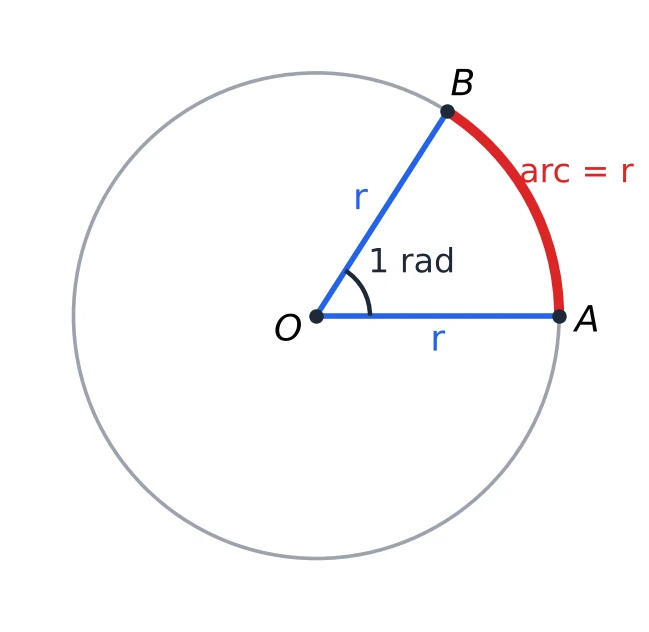
The whole circumference is , so it holds such arcs, and a full turn is radians. Half a turn gives the rule behind every conversion:
Degrees to radians: multiply by . So .
Radians to degrees: multiply by , which is the same as writing 180° in place of . So .
These pairs are worth knowing by heart:
| Degrees | 30° | 45° | 60° | 90° | 120° | 135° | 150° | 180° | 270° | 360° |
|---|---|---|---|---|---|---|---|---|---|---|
| Radians |
Minutes in the angle. Turn the minutes into a fraction of a degree first. 22°30′ is degrees, and .
Radians without . An angle of 2 radians has no in it, so use : . In the same way 1 rad degrees, a little over 57°.
An angle written without the degree sign, such as or , is in radians.
[SSC Tip] In a degree-to-radian question, one of the options can be the right fraction with the dropped, such as for 150°. Your answer keeps the unless the question asks you to put .
Arc Length and Sector Area with the Angle in Radians
An arc as long as the radius makes 1 radian at the centre, so an arc that makes radians is times the radius:
The sector cut off by that arc has area
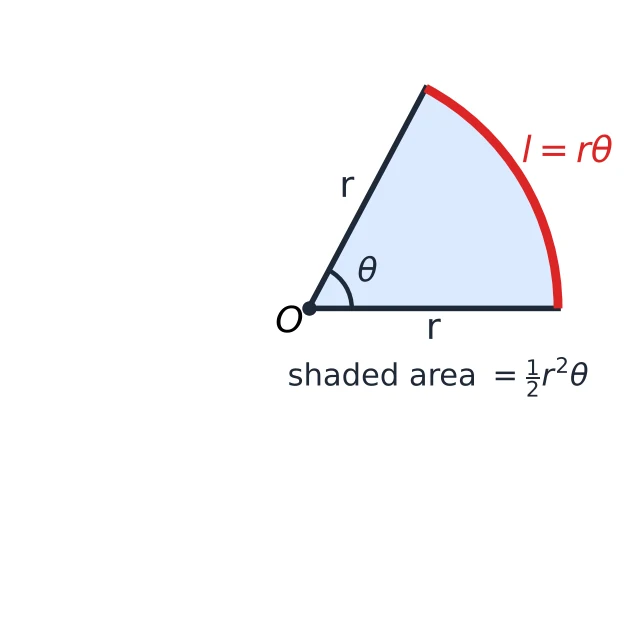
Chapter 13 gave the same results with the angle in degrees, where the and the appear separately. In radians they are already folded into , which is why these formulas are so short.
Arc from the angle. On a circle of radius 21 cm, an angle of at the centre cuts off an arc cm (with ). The sector has area cm².
Angle from the arc. An arc of 33 cm on a circle of radius 14 cm makes radian at the centre. In degrees that is
A swinging pendulum. The bob of a pendulum moves along an arc whose radius is the length of the pendulum. A pendulum 42 cm long that swings through 30° moves its bob along cm.
[SSC Tip] is true only with in radians. Put 120° straight into it for the circle above and the arc comes out as 21 × 120 = 2520 cm, far longer than the whole circumference of 132 cm. Change degrees to radians first.
Wheels, Turning and a Train on a Curve
One revolution of a wheel is one full turn: 360°, or radians. So
A wheel that makes 480 revolutions a minute makes 8 a second, and turns through radians every second. Over a full minute that is radians, so read carefully whether the question wants the angle per second or per minute.
A wheel rolling on the ground. As a wheel rolls without slipping, the length of road it covers equals the length of rim that has touched the road. With the angle in radians,
A wheel of radius 35 cm that rolls 11 m (1100 cm) turns through radians. With that is radians, or 5 full revolutions. Counting revolutions gives the same: one revolution covers cm, and 1100 ÷ 220 = 5.
A train on a circular track. The train runs along an arc of the track, so the angle it turns through, measured at the centre of the curve, is the distance travelled divided by the radius. Take a train at 72 km/h on a curve of radius 1.4 km. In metres per second its speed is , so in 11 seconds it covers 220 m and turns through
Put the distance and the radius in the same unit before dividing: 220 m on a radius of 1.4 km is , not .
Radian or degree in the answer. Questions on wheels and tracks may ask for the angle either way. The radian value is the bare ratio of two lengths; multiply it by only if degrees are wanted.
Clock Hands, Fractions of a Turn and Angles in a Ratio
Clock hands. The minute hand goes round once in 60 minutes and the hour hand once in 12 hours. So
- the minute hand turns 6° a minute, that is radian a minute;
- the hour hand turns 30° an hour, that is 0.5° a minute or radian a minute.
At h hours m minutes the hour hand is (30h + 0.5m)° past 12 and the minute hand is 6m° past 12. The angle between them is the difference, |30h − 5.5m|. If it comes out above 180°, take 360° minus it for the smaller angle.
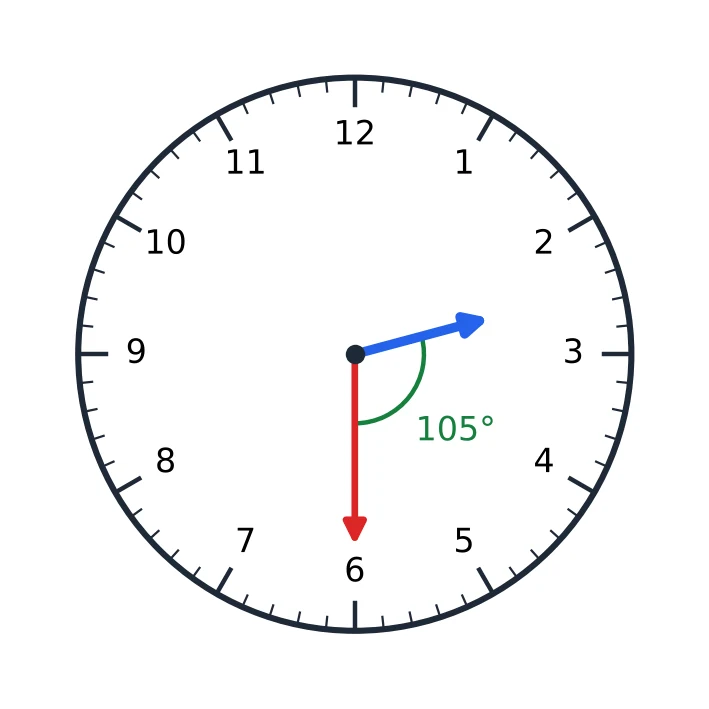
At 2:30 the hour hand has turned 30 × 2 + 0.5 × 30 = 75° from 12 and the minute hand 180°. They are 105° apart, which is radians. The hour hand is halfway between 2 and 3, not on the 2.
From noon to 3:40 the hour hand turns 220 × 0.5 = 110° = rad, while the minute hand turns 220 × 6 = 1320° = rad, three full turns and 240° more. The tip of a minute hand 7 cm long moves along an arc: in 30 minutes the hand turns radians, so the tip moves cm.
An angle as a part of a full turn. Divide by 360° (or by for radians) and multiply by 100 for a percentage.
- 72° is = 20% of a full turn.
- is of a turn, that is 37.5%.
- One radian is of a turn, a little under 16%.
- Going the other way, 40% of a full turn is 144°, which is .
Angles in a ratio. The angles of a triangle add up to 180° ( radians) and those of a quadrilateral to 360° (). Angles of a triangle in the ratio 2 : 3 : 7 are , and of 180°: that is 30°, 45° and 105°, or , and .
The Six Trigonometric Ratios
Trigonometry starts with a right triangle. In triangle ABC below, the right angle is at B and the angle we study, , is at A. Name the sides from A's point of view:
- the hypotenuse AC faces the right angle and is the longest side;
- the opposite side BC is across from (also called the perpendicular);
- the adjacent side AB is the other side that touches (also called the base).
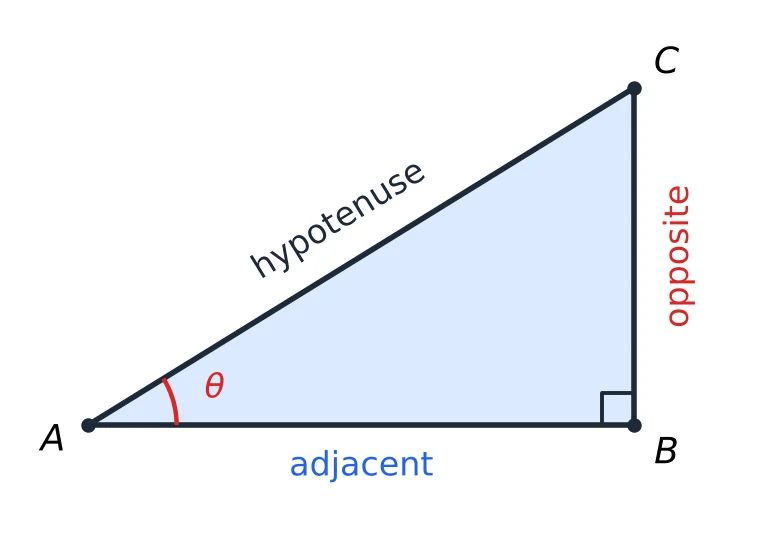
The six ratios are
With P for perpendicular, B for base and H for hypotenuse, the first three are P/H, B/H and P/B. Many students keep this order with the line “Pandit Badri Prasad Har Har Bole”: the first and fourth words give P/H for sin, the second and fifth B/H for cos, the third and sixth P/B for tan.
An example. If AB = 12, BC = 5 and AC = 13, then
Change the angle, and opposite and adjacent swap. Standing at C, the opposite side is AB and the adjacent one is BC, so and . The hypotenuse is the same for both acute angles.
Size does not matter. A right triangle with sides 10, 24 and 26 has the same angles as the 5, 12, 13 triangle, and so the same ratios: . A ratio fixes the angle, not the size of the triangle.
Reading the symbols. is one quantity, not sin multiplied by . means , and is not the same as .
Reciprocal Pairs, and Tan from Sin and Cos
Turn each of the first three ratios upside down and you get the other three:
So , and .
The pairs are sin with cosec and cos with sec: in each pair one name has “co” and the other does not. Pairing sec with sin is the mistake to watch for. If , then , while is a different number, (the adjacent side is 4).
Tan from sin and cos. Divide sin by cos and the hypotenuse cancels:
If and , then at once, with no triangle drawn.
Quick simplifications. Write every ratio in terms of sin and cos, then cancel.
Pythagoras in ratio form. In the triangle, . Dividing by gives
It is a handy check on any pair of values you work out: . The full set of identities, and how to simplify with them, is in Identities and Simplification.
One Ratio Given: Find All the Others
A question may give one ratio and ask for another, or for an expression in several of them. The method does not change:
- Write the given ratio as side over side and put those two numbers on a right triangle.
- Find the third side by Pythagoras.
- Read off whatever is asked.
Take . The opposite side is 8 and the adjacent side 15, so the hypotenuse is .
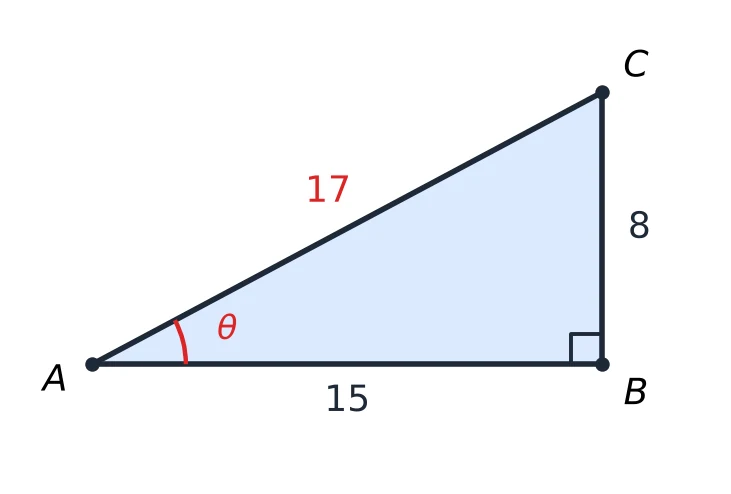
The 8 and 15 need not be the real lengths. Sides 8k, 15k and 17k give the same angle, and k cancels in every ratio.
Pythagorean triplets save the square root. These whole-number right triangles are worth recognising:
| 3, 4, 5 | 5, 12, 13 | 8, 15, 17 | 7, 24, 25 |
| 20, 21, 29 | 12, 35, 37 | 9, 40, 41 | 28, 45, 53 |
| 11, 60, 61 | 33, 56, 65 | 16, 63, 65 | 48, 55, 73 |
| 13, 84, 85 | 36, 77, 85 | 39, 80, 89 | 65, 72, 97 |
with their multiples, such as 6, 8, 10 or 15, 20, 25. The largest number is the hypotenuse. So means adjacent 21, hypotenuse 29 and opposite 20, giving . And means , the opposite side is 72 and .
When the third side is a surd. gives an adjacent side of , so and .
With letters. If , the hypotenuse is and
[SSC Tip] Before drawing, check which two sides the given ratio uses. puts 17 on the hypotenuse and 8 on the adjacent side. Putting the 8 opposite instead swaps every sine with its cosine, and the swapped value makes a ready-made wrong option.
Expressions in the Ratios
Once sin and cos are known, any expression in the six ratios is arithmetic. Find the values from the triangle, put them in, and simplify.
A fraction in sin and cos. Take . Then , the opposite side is 4 and . So
Every term has a 5 underneath, and it cancels. Whenever each term on top and below has exactly one sin or one cos, you can use the sides themselves: 4 for sin and 3 for cos give at once. Values from a Condition, Maximum and Minimum does the same job by dividing through by .
Brackets of the form (1 + x)(1 − x). Multiply out first: , and in the same way . So if ,
The long way agrees: the hypotenuse is 13, , , and .
Sums of two ratios. With the opposite side is 21, so
Squares and products. With and : and .
Before putting values into a long expression, check that for them. If it fails, a side of your triangle is wrong.
Ratios in a Right Triangle with Sides Given
In a triangle question, find the right angle first: the side facing it is the hypotenuse. “Right-angled at B” means AC is the hypotenuse, and the two acute angles are A and C.
Two sides known. Find the third by Pythagoras and read off. In triangle PQR, right-angled at Q, with PR = 89 and PQ = 39, the third side is . Then , and .
A sum of two sides given. Triangle ABC is right-angled at B, with AB = 12 cm and AC + BC = 18 cm. Write Pythagoras as a difference of squares and factorise:
Adding and subtracting AC + BC = 18 and AC − BC = 8 gives AC = 13 cm and BC = 5 cm. Now , and . A difference of two sides is handled the same way.
Sides written in x. If the sides of a right triangle are x, x + 7 and x + 8, the longest is the hypotenuse:
so x = 5 (a length cannot be −3). The sides are 5, 12 and 13, and the smallest angle, which faces the side 5, has sine .
One angle and the other. BC is opposite A but next to C, so the same fraction serves both angles:
The two acute angles add up to 90°, and Standard Angles and Complementary Angles builds a whole method on this.
Mark the angle the question asks about before reading off a side. In a triangle right-angled at B, and use different sides, and picking the wrong one gives an answer that looks just as tidy as the right one.
Isosceles Triangles and Triangles with an Altitude
A triangle without a right angle has no hypotenuse, so its ratios cannot be read off directly. Draw an altitude to make right triangles, then work inside them.
Isosceles triangle. In triangle ABC, AB = AC = 13 cm and BC = 10 cm. The altitude AD from the top meets BC at its midpoint, so BD = DC = 5 cm and cm.
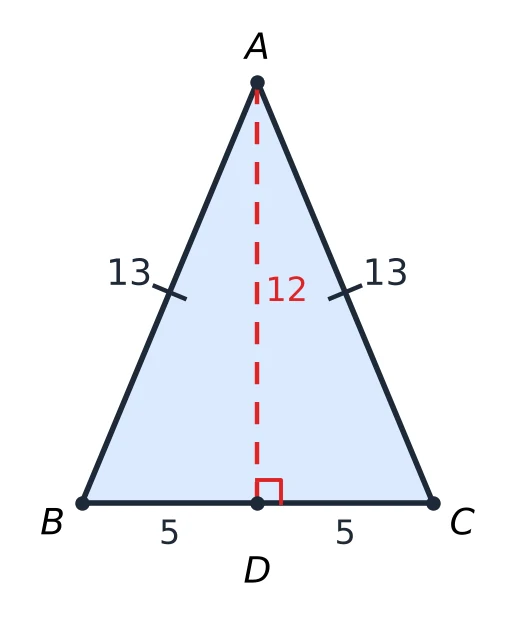
In right triangle ABD,
The altitude also halves the top angle, so is the sine of half of .
Equilateral triangle. All three sides are equal, and the altitude again meets the base at its midpoint. For side 2a the altitude is . Its angles are 60° and 30°, whose values are worked out in Standard Angles and Complementary Angles. If a point D on the base is not the midpoint, drop the altitude AM anyway and work in triangle ADM, which has its right angle at M.
Any triangle with an altitude. In triangle ABC, AD is perpendicular to BC, AB = 15 cm, AC = 13 cm and AD = 12 cm.
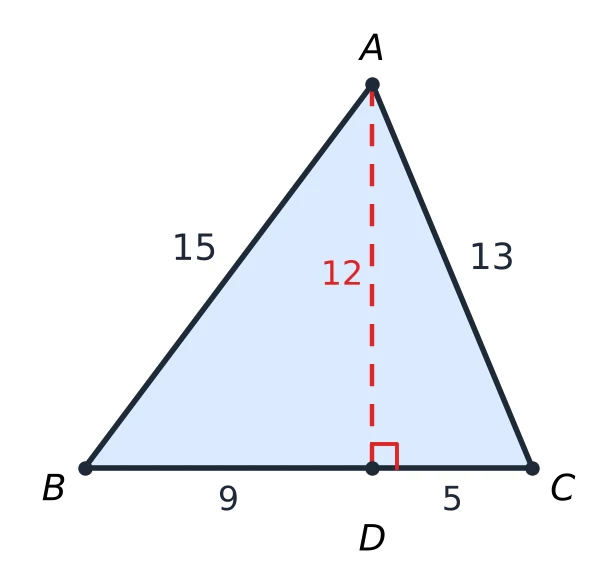
The altitude splits the triangle into two right triangles that share the side AD.
- In triangle ABD: cm, so , and .
- In triangle ACD: cm, so , and .
The base BC is 9 + 5 = 14 cm. Read each angle's ratios inside the right triangle that contains it: B belongs to triangle ABD and C to triangle ACD. Using AB = 15 as if it were a hypotenuse for angle C mixes the two halves and gives nonsense.
How the Ratios Change from 0° to 90°
Place the right triangle inside a circle of radius 1, with the angle at the centre O and the hypotenuse along a radius. The hypotenuse is now 1, so
The figure shows this for 25° and 65°.
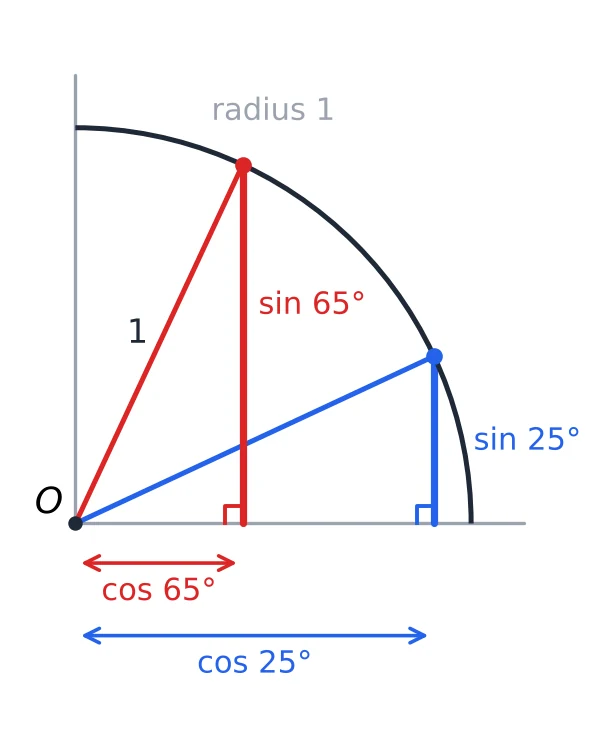
As grows from 0° to 90°, the point climbs the circle: its height grows from 0 to 1 while its distance across shrinks from 1 to 0. So
- increases from 0 to 1, and decreases from 1 to 0;
- increases from 0 and grows without limit as nears 90°;
- the reciprocals move the other way: and decrease, increases.
Bounds. The hypotenuse is the longest side, so for an acute angle and lie between 0 and 1, and and are greater than 1. and can be any positive number. Values such as or cannot happen.
Which is larger? The graphs of sin and cos cross at 45°.
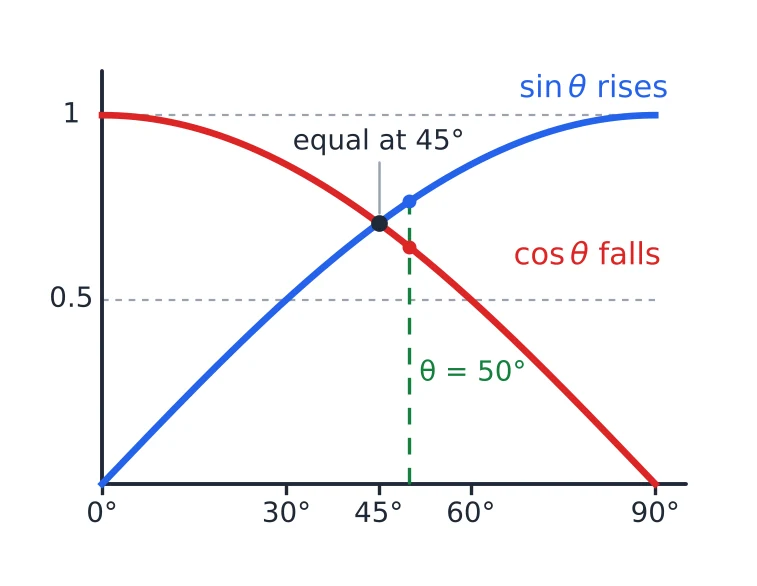
- Below 45°: and .
- At 45°: and .
- Above 45°: and .
So and . Also for every acute angle, since and dividing by a number less than 1 makes it bigger.
Radians in a comparison. means the sine of 1 radian, which is about 57°. So , while .
[SSC Tip] To compare the sine of one angle with the cosine of another, turn the cosine into the sine of 90° minus the angle: , which is less than . The rule behind this is in Standard Angles and Complementary Angles.
Solved Examples
Question 1
What is the radian measure of 40°20′? (a) (b) (c) (d)
Answer. I change the minutes into degrees first: 20′ is of a degree, so the angle is degrees. Now I multiply by : (a) . is 40° alone, with the 20′ thrown away.
Question 2
What is radians in degrees and minutes? (a) 37°50′ (b) 75° (c) 37°30′ (d) 18°45′
Answer. I put 180° in place of : . Half a degree is 30 minutes, so the angle is (c) 37°30′. Writing 37°50′ reads the .5 as 50 minutes, but .5 of a degree is half of 60 minutes.
Question 3
Taking , one radian is closest to (a) 57°27′ (b) 57°16′22″ (c) 57°30′ (d) 57°22′16″
Answer. 1 rad degrees. The leftover of a degree is minutes, and of a minute is , about 21.8 seconds. So one radian is about (b) 57°16′22″. The decimal 57.27° is not 57°27′; its .27 has to be multiplied by 60.
Question 4
The angles of a triangle are in the ratio 3 : 4 : 5. What is the largest angle in radians? (a) (b) (c) (d)
Answer. The parts add up to 3 + 4 + 5 = 12 and the angles share 180°, so one part is 15°. The largest angle is 5 × 15° = 75°, and (d) . Sharing 360° by mistake gives 150°, which is .
Question 5
Two complementary angles differ by radians. What is the larger angle in degrees? (a) (b) (c) (d)
Answer. Complementary angles add up to 90°. The difference is . So the larger angle is (a) and the smaller one is 35°.
Question 6
An arc of a circle of radius 35 cm makes an angle of 72° at the centre. How long is the arc? (Take .) (a) 88 cm (b) 44 cm (c) 22 cm (d) 2520 cm
Answer. In radians, . Then (b) 44 cm. Multiplying 35 by 72 gives 2520 cm, longer than the whole circle (220 cm), because 72 is in degrees.
Question 7
An arc 22 cm long makes an angle at the centre of a circle of radius 28 cm. What is the angle in degrees? (Take .) (a) (b) (c) (d)
Answer. The angle in radians is . To change it to degrees I multiply by : (c) .
Question 8
A wheel makes 300 revolutions per minute. Through how many radians does it turn in one second? (a) (b) (c) 10 (d)
Answer. 300 revolutions a minute is 5 revolutions a second. Each revolution is radians, so in one second the wheel turns (d) . is the angle for a whole minute.
Question 9
What is the angle between the hands of a clock at 5:20, in radians? (a) (b) (c) (d)
Answer. At 5:20 the hour hand has moved past the 5: it is 30 × 5 + 0.5 × 20 = 160° from 12. The minute hand is 6 × 20 = 120° from 12. The gap is 40°, and (c) . If the hour hand is kept exactly on the 5 (150°), the gap comes out as 30°, which is .
Question 10
The minute hand of a clock is 14 cm long. How far does its tip move in 45 minutes? (Take .) (a) 66 cm (b) 88 cm (c) 22 cm (d) 33 cm
Answer. In 60 minutes the hand turns , so in 45 minutes it turns radians. The tip moves along an arc of radius 14 cm: (a) 66 cm.
Question 11
An angle of radians is what percentage of a full turn? (a) 15% (b) 30% (c) 54% (d) 60%
Answer. In degrees, . A full turn is 360°, so the share is (a) 15%. Working in radians gives the same: .
Question 12
A train runs at 66 km/h on a circular track of radius 1500 m. Through what angle (in degrees) does it turn in 10 seconds? (Take .) (a) (b) (c) (d)
Answer. 66 km/h is m per second, so in 10 seconds the train covers m of track. The angle at the centre is arc ÷ radius: radian. In degrees: (d) . Stopping before dividing by gives 22°.
Question 13
In triangle ABC, right-angled at B, AB = 24 cm and BC = 7 cm. What is ? (a) (b) (c) (d) 1
Answer. AC is the hypotenuse: cm. For angle A the opposite side is BC, so . For angle C the adjacent side is BC again, so too. The sum is (c) .
Question 14
If , what is ? (a) (b) (c) (d) 1
Answer. Opposite 20 and adjacent 21, so the hypotenuse is . Then and , and their sum is (b) .
Question 15
If , what is ? (a) (b) (c) (d)
Answer. Secant is hypotenuse over adjacent, so the hypotenuse is 85 and the adjacent side 36. The opposite side is . Then and , which add up to (a) . Adding sec and tan instead would give .
Question 16
If , what is the value of ? (a) (b) (c) (d)
Answer. I multiply out the brackets first. The top is and the bottom is . So the whole fraction is (d) . I never needed the hypotenuse.
Question 17
If , what is ? (a) 2 (b) (c) (d)
Answer. Adjacent 7 and hypotenuse 25, so the opposite side is . Then and . Over the common denominator 168 this is (b) .
Question 18
If and is acute, what is ? (a) (b) (c) (d)
Answer. Adjacent 2 and hypotenuse 3, so the opposite side is . Then (c) .
Question 19
In triangle ABC, right-angled at B, AB = 5 cm and AC + BC = 25 cm. What is ? (a) (b) (c) (d)
Answer. AC is the hypotenuse, so . Factorising, , and since AC + BC = 25, AC − BC = 1. That gives AC = 13 cm and BC = 12 cm. For angle C the opposite side is AB, so (b) . The value would be .
Question 20
In triangle ABC, AB = AC = 25 cm and BC = 14 cm. What is ? (a) (b) (c) (d)
Answer. The triangle is isosceles, so the altitude AD from A meets BC at its midpoint and BD = 7 cm. Then cm. In right triangle ABD, (d) .
Question 21
In triangle ABC, AD is perpendicular to BC, AB = 20 cm, BD = 16 cm and DC = 5 cm. What is ? (a) (b) (c) (d) 1
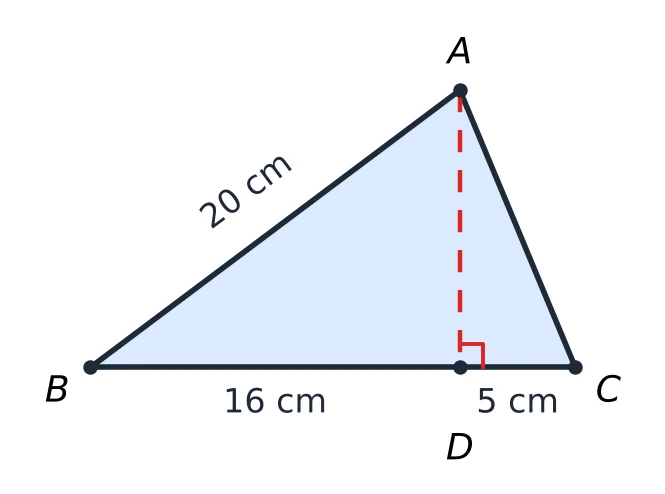
Answer. From triangle ABD, cm. From triangle ADC, cm. So and . Adding: (a) .
Question 22
Which of these is true? (a) (b) (c) (d)
Answer. 50° is more than 45°, and past 45° the sine is the larger of the two. Another way to see it: , and sine increases from 0° to 90°, so is bigger. For the same reason is more than 1. The true statement is (c) .
Question 23
is an acute angle. Which of these values is impossible? (a) (b) (c) (d)
Answer. For an acute angle the hypotenuse is the longest side. So sin and cos are less than 1, while sec and cosec, which have the hypotenuse on top, are more than 1. But tan and cot can be any positive number. A secant below 1 cannot happen, so the impossible one is (b) .
Question 24
ABC is an equilateral triangle of side 6 cm, and D is the point on BC with BD = 2 cm. What is ? (a) (b) (c) (d)
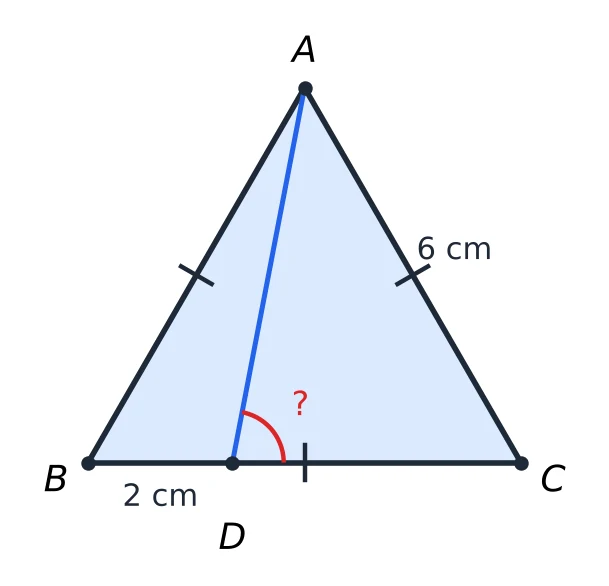
Answer. I drop the altitude AM. It meets BC at its midpoint, so BM = 3 cm and DM = 3 − 2 = 1 cm, with M between D and C. The altitude is cm. Triangle ADM has its right angle at M, and is its angle at D, so (d) . Dividing by BD = 2 instead of DM = 1 gives .