
The Consumer Movement
The consumer movement arose out of consumers' dissatisfaction with the many unfair practices of sellers, when there was no legal system to protect consumers. Earlier, it was assumed to be the consumer's own responsibility to be careful — "buyer beware". Creating awareness took many years and gradually shifted the responsibility for quality onto the sellers.
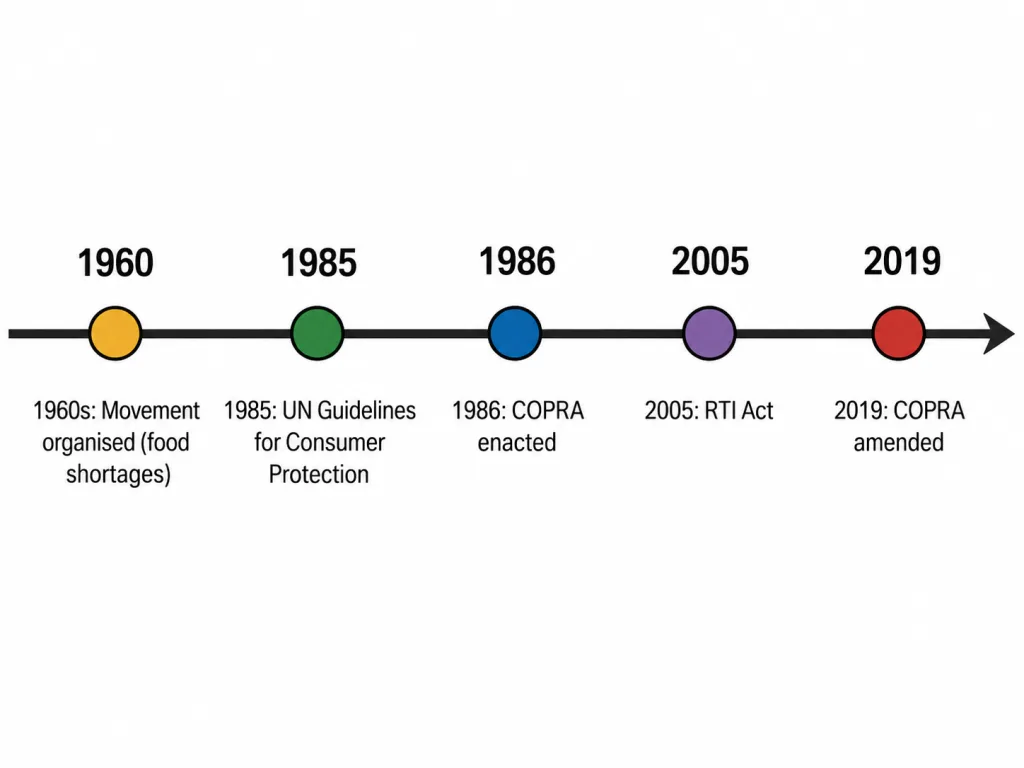
In India, the consumer movement as a social force began with the need to protect consumers against unfair trade practices. Rampant food shortages, hoarding, black-marketing and adulteration of food and edible oil gave birth to the organised consumer movement in the 1960s. Till the 1970s, consumer organisations mostly wrote articles and held exhibitions; more recently, India has seen an upsurge in consumer groups.
Consumers International and COPRA
At the international level, in 1985 the United Nations adopted the UN Guidelines for Consumer Protection — a tool for nations to protect consumers and for advocacy groups to press their governments. This became the foundation of the global consumer movement. Today, Consumers International is an umbrella body of over 200 member organisations from over 100 countries.
These efforts pressured businesses and governments to correct unfair conduct. A major step was the Indian government's enactment of the Consumer Protection Act 1986, popularly known as COPRA (later amended in 2019).
Questions and Answers
Q1. What factors gave birth to the consumer movement in India? Trace its evolution.
Answer: The consumer movement in India was born out of dissatisfaction with unfair trade practices and the lack of any legal protection. Rampant food shortages, hoarding, black-marketing and adulteration of food and edible oil led to the movement's organised form in the 1960s. Till the 1970s, consumer groups mostly wrote articles and held exhibitions; later there was an upsurge in consumer groups. Internationally, the UN Guidelines (1985) and Consumers International strengthened it, and in India it led to COPRA 1986.
Q2. What is COPRA? Why was it important?
Answer: COPRA is the Consumer Protection Act 1986, enacted by the Indian government (and amended in 2019). It was important because, for the first time, it gave consumers a legal system to protect them from exploitation and unfair trade practices, set up consumer courts for redressal, and recognised consumers' rights. It marked a major step in shifting responsibility for fair dealing onto sellers.
Q3. What is Consumers International, and what role does it play?
Answer: Consumers International is an umbrella body of over 200 member organisations from over 100 countries. It grew out of the UN Guidelines for Consumer Protection (1985). It serves as the foundation of the international consumer movement, helping consumer groups worldwide press their governments to adopt measures that protect consumers and promote their interests.