
The Right to Information
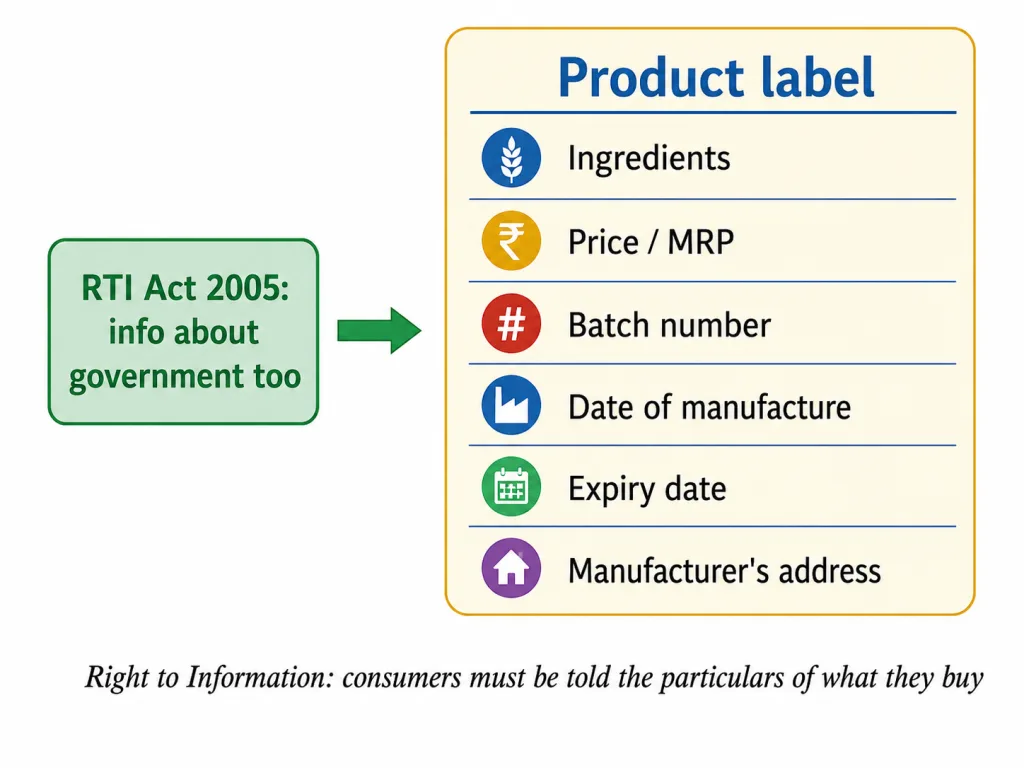
Consumers have the right to be informed about the particulars of the goods and services they buy. That is why rules require manufacturers to display key details on the packing: ingredients, price, batch number, date of manufacture, expiry date and the manufacturer's address. Medicines carry directions for proper use and information on side effects and risks; garments carry washing instructions.
With this information, consumers can complain and seek compensation or replacement if a product is defective. For example, if a product is found defective within the expiry period, a replacement can be demanded; if the expiry date is not printed, the manufacturer cannot escape responsibility. The MRP (maximum retail price) printed on the packet protects buyers — selling above the MRP is illegal, and consumers can even bargain to buy below the MRP.
The Right to Information Act (RTI)
In recent times, the right to information has been expanded to cover government services. In October 2005, the Government of India enacted the Right to Information (RTI) Act, which ensures citizens all information about the functioning of government departments.
Its effect is shown by Amritha, an engineering graduate who, after an interview for a government job, received no news of the result and no reply to her queries. She filed an application under the RTI Act, arguing it was her right to know the result in reasonable time. She was not only informed about the reasons for the delay but also got her appointment letter, having performed well in the interview.
Questions and Answers
Q1. What is the Right to Information? What details must be displayed on a package?
Answer: The Right to Information is the consumer's right to be informed about the particulars of the goods and services they buy. Rules require manufacturers to display, on the packing, details such as ingredients, price, batch number, date of manufacture, expiry date and the manufacturer's address (and, for medicines, directions for use and side effects). With this information, consumers can make informed choices and claim replacement or compensation for defective goods.
Q2. What is the RTI Act? How did it help Amritha?
Answer: The Right to Information (RTI) Act, enacted in October 2005, ensures citizens all information about the functioning of government departments. Amritha, who got no result or reply after a government-job interview, filed an application under the RTI Act claiming her right to know. She was told the reasons for the delay and, having done well, received her appointment letter. The case shows how the RTI Act empowers citizens to demand information from the government.
Q3. What is MRP, and how does it protect consumers?
Answer: MRP stands for maximum retail price — the highest price at which a packed good may be sold, printed on the packet. It protects consumers because a seller cannot legally charge more than the MRP; if they do, the consumer can protest and complain. In fact, consumers may even bargain to buy below the MRP. Thus the printed MRP is part of the consumer's Right to Information.