
The Right to Represent — Consumer Courts
The consumer movement in India has led to the formation of consumer forums or consumer protection councils. They guide consumers on how to file cases in the Consumer Disputes Redressal Commissions and often represent individual consumers in these commissions. These voluntary organisations also receive financial support from the government for creating awareness. (Residents' Welfare Associations may also take up unfair-practice cases on their members' behalf.)
The Three-Tier Machinery under COPRA
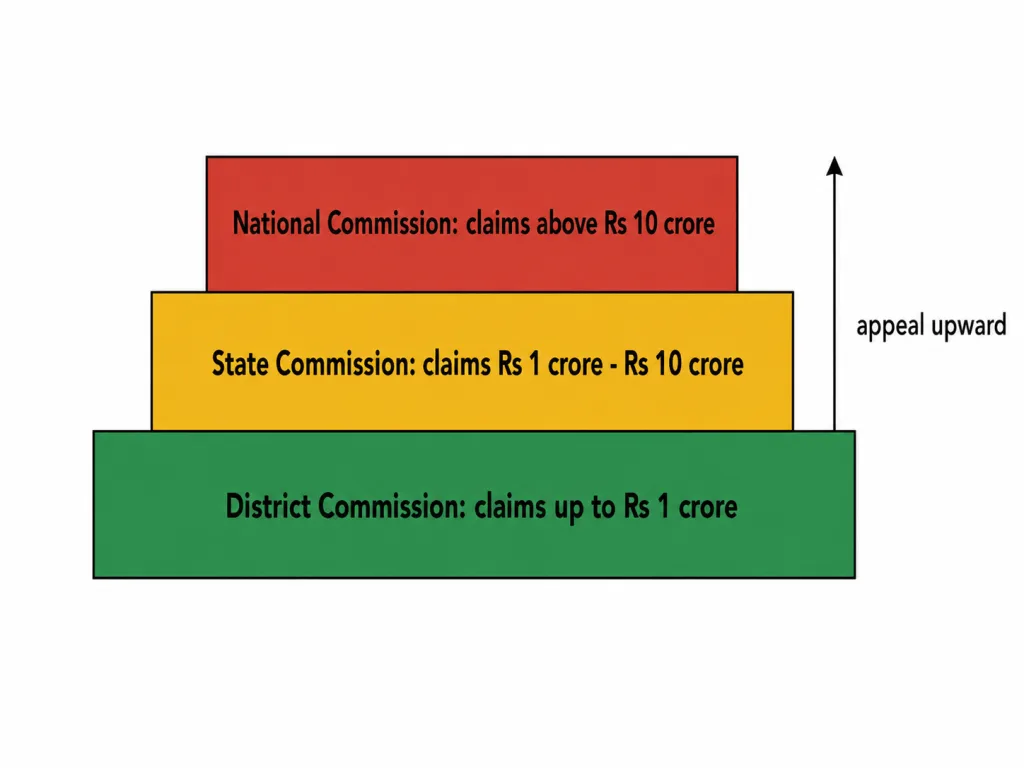
Under COPRA, a three-tier quasi-judicial machinery at the district, state and national levels handles consumer disputes:
- District — the District Consumer Disputes Redressal Commission deals with claims up to Rs 1 crore.
- State — the State Commission deals with claims between Rs 1 crore and Rs 10 crore.
- National — the National Commission deals with claims exceeding Rs 10 crore.
If a case is dismissed at the district level, the consumer can appeal at the state level and then the national level. Thus the Act gives consumers the Right to Represent in the Consumer Disputes Redressal Commissions.
Questions and Answers
Q1. What is the Right to Represent? What role do consumer forums play?
Answer: The Right to Represent is the consumer's right to be heard and represented in the Consumer Disputes Redressal Commissions. Consumer forums or consumer protection councils help by guiding consumers on how to file cases and often representing them in the commissions. These voluntary organisations also receive government financial support to spread awareness, strengthening the consumer's ability to seek justice.
Q2. Describe the three-tier redressal machinery set up under COPRA.
Answer: COPRA set up a three-tier quasi-judicial machinery: the District Commission handles claims up to Rs 1 crore; the State Commission handles claims between Rs 1 crore and Rs 10 crore; and the National Commission handles claims above Rs 10 crore. If a case is dismissed at a lower level, the consumer can appeal to the next higher level (district → state → national). This structure gives consumers accessible avenues to seek redressal.
Q3. What is the difference between a consumer protection council and a Consumer Disputes Redressal Commission?
Answer: A consumer protection council (or consumer forum) is a voluntary organisation that guides and represents consumers, spreads awareness, and helps them file cases; it does not pass judgments. A Consumer Disputes Redressal Commission is the quasi-judicial body (at district, state or national level) that actually hears cases and delivers verdicts, ordering compensation or replacement. In short, councils assist consumers, while commissions decide disputes.