
Why Resources Must Be Developed Carefully
Resources are vital for human survival and for maintaining the quality of life. For a long time people believed that resources were free, unlimited gifts of nature. As a result, human beings used them indiscriminately, which has led to three major problems:
- Depletion of resources to satisfy the greed of a few individuals.
- Accumulation of resources in a few hands, which divides society into two segments — the haves and the have-nots (rich and poor).
- Indiscriminate exploitation of resources, leading to global ecological crises such as global warming, ozone-layer depletion, environmental pollution and land degradation.
Key Point: Using resources without planning harms both people (inequality) and the planet (ecological crisis). This is why development must be sustainable.
What is Sustainable Development?
Sustainable development means that development should take place without damaging the environment, and that development in the present should not compromise with the needs of future generations.
In other words, we must meet our own needs in a way that still leaves enough resources — and a healthy environment — for the generations who come after us.
Definition to remember: Sustainable economic development = growth without environmental damage, keeping the needs of the future in mind.
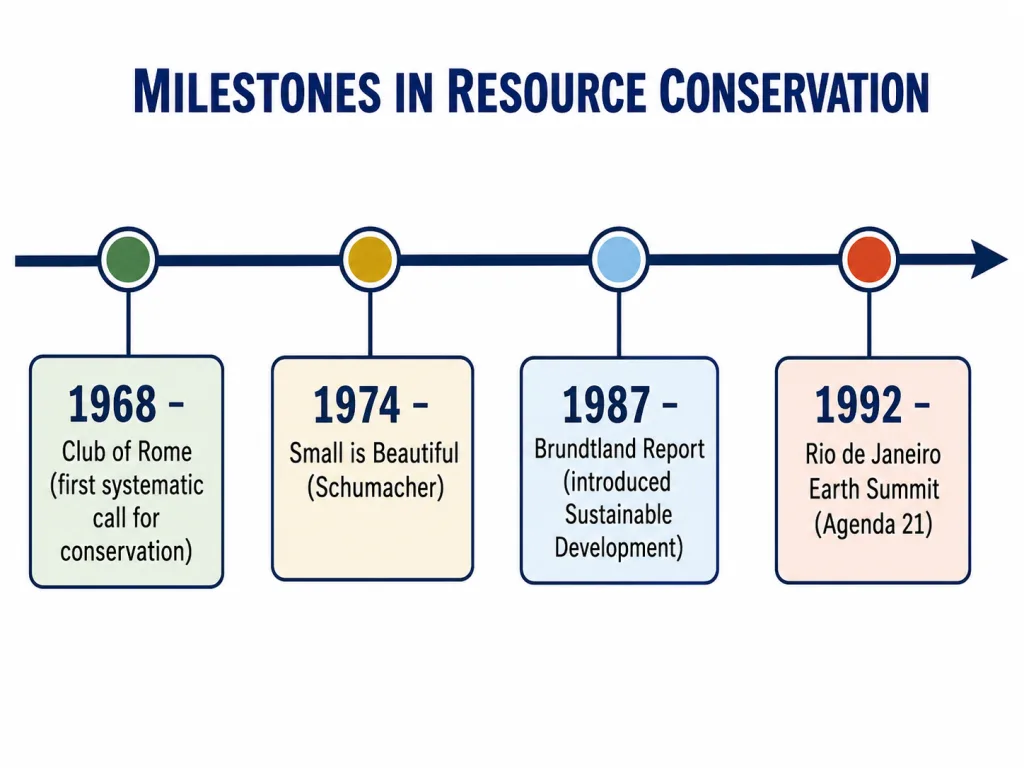
Milestones in Resource Conservation
The idea of conserving resources at the global level developed in stages:
| Year | Contribution |
|---|---|
| 1968 | The Club of Rome advocated resource conservation for the first time in a systematic way. |
| 1974 | Gandhian philosophy was presented again by Schumacher in his book Small is Beautiful. |
| 1987 | The Brundtland Commission Report introduced the concept of 'Sustainable Development', later published as the book Our Common Future. |
| 1992 | The Earth Summit at Rio de Janeiro, Brazil — the first International Earth Summit. |
Exam tip: Learn this sequence — Club of Rome (1968) → Schumacher (1974) → Brundtland (1987) → Rio (1992).
The Rio de Janeiro Earth Summit, 1992
In June 1992, more than 100 heads of state met in Rio de Janeiro, Brazil, for the first International Earth Summit. It was convened to address urgent problems of environmental protection and socio-economic development at the global level.
At the Summit, the assembled leaders:
- Signed the Declaration on Global Climatic Change and Biological Diversity.
- Endorsed the global Forest Principles.
- Adopted Agenda 21 for achieving Sustainable Development in the 21st century.
Agenda 21
Agenda 21 is the declaration signed by world leaders at the 1992 Rio Earth Summit. Its aims are:
- To achieve global sustainable development.
- To combat environmental damage, poverty and disease through global co-operation based on shared interests, mutual needs and responsibilities.
Local Agenda 21: One important idea is that every local government should draw up its own local Agenda 21 — solving environmental problems at the local level leads to global sustainable development.
Questions and Answers
Q1. What is sustainable development?
Answer: Sustainable development means that development should take place without damaging the environment, and that development in the present should not compromise with the needs of future generations. It balances economic growth with environmental protection so that resources remain available for the generations to come.
Q2. Explain any three problems caused by the indiscriminate use of resources.
Answer:
- Depletion of resources to satisfy the greed of a few individuals.
- Accumulation of resources in a few hands, dividing society into the haves and the have-nots (rich and poor).
- Global ecological crises such as global warming, ozone-layer depletion, environmental pollution and land degradation.
Q3. What was the Rio de Janeiro Earth Summit, 1992? State its main outcomes.
Answer: In June 1992 more than 100 heads of state met at Rio de Janeiro (Brazil) for the first International Earth Summit, to address environmental protection and socio-economic development. Its main outcomes were: the Declaration on Global Climatic Change and Biological Diversity, endorsement of the global Forest Principles, and the adoption of Agenda 21 for sustainable development in the 21st century.
Q4. What is Agenda 21? Mention one of its objectives.
Answer: Agenda 21 is the declaration signed by world leaders at the 1992 Rio Earth Summit that aims at achieving global sustainable development in the 21st century. One objective: to combat environmental damage, poverty and disease through global co-operation based on shared interests and mutual responsibilities. It also encourages every local government to draw its own local Agenda 21.
Q5. Arrange the following in the order they contributed to resource conservation: Brundtland Report, Club of Rome, Rio Earth Summit, Small is Beautiful.
Answer: The correct order is: Club of Rome (1968) → Small is Beautiful by Schumacher (1974) → Brundtland Commission Report (1987) → Rio de Janeiro Earth Summit (1992). The Brundtland Report introduced the term 'Sustainable Development', which the Rio Summit then translated into Agenda 21.