
Introduction — What is a Resource?
Look around you. The chair you sit on, the water you drink, the sunlight that lights your room, the soil that grows your food, even the skills of the people in your town — all of these help satisfy human needs. In Geography we give all such things a single name: resources.
Everything available in our environment that can be used to satisfy our needs is called a resource — provided it is technologically accessible, economically feasible, and culturally acceptable.
These three conditions matter. Coal deep inside the earth is useful only if we have the technology to mine it; it becomes a resource only if mining it is economically worthwhile; and it will be used only if society finds it culturally acceptable.
Key Point: A thing becomes a "resource" only when human beings find a way to use it. Resources are therefore not free gifts of nature — they are a function of human activity.
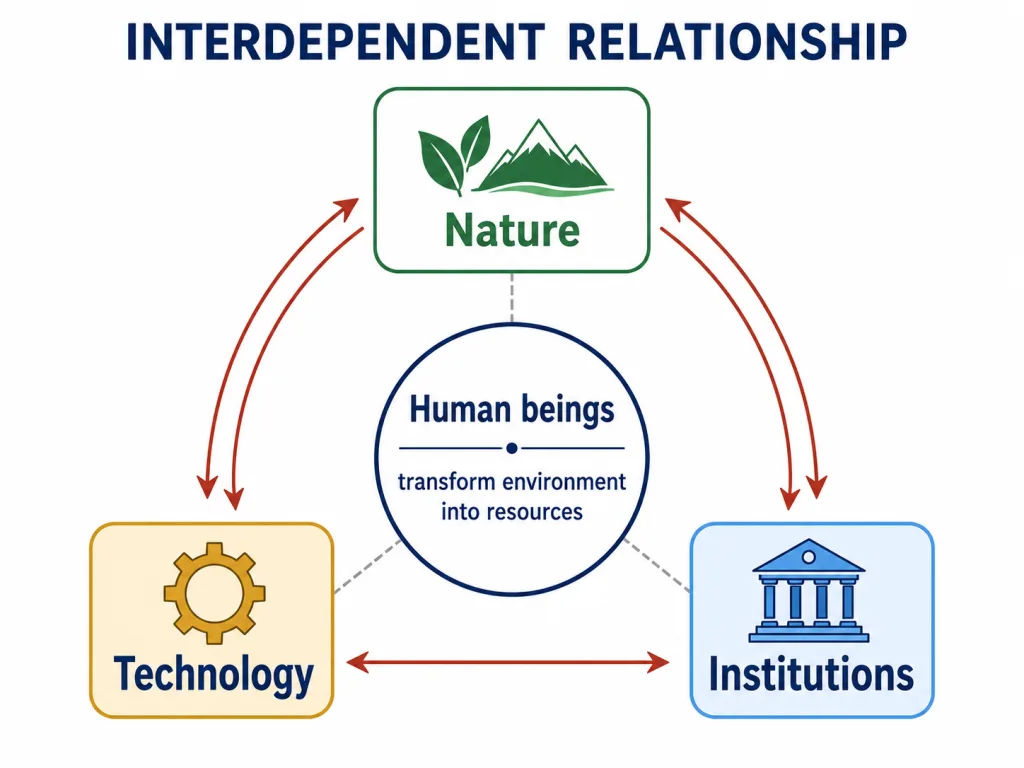
Nature, Technology and Institutions
Resources do not appear on their own. Human beings interact with nature through technology and create institutions (like governments, laws and markets) to speed up their economic development.
This gives an interdependent relationship between three things:
- Nature — provides the raw material (minerals, water, forests, land).
- Technology — the tools, knowledge and skills that convert that material into something useful.
- Institutions — the rules, organisations and social set-up that decide how resources are owned, shared and used.
Human beings are themselves an essential part of resources: it is people who transform the material available in the environment into usable resources.
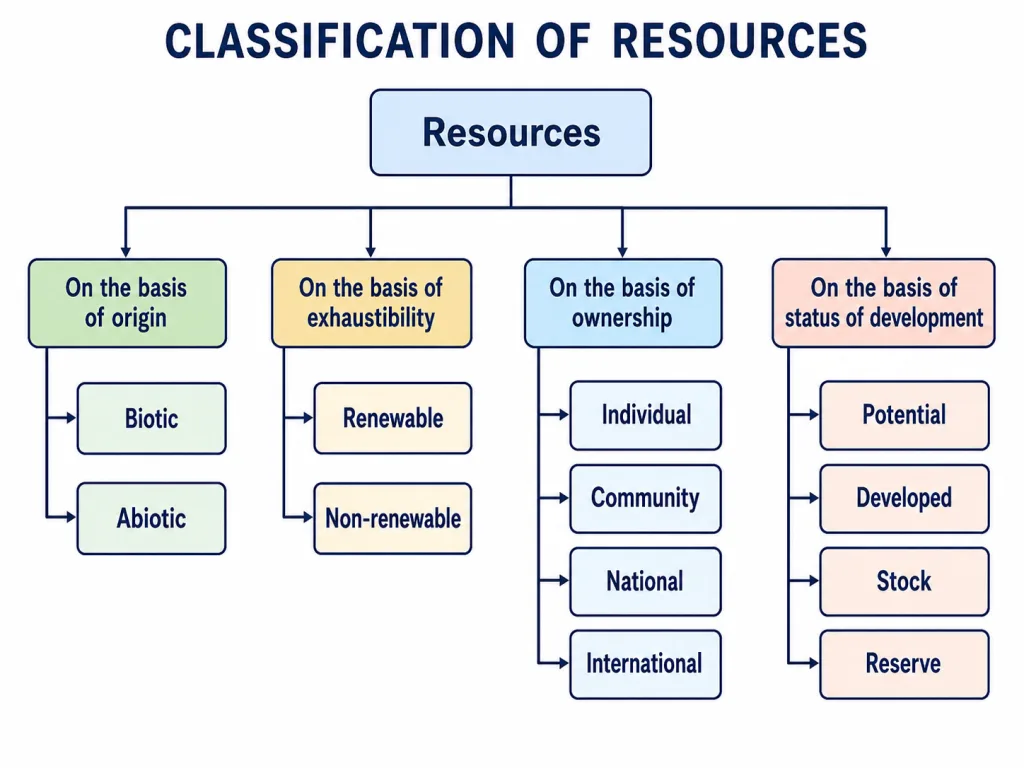
How Resources Are Classified
Because resources are so varied, geographers group them in an organised way. Resources can be classified on four different bases:
| Basis of classification | Types |
|---|---|
| On the basis of origin | Biotic and Abiotic |
| On the basis of exhaustibility | Renewable and Non-renewable |
| On the basis of ownership | Individual, Community, National, International |
| On the basis of status of development | Potential, Developed, Stock, Reserve |
Each of the next sections looks at one of these bases in turn.
1. On the Basis of Origin — Biotic and Abiotic
- Biotic resources are obtained from the biosphere and have life. Examples: human beings, flora and fauna (plants and animals), fisheries, livestock, and fossil fuels such as coal (which formed from once-living matter).
- Abiotic resources are made up of non-living things. Examples: rocks, minerals, metals, land and water.
Memory aid: Bio = life. Biotic resources come from living things; abiotic resources come from non-living things.
2. On the Basis of Exhaustibility — Renewable and Non-renewable
- Renewable (or replenishable) resources are those that can be renewed or reproduced by physical, chemical or mechanical processes. Examples: solar energy, wind energy, water, forests and wildlife. Renewable resources can be further divided into continuous (like solar and wind, always available) and biological (like plants and animals, which renew through reproduction).
- Non-renewable resources take millions of years to form and get exhausted once used, because they cannot be replenished within human time-scales. Examples: minerals and fossil fuels such as coal, petroleum and natural gas.
Key Point: Some non-renewable resources, like metals, are recyclable; others, like fossil fuels, are used up completely once burnt.
3. On the Basis of Ownership
Resources are also grouped by who owns them:
- Individual resources — owned privately by individuals. Examples: a farmer's plot of land, a house, a well or a plantation owned by a person.
- Community-owned resources — accessible to all members of a community. Examples: village grazing grounds (pastures), public parks, ponds and playgrounds.
- National resources — belong to the nation. Technically, all the minerals, water resources, forests, wildlife and land within the political boundaries — and oceanic area up to 12 nautical miles (the territorial sea) — belong to the country.
- International resources — regulated by international institutions. For example, the oceanic resources beyond 200 nautical miles of the Exclusive Economic Zone belong to the open ocean and no individual country can use them without the permission of international bodies.
4. On the Basis of Status of Development
Finally, resources are classified by how far their development has progressed:
- Potential resources — resources that are found in a region but have not yet been used. For example, the vast solar and wind energy potential of Rajasthan and Gujarat, which is not yet fully developed.
- Developed resources — resources that have been surveyed, and their quality and quantity determined for use. Their development depends on technology and the level of feasibility.
- Stock — materials in the environment that have the potential to satisfy human needs but which we do not have the technology to use yet. For example, water is made of hydrogen and oxygen (hydrogen is a rich source of energy), but we still lack the technical know-how to use it easily — so it remains a stock.
- Reserve — the subset of stock that can be put into use with existing technology but has been kept for the future. For example, water in dams kept for generating hydel power, or forests kept in reserve.
Exam tip: The difference between stock and reserve is a favourite Board question. Stock = we lack the technology to use it now; Reserve = we have the technology but are saving it for later.
Questions and Answers
Q1. Define a resource. What three conditions must a substance satisfy to be called a resource?
Answer: Everything available in our environment that can be used to satisfy our needs is called a resource, provided it fulfils three conditions:
- It should be technologically accessible — we must have the means to obtain and use it.
- It should be economically feasible — using it must be worthwhile in terms of cost.
- It should be culturally acceptable — society must be willing to use it. Thus a resource is not a free gift of nature but a function of human activity.
Q2. "Resources are a function of human activities." Explain.
Answer: Materials in nature become resources only when human beings find them useful and develop the ability to use them. It is human beings who, using technology, transform the material available in the environment into resources, and who create institutions to manage them. A waterfall is only "scenery" until people build a turbine to generate electricity from it. Because this transformation depends on human need, knowledge and effort, resources are said to be a function of human activities rather than mere gifts of nature.
Q3. Distinguish between renewable and non-renewable resources with examples.
Answer:
| Renewable resources | Non-renewable resources |
|---|---|
| Can be renewed or reproduced by physical, chemical or mechanical processes | Take millions of years to form and get exhausted after use |
| Available again and again within a human time-scale | Once used up, cannot be replenished in human time-scales |
| Examples: solar energy, wind, water, forests, wildlife | Examples: coal, petroleum, natural gas, minerals |
Renewable resources are further divided into continuous (solar, wind) and biological (plants, animals).
Q4. Differentiate between "stock" and "reserve" on the basis of status of development.
Answer:
- Stock refers to materials in the environment that can satisfy human needs but which we do not yet have the technology to use. Example: hydrogen and oxygen in water are a huge potential energy source, but we lack the technology to use them easily.
- Reserve is that part of the stock which can be put to use with the technology we already have, but which is kept for future use. Example: water in a dam stored for generating hydroelectricity, or forests kept in reserve. In short, a stock lacks the technology for use, while a reserve has the technology but is deliberately saved for the future.
Q5. Give one example each of an individual, a community, a national and an international resource.
Answer:
- Individual resource: a farmer's own field, a house, or a privately owned well.
- Community resource: a village grazing ground (pasture), a public park or a village pond.
- National resource: minerals, forests, wildlife and land within a country's boundaries, and the sea up to 12 nautical miles from the coast.
- International resource: the oceanic resources beyond 200 nautical miles of the Exclusive Economic Zone, which are regulated by international institutions.