
What is Land Degradation?
We share our land with past and future generations. About 95 per cent of our basic needs for food, shelter and clothing come from land. But the continuous use of land over a long period, without proper conservation, has caused land degradation — a decline in the quality and productivity of land. Human activities have not only degraded land directly but have also accelerated natural forces that damage it.
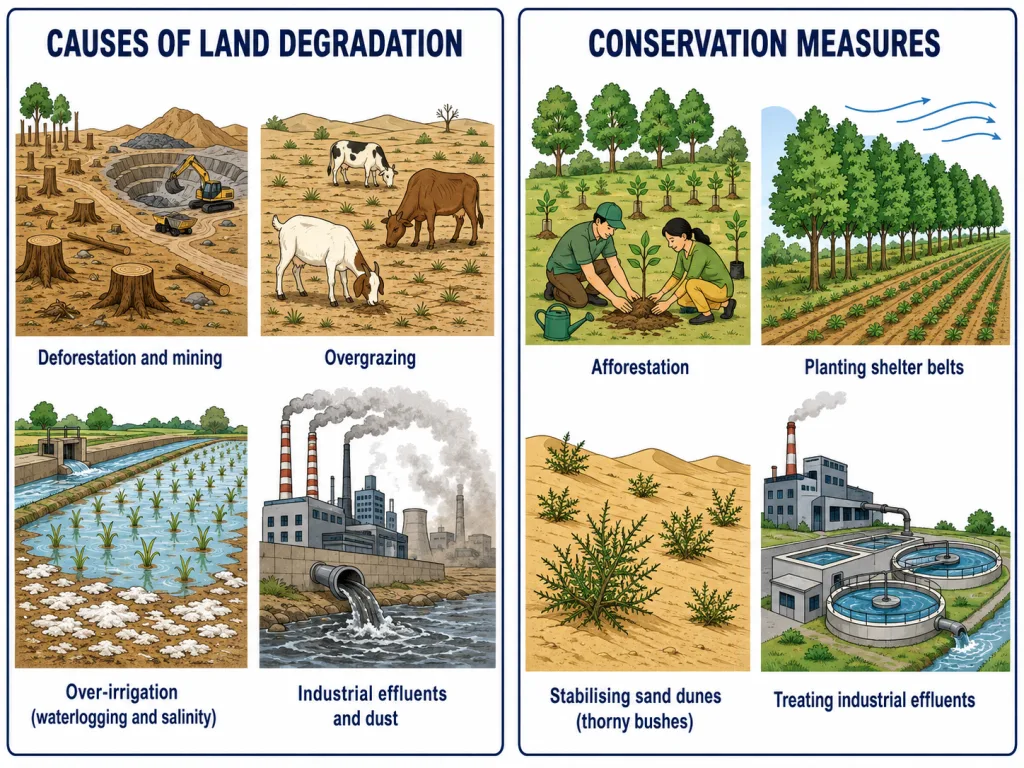
Human Activities That Degrade Land
Certain human activities are the main causes of land degradation in India:
| Activity | States most affected |
|---|---|
| Deforestation due to mining | Jharkhand, Chhattisgarh, Madhya Pradesh, Odisha |
| Overgrazing | Gujarat, Rajasthan, Madhya Pradesh, Maharashtra |
| Over-irrigation (waterlogging, salinity, alkalinity) | Punjab, Haryana, western Uttar Pradesh |
| Mineral processing dust (limestone for cement; calcite and soapstone for ceramics) | industrial belts |
Mining sites are often abandoned after excavation, leaving deep scars and over-burden. Mineral dust settles on land and slows the infiltration of water into the soil. In recent years, industrial effluents have become a major source of land and water pollution.
Measures to Conserve Land
There are many ways to solve the problems of land degradation:
- Afforestation (planting more trees) and proper management of grazing.
- Planting shelter belts of trees and controlling overgrazing.
- Stabilisation of sand dunes by growing thorny bushes (useful in arid areas).
- Proper management of waste lands.
- Control of mining activities.
- Proper treatment and disposal of industrial effluents and wastes before discharge, to reduce land and water degradation in industrial and suburban areas.
Questions and Answers
Q1. What is land degradation, and why is it a serious concern?
Answer: Land degradation is the decline in the quality and productivity of land caused by its continuous use over a long period without proper conservation. It is serious because about 95 per cent of our basic needs for food, shelter and clothing come from land, and degraded land has grave repercussions for both society and the environment.
Q2. Explain any three human activities responsible for land degradation, with the states affected.
Answer:
- Deforestation due to mining — severe in Jharkhand, Chhattisgarh, Madhya Pradesh and Odisha, where abandoned mining sites leave deep scars.
- Overgrazing — a major cause in Gujarat, Rajasthan, Madhya Pradesh and Maharashtra.
- Over-irrigation — in Punjab, Haryana and western Uttar Pradesh, it causes waterlogging and increases salinity and alkalinity in the soil.
Q3. How does mineral processing contribute to land degradation?
Answer: Mineral processing, such as the grinding of limestone for the cement industry and of calcite and soapstone for the ceramic industry, generates huge quantities of dust. When this dust settles on the land, it retards the infiltration of water into the soil, harming the land. In addition, industrial effluents released as waste pollute both land and water.
Q4. Suggest four measures to check land degradation.
Answer: (1) Afforestation and proper management of grazing; (2) planting shelter belts of trees and controlling overgrazing; (3) stabilisation of sand dunes by growing thorny bushes in arid areas; and (4) proper management of waste lands, control of mining activities, and treatment and safe disposal of industrial effluents before discharge.