
What is Soil Erosion?
The denudation (wearing away) of the soil cover and its subsequent washing down is called soil erosion. Normally, the processes of soil formation and erosion go on together and remain in balance. This balance is disturbed by:
- Human activities such as deforestation, over-grazing, construction and mining; and
- Natural forces such as wind, glaciers and running water.
When the rate of erosion exceeds the rate of formation, the soil cover is lost faster than it can be replaced.
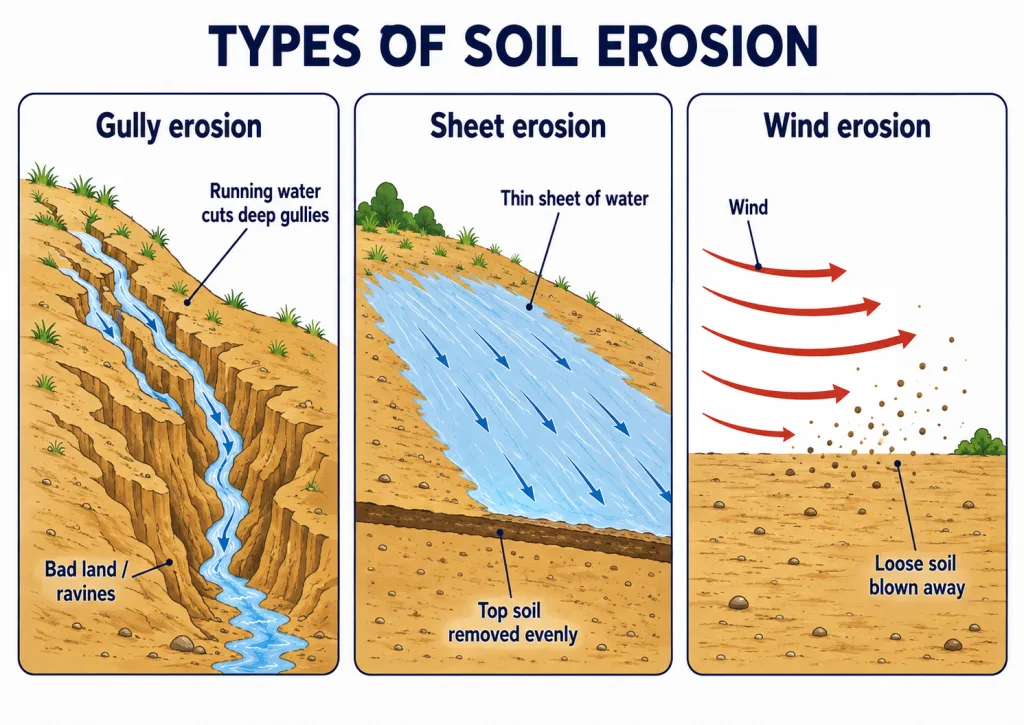
Types of Soil Erosion
| Type | How it happens |
|---|---|
| Gully erosion | Running water cuts through clayey soil and makes deep channels called gullies; the land becomes unfit for cultivation and is called bad land. In the Chambal basin such lands are called ravines. |
| Sheet erosion | Water flows as a sheet over large areas down a slope, and the top soil is washed away. |
| Wind erosion | Wind blows away loose soil from flat or sloping land. |
Soil erosion is also caused by defective farming methods — for example, ploughing up and down the slope forms channels that speed the flow of water.
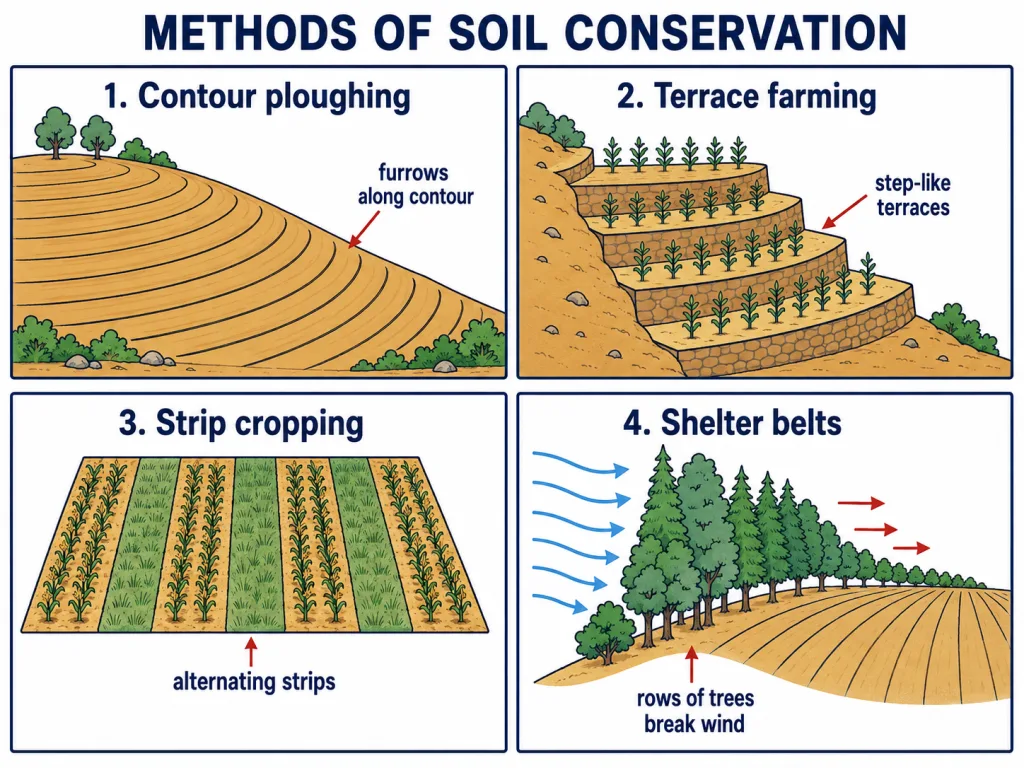
Methods of Soil Conservation
Several farming methods help conserve soil:
- Contour ploughing — ploughing along the contour lines (across the slope) slows the flow of water down the slope.
- Terrace farming — cutting steps (terraces) on hill slopes restricts erosion. The western and central Himalayas have well-developed terrace farming.
- Strip cropping — large fields are divided into strips, with strips of grass left to grow between the crops; this breaks the force of the wind.
- Shelter belts — planting rows of trees to create shelter also breaks the wind and checks erosion; these rows are called shelter belts and have helped stabilise sand dunes and desert areas.
Questions and Answers
Q1. Define soil erosion. What disturbs the balance between soil formation and erosion?
Answer: Soil erosion is the denudation of the soil cover and its subsequent washing down. Normally, soil formation and erosion remain in balance. This balance is disturbed by human activities (deforestation, over-grazing, construction, mining) and by natural forces (wind, glaciers and running water), which speed up the loss of soil.
Q2. Distinguish between gully erosion and sheet erosion.
Answer: In gully erosion, running water cuts deep channels (gullies) through clayey soil, making the land unfit for cultivation (bad land / ravines, as in the Chambal basin). In sheet erosion, water flows as a sheet over a large sloping area and washes away the top layer of soil more or less evenly. Gully erosion cuts deep channels; sheet erosion removes a thin top layer.
Q3. What are ravines and where are they found?
Answer: When running water cuts deep channels (gullies) through clayey soil, the land becomes unfit for cultivation and is called bad land. In the Chambal basin, such deeply dissected bad lands are called ravines.
Q4. Explain any three methods of soil conservation.
Answer:
- Contour ploughing — ploughing along the contour lines across the slope slows the downhill flow of water.
- Terrace farming — cutting steps (terraces) into hill slopes restricts erosion; well developed in the western and central Himalayas.
- Strip cropping — dividing large fields into strips with grass strips between crops breaks the force of the wind. (Planting rows of trees, called shelter belts, works similarly.)