
Soil — The Most Important Natural Resource
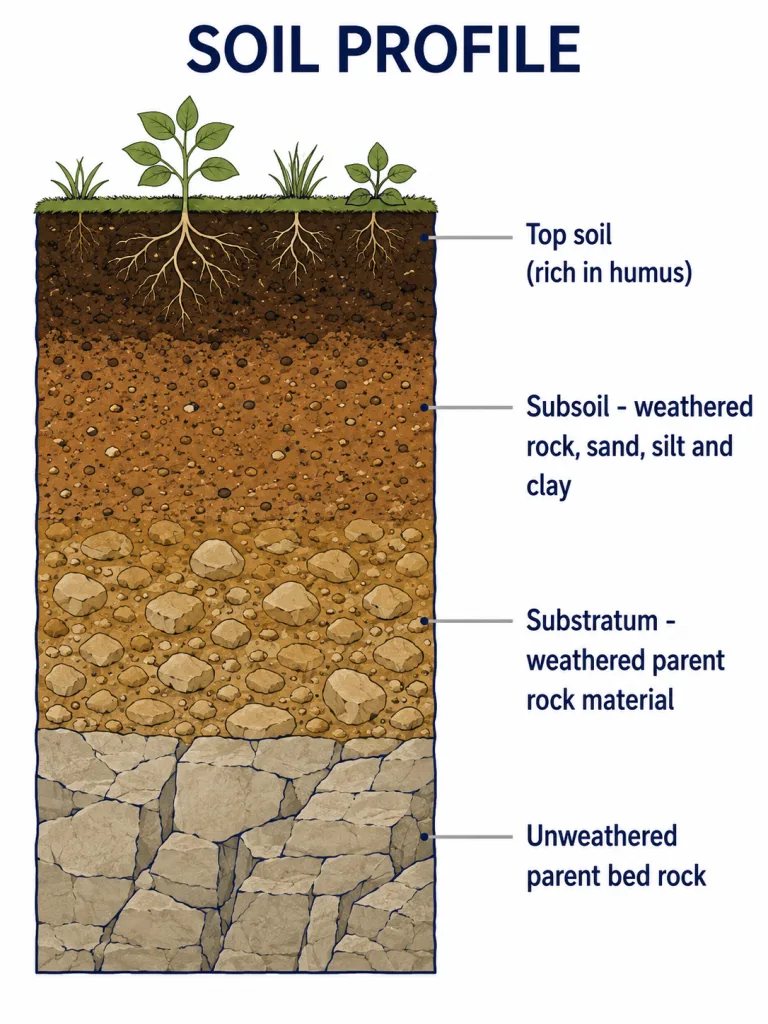
Soil is the most important renewable natural resource. It is the medium of plant growth and supports many different living organisms. Soil is a living system. It takes millions of years to form soil just a few centimetres deep.
The important factors of soil formation are: relief, parent rock (bed rock), climate, vegetation and other forms of life, and time. Natural forces such as changes in temperature, running water, wind, glaciers and the action of decomposers, together with chemical and organic changes, all contribute to the formation of soil. Soil consists of both organic (humus) and inorganic materials.
Alluvial Soil
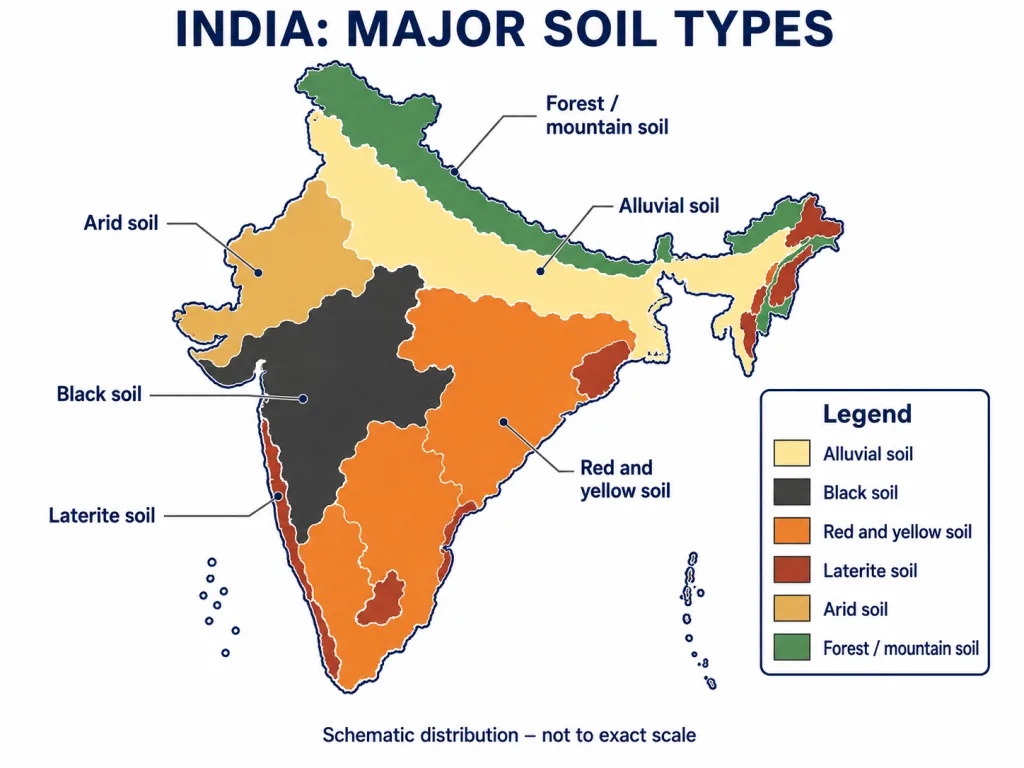
Alluvial soil is the most widely spread and important soil in India. The entire northern plains are made of alluvial soil, deposited by three Himalayan river systems — the Indus, the Ganga and the Brahmaputra. It also extends into Rajasthan and Gujarat, and is found in the eastern coastal plains, especially the deltas of the Mahanadi, Godavari, Krishna and Kaveri.
By age, alluvial soil is of two types:
- Bangar — old alluvium, with a higher concentration of kanker (calcareous nodules).
- Khadar — new alluvium, with more fine particles; it is more fertile than bangar.
Alluvial soils are very fertile and rich in potash, phosphoric acid and lime, ideal for sugarcane, paddy, wheat and other cereals and pulses. Their regions are intensively cultivated and densely populated.
Black Soil (Regur)
Black soil is black in colour and is also known as regur soil. It is ideal for growing cotton, so it is also called black cotton soil.
- It is typical of the Deccan trap (basalt) region and is made of lava flows — found in Maharashtra, Saurashtra, Malwa, Madhya Pradesh and Chhattisgarh, extending along the Godavari and Krishna valleys.
- It is made of extremely fine, clayey material and is well known for its capacity to hold moisture.
- It is rich in calcium carbonate, magnesium, potash and lime, but poor in phosphoric content.
- It develops deep cracks in hot weather, which help aerate the soil. It is sticky when wet and should be tilled soon after the first shower.
Red and Yellow Soil, Laterite Soil
Red and Yellow Soil: Red soil develops on crystalline igneous rocks in areas of low rainfall in the eastern and southern Deccan plateau, and in parts of Odisha, Chhattisgarh, the southern middle Ganga plain and the Western Ghats piedmont. It gets its reddish colour from the diffusion of iron; it looks yellow in a hydrated form.
Laterite Soil: The word comes from the Latin later, meaning brick. It develops under tropical and subtropical climate with alternate wet and dry seasons, and is the result of intense leaching due to heavy rain. It is acidic (pH below 6.0) and generally deficient in plant nutrients. Found in the southern states, the Western Ghats of Maharashtra, Odisha, parts of West Bengal and the north-east. After soil conservation, it is useful for tea, coffee and cashew nut (in the hilly areas of Karnataka, Kerala and Tamil Nadu).
Arid Soil and Forest Soil
Arid Soil: ranges from red to brown in colour, is generally sandy in texture and saline in nature. In some areas the salt content is so high that common salt is obtained by evaporating water. Due to the dry climate and high temperature, evaporation is fast and the soil lacks humus and moisture. Its lower layers have a kankar (calcium carbonate) layer that restricts water infiltration. After proper irrigation it becomes cultivable, as in western Rajasthan.
Forest Soil: found in hilly and mountainous areas with enough rainforests. Its texture varies — loamy and silty in valley sides and coarse-grained on the upper slopes. In the snow-covered Himalayas it is acidic with low humus, while soils in the lower valleys (river terraces, alluvial fans) are fertile.
Questions and Answers
Q1. Why is soil called the most important natural resource? Name the factors of soil formation.
Answer: Soil is the most important renewable natural resource because it is the medium of plant growth and supports countless living organisms — it is itself a living system. It takes millions of years to form even a few centimetres of soil. The main factors of soil formation are relief, parent rock (bed rock), climate, vegetation and other forms of life, and time.
Q2. Distinguish between Bangar and Khadar.
Answer:
| Bangar | Khadar |
|---|---|
| Old alluvial soil | New alluvial soil |
| Higher concentration of kanker (calcareous nodules) | More fine particles |
| Less fertile | More fertile |
Both are types of alluvial soil classified on the basis of their age.
Q3. Why is black soil ideal for cotton? Give its main characteristics.
Answer: Black soil (regur) is made of extremely fine, clayey material with a high capacity to retain moisture, which suits the long growing period of cotton — hence it is called black cotton soil. It is formed from the basalt lava of the Deccan trap, is rich in calcium carbonate, magnesium, potash and lime (but poor in phosphorus), and develops deep cracks in hot weather that help aerate the soil.
Q4. How is laterite soil formed, and for which crops is it useful?
Answer: Laterite soil (from Latin later = brick) forms under a tropical/subtropical climate with alternate wet and dry seasons, as a result of intense leaching by heavy rain. It is acidic (pH below 6.0) and low in nutrients. After suitable soil-conservation measures, it is very useful for growing tea, coffee (in the hilly areas of Karnataka, Kerala and Tamil Nadu) and cashew nut (Tamil Nadu, Andhra Pradesh, Kerala).
Q5. Describe the characteristics of arid soil.
Answer: Arid soils range from red to brown in colour, are generally sandy in texture and saline in nature (in some areas common salt is obtained by evaporating water). Because of the dry climate and high temperature, evaporation is rapid and the soil lacks humus and moisture. A kankar layer in the lower horizons restricts water infiltration. After proper irrigation, arid soil becomes cultivable, as in western Rajasthan.