
Land — A Finite and Precious Resource
We live on land, we perform our economic activities on land, and we use it in many ways. Land is a natural resource of utmost importance. It supports natural vegetation, wildlife, human life, economic activities, transport and communication systems.
But land is an asset of a finite (limited) magnitude. Therefore it is very important to use it carefully, with proper planning.
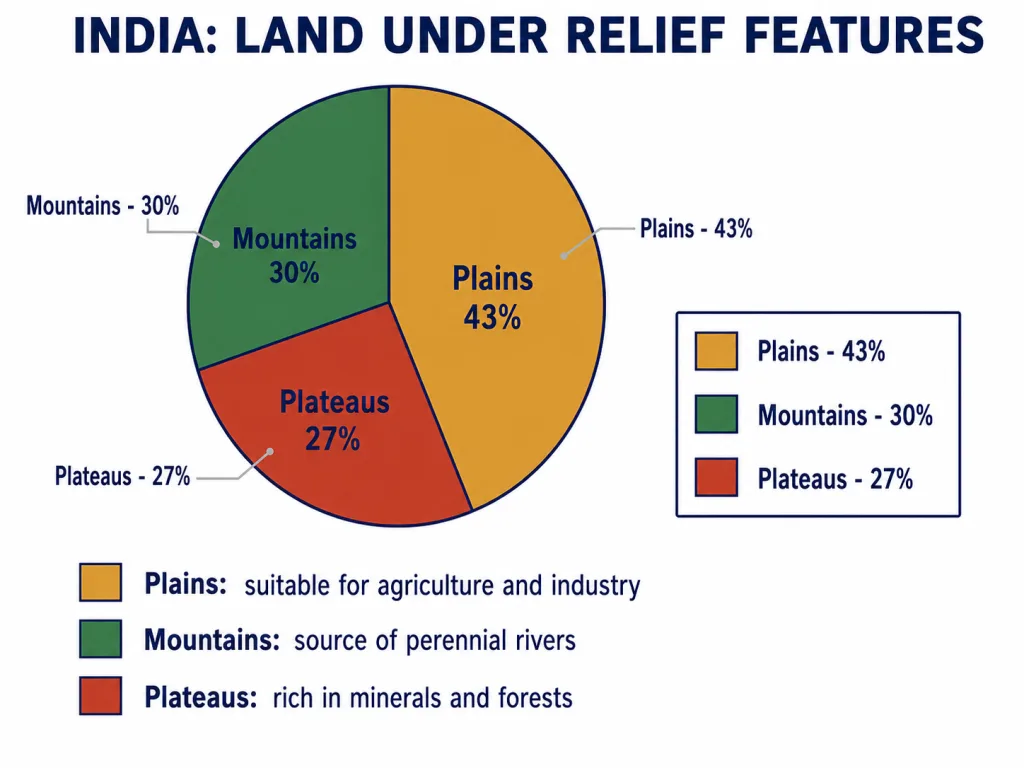
India's Relief Features
India has land under a variety of relief features — mountains, plateaus, plains and islands:
| Relief feature | Share of land | Importance |
|---|---|---|
| Plains | about 43% | Provide facilities for agriculture and industry |
| Mountains | about 30% | Ensure perennial flow of rivers, tourism, ecological value |
| Plateaus | about 27% | Rich reserves of minerals, fossil fuels and forests |
Memory aid: Plains 43 — Mountains 30 — Plateaus 27 (they add up to 100%).
Land Utilisation
Land resources in India are used for the following purposes:
- Forests.
- Land not available for cultivation — (a) Barren and waste land; (b) Land put to non-agricultural uses, e.g. buildings, roads, factories.
- Other uncultivated land (excluding fallow land) — (a) Permanent pastures and grazing land; (b) Land under miscellaneous tree crops and groves (not included in net sown area); (c) Culturable waste land (left uncultivated for more than 5 agricultural years).
- Fallow lands — (a) Current fallow (left without cultivation for one or less than one agricultural year); (b) Other than current fallow (left uncultivated for the past 1 to 5 agricultural years).
- Net sown area (NSA) — the physical extent of land on which crops are sown and harvested.
Net Sown Area and Gross Cropped Area
- Net Sown Area (NSA) is the actual physical area of land on which crops are sown and harvested.
- Gross Cropped Area = Net Sown Area + area sown more than once in an agricultural year.
In other words, if a field grows two crops in a year, it is counted once in the NSA but twice in the gross cropped area.
Exam tip: Gross Cropped Area is always equal to or greater than Net Sown Area, because of double or multiple cropping.
Questions and Answers
Q1. Why is land considered a resource of utmost importance?
Answer: Land supports natural vegetation, wildlife, human life, economic activities, and transport and communication systems. Almost all our basic needs — food, shelter and clothing — depend on it. Since land is an asset of finite magnitude, and cannot be increased, it must be used carefully with proper planning, which makes it a resource of utmost importance.
Q2. Describe the relief features of India and their approximate share of the land area.
Answer: India has land under mountains, plateaus, plains and islands. Plains (about 43%) provide facilities for agriculture and industry; mountains (about 30%) ensure the perennial flow of rivers and offer tourism and ecological value; and plateaus (about 27%) possess rich reserves of minerals, fossil fuels and forests.
Q3. Distinguish between Net Sown Area and Gross Cropped Area.
Answer: Net Sown Area (NSA) is the physical extent of land on which crops are sown and harvested, counted once regardless of how many times it is cropped. Gross Cropped Area is the Net Sown Area plus the area sown more than once in the same agricultural year. Thus a doubly-cropped field is counted once in NSA but twice in gross cropped area.
Q4. What is culturable waste land? How does it differ from current fallow land?
Answer: Culturable waste land is land that has been left uncultivated for more than 5 agricultural years, although it can be cultivated. Current fallow is land left without cultivation for one or less than one agricultural year as part of normal farming practice. Thus culturable waste land is idle for much longer than current fallow land.