
Why India Needs Resource Planning
Resources are unevenly distributed across India. Some regions are rich in one resource but poor in another:
- Jharkhand, Chhattisgarh and Madhya Pradesh are rich in minerals and coal, but lack water, infrastructure and industry in some parts.
- Arunachal Pradesh has plenty of water resources but lacks infrastructure.
- The cold desert of Ladakh is rich in cultural heritage but is deficient in water and some vital minerals.
- Rajasthan is rich in solar and wind energy but short of water.
Because of this uneven spread, balanced resource planning at the national, state, regional and local levels is essential.
What is Resource Planning?
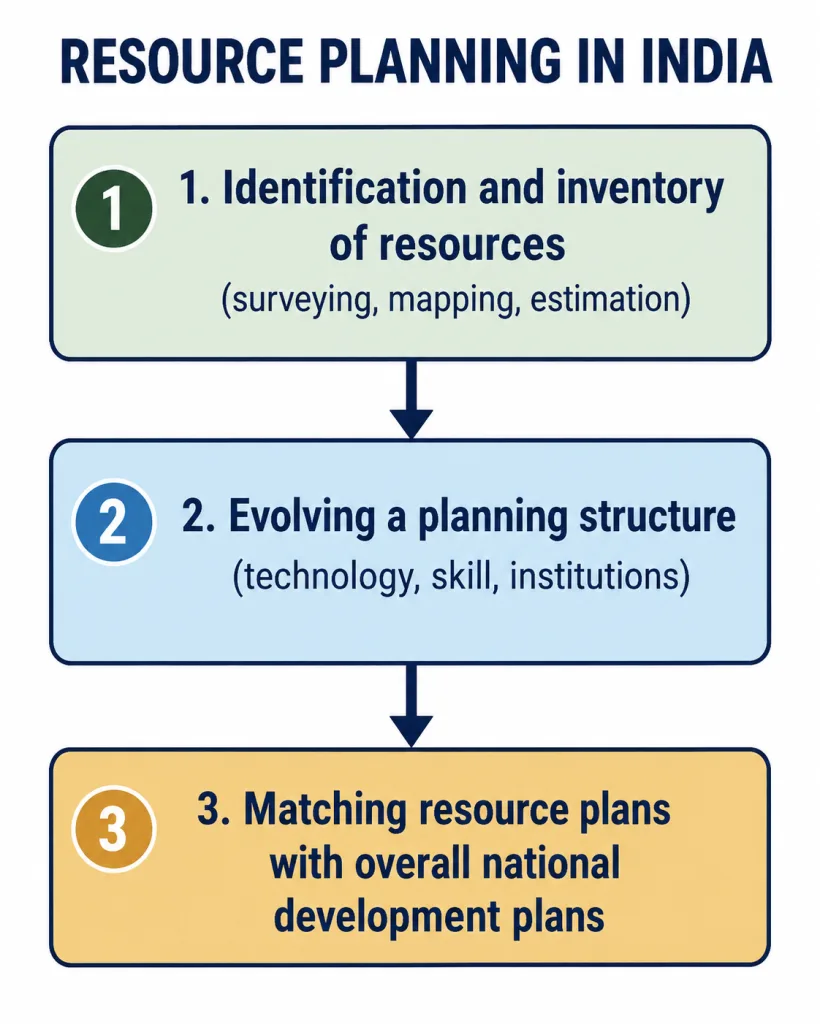
Resource planning is the widely accepted strategy for the judicious (wise) use of resources. In a country like India, with enormous diversity, it is a complex process involving three steps:
- Identification and inventory of resources across the regions of the country — this involves surveying, mapping, and qualitative and quantitative estimation of resources.
- Evolving a planning structure with the appropriate technology, skill and institutional set-up for implementing resource development plans.
- Matching the resource development plans with the overall national development plans.
Exam tip: Learn the three steps in order — survey/inventory → planning structure → match with national plans.
Resource Planning in India Since Independence
India has made concerted efforts to achieve the goals of resource planning right from the First Five Year Plan, launched soon after Independence.
However, the mere availability of resources is not enough. A region can develop only when the availability of resources is accompanied by:
- appropriate technology,
- a good quality of human resources, and
- suitable institutional changes.
History shows this clearly: India was rich in resources but was exploited during colonial rule because the colonisers had superior technology and organisation. So development depends on resources plus technology, people and institutions.
Conservation of Resources
Resources are vital for development, but their irrational consumption and over-utilisation may lead to socio-economic and environmental problems. To overcome these, resource conservation at various levels is important.
This was the main concern of thinkers in the past. Mahatma Gandhi voiced it powerfully:
"There is enough for everybody's need and not for anybody's greed."
Gandhiji blamed greedy, selfish individuals and the exploitative nature of modern technology as the root cause of resource depletion at the global level. He was against mass production and wanted to replace it with production by the masses.
Questions and Answers
Q1. Why is resource planning essential in a country like India?
Answer: Resources in India are very unevenly distributed. Some regions are rich in one resource but deficient in others — for example, Jharkhand and Chhattisgarh are rich in minerals but lack infrastructure, Arunachal Pradesh has water but poor infrastructure, and Rajasthan has solar and wind energy but little water. To use these varied resources wisely and to ensure balanced development, planning at the national, state, regional and local levels is essential.
Q2. Describe the three stages of resource planning in India.
Answer:
- Identification and inventory of resources across regions — through surveying, mapping and qualitative and quantitative estimation.
- Evolving a planning structure endowed with appropriate technology, skill and institutional set-up to implement resource development plans.
- Matching the resource development plans with the overall national development plans.
Q3. "The availability of resources is not a sufficient condition for the development of a region." Explain.
Answer: Availability of resources is only a necessary condition, not a sufficient one. A region develops only when its resources are accompanied by appropriate technology, a skilled and educated population, and supportive institutions. India, though rich in resources, was exploited under colonial rule because the colonisers possessed superior technology and organisation. Hence resources alone cannot ensure development.
Q4. How did Mahatma Gandhi express his views on resource conservation?
Answer: Gandhiji famously said, "There is enough for everybody's need and not for anybody's greed." He held greedy, selfish individuals and the exploitative nature of modern technology responsible for resource depletion at the global level. He opposed mass production and favoured production by the masses, promoting simple, self-reliant and sustainable use of resources.