
Plant Movements — How Plants Respond
Plants don't have a nervous system, yet they still respond to their environment. They sense light, gravity, water, and touch — and grow accordingly!
Two Types of Movements in Plants
1. Tropic (or Tropism) Movements: Directional growth movements in response to a stimulus. Direction depends on stimulus. Slow, due to growth.
2. Nastic Movements: Non-directional movements. Direction does NOT depend on stimulus. Quick, due to changes in cell pressure.
Example: Mimosa (touch-me-not) leaves close when touched.
Why Plants Move Slowly
Plants don't have muscles like animals. They move by growing in a specific direction. Growth takes time → slow response.
Examples:
- Sunflower turns toward sun (over hours).
- Roots grow downward (over days).
- Tendril wraps around support (over hours).
What is Tropism?
'Tropism' = directional growth response of plants to environmental stimuli.
Greek 'tropos' = turning.
Direction:
- Positive tropism = grows TOWARD stimulus.
- Negative tropism = grows AWAY from stimulus.
[NCERT — fundamental]
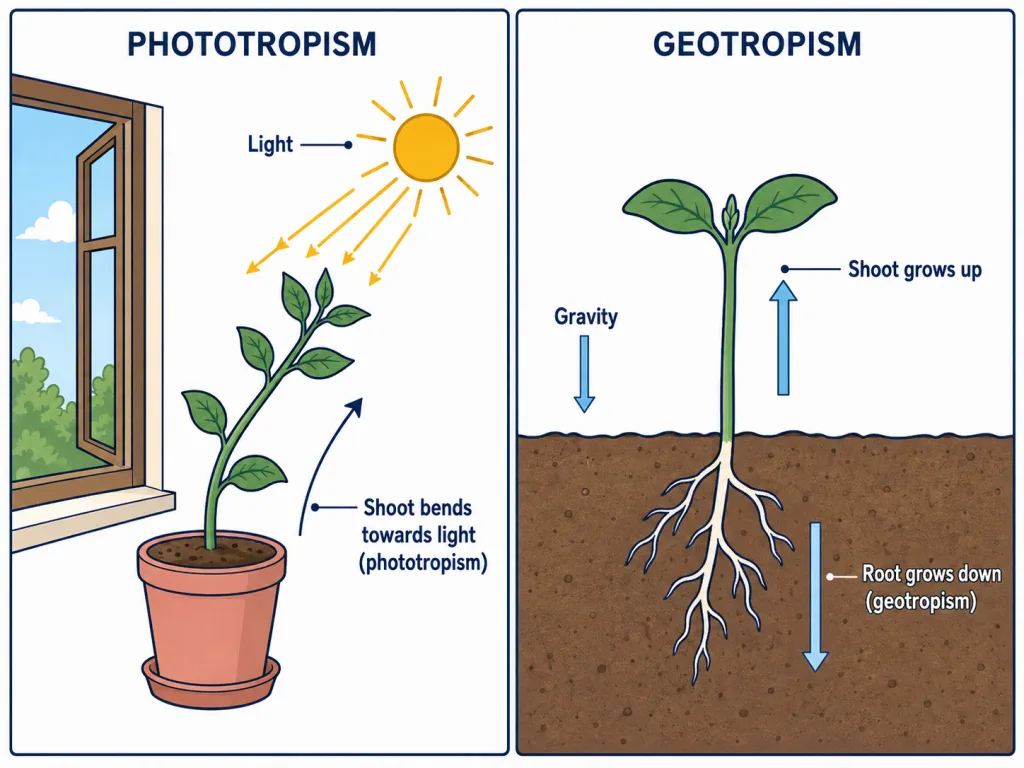
Types of Tropisms
Different stimuli cause different tropisms.
1. Phototropism (Light)
'Photo' = light. Movement in response to light.
Stems: positively phototropic — grow TOWARD light. This is why plants on windowsill bend toward window.
Roots: negatively phototropic — grow AWAY from light (into soil).
Mechanism: light makes auxin move to shaded side → cells on shaded side elongate more → stem bends toward light.
2. Geotropism (or Gravitropism) — Gravity
'Geo' = earth. Movement in response to gravity.
Roots: positively geotropic — grow DOWNWARD. Anchor plant in soil, find water/minerals.
Stems: negatively geotropic — grow UPWARD. Toward sunlight for photosynthesis.
Mechanism: gravity affects auxin distribution.
3. Hydrotropism (Water)
'Hydro' = water. Movement in response to water.
Roots: positively hydrotropic — grow TOWARD water.
Roots often grow towards moist regions of soil. Important for plant survival in dry conditions.
4. Chemotropism (Chemicals)
'Chemo' = chemicals. Movement in response to chemicals.
Example: Pollen tube growth in flower. Pollen lands on stigma → grows down style toward egg. Attracted by chemical signals from ovary.
Important in fertilization in plants.
5. Thigmotropism (Touch)
'Thigmo' = touch. Movement in response to touch/contact.
Example: tendrils of pea, grape vines. Tendril touches a support → wraps around it. Helps plant climb upward toward light.
Pea plant twines around bamboo poles using thigmotropism!
Summary Table
| Tropism | Stimulus | Stem | Root |
|---|---|---|---|
| Phototropism | Light | + (toward) | − (away) |
| Geotropism | Gravity | − (away/up) | + (toward/down) |
| Hydrotropism | Water | − or none | + (toward) |
| Chemotropism | Chemicals | Variable | Variable |
| Thigmotropism | Touch | Tendrils + | Variable |
'+' = positive (toward stimulus) '−' = negative (away from stimulus)
[NCERT — important]
Mechanism of Phototropism
Let's understand how light causes stems to bend toward it.
The Experiment (Charles Darwin's Discovery)
1880, Charles Darwin and son Francis tried this: 1. They covered tip of growing seedling — no bending. 2. They covered base of seedling — bending occurred normally.
Conclusion: tip of plant senses light.
How Light Affects Auxin
Step 1: Light hits the tip of the stem. Tip is where plant hormone auxin is produced.
Step 2: Auxin moves to shaded side. Light makes auxin migrate AWAY from light. So shaded side has more auxin than lit side.
Step 3: Cells on shaded side grow faster. Auxin causes cell elongation. More auxin → more elongation. Shaded cells become longer.
Step 4: Stem bends toward light. Longer cells on shaded side push the stem to bend. Plant grows toward light.
Diagram (Verbal)
Light ←  ─── (light from this side)
          |
     STEM TIP (auxin made here)
          |
        | * |  ← cells with less auxin (light side)
        | **|  ← cells with more auxin (shaded side)
        | **|  ← cells elongate more on shaded side
        | **|  ← stem bends toward light
Importance for Plants
Plants need light for photosynthesis. By bending toward light, they: 1. Get maximum sunlight. 2. Make more food. 3. Survive better.
Without phototropism, plants in shade would not survive.
Why Do Houseplants Bend Toward Window?
Same reason: phototropism. Plant on windowsill bends toward light. Solution: rotate the plant regularly so all sides get equal light.
Geotropism Mechanism
Similar to phototropism, but with gravity. Auxin accumulates on lower side of horizontal stem. Lower cells elongate more → stem grows upward.
In roots: opposite — auxin INHIBITS root growth. More auxin on lower side → lower cells grow LESS → roots grow downward.
Same hormone (auxin) — different effects in stems vs roots!
[NCERT — important + diagram]
Nastic Movements — Different from Tropisms
Definition
'Nastic movements' = non-directional movements in plants. Direction does not depend on stimulus. Often quick (not growth-related).
Famous Example: Mimosa (Touch-me-not)
Common plant in India. When you touch its leaves, they fold up immediately!
How it works: 1. Touch is detected by receptor cells. 2. Signal sent through plant. 3. Cells at base of leaflets (pulvinus) lose water suddenly. 4. Cells become flaccid → leaflets droop. 5. After some time, water returns → leaflets open again.
This is thigmonastic (touch-induced nastic movement).
Note: this is fast (~1 second) — unusual for plants!
Why Mimosa Folds Leaves?
1. Defence: sudden movement startles herbivores. 2. Reduces damage: insects fall off when leaves fold. 3. Survival adaptation.
Other Nastic Movement Examples
1. Photonastic (light-induced): Sunflower opens petals in morning, closes at evening. Mostly about temperature/light.
2. Nyctinasty (sleep movements): Some leaves fold at night, open in day. Examples: sensitive plants, prayer plants, beans.
3. Thermonasty (temperature): Tulips open in warmth, close in cold.
Comparing Tropic and Nastic Movements
| Feature | Tropic | Nastic |
|---|---|---|
| Direction | Depends on stimulus | Does not depend on stimulus |
| Mechanism | Growth | Cell pressure changes |
| Speed | Slow (hours-days) | Fast (seconds-minutes) |
| Reversibility | Permanent | Temporary |
| Examples | Phototropism, geotropism | Mimosa folding, sunflower opening |
Significance of Plant Movements
Plants are not 'still' as we think — they're active! 1. Growing toward light for photosynthesis. 2. Roots seeking water for hydration. 3. Folding leaves for defence. 4. Tendrils climbing for support. 5. Flowers opening for pollinators.
All this without nervous system — just hormones and cell mechanics!
Plants are clever, just slow.
[NCERT — comparison important]
Memory Capsule — Section 4
Quick revision of plant tropisms.
Two Types of Movements in Plants
1. Tropic — directional, growth-based, slow. 2. Nastic — non-directional, cell-pressure based, fast.
5 Tropisms (Memorise!)
| Tropism | Stimulus | Example |
|---|---|---|
| Phototropism | Light | Stem to light |
| Geotropism | Gravity | Roots down |
| Hydrotropism | Water | Roots to water |
| Chemotropism | Chemicals | Pollen tube |
| Thigmotropism | Touch | Tendrils on support |
Direction
Stems:
- Positively phototropic (toward light).
- Negatively geotropic (away from gravity, up).
Roots:
- Negatively phototropic (away from light, into soil).
- Positively geotropic (toward gravity, down).
- Positively hydrotropic (toward water).
Phototropism Mechanism
1. Tip of stem produces auxin. 2. Light moves auxin to shaded side. 3. Cells on shaded side elongate more. 4. Stem bends toward light.
Nastic Movement Example
Mimosa (touch-me-not): Touch → leaflets fold → reopens later. Fast (~1 second), reversible.
Why Plants Move
1. Photosynthesis — grow toward light. 2. Water — roots toward water. 3. Anchorage — roots grow downward. 4. Climbing — tendrils grasp supports. 5. Defence — quick leaf folding. 6. Pollination — flowers open for insects.
Comparison
| Feature | Tropic | Nastic |
|---|---|---|
| Direction | Stimulus-dependent | Not stimulus-dependent |
| Mechanism | Growth | Pressure change |
| Speed | Slow | Fast |
Key Hormone
Auxin = main hormone in tropisms. Causes cell elongation. Distribution affected by light, gravity.
One-Liner Insights
1. Plants move by growing (slow). 2. Tropic = directional. Nastic = not directional. 3. Auxin causes phototropism. 4. Mimosa = famous nastic example. 5. Plants are clever, just slow!
[Quick reference for revision!]
Example 1: NCERT — Tropic Movements
What are tropic movements? List 3 examples and explain each briefly.
Solution:
Definition
'Tropic movements' (or tropisms) = directional growth movements in plants in response to environmental stimuli.
Direction of growth depends on direction of stimulus.
3 Examples
1. Phototropism (Response to Light):
Stems bend toward light. Roots grow away from light.
Example: house plant on windowsill bends toward window.
Mechanism: light moves auxin to shaded side → cells there grow more → stem bends toward light.
2. Geotropism (Response to Gravity):
Roots grow downward (toward gravity). Stems grow upward (away from gravity).
Example: even if you plant a seed upside down, root will grow down and shoot will grow up.
This anchors plant in soil and helps it reach light.
3. Hydrotropism (Response to Water):
Roots grow toward water.
Example: in dry soil with water on one side, roots grow toward the moist area.
Important for plant survival in arid conditions.
Other Tropisms (Bonus)
4. Chemotropism — pollen tubes grow toward chemicals from ovary. 5. Thigmotropism — tendrils wrap around supports they touch.
Summary
Plants have evolved these tropisms over millions of years to: 1. Find light (food). 2. Find water. 3. Anchor themselves. 4. Climb structures. 5. Reproduce (pollen tube).
All directed by hormones, mainly auxin.
Plants move slowly but purposefully!
[NCERT — important]
Example 2: NCERT — Phototropism Mechanism
Explain how plants bend toward light. Include the role of auxin.
Solution:
Phototropism — Plant Bending Toward Light
'Phototropism' = directional growth of plant in response to light. Stems are positively phototropic (toward light). Roots are negatively phototropic (away from light).
Mechanism
Step 1: Sensing Light The TIP of the stem detects light direction. This was discovered by Charles Darwin (1880).
Step 2: Auxin Production Cells in stem tip produce auxin — a plant hormone. Auxin promotes cell elongation.
Step 3: Auxin Movement When light hits one side: Auxin moves AWAY from light side. Auxin accumulates on shaded side.
Step 4: Cell Elongation Cells with more auxin elongate more. Shaded side has more auxin → cells there elongate more. Lit side has less auxin → less elongation.
Step 5: Bending Longer cells on shaded side cause stem to bend. Plant grows toward light.
Diagram (Verbal)
   Light ← (from left)
         |
   STEM TIP (auxin made)
         |
         | low auxin (light side, short cells)
         | high auxin (shade side, long cells)
         |
     Bend toward light
Importance
1. Plants need light for photosynthesis. 2. Bending toward light → maximum sunlight. 3. Better food production. 4. Survival in shaded environments.
Why Roots Are Different
In roots, auxin INHIBITS growth. If light hits one side of root → auxin moves to shade side. Shade side has more auxin → less elongation. Root bends AWAY from light.
Same hormone, different effects in stems vs roots — beautiful biology!
Real-Life Examples
1. Houseplants bend toward window (phototropism). 2. Sunflowers track the sun across sky (heliotropism — special case). 3. Plants in forest grow tall to reach light above canopy. 4. Vines climb walls toward sun.
Practical Tip
If your house plant looks one-sided: Rotate it weekly so all sides get equal light. This prevents bending and promotes even growth.
[NCERT — Board favourite]
Example 3: NCERT — Geotropism
What is geotropism? Why do roots grow downward and stems grow upward?
Solution:
Geotropism
'Geo' = earth. 'Tropism' = directional movement. Geotropism = plant's growth response to gravity.
Roots: Positively Geotropic
Roots grow DOWNWARD, in direction of gravity.
Why important? 1. Anchor plant in soil. 2. Find water below. 3. Find minerals below. 4. Stable plant that won't blow over.
Stems: Negatively Geotropic
Stems grow UPWARD, against gravity.
Why important? 1. Reach sunlight for photosynthesis. 2. Pollinators can find flowers. 3. Disperse seeds further. 4. Avoid competition with other plants below.
Mechanism
Phase 1: Detection of Gravity Cells in root tip have statoliths — small starch grains. Statoliths fall to bottom of cells (due to gravity). Cell senses 'this is the bottom'.
Phase 2: Auxin Distribution Auxin moves to lower side of horizontal root.
Phase 3: Different Effects in Stems vs Roots
In stems: more auxin → more elongation. Lower side cells elongate → stem grows upward.
In roots: more auxin → less elongation (auxin inhibits root cells). Lower side cells grow less → root grows downward.
Same hormone, opposite effects!
Demonstration
Famous experiment: 1. Take a seed and plant it horizontally. 2. Within hours, root grows downward. 3. Stem grows upward.
Even if you turn the pot upside down: Root still grows down (toward earth). Stem still grows up (away from earth).
Why Plants Care About Gravity?
Without geotropism: 1. Roots wouldn't anchor plant. 2. Stems might grow sideways/down. 3. Plant wouldn't reach sunlight. 4. Cannot survive.
Hence geotropism is critical.
Real-Life Implications
1. Astronauts: plants grown in space (without gravity) grow randomly! Need artificial 'gravity' or light cues.
2. Bonsai plants are sometimes turned to manipulate growth.
*3. Tropisms work together: *Roots: positive geotropism + positive hydrotropism + negative phototropism = grow down toward water.* Stems: negative geotropism + positive phototropism = grow up toward light.
All tropisms coordinated — plants are clever!
[NCERT — important]
Example 4: Application — Mimosa Plant
Why do leaves of Mimosa fold when touched? Is this a tropic or nastic movement?
Solution:
About Mimosa (Touch-me-not, 'Lajwanti')
Common plant in India. Has compound leaves with many small leaflets. Famous for folding leaves on touch!
Why Leaves Fold
This is a defence mechanism.
When touched (by insect, animal): 1. Cells at base of leaflets (called pulvinus) detect the touch. 2. Signal travels rapidly through plant. 3. Pulvinus cells lose water suddenly. 4. Cells become flaccid (lose pressure). 5. Leaflets fold inward. 6. Damaged-looking — insects/herbivores avoid.
Time: ~1 second!
Why It's Fast
Most plant movements are slow (growth-based). Mimosa is unusual — relies on water pressure changes in cells, not growth. This is a nastic movement (specifically thigmonastic).
Reopening
After ~10-30 minutes: Cells regain water → become turgid (firm). Leaflets unfold. Ready for next touch.
Tropic vs Nastic — Why Mimosa is Nastic
| Feature | Tropic | Nastic |
|---|---|---|
| Direction | Depends on stimulus | Independent |
| Mechanism | Growth | Cell pressure |
| Speed | Slow | Fast |
| Examples | Roots growing down | Mimosa, sunflower opening |
Mimosa folding is nastic because: 1. Direction doesn't depend on touch direction. 2. No growth involved — just water movement. 3. Very fast — seconds. 4. Reversible.
Why Did This Evolve?
Theories: 1. Discourage herbivores — sudden movement startles them. 2. Drop insects — leaves fold, insects can't grip. 3. Reduce visibility — folded leaves harder to see. 4. Protect leaves — closed leaves harder to eat.
Other Nastic Movements
1. Sunflower opens in morning, closes evening. 2. Tulips open in warm, close in cold. 3. Beans fold leaves at night ('sleep movements'). 4. Carnivorous plants (Venus fly trap) close on prey.
Importance
Nastic movements show plants can do fast responses too — but only for specific situations. For most needs (growing toward light, roots down), tropisms work.
Plants are not as 'slow' as we think!
[NCERT — Application]
Example 5: Synthesis Question
(a) Compare and contrast tropic and nastic movements. (b) Why do tendrils of climbing plants wrap around supports? (c) Trace what happens when a plant is laid on its side (with diagram).
Solution:
(a) Tropic vs Nastic Movements
| Feature | Tropic Movements | Nastic Movements |
|---|---|---|
| Direction | Stimulus-dependent | Independent of stimulus |
| Cause | Growth (cell elongation) | Cell pressure change |
| Speed | Slow (hours-days) | Fast (seconds-minutes) |
| Permanence | Permanent | Temporary, reversible |
| Examples | Phototropism, geotropism | Mimosa folding, sunflower |
| Hormone | Auxin (mainly) | Various |
Both types help plants respond to environment, but in different ways. Tropic = long-term adaptation. Nastic = quick reactions.
(b) Tendrils — Climbing Behaviour
Tendrils = thin, thread-like extensions of leaf or stem. Examples: pea, grape vine, passion fruit.
Why Tendrils Wrap (Thigmotropism):
1. Tendril grows in the air, searching for a support. 2. When it touches an object (e.g., bamboo pole):
- Receptor cells detect contact.
- Auxin redistributes — accumulates on UNTOUCHED side. 3. Cells on untouched side grow MORE than touched side. 4. Tendril curls around the support. 5. Plant uses support to climb upward toward sunlight.
This is thigmotropism — directional growth in response to touch.
Importance: 1. Plant gets sunlight without growing thick stem. 2. Saves energy compared to standalone trees. 3. Common in vines, creepers.
(c) Plant Laid on Its Side
Imagine you take a potted plant and lay it horizontally. Within hours:
Step 1: Detection Statoliths (starch grains) in root and stem cells fall to lower side. Plant 'senses' new direction of gravity.
Step 2: Auxin Redistribution Auxin accumulates on lower side of horizontal stem and root.
Step 3: Differential Growth
In stem: - Lower side has more auxin. - More auxin → more elongation. - Lower cells grow more. - Stem bends UPWARD (negative geotropism).
In root: - Lower side has more auxin. - More auxin → INHIBITS growth (in roots). - Lower cells grow LESS. - Upper cells grow more. - Root bends DOWNWARD (positive geotropism).
Step 4: Result Within 24 hours: Root: starts growing downward (curved). Stem: starts growing upward (curved). Plant adjusts to new orientation.
Verbal Diagram
Before (vertical):
  ____ Stem (up)
  |
  |
  |
  Root (down)

Lay horizontal:
  ──────── Stem and root
     ↓
     ↓
  After hours:
  ↑ Stem bending up
  └────╴ Root bending down
Why This is Important
1. Survival: plant always orients correctly. 2. Adaptation: even after disturbance, plant readjusts. 3. Hormonal coordination: auxin works perfectly. 4. Slow but effective: doesn't need brain/nerves.
Final Insight
Plants without nervous system still: 1. Sense environment (light, gravity, touch, water, chemicals). 2. Respond appropriately (grow toward/away). 3. Coordinate complex behaviour.
All through hormones (auxin, etc.) and cellular mechanics.
Plants are slow but smart organisms!
[Board: 5-mark synthesis]