
Overview of Human Nervous System
The human nervous system is the body's command and communication network. It controls every movement, thought, sensation, and reflex.
Two Main Divisions
1. Central Nervous System (CNS): Brain + Spinal Cord. The 'control center'. Processes information, makes decisions.
2. Peripheral Nervous System (PNS): All nerves outside CNS. Connects CNS to body. Carries signals to/from body.
Diagram (Verbal)
      Brain
        |
     Skull (protection)
        |
   Spinal cord ─── (within vertebral column)
        |
        ├── Cranial nerves (12 pairs from brain)
        └── Spinal nerves (31 pairs from spinal cord)
Functions of Nervous System
1. Sense the environment — receptors detect stimuli. 2. Process information — brain analyses. 3. Coordinate responses — sends signals to muscles/glands. 4. Store memories — learn from experience. 5. Control involuntary functions — heartbeat, breathing. 6. Reflex actions — quick responses.
All this in real-time, every second.
[NCERT — fundamental]
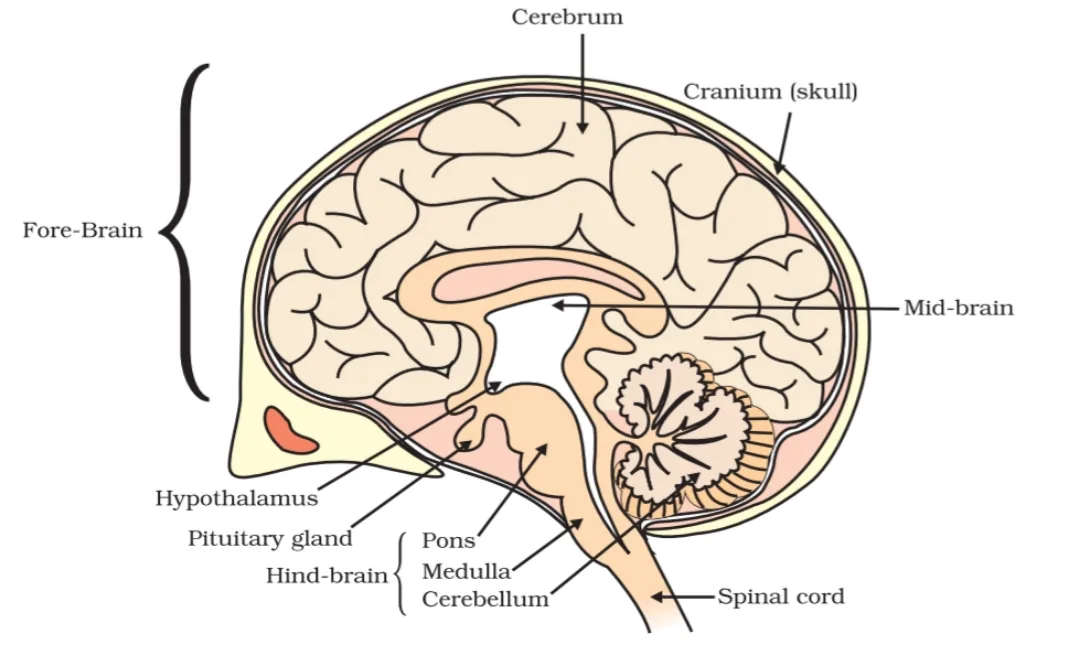
The Brain — The Master Controller
Position and Protection
Brain sits inside the skull (cranium) — bony case. Surrounded by 3 protective membranes called meninges. Cushioned by cerebrospinal fluid (CSF).
Weight: ~1.4 kg in adults. Contains ~86 billion neurons.
3 Main Parts of Brain
Brain divided into 3 regions:
1. Forebrain — largest, most developed. 2. Midbrain — small, between others. 3. Hindbrain — at base, connects to spinal cord.
Forebrain (Largest Part)
Main component: Cerebrum. Largest part of brain (~85% of brain weight). Has 2 hemispheres (left + right). Surface has folds (gyri) and grooves (sulci) → increases surface area.
Functions of Cerebrum: 1. Voluntary movements (motor cortex). 2. Senses (vision, hearing, touch processing). 3. Thinking, reasoning, intelligence. 4. Memory (short-term and long-term). 5. Learning. 6. Emotions (with help from limbic system). 7. Language (Broca's and Wernicke's areas).
Forebrain also includes: - Thalamus — relay station for sensory info. - Hypothalamus — regulates body temperature, hunger, hormones.
Midbrain
Small region between forebrain and hindbrain. Functions: 1. Visual reflexes (e.g., pupil contraction). 2. Auditory reflexes (orienting toward sound). 3. Connects forebrain and hindbrain.
Hindbrain (3 Parts)
1. Cerebellum: Located at back of head. Looks like a small cauliflower. Functions:
- Coordinates voluntary movements (smooth, precise).
- Maintains balance and posture.
- Fine motor skills (writing, playing instruments).
Damage: clumsy movements, loss of balance.
2. Pons: Connects cerebellum to rest of brain. Helps regulate breathing. Bridge between brain regions.
3. Medulla Oblongata: Lowest part of brain, connects to spinal cord. Controls vital involuntary functions:
- Heart rate.
- Breathing rate.
- Blood pressure.
- Reflexes (cough, sneeze, vomit, swallow).
Damage to medulla = often fatal (heart/breathing stop).
Summary
| Part | Main Functions |
|---|---|
| Cerebrum (forebrain) | Thinking, voluntary movement, senses |
| Midbrain | Visual/auditory reflexes |
| Cerebellum | Balance, coordination |
| Pons | Bridge, breathing |
| Medulla | Vital functions (heart, breathing) |
[NCERT — diagram important]
The Spinal Cord
Structure
Long, tube-like structure of nerve tissue. Length: ~45 cm in adult. Position: from brain (medulla) down through vertebral column. Protected by:
- Vertebral column (bones).
- Meninges (3 membranes).
- CSF (fluid cushion).
Diagram (Verbal Cross-Section)
   ────────── Skull (protects brain)
           |
        Brain
           |
        Medulla
           |
   ────────── Spinal Cord begins
           |
     Spinal nerves (31 pairs)
     branch off here
           |
   ────────── Vertebral column ends
   (Cauda equina = nerve roots)
Functions
1. Reflex Center: Most reflexes happen here, NOT in brain. Examples: knee-jerk, hand from hot. Why? — saves time (closer to body parts).
2. Pathway: Carries signals between brain and body. Sensory info: body → spinal cord → brain. Motor commands: brain → spinal cord → body.
3. Connection Point: 31 pairs of spinal nerves branch out from it to all body parts.
Spinal Cord Damage
If spinal cord is damaged (accident): 1. Nerves below injury can't communicate with brain. 2. Result: paralysis below injury site.
Example:
- Damage in neck → paralysis of arms + legs (quadriplegia).
- Damage in lower back → paralysis of legs (paraplegia).
Sad reality: spinal cord doesn't regenerate well — injuries often permanent.
Vertebral Column
Bones (vertebrae) protecting spinal cord. 33 vertebrae:
- 7 cervical (neck).
- 12 thoracic (chest).
- 5 lumbar (lower back).
- 5 sacral (fused).
- 4 coccygeal (tailbone).
This is why we have 'good posture' — protects spinal cord.
[NCERT — important]
Peripheral Nervous System (PNS)
Definition
'Peripheral Nervous System' (PNS) = all nerves outside the brain and spinal cord.
Connects CNS to entire body.
Two Components
1. Cranial Nerves (12 pairs): Originate directly from the brain. Mostly serve head, neck, internal organs.
Examples:
- Optic nerve — eyes.
- Auditory nerve — ears.
- Olfactory nerve — nose.
- Vagus nerve — heart, stomach.
2. Spinal Nerves (31 pairs): Originate from the spinal cord. Serve body below neck.
Each spinal nerve has:
- Sensory fibres (carrying signal in).
- Motor fibres (carrying signal out).
Two Functional Divisions of PNS
1. Somatic Nervous System (Voluntary): Controls voluntary muscles (skeletal). Connects CNS to skin and muscles you control. Example: walking, picking up objects.
2. Autonomic Nervous System (Involuntary): Controls involuntary functions. Internal organs, glands.
Two further branches:
a) Sympathetic Nervous System: 'Fight or flight' system. Active during stress/danger. Effects:
- Heart rate up.
- Pupils dilate.
- Breathing fast.
- Digestion stops.
b) Parasympathetic Nervous System: 'Rest and digest' system. Active during calm. Effects:
- Heart rate slows.
- Pupils contract.
- Breathing slows.
- Digestion active.
Comparison
| Aspect | Sympathetic | Parasympathetic |
|---|---|---|
| When active | Stress, danger | Calm, rest |
| Heart rate | Up | Down |
| Pupils | Dilate | Contract |
| Digestion | Stops | Active |
| Typical state | Fight or flight | Rest and digest |
Body switches between these as needed.
Together, sympathetic + parasympathetic maintain homeostasis (internal balance).
[NCERT — important]
Common Disorders of Nervous System
Understanding what can go wrong helps appreciate the system.
1. Stroke
Damage to brain due to blocked or burst artery. Symptoms: paralysis, slurred speech, vision loss. Time-critical: treat within 'golden hour' for best recovery.
2. Alzheimer's Disease
Progressive memory loss. Common in elderly. Plaques and tangles in brain. No cure — only management.
3. Parkinson's Disease
Loss of dopamine-producing neurons. Symptoms: tremors, slow movement, stiffness. Treatable with medication.
4. Epilepsy
Recurrent seizures (sudden electrical disturbances). Causes: brain injury, stroke, tumours, idiopathic. Controllable with medications.
5. Multiple Sclerosis
Damage to myelin sheaths. Slows nerve signals. Symptoms: weakness, vision problems, fatigue.
6. Spinal Cord Injuries
Often from accidents. Cause paralysis below injury. Spinal cord doesn't regenerate well.
Brain Protection
Why protection matters: Brain is delicate — only ~1.4 kg of soft tissue. Surrounded by: 1. Skull (cranium) — bony helmet. 2. Meninges — 3 membranes. 3. CSF (cerebrospinal fluid) — shock-absorbing fluid.
Without these: brain damaged easily. Wear helmets when biking, motorcycling!
Maintaining Nervous System Health
1. Sleep well — brain consolidates memories during sleep. 2. Eat brain-healthy food — fish (omega-3), nuts, vegetables. 3. Exercise — improves blood flow to brain. 4. Mental activity — puzzles, reading, learning. 5. Avoid head injuries — wear helmets. 6. Manage stress — chronic stress harms brain. 7. Avoid drugs/alcohol — damage neurons. 8. Regular check-ups — catch problems early.
A healthy nervous system = healthy life!
Recent Research
Brain can grow new neurons — called neurogenesis. Mostly in hippocampus (memory area). Encouraged by: exercise, learning, healthy diet. Discouraged by: stress, depression, alcohol.
This is why staying mentally active in old age helps prevent Alzheimer's.
[NCERT — important + medical relevance]
Memory Capsule — Section 3
Quick revision of the human nervous system.
Two Divisions
1. CNS = Brain + Spinal cord. 2. PNS = All other nerves.
Brain — 3 Main Parts
Forebrain (Cerebrum + Thalamus + Hypothalamus): Thinking, voluntary movement, senses, memory. Largest part.
Midbrain: Visual/auditory reflexes. Connects forebrain and hindbrain.
Hindbrain (3 sub-parts): 1. Cerebellum — balance, coordination. 2. Pons — bridge, breathing. 3. Medulla — heart, breathing, vital functions.
Brain Protection
1. Skull (cranium) — bony case. 2. Meninges — 3 membranes. 3. Cerebrospinal fluid (CSF) — shock absorber.
Spinal Cord
Length: ~45 cm. Functions: 1. Reflex center. 2. Pathway between brain and body. 3. 31 pairs of spinal nerves branch out.
Peripheral Nervous System
Components: 1. Cranial nerves (12 pairs from brain). 2. Spinal nerves (31 pairs from spinal cord).
Two divisions: 1. Somatic — voluntary movements. 2. Autonomic — involuntary:
- Sympathetic — fight or flight.
- Parasympathetic — rest and digest.
Numbers to Remember
- Brain weight: ~1.4 kg.
- Brain neurons: ~86 billion.
- Spinal cord length: ~45 cm.
- Cranial nerves: 12 pairs.
- Spinal nerves: 31 pairs.
- Brain energy use: ~20% of body's energy!
Common Disorders
1. Stroke — blocked brain artery. 2. Alzheimer's — memory loss. 3. Parkinson's — movement issues. 4. Epilepsy — seizures. 5. Spinal cord injuries — paralysis.
Voluntary vs Involuntary
| Voluntary | Involuntary | |
|---|---|---|
| Brain part | Cerebrum | Medulla, hypothalamus |
| Examples | Walking, talking | Heartbeat, breathing |
One-Liner Insights
1. Brain = 3 parts: forebrain (largest), midbrain, hindbrain. 2. Cerebrum = thinking + voluntary movement. 3. Cerebellum = balance + coordination. 4. Medulla = heart + breathing. 5. Spinal cord = reflexes + pathway. 6. PNS = nerves outside CNS.
[Last-minute revision card!]
Example 1: NCERT — Parts of Human Brain
Name the 3 main parts of human brain. State the major function of each.
Solution:
3 Main Parts of Brain
1. Forebrain: Largest part. Contains:
- Cerebrum (largest, 85% of brain).
- Thalamus — relay station.
- Hypothalamus — regulates temperature, hormones.
Functions: 1. Voluntary movements. 2. Sensory processing (sight, sound, touch). 3. Thinking, reasoning, intelligence. 4. Memory, learning. 5. Emotions. 6. Language.
2. Midbrain: Small region between forebrain and hindbrain.
Functions: 1. Visual reflexes (e.g., pupil contraction in bright light). 2. Auditory reflexes (turning head toward sound). 3. Connects forebrain to hindbrain.
3. Hindbrain (3 parts):
a) Cerebellum:
- Balance.
- Coordination of voluntary movements (smooth, precise).
- Posture.
b) Pons:
- Bridge between brain regions.
- Helps regulate breathing.
c) Medulla Oblongata:
- Heart rate.
- Breathing rate.
- Blood pressure.
- Vital reflexes (cough, sneeze, vomit, swallow).
Importance
Each part has specific roles, but they work together. Damage to any part → specific deficits:
- Cerebrum damage → cognitive problems.
- Cerebellum damage → balance, coordination problems.
- Medulla damage → often fatal (heart/breathing).
[NCERT — Board favourite]
Example 2: NCERT — Cerebellum and Cerebrum
Differentiate between cerebrum and cerebellum.
Solution:
Comparison Table
| Feature | Cerebrum | Cerebellum |
|---|---|---|
| Position | Top, front of brain | Behind, lower part |
| Size | Largest part (~85%) | Small, behind |
| Surface | Heavily folded (gyri, sulci) | Less folded |
| Hemispheres | 2 (left + right) | 2 |
| Main function | Voluntary movement, thinking | Balance, coordination |
Functions of Cerebrum
1. Voluntary movements — motor cortex sends signals. 2. Senses — visual, auditory, touch processing. 3. Thinking, reasoning — frontal lobe. 4. Memory — temporal lobe (hippocampus). 5. Learning — through synaptic changes. 6. Emotions — limbic system involved. 7. Language — Broca's (speaking) and Wernicke's (understanding) areas.
Functions of Cerebellum
1. Coordination — makes movements smooth, precise. 2. Balance — keeps you upright. 3. Posture — maintains body position. 4. Fine motor skills — writing, playing instruments.
Damage Examples
Cerebrum damage: Cognitive problems — memory loss, language issues, paralysis. Stroke often affects cerebrum.
Cerebellum damage: Movement problems — clumsy, jerky movements. Cannot walk straight. Balance problems. Tremors. Drunk-like appearance (alcohol affects cerebellum!).
A Key Difference
Cerebrum INITIATES movements (decides to move). Cerebellum FINE-TUNES movements (makes them smooth).
Both work together for any voluntary action.
Example: drinking water: Cerebrum: 'I want water.' Cerebellum: 'Move arm smoothly to grasp glass without spilling.'
[NCERT — important comparison]
Example 3: Application — What Happens When You Drink Alcohol
Why do people stagger and slur their speech when drunk?
Solution:
Effects of Alcohol on Brain
Alcohol is a depressant — slows down brain activity.
Specific Effects
1. Cerebellum (most affected): Cerebellum controls balance and coordination. Alcohol disrupts cerebellum → loss of balance, staggering.
Why drunk people sway, stumble.
2. Cerebrum: Slowed thinking, poor judgement. Slurred speech (Broca's area affected). Memory impaired.
Why drunk people make poor decisions.
3. Reduced Reflexes: Synaptic transmission slowed. Slower reaction times.
Why drunk driving is dangerous.
4. Effects on Hypothalamus: Body temperature regulation impaired. Hence alcohol can cause hypothermia (losing body heat).
5. Effects on Medulla: High doses → breathing slowed. Very high doses → can stop breathing → death (alcohol poisoning).
Why Alcohol Affects Brain Like This
Alcohol crosses blood-brain barrier. Affects neurotransmitters (especially GABA — inhibitory). GABA boost → brain slows down. Chronic alcohol use = brain damage (especially cerebellum).
Recovery
Alcohol takes ~1 hour to be metabolised by liver. Effects gradually wear off. Long-term effects: chronic alcoholism damages cerebellum permanently.
Safe Practice
Don't drink and drive — reaction time slowed. Recommended: limit alcohol, never drink in excess.
This is why drunk driving laws exist — protect everyone!
Real-World Application
This is why cricketers don't drink before matches. Surgeons avoid alcohol — need fine motor skills. Pilots can't drink before flying.
Brain function is precious — protect it.
[Application — Real life]
Example 4: NCERT — Spinal Cord and Spinal Nerves
Describe the spinal cord. What is the importance of spinal nerves?
Solution:
Spinal Cord
Long, tube-like structure of nerve tissue. Length: ~45 cm in adult. From base of brain (medulla) down through vertebral column.
Protection
1. Vertebral column — bones surrounding it. 2. Meninges — 3 protective membranes. 3. Cerebrospinal fluid (CSF) — shock-absorbing fluid.
Structure (Cross-Section)
If you cut spinal cord:
- Grey matter (inside, butterfly shape) — cell bodies of neurons.
- White matter (outside) — myelinated axons.
Spinal cord is shorter than vertebral column. Below it: nerve roots = cauda equina ('horse's tail').
Functions of Spinal Cord
1. Reflex Centre: Most reflexes happen here, NOT in brain. Faster than involving brain.
2. Pathway: Carries signals between brain and rest of body. Sensory info: body → spinal cord → brain. Motor commands: brain → spinal cord → body.
3. Connection Hub: 31 pairs of spinal nerves branch out. Connect to all body parts below neck.
Spinal Nerves (31 pairs)
Branch off from spinal cord at regular intervals.
Distribution:
- 8 pairs: cervical (neck region).
- 12 pairs: thoracic (chest region).
- 5 pairs: lumbar (lower back).
- 5 pairs: sacral (hip).
- 1 pair: coccygeal (tailbone).
Total: 31 pairs.
Functions of Spinal Nerves
Each spinal nerve carries: 1. Sensory fibres (afferent) — bring sensations from body to spinal cord. 2. Motor fibres (efferent) — carry signals from spinal cord to muscles/glands.
Together: control all body functions below neck.
Importance
1. Body Communication: Without spinal nerves, body parts can't communicate with brain.
2. Reflexes: Quick responses through spinal cord + spinal nerves.
3. Movement: Motor commands reach muscles via spinal nerves.
4. Sensation: Touch, pain, temperature signals reach brain.
What If Damaged?
Spinal cord injury:
- Above injury: normal function.
- Below injury: paralysis (no signal can pass).
- Spinal cord doesn't regenerate well — often permanent.
Common causes:
- Accidents (car, fall).
- Sports injuries.
- Diseases.
Conclusion
Spinal cord = bridge between brain and body. Spinal nerves = the wires connecting them. Together: essential for all functions below the neck.
Hence vertebral column protects spinal cord — its damage = paralysis.
[NCERT — important]
Example 5: Synthesis — Why Brain is Protected
(a) How is brain protected from injury? (b) What happens if medulla is damaged? (c) Compare voluntary and involuntary actions in terms of brain control.
Solution:
(a) Brain Protection — 3 Layers
Layer 1: Skull (Cranium) Hard, bony case. Protects from physical impact. Like a 'helmet' nature gave us.
Layer 2: Meninges Three membranes:
- Dura mater (outer, tough).
- Arachnoid mater (middle, web-like).
- Pia mater (inner, delicate).
Functions: 1. Cover and cushion brain. 2. Hold blood vessels. 3. Contain CSF.
Layer 3: Cerebrospinal Fluid (CSF) Clear fluid in space between brain and skull. Functions: 1. Shock absorber (cushions impact). 2. Removes wastes. 3. Provides nutrients.
Total: 3 layers of protection!
Why Brain Needs So Much Protection
1. Soft tissue — only 1.4 kg. 2. Cannot regenerate (mostly). 3. Vital — controls everything. 4. Delicate — even small injury causes problems.
Hence helmets are crucial for biking, motorcycling, sports!
(b) If Medulla is Damaged
Medulla controls vital involuntary functions: 1. Heart rate. 2. Breathing rate. 3. Blood pressure. 4. Vital reflexes (cough, swallow, vomit).
Damage Effects: 1. Heart problems — irregular rhythm, may stop. 2. Breathing problems — slow or stop. 3. Blood pressure issues — drops. 4. Loss of reflexes — can't swallow, cough.
Often fatal: Damage to medulla can stop heart or breathing. Hence its protection is critical.
This is why brain stem injuries are very dangerous.
(c) Voluntary vs Involuntary
Voluntary Actions:
Controlled by: Cerebrum (forebrain). Path: Cerebrum → motor neurons → skeletal muscles.
Examples:
- Walking (decide pace).
- Writing (choose words).
- Talking (control voice).
- Eating (move utensil).
You can stop them at will.
Involuntary Actions:
Controlled by: Medulla, hypothalamus, autonomic nervous system. Pathway: bypass conscious brain.
Examples:
- Heartbeat (continuous).
- Breathing (mostly automatic).
- Digestion.
- Pupil dilation.
- Sweating.
- Reflexes.
You usually can't stop them at will.
Comparison Table
| Aspect | Voluntary | Involuntary |
|---|---|---|
| Control | Cerebrum | Medulla, hypothalamus |
| Conscious? | Yes | No |
| Speed | Variable | Often instant (reflex) |
| Examples | Walking, writing | Heartbeat, breathing |
| Can stop? | Yes | Mostly no |
Mixed Cases
Some actions are mixed: 1. Breathing — mostly involuntary, can be voluntary briefly. 2. Walking — voluntary at first, becomes 'automatic' with practice. 3. Heart rate — mostly involuntary, but yoga/meditation can influence.
Final Insight
Brain organises its work brilliantly: 1. Cerebrum for thinking and voluntary actions. 2. Medulla for vital involuntary functions. 3. Cerebellum for coordination. 4. Spinal cord for fast reflexes.
All work together → coordinated, complex behaviour we call 'human'.
[Board: 5-mark synthesis]