
Major Endocrine Glands of Human Body
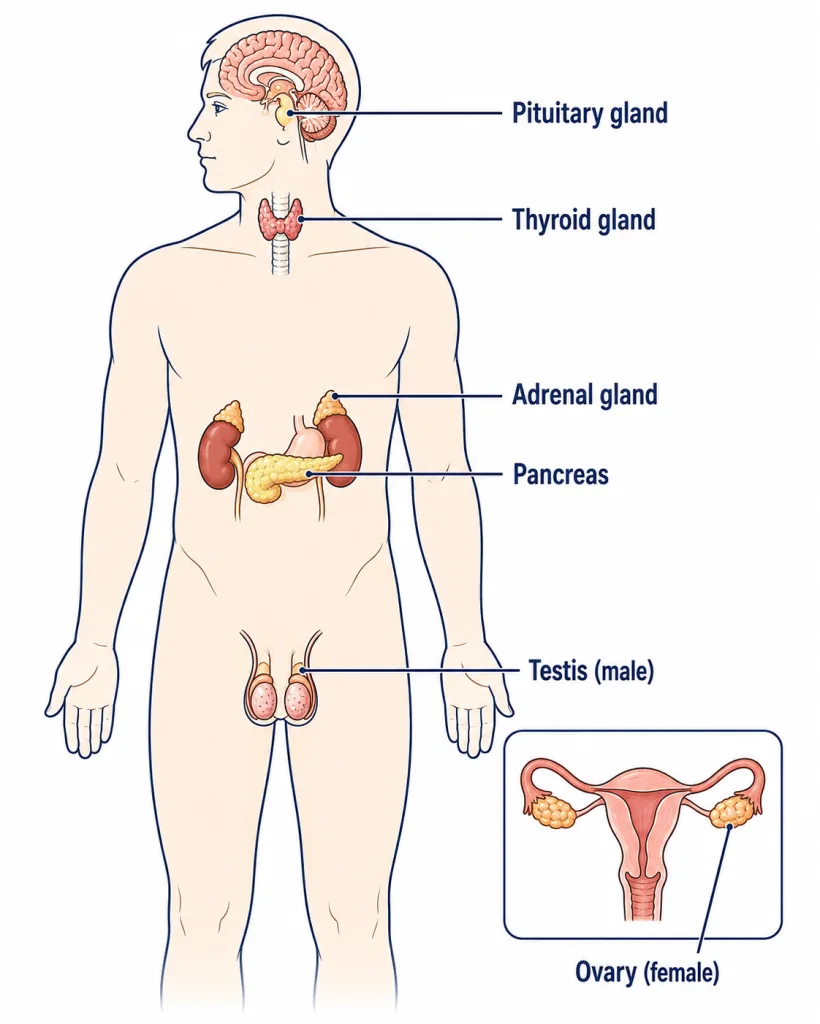
Let's tour the human body and meet the main hormone-producing glands.
Location of Major Glands
1. Pituitary — base of brain. 2. Pineal — top of brain. 3. Hypothalamus — in brain. 4. Thyroid — neck (front). 5. Parathyroid — neck (behind thyroid). 6. Thymus — chest. 7. Adrenal — on top of kidneys. 8. Pancreas — in abdomen. 9. Testes (males) — in scrotum. 10. Ovaries (females) — in pelvis.
Diagram (Verbal)
        Brain
         |
      Pituitary (master)
        ↓
      Thyroid (neck)
        ↓
      Thymus (chest)
        ↓
      Adrenal (above kidneys)
        ↓
      Pancreas
        ↓
      Testes/Ovaries
Each gland has a specific role. Together, they coordinate the entire body.
[NCERT — important]
Pituitary Gland — The Master Gland
Why 'Master Gland'?
Pituitary controls many other endocrine glands. It's the 'orchestra conductor' of hormones.
Location
Inside skull, below brain. Tiny — size of pea. Connected to hypothalamus (in brain).
Hormones Produced
1. Growth Hormone (GH or Somatotropin): Function: regulates body growth. Acts on bones, muscles. Effects in childhood — determines final height.
Disorders:
- Too little: dwarfism (short stature).
- Too much: gigantism in children, acromegaly in adults.
2. Thyroid Stimulating Hormone (TSH): Tells thyroid to produce thyroxine. Indirectly affects metabolism.
3. Follicle Stimulating Hormone (FSH): Stimulates gonads (testes/ovaries). Important for puberty + reproduction.
4. Luteinizing Hormone (LH): Also stimulates gonads. Triggers ovulation in females, testosterone in males.
5. Anti-Diuretic Hormone (ADH or Vasopressin): Acts on kidneys. Regulates water reabsorption. High ADH → less urine, conserves water. Disorder: diabetes insipidus (excess urine).
6. Prolactin: Stimulates milk production after childbirth.
7. Oxytocin: Causes uterine contractions during childbirth. Stimulates milk ejection.
Why So Important?
Pituitary affects: 1. Growth. 2. Reproduction. 3. Water balance. 4. Stress response (via other glands). 5. Childbirth. 6. Lactation.
If pituitary fails → many systems affected.
Hypothalamus controls pituitary → brain controls hormones!
[NCERT, Board: 5-mark]
Other Major Endocrine Glands
1. Thyroid Gland
Located in front of neck (below Adam's apple). Butterfly-shaped.
Hormone: Thyroxine (T4) and Triiodothyronine (T3).
Functions of Thyroxine: 1. Regulates metabolism — speed of all cellular activities. 2. Body heat production. 3. Brain development (in children). 4. Growth. 5. Heart rate regulation.
Iodine Required: Thyroxine contains iodine. Without iodine in diet → cannot make thyroxine → goitre (enlarged thyroid). Solution: iodised salt.
2. Parathyroid Gland
Behind thyroid (4 small glands). Hormone: parathormone. Function: regulates blood calcium levels.
3. Adrenal Gland
On top of each kidney. Two parts: cortex (outer) and medulla (inner).
Hormone from Medulla: Adrenaline (Epinephrine). 'Fight or flight' hormone.
Effects: 1. Increases heart rate. 2. Dilates pupils. 3. Increases breathing rate. 4. Mobilises glucose for energy. 5. Diverts blood from gut to muscles.
Released during stress, danger, excitement.
Hormones from Cortex: 1. Cortisol — stress hormone (long-term). 2. Aldosterone — regulates salt balance. 3. Sex hormones (small amounts).
4. Pancreas
Behind stomach. Both endocrine and exocrine.
Endocrine Hormones:
a) Insulin: Produced by beta cells of pancreas. Function: lowers blood glucose. Helps cells take up glucose (liver, muscles, fat). Stores glucose as glycogen. Without insulin → diabetes!
b) Glucagon: Produced by alpha cells. Function: raises blood glucose. Releases glycogen from liver. Opposite of insulin.
Insulin and glucagon work together to maintain blood sugar.
5. Testes (in Males)
Hormone: Testosterone. Functions: 1. Male secondary sex characteristics (facial hair, deeper voice, broader chest). 2. Muscle development. 3. Sperm production. 4. Sex drive. 5. Bone density.
Pituitary's FSH and LH stimulate testes.
6. Ovaries (in Females)
Hormones: Oestrogen and Progesterone.
Oestrogen: 1. Female secondary sex characteristics (breast development, broader hips). 2. Menstrual cycle regulation. 3. Bone density.
Progesterone: 1. Prepares uterus for pregnancy. 2. Maintains pregnancy. 3. Stops ovulation during pregnancy.
FSH and LH from pituitary control ovaries.
Summary Table
| Gland | Hormone | Main Function |
|---|---|---|
| Pituitary | GH, TSH, FSH, LH, ADH | Master gland |
| Thyroid | Thyroxine | Metabolism |
| Adrenal | Adrenaline | Stress response |
| Pancreas | Insulin, glucagon | Blood sugar |
| Testes | Testosterone | Male traits |
| Ovaries | Oestrogen, Progesterone | Female traits |
[NCERT — must-know table]
Memory Capsule — Section 7
Quick revision of major endocrine glands.
Glands and Their Locations
1. Pituitary — brain (master gland). 2. Thyroid — neck. 3. Pancreas — abdomen. 4. Adrenal — on top of kidneys. 5. Testes — males. 6. Ovaries — females.
Major Hormones
| Gland | Hormone | Function |
|---|---|---|
| Pituitary | Growth hormone (GH) | Body growth |
| Pituitary | TSH | Stimulates thyroid |
| Pituitary | FSH, LH | Reproduction |
| Pituitary | ADH | Water balance |
| Thyroid | Thyroxine | Metabolism (needs iodine) |
| Pancreas | Insulin | Lowers blood sugar |
| Pancreas | Glucagon | Raises blood sugar |
| Adrenal | Adrenaline | Fight or flight |
| Testes | Testosterone | Male traits |
| Ovaries | Oestrogen | Female traits |
| Ovaries | Progesterone | Pregnancy |
Key Hormones to Remember
1. Growth hormone → height (childhood). 2. Thyroxine → metabolism (needs iodine). 3. Insulin → lowers blood sugar. 4. Adrenaline → fight or flight. 5. Testosterone → male traits (puberty). 6. Oestrogen → female traits (puberty).
Disorders Linked to Hormone Issues
| Disorder | Cause | Symptoms |
|---|---|---|
| Dwarfism | Low GH (childhood) | Short height |
| Gigantism | High GH (childhood) | Very tall |
| Goitre | Low iodine | Enlarged thyroid |
| Diabetes | Low insulin | High blood sugar |
| Hyperthyroidism | High thyroxine | Fast metabolism |
| Hypothyroidism | Low thyroxine | Slow metabolism |
Why Iodine is Important
Thyroxine (from thyroid) needs iodine. No iodine → no thyroxine → goitre. Indian government adds iodine to salt to prevent this.
One-Liner Insights
1. Pituitary = master gland (controls others). 2. Iodine deficiency → goitre. 3. Insulin deficiency → diabetes. 4. Adrenaline = stress hormone. 5. Sex hormones from gonads (testes/ovaries).
[Quick reference!]
Example 1: NCERT — Pituitary Gland
Why is pituitary called the 'master gland'? Name 3 important hormones it produces.
Solution:
Why 'Master Gland'?
Pituitary controls many other endocrine glands of the body.
It's like an 'orchestra conductor': 1. Tells thyroid → produce thyroxine. 2. Tells adrenal → produce cortisol. 3. Tells gonads → produce sex hormones. 4. Controls growth. 5. Controls water balance.
Hence pituitary is the 'master' — it controls others.
Note: pituitary is itself controlled by hypothalamus (in brain). So really, brain controls hormones through pituitary.
3 Important Pituitary Hormones
1. Growth Hormone (GH): Function: regulates body growth. Acts on bones, muscles.
Disorders:
- Too little (childhood): dwarfism (very short).
- Too much (childhood): gigantism (very tall).
- Too much (adult): acromegaly (enlarged hands, feet, face).
2. Thyroid Stimulating Hormone (TSH): Tells thyroid to make thyroxine. Without TSH → thyroid stops working. Affects metabolism indirectly.
3. Anti-Diuretic Hormone (ADH or Vasopressin): Acts on kidneys. Regulates water reabsorption. High ADH → less urine, body retains water. Low ADH → more urine, body loses water.
Disorder: diabetes insipidus (low ADH → excess urine).
Other Important Pituitary Hormones
4. FSH and LH — control reproduction. 5. Prolactin — milk production after childbirth. 6. Oxytocin — childbirth contractions, milk ejection.
Why Pituitary is So Critical
If pituitary fails: 1. No growth. 2. Thyroid stops. 3. Reproduction problems. 4. Water balance issues. 5. Stress response problems.
Multiple systems collapse.
Hence proper pituitary function is essential for life.
Tiny gland — huge importance!
[NCERT — Board favourite]
Example 2: NCERT — Iodine and Goitre
Why is iodine important for our body? What is goitre?
Solution:
Why Iodine is Important
Iodine is essential for thyroxine production.
Thyroxine = hormone from thyroid gland. Contains iodine atoms. Without iodine → cannot make thyroxine → many problems!
Functions of Thyroxine
Thyroxine (T4) regulates: 1. Body metabolism — speed of cellular activities. 2. Heat production — body temperature. 3. Brain development (especially in children). 4. Heart rate. 5. Growth.
Imagine thyroxine as the 'thermostat' of the body.
Goitre — When Iodine is Lacking
'Goitre' = enlarged thyroid gland (visible swelling in neck).
How it Develops: 1. Low iodine in diet. 2. Thyroid can't make enough thyroxine. 3. Pituitary detects low thyroxine. 4. Pituitary releases more TSH. 5. TSH stimulates thyroid → tries harder. 6. Thyroid grows larger but still can't make thyroxine. 7. Result: enlarged thyroid (goitre).
Symptoms of Goitre
Physical: 1. Visible neck swelling. 2. Difficulty swallowing (severe cases). 3. Tight feeling in neck.
Hormonal (low thyroxine): 1. Tiredness. 2. Weight gain. 3. Cold sensitivity. 4. Slow heart rate. 5. Memory problems. 6. In children: stunted growth, mental retardation (cretinism).
Why Indian Government Promotes Iodised Salt
1. India is iodine-deficient region (especially Himalayan and inland areas). 2. Adding iodine to salt is cheap. 3. Everyone uses salt → universal coverage. 4. Prevents goitre + protects children's brain development.
Mandate: all salt sold should be iodised. Hugely successful public health intervention.
Other Iodine Sources
1. Iodised salt (main source). 2. Seafood (fish, shrimp). 3. Seaweed. 4. Eggs. 5. Dairy.
Hyperthyroidism (Opposite Problem)
Some people make TOO MUCH thyroxine.
Symptoms: 1. Weight loss. 2. Fast heart rate. 3. Heat intolerance. 4. Anxiety, hyperactivity. 5. Bulging eyes (Graves' disease).
Treatment: medication, surgery, radioactive iodine.
Hypothyroidism
Low thyroxine. Symptoms: 1. Tiredness. 2. Weight gain. 3. Cold sensitivity. 4. Depression. 5. Dry skin. 6. Slow thinking.
Treatment: synthetic thyroxine pills.
Children Especially Vulnerable
Iodine deficiency in childhood = cretinism. 1. Severely stunted growth. 2. Mental retardation. 3. Permanent brain damage.
Hence iodised salt is critical for child health.
Simple solution to a serious problem.
[NCERT, Application — Real life]
Example 3: NCERT — Insulin and Diabetes
Why is insulin important? What is diabetes?
Solution:
Insulin
'Insulin' = hormone produced by beta cells of pancreas. Function: lowers blood glucose levels.
How Insulin Works
After meal: 1. Food digested → glucose enters blood. 2. Blood glucose rises. 3. Pancreas detects high glucose. 4. Releases insulin into blood. 5. Insulin acts on:
- Liver → store glucose as glycogen.
- Muscles → use glucose, store glycogen.
- Fat cells → store glucose as fat. 6. Blood glucose drops to normal. 7. Pancreas stops releasing insulin.
Why Insulin is Critical
Without insulin: 1. Glucose stays in blood (high blood sugar). 2. Cells can't get glucose for energy. 3. Body breaks down fats and proteins instead. 4. Lots of glucose lost in urine.
Result: diabetes.
Diabetes Mellitus
'Diabetes mellitus' = condition of high blood sugar due to insulin problems.
Two Types
Type 1 Diabetes: Pancreas can't produce insulin (beta cells damaged). Usually appears in children. Treatment: insulin injections for life.
Type 2 Diabetes: Pancreas makes insulin but cells don't respond well (insulin resistance). Usually appears in adults. Treatment: diet, exercise, sometimes medications. Most common type — rising rapidly in India.
Symptoms of Diabetes
1. Frequent urination (polyuria) — excess sugar in urine pulls water with it. 2. Excessive thirst (polydipsia) — body dehydrates. 3. Excessive hunger (polyphagia) — cells can't get glucose, body 'hungry'. 4. Weight loss (despite eating). 5. Fatigue — cells starved of energy. 6. Blurred vision. 7. Slow wound healing.
Long-term Complications
1. Cardiovascular disease — heart attacks, strokes. 2. Kidney damage — diabetic nephropathy. 3. Eye damage — diabetic retinopathy → blindness. 4. Nerve damage — neuropathy (numbness, pain). 5. Foot problems — non-healing wounds, amputations. 6. Increased infections.
Diagnosis
1. Fasting blood sugar > 126 mg/dL. 2. Random blood sugar > 200 mg/dL. 3. HbA1c > 6.5% (3-month average). 4. Glucose in urine (advanced cases).
Prevention
Type 2 diabetes is largely preventable: 1. Healthy diet — less sugar, refined carbs. 2. Regular exercise. 3. Maintain healthy weight. 4. Avoid smoking. 5. Manage stress. 6. Regular check-ups (especially after 40).
India's Diabetes Crisis
1. ~10 crore Indians have diabetes (2024). 2. Rising rapidly due to:
- Urbanisation.
- Sedentary lifestyle.
- High-carb, sugary diet.
- Stress. 3. India = 'diabetes capital of the world'.
Hence prevention + early detection critical.
Treatment
Type 1: Insulin injections (no other choice). Type 2: 1. Diet, exercise. 2. Oral medications (metformin). 3. Insulin (if other treatments fail).
Key Insight
Insulin is one of the most important discoveries in medical history. Discovered in 1921 by Banting and Best. Saved millions of lives.
Without insulin technology, type 1 diabetes was a death sentence.
[NCERT — important + Real life]
Example 4: Adrenaline — The Fight or Flight Hormone
What is adrenaline? Describe its effects on the body.
Solution:
Adrenaline (Epinephrine)
'Adrenaline' = hormone produced by medulla of adrenal gland (located on top of kidneys).
Released during stress, danger, excitement, exercise.
Famous as the 'fight or flight' hormone.
When is Adrenaline Released?
Triggers: 1. Sudden danger (snake, accident). 2. Fear (public speaking, exam). 3. Exercise (intense physical activity). 4. Excitement (riding rollercoaster). 5. Anger (confrontation). 6. Cold (briefly).
Brain detects stress → tells adrenal medulla → release adrenaline.
Effects on Body
1. Heart Rate Up: Heart pumps faster (~30-50% faster). More blood circulation.
2. Blood Pressure Up: Blood vessels constrict in some areas. Pressure increases.
3. Pupils Dilate: Better vision in dim light. See more clearly.
4. Faster Breathing: Breathing rate increases. More oxygen for muscles.
5. Glucose Released: Liver releases stored glycogen as glucose. Quick energy for muscles.
6. Blood Diverted to Muscles: Blood vessels in gut constrict. Blood vessels in muscles dilate. Result: more blood to muscles for action.
7. Sweating: Body cools as it prepares for action. Anticipating exertion.
8. Slowed Digestion: Body diverts resources from digestion to action. Why we 'lose appetite' under stress.
9. Hair Stands Up (Goosebumps): Tiny muscles contract. Evolutionary remnant — bigger appearance to scare predators.
Why is This Useful?
Imagine encountering a tiger: Without adrenaline:
- Slow reaction.
- Tired muscles.
- Can't run/fight.
- Likely killed.
With adrenaline:
- Fast reaction.
- Energised muscles.
- Can run away/fight.
- Better chance of survival.
Adrenaline = survival tool. Evolved in our ancestors over millions of years.
Modern Uses of 'Fight or Flight'
Same response triggers in modern situations: 1. Public speaking — heart races, palms sweat. 2. Exams — nervous tension. 3. Sports — boost performance. 4. First date — butterflies in stomach. 5. Driving in traffic — alertness.
Useful in moderation.
Modern Problem: Chronic Stress
Modern life triggers adrenaline too often. Chronic stress = constant adrenaline → harmful.
Effects of chronic stress: 1. High blood pressure. 2. Heart disease. 3. Anxiety, panic. 4. Digestive problems. 5. Weakened immune system. 6. Insomnia.
Solution: 1. Stress management — meditation, yoga. 2. Exercise — uses adrenaline productively. 3. Adequate sleep. 4. Healthy diet. 5. Hobbies, relaxation.
Medical Use of Adrenaline
1. EpiPen — for severe allergic reactions (anaphylaxis). 2. Cardiac arrest treatment — to restart heart. 3. Asthma attacks — to dilate airways.
Synthetic adrenaline is a life-saving medication.
Working with Other Systems
Nervous + Adrenaline = stress response: 1. Brain detects stress. 2. Sympathetic nerves activate. 3. Adrenal medulla releases adrenaline. 4. Body prepared for action.
Both systems coordinate beautifully.
Final Insight
Adrenaline shows how endocrine system can act fast (within minutes). Bridge between nervous and endocrine systems. Essential for survival, sports performance, modern life.
Use it wisely — too much = harmful.
[Application — Real life]
Example 5: Synthesis — Comprehensive
(a) Why is balance of hormones important? (b) Match the gland with its hormone: Pituitary, Thyroid, Pancreas, Adrenal, Testes, Ovaries Adrenaline, Thyroxine, Insulin, Growth hormone, Testosterone, Oestrogen (c) Discuss the importance of iodised salt in India.
Solution:
(a) Why Hormone Balance is Important
Hormones don't work in isolation. Body has ~50+ hormones. All work together — like an orchestra. Balance is crucial.
Examples of Imbalance:
1. Too much insulin: Hypoglycemia (low blood sugar). Cause: insulin overdose, pancreatic tumour. Symptoms: dizziness, sweating, confusion, coma.
2. Too little insulin: Diabetes (high blood sugar). Symptoms: frequent urination, thirst, weight loss. Long-term: many complications.
3. Too much thyroxine: Hyperthyroidism. Fast metabolism, weight loss, anxiety.
4. Too little thyroxine: Hypothyroidism, goitre, cretinism (children). Slow metabolism, weight gain, cold intolerance.
5. Too much growth hormone (childhood): Gigantism — very tall.
6. Too little growth hormone (childhood): Dwarfism — very short.
Hence: 1. Body monitors hormone levels constantly. 2. Uses feedback mechanisms (negative feedback). 3. Maintains balance.
(b) Matching Glands and Hormones
| Gland | Hormone |
|---|---|
| Pituitary | Growth hormone |
| Thyroid | Thyroxine |
| Pancreas | Insulin |
| Adrenal | Adrenaline |
| Testes | Testosterone |
| Ovaries | Oestrogen |
Each gland → specific hormone(s) → specific function.
Quick Functions Recap
1. GH (pituitary) → growth. 2. Thyroxine (thyroid) → metabolism. 3. Insulin (pancreas) → blood sugar. 4. Adrenaline (adrenal) → fight or flight. 5. Testosterone (testes) → male traits. 6. Oestrogen (ovaries) → female traits.
(c) Importance of Iodised Salt in India
Background: Indian Iodine Deficiency
1. Indian soil — especially Himalayan, hilly, inland — has low iodine. 2. Crops grown have low iodine. 3. People consuming these crops → iodine-deficient. 4. Pre-1990: ~70% of Indians at risk of iodine deficiency.
Consequences of Iodine Deficiency
1. Goitre — enlarged thyroid (visible). 2. Hypothyroidism — slow metabolism. 3. Cretinism in children:
- Severely stunted growth.
- Mental retardation.
- Permanent damage. 4. Lower IQ in iodine-deficient regions. 5. Pregnancy problems — miscarriage, low birth weight.
Worldwide: iodine deficiency = main preventable cause of mental retardation!
Solution: Iodised Salt
1. Government adds iodine to common salt (~30 ppm). 2. Mandatory in all packaged salt. 3. Cheap (almost no extra cost). 4. Universal coverage (everyone uses salt). 5. No extra effort needed by consumer.
Impact in India
1. Goitre cases reduced dramatically. 2. IQ of children improved. 3. Public health success story.
Programme: National Iodine Deficiency Disorders Control Programme (NIDDCP).
Why it Works
1. Salt is universal — everyone consumes it. 2. Daily intake — small but regular. 3. Cheap fortification — government-mandated. 4. No alternative needed — uses existing diet.
Lesson
Iodised salt is one of the simplest and most successful public health interventions in history.
Saved millions from preventable mental and physical disabilities.
Lesson: small interventions can have huge impact when applied correctly.
[Board: 5-mark synthesis]