
What is Control and Coordination?
Let's start with a thought experiment. When you accidentally touch a hot pan, your hand pulls back immediately — even before you 'think' about it. How does your body know what to do?
The answer: control and coordination.
Definition
'Control and coordination' = the life process by which an organism senses changes in its environment (stimuli) and produces appropriate responses.
Why is This Important?
Living organisms must: 1. Sense their environment (light, heat, food, danger). 2. Process information quickly. 3. Respond appropriately (move toward food, away from danger). 4. Coordinate body parts to work together. 5. Maintain internal balance (homeostasis).
Without these abilities, an organism cannot survive.
Stimuli and Responses
Stimulus (plural: stimuli): any change in the environment that an organism can detect. Examples:
- Light shining in eyes.
- Hot surface touched.
- Food smell.
- Loud noise.
- Cold temperature.
Response: the action taken by organism to deal with stimulus. Examples:
- Closing eyes.
- Pulling hand back.
- Moving toward food.
- Looking toward sound.
- Shivering.
Two Types of Coordination
Animals and plants have different coordination systems:
1. Nervous Coordination (animals only): Uses electrical signals through neurons. Fast, immediate response. Example: pulling hand from hot pan.
2. Chemical (Hormonal) Coordination: Uses chemicals (hormones). Slower, longer-lasting effects. Examples in animals: thyroxine, insulin. Examples in plants: auxin, gibberellin.
Plants don't have a nervous system — they only use hormones.
[NCERT — fundamental]
Why Coordination is Essential
Real-Life Examples
Think of these everyday situations and how coordination is at work:
1. Drinking a glass of water: Eyes see glass → brain calculates distance → arm muscles move precisely → fingers grasp → mouth opens → swallowing reflex. Many systems coordinated in seconds.
2. Salivating when smelling food: Smell receptors → brain → salivary glands secrete saliva → ready to digest.
3. Sweating in summer: Temperature receptors → brain → sweat glands → cooling effect.
4. Pupil dilation in dark: Light receptors → brain → eye muscles → pupil widens.
All these involve detecting stimuli + processing + appropriate response.
Effects of Poor Coordination
If nervous system fails: 1. Cannot sense stimuli. 2. Cannot move properly. 3. Reflexes lost. 4. Brain damage → coma.
If hormonal system fails: 1. Diabetes (insulin failure). 2. Goitre (thyroid problem). 3. Dwarfism/Gigantism (growth hormone issues). 4. Stunted plant growth (auxin imbalance).
Hence, coordination is essential for life and health.
Comparing Different Organisms
Plants: 1. No nervous system. 2. Use only chemical coordination (hormones). 3. Slow responses (over hours/days). 4. Examples: bending toward light, growing roots downward.
Simple Animals (like Hydra): 1. Simple nerve net. 2. Basic responses to touch.
Complex Animals (like Humans): 1. Highly developed nervous system + endocrine system. 2. Brain has billions of neurons. 3. Fast and complex responses. 4. Both immediate (nervous) + long-term (hormonal) coordination.
The Big Picture
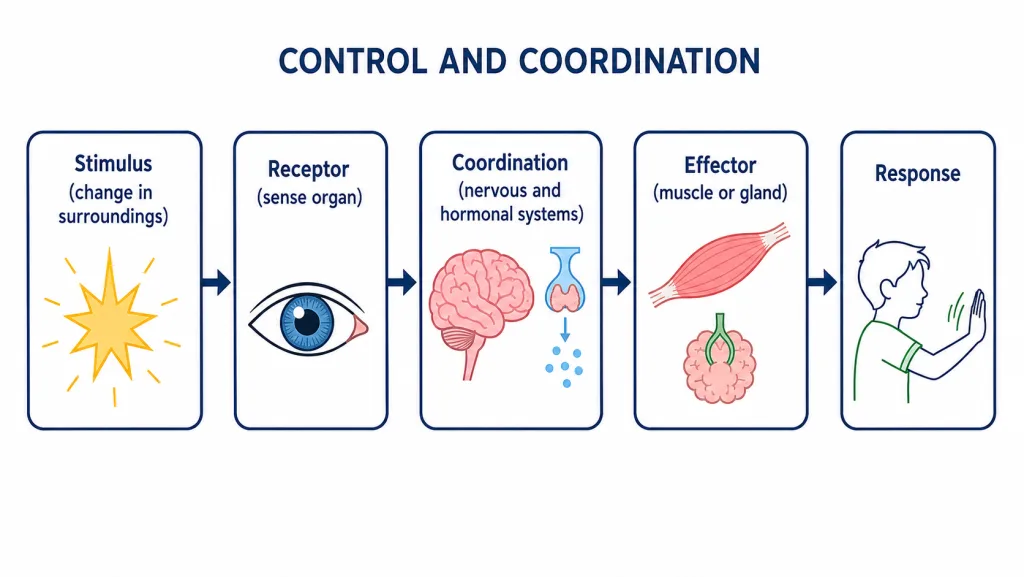
Coordination shows the interconnectedness of life: 1. Sensing — receptors detect stimuli. 2. Processing — brain/cells decide. 3. Responding — muscles/glands act. 4. Adjusting — feedback loops fine-tune.
Every second, billions of these mini-coordination events happen in your body!
[NCERT — important concept]
Comparison: Nervous vs Hormonal Coordination
Both systems work together, but in different ways.
Comparison Table
| Feature | Nervous System | Endocrine (Hormonal) |
|---|---|---|
| Type of signal | Electrical | Chemical (hormones) |
| Path | Neurons (nerves) | Blood |
| Speed | Very fast (milliseconds) | Slower (seconds to days) |
| Duration of effect | Short | Long-lasting |
| Targets | Specific muscles/glands | Distant organs |
| Examples | Reflex, voluntary movements | Growth, metabolism |
| Reversibility | Quick (signal stops) | Slow (hormones break down) |
When is Each Used?
Nervous system: 1. Emergency situations (touch hot, danger). 2. Voluntary movements (walking, writing). 3. Senses (sight, sound, smell). 4. Reflexes.
Hormonal system: 1. Growth (over years). 2. Metabolism (daily). 3. Reproduction. 4. Stress response (longer than 'fight or flight'). 5. Plant responses (light, gravity).
Working Together — Example: Stress Response
When you encounter a fierce dog:
Step 1 (Nervous): Eyes detect dog → brain → muscles tense → ready to run. This happens in milliseconds.
Step 2 (Hormonal): Brain → adrenal glands → release adrenaline. Adrenaline:
- Increases heart rate.
- Dilates pupils.
- Boosts breathing.
- Provides energy (glucose mobilization). Effects last minutes.
Step 3 (Nervous + Hormonal): You run away or fight. Both systems coordinate the response.
This is the famous 'fight or flight' response.
Conclusion
Both systems are essential — they're complementary, not competing.
Quick situations: nervous system. Long-term changes: hormonal system.
[Board: 3-mark comparison]
Components of Coordination Systems
Nervous System Components
1. Receptors (Sense Organs): Detect stimuli from environment.
- Eyes (photoreceptors): light.
- Ears (auditory + balance receptors): sound + position.
- Nose (olfactory receptors): smell.
- Tongue (gustatory receptors): taste.
- Skin (touch, pressure, pain, temperature receptors).
2. Effectors: Carry out the response.
- Muscles — for movement.
- Glands — for secretion.
3. Communication System (Nervous System):
- Central Nervous System (CNS) — brain + spinal cord.
- Peripheral Nervous System (PNS) — nerves connecting CNS to body.
- Neurons — basic units that carry signals.
Endocrine System Components
1. Endocrine Glands: Produce hormones. Examples:
- Pituitary (in brain).
- Thyroid (neck).
- Adrenal (above kidneys).
- Pancreas.
- Gonads (testes/ovaries).
2. Hormones: Chemical messengers. Travel via blood. Act on specific 'target' organs.
3. Target Cells: Cells with receptors for specific hormones. Only target cells respond.
Plant Coordination System
Plants don't have nervous system, only hormones.
Plant Hormones (5 types): 1. Auxin — promotes growth, phototropism. 2. Gibberellin — stem elongation, seed germination. 3. Cytokinin — cell division. 4. Abscisic Acid — growth inhibitor (closes stomata). 5. Ethylene — fruit ripening.
Plant responses are slower but elegant — bending toward light, ripening fruits, etc.
How They Work Together
STIMULUS
   ↓
Receptors (eyes, ears, etc.)
   ↓
Nervous system (immediate)
   ↓
Endocrine system (long-term)
   ↓
Effectors (muscles, glands)
   ↓
RESPONSE
Coordination = receiving + processing + responding.
[NCERT — comprehensive]
Memory Capsule — Section 1
Quick revision of control and coordination basics.
Definitions
- Control and Coordination = sensing stimuli + producing responses.
- Stimulus = environmental change detected (e.g., light, heat).
- Response = organism's action (e.g., pulling hand back).
- Receptor = organ that detects stimuli.
- Effector = organ that performs response.
Two Coordination Systems
| Nervous | Hormonal | |
|---|---|---|
| Signal | Electrical | Chemical |
| Path | Neurons | Blood |
| Speed | Fast (ms) | Slow (s-days) |
| Effect | Short | Long-lasting |
| Both have | Animals | Animals + Plants |
Receptors in Humans
5 sensory organs: 1. Eyes — sight. 2. Ears — sound + balance. 3. Nose — smell. 4. Tongue — taste. 5. Skin — touch, pressure, pain, temperature.
Effectors
1. Muscles — movement. 2. Glands — secretion.
Plants and Coordination
Plants have: 1. No nervous system. 2. Only hormones (auxin, gibberellin, cytokinin, abscisic acid, ethylene). 3. Slower responses (hours to days). 4. Tropic movements (bending toward light, growing down with gravity).
Key Insights
1. Coordination = sensing + processing + responding. 2. Nervous = fast + short. Hormonal = slow + long. 3. Both work together (e.g., stress response). 4. Plants only use hormones. 5. Failure of coordination = many diseases (diabetes, goitre, etc.).
One-Liner Insights
1. Touch hot → reflex pulls hand back (nervous). 2. Adrenaline = fight or flight (hormonal). 3. Plants bend toward light (auxin → phototropism). 4. Diabetes = pancreas fails to make enough insulin. 5. Coordination is essential for life — failure = disease.
[Quick reference for last-minute revision!]
Example 1: NCERT — Definition
What is control and coordination? Why is it important for living organisms?
Solution:
Definition
'Control and coordination' = the life process by which organisms sense changes in their environment (stimuli) and produce appropriate responses.
Why Important
1. Survival: Detect predators → run away. Detect food → approach it. Detect heat → withdraw.
2. Movement: Walking, running, talking — all need coordinated muscle action.
3. Internal balance (homeostasis): Body temperature regulation. Blood sugar control. Water-salt balance.
4. Growth and Development: Hormones control proper growth. Without coordination, growth is abnormal.
5. Reproduction: Hormones coordinate reproductive cycle. Mate selection involves senses + behaviour.
Without Coordination
Organism cannot: 1. Find food. 2. Avoid danger. 3. Maintain internal environment. 4. Grow properly. 5. Reproduce.
Result: cannot survive.
Hence, coordination is essential for all life processes to work together.
[NCERT — fundamental]
Example 2: NCERT — Stimuli and Responses
Give 5 examples each of: (a) Stimuli (b) Responses
Solution:
(a) Stimuli (Environmental Changes)
1. Light: Bright sunlight in eyes. Receptor: photoreceptors in eyes.
2. Sound: Loud noise (car horn). Receptor: ears (auditory).
3. Touch/Pressure: Pin prick on skin. Receptor: skin (touch receptors).
4. Heat: Hot stove (suddenly hot). Receptor: skin (temperature receptors).
5. Smell: Smell of cooking food. Receptor: nose (olfactory).
(b) Responses (Organism's Actions)
1. Withdrawal: Pulling hand from hot stove. Effector: arm muscles.
2. Closing eyes: When bright light shines. Effector: eye muscles.
3. Salivation: Mouth waters at smell of food. Effector: salivary glands.
4. Movement: Looking toward source of sound. Effector: neck muscles.
5. Sweating: In hot weather. Effector: sweat glands.
Quick Pattern
Stimulus → Receptor → Brain → Effector → Response.
Each stimulus type has its own receptor. Each response is appropriate to the stimulus.
This is coordinated action — what makes an organism functional.
[NCERT — Application]
Example 3: NCERT — Nervous vs Hormonal
Differentiate between nervous and hormonal coordination.
Solution:
Comparison Table
| Feature | Nervous | Hormonal |
|---|---|---|
| Signal type | Electrical | Chemical (hormones) |
| Pathway | Through neurons | Via blood |
| Speed | Very fast (milliseconds) | Slow (seconds to days) |
| Duration | Brief | Long-lasting |
| Targets | Specific (e.g., one muscle) | Multiple (target cells) |
| Examples | Reflexes, sight, sound | Growth, metabolism |
| Reversibility | Quick (signal off) | Slow (hormones degrade) |
Detailed Differences
Speed of Action: Nervous: ~0.1 seconds (touch hot → withdraw hand). Hormonal: ~minutes to days (puberty changes over years).
Mode of Communication: Nervous: signal travels along neurons (like electrical wires). Hormonal: hormones flow in blood (like a postal system).
Effects: Nervous: brief, local (specific muscle). Hormonal: long-lasting, widespread (entire body).
When Each is Used
Nervous System: 1. Quick reflexes (touch, pain). 2. Voluntary movements (walking, writing). 3. Senses (sight, sound, smell).
Hormonal System: 1. Growth (over years). 2. Metabolism (daily). 3. Reproduction. 4. Stress response. 5. Plant responses.
Working Together
Most situations involve both:
Example: hearing alarm clock: 1. Nervous: hear alarm → brain → muscles activate (immediate). 2. Hormonal: cortisol (stress hormone) released → wakefulness, alertness (longer-lasting).
Both coordinate effectively.
Plants Are Different
Plants only use hormonal coordination — no nervous system. Hence, plant responses are slow. Example: bending toward light = days of growth.
Animals need fast responses → evolved nervous system. Plants are stationary → slow responses are fine.
[NCERT — important comparison]
Example 4: Application — Stress Response
When you suddenly see a snake on the path, what happens in your body? Explain in terms of coordination.
Solution:
Phase 1: Detection (Nervous - milliseconds)
1. Eyes detect snake — photoreceptors send signal. 2. Brain processes — recognises 'snake' as danger. 3. Brain activates muscles — ready to run/fight.
Time: ~0.1 seconds.
Phase 2: Hormonal Response (seconds-minutes)
Brain signals adrenal glands → release adrenaline:
Effects of adrenaline: 1. Heart rate increases — pumps more blood. 2. Pupils dilate — better vision. 3. Breathing speeds up — more O₂. 4. Liver releases glucose — energy for muscles. 5. Blood diverted to skeletal muscles (away from digestion). 6. Sweating — to cool body during action.
Time: starts within seconds, peaks at 1-2 minutes.
Phase 3: Action
Now ready to: 1. Run away (flight) — most common. 2. Fight (if cornered). 3. Freeze (sometimes).
This is the 'fight or flight' response.
Phase 4: Recovery (after danger gone)
1. Brain calms down. 2. Adrenaline breaks down. 3. Heart rate returns to normal. 4. Body returns to baseline.
Time: 15-30 minutes.
Coordination Involved
Nervous System: 1. Detect snake. 2. Decide to act. 3. Activate muscles.
Hormonal System: 1. Release adrenaline. 2. Long-term effects.
Both Together: 1. Fast initial reaction (nervous). 2. Sustained body changes (hormonal). 3. Returning to normal (both).
Why Useful?
Evolution gave us this response to survive in dangerous situations. Even today, useful for: 1. Sports performance. 2. Public speaking. 3. Emergencies.
Modern problem: chronic stress (constant fight-flight) can harm health.
[Application — JEE/NEET]
Example 5: Synthesis Question
(a) Why don't plants have a nervous system? (b) Compare coordination in Hydra (simple animal) and humans (complex animal). (c) Why is hormonal coordination 'long-term' compared to nervous coordination?
Solution:
(a) Why Plants Don't Have Nervous System
1. Stationary lifestyle: plants don't move location, don't need fast responses. 2. Slow growth: plant responses spread over hours/days, not seconds. 3. Different needs: plants need to grow toward light, water — slow tropic movements work. 4. Different evolution: plants evolved hormonal coordination as primary system.
Hence, plants only use hormones — sufficient for their lifestyle.
(b) Hydra vs Humans
Hydra (simple animal): 1. Body: simple, cylindrical. 2. Nervous system: simple nerve net (no brain, no spinal cord). 3. Senses: basic touch, chemical detection. 4. Responses: limited (extend tentacles, contract). 5. No specialised receptors or effectors.
Humans: 1. Body: highly complex. 2. Nervous system: brain + spinal cord + many nerves. 3. Senses: 5 specialized organs (eyes, ears, nose, tongue, skin). 4. Responses: complex (running, talking, thinking, feeling). 5. Both nervous AND hormonal coordination. 6. Conscious thought, learning, memory.
Comparison Table:
| Feature | Hydra | Humans |
|---|---|---|
| Brain | None | Highly developed |
| Sensory organs | Basic | 5 specialised |
| Movement | Simple | Complex |
| Thinking | None | Yes |
| Hormonal | Limited | Highly developed |
| Memory | None | Yes |
Hence: complexity of coordination depends on complexity of organism!
(c) Why Hormonal is 'Long-term'?
Reasons:
1. Slower release: Hormones are made and released into blood (takes time). Nervous signal: instant electrical impulse.
2. Distance to travel: Hormones travel through blood — many minutes to reach all body parts. Nervous signal: along specific nerve, milliseconds.
3. Slow degradation: Hormones stay in blood for minutes-hours-days before breaking down. Nervous signal: stops as soon as stimulation ends.
4. Long-acting effects: Once hormone binds receptor, effects continue. Examples: growth hormone affects body for years; insulin affects sugar levels for hours.
Hence: hormonal effects are persistent, longer-lasting — perfect for processes like growth, metabolism, reproduction.
Final Word
Coordination shows the interconnectedness of life: 1. Two systems (nervous + hormonal) for two needs (fast + slow). 2. Plants vs animals — different lifestyles, different solutions. 3. Simple vs complex animals — varying complexity of coordination.
All life forms need to sense and respond — coordination is the foundation.
[Board: 5-mark synthesis]