
What are Plant Hormones?
Plants don't have a nervous system, but they do have chemical messengers — plant hormones (also called phytohormones).
Definition
'Plant hormones' = organic chemicals produced in small amounts in plants that regulate growth, development, and responses to environment.
How They Work
1. Made in one part of plant. 2. Move to other parts (sometimes via xylem/phloem). 3. Affect cell division, elongation, or differentiation. 4. Coordinate plant activities.
5 Main Plant Hormones (Memorise!)
1. Auxin — promotes growth, phototropism. 2. Gibberellin — stem elongation, seed germination. 3. Cytokinin — cell division, growth in fruits. 4. Abscisic Acid (ABA) — growth inhibitor, closes stomata. 5. Ethylene — fruit ripening (a gas!).
Comparison with Animal Hormones
| Plant Hormones | Animal Hormones |
|---|---|
| No specific glands | Specific endocrine glands |
| Move via plant tissues | Move via blood |
| Affect growth, environment | Affect metabolism, behaviour |
| Examples: auxin | Examples: insulin |
Both work as chemical messengers — but plants are simpler.
[NCERT — fundamental]
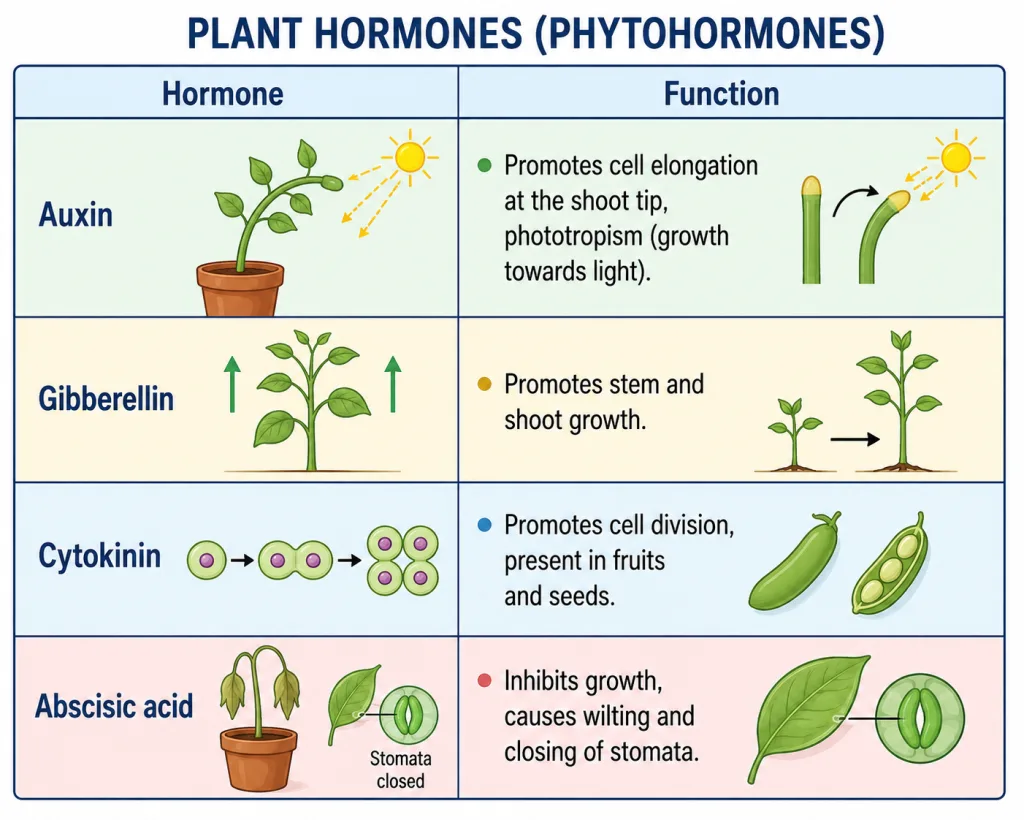
The 5 Main Plant Hormones
1. Auxin
'Auxin' = main growth-promoting hormone in plants.
Where Made: tips of stems, roots, young leaves. Main Function: cell elongation.
Effects: 1. Stem elongation — cells grow longer. 2. Phototropism — moves to shaded side, causes bending. 3. Apical dominance — main stem grows, side branches suppressed. 4. Root initiation — used to grow new roots from cuttings. 5. Fruit growth (in some plants).
Discovered by Charles Darwin (1880) in his classic experiment.
2. Gibberellin
Promotes stem elongation and other functions.
Where Made: young leaves, seeds.
Effects: 1. Stem elongation — internodes grow longer (taller plant). 2. Seed germination — wakes up dormant seeds. 3. Fruit growth — bigger fruits (e.g., grapes). 4. Flowering — induces flowering in some plants. 5. Bolting — induces stem elongation in rosette plants.
Practical use: increase yield in agriculture.
3. Cytokinin
Promotes cell division and growth in young tissues.
Where Made: roots (from where it travels to other parts).
Effects: 1. Cell division — promotes mitosis. 2. Growth in fruits — particularly young fruits. 3. Delays ageing of leaves. 4. Bud formation — encourages lateral buds. 5. Tissue culture — used to grow plants from cells in lab.
Often works together with auxin.
4. Abscisic Acid (ABA)
Growth inhibitor — opposite of auxin/gibberellin.
Where Made: mature leaves, roots.
Effects: 1. Closes stomata — when plant lacks water (drought). 2. Seed dormancy — keeps seeds 'asleep'. 3. Inhibits growth — slows down activities. 4. Leaf fall (abscission) — promotes shedding of leaves in autumn. 5. Stress response — helps plant survive drought.
'Stress hormone' of plants.
5. Ethylene
A gas — unique because it's gaseous. Easily diffuses through plant.
Where Made: ripening fruits, ageing tissues.
Effects: 1. Fruit ripening — main role! 2. Leaf fall — works with ABA. 3. Flower opening. 4. Stress response.
Why bananas ripen faster when stored together: they release ethylene which speeds up ripening of nearby fruits!
Quick Summary Table
| Hormone | Main Function |
|---|---|
| Auxin | Cell elongation, phototropism |
| Gibberellin | Stem elongation, germination |
| Cytokinin | Cell division, fruit growth |
| Abscisic Acid | Inhibitor, stomata closing |
| Ethylene | Fruit ripening (gas) |
[NCERT — important]
How Auxin Works in Phototropism
Most famous role of auxin.
Charles Darwin's Experiment (1880)
Classic experiment that started everything:
1. Grass seedlings placed near light. 2. Three setups:
- Normal seedlings: bend toward light.
- Tip cut off: no bending.
- Tip covered with cap: no bending.
- Base covered (tip exposed): still bends. 3. Conclusion: tip senses light.
Later research showed auxin made in tip moves to shaded side → causes bending.
Auxin Distribution and Bending
   Light →
        |
  TIP (auxin made here)
        |
        | * (less auxin)
        | ** (more auxin, on shaded side)
        | *** (lots of auxin, lots of growth)
        | bend toward light
1. Tip senses light. 2. Auxin moves AWAY from light → to shaded side. 3. Cells with more auxin grow longer. 4. Stem bends toward light.
Auxin in Roots — The Reverse
In roots, auxin behaves OPPOSITE: High auxin → INHIBITS root cell elongation.
If root is laid horizontally: Gravity pulls auxin to lower side. Lower side has more auxin → grows LESS. Upper side grows more. Root bends downward.
Same hormone, opposite effects in roots vs stems!
Practical Applications of Plant Hormones
1. Rooting Powder: Synthetic auxin (e.g., IBA, NAA). Apply to cut stem ends → encourages root formation. Used to grow new plants from cuttings.
2. Fruit Ripening: Ethylene used to ripen unripe fruits. Bananas, mangoes ripened in ethylene chambers. Why supermarkets get fruits 'ready'.
3. Seed Germination: Gibberellin sprayed on seeds → wakes them up. Better crop emergence.
4. Bigger Fruits: Gibberellin sprays → larger grapes, oranges.
5. Weed Killers (Herbicides): Synthetic auxins (2,4-D) — overdose kills weeds. Selectively kills broadleaf weeds in cereal crops.
6. Tissue Culture: Auxin + cytokinin in right ratio → grow new plants from single cells. Important in horticulture, conservation.
Bonus: Hormones Are Regulators
Plant hormones don't 'do' things — they regulate. Small amounts have big effects. Concentration matters more than total amount.
[NCERT, JEE/NEET — important]
Memory Capsule — Section 5
Quick revision of plant hormones.
5 Plant Hormones (Must Know!)
| Hormone | Function | Example/Use |
|---|---|---|
| Auxin | Cell elongation, phototropism | Rooting from cuttings |
| Gibberellin | Stem elongation, germination | Bigger grapes |
| Cytokinin | Cell division, fruit growth | Tissue culture |
| Abscisic Acid | Stress, stomata closing | Drought response |
| Ethylene | Fruit ripening (gas) | Banana ripening |
Auxin in Phototropism
1. Tip senses light. 2. Auxin moves to SHADED side. 3. More auxin → cells elongate more. 4. Stem bends TOWARD light.
In Roots
High auxin → INHIBITS root growth. Hence roots show different behaviour — bend AWAY from auxin.
Practical Uses
1. Rooting hormone — synthetic auxin. 2. Fruit ripening — ethylene. 3. Seed germination — gibberellin. 4. Weed killers — synthetic auxin (2,4-D). 5. Tissue culture — auxin + cytokinin.
Discovery Highlight
Darwin (1880) discovered auxin via grass seedling experiments. Tip senses light → auxin moves → bending.
Special Features
1. Ethylene is a gas — unique! 2. Abscisic acid is inhibitor — opposite of auxin. 3. Same hormone, different effects in stems vs roots (auxin).
One-Liner Insights
1. Auxin = growth + bending. 2. Gibberellin = bigger plants. 3. Cytokinin = more cells. 4. ABA = stress + dormancy. 5. Ethylene = ripens fruits (gas).
Comparison: Plant vs Animal Hormones
| Plant | Animal |
|---|---|
| No specific glands | Specific endocrine glands |
| Move via tissue | Move via blood |
| Effects on growth | Effects on metabolism |
| 5 main types | Many types |
[Quick reference!]
Example 1: NCERT — Plant Hormones
Name the 5 main plant hormones. State the function of each.
Solution:
5 Main Plant Hormones
1. Auxin: Functions:
- Promotes cell elongation in stems.
- Causes phototropism (bending toward light).
- Apical dominance (main stem grows, side branches suppressed).
- Promotes rooting in cuttings.
Example: makes stems grow taller toward light.
2. Gibberellin: Functions:
- Stem elongation (internodes grow).
- Seed germination (wakes seeds).
- Promotes flowering in some plants.
- Increases fruit size.
Example: makes plants grow taller, bigger grapes.
3. Cytokinin: Functions:
- Promotes cell division.
- Growth in fruits.
- Delays ageing of leaves.
- Used in tissue culture.
Example: keeps fruits/leaves growing.
4. Abscisic Acid (ABA): Functions:
- Growth inhibitor (opposite of auxin).
- Closes stomata during drought.
- Maintains seed dormancy.
- Promotes leaf fall (abscission).
Example: helps plants survive drought.
5. Ethylene: Functions:
- Promotes fruit ripening (main role).
- Promotes leaf fall.
- A gas — diffuses through plant.
Example: ripens unripe bananas/mangoes.
Quick Summary
| Hormone | Effect |
|---|---|
| Auxin | Growth/elongation, phototropism |
| Gibberellin | Tall plants, germination |
| Cytokinin | Cell division, fruit growth |
| ABA | Inhibits, stress response |
| Ethylene | Ripens fruits |
Why Plants Have These Hormones
1. Coordinate growth. 2. Respond to environment. 3. Survive stress. 4. Reproduce.
All without nervous system!
Plants are masters of chemical signalling.
[NCERT — must know]
Example 2: NCERT — Auxin and Phototropism
How does auxin cause phototropism? Describe Darwin's experiment.
Solution:
Darwin's Experiment (1880)
Charles Darwin and son Francis studied grass seedlings:
Setup 1: Normal seedlings Light from one side → seedlings bent toward light. (Control)
Setup 2: Tip cut off Tip of seedling removed → NO bending. Conclusion: tip is important.
Setup 3: Tip covered with cap Tip covered (light blocked) → NO bending. Confirms: tip senses light.
Setup 4: Base covered Tip exposed, base covered → bending occurred normally. Confirms: only tip needs to see light.
Conclusion: 'something' produced in tip causes bending. Later identified as auxin.
How Auxin Causes Phototropism
Step 1: Light sensing Tip of stem senses light direction.
Step 2: Auxin movement Auxin moves from lit side to shaded side.
Step 3: Cell elongation Cells with more auxin elongate MORE. Shaded side has more auxin → cells grow longer there.
Step 4: Bending Longer cells on shaded side push the stem. Stem bends TOWARD light.
Diagram
Light →
        ⬇
     STEM TIP
     (auxin made)
        ⬇
   __________
   | low auxin (lit side)
   |     ↑ light
   __________
   | high auxin (shaded side)
   | cells longer
   __________
   bend toward light
Why Plants Need This
1. Light is essential for photosynthesis — without it, plant dies. 2. Bending toward light = maximum sunlight absorbed. 3. Better food production. 4. Survival in shaded environments.
Roots Are Different
In roots, auxin INHIBITS growth. If light hits root from one side: Auxin moves to shaded side. Shaded side grows LESS (auxin inhibits). Root bends AWAY from light.
Negative phototropism in roots.
Modern Confirmation
Synthetic auxins applied artificially confirm Darwin's findings. Auxin = growth-promoting hormone in stems. Auxin = growth-inhibiting in roots.
[NCERT — Board favourite]
Example 3: Application — Why Bananas Ripen Faster Together
Why do bananas (or other fruits) ripen faster when stored together?
Solution:
The Phenomenon
Fruits stored together ripen faster than alone. Especially if one is already ripening.
Reason: Ethylene
Ethylene is a plant hormone — and a gas. Ripening fruits release ethylene. Ethylene speeds up ripening in nearby fruits.
How It Works
Step 1: One banana starts to ripen. Step 2: It releases ethylene gas. Step 3: Ethylene reaches other bananas. Step 4: They start ripening too. Step 5: They release more ethylene. Step 6: Cascade — all bananas ripen rapidly.
Result: bunch ripens together.
Why is Ethylene Effective?
Ethylene triggers: 1. Cell wall softening — fruit becomes soft. 2. Starch → sugar conversion — fruit becomes sweet. 3. Chlorophyll breakdown — green → yellow/red. 4. Aroma development — fruit smells ripe.
Hence: smaller, harder fruit → larger, softer, sweeter, fragrant.
Practical Uses
1. Ripening rooms: Commercial fruit ripeners (like at supermarket). Unripe fruits placed in ethylene chambers. Ripen in days.
2. Brown paper bag trick: Put unripe fruit in paper bag. Add a ripe banana or apple. Bag traps ethylene → faster ripening.
3. Avoid ethylene damage: Don't store some fruits with bananas/apples. Cucumbers, leafy greens, broccoli are sensitive. Will spoil faster from ethylene exposure.
Negative Side
Ethylene also causes: 1. Wilting of cut flowers. 2. Spoilage of vegetables. 3. Yellowing of leaves.
Hence: Florists avoid storing flowers with fruits. Vegetables stored separately from fruits.
Why Ethylene is Unique
Among plant hormones, ethylene is the only gas. Easily diffuses through air → affects nearby plants. This explains why fruits ripen 'in waves' in nature.
Real-Life Application
Indian markets and farmers: Use ethylene (or chemicals like calcium carbide that release acetylene) to ripen fruits artificially. WARNING: calcium carbide is harmful — causes health issues. Government banned it. Better methods: ethylene gas in controlled chambers.
This is why organically ripened fruits taste better — slowly ripened with natural ethylene.
[Application — Real life]
Example 4: Synthesis Question
(a) Compare growth-promoting and growth-inhibiting plant hormones. (b) How does abscisic acid help plants survive drought? (c) List 5 practical applications of plant hormones.
Solution:
(a) Growth-Promoting vs Growth-Inhibiting Hormones
Growth-Promoting Hormones:
1. Auxin — cell elongation. 2. Gibberellin — stem elongation, germination. 3. Cytokinin — cell division.
Together: make plants grow bigger, faster.
Growth-Inhibiting Hormone:
1. Abscisic Acid (ABA) — opposite of growth promoters.
Sometimes: Ethylene also acts as inhibitor in some contexts.
Comparison
| Aspect | Growth-Promoting | Growth-Inhibiting |
|---|---|---|
| Examples | Auxin, gibberellin, cytokinin | ABA |
| Effects | Cells grow, divide | Cells stop, slow |
| When active | Normal growth | Stress, dormancy |
| Plant condition | Healthy | Stressed, sleeping |
How They Work Together
A plant doesn't always grow. Sometimes it needs to stop (winter, drought, seed dormancy). Hence balance of promoters vs inhibitors.
Example: when conditions are good → auxin/gibberellin high, plant grows. When stress hits → ABA high, growth slows.
This balance is crucial for survival!
(b) Abscisic Acid in Drought
ABA = 'stress hormone' of plants.
During drought:
1. Plant detects water shortage (low water in cells). 2. ABA produced in roots. 3. ABA travels via xylem to leaves. 4. ABA acts on guard cells of stomata. 5. Guard cells lose water → become flaccid → close stomata. 6. Less water lost via transpiration. 7. Plant survives drought.
Without ABA: plant would lose all water → die.
Other ABA effects in drought: 1. Slows growth (saves energy). 2. Causes leaf shedding (less surface area). 3. Promotes seed dormancy (waits for rain).
ABA is the plant's emergency manager!
(c) 5 Practical Applications
1. Rooting Hormone: Synthetic auxin (IBA, NAA) applied to cut stem ends. Promotes root formation. Used to grow new plants from cuttings. Important in horticulture, gardening.
2. Fruit Ripening: Ethylene used in commercial fruit ripening chambers. Bananas, mangoes, tomatoes ripened on demand. Provides ripe fruits year-round.
3. Bigger Fruits: Gibberellin sprays on grape, orange, apple. Result: larger fruits, higher yield. Used in commercial farming.
4. Weed Killing: Synthetic auxins (e.g., 2,4-D). Overdose disrupts weed growth. Selective: kills broadleaf weeds, spares cereal crops. Used in agriculture.
5. Tissue Culture: Auxin + cytokinin in right ratios. Grow whole plants from single cells in lab. Used in:
- Mass production of identical plants.
- Conservation of rare species.
- Disease-free planting material.
- Genetic engineering.
Other Applications
6. Seed treatment: Gibberellin → faster germination. Better crop establishment.
7. Flower induction: Some hormones induce flowering. Used in cut-flower industry.
8. Storage of fruits: Inhibitors used to delay ripening during transport.
Importance
Plant hormones = backbone of modern agriculture. Increase yield, improve quality, save resources. Indian farmers benefit from these technologies.
A small amount of hormone — big impact on food production!
[Board: 5-mark synthesis]