
Feedback Mechanisms — Body's Self-Regulation
The body needs to keep hormone levels just right — not too high, not too low. How does it do this?
Through feedback mechanisms.
Definition
'Feedback mechanism' = a self-regulating process where the output of a system controls its own input.
Like a thermostat in a room: Temperature too high → AC turns on → cools room → AC turns off.
Body uses similar 'feedback' to control hormones.
Two Types
1. Negative Feedback (Most Common): Reduces the output to maintain balance. 'When too much, decrease.' Used by most hormones.
2. Positive Feedback (Rare): Amplifies the output. 'When some, more.' Used in specific situations like childbirth.
Negative Feedback — Most Important
Most body systems use negative feedback for stability.
General Pattern: 1. Stimulus → hormone released. 2. Hormone causes effect. 3. Effect reduces the original stimulus. 4. Less stimulus → less hormone. 5. Balance maintained.
This keeps things stable.
Example 1: Insulin and Blood Sugar
Famous example of negative feedback.
Steps:
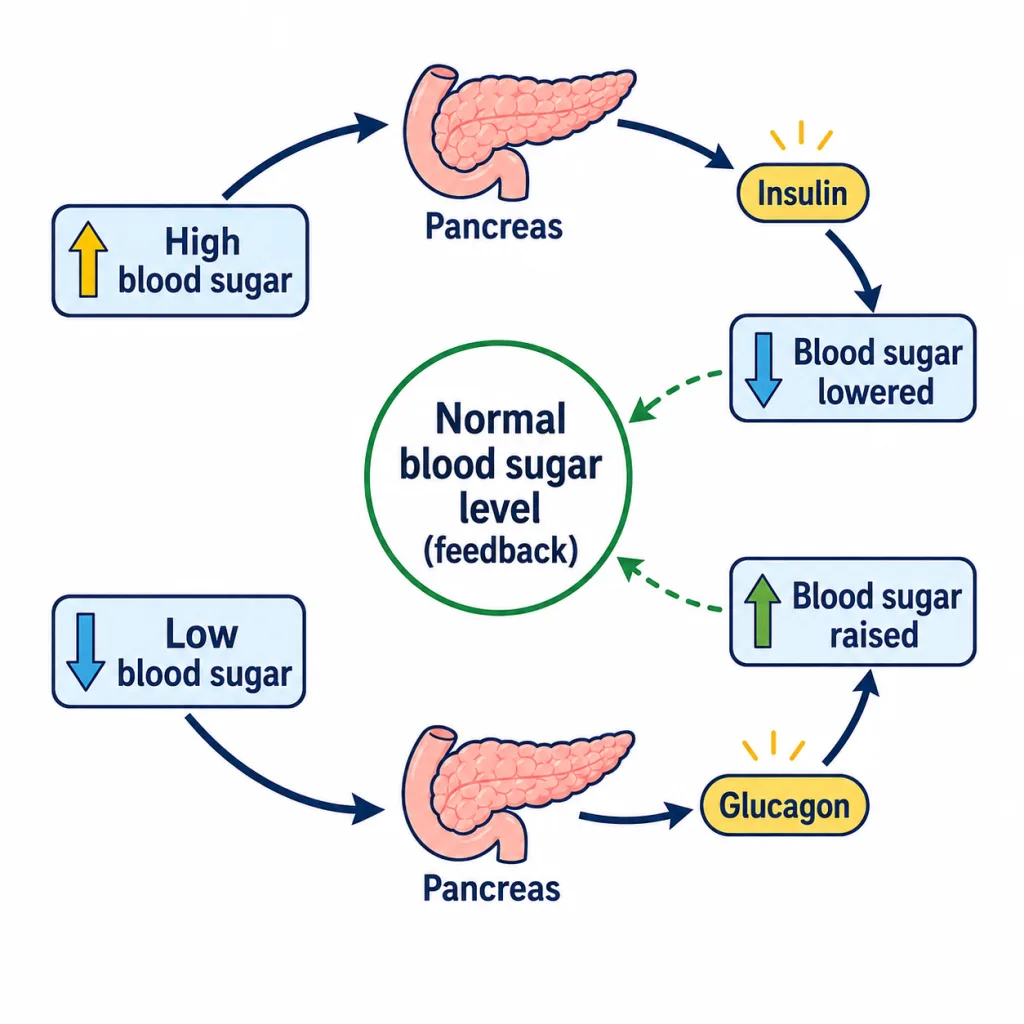
1. Stimulus: Eat meal → blood sugar rises. 2. Sensor: Pancreas detects high sugar. 3. Response: Releases insulin. 4. Effect: Insulin makes cells take up glucose. 5. Reduction: Blood sugar falls. 6. Negative feedback: Pancreas detects lower sugar → stops insulin release.
This loop keeps blood sugar around 70-110 mg/dL.
Example 2: Thyroid Hormone Regulation
1. Hypothalamus detects need for thyroxine. 2. Sends TRH (thyroid releasing hormone) to pituitary. 3. Pituitary releases TSH (thyroid stimulating hormone). 4. TSH stimulates thyroid → produces thyroxine. 5. Thyroxine acts on body cells (increases metabolism). 6. Negative feedback: High thyroxine → tells hypothalamus to slow down. 7. Less TRH → less TSH → less thyroxine. 8. Levels stabilise.
Brilliant self-regulation!
Why Feedback is Essential
Without feedback: 1. Hormone levels would go too high or too low. 2. Body chemistry would be chaotic. 3. Diseases would result.
With feedback: 1. Stability maintained. 2. Homeostasis achieved. 3. Health preserved.
Homeostasis
'Homeostasis' = maintaining stable internal environment. Body keeps things constant:
- Body temperature: 37°C.
- Blood sugar: 70-110 mg/dL.
- pH: 7.35-7.45.
- Water-salt balance.
All through feedback mechanisms!
Hormones are key players in homeostasis.
[NCERT — important concept]
Major Hormonal Disorders
When feedback fails, or hormones are out of balance, diseases result. Let's look at common hormonal disorders.
1. Diabetes Mellitus
'Sweet disease' (sugar in urine). Caused by insulin problems.
Type 1 Diabetes: Pancreas can't make insulin. Cause: autoimmune destruction of beta cells. Onset: usually in children. Treatment: insulin injections for life.
Type 2 Diabetes: Cells don't respond well to insulin. Cause: lifestyle (obesity, lack of exercise) + genetics. Onset: usually adults. Treatment: diet, exercise, medications.
Symptoms: 1. Frequent urination. 2. Excessive thirst. 3. Excessive hunger. 4. Weight loss. 5. Fatigue. 6. Glucose in urine.
Long-term effects: heart disease, blindness, kidney failure, amputations.
2. Goitre
Enlarged thyroid gland. Cause: iodine deficiency → thyroid can't make thyroxine → enlarges trying.
Symptoms: visible neck swelling. Prevention: iodised salt. Common in: iodine-deficient regions of India (Himalayan, hilly).
3. Hypothyroidism
Low thyroxine. Cause: thyroid problems, iodine deficiency, autoimmune disease.
Symptoms: 1. Fatigue, weakness. 2. Weight gain. 3. Cold sensitivity. 4. Slow heart rate. 5. Depression. 6. Dry skin, hair loss.
Treatment: synthetic thyroxine pills.
4. Hyperthyroidism
Too much thyroxine. Cause: Graves' disease, thyroid tumour.
Symptoms: 1. Weight loss (despite eating). 2. Fast heart rate. 3. Heat intolerance. 4. Anxiety, hyperactivity. 5. Bulging eyes (Graves'). 6. Tremors.
Treatment: medications, surgery, radioactive iodine.
5. Cretinism
Severe iodine/thyroxine deficiency in children. Causes: stunted growth, mental retardation, permanent damage. Prevention: ensure iodine in pregnancy and childhood.
6. Dwarfism
Caused by: Low growth hormone in childhood. Result: very short stature. Treatment: GH injections.
7. Gigantism / Acromegaly
Gigantism: Excess GH in childhood → very tall. Acromegaly: Excess GH in adulthood → enlarged hands, feet, face. Both due to pituitary tumour usually.
8. Diabetes Insipidus
Different from diabetes mellitus! Cause: low ADH (anti-diuretic hormone). Symptoms: excessive urine, severe thirst. Treatment: synthetic ADH.
Summary Table
| Disorder | Cause | Symptoms |
|---|---|---|
| Diabetes mellitus | Low insulin / resistance | High blood sugar |
| Goitre | Iodine deficiency | Neck swelling |
| Hypothyroidism | Low thyroxine | Tired, weight gain |
| Hyperthyroidism | High thyroxine | Weight loss, anxiety |
| Cretinism | Iodine deficiency in children | Stunted, retarded |
| Dwarfism | Low GH in childhood | Short stature |
| Gigantism | High GH in childhood | Very tall |
| Acromegaly | High GH in adults | Enlarged hands/feet |
[NCERT — important]
Memory Capsule — Section 8
Quick revision of feedback mechanisms and disorders.
Feedback Mechanisms
Body's self-regulation of hormones. Maintains balance (homeostasis).
Two Types: 1. Negative feedback (most common) — reduces output. 2. Positive feedback (rare) — amplifies output.
Insulin Feedback (Example)
Eat → Sugar up → Pancreas makes insulin → Cells take sugar → Sugar normal → Pancreas stops insulin.
Loop maintains blood sugar 70-110 mg/dL.
Thyroid Feedback (Example)
Low thyroxine → hypothalamus → pituitary releases TSH → thyroid makes thyroxine → high thyroxine → hypothalamus stops → balance maintained.
Major Disorders
1. Diabetes Mellitus:
- Cause: insulin problem.
- Symptoms: high blood sugar, frequent urination.
2. Goitre:
- Cause: iodine deficiency.
- Symptoms: enlarged thyroid (neck swelling).
3. Cretinism:
- Cause: iodine deficiency in children.
- Symptoms: stunted, mental retardation.
4. Dwarfism:
- Cause: low growth hormone in childhood.
- Symptoms: short stature.
5. Gigantism / Acromegaly:
- Cause: high growth hormone.
- Symptoms: very tall (gigantism, children) or enlarged hands/feet (acromegaly, adults).
6. Hyperthyroidism:
- Cause: high thyroxine.
- Symptoms: weight loss, fast heart, anxiety.
7. Hypothyroidism:
- Cause: low thyroxine.
- Symptoms: tired, weight gain, cold sensitivity.
Prevention Tips
1. Iodised salt → prevents goitre, cretinism. 2. Healthy diet → prevents type 2 diabetes. 3. Regular exercise → maintains insulin sensitivity. 4. Stress management → prevents adrenal issues. 5. Regular check-ups → catch problems early. 6. Adequate sleep → maintains hormone balance.
Why Hormonal Disorders Matter
Hormones control: 1. Growth. 2. Metabolism. 3. Reproduction. 4. Stress response. 5. Mood.
Imbalance affects ALL of these. Hence proper diagnosis + treatment is critical.
One-Liner Insights
1. Feedback = self-regulation. 2. Negative feedback = most common (stability). 3. Diabetes = sugar problem (insulin). 4. Goitre = iodine deficiency. 5. Cretinism = iodine deficiency in children. 6. Dwarfism = low GH; gigantism = high GH (childhood). 7. Iodised salt prevents goitre (simple solution).
[Last-minute revision card!]
Example 1: NCERT — Feedback Mechanism
What is a feedback mechanism? Explain with the example of blood sugar regulation.
Solution:
Definition
'Feedback mechanism' = a process where the output of a system controls its own input, maintaining balance.
Like a thermostat in your AC — when room is cold enough, it turns off.
Two Types
Negative Feedback: Output reduces input. Most common in body. Maintains balance.
Positive Feedback: Output amplifies input. Used in specific situations (childbirth, blood clotting).
Blood Sugar Regulation Example
Body keeps blood sugar at 70-110 mg/dL through negative feedback.
When Blood Sugar Rises (after meal):
Step 1: You eat food → digested → glucose enters blood. Step 2: Blood sugar rises (e.g., to 150 mg/dL). Step 3: Pancreas detects high sugar. Step 4: Pancreas releases insulin into blood. Step 5: Insulin acts on:
- Liver: stores glucose as glycogen.
- Muscles: take up glucose for energy.
- Fat cells: store glucose as fat. Step 6: Blood sugar falls back to normal. Step 7: Negative feedback: Pancreas detects normal sugar → stops insulin release.
When Blood Sugar Falls (between meals):
Step 1: You haven't eaten → blood sugar drops. Step 2: Pancreas detects low sugar. Step 3: Pancreas releases glucagon. Step 4: Glucagon acts on liver:
- Breaks down glycogen → glucose.
- Releases glucose into blood. Step 5: Blood sugar rises back to normal. Step 6: Pancreas stops glucagon release.
How Insulin and Glucagon Work Together
Insulin and glucagon are opposite — work together to balance.
| Stimulus | Hormone | Effect |
|---|---|---|
| High sugar | Insulin | Lowers sugar |
| Low sugar | Glucagon | Raises sugar |
Like two opposing forces keeping balance.
Why This is Important
Without feedback: 1. Sugar would go too high → damages organs (diabetes complications). 2. Sugar would go too low → brain starves (hypoglycemia).
With feedback: 1. Sugar stays in safe range. 2. Brain has constant glucose supply. 3. Body functions normally.
When Feedback Fails
Type 1 Diabetes: Pancreas can't make insulin. Sugar stays high after meals. Need insulin injections.
Type 2 Diabetes: Cells don't respond to insulin. Insulin levels may be normal but ineffective. Sugar stays high.
Hypoglycemia: Too much insulin (or insulin overdose). Sugar drops too low. Symptoms: dizziness, sweating, confusion, coma.
Bigger Picture
Feedback mechanisms are nature's way of: 1. Maintaining stability. 2. Adapting to changes. 3. Keeping body healthy.
Hormones + feedback = perfect balance.
Truly elegant biology!
[NCERT — important]
Example 2: Application — Diabetes
A person notices: frequent urination, excessive thirst, weight loss despite eating well. What might be the disease? How is it caused, and how can it be managed?
Solution:
Likely Disease: Diabetes Mellitus
Symptoms match perfectly: 1. Frequent urination (polyuria) — high sugar in urine pulls water out. 2. Excessive thirst (polydipsia) — body trying to compensate for water loss. 3. Weight loss despite eating — body can't use glucose, breaks down fats and proteins. 4. Excessive hunger (polyphagia) — cells starved of energy. 5. Fatigue — cells can't get glucose for energy.
Cause
Diabetes mellitus = high blood sugar due to insulin problems.
Two Types:
Type 1 (Insulin Dependent): Beta cells of pancreas destroyed (autoimmune). No insulin produced. Usually starts in children/young adults. Need insulin injections.
Type 2 (Insulin Resistant): Pancreas makes insulin, but cells don't respond well. Usually adults, often associated with obesity. Most common type (90%+). Risk factors:
- Obesity.
- Sedentary lifestyle.
- Family history.
- Age.
- Stress.
Diagnosis
Tests: 1. Fasting blood sugar > 126 mg/dL = diabetes. 2. Random blood sugar > 200 mg/dL = diabetes. 3. HbA1c > 6.5% = diabetes. 4. Urine test — glucose detected.
Management
For Type 1: 1. Insulin injections — multiple times daily. 2. Diet management — match insulin to food intake. 3. Blood sugar monitoring — many times daily. 4. Exercise — improves insulin action.
For Type 2: *1. Diet:
- Less sugar, refined carbs.
- More fibre, vegetables.
- Smaller portions. 2. Exercise: at least 30 min, 5 days/week. 3. Weight loss if overweight. *4. Medications:
- Metformin (most common).
- Other oral drugs.
- Insulin (if needed). 5. Blood sugar monitoring. 6. Stress management.
Long-term Management
Goal: keep blood sugar near normal.
Why? Long-term complications: 1. Heart disease — leading cause of death in diabetics. 2. Kidney damage — diabetic nephropathy → dialysis. 3. Eye damage — diabetic retinopathy → blindness. 4. Nerve damage — neuropathy (numbness, pain). 5. Foot problems — non-healing wounds, amputations. 6. Gum disease. 7. Increased infections.
Good control prevents most complications.
Prevention (Type 2)
1. Healthy weight — avoid obesity. 2. Active lifestyle — exercise daily. *3. Healthy diet:
- Low refined sugar.
- Whole grains.
- Vegetables, fruits.
- Limit saturated fats. 4. Limit alcohol. 5. Don't smoke. 6. Manage stress. 7. Regular check-ups especially after 40.
India's Diabetes Crisis
1. ~10 crore Indians have diabetes (rising). 2. India = 'diabetes capital of the world'. 3. Why?
- Genetic predisposition (Indians more prone).
- Western diet adoption.
- Sedentary jobs (IT, desk work).
- Stress.
- Poor early detection. 4. Solution: lifestyle changes + early screening.
Real-Life Tip
If you have any of the symptoms or family history: 1. Get blood sugar tested. 2. Adopt healthy lifestyle. 3. Don't ignore — early action prevents complications.
Diabetes is manageable but takes consistent effort.
[Application — Real life]
Example 3: NCERT — Goitre and Iodised Salt
What is goitre? How does iodised salt help prevent it?
Solution:
Goitre
'Goitre' = enlarged thyroid gland (visible swelling in front of neck).
Cause
Caused by iodine deficiency:
Step 1: Diet has insufficient iodine. Step 2: Thyroid gland needs iodine to make thyroxine. Step 3: Without iodine, thyroid can't make enough thyroxine. Step 4: Pituitary detects low thyroxine. Step 5: Pituitary releases more TSH. Step 6: TSH stimulates thyroid to work harder. Step 7: Thyroid grows (enlarges) trying to make thyroxine. Step 8: Visible swelling = goitre.
Negative feedback gone wrong (because raw material is missing).
Symptoms
Physical: 1. Visible neck swelling. 2. Sometimes difficulty swallowing. 3. Pressure feeling in neck.
Hormonal (low thyroxine - hypothyroidism): 1. Fatigue, weakness. 2. Weight gain (slow metabolism). 3. Cold sensitivity. 4. Slow heart rate. 5. Memory problems. 6. Constipation. 7. Dry skin, hair loss.
In Children (Cretinism): 1. Stunted growth. 2. Mental retardation. 3. Permanent damage.
Iodised Salt — The Solution
'Iodised salt' = common salt fortified with iodine compounds.
Indian government adds: 1. Potassium iodate (KIO₃). 2. ~30 ppm of iodine. 3. Mandatory in all packaged salt sold in India.
How Iodised Salt Helps
Step 1: People consume salt daily (in food). Step 2: Iodine from salt enters body. Step 3: Thyroid uses iodine to make thyroxine. Step 4: Thyroxine production normal. Step 5: No need for thyroid to enlarge. Step 6: Goitre prevented.
Simple, effective, life-saving.
Why Salt is Best Choice
1. Universal use — everyone consumes salt. 2. Daily intake — small but regular. 3. Cheap — minimal cost increase. 4. Easy mass distribution — salt already a commodity. 5. No special effort — consumer doesn't change behaviour. 6. Government can mandate — through law.
Indian Iodisation Program
1. Started: 1962 (Goitre Control Programme). 2. Scaled up: 1986 (Universal Salt Iodisation). 3. Mandatory: 1992 (all packaged salt must be iodised). 4. NIDDCP: National Iodine Deficiency Disorders Control Programme.
Impact
Before: ~70% Indians at risk of iodine deficiency. Common goitre, cretinism in some areas.
After: Goitre prevalence dropped dramatically. Children's IQ improved. Public health success.
Other Sources of Iodine
1. Iodised salt (main source). 2. Seafood — fish, shrimp. 3. Seaweed — high in iodine. 4. Eggs. 5. Dairy products. 6. Iodine supplements (only on doctor's advice).
Hyperthyroidism (Opposite Problem)
Some have TOO MUCH thyroxine (Graves' disease). Symptoms: 1. Weight loss. 2. Fast heart rate. 3. Heat intolerance. 4. Anxiety. 5. Bulging eyes.
Treatment: medication, sometimes surgery.
Public Health Lesson
Iodised salt is one of the most successful public health interventions in history. Cheap, easy, universal — saves millions from preventable disease.
Other examples of similar interventions: 1. Vitamin D in milk. 2. Folic acid in flour. 3. Vaccinations.
Small action, big impact!
[NCERT — Real life application]
Example 4: Synthesis — Comprehensive
(a) Explain negative feedback with an example. (b) Compare diabetes mellitus and diabetes insipidus. (c) List 5 hormonal disorders and their causes.
Solution:
(a) Negative Feedback
Most hormones use negative feedback to maintain balance.
Example: Thyroid Regulation
Body keeps thyroxine at right level via this feedback loop:
Step 1: Hypothalamus monitors thyroxine in blood. Step 2: If thyroxine LOW:
- Hypothalamus releases TRH (thyroid releasing hormone).
- TRH goes to pituitary. Step 3: Pituitary releases TSH (thyroid stimulating hormone). Step 4: TSH reaches thyroid → stimulates thyroxine production. Step 5: Thyroid makes thyroxine. Step 6: Thyroxine acts on body cells (increases metabolism). Step 7: Thyroxine level RISES. Step 8: Hypothalamus detects high thyroxine. Step 9: Negative feedback: Hypothalamus reduces TRH. Step 10: Less TRH → less TSH → less thyroxine production. Step 11: Thyroxine returns to normal.
Loop maintains stable thyroxine level.
Key Principle
'Output reduces its own production.'
Like a thermostat: Room hot → AC turns on → cools → AC turns off.
Body uses this for many systems: 1. Thyroxine. 2. Insulin/Blood sugar. 3. Stress hormones (cortisol). 4. Sex hormones (cyclic). 5. Body temperature.
Positive Feedback (Rare)
Output amplifies itself.
Examples: 1. Childbirth: Oxytocin → contractions → more oxytocin → stronger contractions → birth. 2. Blood clotting: Initial clot → triggers more clotting → seals wound.
Used when an end-state is needed quickly.
(b) Diabetes Mellitus vs Diabetes Insipidus
Both have 'diabetes' (Greek: 'siphon') — meaning excess urination. But VERY different diseases.
Diabetes Mellitus ('Sugar Diabetes'): 1. Cause: insulin problem. 2. Hormone affected: insulin (from pancreas). 3. Mechanism: high blood sugar → sugar in urine → pulls water out. 4. Urine: contains sugar (sweet — 'mellitus' means sweet). 5. Symptoms: high blood sugar, frequent urination, thirst, weight loss. 6. Treatment: insulin, diet, exercise. 7. Most common (~95% of 'diabetes' cases).
Diabetes Insipidus ('Tasteless Diabetes'): 1. Cause: ADH problem (low or kidney doesn't respond). 2. Hormone affected: ADH (from pituitary). 3. Mechanism: kidneys don't reabsorb water → excess urine. 4. Urine: NO sugar (tasteless — 'insipidus' means tasteless). 5. Symptoms: extremely frequent urination, severe thirst. 6. Treatment: synthetic ADH (vasopressin). 7. Rare.
Comparison Table
| Aspect | Diabetes Mellitus | Diabetes Insipidus |
|---|---|---|
| Cause | Insulin problem | ADH problem |
| Gland | Pancreas | Pituitary |
| Sugar in urine? | Yes | No |
| Blood sugar | High | Normal |
| Urine volume | High | VERY high |
| Frequency | Common | Rare |
Both cause excess urine, but for different reasons!
(c) 5 Hormonal Disorders
1. Diabetes Mellitus: Cause: insulin deficiency or resistance. Symptoms: high blood sugar, frequent urination, thirst. Affects: ~10 crore Indians.
2. Goitre: Cause: iodine deficiency. Symptoms: enlarged thyroid (neck swelling). Prevention: iodised salt.
3. Cretinism: Cause: iodine deficiency in children. Symptoms: stunted growth, mental retardation. Prevention: ensure iodine in pregnancy/childhood.
4. Dwarfism: Cause: low growth hormone (GH) in childhood. Symptoms: very short stature. Treatment: GH injections in childhood.
5. Hyperthyroidism (Graves' disease): Cause: too much thyroxine. Symptoms: weight loss, fast heart, anxiety, bulging eyes. Treatment: medication, surgery.
Other Disorders
6. Hypothyroidism: low thyroxine — fatigue, weight gain, cold intolerance. 7. Gigantism/Acromegaly: excess GH — very tall (childhood) or enlarged hands/feet (adult). 8. Diabetes Insipidus: low ADH — excessive urine. 9. Cushing's syndrome: excess cortisol — weight gain, weak bones. 10. Addison's disease: low cortisol — fatigue, low BP.
Importance of Awareness
1. Many disorders are treatable if caught early. 2. Some prevention is easy (iodised salt, healthy lifestyle). 3. Don't ignore symptoms — see doctor. 4. Hormonal balance = good health.
Hormones rule our lives — keep them in balance!
[Board: 5-mark synthesis]