
Hormones in Animals
Apart from the nervous system, animals (including humans) have another coordination system — the endocrine system, which uses hormones.
Definition
'Hormones' = chemical messengers produced by endocrine glands that travel via blood to specific target organs and regulate body functions.
From Greek 'hormao' = to set in motion.
Key Properties of Hormones
1. Chemical messengers — not electrical. 2. Made in glands — specific organs. 3. Travel in blood — reach far parts. 4. Act on target organs — only specific cells respond. 5. Active in tiny amounts — small doses, big effects. 6. Have specific effects — each hormone has unique role. 7. Slow but long-lasting — effects continue.
How Hormones Work
Step 1: Endocrine gland makes hormone. Step 2: Hormone enters blood. Step 3: Blood carries hormone everywhere. Step 4: Only target cells (with specific receptors) respond. Step 5: Hormone causes specific effect. Step 6: Effect lasts until hormone is broken down.
Endocrine vs Exocrine Glands
Endocrine Glands: 'Endo' = inside. 'Ductless' — no tubes/ducts. Hormones go directly into blood. Examples: pituitary, thyroid, pancreas, adrenal.
Exocrine Glands: 'Exo' = outside. Have ducts/tubes. Secretion goes through ducts to a specific place. Examples: salivary glands (saliva to mouth), sweat glands (sweat to skin), liver (bile to gut).
Some glands (like pancreas) are both — produce hormones (endocrine) AND digestive juices (exocrine).
Comparison: Nervous vs Endocrine
| Feature | Nervous System | Endocrine System |
|---|---|---|
| Signal | Electrical (neurons) | Chemical (hormones) |
| Path | Through neurons | Via blood |
| Speed | Very fast (ms) | Slower (min-days) |
| Duration | Brief | Long-lasting |
| Targets | Specific muscles | Target cells |
Both work together.
[NCERT — fundamental]
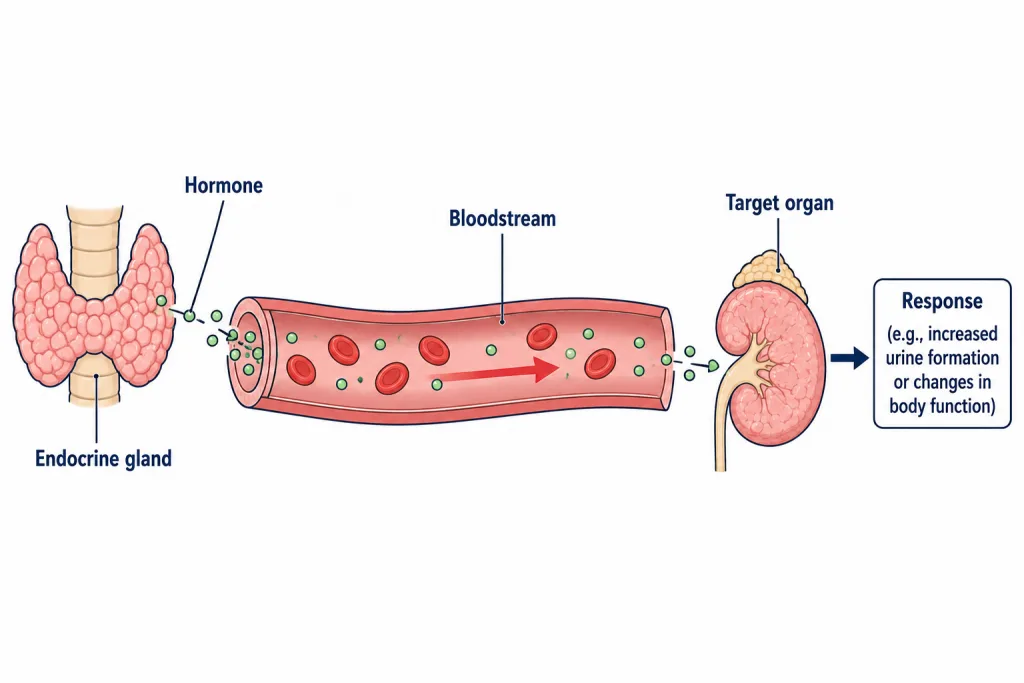
How Hormones Reach Target Cells
Imagine hormones as 'addressed letters' in your blood — they travel through the body but only certain cells can 'read' them.
The Target Cell Concept
Target cells = cells that have receptors for a specific hormone. Only target cells respond to that hormone. Other cells ignore it.
This explains how hormones can have specific effects despite traveling everywhere.
Example: Insulin
Insulin is made by pancreas. Travels in blood throughout body. BUT only acts on:
- Liver cells (store glucose).
- Muscle cells (use glucose).
- Fat cells (store as fat).
These cells have insulin receptors. Other cells (e.g., bone cells) don't have insulin receptors → don't respond.
This is why hormones have specific effects — they target only certain cells.
Receptor-Hormone Interaction
Like a 'lock and key':
- Hormone = key.
- Receptor = lock.
- Only matching key fits the lock. Once bound, hormone causes specific changes inside the cell.
Hormones Made in Tiny Amounts
Hormones are very potent. Body produces hormones in tiny amounts (sometimes just micrograms). Example: human body makes ~30-50 micrograms of growth hormone per day.
But effects are huge — controls growth!
Hormones Have Specific Lifespans
Hormones don't last forever in blood. Body breaks them down (in liver, kidneys). Half-life varies:
- Insulin: ~6 minutes.
- Adrenaline: ~5 minutes.
- Thyroxine: 6 days.
- Growth hormone: 30 minutes.
Constant production-degradation balance maintains hormone levels.
Why Have Two Systems (Nervous + Endocrine)?
Quick situations: nervous system (e.g., reflexes, immediate movements). Long-term changes: endocrine system (e.g., growth, metabolism). Mixed: stress response uses both.
Nature gave us both because we need both speed and persistence.
[NCERT — important concept]
Comparing Nervous and Endocrine Systems
Detailed Comparison
| Feature | Nervous System | Endocrine System |
|---|---|---|
| Type of message | Electrical signals | Chemical messengers |
| Path | Neurons (nerves) | Blood |
| Speed | Very fast (~0.1 sec) | Slow (minutes-days) |
| Duration | Brief | Long-lasting |
| Reach | Specific (point-to-point) | Widespread (anywhere with receptors) |
| Energy use | High | Low |
| Examples | Reflexes, voluntary movement | Growth, metabolism |
| Components | Neurons + brain + spinal cord | Glands + hormones |
When Each is Used
Nervous System Used For: 1. Quick reactions — pulling hand from hot. 2. Voluntary movements — walking, eating. 3. Senses — seeing, hearing. 4. Reflexes — coughing, blinking.
Endocrine System Used For: 1. Growth — over years. 2. Metabolism — energy use. 3. Reproduction — sex hormones. 4. Stress response — adrenaline. 5. Body temperature. 6. Water-salt balance.
Examples Where They Work Together
1. Stress (Fight or Flight): Nervous: brain detects danger, alerts muscles. Endocrine: adrenal gland releases adrenaline → heart, lungs, muscles.
2. Eating: Nervous: chewing, swallowing. Endocrine: insulin manages blood sugar after meal.
3. Cold Weather: Nervous: shivering (muscle contraction). Endocrine: thyroxine (increases metabolism).
Both systems coordinate beautifully.
Why Both Are Needed
Imagine if we only had nervous system: 1. Couldn't grow over years. 2. No metabolism control. 3. No long-term changes.
Imagine if we only had endocrine system: 1. Couldn't escape immediate danger. 2. No quick reflexes. 3. No fine movement control.
Hence both systems together = perfect coordination!
Hormones at Different Life Stages
Different hormones dominate at different ages:
Birth-Childhood: growth hormone, thyroxine (rapid growth). Teenage: sex hormones (puberty changes). Adulthood: all hormones balanced (maintenance). Old age: declining hormone levels (slow changes).
Hormonal changes shape our entire life journey!
[Board: 5-mark comparison]
Memory Capsule — Section 6
Quick revision of animal hormones and endocrine system.
Definitions
- Hormone = chemical messenger from endocrine gland → travels in blood → acts on target.
- Endocrine glands = ductless glands secreting hormones into blood.
- Exocrine glands = have ducts (e.g., salivary, sweat).
- Target cells = cells with receptors for specific hormone.
Properties of Hormones
1. Chemical messengers. 2. Made in glands. 3. Travel in blood. 4. Act on target cells (have receptors). 5. Active in tiny amounts. 6. Specific effects. 7. Slow but long-lasting.
Endocrine vs Exocrine Glands
| Endocrine | Exocrine | |
|---|---|---|
| Ducts | No | Yes |
| Secretion | Hormones | Enzymes, etc. |
| Goes to | Blood | Specific organ |
| Examples | Pituitary, thyroid | Salivary, sweat |
Major Endocrine Glands (Preview)
Will be covered in detail in Section 7: 1. Pituitary (master gland) — many hormones. 2. Thyroid — thyroxine. 3. Pancreas — insulin, glucagon. 4. Adrenal — adrenaline. 5. Testis/Ovary — sex hormones.
Nervous vs Endocrine
| Nervous | Endocrine | |
|---|---|---|
| Signal | Electrical | Chemical |
| Path | Neurons | Blood |
| Speed | Fast | Slow |
| Duration | Brief | Long-lasting |
Both work together.
Working Together
Stress response = nervous + endocrine. Growth = endocrine (over years). Reflex = nervous (milliseconds).
Key Insights
1. Hormones = small molecules, big effects. 2. Travel via blood, act on specific cells. 3. Receptors determine 'target'. 4. Made in tiny amounts (micrograms). 5. Affect every aspect of life — growth to reproduction.
One-Liner Memory Aids
1. Endo = inside (no ducts) → blood. 2. Exo = outside (has ducts) → specific place. 3. Receptor = key match for hormone. 4. Long-lasting effects = endocrine. 5. Hormones rule the long-term.
[Quick reference for Section 7 + 8!]
Example 1: NCERT — What are Hormones?
Define hormones. List their main characteristics.
Solution:
Definition
'Hormones' = chemical messengers produced by endocrine glands that travel through blood and regulate body functions by acting on specific target cells.
Main Characteristics of Hormones
1. Chemical messengers: Different from electrical signals of nervous system.
2. Made by endocrine glands: Specific organs called glands produce them. Examples: pituitary, thyroid, pancreas.
3. Released into blood: Glands have no ducts (ductless). Hormones go directly into bloodstream.
4. Travel widely: Blood carries them throughout body. Reach all parts.
5. Act on target cells: Only cells with specific receptors respond. Other cells ignore the hormone. This gives specificity.
6. Effective in tiny amounts: Tiny doses — but big effects. Body produces hormones in micrograms or even less.
7. Slow but long-lasting effects: Take time to act (minutes-days). But effects last long. Hence hormones are good for long-term control.
8. Specific to function: Each hormone has unique role. Example: insulin → glucose; thyroxine → metabolism.
9. Need to be removed: Body breaks down hormones (liver, kidneys). Otherwise effects would never end. Half-life varies (minutes to days).
10. Regulate body homeostasis: Maintain internal balance — temperature, blood sugar, water balance.
Types of Action
Hormones can: 1. Activate — start a process (insulin → glucose uptake). 2. Inhibit — stop a process (some hormones). 3. Regulate — adjust intensity (growth hormone → growth rate).
Why Hormones Are Important
Without hormones: 1. No growth (dwarfism). 2. Sugar imbalance (diabetes). 3. No reproduction. 4. No stress response. 5. No metabolism control.
Hence hormones are essential for life.
[NCERT — fundamental]
Example 2: NCERT — Endocrine vs Exocrine Glands
Differentiate between endocrine and exocrine glands. Give examples.
Solution:
Comparison Table
| Feature | Endocrine | Exocrine |
|---|---|---|
| Ducts | No (ductless) | Yes |
| Secretion | Hormones | Enzymes, sweat, saliva, etc. |
| Where it goes | Directly into blood | Through duct to specific place |
| Action | On distant target organs | Local (where duct ends) |
| Speed | Slower | Quick |
| Examples | Pituitary, thyroid, pancreas | Salivary, sweat, liver |
Endocrine Glands (Examples)
1. Pituitary gland: Located in brain. Produces many hormones (growth hormone, TSH). Hormones reach all body parts via blood.
2. Thyroid gland: Located in neck. Produces thyroxine. Affects metabolism throughout body.
3. Pancreas (endocrine part): Produces insulin and glucagon. Goes into blood, regulates blood sugar.
4. Adrenal gland: On top of kidneys. Produces adrenaline. 'Fight or flight' response.
5. Gonads: Testes (male): testosterone. Ovaries (female): oestrogen, progesterone.
Exocrine Glands (Examples)
1. Salivary glands: In mouth. Produce saliva → flows through ducts to mouth. Saliva digests starch, lubricates food.
2. Sweat glands: In skin. Produce sweat → ducts open onto skin surface. Cools body, removes wastes.
3. Liver (exocrine part): Produces bile. Goes through bile duct to gall bladder, then to small intestine. Helps fat digestion.
4. Pancreas (exocrine part): Produces pancreatic juice (with enzymes). Goes through pancreatic duct to small intestine. Helps digestion.
Glands That Are Both
Some glands are both endocrine and exocrine:
1. Pancreas: Endocrine: produces insulin, glucagon (into blood). Exocrine: produces digestive enzymes (through duct to gut).
2. Liver: Endocrine: makes some hormones. Exocrine: produces bile.
Such glands have mixed function — both ductless and ducted parts.
Why This Matters
Different needs require different delivery: 1. Local effect: use ducts (saliva to mouth). 2. Body-wide effect: use blood (insulin everywhere).
Body has both systems for different purposes.
[NCERT — important]
Example 3: Application — How Hormones Work
Explain how a hormone can travel everywhere in body but only affect specific cells.
Solution:
The Puzzle
Hormone travels in blood — reaches every cell. Yet only some cells respond. How?
Answer: Receptors!
Cells have receptors on their surface or inside. Receptors are like 'locks' specific to certain hormones (the 'keys'). Only cells with matching receptors respond.
Example: Insulin
Insulin = hormone from pancreas. Travels in blood throughout body.
Cells with insulin receptors:
- Liver cells.
- Muscle cells.
- Fat cells.
These cells: 1. Bind insulin via receptors. 2. Take up glucose from blood. 3. Use or store it.
Cells without insulin receptors (e.g., bone, brain) don't respond. They get glucose by other means.
Lock-and-Key Mechanism
Like physical lock and key: Insulin (key) → fits insulin receptor (lock). Adrenaline → fits adrenaline receptor. No mismatch.
This ensures: 1. Only correct cells respond. 2. No random effects. 3. Specific control.
What Happens After Binding?
Hormone binds receptor → starts a chain of events:
1. Surface receptors (water-soluble hormones): Hormone binds outside. Triggers signal inside cell. Cell changes activity. Examples: insulin, adrenaline.
2. Internal receptors (fat-soluble hormones): Hormone enters cell. Binds receptor inside. Goes to nucleus. Changes gene expression. Examples: thyroxine, sex hormones.
Why This Specificity is Useful
1. Energy efficient: body doesn't waste effort on unwanted cells. 2. Precise control: specific functions affected. 3. Avoids side effects: only target cells respond. 4. Coordination: different organs respond to different hormones.
Failures in This System
Receptor problems can cause disease: 1. Type 2 diabetes: insulin receptors don't respond well. 2. Thyroid resistance: receptors don't bind thyroxine. 3. Hormonal disorders: various.
Even if hormone is fine, if receptors fail, hormone doesn't work.
A Beautiful System
Body has: ~50+ hormones. Each with specific receptors. Acts on specific target cells. Coordinates all body functions.
All without nervous system — just chemicals + receptors!
Truly elegant biology.
[Application — JEE/NEET]
Example 4: Synthesis — Comprehensive
(a) How do hormones reach target cells? (b) Why is hormonal coordination 'long-term' compared to nervous coordination? (c) Compare nervous and endocrine systems with one example each.
Solution:
(a) Hormones Reaching Target Cells
Step 1: Production Endocrine gland produces hormone. Examples: pancreas → insulin; thyroid → thyroxine.
Step 2: Release into Blood Glands are ductless — hormones go directly into blood. Now hormone is in circulation.
Step 3: Travel via Blood Heart pumps blood throughout body. Hormone travels everywhere. Reaches every cell potentially.
Step 4: Recognition by Target Cells Target cells have receptors for specific hormones. Other cells lack these receptors.
Step 5: Binding Hormone binds to its receptor (like key in lock). This is what makes the cell respond.
Step 6: Cellular Response Binding triggers changes inside cell. Various effects possible:
- Open glucose channels (insulin).
- Increase metabolism (thyroxine).
- Speed up heart (adrenaline).
Step 7: Effect Continues Hormone effects last as long as hormone is present. Body breaks down hormone gradually. Effects fade as hormone decreases.
Diagram (Verbal)
Gland → Hormone → Blood → All cells
                              ↓
           Cells WITH receptors → respond
           Cells WITHOUT receptors → ignore
(b) Why Hormonal is 'Long-term'?
Reason 1: Travel time Hormones go through blood. Heart needs ~1 minute to circulate blood once. Several minutes for hormone to reach all targets.
Compare with nervous: signal travels at 100 m/s along neurons. Reaches target in milliseconds.
Reason 2: Persistence Hormones don't disappear instantly. Body breaks them down gradually (minutes to hours). Effects continue while hormone is present.
Compare with nervous: signal stops the moment stimulation stops.
Reason 3: Cumulative effects Hormones cause cellular changes (gene activity, protein production). These changes persist even after hormone is gone. Example: growth hormone affects body for years.
Compare with nervous: effect ends when signal ends.
Reason 4: Cumulative biological response Hormones often work in cycles (e.g., menstrual cycle, daily cortisol cycle). Long-term patterns emerge.
(c) Nervous vs Endocrine — Examples
Nervous Example: Withdrawing Hand from Hot Pan Stimulus: heat. 1. Skin receptor detects. 2. Sensory neuron → spinal cord (~30 ms). 3. Relay neuron → motor neuron (~10 ms). 4. Motor neuron → arm muscle (~30 ms). 5. Arm pulls back (~50 ms). Total: ~120 ms (0.12 seconds). Effect duration: brief — only while danger present.
Endocrine Example: Insulin After Eating Stimulus: high blood sugar after meal. 1. Pancreas detects high sugar. 2. Releases insulin into blood (~30 seconds). 3. Insulin travels via blood (~minutes). 4. Reaches liver, muscles, fat cells. 5. They take up glucose from blood. 6. Blood sugar normalises. Total: ~10-30 minutes. Effect duration: hours — until next meal.
Comparison Table
| Feature | Nervous (Reflex) | Endocrine (Insulin) |
|---|---|---|
| Stimulus | Hot pan | Sugar in blood |
| Path | Neurons | Blood |
| Speed | ~0.1 sec | ~10-30 min |
| Duration | Brief | Hours |
| Action | Specific (one muscle) | Multiple organs |
| Goal | Immediate safety | Long-term metabolism |
Why Both Systems?
Nervous = perfect for emergencies (fast). Endocrine = perfect for long-term control (lasting). Together = comprehensive coordination.
Evolution gave us both because we need both fast AND lasting responses.
Final Insight
Hormones are a beautiful example of how chemistry can create coordination at the body level. Without nervous system, life would lack speed. Without endocrine system, life would lack persistence.
Both work together for the symphony of life.
[Board: 5-mark synthesis]