
What Algae Are
The definition is compact and worth learning word for word, because a one-mark question asks for exactly this:
Algae are chlorophyll-bearing, simple, thalloid, autotrophic and largely aquatic organisms - both fresh water and marine.
Five adjectives, and each carries weight. Thalloid means the body is not differentiated into root, stem and leaf - that differentiation begins only with pteridophytes.
Other habitats they turn up in:
- Moist stones
- Soils
- Wood
And in association with other organisms:
- With fungi, as lichens
- With animals, for example on the sloth bear
[NEET Important] The sloth bear detail looks like trivia and is asked as trivia. Algae growing on animals is a genuine associative habitat, not a throwaway line.
Form and Size
The range is enormous:
| Form | Example |
|---|---|
| Colonial | Volvox |
| Filamentous | Ulothrix, Spirogyra |
| Massive plant bodies | Kelps (marine forms) |
So within one group you move from a ball of cells you need a microscope to see, up to a kelp large enough to form an underwater forest.
Reproduction - Three Routes
Vegetative reproduction is by fragmentation. Each fragment develops into a thallus.
Asexual reproduction is by the production of different types of spores, the most common being the zoospores. Zoospores are flagellated (motile) and on germination give rise to new plants.
Sexual reproduction takes place through fusion of two gametes - and this is where the chapter's most-asked distinction lives.
Isogamy, Anisogamy and Oogamy
The three types are separated by the size and motility of the fusing gametes, and every part of the following table is examined.
| Type | Gametes | Examples |
|---|---|---|
| Isogamous | Similar in size. Either flagellated (as in Ulothrix) or non-flagellated / non-motile (as in Spirogyra) | Ulothrix, Spirogyra |
| Anisogamous | Dissimilar in size | species of Eudorina |
| Oogamous | One large, non-motile (static) female gamete fuses with a smaller, motile male gamete | Volvox, Fucus |
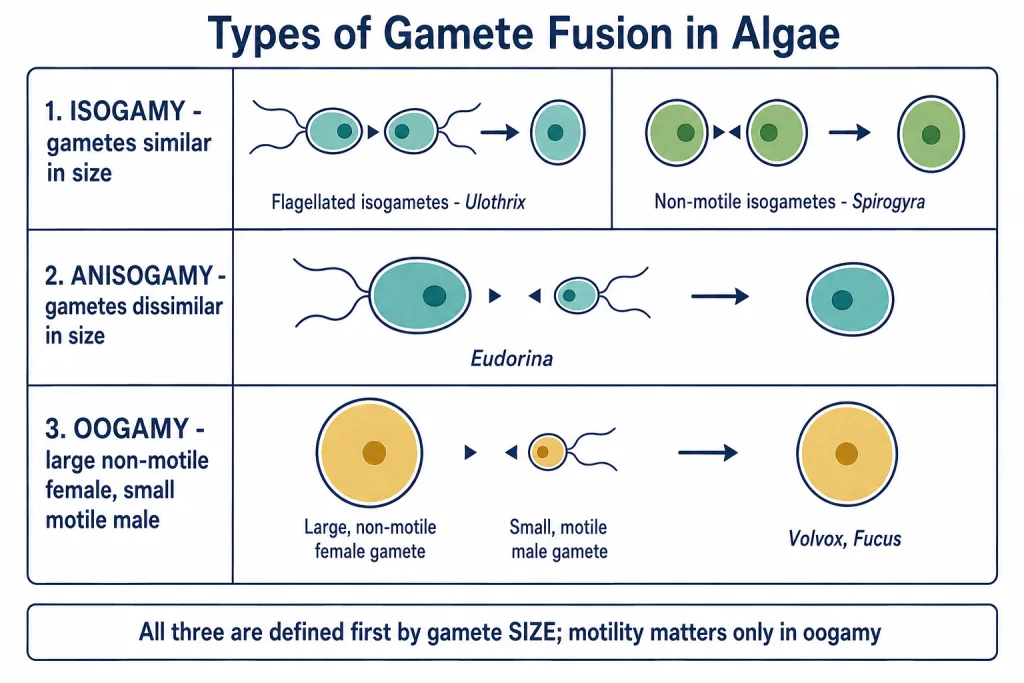
[NEET Important] Isogamy is defined by size, not by motility. That is why Ulothrix (flagellated gametes) and Spirogyra (non-motile gametes) are both isogamous - their gametes are the same size in each case. Questions built on this expect you to resist the pull of the word 'motile'.
A second trap: Volvox appears twice in this section - once as the example of a colonial alga, and once as an example of oogamy. Both associations are asked.
Economic Importance of Algae
This one is asked constantly, and the list has a natural order - ecological first, then food, then products.
Ecological
- At least half of the total carbon dioxide fixation on earth is carried out by algae through photosynthesis.
- Being photosynthetic, they increase the level of dissolved oxygen in their immediate environment.
- They are of paramount importance as primary producers of energy-rich compounds, which form the basis of the food cycles of all aquatic animals.
As food
- Many species of Porphyra, Laminaria and Sargassum are among the 70 species of marine algae used as food.
- Chlorella, a unicellular alga rich in proteins, is used as a food supplement even by space travellers.
Commercial products
| Product | Source |
|---|---|
| Algin (a hydrocolloid) | Brown algae |
| Carrageen (a hydrocolloid) | Red algae |
| Agar | Gelidium and Gracilaria |
Hydrocolloids are water holding substances, produced in large amounts by certain marine brown and red algae. Agar is used to grow microbes and in preparations of ice-creams and jellies.
[NEET Important] Three product-to-source pairings, and they are swapped constantly in options: algin - brown algae, carrageen - red algae, agar - Gelidium and Gracilaria. And the number to remember is 70 species used as food, alongside at least half of global carbon dioxide fixation.
Quick Recap
- Algae are chlorophyll-bearing, simple, thalloid, autotrophic and largely aquatic - fresh water and marine - and also occur on moist stones, soils and wood, and in association with fungi (lichens) and animals (e.g. on sloth bear).
- Form ranges from colonial Volvox through filamentous Ulothrix and Spirogyra to the massive kelps.
- Vegetative reproduction: fragmentation; each fragment develops into a thallus.
- Asexual reproduction: spores, most commonly flagellated motile zoospores which germinate into new plants.
- Sexual reproduction: fusion of two gametes - isogamous (similar size; Ulothrix flagellated, Spirogyra non-motile), anisogamous (dissimilar size; Eudorina), oogamous (large non-motile female + small motile male; Volvox, Fucus).
- At least half of global carbon dioxide fixation is by algae; they raise dissolved oxygen and are primary producers for aquatic food cycles.
- 70 species of marine algae used as food, including Porphyra, Laminaria, Sargassum; Chlorella is a protein-rich food supplement used by space travellers.
- Hydrocolloids = water-holding substances: algin from brown algae, carrageen from red algae. Agar from Gelidium and Gracilaria, used to grow microbes and in ice-creams and jellies.
- Algae are divided into Chlorophyceae, Phaeophyceae and Rhodophyceae.
Solved Examples
Question 1
Q. Define algae in one sentence.
Answer. Algae are chlorophyll-bearing, simple, thalloid, autotrophic and largely aquatic organisms, found in both fresh water and marine habitats.
Question 2
Q. Give one colonial and two filamentous algae.
Answer. Colonial: Volvox. Filamentous: Ulothrix and Spirogyra.
Question 3
Q. What is the commonest asexual spore in algae, and what is its key feature?
Answer. The zoospore. It is flagellated (motile) and germinates into a new plant.
Question 4
Q. Name the source of agar.
Answer. Gelidium and Gracilaria.
Question 5
Q. Which alga, rich in proteins, is used as a food supplement by space travellers?
Answer. Chlorella, a unicellular alga.
Question 6
Q. Distinguish isogamy, anisogamy and oogamy with one example each.
Answer.
- Isogamy: the two fusing gametes are similar in size. They may be flagellated, as in Ulothrix, or non-flagellated and non-motile, as in Spirogyra.
- Anisogamy: the two gametes are dissimilar in size, as in species of Eudorina.
- Oogamy: a large, non-motile female gamete fuses with a smaller, motile male gamete, as in Volvox and Fucus.
Takeaway: All three are defined on size first. Motility only enters the definition at oogamy.
Question 7
Q. Ulothrix has flagellated gametes and Spirogyra has non-motile ones, yet both are isogamous. Explain.
Answer. Because isogamy is defined by the gametes being similar in size, not by whether they swim. In Ulothrix both gametes are flagellated and equal in size; in Spirogyra both are non-flagellated and equal in size. Since in each species the two fusing gametes match each other, both cases are isogamous.
Question 8
Q. State three ecological contributions of algae.
Answer.
- Algae do at least half of the total carbon dioxide fixation on earth through photosynthesis.
- They photosynthesise, so they increase the level of dissolved oxygen in their immediate environment.
- They are primary producers of energy-rich compounds, which form the basis of the food cycles of all aquatic animals.
Question 9
Q. What are hydrocolloids? Name two, with their sources.
Answer. Hydrocolloids are water holding substances. Certain marine brown and red algae make them in large amounts, and they are sold commercially. Two examples:
- Algin, from brown algae
- Carrageen, from red algae
Question 10
Q. Name three algae used as food and state how many marine algal species are used this way.
Answer. Porphyra, Laminaria and Sargassum. Many species of these are among the 70 species of marine algae used as food.
Question 11
Q. A pond alga is colonial, and its sexual reproduction involves a large static gamete fusing with a small swimming one. Name the alga and the type of reproduction.
Answer. The alga is Volvox, and it is colonial. The sexual reproduction is oogamous, because a large non-motile female gamete fuses with a smaller motile male gamete.
Question 12
Q. Explain why algae are described as thalloid, and what this implies about their body organisation compared with pteridophytes.
Answer. Thalloid means the plant body is a thallus - a simple body that is not differentiated into true root, stem and leaf. Algae have no vascular tissue and no organs, so the whole body does the photosynthesis, the anchorage and the absorption itself.
Pteridophytes sit at the other end of this comparison. Their main plant body is a sporophyte differentiated into true root, stem and leaves, and those organs have well-differentiated vascular tissues. Bryophytes come in between: their body is still thallus-like but more differentiated than that of algae, with root-like, leaf-like and stem-like structures that are not true organs.
Question 13
Q. Trace the three modes of reproduction in algae and state what each produces.
Answer.
- Vegetative - fragmentation. The thallus breaks; each fragment develops into a thallus. No spores, no gametes, and the offspring are genetically identical to the parent.
- Asexual - spores. The alga makes different types of spores, most commonly zoospores, which are flagellated and motile and germinate to give rise to new plants. Still no gamete fusion, so still no genetic recombination.
- Sexual - gamete fusion. Two gametes fuse, in one of three ways: isogamous, anisogamous or oogamous. This is the only route that recombines genetic material.
Takeaway: The three routes differ in what is produced - fragments, spores, gametes - and only the third involves fusion.
Question 14
Q. Write a note on the economic importance of algae under three headings.
Answer.
1. Ecological role. Algae do at least half of the total carbon dioxide fixation on earth through photosynthesis. They increase dissolved oxygen in their immediate environment, and they are of paramount importance as primary producers of energy-rich compounds, which form the basis of the food cycles of all aquatic animals.
2. As food. About 70 species of marine algae are used as food, including many species of Porphyra, Laminaria and Sargassum. Chlorella, a unicellular alga rich in proteins, is used as a food supplement even by space travellers.
3. Commercial products. Certain marine brown and red algae produce large amounts of hydrocolloids - water holding substances - namely algin from brown algae and carrageen from red algae. Agar, obtained from Gelidium and Gracilaria, is used to grow microbes and in the preparation of ice-creams and jellies.
Takeaway: Answer this in three labelled parts. A list without headings reads as one point to a marker, not three.